5 Powerful Wireless Charging Market Trends Shaping 2026
Introduction
In late June 2026, more than 20 of the world's most influential technology companies — including Apple, Google, Xiaomi, OPPO, Huawei, Panasonic Automotive Systems, NXP Semiconductors, and Renesas — convened in Beijing for the Wireless Power Consortium's (WPC) Qi Off-cycle Meeting, a four-day summit dedicated to finalizing the technical architecture of the next-generation Qi 50W wireless charging standard. The meeting, hosted by Xiaomi and marking the first WPC Off-cycle Meeting ever held in Beijing, was not a product launch or a marketing event — it was a deliberate, engineering-level effort to build the universal infrastructure for the next decade of power delivery. That a single industry consortium meeting could draw participation from competing smartphone giants, semiconductor leaders, and automotive systems providers speaks volumes about the strategic urgency now surrounding the wireless charging market.
The global wireless charging market is no longer a peripheral feature of consumer electronics. It has become a foundational technology layer spanning smartphones, wearables, electric vehicles, industrial automation, healthcare devices, and aerospace applications. According to Next Move Strategy Consulting (NMSC), the global Wireless Charging Market is projected to reach USD 71.47 billion by 2030, expanding at a CAGR of 15.8% during the forecast period 2024–2030. This article examines the five most consequential trends currently reshaping this market, their regulatory and commercial implications, and the strategic actions that C-level executives and institutional investors should prioritize.
For More Information: Download FREE Sample on Wireless Charging Market Report
From 15W to 50W: The Wireless Charging Market's Standards Revolution
The Qi2.2 Certification Milestone
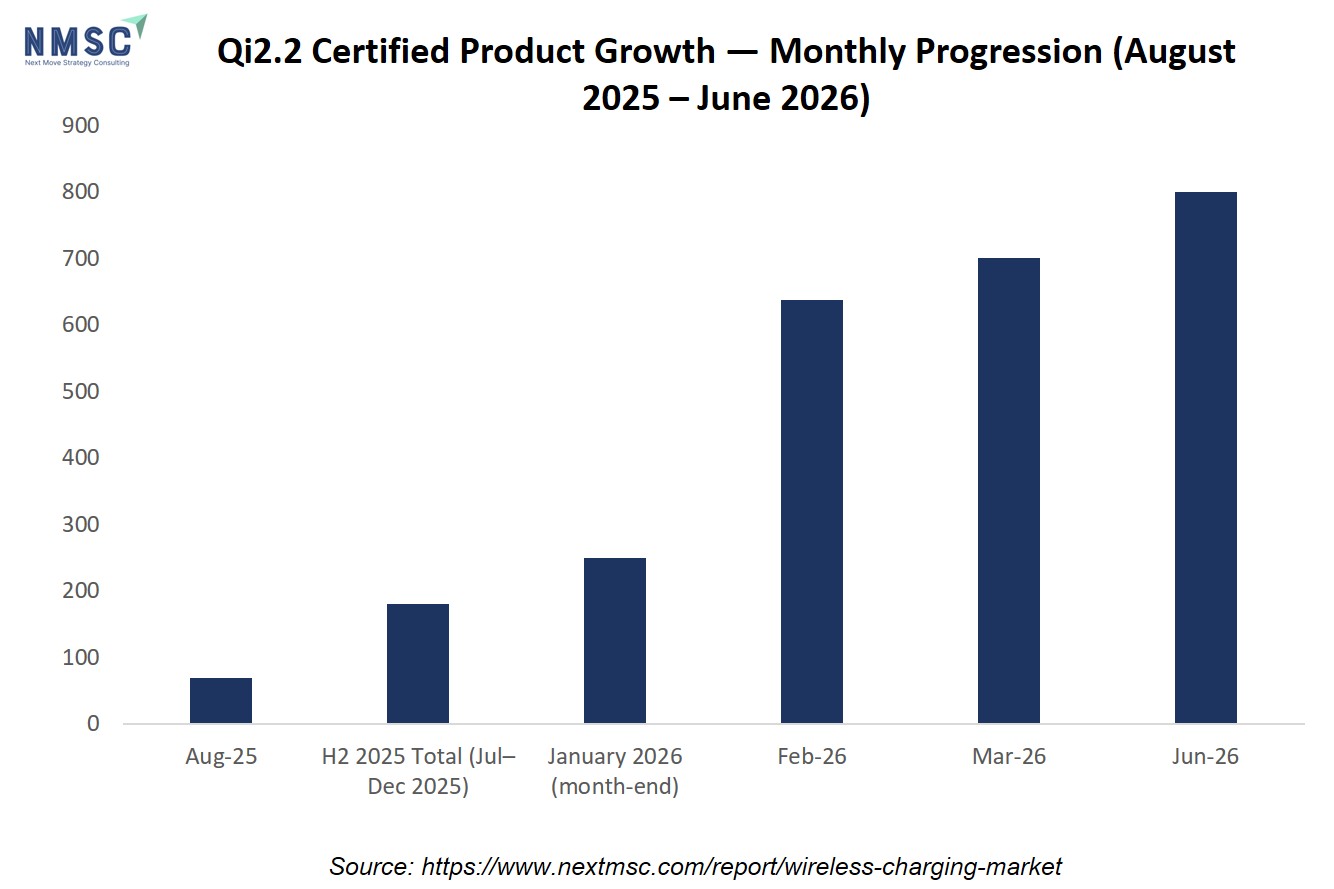
The most structurally significant development in the wireless charging market was the formal launch and rapid adoption of the Qi2.2 standard—also branded as Qi2 25W. On July 23, 2025, the Wireless Power Consortium officially opened certification for Qi2.2, and within the first 72 hours, over 40 manufacturers had submitted products for testing. By February 2026, 637 Qi2.2-certified products had entered the market—a nine-fold increase from the 69 products certified under the standard in August 2025. Total Qi2 certifications across all versions reached 2,197 by that point, representing six times the adoption rate of the previous generation.
The Qi2.2 standard delivers a headline power upgrade from 15W to 25W, closing the gap with proprietary charging architectures that Apple and Samsung had been shipping on flagship devices. Critically, Qi2.2 extends this 25W capability to the broader Android ecosystem without locking users into a single manufacturer's charging infrastructure. The standard also mandates more sophisticated Foreign Object Detection (FOD) algorithms, dynamic thermal throttling in 1W increments, and Extended Power Profile (EPP) compliance across tablets, laptops, and power tools — categories that had previously been confined to proprietary wireless charging solutions.
Belkin was among the first accessory manufacturers to receive Qi2 25W certification, announced on July 15, 2025, with its lineup incorporating ChillBoost cooling technology to sustain consistent 25W output. The WPC, which governs the Qi standard, currently counts more than 300 member companies and over 13,000 Qi-certified products across its ecosystem.
The Race Toward Qi 50W: A Universal Standard in Development
While Qi2.2 represents the current commercial frontier, the WPC's Beijing meeting in June 2026 signals that the industry is already engineering the next leap. The Qi 50W specification — still under development and expected to be finalized in 2028 — aims to create a universal, cross-brand 50W wireless charging solution. Xiaomi is advocating for its "small inductance, low voltage, high power" architecture as the technical foundation, arguing that this approach reduces energy loss, improves thermal performance, and enables slimmer device designs.
Proprietary systems from OnePlus, OPPO, and Xiaomi have already commercialized 50W wireless charging, with Xiaomi demonstrating experimental systems exceeding 80W. However, these remain brand-locked solutions. The Qi 50W standard's value proposition is not raw speed — it is interoperability at scale.
The EU Regulatory Catalyst: Standardization as Policy
Simultaneously, the European Union's regulatory framework is reshaping the wireless charging market from the demand side. The EU's Common Charging Directive (Directive EU 2022/2380) mandated USB-C as the universal wired charging port for all handheld mobile phones, tablets, digital cameras, headphones, and portable speakers as of December 28, 2024. As of April 28, 2026, the requirement extended to all new laptops sold within the EU. The Commission estimates that these measures will reduce electronic waste by 980 tonnes annually and save EU consumers at least €250 million per year in unnecessary charger purchases.
Critically for the wireless charging market, the European Commission adopted the M/607 standardisation request on February 26, 2025, instructing European Standardisation Organisations to develop harmonised wireless charging standards. The Commission's 2024 market study on wireless charging technologies acknowledged "ongoing market growth" and the ability of wireless charging to offer "an age of convenience and aesthetic simplicity," while noting that the technology is still developing with a low level of fragmentation. The EU has signalled that mandatory wireless charging requirements may follow once the technology matures sufficiently.
Long-Distance and Room-Scale Charging: The Next Commercial Frontier
Beyond proximity charging pads, the wireless charging market has steadily advanced toward spatial and long-distance power delivery. The regulatory foundation was built as early as December 2017 when the U.S. Federal Communications Commission (FCC) approved the first 'power-at-a-distance' system. Since then, developers like Ossia have successfully scaled the technology; their Cota wireless power system has secured multiple FCC certifications to safely broadcast radio-frequency power across entire rooms without physical contact or precise pad alignment. With commercial rollouts expanding across industrial and smart-home ecosystems, spatial charging is solidifying ambient, passive power as a marketplace reality.
Automotive Integration: Wireless EV Charging Gains Momentum
The automotive sector represents one of the most capital-intensive growth vectors for the wireless charging market. Bloomberg has reported on the accelerating momentum behind wireless EV charging pilot programs, with companies coalescing around standardized magnetic resonance technology and automakers embarking on commercial experiments. According to BloombergNEF's 2026 Electric Vehicle Outlook, public charging networks grew 28% in 2025 from the prior year, underscoring the broader infrastructure investment cycle within which wireless EV charging is positioned. WiTricity Corporation, a key player in magnetic resonance-based wireless EV charging, announced a strategic alliance with Nagano Japan Radio in November 2023 to commercialize industrial wireless charging systems integrating WiTricity's magnetic resonance technology with Nagano's wireless communication and coil winding capabilities.
NMSC Strategic Perspective: Convergence of Standards and Regulation as a Market Inflection Point
From Next Move Strategy Consulting's analytical standpoint, the simultaneous convergence of three forces — the Qi2.2 commercial rollout, the EU's wireless charging standardisation mandate, and the FCC's approval of long-distance residential charging — constitutes a structural inflection point for the wireless charging market. These are not incremental developments; they represent the transition of wireless charging from a premium feature to a regulated, interoperable infrastructure layer. NMSC's analysis indicates that the consumer electronics and automotive verticals will serve as the primary demand engines through 2030, while healthcare and industrial applications will emerge as high-margin growth segments as wireless charging technology matures into mission-critical use cases. Stakeholders who position their product roadmaps and investment theses around open-standard, multi-device, and multi-application wireless charging architectures will be best placed to capture disproportionate value in this market.
Section Summary: The wireless charging market in 2026 is defined by a rapid standards upgrade cycle, regulatory harmonisation pressure from the EU, and the emergence of long-distance and automotive charging as commercially viable categories.
Key Takeaways:
-
The Qi2.2 (25W) standard launched in January 2026 and reached 637 certified products within two months, representing a nine-fold increase from August 2025.
-
Apple, Google, Xiaomi, and 17+ other companies are actively co-developing the Qi 50W standard, expected to be finalized in 2028.
-
The EU's Common Charging Directive now covers laptops (April 2026) and is actively pursuing wireless charging harmonisation through the M/607 standardisation mandate.
-
The FCC approved the first 5W residential long-distance wireless charging system in March 2026, opening a new commercial category.
Industry Impact Analysis
Consumer Electronics: A New Baseline for Device Expectations
The Qi2.2 standard's rapid adoption is fundamentally resetting consumer expectations across the smartphone, wearable, and laptop categories. iPhone 17, 17 Pro, and 17 Pro Max support Qi2 25W natively, while the iPhone 16 series gained 25W support through iOS 26. The Samsung Galaxy S26 Ultra supports Qi2 25W, and the Google Pixel 10 Pro XL supports Qi2 25W with built-in magnets. This cross-platform convergence on a single open standard is compressing the competitive differentiation that proprietary charging ecosystems previously provided, forcing accessory manufacturers and OEMs alike to compete on user experience, thermal management, and ecosystem integration rather than raw wattage claims.
The NFC Forum's Wireless Charging Specification 2.0 (WLC 2.0) is addressing the smaller-device segment — enabling wireless charging of IoT devices, stylus pens, earbuds, and wearables using a single NFC antenna for both communication and charging. In March 2026, two NFC Forum Specifications were formally adopted as IEC international standards, providing the regulatory legitimacy needed for broader industrial and healthcare deployment. The NFC Forum is also advancing its specification to enable charging up to 3W, which would support a wider range of devices and potentially replace disposable batteries in certain IoT applications.
Automotive and Industrial: High-Power Wireless Charging as Infrastructure
In the automotive sector, the integration of wireless charging pads in electric vehicles eliminates the need for traditional charging cables and provides a seamless charging experience. The NMSC report identifies the surge in EV demand — driven by escalating fuel prices and environmental policy — as a pivotal driver for wireless charging infrastructure investment. The International Energy Agency has documented the rapid growth of the EV market, with sales surpassing 10 million units in 2022, a trajectory that has continued to accelerate.
For industrial applications, wireless charging is enabling the next generation of Automated Guided Vehicles (AGVs), Autonomous Mobile Robots (AMRs), and industrial tools that require continuous, cable-free power in manufacturing and warehouse environments. The WiTricity-Nagano Japan Radio alliance exemplifies the strategic partnerships forming to commercialize magnetic resonance-based industrial wireless charging at scale.
Regulatory and Standardization Impact: Reducing Fragmentation Risk
The EU's active monitoring of the wireless charging landscape — and its explicit mandate for European Standardisation Organisations to develop harmonised wireless charging standards — significantly reduces the long-term fragmentation risk that has historically constrained enterprise adoption. The NFC Forum's Michael Stark, Senior Principal Standards Architect at NXP Semiconductors, has noted that the EU is "keen to avoid market fragmentation across this landscape, especially as an ever-increasing number of innovative and diverse wireless charging applications are emerging, including novel applications in healthcare, in-car charging, and IoT." This regulatory clarity is a net positive for institutional investors and enterprise procurement teams evaluating long-term wireless charging infrastructure commitments.
Section Summary: The wireless charging market's impact is being felt across consumer electronics, automotive, industrial, and healthcare verticals, with regulatory standardisation reducing fragmentation risk and accelerating enterprise adoption.
Key Takeaways:
-
Qi2.2 has established a new cross-platform baseline for flagship smartphones from Apple, Samsung, and Google in 2026.
-
NFC Forum's WLC 2.0 and its IEC adoption (March 2026) are enabling wireless charging for IoT and small-device categories.
-
EU standardisation mandates are reducing long-term fragmentation risk, creating a more predictable investment environment.
-
Industrial wireless charging is gaining traction through strategic alliances such as WiTricity-Nagano Japan Radio, targeting AGVs, AMRs, and factory automation.
Key Data & Statistics
Wireless Charging Standard Comparison — Qi vs. Qi2 vs. Qi2 25W
|
Feature |
Qi (Original) |
Qi2 (15W) |
Qi2 25W (Qi2.2) |
|
Maximum Power Output |
Up to 10W |
Up to 15W |
Up to 25W |
|
Magnetic Alignment |
No |
Yes (MPP) |
Yes (MPP, enhanced) |
|
Platform Support |
Android & iOS |
Android & iOS |
Android & iOS |
|
Open Standard |
Yes |
Yes |
Yes |
|
Foreign Object Detection |
Basic |
Improved |
Advanced (in-band, mandatory) |
|
Thermal Management |
Basic |
Tighter controls |
Dynamic throttling (1W increments) |
|
Device Categories Covered |
Smartphones |
Smartphones, wearables |
Smartphones, tablets, laptops, power tools |
|
Certification Requirement |
Yes |
Yes |
Yes (691 test cases) |
|
Backward Compatibility |
— |
Yes (Qi) |
Yes (Qi2 and Qi) |
|
Commercial Availability |
Since 2008 |
2023 |
January 2026 |
EU Common Charging Directive — Key Milestones & Wireless Charging Implications
|
Milestone |
Date |
Scope |
Wireless Charging Implication |
|
Directive (EU) 2022/2380 Enacted |
December 2022 |
All handheld devices, tablets, cameras, headphones, speakers |
Established USB-C as universal wired standard; flagged future wireless harmonisation need |
|
Common Charging Requirements — Phase 1 |
December 28, 2024 |
Mobile phones, tablets, digital cameras, headphones, earbuds, keyboards, mice, portable navigation systems |
Accelerated consumer shift toward cable-free alternatives; increased wireless charging demand |
|
Common Charging Requirements — Phase 2 |
April 28, 2026 |
All new laptops sold in the EU |
Expanded wireless charging opportunity for laptop category; Qi2.2 laptop certification emerging |
|
M/607 Standardisation Request Adopted |
February 26, 2025 |
Wireless charging technologies for consumer devices |
Mandated European Standardisation Organisations to develop harmonised wireless charging standards |
|
Commission Review — Wireless Charging |
By December 28, 2025 |
All radio equipment categories |
First report on extending common charger requirements; wireless charging under active assessment |
|
Potential Mandatory Wireless Charging Requirements |
Post-2026 (TBD) |
Consumer electronics, IoT, healthcare, automotive |
Regulatory framework for universal wireless charging interoperability under development |
Future Outlook & Forecast for the Wireless Charging Market
NMSC Market Forecast: USD 71.47 Billion by 2030
According to Next Move Strategy Consulting's latest research (updated May 2026), the global wireless charging market is forecast to reach USD 71.47 billion by 2030, at a CAGR of 15.8% during the forecast period. The report covers 28 countries across North America, Europe, Asia-Pacific, and the Rest of the World, and profiles 10 leading companies including Renesas Electronics Corporation, Murata Manufacturing Company Ltd., Qualcomm Incorporated, Samsung Electronics, Sony Corporation, Xiaomi Corporation, Energizer Holdings Inc., Texas Instruments Inc., WiTricity Corporation, and Robert Bosch GmbH.
Technology Segment Outlook
The NMSC report segments the wireless charging market by technology into Inductive, Magnetic Resonance, Radio Frequency, and Other Technologies. Inductive charging currently dominates due to its widespread adoption in consumer electronics, underpinned by the Qi standard's global penetration. However, Magnetic Resonance is positioned as the high-growth segment, driven by its applicability to automotive EV charging, industrial AGVs, and emerging long-distance charging use cases. Radio Frequency charging, while currently limited in commercial scale, is gaining regulatory traction following the FCC's March 2026 approval of residential long-distance systems.
Regional Outlook
Asia-Pacific is projected to hold the largest share of the wireless charging market through 2030, driven by the high smartphone penetration in China, India, Japan, and South Korea, and the region's accelerating EV adoption supported by government sustainability mandates. China's domestic wireless charging ecosystem — where manufacturers such as Xiaomi, OPPO, and Vivo have shipped 50–80W proprietary wireless charging for over a year — positions the region as both the largest consumer and the most advanced technology developer in this space.
North America is experiencing substantial growth, driven by EV adoption, the expansion of the consumer electronics industry, and the FCC's progressive regulatory stance on long-distance wireless charging. Europe's growth trajectory is being shaped by the EU's regulatory framework, which is creating both compliance-driven demand and a structured environment for wireless charging infrastructure investment.
Key Technology Predictions Through 2028
-
80% of new smartphones are expected to ship with Qi2.2 or a successor standard by 2028, as Apple is anticipated to mandate Qi2.2 certification for all iPhones by 2027.
-
Room-scale wireless charging systems targeting consumer markets are expected from Ossia, Energous, and GuRu Wireless between 2027 and 2028.
-
Next-Gen Laptop Power: While laptops require too much power for the 25W Qi2.2 standard, development of high-wattage magnetic resonance technology is underway, with the first wireless laptop charging solutions expected in premium ultrabooks by 2028.
-
Factory-installed wireless EV charging from multiple automakers is projected by 2028, building on current aftermarket and pilot deployments.
Section Summary: The wireless charging market is on a sustained high-growth trajectory, with NMSC projecting a 15.8% CAGR through 2030. Asia-Pacific leads in adoption, North America and Europe are accelerating, and the technology roadmap points toward room-scale, automotive, and industrial wireless charging as the next major commercial frontiers.
Key Takeaways:
-
NMSC projects the global wireless charging market to grow from USD 21.44 billion (2023) to USD 71.47 billion (2030) at a 15.8% CAGR.
-
Magnetic Resonance technology is the highest-growth segment, driven by EV and industrial applications.
-
Asia-Pacific holds the largest regional share, with China as the most advanced wireless charging technology market.
-
The Qi 50W standard (2028 target) and room-scale charging systems (2027–2028) represent the next major commercial inflection points.
Next Steps for Stakeholders
For C-Level Executives and Product Leaders:
-
Align product roadmaps with Qi2.2 and Qi 50W timelines. Organizations in consumer electronics, automotive, and industrial equipment should evaluate Qi2.2 certification requirements now and begin technical planning for Qi 50W compatibility ahead of the 2028 standard finalization. Early certification positions brands as ecosystem leaders rather than late adopters.
-
Engage with EU standardisation processes proactively. The European Commission's M/607 mandate is actively shaping the future regulatory framework for wireless charging. Companies with significant EU market exposure should participate in European Standardisation Organisation working groups to influence technical specifications and ensure compliance readiness.
-
Evaluate long-distance and room-scale charging as a strategic differentiator. The FCC's March 2026 approval of 5W residential long-distance charging opens a new product category. Consumer electronics brands, smart home platform operators, and real estate developers should assess integration opportunities ahead of the anticipated 2027 commercial rollout.
-
Prioritize automotive wireless charging partnerships. The EV wireless charging segment is entering a critical infrastructure investment phase. OEMs, Tier 1 automotive suppliers, and charging infrastructure operators should evaluate strategic alliances — modelled on the WiTricity-Nagano Japan Radio partnership — to secure technology and market position before the segment consolidates.
For Institutional Investors:
-
Monitor WPC member companies and semiconductor suppliers. The Qi 50W development process involves NXP Semiconductors, Renesas, Qualcomm, and other semiconductor leaders. These companies are positioned to capture significant value as the standard scales to billions of devices.
-
Assess regulatory risk and opportunity in the EU market. The EU's progressive wireless charging standardisation agenda creates both compliance costs and market expansion opportunities. Investment theses should account for the regulatory timeline and its impact on product development cycles and market entry barriers.
Conclusion
The wireless charging market in 2026 is undergoing its most consequential transformation since the original Qi standard was introduced in 2008. The Qi2.2 standard's rapid commercial adoption, the EU's regulatory push for wireless charging harmonisation, the FCC's approval of long-distance residential charging, and the industry-wide collaboration on the Qi 50W specification collectively signal that wireless charging is transitioning from a consumer convenience feature to a regulated, interoperable infrastructure technology. For C-level executives and institutional investors, the strategic imperative is clear: the organizations that align their product architectures, regulatory engagement, and capital allocation with open-standard, multi-application wireless charging ecosystems today will be best positioned to capture value as the global wireless charging market scales toward USD 71.47 billion by 2030. The cable is not yet obsolete — but the infrastructure to replace it is being built, standardised, and regulated at an accelerating pace.
About the Author
 Sanyukta Deb
— Sanyukta Deb is Digital Marketing Team Lead at Next Move Strategy Consulting, where she has led content strategy and technical SEO for the firm's B2B market research publications for over 2 years. Her editorial process translates NextMSC's primary and secondary research — spanning technology, industrial, and consumer sectors — into commercial narratives, backed by search-intent, keyword, and competitive analysis. She brings 5 years of overall experience in digital marketing and content strategy.
Sanyukta Deb
— Sanyukta Deb is Digital Marketing Team Lead at Next Move Strategy Consulting, where she has led content strategy and technical SEO for the firm's B2B market research publications for over 2 years. Her editorial process translates NextMSC's primary and secondary research — spanning technology, industrial, and consumer sectors — into commercial narratives, backed by search-intent, keyword, and competitive analysis. She brings 5 years of overall experience in digital marketing and content strategy.
About the Reviewer
 Debashree Dey
— Debashree Dey is Assistant Manager at Next Move Strategy Consulting, where she supports cross-vertical market content and communications across diverse industries for 6 years. Her professional background includes senior content writing, communications, and published manuscript authorship, with experience developing audience-focused business narratives and maintaining clear, consistent messaging. Her role supports research-led content development and editorial quality across NextMSC publications.
Debashree Dey
— Debashree Dey is Assistant Manager at Next Move Strategy Consulting, where she supports cross-vertical market content and communications across diverse industries for 6 years. Her professional background includes senior content writing, communications, and published manuscript authorship, with experience developing audience-focused business narratives and maintaining clear, consistent messaging. Her role supports research-led content development and editorial quality across NextMSC publications.

















Add Comment