Starship’s Orbital Debut Reshapes Space Launch Services Market | NextMSC
Introduction
On September 28, 2026, SpaceX's Starship rocket reached orbit for the first time in its 14th test flight, deployed 26 next-generation Starlink V3 satellites, and completed the world's most powerful rocket's first revenue-generating commercial mission — all in a single afternoon. That milestone did not occur in isolation. It arrived against a backdrop of the most consequential policy, investment, and competitive shifts the space launch industry has witnessed in a generation.
According to Next Move Strategy Consulting's Space Launch Services Market report, the global space launch services market is projected to reach USD 40.12 billion by 2030, growing at a CAGR of 13.6% from 2022 to 2030. This trajectory is no longer driven solely by government procurement cycles. It is being reshaped in real time by reusable heavy-lift vehicles entering commercial service, a U.S. federal mandate to enable 1,000 launches annually by 2030, and a new class of orbital applications — from in-space pharmaceutical manufacturing to AI-powered satellite data centers — that are expanding the addressable market well beyond traditional satellite deployment.
For More Information: Download FREE Sample on Parcel Space Launch Services Market Report
Starship's Orbital Debut and the New Commercial Launch Paradigm
The Mission That Changed the Calculus
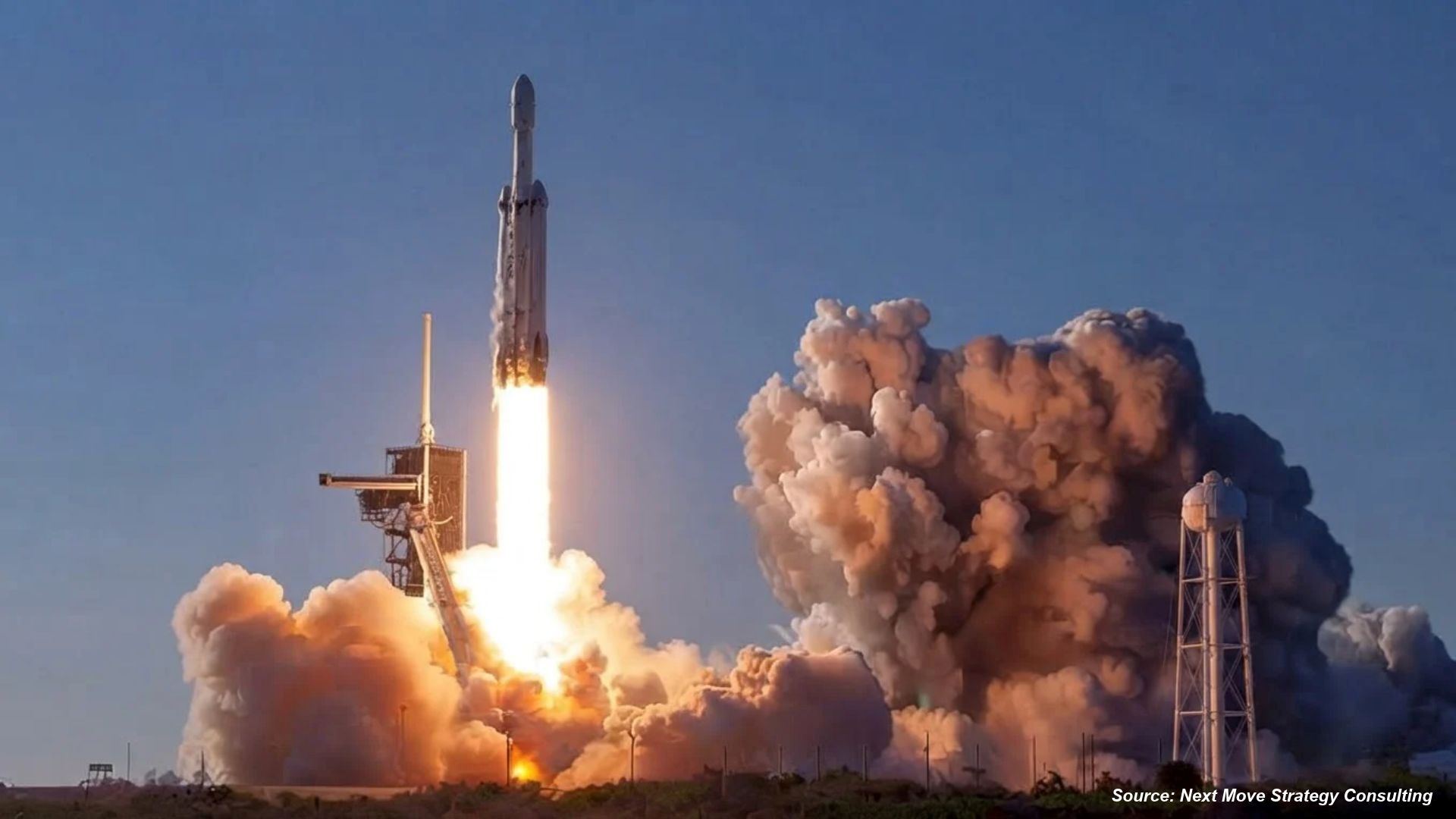
On September 28, 2026, SpaceX's Starship — a 40-story-tall vehicle consisting of a Super Heavy booster topped by the Starship upper stage — lifted off from the company's Starbase complex near Brownsville, Texas, on its 14th test flight. Despite an engine shutdown during ascent that briefly threatened the mission, the spacecraft successfully reached orbit, deployed all 26 Starlink V3 satellites at an altitude of approximately 269 km, and executed a controlled descent into the Pacific Ocean.
The commercial significance of this flight extends far beyond the engineering milestone. According to Reuters reporting on September 28, 2026, analysts estimate the launch of SpaceX's new V3 Starlink satellites equates to hundreds of millions of dollars in projected revenue for SpaceX's Starlink unit, based on the network's added customer capacity. The V3 satellites can handle 10 times more data than their predecessor V2 mini-satellites, which SpaceX has been launching 20 to 30 at a time on Falcon 9 rockets. Once Starship enters routine operation, SpaceX intends to launch V3 satellites in batches of 60 per mission — a throughput that would compress the timeline for global broadband saturation and simultaneously reduce per-satellite launch costs to levels that no competing vehicle can currently match.
Starship's development has cost SpaceX more than USD 15 billion to date, according to Reuters reporting from May 2026. The company went public in June 2026 with a record-shattering IPO that made it the sixth-largest U.S. company by value, with a market capitalization of USD 2 trillion as of the orbital debut flight.
The orbital debut also underscores a structural shift in how launch capacity is priced. According to SpaceX's published launch manifest, a Falcon 9 mission is listed at approximately USD 74 million. Starship, once operational at scale, is designed to carry payloads an order of magnitude larger at a fraction of the per-kilogram cost — a pricing dynamic that will force every incumbent launch provider to reassess its commercial positioning.
The Competitive Response: New Glenn, Neutron, and the Multi-Provider Race
SpaceX's dominance is not going unchallenged. Blue Origin's New Glenn rocket, which suffered an explosion in May 2026 that destroyed Launch Complex 36A at Cape Canaveral, has since announced a two-pad development plan to restore and expand its launch cadence. Rocket Lab, meanwhile, is advancing its medium-lift reusable Neutron rocket — designed to carry approximately 13,000 kg to LEO — targeting the constellation deployment market that Starship will not fully serve at the small-to-medium payload tier.
On September 1, 2026, NASA awarded Blue Origin a firm-fixed-price contract worth up to $700 million to design, build, launch, and operate the Mars Telecommunications Network (MTN) orbiter, using its Blue Ring spacecraft platform. Rocket Lab subsequently filed a bid protest with the U.S. Government Accountability Office (GAO) on September 11, 2026.
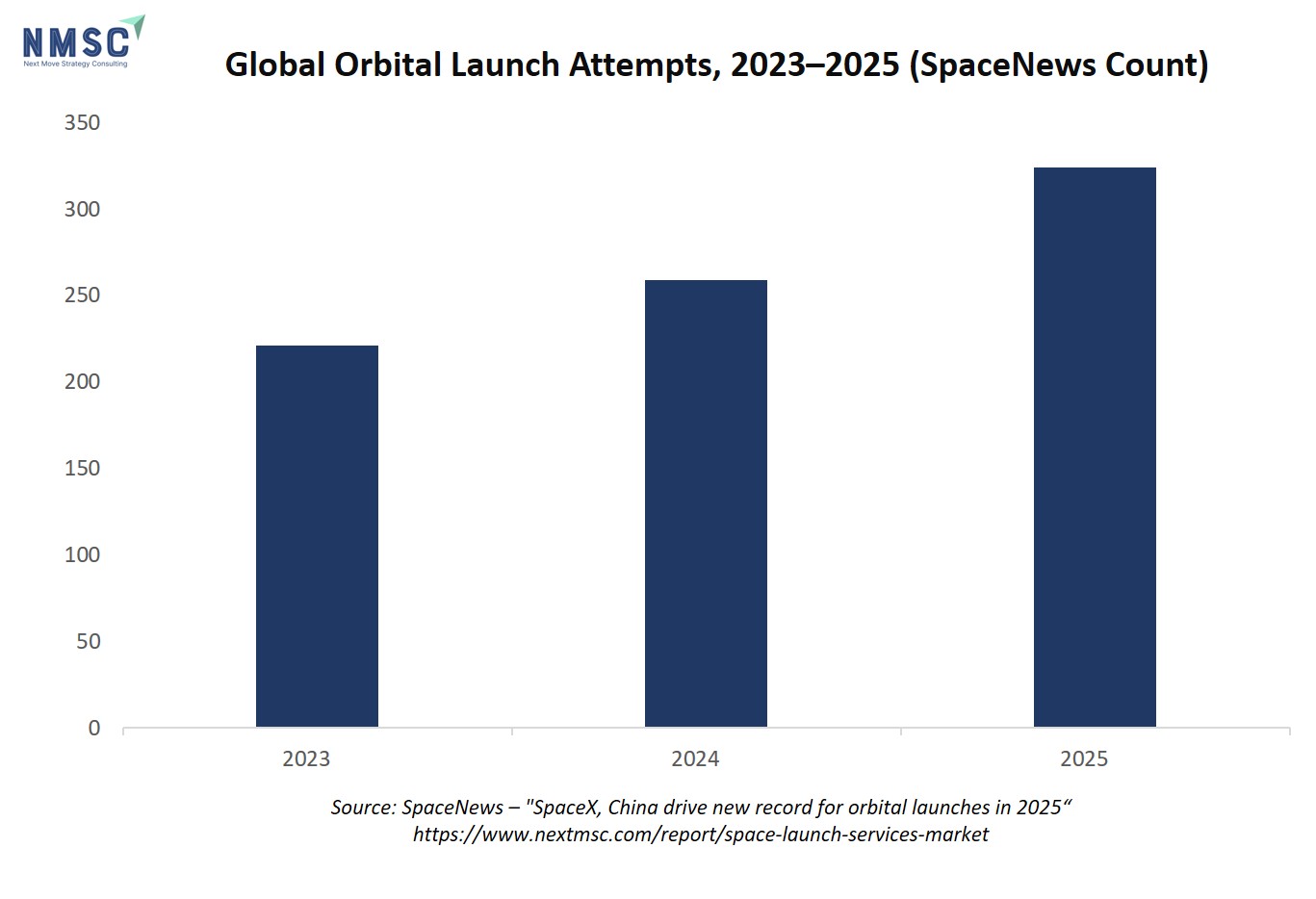
China's launch cadence adds a further competitive dimension. In 2025, China conducted 93 orbital launches — second only to the United States' 193 — and is advancing its Long March-12 rocket for large-scale satellite constellation deployment, with plans to deploy 310 satellites in 2026, scaling to 900 in 2027 and 3,600 annually from 2028 onward.
NMSC Strategic Perspective: What Starship's Orbital Debut Means for Market Structure
From a market-structure standpoint, NextMSC primary research and analysis identifies Starship's transition from test vehicle to revenue-generating asset as the single most consequential near-term variable in the space launch services market's trajectory toward USD 40.12 billion by 2030. The mechanism is specific: Starship's payload capacity to LEO — estimated at over 100 metric tonnes in a fully reusable configuration — enables SpaceX to serve not only its own Starlink constellation but also third-party mega-constellation operators, government cargo missions, and emerging in-space manufacturing customers from a single vehicle platform. This consolidation of demand onto one vehicle type compresses the cost curve for all LEO-bound payloads and simultaneously raises the competitive bar for every other launch provider seeking commercial contracts in the USD 50 million-and-above mission tier.
NextMSC proprietary research and estimates further indicate that the reusable launch vehicle segment — already the dominant growth driver within the broader space launch services market — will account for a disproportionate share of incremental revenue through 2030, as operators shift from single-use architectures to reusable systems that reduce per-mission costs and enable higher annual launch frequencies.
Section Summary:
Starship's orbital debut on September 28, 2026 marked the vehicle's first revenue-generating commercial mission and validated the technical foundation for SpaceX's ambition to launch hundreds of missions annually. The competitive landscape is simultaneously broadening, with Blue Origin, Rocket Lab, and China's state-backed providers each advancing next-generation vehicles.
-
SpaceX's Starship deployed 26 Starlink V3 satellites on its first orbital mission, with each V3 satellite carrying 10× the data capacity of its predecessor.
-
SpaceX's USD 2 trillion market capitalization following its June 2026 IPO reflects investor confidence in Starship's commercial scalability.
-
Blue Origin's two-pad recovery plan and Rocket Lab's Neutron development signal a maturing multi-provider market.
-
China's 93 orbital launches in 2025 and its planned mega-constellation rollout represent a structural competitive pressure on Western commercial providers.
Industry Impact Analysis
The 1,000-Launch Mandate: How U.S. Policy Is Restructuring Market Access
On August 20, 2026, U.S. President Donald Trump signed a National Security Presidential Memorandum establishing a new National Space Transportation Policy with a single, quantified objective: enable at least 1,000 launches and reentries on American soil annually by 2030 — up from 178 launches in 2025, a figure that is already 10 times higher than in 2013.
The policy's operational directives are specific and consequential for market participants. The Memorandum instructs the Secretary of Transportation and the Secretary of the Interior to identify additional launch and reentry sites on federal land, designate priority airspace for critical space launch corridors, and integrate space transportation activities into air traffic control modernization. It also directs agencies to incentivize co-development of space transportation infrastructure with private sector partners and to expedite permitting and environmental reviews.
White House Office of Science and Technology Policy Director Michael Kratsios described the policy as one that "meets this moment of explosive growth and positions America to lead the next era of space," calling for a "commercial-first approach enabling Americans on the Moon by 2028 and initial Moon Base elements by 2030, and rapid, resilient launch capabilities for national security."
The policy's commercial-first orientation is reinforced by a separate August 2025 Executive Order on "Enabling Competition in the Commercial Space Industry," which directed agencies to remove regulatory barriers to commercial launch and streamline license and permit approvals. The Belfer Center for Science and International Affairs at Harvard Kennedy School noted in its September 2025 analysis that the order also called on the Secretary of Commerce to reform "novel space activity authorization" — addressing a regulatory gap for in-space services such as on-orbit servicing, debris removal, and in-space manufacturing that lack clear governance under existing U.S. law.
FAA's Environmental Waiver Proposal: Accelerant or Liability?
In July 2026, the Federal Aviation Administration issued a proposed rulemaking to waive requirements under 13 federal environmental laws for commercial space licenses and permits — including the National Environmental Policy Act and the Endangered Species Act. The proposal, published in the Federal Register on July 30, 2026, is designed to eliminate or expedite environmental reviews that the FAA characterizes as obstacles to commercial launch approvals.
The proposal has generated significant legal opposition. Earthjustice filed formal comments in August 2026 arguing that "the FAA does not have legal authority to wholesale waive application of the 13 environmental protection laws." For market participants, the outcome of this rulemaking will directly determine the speed at which new launch sites can be permitted and the cost of environmental compliance for existing operators — a variable with material implications for the competitive economics of the U.S. launch market.
Orbital Manufacturing: A New Demand Category Expanding the Addressable Market
The space launch services market's addressable demand is no longer confined to satellite deployment and government cargo. On September 30, 2026, Reuters reported that Varda Space Industries raised USD 250 million at a USD 1.6 billion valuation to scale orbital drug manufacturing — a business model that requires dedicated, recurring launch capacity for manufacturing platforms and return capsules. The White House's August 2026 National Space Transportation Policy explicitly identified "novel in-space manufacturing and transportation capabilities" as enabling "discovery and development of high-value materials and pharmaceuticals" — a policy signal that federal procurement and regulatory support for this demand category is forthcoming.
Separately, in September 2026, Reuters reported that Google is planning the first test of AI chips in space under its Project Suncatcher initiative — a development that, if scaled, would create a new category of orbital computing infrastructure requiring dedicated launch services.
Artemis II and the Government Anchor Demand
In April 2026, NASA's Artemis II mission sent astronauts to lunar orbit for the first time in over 50 years — a milestone that validates the government anchor demand underpinning the heavy-lift segment of the launch services market. The Trump administration's directive for NASA to facilitate commercial transportation to and from the Moon — and to explore commercial avenues for human Mars missions — signals that government lunar and deep-space demand will increasingly flow through commercial launch contracts rather than cost-plus government programs.
Section Summary:
The U.S. policy environment has shifted decisively toward commercial launch acceleration, with a quantified 1,000-launch-per-year target by 2030 and a regulatory deregulation agenda that, if sustained, will materially reduce the time and cost of bringing new launch sites and vehicles to market.
-
The Trump administration's August 2026 National Space Transportation Policy sets a 1,000-launch-per-year target by 2030 — a 5.6× increase from 2025's 178 launches.
-
The FAA's proposed waiver of 13 environmental laws for commercial space launches is under active legal challenge, creating near-term regulatory uncertainty for new site development.
-
Varda's USD 250 million raise at a USD 1.6 billion valuation signals that orbital manufacturing is transitioning from demonstration to commercial scale, creating a new recurring demand category for launch services.
-
Artemis II's April 2026 lunar orbit mission anchors government heavy-lift demand and validates the commercial-first procurement model for future Moon and Mars missions.
Pros and Cons of Recent Market Developments
|
Development |
Pros |
Cons |
|
Trump's 1,000-Launch-Per-Year Policy (Aug 2026) |
Creates a clear federal demand signal that de-risks private investment in launch infrastructure; directs federal land for new launch sites, expanding geographic capacity |
Achieving a 5.6× increase in annual launches by 2030 requires permitting, workforce, and infrastructure scaling that may not materialize within the policy's timeline |
|
SpaceX Starship Orbital Debut (Sept 2026) |
Validates the world's most capable reusable rocket as a commercial asset; V3 Starlink deployment demonstrates revenue-generating potential; reduces per-kg launch costs for all LEO payloads |
Engine failure during ascent highlights ongoing reliability risks; SpaceX's USD 2 trillion valuation concentrates systemic risk in a single private operator; competitors face a widening cost gap |
|
FAA Environmental Waiver Proposal (Jul 2026) |
Reduces permitting timelines for new launch sites and vehicles; removes a key bottleneck that has delayed commercial launch approvals |
Active legal challenges from environmental groups create regulatory uncertainty; potential rollback could strand infrastructure investments made in anticipation of the waiver |
|
SpaceX IPO (Jun 2026) |
Provides SpaceX with public capital markets access to fund Starship scaling and Starlink expansion; increases transparency and institutional investor participation in the space economy |
SpaceX's dominant market position — approximately 85% of U.S. orbital launches in 2025 — may deter new entrants and reduce competitive pricing pressure |
|
Varda Orbital Drug Manufacturing Scale-Up (Sept 2026) |
Opens a new recurring demand category for launch services beyond satellite deployment; USD 1.6 billion valuation signals institutional confidence in in-space manufacturing economics |
Regulatory framework for in-space manufacturing remains incomplete; mission failure risk is high for early-stage orbital manufacturing platforms |
|
Blue Origin New Glenn Explosion (May 2026) |
Accelerates Blue Origin's two-pad development plan, potentially increasing its long-term launch cadence |
Destroys Launch Complex 36A, reducing near-term U.S. launch site capacity and delaying Blue Origin's competitive entry into the heavy-lift commercial market |
Key Data & Statistics
Global Orbital Launch Activity by Year (2020–2026)
|
Year |
Total Global Orbital Launches |
U.S. Orbital Launches |
SpaceX Falcon 9 Launches |
China Orbital Launches |
|
2020 |
~114 |
~44 |
26 |
~39 |
|
2021 |
~145 |
~51 |
31 |
~55 |
|
2022 |
~186 |
~78 |
61 |
~64 |
|
2023 |
~222 |
~116 |
96 |
~67 |
|
2024 |
~259 |
~157 |
134 |
~68 |
|
2025 |
321 (record) |
193 (record) |
165 (record) |
93 |
|
2026 (Jan–Sept) |
220+ |
~170+ |
~113+ |
~60+ |
Key Space Launch Services Market Developments Timeline (2025–2026)
|
Date |
Event |
Operator / Entity |
Market Significance |
|
Aug 2025 |
Executive Order: "Enabling Competition in the Commercial Space Industry" |
White House |
Directed agencies to remove regulatory barriers; initiated novel space activity authorization reform |
|
Dec 2025 |
Executive Order: America First Space Policy |
White House |
Set bold vision for U.S. leadership in space exploration, security, and commerce |
|
Apr 2026 |
Artemis II lunar orbit mission |
NASA / Commercial partners |
First crewed lunar orbit in 50+ years; validates commercial-first heavy-lift procurement model |
|
May 2026 |
New Glenn explosion destroys Launch Complex 36A |
Blue Origin |
Reduces near-term U.S. heavy-lift capacity; accelerates Blue Origin's two-pad rebuild plan |
|
Jun 2026 |
SpaceX IPO — sixth-largest U.S. company by value |
SpaceX |
USD 2 trillion valuation; public capital access for Starship scaling and Starlink V3 deployment |
|
Jul 2026 |
FAA proposes waiver of 13 environmental laws for commercial space |
FAA / U.S. DOT |
Potential to accelerate launch site permitting; under active legal challenge |
|
Aug 2026 |
National Space Transportation Policy signed |
White House |
1,000-launch-per-year target by 2030; directs federal land for new launch and reentry sites |
|
Sept 2026 |
Starship 14th flight — first orbital mission; 26 Starlink V3 satellites deployed |
SpaceX |
First revenue-generating Starship mission; validates world's most capable reusable rocket |
|
Sept 2026 |
Varda raises USD 250M at USD 1.6B valuation for orbital drug manufacturing |
Varda Space Industries |
Establishes orbital manufacturing as a new recurring demand category for launch services |
|
Sept 2026 |
Blue Origin secures multi-million dollar contract over Rocket Lab |
Blue Origin |
Signals emergence of a credible second heavy-lift commercial provider |
Future Outlook & Forecast
NMSC Market Forecast: USD 40.12 Billion by 2030
According to NextMSC primary research and analysis, the global space launch services market is projected to reach USD 40.12 billion by 2030, growing at a CAGR of 13.6% from a base of USD 11.20 billion in 2021. This trajectory reflects the compounding effect of three structural forces: the commercialization of heavy-lift reusable vehicles, the proliferation of LEO satellite mega-constellations, and the expansion of the addressable market into in-space services and manufacturing.
The LEO orbit segment is the primary volume driver within this forecast. NextMSC proprietary research and estimates identify LEO as the dominant orbit type by launch frequency, driven by the deployment of broadband satellite constellations — including SpaceX's Starlink, Amazon's Project Kuiper (being advanced through ULA's Atlas V), and China's planned 3,600-satellite-per-year deployment cadence from 2028. The reusable launch vehicle segment, anchored by Falcon 9's 165-launch record in 2025 and Starship's entry into commercial service, is the primary cost-reduction mechanism enabling this volume growth.
The commercial end-user segment is outpacing the military and government segments in growth rate, consistent with the U.S. policy shift toward commercial-first procurement. The White House's August 2026 directive for NASA to facilitate commercial transportation to the Moon and to explore commercial avenues for human Mars missions will further accelerate this shift, converting what were historically government-funded missions into commercial contract opportunities.
The Path to 1,000 Annual Launches: Infrastructure and Workforce Constraints
The U.S. government's 1,000-launch-per-year target by 2030 implies an average of nearly three launches per day from American soil — compared to approximately 0.5 per day in 2025. Achieving this cadence requires not only the technical readiness of Starship and next-generation vehicles, but also the permitting and construction of additional launch and reentry sites, the expansion of range scheduling capacity, and the development of an aerospace manufacturing and operations workforce at a scale the industry has not previously required. The FAA's proposed environmental waiver, if upheld, would remove one of the most significant permitting bottlenecks. However, as Earthjustice's August 2026 formal comments to the FAA noted, the legal authority for such a wholesale waiver remains contested.
The World Economic Forum has identified three commercial trends propelling the broader space market toward a USD 1.8 trillion valuation: lower costs driven by software-defined development, faster iteration cycles enabled by commercial capital, and the convergence of space infrastructure with terrestrial digital services. Each of these trends directly expands the demand base for launch services.
Section Summary:
NextMSC's forecast of USD 40.12 billion by 2030 at a 13.6% CAGR is supported by a convergence of policy, technology, and demand-side catalysts that are simultaneously expanding the volume and value of launch services.
-
The LEO segment, driven by mega-constellation deployments from SpaceX, Amazon, and Chinese operators, is the primary volume driver within the NMSC forecast period.
-
The U.S. government's 1,000-launch-per-year target by 2030 represents a policy-level demand signal that de-risks private investment in launch infrastructure at a scale not previously seen.
-
Starship's entry into commercial service — with a target of 60 V3 Starlink satellites per launch in routine operations — will compress per-satellite launch costs and accelerate constellation deployment timelines.
-
New demand categories, including orbital drug manufacturing (Varda, USD 1.6 billion valuation) and orbital AI computing (Google Project Suncatcher), are expanding the addressable market beyond traditional satellite deployment.
Next Steps for Stakeholders
For C-Level Executives at Launch Operators and Aerospace Manufacturers:
The window to secure long-term launch contracts with mega-constellation operators — particularly for the LEO segment — is narrowing as SpaceX's Starship moves toward routine commercial service. Operators with medium-lift reusable vehicles (Rocket Lab's Neutron, Blue Origin's New Glenn) should prioritize securing anchor customers in the 1,000–13,000 kg payload tier that Starship will not serve cost-effectively at low volumes. Investment in launch site diversification — particularly in light of the FAA's proposed environmental waiver and the White House's directive to identify federal land for new sites — should be evaluated now, before permitting timelines are reset by potential legal rulings.
For Institutional Investors:
The space launch services market's USD 40.12 billion trajectory by 2030, as projected by NextMSC primary research and analysis, is underpinned by policy mandates, not merely market projections. The U.S. government's 1,000-launch-per-year target creates a floor of demand that reduces the revenue risk for well-capitalized launch providers. SpaceX's USD 2 trillion post-IPO valuation reflects this policy premium. Investors evaluating the second tier of launch providers — Blue Origin, Rocket Lab, and emerging international operators — should assess their ability to serve the specific payload tiers and orbital regimes that Starship's economics will not address.
For Government and Defense Procurement Officials:
The National Space Transportation Policy's directive to refrain from government space transportation activities that "preclude, discourage, or compete with United States commercial space transportation activities" signals a structural shift in how defense and intelligence community launch requirements will be procured. Procurement frameworks should be updated to reflect commercial-first sourcing, with government-unique requirements clearly delineated to avoid crowding out commercial capacity.
For New Market Entrants in Orbital Services (Manufacturing, Computing, Pharmaceuticals):
The regulatory framework for novel in-space activities — on-orbit servicing, debris removal, in-space manufacturing — remains incomplete, as the Belfer Center's September 2025 analysis documented. Entities planning orbital manufacturing or servicing missions should engage proactively with the Department of Commerce's novel space activity authorization process, which the August 2025 Executive Order directed to be reformed. Early engagement will reduce licensing risk and position companies to benefit from the first-mover advantages in a market that Varda's USD 1.6 billion valuation confirms is attracting institutional capital.
Conclusion
The space launch services market is undergoing a structural transformation that is compressing decades of incremental progress into a span of months. Starship's orbital debut on September 28, 2026 — the same week that Varda closed a USD 250 million raise for orbital drug manufacturing and Google announced its first orbital AI chip test — illustrates how rapidly the demand base for launch services is diversifying beyond satellite deployment. Against this backdrop, the U.S. government's mandate to enable 1,000 annual launches by 2030 is not an aspirational target; it is a procurement and infrastructure directive backed by executive authority, FAA rulemaking, and federal land allocation.
According to NextMSC primary research and analysis, the global space launch services market is on a trajectory from USD 11.20 billion in 2021 to USD 40.12 billion by 2030 at a 13.6% CAGR — a forecast that the events of 2026 are validating in real time. For executives, investors, and policymakers, the strategic question is no longer whether the market will reach this scale, but which operators, infrastructure investments, and regulatory frameworks will capture the value when it does.
About the Author
 Sanyukta Deb
— Sanyukta Deb is Digital Marketing Team Lead at Next Move Strategy Consulting, where she has led content strategy and technical SEO for the firm's B2B market research publications for over 2 years. Her editorial process translates NextMSC's primary and secondary research — spanning technology, industrial, and consumer sectors — into commercial narratives, backed by search-intent, keyword, and competitive analysis. She brings 5 years of overall experience in digital marketing and content strategy.
Sanyukta Deb
— Sanyukta Deb is Digital Marketing Team Lead at Next Move Strategy Consulting, where she has led content strategy and technical SEO for the firm's B2B market research publications for over 2 years. Her editorial process translates NextMSC's primary and secondary research — spanning technology, industrial, and consumer sectors — into commercial narratives, backed by search-intent, keyword, and competitive analysis. She brings 5 years of overall experience in digital marketing and content strategy.
About the Reviewer
 Debashree Dey
— Debashree Dey is Assistant Manager at Next Move Strategy Consulting, where she supports cross-vertical market content and communications across diverse industries for 6 years. Her professional background includes senior content writing, communications, and published manuscript authorship, with experience developing audience-focused business narratives and maintaining clear, consistent messaging. Her role supports research-led content development and editorial quality across NextMSC publications.
Debashree Dey
— Debashree Dey is Assistant Manager at Next Move Strategy Consulting, where she supports cross-vertical market content and communications across diverse industries for 6 years. Her professional background includes senior content writing, communications, and published manuscript authorship, with experience developing audience-focused business narratives and maintaining clear, consistent messaging. Her role supports research-led content development and editorial quality across NextMSC publications.


















Add Comment