Cognex’s $500M RealSense Deal Reshapes Computer Vision Market | NextMSC

Introdution
On September 22, 2026, Cognex Corporation (NASDAQ: CGNX) — the global technology leader in industrial machine vision — announced a definitive agreement to acquire RealSense, the market leader in depth-sensing cameras and vision technology for robotic perception and Physical AI, for approximately USD 500 million, financed entirely from existing cash and investments. The transaction, expected to close in Q4 2026, is the most consequential consolidation event in the industrial computer vision sector this year — and it arrives at a moment when the broader market is accelerating well beyond its traditional manufacturing roots.
According to Next Move Strategy Consulting's Computer Vision Market report, the global computer vision market is projected to reach USD 29.3 billion by 2030, growing at a CAGR of 15.2% from 2024 to 2030. The Cognex-RealSense deal is a direct commercial validation of that trajectory: Cognex's own internal estimate places the robotic perception sub-market at USD 600 million today, growing at more than 25% annually to approximately USD 1.6 billion by 2030 — a segment that did not exist as a discrete commercial category five years ago.
For More Information: Download FREE Sample on Computer Vision Market Report
The Strategic Logic Behind the Cognex-RealSense Deal
RealSense was originally founded by Intel in 2014 and spun out as an independent company in 2025. Its technology — depth-sensing cameras and vision systems used in autonomous mobile robots, humanoid robots, fixed-arm perception-guided robotics, and quadrupeds — addresses a capability gap that 2D machine vision systems cannot fill: enabling machines to perceive and navigate three-dimensional physical environments in real time.
"RealSense represents a compelling strategic expansion for Cognex into robotic perception, one of the most attractive adjacent markets in machine vision," said Matt Moschner, President and Chief Executive Officer of Cognex, in the company's official press release dated September 22, 2026. "RealSense brings a leading 3D perception platform with proprietary technology, a strong developer community and a compelling value proposition for customers. Combined with Cognex's machine vision expertise and global reach, RealSense positions us to offer a full-stack visual intelligence platform, spanning industrial ID, 2D and 3D machine vision measurement to 3D depth perception and robotic navigation, built to serve the full spectrum of Physical AI."
Nadav Orbach, Chief Executive Officer of RealSense, framed the rationale from the target's perspective: "RealSense was built on a simple idea: robots and autonomous systems can't act intelligently in the physical world if they can't first perceive it accurately. We've called that mission the Visual Cortex of Physical AI. Joining Cognex puts that mission on an entirely new scale, giving us access to a global industrial customer base and go-to-market reach that would have taken us years to build on our own."
RealSense is expected to generate revenue of USD 80 million to USD 90 million in 2026, representing more than 50% growth over the prior year. Dennis Fehr, Chief Financial Officer of Cognex, stated in the same press release that the transaction is "highly aligned with our disciplined M&A strategy" and that "RealSense is expected to be strongly accretive to Cognex's growth profile."
AI Adoption in Manufacturing Vision Systems Reaches an Inflection Point
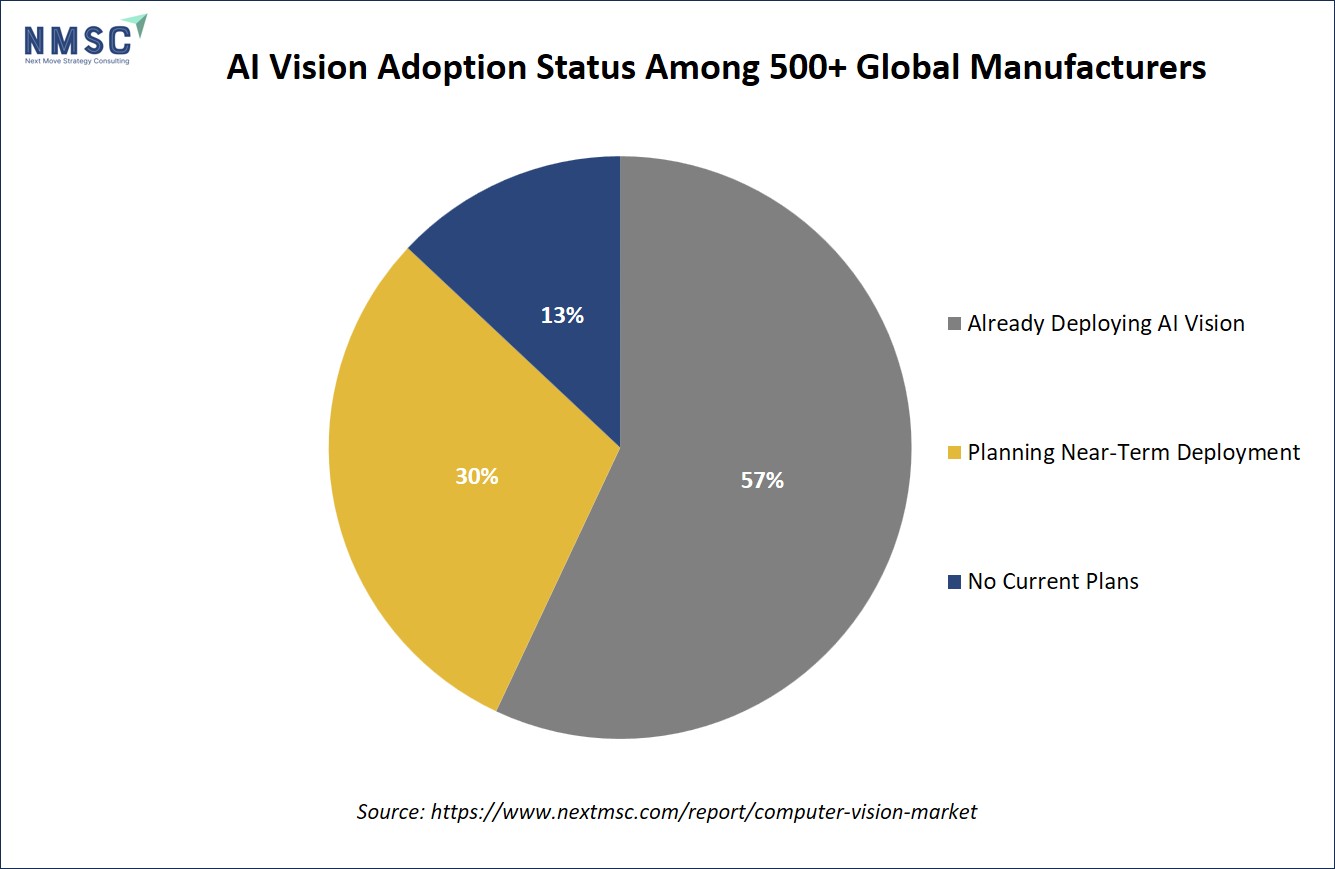
The Cognex acquisition does not occur in isolation. In March 2026, Cognex published a global research report — How AI Is Transforming Machine Vision Through Performance and Simplicity — drawing on firsthand survey data from more than 500 manufacturers, OEMs, and system integrators across North America, Europe, and Asia. The findings reveal that 57% of respondents already deploy AI in their machine vision operations, with a further 30% planning near-term deployments. Adoption is concentrated in automotive, electronics, and logistics — sectors where product variability, tighter dimensional tolerances, and accelerating automation are pushing vision systems beyond the detection limits of rule-based algorithms.
"This research confirms what we see globally: AI isn't just improving machine vision performance — it's reshaping how manufacturers think about quality, efficiency, and automation," said Matt Moschner, President and CEO of Cognex, in the March 23, 2026 press release. "The convergence of powerful AI and practical usability enables factories to deploy intelligence at the edge, adapt in real time, and accelerate toward fully autonomous operations."
Shirin Saleem, VP of Engineering at Cognex, added in the same release: "Newer AI vision solutions include features such as intuitive visualization tools, robust audit trails, reduced data requirements, and lower dependence on specialized expertise. These advancements have significantly narrowed the gap between perceived implementation risk and real-world user experience."
Respondents with more than three years of AI vision experience were significantly more likely to report that AI systems are easy to scale across multiple sites (+10.9 percentage points) and fast to develop and deploy (+9.1 percentage points) — a finding that directly challenges the persistent narrative that AI-based vision systems carry prohibitive integration complexity.
The Electric Vehicle Surge: A Structural Demand Driver for Automotive Computer Vision
One of the most durable demand vectors for computer vision — particularly in the automotive segment — is the accelerating global transition to electric vehicles. According to the International Energy Agency's Global EV Outlook 2026, electric car sales grew 20% globally to exceed 20 million units in 2025, with one-quarter of all new cars sold worldwide being electric. Global electric car sales are expected to grow further to 23 million in 2026, representing 28% of total car sales.
This matters directly for computer vision because electric and software-defined vehicles require substantially more embedded vision capability than their internal combustion counterparts. Advanced driver assistance systems, battery management optimization, and autonomous navigation — all of which depend on real-time visual data processing — are standard features in modern EV architectures. The IEA notes that driverless taxis, all of them electric, are now operating commercially in more than 20 cities, primarily in China and the United States, creating a live deployment environment for automotive-grade computer vision at scale.
China's dominance in EV manufacturing — accounting for nearly 75% of electric cars produced globally in 2025 — also concentrates the demand for vision-guided robotic assembly systems in the Asia-Pacific region, where production lines must handle the highest volumes and the most rapid model changeovers of any automotive market.
Venture Capital Inflows Reach a Decade High in 2026
The investment community's conviction in computer vision's commercial trajectory is reflected in funding data that has no precedent in the sector's history. According to Tracxn's Computer Vision Sector analysis (last updated September 2, 2026), computer vision companies raised USD 6.77 billion in equity funding through August 2026 — a 117% increase compared to the USD 3.08 billion raised over the same period in 2025.
The sector has now produced 20 unicorns, recorded 157 acquisitions, and seen 43 IPOs — an exit rate of approximately 8.5%, more than double the 4.3% exit rate of the broader technology sector. The United States leads all geographies with USD 21.2 billion in cumulative funding, followed by China at USD 6.4 billion and the United Kingdom at USD 3.1 billion.
Market Segmentation: Where the Growth Is Concentrated
According to NextMSC primary research and analysis, the computer vision market is segmented by component (hardware, software, services), product (PC-based systems and smart camera-based systems), offering (deep learning and traditional computer vision), application, end user, and region.
Regional Analysis: North America Leads, Asia-Pacific Accelerates
According to NextMSC primary research and analysis, North America holds the dominant share of the global computer vision market and is expected to maintain that position through 2030. The region's leadership is anchored by the concentration of key technology vendors — including Cognex, Teledyne Technologies, Texas Instruments, and Intel Corporation — alongside deep enterprise adoption in retail automation, semiconductor manufacturing, and logistics.
Asia-Pacific is the fastest-growing regional market, driven by the world's largest automotive manufacturing base, aggressive government digitalization programs, and the rapid scaling of EV production lines that require vision-guided assembly at volumes unmatched elsewhere. China's position as the producer of nearly 75% of global electric cars in 2025 directly translates into sustained demand for high-throughput machine vision systems on its factory floors.
Competitive Landscape: Consolidation Accelerates as the Market Matures
The computer vision market's competitive structure is undergoing rapid consolidation. The Cognex-RealSense transaction is the headline deal, but it is part of a broader pattern: Tracxn data shows nine acquisitions in the computer vision sector through July 2026, following 21 acquisitions in full-year 2025 and 16 in 2024.
Four IPOs in the computer vision sector have occurred in 2026 through September, including Mech-Mind's listing on the Hong Kong Exchanges on September 1, 2026, and Rank One Computing's NASDAQ debut on February 20, 2026 — signaling that the sector's most mature players are now accessing public capital markets to fund the next phase of scale.
Key players profiled in NextMSC's Computer Vision Market report include Baumer, Cognex Corporation, Intel Corporation, Keyence Corporation, Matterport Inc., National Instruments Corp., Omron Corporation, Sony Semiconductor Solutions Corporation, Teledyne Technologies Incorporated, and Texas Instruments Incorporated. These players are competing across product innovation, geographic expansion, and strategic M&A to capture share in a market that is simultaneously broadening its application base and deepening its AI integration.
NMSC Strategic Perspective: Physical AI Is Redefining the Computer Vision Addressable Market
The Cognex-RealSense transaction is not simply a product-line extension — it is a signal that the computer vision market's addressable opportunity is being fundamentally redefined by the emergence of Physical AI: the integration of AI-driven perception into robots, autonomous vehicles, and industrial systems that must navigate and act within unstructured physical environments.
According to NextMSC primary research and analysis, the traditional computer vision market — built on 2D image capture, rule-based defect detection, and fixed-camera inspection stations — is being structurally expanded by three converging forces:
1.The Humanoid and Mobile Robot Deployment Wave: As humanoid robots and autonomous mobile robots move from laboratory prototypes to factory-floor deployments, they require 3D depth perception systems that can operate in real time under variable lighting, occlusion, and spatial complexity. RealSense's technology directly addresses this requirement, and Cognex's acquisition gives it a platform position in a market that did not exist at commercial scale three years ago.
2.The EV Production Ramp as a Vision System Multiplier: Each new EV assembly line requires a substantially higher density of vision-guided robotic systems than a conventional internal combustion engine line, because EV battery pack assembly, cell inspection, and module handling demand micron-level precision that human operators cannot consistently deliver. With global EV sales projected to reach 23 million units in 2026 per the IEA's Global EV Outlook 2026, the pipeline of new EV production capacity being commissioned globally represents a multi-year order backlog for industrial vision system vendors.
3.The Deep Learning Usability Inflection: The Cognex survey data showing that 57% of manufacturers have already deployed AI vision — and that experienced users report dramatically higher ease-of-scaling and deployment speed — indicates that the market has crossed the usability threshold that historically constrains enterprise technology adoption. When the majority of the target customer base has already deployed a technology and reports positive operational outcomes, the remaining 30% planning near-term deployment represents a near-term revenue wave, not a speculative pipeline.
NextMSC's analysis indicates that the market's 15.2% CAGR through 2030 is underpinned by these structural demand vectors rather than by cyclical technology spending. The primary risk to this trajectory remains the high upfront deployment cost of integrated computer vision solutions and the complexity of retrofitting legacy production lines — constraints that are being progressively addressed by the shift toward modular, AI-native vision platforms that reduce the need for specialized engineering expertise at the point of deployment.
Bottom Line
The global computer vision market is at a structural inflection point. Cognex Corporation's USD 500 million acquisition of RealSense on September 22, 2026 — the largest machine vision deal of the year — marks the moment when the industry's leading incumbent formally committed to the Physical AI era, acquiring 3D depth-sensing capability to serve humanoid robots, autonomous mobile robots, and next-generation EV assembly lines that 2D vision systems cannot address. According to NextMSC primary research and analysis, the market is on a trajectory from USD 12.5 billion in 2023 to USD 29.3 billion by 2030 at a 15.2% CAGR — a forecast now reinforced by record venture capital inflows of USD 6.77 billion through August 2026, a 117% year-on-year increase per Tracxn data. The IEA's projection of 23 million global EV sales in 2026 — each vehicle requiring a higher density of vision-guided robotic assembly than its combustion-engine predecessor — provides a durable, policy-backed demand floor for the automotive segment. With 57% of global manufacturers already deploying AI vision systems and 30% planning near-term adoption per Cognex's own survey of 500+ industry participants, the market's growth is no longer speculative. It is operational.
About Next Move Strategy Consulting
Next Move Strategy Consulting is a premier market research and management consulting firm that has been committed to provide strategically analysed well documented latest research reports to its clients. The research industry is flooded with many firms to choose from, what makes NMSC different from the rest is its top-quality research and the obsession of turning data into knowledge by dissecting every bit of it and providing fact-based research recommendation that is supported by information collected from over 500 million websites, paid databases, industry journals and one on one consultations with industry experts across a diverse range of industry sectors. The high-quality customized research reports with actionable insights and excellent end-to-end customer service help our clients to take critical business decisions that enables them to move beyond time and have competitive edge in the industry.
We have been servicing over 1000 customers globally that includes 90% of the Fortune 500 companies over a decade. Our analysts are constantly tracking various high growth markets and identifying hidden opportunities in each sector or the industry. We provide one of the industry's best quality syndicate as well as custom research reports across 10 different industry verticals. We are committed to deliver high quality research solutions in accordance to your business needs. Our industry standard delivery solutions that ranges from the pre consultation to after-sales services, provide an excellent client experience and ensure right strategic decision making for businesses.
About the Author
 Sanyukta Deb
— Sanyukta Deb is Digital Marketing Team Lead at Next Move Strategy Consulting, where she has led content strategy and technical SEO for the firm's B2B market research publications for over 2 years. Her editorial process translates NextMSC's primary and secondary research — spanning technology, industrial, and consumer sectors — into commercial narratives, backed by search-intent, keyword, and competitive analysis. She brings 5 years of overall experience in digital marketing and content strategy.
Sanyukta Deb
— Sanyukta Deb is Digital Marketing Team Lead at Next Move Strategy Consulting, where she has led content strategy and technical SEO for the firm's B2B market research publications for over 2 years. Her editorial process translates NextMSC's primary and secondary research — spanning technology, industrial, and consumer sectors — into commercial narratives, backed by search-intent, keyword, and competitive analysis. She brings 5 years of overall experience in digital marketing and content strategy.
About the Reviewer
 Debashree Dey
— Debashree Dey is Assistant Manager at Next Move Strategy Consulting, where she supports cross-vertical market content and communications across diverse industries for 6 years. Her professional background includes senior content writing, communications, and published manuscript authorship, with experience developing audience-focused business narratives and maintaining clear, consistent messaging. Her role supports research-led content development and editorial quality across NextMSC publications.
Debashree Dey
— Debashree Dey is Assistant Manager at Next Move Strategy Consulting, where she supports cross-vertical market content and communications across diverse industries for 6 years. Her professional background includes senior content writing, communications, and published manuscript authorship, with experience developing audience-focused business narratives and maintaining clear, consistent messaging. Her role supports research-led content development and editorial quality across NextMSC publications.
















Add Comment