How to Use AI in Your Business: 7 Key Implementation Tips

You've already used AI today, whether you noticed it or not the assistant on your phone, the chatbot that rebooked your flight, the fraud alerts your bank sent before you even saw the charge. Inside businesses, that same shift has moved a lot faster than most people realize. AI is no longer a side project; it's showing up in budgets, org charts, and board decks.
That shift is exactly what's driving the Enterprise AI Market, which NMSC estimates reached USD 46.51 billion in 2026 and is on pace to reach USD 252.86 billion by 2035 a 20.7% compound annual growth rate. Behind those numbers are very concrete decisions enterprises are making right now: which model provider to standardize on, how to govern autonomous agents, and how to move AI out of pilot programs and into daily operations. This piece looks at what's actually driving that spending, who's winning it, and where businesses are putting AI to work today.
What's Actually Driving the Enterprise AI Market Right Now
According to NMSC's research, enterprise AI demand is broad-based, but a few patterns stand out. Solution-based platforms software that bundles model access with governance and integration tooling account for roughly 68% of spending, while professional and managed services are growing faster as enterprises hire help to customize AI for specific workflows. Cloud deployment leads by a wide margin over on-premises, and BFSI is currently the largest industry vertical by spend, with healthcare growing fastest as providers adopt AI for clinical documentation and diagnostic support.
The single biggest shift in 2026, though, is agentic AI: systems that don't just answer prompts but execute multi-step work processing a claim, reconciling an invoice, or routing a support ticket with minimal human handoff. That shift is significant enough that NMSC tracks it as its own adjacent category in the AI Agents Market report, and it shows up everywhere in how the industry's biggest vendors are positioning themselves, discussed next.
Industry Impact: How the Frontier AI Labs Are Competing
The clearest signal of how fast enterprise AI is scaling comes from the model providers and infrastructure companies underneath it.
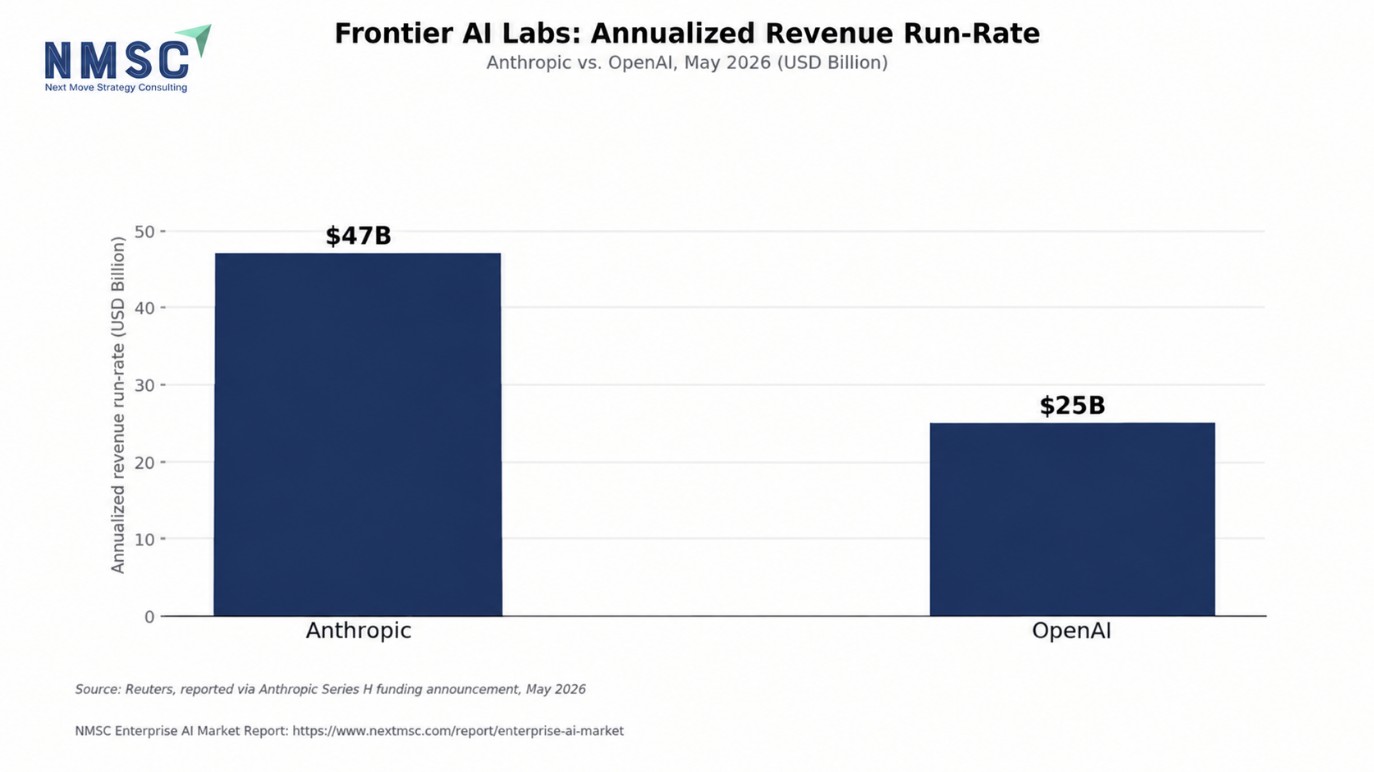
Anthropic PBC and OpenAI, the two leading frontier AI labs, have both converted rapid growth into enterprise-specific infrastructure this year. Anthropic closed a $65 billion Series H round in May 2026 at a $965 billion valuation, with its annualized revenue run-rate reaching $47 billion that same month overtaking OpenAI's roughly $25 billion run-rate, per Reuters. Anthropic filed a confidential S-1 on June 1, 2026, targeting an October 2026 Nasdaq listing, and separately launched a $1.5 billion enterprise AI deployment joint venture in May 2026 with Blackstone and Hellman & Friedman each committing $300 million. Google has committed up to $40 billion to Anthropic, per an April 24, 2026 Reuters report. OpenAI, meanwhile, pursued a parallel enterprise strategy: a February 2026 Frontier Alliances program with BCG, McKinsey, Accenture, and Capgemini; a June 2026 OpenAI Partner Network committing $150 million to help partners deploy its technology, with a goal of certifying 300,000 consultants by year-end; and, in August 2026, a strategic partnership with IBM integrating GPT-5.6, Codex, and ChatGPT Work directly into IBM Consulting Advantage IBM's second such frontier-model alliance after a similar deal with Anthropic roughly a year earlier.
The infrastructure layer underneath both labs has been just as active. Microsoft and OpenAI restructured their partnership on April 27, 2026, ending Azure's exclusivity over OpenAI's models Microsoft keeps its IP license through 2032 and remains a major shareholder, but OpenAI can now sell through other clouds. That opening was set up in part by Amazon, which in February 2026 committed up to $50 billion to OpenAI as part of a $110 billion round valuing the company at roughly $840 billion, with OpenAI committing to spend $100 billion on AWS infrastructure over eight years. Google used its Cloud Next '26 event in April to launch the Gemini Enterprise Agent Platform explicitly replacing its standalone Vertex AI roadmap alongside eighth-generation TPUs and an Agent Gallery of third-party agents from partners including Salesforce, ServiceNow, and Oracle; it followed with the Gemini 3.5 model family at I/O in May.
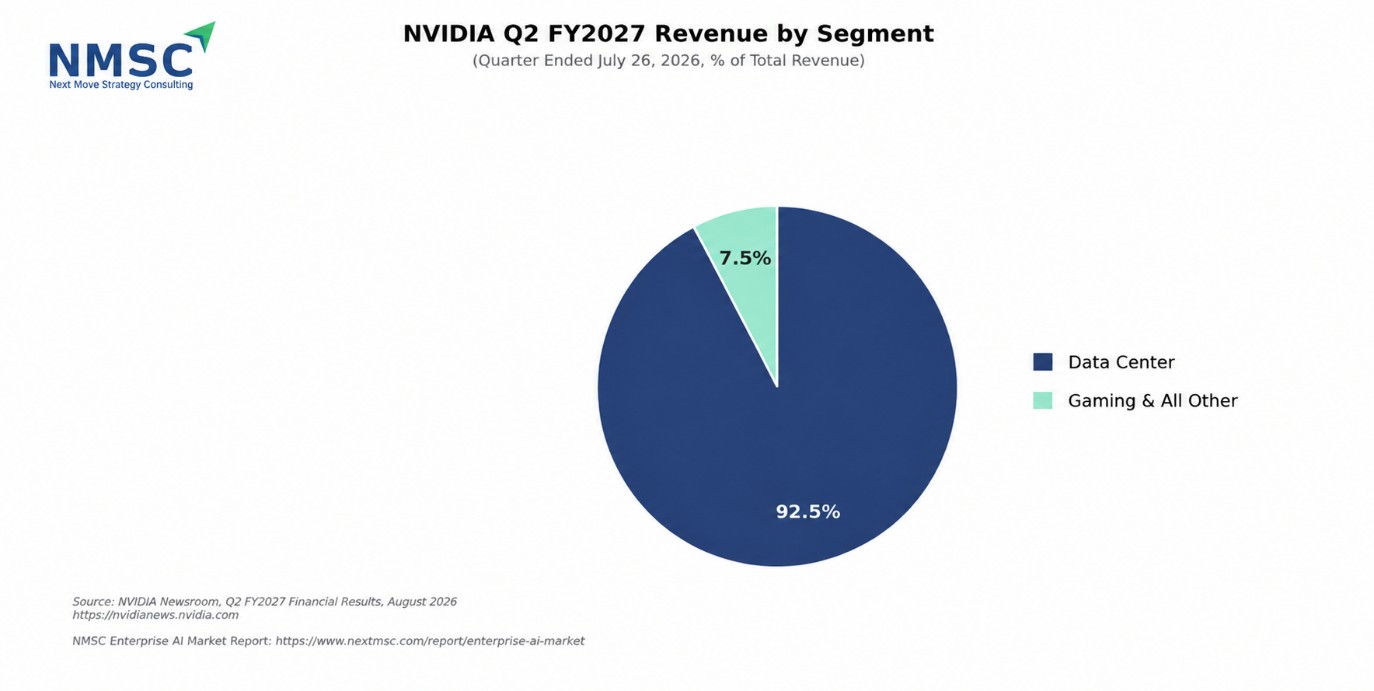
NVIDIA's results show what all of this demand looks like in hardware terms: data center revenue reached roughly $89 billion in its fiscal Q2 2027 (the quarter ended July 26, 2026), up 116.6% year-over-year, as its Blackwell Ultra and Vera Rubin architectures ramp to meet enterprise inference demand.
Section summary: The competition among frontier AI labs and hyperscalers has moved from model quality alone to enterprise go-to-market infrastructure consulting alliances, joint ventures, and multi-cloud distribution deals while NVIDIA's data center growth confirms that the underlying compute buildout shows no sign of slowing.
-
Anthropic's $47 billion ARR (May 2026) overtook OpenAI's roughly $25 billion, per Reuters, following a $65 billion raise at a $965 billion valuation
-
Microsoft and OpenAI ended Azure's exclusivity in April 2026, opening OpenAI's models to AWS and (soon) Google Cloud
-
Amazon's up-to-$50 billion OpenAI investment came with an $100 billion, eight-year AWS spending commitment
-
NVIDIA's data center revenue grew 116.6% year-over-year in its fiscal Q2 2027, reflecting sustained enterprise AI infrastructure demand
Competitive Landscape: Enterprise Software Vendors Race to Embed AI
Below the frontier labs, the enterprise software vendors that already sit inside large organizations' workflows are racing to embed AI agents directly into those systems rather than compete on model quality alone.
Salesforce's Agentforce has become the fastest-growing product in the company's history, reaching $1.4 billion in annualized revenue on 114% growth; its June 2026 Summer '26 release added multi-agent orchestration, and in September 2026 Siemens expanded its Agentforce deployment to qualify inbound leads for 18,000 sellers. SAP used its May 2026 Sapphire conference to unveil “Autonomous Enterprise,” repositioning its ERP business around agents that handle operational work end-to-end, with its Joule assistant now embedded across more than 80 enterprise scenarios. Oracle is pursuing a similar strategy through Fusion Agentic Apps, embedding autonomous agents directly into procurement, finance, and supply chain modules. ServiceNow, meanwhite, has already converted this trend into revenue: its AI business surpassed $1 billion in annual contract value, built around positioning itself as an “AI Control Tower” with built-in governance controls, including a kill switch for agents that misbehave.
Data and analytics vendors are seeing similar momentum. Snowflake signed a $6 billion AWS contract and has traded up sharply in 2026 on AI-driven consumption growth. Palantir Technologies reported Q1 2026 revenue growth of 85% year-over-year (U.S. commercial revenue up 133%), guided to more than $3.224 billion in U.S. commercial revenue for 2026, and has now beaten earnings estimates for eight consecutive quarters; the U.S. Special Operations Command also expanded its Palantir contract during the year. C3.ai's year looked very different: full fiscal-year 2026 revenue came in at $250.27 million, with a steep fourth-quarter decline and a 35% workforce reduction as part of a broader restructuring under returning CEO Thomas Siebel even as the company expanded its Shell partnership in June 2026 to cover agent-based asset reliability and landed new U.S. Department of Agriculture and Department of Energy contracts.
Infrastructure and hardware vendors are adapting too. Hewlett Packard Enterprise used its June 2026 Discover conference to extend its NVIDIA-based “AI Factory” with new GreenLake Intelligence governance tools including a registry that tracks every AI agent an organization has deployed and a copilot that tracks token costs across vendors. IBM, alongside its OpenAI deal noted above, continued expanding its watsonx.governance platform to help enterprises document model lineage and monitor AI behavior against internal risk policies. Intel, for its part, expanded a collaboration with Google Cloud in mid-2026 to deploy Gemini Enterprise internally across its own core business functions notable as much for Intel adopting enterprise AI as a customer as for its chip business.
Section summary: Enterprise software incumbents are converting existing customer relationships into AI revenue faster than most new entrants can, while data and infrastructure vendors show a wide spread of outcomes from Palantir's sustained growth to C3.ai's restructuring that underscores how uneven enterprise AI monetization still is.
-
Salesforce's Agentforce reached $1.4 billion in ARR on 114% growth, the fastest-growing product in company history
-
ServiceNow's AI business passed $1 billion in annual contract value; SAP and Oracle are both repositioning their ERP suites around autonomous agents
-
Palantir posted eight consecutive earnings beats and 85% Q1 2026 revenue growth, while C3.ai cut headcount by 35% amid a steep revenue decline
-
HPE and IBM are both building AI governance tooling agent registries, cost tracking, and model lineage as a distinct product category
Where Enterprises Are Actually Putting AI to Work
Strategy decks aside, most of this spending lands in a handful of concrete business functions.
Customer Service
AI-powered chatbots and virtual agents now handle round-the-clock, multilingual customer support, resolving routine queries and freeing human agents for complex cases a major driver behind the roughly 21% of enterprise AI spend NMSC attributes to customer support and experience applications.
Marketing
AI helps marketing teams analyze audience data, personalize campaigns, optimize paid ad spend in real time, and monitor social sentiment. This is also where generative AI marketing platforms have matured fastest covered in more detail below.
Cybersecurity
AI-powered detection systems identify malware and phishing patterns and flag anomalous network activity before it becomes a breach, while AI-driven biometric authentication adds another identity-verification layer.
Sales
AI automates lead generation, customer segmentation, and prospecting, and increasingly powers dynamic, real-time pricing models built on predictive analysis of past customer behavior.
Human Resources
AI now touches recruiting, candidate screening, interview scheduling, and onboarding, and increasingly consolidates these processes into a single platform rather than a patchwork of spreadsheets. Tools such as SenseHR combine these workflows with core HR functions, giving HR teams real-time visibility into workforce data and reducing the manual errors that come from disconnected systems.
Supply Chain Management
AI forecasts demand to avoid stockouts, optimizes delivery routing, and supports predictive maintenance that flags equipment failures before they cause costly downtime.
Accounting, Finance, and Risk
AI-powered accounting software now automates invoicing, expense reporting, and payroll, while also supporting financial planning, fraud detection, and compliance automation. Risk assessment in particular has become a distinct AI use case in its own right resources like Vanta's guide to working backwards from the controls reflect a broader shift toward building risk and compliance programs around the specific controls regulators and auditors will actually check, rather than generic checklists.
The Specialist Layer: Language AI, Marketing AI, and MLOps
Alongside the frontier labs and platform vendors, a smaller set of specialist companies is shaping specific corners of the enterprise AI stack.
DeepL, the German language-AI company, expanded its enterprise distribution by launching on AWS Marketplace and releasing a real-time Voice API for transcription and translation in February 2026, and acquired Mixhalo in June 2026. Jasper AI released its 2026 State of AI in Marketing report in January based on a survey of 1,400 marketers, it found 91% now use AI in their work, up from 63% a year earlier and in June launched an end-to-end “GEO Agent” that autonomously monitors and optimizes how a brand appears across AI-powered search and discovery tools; the company strengthened its executive team with a new CMO and CFO in August. Persado has spent 2026 repositioning around agentic AI for regulated industries, extending its compliance-aware generative content platform already used by a majority of the largest U.S. banks into an “agentic creative agency” model built for financial-services marketing constraints. Domino Data Lab unified its experimentation, evaluation, deployment, and monitoring tools into a single governed workflow for agentic AI applications in February 2026, and used its June REV conference to detail work moving open-source AI models into regulated production environments for pharmaceutical clients.
Future Outlook: Where the Enterprise AI Market Goes from Here
According to NMSC's proprietary research, the Enterprise AI Market is projected to grow from USD 46.51 billion in 2026 to USD 252.86 billion by 2035, a 20.7% compound annual growth rate an absolute dollar opportunity of more than USD 200 billion over the forecast period. Growth is broad-based: NMSC's analysis points to rising generative and agentic AI adoption, expanding hyperscale cloud infrastructure investment, and growing small and medium-sized business adoption via cloud marketplaces as the largest contributors to that growth, partially offset by data-privacy and AI-regulation compliance costs and a persistent shortage of skilled AI implementation talent.
Regionally, North America is expected to remain the largest market through the forecast period, but Asia-Pacific is projected to grow fastest at a 25.0% CAGR, with India the single fastest-growing country covered in the report at roughly 29.8%. By industry, healthcare is projected to grow fastest among verticals as providers adopt AI for clinical documentation, diagnostics, and administrative automation detailed in the table below alongside the market's other major verticals.
Enterprise AI Market size by industry vertical, 2025–2035.
|
Industry Vertical |
2025 (USD) |
2035 (USD) |
CAGR % (2026–2035) |
|
Manufacturing |
$5.39 Billion |
$37.93 Billion |
21.6% |
|
Media & Advertising |
$3.47 Billion |
$20.23 Billion |
19.1% |
|
BFSI |
$8.48 Billion |
$50.57 Billion |
19.4% |
|
IT & Telecom |
$7.32 Billion |
$42.99 Billion |
19.2% |
|
Retail |
$5.01 Billion |
$32.87 Billion |
20.7% |
|
Healthcare |
$5.39 Billion |
$42.99 Billion |
23.3% |
|
Automotive & Transportation |
$2.31 Billion |
$17.70 Billion |
22.8% |
|
Others |
$1.16 Billion |
$7.59 Billion |
20.7% |
|
Total |
$38.53 Billion |
$252.86 Billion |
20.7% |
Table 2: Enterprise AI Market report snapshot.
|
Parameter |
Detail |
|
Market Size in 2025 |
USD 38.53 Billion |
|
Market Size in 2026 |
USD 46.51 Billion |
|
Revenue Forecast in 2035 |
USD 252.86 Billion |
|
Growth Rate |
CAGR of 20.7% from 2026 to 2035 |
|
Companies Profiled |
20 |
|
Countries Covered |
38 |
|
Dominant Region |
North America (~42% share, 2025) |
|
Fastest-Growing Region |
Asia-Pacific (25.0% CAGR) |
Section summary: The long-term case for the enterprise AI market rests on structural rather than cyclical drivers, and those drivers point toward continued, broad-based growth through 2035 even as regulatory compliance costs and talent shortages remain real constraints on how fast individual enterprises can move.
-
NMSC projects the market will grow more than fivefold, from $46.51 billion in 2026 to $252.86 billion by 2035
-
Asia-Pacific (25.0% CAGR) and India (29.8% CAGR) are projected to grow fastest among regions and countries, respectively
-
Healthcare is the fastest-growing industry vertical at a 23.3% CAGR, as providers scale AI beyond pilots into core clinical workflows
Conclusion
The enterprise AI market's growth in 2026 hasn't been about any single breakthrough it’s been the compounding effect of frontier labs building real enterprise go-to-market infrastructure, established software vendors embedding agents into systems businesses already run on, and specialist vendors sharpening tools for specific functions like marketing, translation, and MLOps. For business leaders, the practical takeaway from the seven use cases above hasn't changed: start with a clear pain point, choose tools that fit your existing workflow and governance requirements, and expect implementation not model selection to be the hard part.
Download Free Sample of NMSC's full Enterprise AI Market report for detailed segment-level forecasts, regional breakdowns, and competitive benchmarking through 2035.
About the Author
 Sanyukta Deb
— Sanyukta Deb is Digital Marketing Team Lead at Next Move Strategy Consulting, where she has led content strategy and technical SEO for the firm's B2B market research publications for over 2 years. Her editorial process translates NextMSC's primary and secondary research — spanning technology, industrial, and consumer sectors — into commercial narratives, backed by search-intent, keyword, and competitive analysis. She brings 5 years of overall experience in digital marketing and content strategy.
Sanyukta Deb
— Sanyukta Deb is Digital Marketing Team Lead at Next Move Strategy Consulting, where she has led content strategy and technical SEO for the firm's B2B market research publications for over 2 years. Her editorial process translates NextMSC's primary and secondary research — spanning technology, industrial, and consumer sectors — into commercial narratives, backed by search-intent, keyword, and competitive analysis. She brings 5 years of overall experience in digital marketing and content strategy.
About the Reviewer
 Debashree Dey
— Debashree Dey is Assistant Manager at Next Move Strategy Consulting, where she supports cross-vertical market content and communications across diverse industries for 6 years. Her professional background includes senior content writing, communications, and published manuscript authorship, with experience developing audience-focused business narratives and maintaining clear, consistent messaging. Her role supports research-led content development and editorial quality across NextMSC publications.
Debashree Dey
— Debashree Dey is Assistant Manager at Next Move Strategy Consulting, where she supports cross-vertical market content and communications across diverse industries for 6 years. Her professional background includes senior content writing, communications, and published manuscript authorship, with experience developing audience-focused business narratives and maintaining clear, consistent messaging. Her role supports research-led content development and editorial quality across NextMSC publications.


















Add Comment