A Data Center Colocation Market Moving Toward AI-Ready, Power-Intensive Infrastructure

The Data Center Colocation Market is entering a new phase of expansion as artificial intelligence (AI), cloud computing, enterprise digital transformation, and data-intensive applications increase demand for scalable, interconnected computing infrastructure. Based on the market estimates supplied for this analysis, the market was valued at USD 129.69 billion in 2025 and is estimated at USD 153.34 billion in 2026, forecast to reach USD 396.69 billion by 2035, expanding at a CAGR of 11.14% from 2026 to 2035. This growth trajectory reflects increasing demand for outsourced data center capacity, enterprise IT infrastructure, cloud connectivity, secure data storage, and facilities designed to accommodate high-density computing workloads.
The competitive landscape is shaped by specialized colocation operators that provide physical infrastructure for enterprises, cloud platforms, network providers, and hyperscale customers. Equinix emphasizes interconnection and carrier-neutral facilities, while Digital Realty combines colocation with hyperscale development through its PlatformDIGITAL platform. NTT DATA operates a global data center network supporting enterprise and cloud workloads, whereas CyrusOne and QTS focus substantially on large-scale campus development and hyperscale infrastructure. Competition increasingly depends on access to electricity, development-ready land, resilient power systems, advanced cooling, network connectivity, and the ability to deliver capacity within customer deployment timelines.
Want Insights on the Data Center Colocation Market? Access a FREE Sample Instantly
Key Takeaway
The competitive landscape of the Data Center Colocation Market is increasingly shaped by infrastructure scale, power availability, AI-related capacity requirements, and geographic expansion. Equinix is extending its international footprint and developing AI-ready facilities that support interconnected digital ecosystems. Digital Realty is expanding its hyperscale development pipeline while strengthening its colocation and connectivity platform. NTT DATA is investing in new development sites across strategic global markets, while CyrusOne is securing power infrastructure to accelerate hyperscale campus deployment. QTS is advancing major data center campuses in the United States, supported by long-term infrastructure investment.
These strategies illustrate the different ways colocation providers are responding to rising demand for digital infrastructure. Interconnection-focused operators compete through network density, customer ecosystems, and access to multiple cloud providers, while hyperscale-oriented developers emphasize power capacity, land availability, construction scale, and deployment speed. The market's next phase of competition will depend on how effectively companies coordinate facility development, electricity supply, cooling systems, connectivity, and customer requirements as AI and cloud workloads expand.
Equinix, Inc.
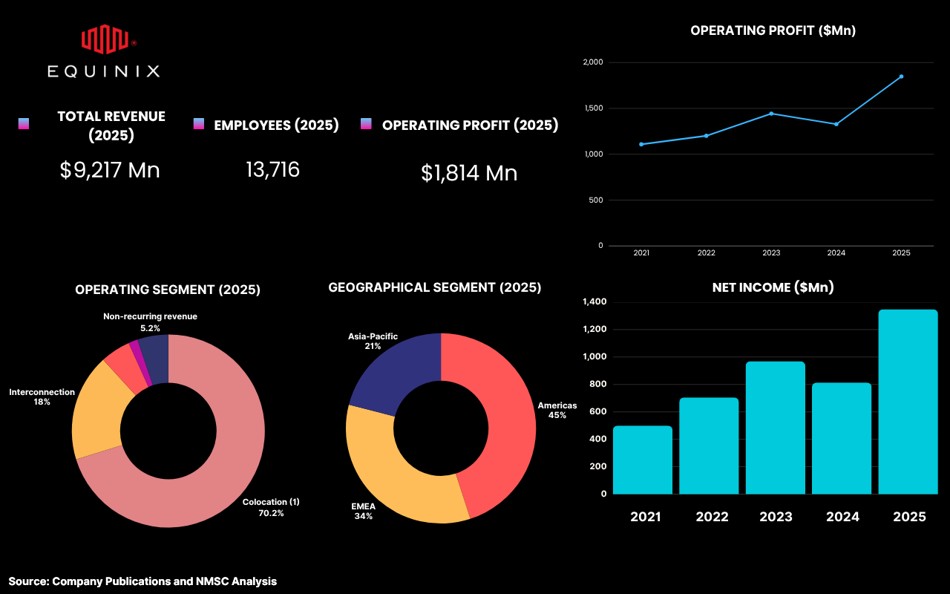
Equinix, Inc. operates a global digital infrastructure platform that provides colocation, interconnection, and connectivity services to enterprises, cloud providers, network operators, and digital service companies. Its International Business Exchange (IBX) facilities enable customers to deploy IT infrastructure close to cloud platforms, business partners, and network ecosystems. The company's strategy combines retail colocation with hyperscale infrastructure through its xScale portfolio, serving customers with different capacity and connectivity requirements.
Equinix continued expanding its AI-ready infrastructure in September 2025 with the opening of its first International Business Exchange data center in Chennai, India. The company announced an initial investment of USD 69 million in the CN1 facility, which provides 800 cabinets in its first phase and is designed to accommodate 4,250 cabinets when fully built. The facility supports liquid cooling and provides interconnection services, extending the company's Indian footprint beyond its existing Mumbai campus. Equinix reported that its global portfolio comprised more than 270 data centers across 77 markets in 36 countries at the time of the announcement.
Equinix also advanced its global AI infrastructure strategy in June 2026 through a collaboration with Cisco and NVIDIA to deploy secure AI factories across its global data center footprint. The initiative connects Equinix's facilities and interconnection capabilities with technologies designed to support enterprise AI infrastructure. This development complements the company's colocation business by addressing customers' requirements for secure, interconnected environments to deploy AI workloads across distributed locations.
These developments highlight Equinix's approach to the Data Center Colocation Market. Rather than competing solely on installed capacity, the company emphasizes interconnection, hybrid multicloud access, and facilities capable of accommodating demanding computing workloads. Its strategy connects physical infrastructure with the broader digital ecosystem that customers use to deploy enterprise applications and AI services.
NMSC's market assessment finds that Equinix's competitive position is closely linked to the value of interconnected infrastructure. As organizations distribute workloads across private environments, public clouds, and AI platforms, access to multiple service providers within connected facilities becomes an important consideration. Equinix's combination of colocation, interconnection, and AI-ready infrastructure supports its positioning in markets where connectivity and deployment flexibility are central customer requirements.
Digital Realty Trust, Inc.
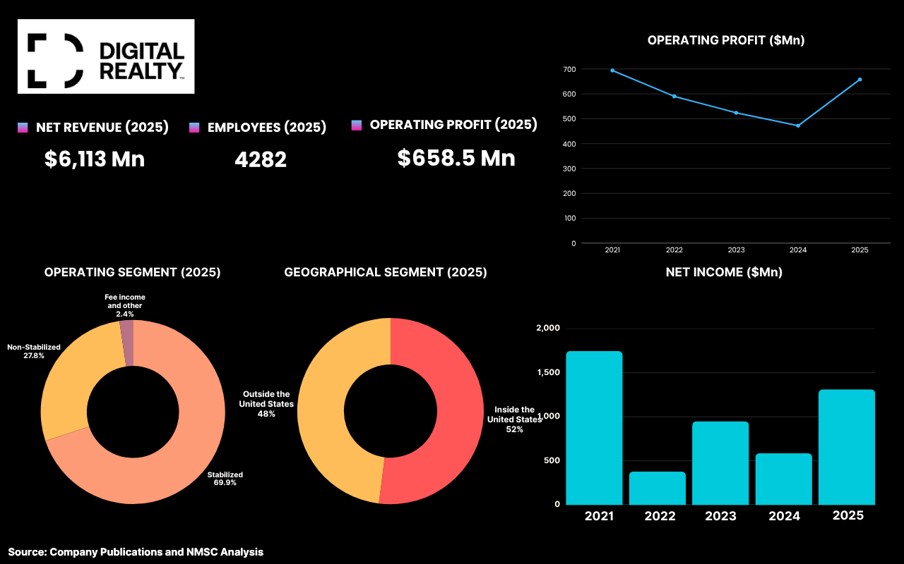
Digital Realty Trust, Inc. provides data center colocation, interconnection, and hyperscale infrastructure through its PlatformDIGITAL platform. The company serves enterprises, cloud service providers, network operators, and large technology customers requiring secure, scalable infrastructure across major digital markets. Its strategy combines enterprise-oriented colocation with large-scale data center development, enabling customers to connect distributed IT environments while expanding computing capacity.
In August 2025, Digital Realty broke ground on its first data center in Rome, Italy. The ROM1 facility was designed to support AI technologies and provide access to regional and international connectivity providers. The company announced that the facility would offer more than 3 MW of installed IT capacity upon completion, with the broader 22-hectare site providing room for future expansion. The development also incorporates connectivity opportunities associated with subsea cable systems linking Europe, Africa, the Middle East, and Asia.
Digital Realty expanded its development strategy in June 2026 by acquiring approximately 1,440 acres at Astra Enterprise Park near Kansas City for hyperscale data center development. The company stated that the site could support up to 2 GW of utility power. The announcement formed part of a broader set of transactions intended to expand hyperscale development capacity and strengthen its colocation and connectivity portfolio.
These developments demonstrate how Digital Realty is pursuing growth through both regional connectivity hubs and large-scale hyperscale sites. Its Rome investment addresses the importance of network access and geographic positioning, while the Kansas City acquisition reflects the increasing emphasis on securing suitable land and power infrastructure for future capacity. Together, these investments support a portfolio serving customers with different requirements for scale, location, and interconnection.
NMSC's evaluation finds that Digital Realty's competitive positioning reflects the growing convergence of colocation and hyperscale infrastructure. Customers require facilities that provide both access to digital ecosystems and the capacity to accommodate substantial computing workloads. Digital Realty's development pipeline and interconnected platform provide a basis for serving these needs, although the timing and scale of future growth remain dependent on project execution, power availability, and customer demand.
NTT DATA Group Corporation
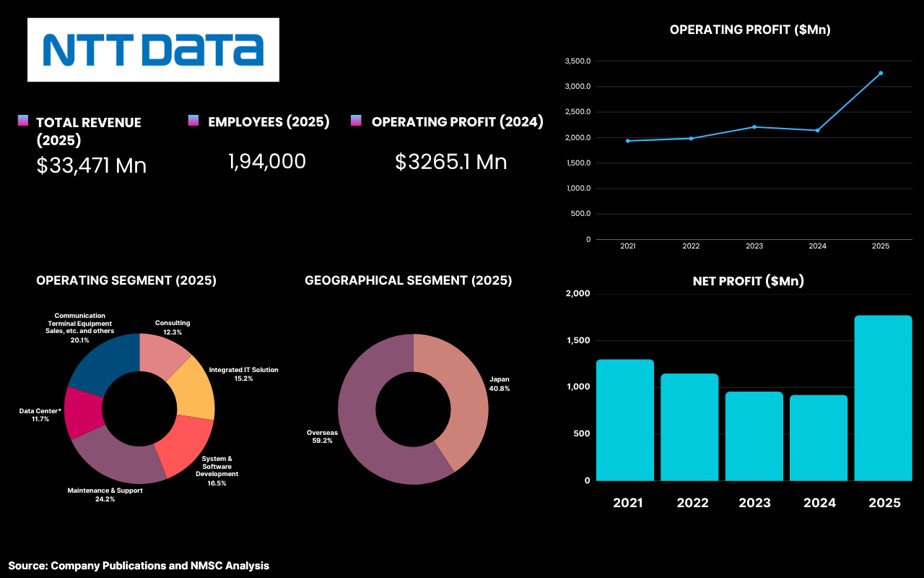
NTT DATA Group Corporation is a global IT services and digital infrastructure provider with operations spanning consulting, cloud, enterprise technology, connectivity, and data centers. Through NTT Global Data Centers, the company operates facilities serving hyperscalers, enterprises, and multinational organizations. Its colocation business provides physical infrastructure for customers that require secure, resilient, and geographically distributed environments without independently developing and operating every facility.
In May 2025, NTT DATA announced land acquisitions across seven strategic markets in North America, Europe, and Asia to support nearly 1 GW of planned future data center capacity. The expansion formed part of the company's previously announced USD 10 billion investment program to grow its data center business through 2027. The initiative reflects an approach based on securing development sites ahead of anticipated demand, particularly in markets where cloud computing and AI workloads are increasing infrastructure requirements.
NTT DATA's broader expansion program also includes investments in AI-ready facilities and high-capacity campuses. In January 2025, the company reported that its Global Data Centers division had opened 10 new data centers during 2024, adding more than 370 MW of capacity. It also highlighted a planned development in Johor Bahru, Malaysia, expected to provide approximately 290 MW of capacity, incorporating technologies such as direct liquid cooling. These developments illustrate the company's emphasis on expanding its physical infrastructure base while preparing facilities for increasingly demanding workloads.
NTT DATA's strategy highlights the importance of combining geographic expansion with infrastructure capabilities that address changing customer requirements. Large development sites support future capacity additions, while cooling technologies and resilient facility designs help accommodate workloads with demanding power and thermal requirements. Its global operating model also serves customers seeking consistent infrastructure services across multiple regions.
NMSC's analysis indicates that NTT DATA's competitive position is supported by its combination of global data center operations and enterprise technology expertise. Its investment program addresses the need for additional physical capacity while allowing multinational customers to access infrastructure across strategic markets. The company's ability to convert planned sites into operational capacity will remain important as power constraints, construction timelines, and customer requirements influence market expansion.
CyrusOne, Inc.
CyrusOne, Inc. develops and operates data centers serving hyperscale cloud providers and enterprise customers. The company emphasizes large-scale facilities, power availability, and campus development to accommodate customers with substantial computing and storage requirements. Its business model is closely linked to the ability to secure suitable sites and supporting infrastructure before bringing new data center capacity online.
In July 2025, CyrusOne and Calpine announced a collaboration to develop a new hyperscale data center facility in Texas. The announcement established a framework for combining data center development with energy infrastructure, addressing the electricity requirements associated with large computing campuses. The collaboration reflects the growing importance of coordinating site development and power supply as customers seek to deploy larger workloads.
CyrusOne advanced this strategy in January 2026 through an agreement with Eolian to accelerate deployment at its DFW7 data center campus in Fort Worth, Texas. The project was designed to enable rapid development of a 200 MW campus by leveraging existing high-voltage transmission infrastructure and adjacent substation capacity. In February 2026, Constellation also announced a separate 380 MW agreement to support a new CyrusOne data center adjacent to the Freestone Energy Center in Texas, with an exclusive agreement covering a further 380 MW for a potential second phase.
These developments illustrate the importance of power infrastructure in CyrusOne's growth strategy. For hyperscale customers, the availability of electricity and grid connections directly influences deployment schedules and the scale of facilities that can be developed. Partnerships involving energy providers and infrastructure developers help coordinate these requirements, although the final delivery of capacity remains subject to project execution and applicable approvals.
NMSC's market assessment finds that CyrusOne's competitive position is closely connected to its ability to align campus development with reliable power access. As AI and cloud workloads increase the need for high-capacity facilities, power infrastructure becomes a key consideration alongside land availability, cooling, and network connectivity. CyrusOne's development partnerships demonstrate how colocation providers are coordinating infrastructure investments to address the operational requirements of hyperscale customers.
QTS Realty Trust, LLC
QTS Realty Trust, LLC operates as QTS Data Centers, a Blackstone portfolio company that develops and operates data center infrastructure for hyperscale technology companies, enterprises, and government customers. The company emphasizes large-scale campus development, scalable infrastructure, and operational services for customers requiring substantial capacity. Its strategy also incorporates community engagement and infrastructure planning as data center development expands into new markets.
In August 2025, QTS announced a new data center campus in Cedar Rapids, Iowa, with a planned investment of USD 10 billion. The company described the project as a major economic development initiative for the region. The announcement highlighted the growing scale of investment associated with new data center campuses and the importance of local infrastructure, workforce availability, and long-term site development.
QTS continued expanding its development pipeline in 2026. In May, the company and the City of Van Wert announced plans for a data center campus in northwest Ohio, with approximately USD 10 billion in expected capital investment. The announcement projected more than 1,500 construction jobs and approximately 200 full-time QTS positions. In July 2026, QTS and Lancium announced another campus planned for Hall County, Texas, with more than USD 10 billion in expected capital investment. QTS is responsible for designing, building, and operating the data center buildings at the proposed development.
QTS's expansion strategy reflects the increasing importance of large campuses designed to accommodate future digital infrastructure demand. Such developments require coordinated planning for electricity, construction, connectivity, cooling, and community infrastructure. The company's investments also demonstrate that data center development is becoming an important regional infrastructure activity, with economic and operational considerations extending beyond the facility itself.
NMSC's evaluation finds that QTS is positioned to participate in the expansion of hyperscale colocation infrastructure through its focus on large-scale campus development. Its announced projects reflect the importance of securing suitable locations and coordinating supporting infrastructure as capacity requirements rise. The commercial contribution of these projects will depend on execution, infrastructure readiness, and the conversion of planned developments into operational capacity.
Band Title: Understand the Competitive Structure of the Data Center Colocation Market
Band Subline: Access market sizing, segment-level forecasts, regional analysis, competitive positioning, market shares, and strategic insights across the global Data Center Colocation Market.
Band Button: Download Free Sample
The Changing Landscape of Data Center Colocation
The Data Center Colocation Market is moving toward infrastructure designed to accommodate growing cloud adoption, enterprise workloads, AI computing, and increasingly interconnected digital services. Providers are expanding existing facilities and developing new campuses to address demand for scalable computing capacity. At the same time, power availability, advanced cooling, connectivity, and site readiness are becoming central considerations in infrastructure planning. These requirements are influencing both the location of new developments and the investment models used to bring capacity online.
The competitive landscape reflects distinct but complementary strategies. Equinix is combining global interconnection capabilities with AI-ready facilities and enterprise infrastructure. Digital Realty is expanding its hyperscale development pipeline while strengthening its colocation and connectivity platform. NTT DATA is securing new development sites across strategic markets, while CyrusOne is coordinating campus expansion with power infrastructure. QTS is advancing large-scale developments across the United States. Together, these strategies illustrate how location, power, capacity, and connectivity are becoming increasingly interconnected in the colocation business.
NMSC's assessment indicates that the next phase of competition will depend on providers' ability to deliver infrastructure that aligns with customer requirements and local resource availability. Operators with strong development pipelines, reliable power access, effective facility management, and connectivity ecosystems will be better positioned to address demand for outsourced digital infrastructure. As the market moves toward its projected value of USD 396.69 billion by 2035, execution capacity and infrastructure readiness will remain important determinants of competitive positioning.
About the Author
 Mayurima Roy
— Mayurima Roy is Research Analyst at Next Move Strategy Consulting, where she has spent 4 years working across the firm's full industry coverage rather than a single fixed vertical. Her work centers on structured research, ongoing trend tracking, competitive assessment, and insight-led content development, translating complex market data into clear, decision-ready narratives that support informed client decision-making across diverse global industries, market sectors, and world regions every day.
About the Reviewer
 Supradip Baul
— Supradip Baul is an accomplished business consultant and strategist with over a decade of rich experience in market intelligence, strategy, technology, and business transformation. His work has included rigorous qualitative and quantitative analysis across multiple industries, helping clients shape investment decisions and long-term roadmaps. Earlier in his career, he was associated with Gartner, where he contributed to industry-leading reports and market share analyses. He has worked with leading global companies and holds an MBA with a dual specialization in Marketing and Finance.











Add Comment