A Data Center Market Moving from Cloud Expansion to AI-Scale Infrastructure
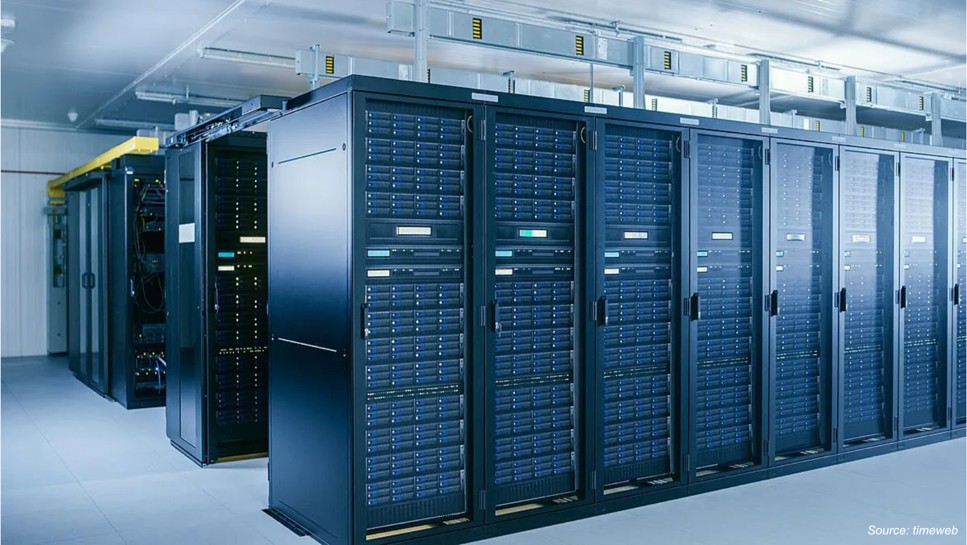
The Data Center Market is entering a new phase of expansion as hyperscale cloud adoption, enterprise digital transformation, artificial intelligence (AI), and data-intensive applications increase demand for scalable computing infrastructure. According to NMSC analysis, the global Data Center Market was valued at USD 419.42 billion in 2025 and is estimated at USD 495.90 billion in 2026, projected to reach USD 1,282.86 billion by 2035, expanding at a CAGR of 11.14% from 2026 to 2035. This growth trajectory reflects increasing demand for compute capacity, cloud hosting, enterprise workloads, data storage, high-speed connectivity, and facilities designed for increasingly intensive AI workloads.
The competitive landscape spans different but interconnected business models. Hyperscale cloud providers, including AWS, Microsoft Azure, Google Cloud, and Oracle Cloud Infrastructure (OCI), are expanding their data center capacity to deliver cloud computing and AI services. Data center operators such as NTT DATA provide physical infrastructure and colocation capabilities for enterprises, hyperscalers, and multinational organizations. Competition increasingly depends on access to power, suitable locations, cooling technologies, resilient connectivity, infrastructure efficiency, and the ability to bring new capacity online in line with customer demand.
Want Insights on the Data Center Market? Access a FREE Sample Instantly
Key Takeaway
The competitive landscape of the Data Center Market is increasingly shaped by scale, infrastructure investment, AI workloads, and geographic expansion. AWS is extending its data center footprint through large-scale campus development and specialized AI infrastructure. Microsoft is combining hyperscale facilities with custom-designed AI computing systems. Google is expanding data center capacity alongside connectivity and energy investments. Oracle is directing substantial financing toward Oracle Cloud Infrastructure and large AI-oriented campuses, while NTT DATA is strengthening its position as a global data center operator through facility expansion and infrastructure services.
These strategies highlight the different ways providers are capturing demand. Cloud platforms compete through computing capacity, service availability, and integrated AI infrastructure, while data center operators provide the physical facilities, power resilience, cooling, and connectivity that underpin digital services. Their investment decisions are increasingly interconnected as AI and cloud workloads place greater demands on data center design and operating capacity.
Amazon Web Services (AWS)
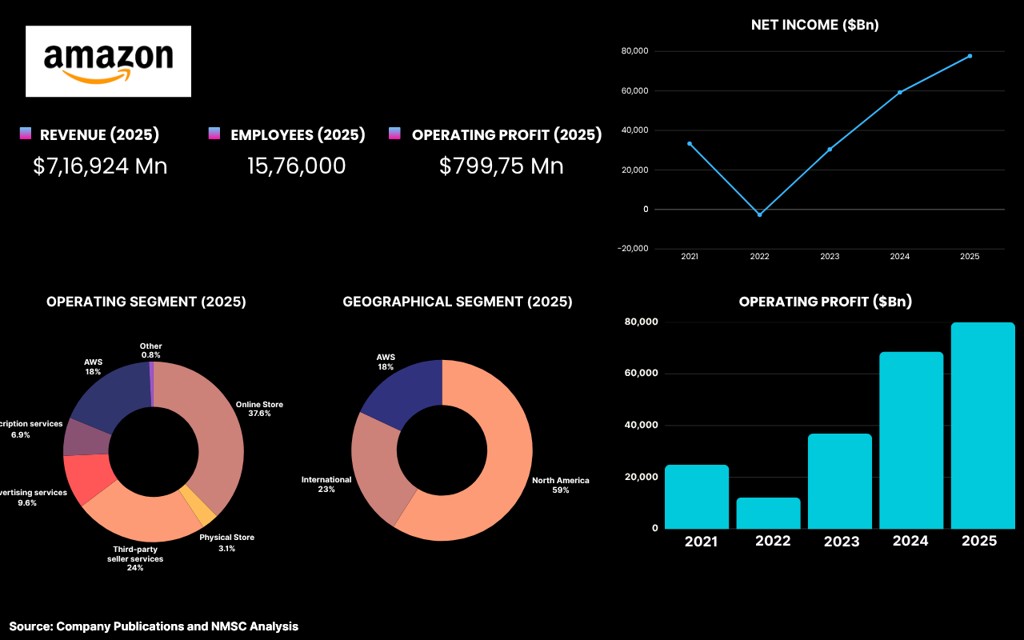
Amazon Web Services (AWS), the cloud computing business of Amazon, provides computing, storage, networking, databases, and AI services through its global infrastructure. Its data center strategy combines large-scale facility development with cloud platforms and purpose-built computing technologies. AWS serves enterprises, public-sector organizations, and technology companies that require scalable infrastructure for cloud applications, AI development, data processing, and high-performance computing.
AWS's recent investments demonstrate the increasing scale of infrastructure required to support specialized workloads. In November 2025, Amazon announced plans to invest up to USD 50 billion to expand AI and high-performance computing infrastructure for U.S. government customers. The investment was expected to add nearly 1.3 gigawatts of compute capacity across AWS Top Secret, AWS Secret, and AWS GovCloud (US) regions, with construction activity expected to begin in 2026. The initiative targets government workloads requiring advanced computing capabilities and stringent security and compliance controls.
AWS's physical infrastructure expansion continued in 2026. In August 2026, Amazon increased its planned investment in northwest Louisiana from USD 12 billion to USD 18 billion, incorporating a third data center campus into the regional development plan. The three planned campuses are being developed in partnership with STACK Infrastructure. Amazon also stated that it would fund the energy infrastructure and grid upgrades required to serve its facilities, rather than pass those infrastructure costs to local ratepayers.
These developments highlight AWS's approach to the Data Center Market. Rather than relying solely on the expansion of general-purpose cloud capacity, the company is investing in infrastructure tailored to specific customer requirements, including AI computing and government workloads. Its ability to combine data center facilities, cloud services, networking, and computing technologies supports an integrated infrastructure model in which physical capacity expansion is directly linked to demand for digital services.
NMSC’s market assessment finds that AWS's strategic position reflects the growing importance of infrastructure scale and deployment capacity. As customers increase their consumption of AI and cloud services, investments in facilities, energy supply, and specialized computing infrastructure are becoming central to maintaining service availability and supporting future demand.
Microsoft Corporation

Microsoft Corporation operates Microsoft Azure, a global cloud computing platform supporting enterprise applications, data storage, analytics, AI, and high-performance computing. Its data center strategy combines large-scale facility development with investments in computing systems designed to improve AI workload performance and infrastructure utilization. This positions Microsoft across both the physical infrastructure and cloud-service layers of the Data Center Market.
In June 2026, Microsoft announced plans for a new data center campus in Pecos, Texas, expected to expand its global data center capacity by approximately 2 gigawatts. The multibillion-dollar investment is intended to address demand for AI and cloud services across industries and regions. Microsoft also stated that construction activity could support more than 6,000 jobs at peak build-out. The project illustrates the scale of physical infrastructure required as AI workloads become an increasingly important source of cloud capacity demand.
Microsoft is also developing its own AI computing systems to complement its data center investments. In an announcement dated October 12, 2026, the company stated that its Azure Maia family would expand to multi-gigawatt deployments beginning in 2027. Microsoft reported that Maia 200 was already serving production workloads, including Microsoft Copilot, while Maia 300 was scheduled to enter production deployment in 2027. The company also described a Maia 300 rack configuration featuring 96 accelerators, designed to increase computing throughput and improve infrastructure efficiency for AI inference.
Microsoft's strategy connects physical data center capacity with the design of computing hardware and cloud services. The company's focus on its own AI systems enables closer coordination between chips, networking, software, and facility requirements. This matters as AI applications place increasing demands on rack-level power delivery, heat management, data movement, and efficient use of installed computing capacity.
NMSC’s evaluation finds that Microsoft's competitive position is increasingly tied to its ability to scale data center capacity while improving the performance and utilization of the systems deployed within those facilities. Its strategy demonstrates how hyperscale operators are coordinating infrastructure investment and computing-system development to support the next phase of cloud and AI adoption.
Google LLC (Alphabet)
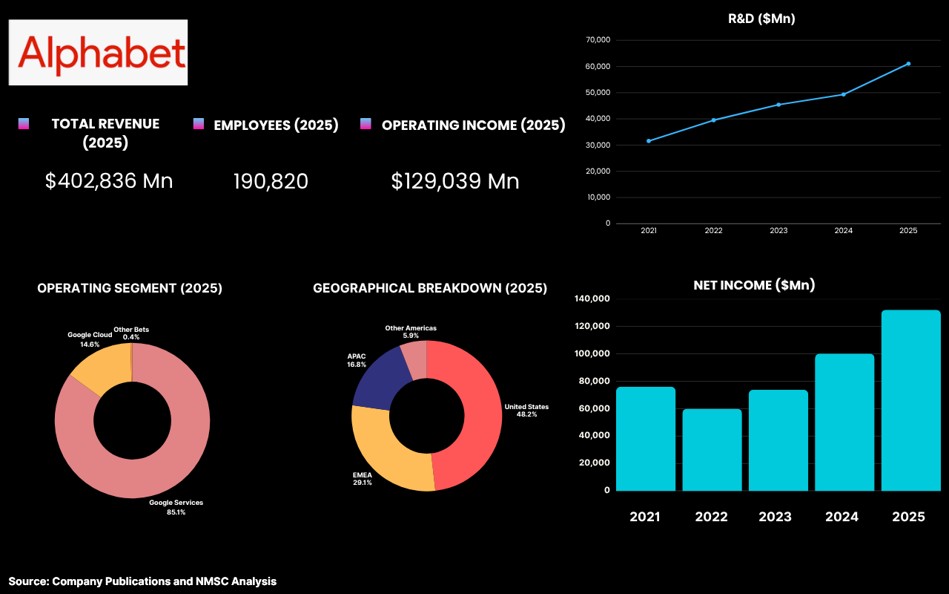
Google LLC, part of Alphabet Inc., operates Google Cloud and the digital infrastructure supporting services such as Search, Maps, and Gemini. Its data center strategy combines computing capacity, global connectivity, and energy infrastructure. As cloud and AI demand increases, Google is expanding facilities in strategic markets while investing in supporting infrastructure intended to strengthen network resilience and long-term capacity availability.
In September 2026, Google announced approximately USD 14.56 billion investment in Finland over the following two years, covering digital infrastructure, clean-energy projects, and local partnerships. The investment represents a major expansion of Google's commitment to the country, which already hosts its Hamina data center. Google linked the investment to growing demand for services including Search, Maps, and Gemini and highlighted the importance of energy infrastructure and clean-energy supply as its digital infrastructure expands.
Google's AI infrastructure strategy also includes a major development in India. In October 2025, Google announced an investment of approximately USD 15 billion over five years, covering 2026–2030, to establish an AI hub in Visakhapatnam, Andhra Pradesh. The initiative includes gigawatt-scale computing capacity and a new international subsea gateway intended to strengthen global connectivity. The project links data center development with network infrastructure to support AI services, enterprises, and digital ecosystems.
Google's strategy demonstrates that data center expansion requires more than additional buildings and computing equipment. AI workloads increase demand for reliable electricity, fiber connectivity, and infrastructure capable of supporting large-scale data movement. Investments in subsea cables, energy projects, and data center campuses therefore form interconnected components of the company's infrastructure strategy.
Based on NMSC's analysis, Google is strengthening its position through coordinated investment in computing capacity, connectivity, and energy infrastructure. Its developments show how hyperscale providers are treating the wider infrastructure ecosystem as a strategic consideration when expanding AI and cloud operations.
Oracle Corporation
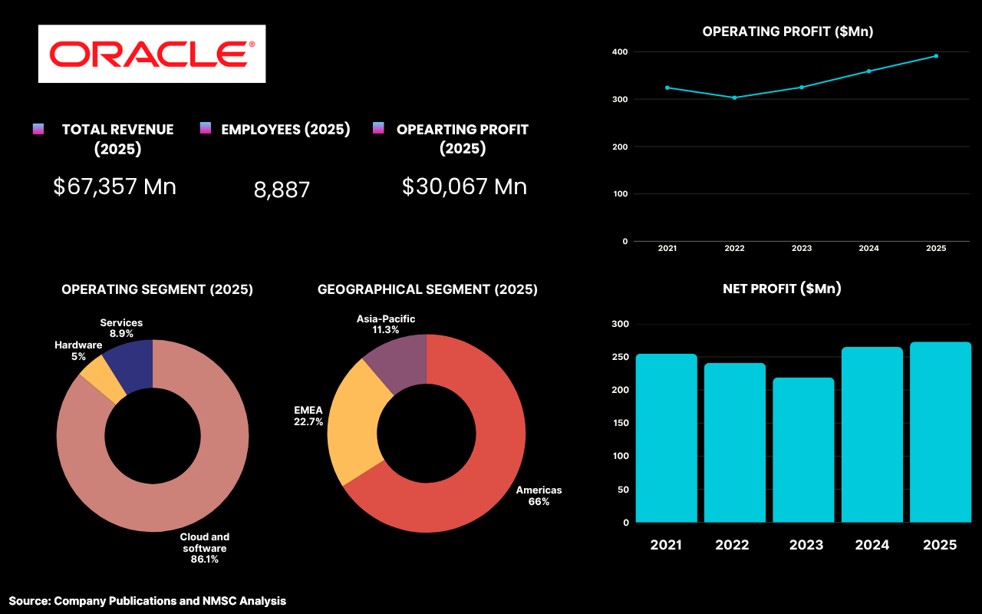
Oracle Corporation provides cloud infrastructure, databases, enterprise applications, and computing services through Oracle Cloud Infrastructure (OCI). Its data center strategy is increasingly focused on expanding AI computing capacity and supporting customers with substantial infrastructure requirements. OCI combines computing, storage, networking, and cloud services to support enterprise applications, AI model development, inference, and data-intensive workloads.
Oracle announced in February 2026 that it planned to raise USD 45 billion to USD 50 billion in gross cash proceeds during calendar year 2026 to fund the expansion of Oracle Cloud Infrastructure. The company stated that the funding would support additional capacity to meet contracted demand from major OCI customers. This plan illustrates the financing requirements associated with scaling cloud infrastructure as demand for AI computing and related services increases.
Oracle's large-scale development strategy was also highlighted in an October 13, 2026, update on Project Jupiter, its data center campus in New Mexico. Oracle reported that the project was projected to generate more than USD 13 billion in economic impact during construction and the first 17 years of full operations. Once fully operational, the four-building campus was projected to support more than 3,100 direct, indirect, and induced jobs across the county and produce approximately USD 560 million in annual direct economic output locally.
These figures represent projected regional economic impact, rather than the campus's construction cost or Oracle's direct investment amount.
Oracle's strategy reflects a shift toward larger AI-oriented cloud infrastructure projects backed by substantial financing and customer commitments. Its investments address the need for scalable computing environments that support enterprise cloud adoption and increasingly demanding AI workloads. Large campus projects also highlight the importance of coordinating data center capacity with electricity supply, site development, infrastructure planning, and local economic considerations.
NMSC's market assessment finds that Oracle's position is strengthened by the combination of enterprise cloud services and large-scale infrastructure expansion. Its strategy demonstrates how demand for AI and cloud capacity is influencing capital allocation, facility development, and the scale at which infrastructure providers plan future investments.
NTT DATA Group Corporation
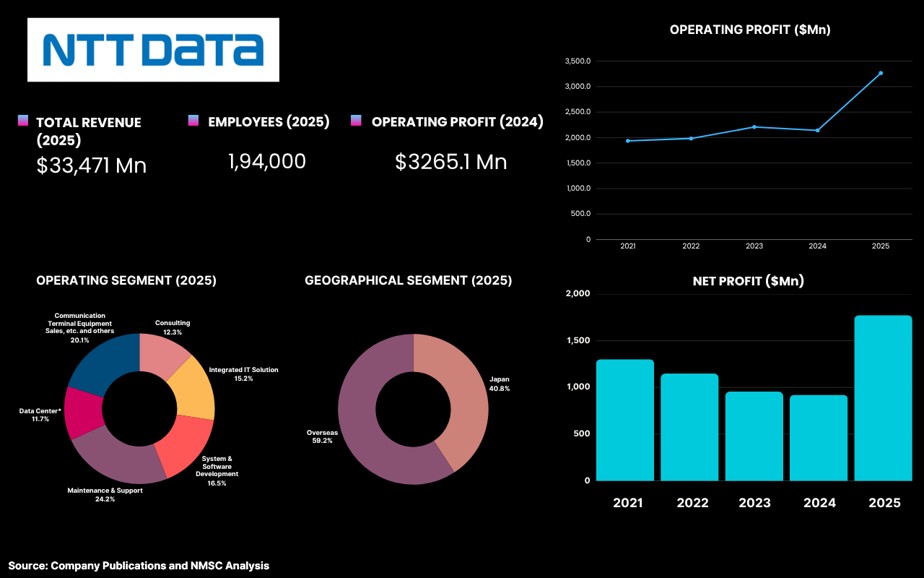
NTT DATA Group Corporation is a global IT services and digital infrastructure provider with operations spanning consulting, cloud, connectivity, enterprise technology, and data centers. Through NTT Global Data Centers, the company operates facilities serving hyperscalers, enterprises, and multinational organizations. Its business model differs from that of cloud platforms because it also provides the physical infrastructure that customers use to deploy and operate their own digital services.
NTT DATA reported approximately 1,500 megawatts of data center capacity as of the end of March 2025 in its July 2025 announcement concerning the listing of NTT DC REIT on the Singapore Exchange. The company stated that the real estate investment trust was designed to support the data center business by creating a mechanism to recycle capital from data center investments and enable further growth.
NTT DATA expanded its Japanese infrastructure footprint in April 2026 with the opening of the Keihanna OSK11 Data Center in Kyoto. The AI-ready facility provides 30 megawatts of IT capacity and was identified as NTT DATA's fourteenth data center in Japan. Its infrastructure includes dual power substations, carrier-neutral connectivity, and an N+1 air-cooled chiller design. These features support resilience and efficient operation for customers with demanding availability and infrastructure requirements.
The company also stated that OSK11 forms part of the NTT Global Data Centers platform, which comprises more than 160 data centers across over 20 countries. This network supports deployment and scaling for multinational customers requiring data center capacity in multiple markets.
NTT DATA's strategy highlights the continuing role of specialized data center operators in the broader market. While hyperscale cloud providers invest in their own facilities, enterprises and service providers also require access to secure, resilient, and geographically distributed data center infrastructure. Capacity expansion, power resilience, cooling, carrier connectivity, and facility operations remain important considerations for customers that need to deploy workloads across locations.
NMSC's analysis indicates that NTT DATA is positioned to benefit from demand for physical data center capacity as cloud adoption and AI workloads expand. Its combination of global facility operations, infrastructure services, and capital recycling mechanisms provides a different route to market participation from companies whose principal focus is cloud computing services.
Band Title: Understand the Competitive Structure of the Data Center Market
Band Subline: Access market sizing, segment-level forecasts, regional analysis, competitive positioning, market shares, and strategic insights across the global Data Center Market.
Band Button: Download Free Sample
Market Outlook: AI and Cloud Expansion Are Reshaping the Data Center Market
The Data Center Market is moving toward infrastructure designed to support growing cloud adoption, AI computing, enterprise workloads, and data-intensive digital services. Hyperscale providers are expanding physical capacity while developing computing systems and cloud platforms designed for increasingly demanding workloads. At the same time, data center operators are investing in new facilities, connectivity, power resilience, and cooling capabilities to accommodate customer requirements across regions and industries.
The competitive landscape reflects distinct but complementary strategies. AWS is investing in large-scale data center campuses and specialized AI infrastructure for government customers. Microsoft is combining data center expansion with its Azure Maia computing systems. Google is integrating data center development with connectivity and energy investments. Oracle is financing additional OCI capacity and advancing large AI-oriented campus projects, while NTT DATA continues to expand its global data center footprint. Together, these developments illustrate how capacity, computing technology, location, and power infrastructure are becoming increasingly interconnected.
NMSC's assessment indicates that the next phase of competition will depend on the ability to develop capacity efficiently, secure adequate power, manage operating requirements, and meet customer needs for reliable cloud and AI services. Hyperscale providers are positioned to expand through integrated cloud ecosystems and sustained infrastructure investment, while data center operators support the wider market through physical facilities and infrastructure services. Companies that align their expansion strategies with customer demand, infrastructure availability, and operational resilience will be better positioned to participate in the market's projected growth.
About the Author
 Mayurima Roy
— Mayurima Roy is Research Analyst at Next Move Strategy Consulting, where she has spent 4 years working across the firm's full industry coverage rather than a single fixed vertical. Her work centers on structured research, ongoing trend tracking, competitive assessment, and insight-led content development, translating complex market data into clear, decision-ready narratives that support informed client decision-making across diverse global industries, market sectors, and world regions every day.
About the Reviewer
 Debashree Dey
— Debashree Dey is Assistant Manager at Next Move Strategy Consulting, where she supports cross-vertical market content and communications across diverse industries for 6 years. Her professional background includes senior content writing, communications, and published manuscript authorship, with experience developing audience-focused business narratives and maintaining clear, consistent messaging. Her role supports research-led content development and editorial quality across NextMSC publications.












Add Comment