Advanced Driver Assistance Systems (ADAS): Why Mandates Win Now | NextMSC

Introduction
On July 7, 2026, the second phase of the European Union's General Safety Regulation took full effect, and every newly registered passenger car and van in the bloc must now carry an advanced emergency brake that detects pedestrians and cyclists, together with an advanced driver distraction warning system, according to the European Commission's news article of July 8, 2026. Five days earlier, on July 2, 2026, China's Ministry of Industry and Information Technology announced the country's first mandatory national standard for combined driver assistance systems, effective January 1, 2027, as reported by Xinhua. Two of the world's largest vehicle markets have therefore moved driver assistance from a trim-level option to a legal obligation within a single week.
According to Next Move Strategy Consulting's Advanced Driver Assistance Systems (ADAS) Market report, the global advanced driver assistance systems (ADAS) market was valued at USD 20.73 billion in 2021 and is projected to reach USD 74.57 billion by 2030, growing at a CAGR of 14.2% from 2022 to 2030. This analysis examines how the 2026 rulebooks in Brussels, Beijing, Geneva and Washington, together with fresh results from Mobileye, Hesai Group and Qualcomm, are changing the economics of ADAS.
For More Information: Download FREE Sample on Advanced Driver Assistance Systems (ADAS) Market Report
NextMSC's research segments the ADAS market by component, by level of autonomy from L1 to L5, by system type and by vehicle type, covering both internal combustion engine and electric vehicles. Regulation now acts on every one of those layers at once, which is the central argument of this article.
From Option to Obligation: How 2026 Rulebooks Are Reshaping the Advanced Driver Assistance Systems (ADAS) Market
Europe, July 7: Driver Monitoring Joins Emergency Braking as Standard Equipment
The European Commission's article of July 8, 2026 confirmed that the new requirements apply to all newly registered passenger cars and vans from July 7, 2026. The mandatory list comprises advanced emergency braking that detects pedestrians and cyclists, an advanced driver distraction warning system, improved forward vision, new tests for worn tyres and a larger safety glass area to protect pedestrians. The Commission added that many safety systems have been mandatory since 2024 and that the legislation was phased because the more demanding features needed development time. It also stated that the requirements are intended to encourage widespread adoption of advanced driver assistance systems within the Union's Vision Zero goal of near-zero road transport fatalities by 2050.
The commercial consequence is that driver monitoring, previously a premium or regional feature, becomes a volume component. Smart Eye, a Swedish driver-monitoring supplier, stated on July 7, 2026 that direct driver monitoring becomes a standard safety technology across one of the world's largest automotive markets. For suppliers, a discretionary content opportunity becomes a fitment rate set by law.
China, July 2: GB 47955-2026 Places Combined Driver Assistance Under Mandatory Safety Rules
Xinhua reported on July 2, 2026 that the Ministry of Industry and Information Technology had issued a mandatory national standard on safety requirements for combined driver assistance systems in intelligent and connected vehicles, approved by the State Administration for Market Regulation and the National Standardization Administration. The ministry stated that, since the start of 2026, 70% of new passenger cars in China have featured combined driver assistance functions, and that models offering navigation-assisted driving exceed 30%. Gasgoo, in an article dated July 10, 2026, identified the document as GB 47955-2026 and described three tiers: basic single-lane systems, basic multi-lane systems that change lanes only when the driver triggers the turn signal, and navigation-assisted driving systems that change lanes automatically and navigate ramps but may not cross solid lines. Gasgoo noted that the tiers are intended to end marketing labels such as L2.5 and L2.9.
According to Xinhua, the standard also sets baseline rules for system functions, data recording, manufacturer safety guarantees, human-machine interaction, user instructions and user training, and the ministry committed to tighter market-access management and faster release of further mandatory standards, including for automated driving systems. Gasgoo added that the standard imposes more detailed driver-monitoring demands than UN Regulation No. 171. Each tier therefore carries a defined test and documentation burden that favours suppliers able to deliver validated perception, compute and driver-monitoring stacks.
UNECE, June 24: One Rulebook for Supervised and Driverless Systems
On June 24, 2026, UNECE announced that its World Forum for Harmonization of Vehicle Regulations, known as WP.29, had approved the first global framework that legally enables fully autonomous driving systems. UNECE stated that the regulation requires safety management systems, credible testing, safety-case validation and continuous in-service monitoring, and that the United States, China, the European Union, Japan, Canada and the United Kingdom support it. UNECE's working-party documentation lists, alongside the new regulation, 92 amendments to existing regulations and a 02 series of amendments to UN Regulation No. 171 on Driver Control Assistance Systems.
Supplier Evidence: Mobileye, Hesai Group and Qualcomm Show Where Value Is Moving
Mobileye's third-quarter 2026 results, released on October 29, 2026, show volume holding while price per system slips. The company shipped 9.5 million EyeQ and SuperVision systems in the quarter, against 9.2 million a year earlier, yet average system price fell 5% to USD 49.1 from USD 51.7, which Mobileye attributed mainly to a higher mix of China OEM export volumes that carry less software content. Total revenue was USD 492 million, against USD 504 million in the third quarter of 2025. Prof. Amnon Shashua, Mobileye's President and Chief Executive Officer, said in the release: “Mobileye delivered another quarter of strong results from its ADAS products.” He added that nine-month EyeQ shipment volume rose 11% while global automotive production declined by an estimated 1%.
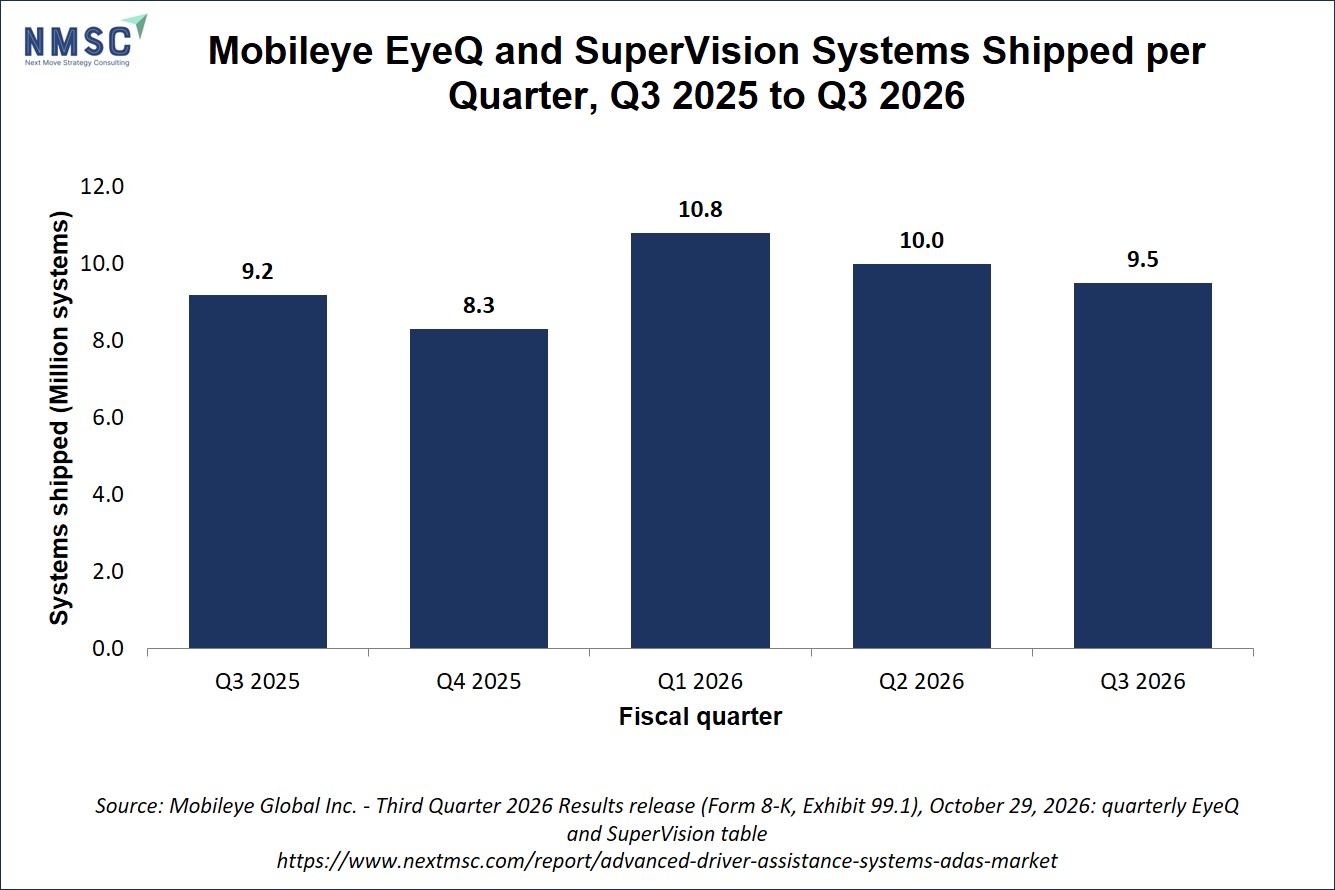
Mobileye's release reports 9.2 million systems shipped in the third quarter of 2025, 8.3 million in the fourth quarter of 2025, 10.8 million in the first quarter of 2026, 10.0 million in the second quarter of 2026 and 9.5 million in the third quarter of 2026. The first-quarter 2026 figure is the highest of the five periods shown, and all values are reported actuals from a single table in the company's release.
Mobileye also reported Surround ADAS and Cloud-Enhanced ADAS design wins, including a nomination from Stellantis to supply Cloud-Enhanced ADAS for select future U.S. vehicles beginning in 2027, later expanded to European platforms, and it narrowed its full-year 2026 revenue guidance to USD 1,995 million to USD 2,020 million. Rising unit volume, a falling unit price and widening content per vehicle form the economic signature of a feature moving from optional to mandatory.
Hesai Group's third-quarter 2026 results, published on November 10, 2026, reported total lidar shipments of 729,673 units, up 65.3% from 441,398 a year earlier. ADAS lidar accounted for 638,055 of those units, up 67.6% from 380,759, while the lidar segment contributed RMB977.8 million of revenue, up 22.9%. Hesai stated that it held a 43% share of China's long-range ADAS lidar market in September 2026, citing Gasgoo, and named ET-series main lidar design wins with five leading global automakers, including a top European automaker, Cadillac, Geely and Great Wall Motor, plus FT-series blind-spot lidar wins with Leapmotor and a top European automaker.
Qualcomm's annual report on Form 10-K for the fiscal year ended September 27, 2026 shows automotive revenues in its QCT semiconductor segment of USD 6,004 million, up from USD 3,957 million in fiscal 2025, an increase of USD 2,047 million, while handset revenues fell to USD 24,072 million from USD 27,793 million. Qualcomm describes its Snapdragon Digital Chassis as spanning connectivity, digital cockpit and ADAS and automated driving. The filing shows automotive compute, of which ADAS is one layer, becoming a material revenue line for a company whose chip business has long depended on handsets.
NMSC Strategic Perspective: Compliance Becomes the Entry Ticket, Not the Differentiator
NextMSC primary research and analysis reads these developments as one structural shift. The NextMSC report identifies government safety regulation, consumer demand for comfort and safety, and the adoption of integrated radar and camera systems as drivers, and the 2026 rulebooks convert the first of those from a forecast assumption into an enforced requirement in Europe and, from January 2027, in China. The same report lists high installation cost among the restraints, and Mobileye's 5% decline in average system price shows how mandates and volume compress unit prices even as shipments rise.
NextMSC's conclusion is that revenue growth in the ADAS market will depend less on selling a first system into each vehicle and more on content per vehicle, meaning surround sensing, compute, driver monitoring and software layered above the regulatory baseline. NextMSC's report also anticipates that North America will continue to hold the highest market share and that Europe will show a steady rise through 2030. The mandates in Europe and China widen the set of regions in which fitment is compulsory, while the United States still has to settle the timing of its own requirement.
Section Summary:
Within a single week in July 2026, Europe and China converted driver assistance into a legal requirement, and UNECE extended a common rulebook to driverless systems. Supplier results from Mobileye, Hesai Group and Qualcomm confirm rising volumes alongside falling unit prices.
-
Europe's July 7, 2026 phase makes pedestrian-and-cyclist emergency braking and driver distraction warning standard on every newly registered passenger car and van.
-
China's GB 47955-2026, effective January 1, 2027, creates three mandatory tiers for combined driver assistance, including navigation-assisted driving.
-
Unit volumes are rising faster than unit revenue, so content per vehicle becomes the growth variable.
Industry Impact Analysis: How Regulation Reprices the Advanced Driver Assistance Systems (ADAS) Market
Policy Divergence: Brussels and Beijing Mandate, Washington Reconsiders
The United States presents a contrasting picture. According to NHTSA's final rule on petitions for reconsideration, FMVSS No. 127 requires automatic emergency braking, pedestrian automatic emergency braking and forward collision warning on all new light vehicles by September 1, 2029, with small-volume manufacturers required to comply by September 1, 2030. The U.S. Department of Transportation's Unified Agenda entry for RIN 2127-AM69 proposes to extend the compliance lead time by two years and to allow a temporary period of repeated trials, with a notice of proposed rulemaking targeted for July 2026. Sidley Austin LLP's July 9, 2026 review of the Department's 2026 regulatory agenda identified this rulemaking among three related to automatic emergency braking. NextMSC has not confirmed publication of the proposal at the time of writing, so the September 2029 date in the published final rule remains the operative reference. For multinational suppliers, a single hardware platform must now satisfy a firm European date, a firm Chinese date and a United States date that may move.
UNECE's framework adds a second layer to this divergence. Because the six supporting markets named by UNECE include the United States, China and the European Union, suppliers that qualify a sensing and compute stack for supervised assistance today can reuse much of the safety case, testing evidence and monitoring data when customers move toward driverless operation, which lengthens the useful life of validated platforms.
Supply-Chain Implications: Content per Vehicle Rises While Price per Unit Falls
The supplier data show a consistent pattern. Mobileye shipped more systems at a lower average price, and Hesai's total lidar unit shipments rose 65.3% while its lidar segment revenue rose 22.9%. NextMSC reads both as evidence that mandatory fitment pushes volume toward cost-optimised configurations, particularly in vehicles exported from China, where Mobileye reported lower software content. Value therefore migrates toward the layers that regulation cannot commoditise quickly: surround perception, central compute, driver monitoring that satisfies a defined test, and updatable software. Hesai's blind-spot lidar wins alongside its main lidar wins suggest that some automakers are specifying more than one lidar per vehicle, and Qualcomm's USD 2,047 million automotive revenue increase in fiscal 2026 indicates that the compute layer beneath those sensors is scaling at the same time.
Regional Read-Across: Europe, China and the Export Corridor
Hesai stated that it has export programs with seven leading automakers, including Chery, and Mobileye attributed its lower average system price to a higher mix of China OEM export volumes. Because Gasgoo reports that China's standard is more detailed than UN Regulation No. 171 on driver monitoring, NextMSC expects exporters to treat the stricter regime as their design baseline, which narrows the compliance gap between regions over time.
Section Summary:
Regulation is reallocating value inside the ADAS stack. The United States remains the one major market where the compliance date is under review, while Europe and China have fixed theirs.
-
The United States keeps September 1, 2029 as its published AEB compliance date, with a two-year extension on the federal agenda.
-
Mobileye's 5% lower average system price and Hesai's 22.9% lidar revenue growth against 65.3% unit growth show price compression under volume.
-
Export programs from China link European and Chinese compliance regimes through shared hardware platforms.
Pros and Cons of Recent Market Developments
The table below sets the commercial advantages of the 2026 rule changes against the pressures they create for suppliers and automakers. Each entry is tied to a source cited in this article.
|
Pros |
Cons |
|
Mandatory EU fitment from July 7, 2026 gives suppliers a legally defined volume base for emergency braking and driver distraction warning. |
Mobileye's average system price fell 5% to USD 49.1 in the third quarter of 2026, so volume growth can coincide with lower unit revenue. |
|
China's GB 47955-2026 replaces labels such as L2.5 and L2.9 with three defined tiers, giving buyers and regulators a common vocabulary. |
The standard adds data-recording and user-training duties from January 1, 2027, raising compliance cost for every tier. |
|
UNECE's June 24, 2026 framework places supervised and driverless systems under one architecture backed by six major markets. |
A possible two-year extension of FMVSS No. 127 complicates global platform planning. |
|
Hesai's ADAS lidar shipments rose 67.6% to 638,055 units, and Qualcomm's automotive revenues rose USD 2,047 million in fiscal 2026. |
Hesai's lidar segment revenue rose 22.9% against 65.3% unit growth, indicating margin pressure on sensor makers. |
Key Data & Statistics
The first table consolidates the regulatory milestones that now frame ADAS demand, and the second lists the latest supplier indicators drawn from company filings and releases. Dates are those given by the cited institutions.
Regulatory Milestones Shaping ADAS Demand
|
Jurisdiction |
Instrument |
Date |
Requirement |
|
European Union |
General Safety Regulation, second phase |
In effect July 7, 2026 |
Pedestrian-and-cyclist emergency braking and driver distraction warning on newly registered passenger cars and vans |
|
China |
GB 47955-2026 |
Effective January 1, 2027 |
Three tiers of combined driver assistance, with data recording and user training |
|
UNECE (global) |
WP.29 automated driving framework |
Adopted June 24, 2026 |
Safety management, testing, safety-case validation and in-service monitoring |
|
United States |
FMVSS No. 127 |
Compliance September 1, 2029 |
AEB, pedestrian AEB and forward collision warning on new light vehicles; extension proposed |
ADAS Supplier Indicators, Latest Reported Period
|
Company |
Indicator |
Latest value |
Prior-year value |
|
Mobileye |
Systems shipped, Q3 2026 |
9.5 million |
9.2 million |
|
Mobileye |
Average system price, Q3 2026 |
USD 49.1 |
USD 51.7 |
|
Hesai Group |
ADAS lidar shipments, Q3 2026 |
638,055 units |
380,759 units |
|
Qualcomm |
QCT automotive revenues, fiscal 2026 |
USD 6,004 million |
USD 3,957 million |
Future Outlook & Forecast: The ADAS Market Through the 2027 and 2029 Deadlines
NextMSC's forecast, as stated in the Advanced Driver Assistance Systems (ADAS) Market report, is a rise from USD 20.73 billion in 2021 to USD 74.57 billion by 2030, with a CAGR of 14.2% over 2022 to 2030. The report names Continental AG, Magna International, Robert Bosch GmbH, NXP Semiconductors, Nvidia, Denso and Valeo, among others, as participants. The 2026 events described above do not replace that forecast; they sharpen the timeline against which it will be tested.
Three dates anchor the next phase. January 1, 2027 brings China's combined driver assistance standard into force. September 1, 2029 remains the published United States compliance date for FMVSS No. 127, subject to the proposed amendment. NextMSC's 2030 horizon follows immediately after, so the final years of the forecast period coincide with the first full production cycles built under all three regimes. The near-term company signals are consistent with that sequence: Mobileye updated its 2026 revenue guidance to USD 1,995 million to USD 2,020 million, and Hesai guided fourth-quarter 2026 net revenues of RMB1,100 million to RMB1,150 million.
NextMSC's report also identifies constraints that regulation does not remove. High installation costs remain a restraint, and inadequate road infrastructure in developing countries, including poorly maintained roads and lane markings, limits how well camera-based functions perform there. NextMSC therefore expects growth to be strongest where mandates, road quality and vehicle electrification coincide.
Section Summary:
The forecast period to 2030 now has three visible regulatory anchors, and the supplier data point to rising volume, falling unit price and growing content per vehicle.
-
NextMSC projects USD 74.57 billion by 2030 at a CAGR of 14.2% from 2022 to 2030.
-
China's January 1, 2027 effective date and the United States' September 1, 2029 date bracket the middle of the forecast window.
-
Installation cost and road infrastructure remain constraints that regulation alone does not resolve.
Next Steps for Stakeholders
The evidence assembled above supports specific actions for executives and investors who allocate capital across the assisted-driving value chain.
-
Automaker executives: Specify driver-monitoring and emergency-braking hardware to the strictest of the European, Chinese and United States regimes, and decide whether surround sensing and compute will be differentiators or baseline.
-
Tier-1 and semiconductor leaders: Plan for lower average system prices on first-generation fitment, and move targets toward content per vehicle, software and validation services, as Mobileye's and Qualcomm's results indicate.
-
Sensor suppliers: Track revenue per unit alongside shipments, since Hesai's lidar revenue grew 22.9% against 65.3% unit growth, and prioritise multi-sensor design wins.
-
Investors: Separate companies exposed to mandated volume from those exposed to optional premium content, and monitor the United States rulemaking on FMVSS No. 127 as the main open regulatory variable.
-
Compliance and product teams: Build one documentation and data-logging architecture that satisfies China's GB 47955-2026 from January 1, 2027 and UN Regulation No. 171, rather than two separate processes.
Conclusion
The advanced driver assistance systems (ADAS) market entered the second half of 2026 with its demand logic rewritten by regulators. Europe made pedestrian-and-cyclist emergency braking and driver distraction warning compulsory on July 7, 2026, China announced a three-tier mandatory standard effective January 1, 2027, and UNECE adopted a global framework that spans supervised and driverless systems. Mobileye, Hesai Group and Qualcomm each report growing volumes, while unit prices and revenue per unit come under pressure. NextMSC's forecast of USD 74.57 billion by 2030 therefore rests on a market where compliance is the starting point, and where value accrues to the companies that add content above it.
About the Author
 Priyanshu Das
— Priyanshu Das is SEO Executive at Next Move Strategy Consulting, where he has led on-page and off-page SEO, keyword research, and SEO audits for the firm's B2B market research publications for 2 years. His audit process combines technical crawl analysis, backlink profile review, and competitor keyword gap mapping — using tools including Screaming Frog and Google Search Console — to prioritize fixes by organic search-visibility impact, informed by his own prior in-house and agency SEO experience.
About the Reviewer
 Sanyukta Deb
— Sanyukta Deb is Digital Marketing Team Lead at Next Move Strategy Consulting, where she has led content strategy and technical SEO for the firm's B2B market research publications for over 2 years. Her editorial process translates NextMSC's primary and secondary research — spanning technology, industrial, and consumer sectors — into commercial narratives, backed by search-intent, keyword, and competitive analysis. She brings 5 years of overall experience in digital marketing and content strategy.















Add Comment