Unmanned Ground Vehicles: Battlefield Robotics Reshape 2026

Introduction
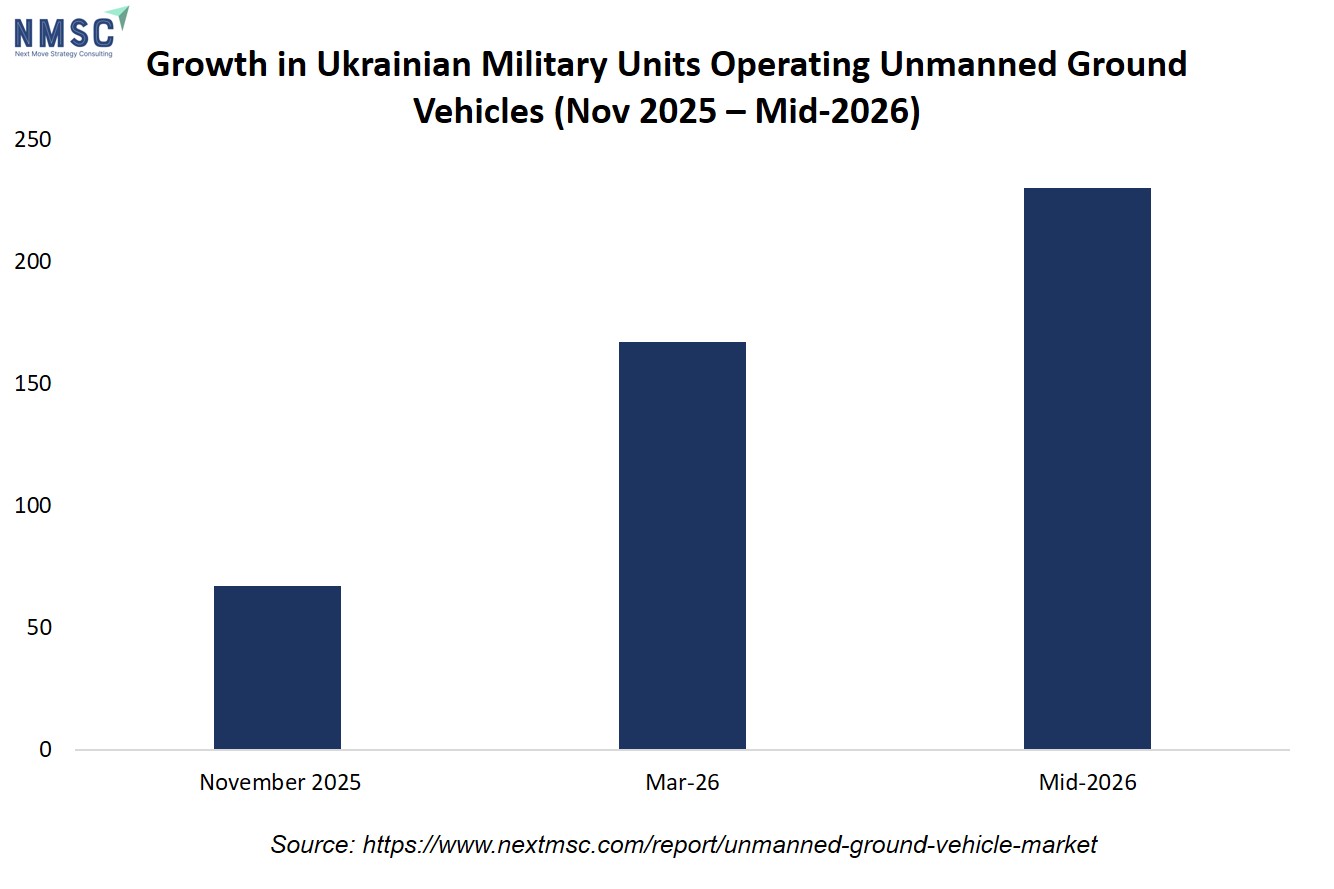
The war in Ukraine has permanently altered how military planners think about unmanned ground vehicles (UGVs). What began as experimental logistics robots has evolved into a frontline necessity, with Kyiv's Defense Ministry announcing plans to contract 25,000 unmanned ground vehicles in the first half of 2026 alone — more than double the total procured throughout 2025. This is not an isolated development. It is a signal that unmanned ground vehicles have crossed the threshold from niche battlefield tool to a core pillar of modern military modernization programs.
For institutional investors, defense primes, and government procurement officers, this shift raises a critical question: is the unmanned ground vehicle market ready to absorb the surge in demand, or is the industry still catching up to a rapidly evolving operational requirement? This article examines the forces driving global adoption of military unmanned ground vehicles, the strategic implications for defense robotics investment, and where the broader unmanned ground vehicle market is headed through the end of the decade.
Ukraine's Robotic Frontline Redefines Tactical Unmanned Vehicles
The single most globally impactful development shaping the unmanned ground vehicle market over the past six months has been Ukraine's accelerated push to replace soldiers with robotic ground systems along its most dangerous frontline sectors. Defense Minister Mykhailo Fedorov confirmed that Ukrainian forces conducted more than 9,000 UGV missions in March 2026 alone, and that the ministry's stated objective is for "100% of frontline logistics" to be performed by unmanned platforms. Kyiv has already spent roughly $330 million to push more than 181,000 drones, UGVs, and electronic warfare systems to the front since January through a digital procurement platform that allows frontline units to order equipment directly from domestic manufacturers.
For More Information – Download FREE Sample on UGV Market Report
In a landmark tactical development, operators from Ukraine's 3rd Separate Assault Brigade used only aerial drones and unmanned ground vehicles to capture a fortified Russian position in Kharkiv Oblast, marking what President Volodymyr Zelenskyy described as the first time in the war that an enemy position was taken using exclusively unmanned platforms. Ukraine's ground robots now reportedly account for approximately 90% of Kyiv's military logistics activity, according to reporting cited by the U.S. Army's own unmanned systems planning documents.
This battlefield transformation is rippling outward. The U.S. Army issued a formal notice in April 2026 seeking an autonomous UGV capable of resupplying frontline units and evacuating wounded personnel across the "last tactical mile" — the most dangerous and logistically complex stretch of the modern battlefield. At Eurosatory 2026 in Paris, more than 50 UGV manufacturers exhibited systems, with over 40 Ukrainian firms alone showcasing combat-proven robotic ground systems, including Ukroboronprom's missile-armed Ravlyk UMP-3, which can carry payloads of up to 200 kilograms.
NMSC's Strategic Perspective on the Ukraine-Driven UGV Shift
From Next Move Strategy Consulting's vantage point, the Ukraine conflict has functioned as an accelerant rather than a distortion of the underlying unmanned ground vehicle market growth trajectory. Battlefield validation of autonomous logistics vehicles and casualty evacuation robots is compressing what would typically be a decade-long defense acquisition cycle into a matter of quarters. NMSC's analysis suggests three durable implications for institutional stakeholders: first, NATO member states are likely to fast-track commercial solutions opening (CSO) contracting pathways — mirroring the U.S. Army's own "last tactical mile" notice — to bypass traditional multi-year procurement timelines. Second, demand is shifting toward modular, mission-adaptable UGV platforms capable of dual-use configuration (cargo and casevac) rather than single-purpose designs, a trend the NMSC UGV market report identifies as central to long-term segment growth. Third, and most importantly for investors, the current environment shows industry supply outpacing near-term formal military adoption outside Ukraine, a gap that independent experts have flagged as a real commercialization risk requiring careful capital allocation discipline. NMSC views the Ukraine theater not as a temporary war economy anomaly, but as the primary proving ground establishing design standards, autonomy benchmarks, and interoperability protocols — such as NATO cataloging of the Bizon-L logistics UGV — that will define global military modernization programs through 2030.
Section Summary: Ukraine's battlefield reliance on unmanned ground vehicles has become the defining catalyst for global UGV demand, prompting rapid procurement responses from NATO militaries and a surge in exhibitor activity at major defense trade shows.
-
Ukraine plans to contract 25,000 UGVs in H1 2026 alone, more than double the 2025 total.
-
The U.S. Army is actively soliciting autonomous UGVs for frontline resupply and casualty evacuation.
-
Over 50 UGV manufacturers exhibited at Eurosatory 2026, led by Ukrainian firms with combat-tested systems.
-
NMSC assesses a near-term gap between industry supply and formal military adoption outside Ukraine as the key commercialization risk.
Industry Impact Analysis
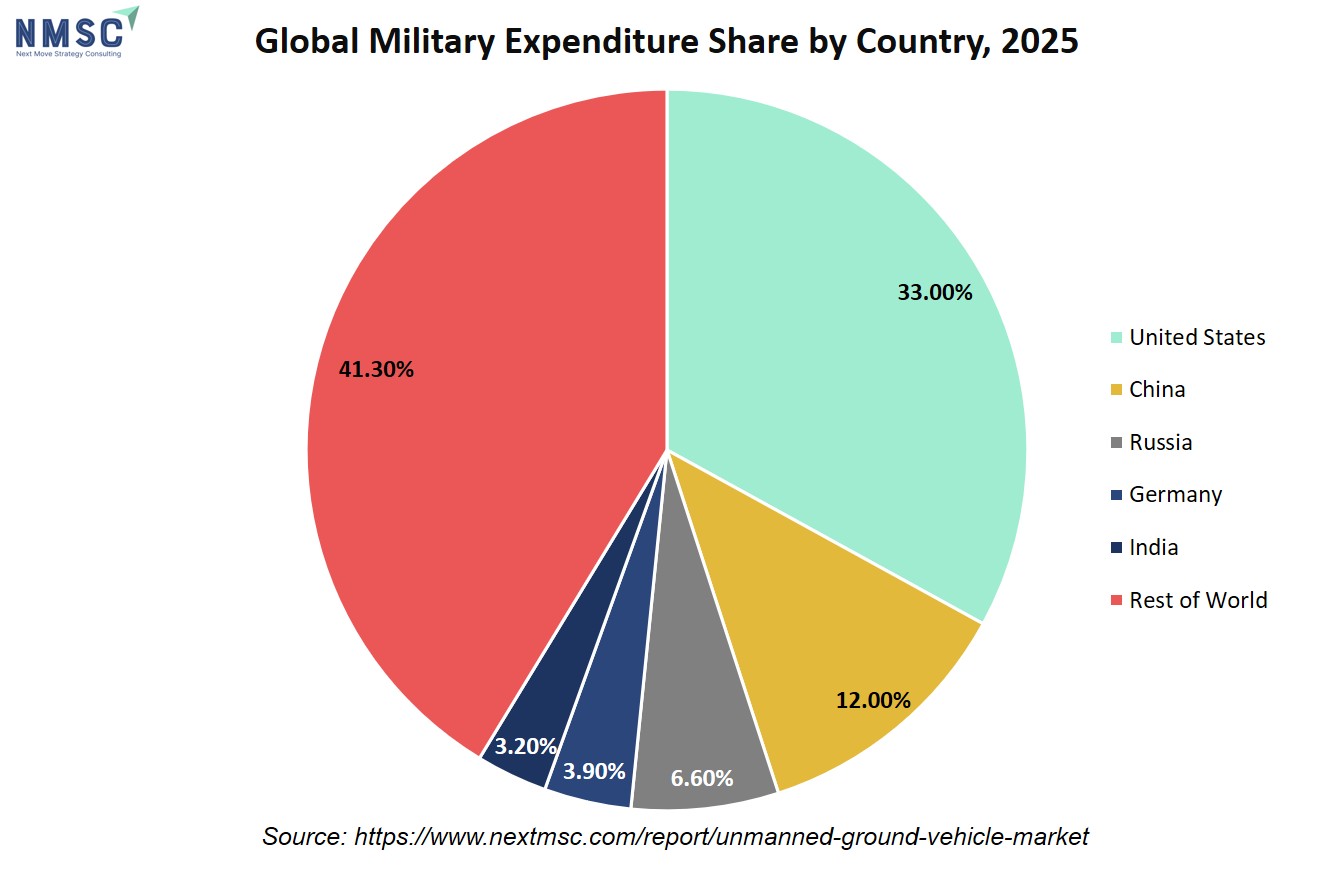
The unmanned ground vehicle market is being shaped by a broader realignment in global defense spending. According to the Stockholm International Peace Research Institute (SIPRI), world military expenditure reached $2,887 billion in 2025, a 2.9% real-terms increase, with European spending rising by 14% to $864 billion — the sharpest annual growth in Central and Western Europe since the end of the Cold War. Military expenditure in Asia and Oceania also grew 8.1%, the fastest pace since 2009, as China's spending rose to $336 billion and Japan's climbed to $62.2 billion, its highest share of GDP since 1958.
This surge in defense budgets directly benefits robotic ground systems procurement. Germany's military expenditure grew 24% year-on-year to $114 billion, and Spain's rose 50% to $40.2 billion, both nations exceeding NATO's 2.0% GDP spending threshold for the first time in decades — a trend that typically translates into accelerated equipment modernization, including autonomous ground vehicles and surveillance and reconnaissance UGVs. Meanwhile, U.S. Congress-approved spending for 2026 has risen to over $1 trillion, reversing a 2025 dip caused by the absence of new Ukraine aid appropriations.
On the procurement side, explosive ordnance disposal (EOD) robots remain one of the most mature and consistently funded UGV subsegments. The U.S. Navy has awarded contracts worth over $18 million to iRobot for EOD robot delivery, while Boeing and iRobot secured an Air Force contract for up to 70 small unmanned ground systems, and Northrop Grumman's Remotec division continues supplying the Army and Marine Corps with EOD robotic systems under existing sustainment contracts. This steady institutional demand for border security robotic systems and EOD platforms provides a stable revenue floor beneath the more volatile combat-UGV segment.
However, industry experts caution that formal military adoption still lags behind manufacturing capacity. Federico Borsari of the Center for European Policy Analysis noted at Eurosatory 2026 that "the UGV segment is rapidly growing, but the offer clearly exceeds demand currently, where there's a gap between what the industry proposes and the demand from forces." Technical hurdles also persist: during NATO's Crystal Arrow exercise in Latvia, operators reported that Starlink-equipped UGVs lost line-of-sight and signal connectivity when deployed in dense forested terrain.
Section Summary: Rising global defense budgets, particularly across NATO Europe and Asia-Pacific, are creating favorable tailwinds for UGV procurement, but a real gap between manufacturing supply and confirmed military orders — alongside unresolved connectivity challenges — tempers near-term commercialization certainty.
-
Global military spending hit $2,887 billion in 2025, with Europe posting its fastest growth since the Cold War.
-
EOD robot contracts continue to provide a stable, recurring revenue base for established defense primes.
-
Industry supply of UGVs currently exceeds confirmed demand from militaries outside Ukraine.
-
Communication reliability in contested, forested, or GPS-denied environments remains an unresolved technical constraint.
Pros and Cons of Recent Market Developments
|
Pros |
Cons |
|
Battlefield validation in Ukraine has proven UGV effectiveness for logistics, casualty evacuation, and even offensive operations. |
Industry production capacity currently exceeds confirmed procurement demand from militaries outside Ukraine. |
|
Rising NATO and Asia-Pacific defense budgets are accelerating funding availability for autonomous ground vehicles. |
Communication systems such as Starlink face reliability issues in forested or GPS-denied combat environments. |
|
Commercial solutions opening (CSO) contracting pathways are shortening acquisition timelines for new UGV programs. |
Regulatory and cybersecurity standards for autonomous ground operations remain inconsistent across regions. |
|
Established EOD robot contracts provide steady, recurring revenue independent of combat-UGV market volatility. |
Scaling manufacturing to tens of thousands of units annually strains supply chains and quality assurance. |
Top Military Spending Countries and Annual Growth (2025)
|
Region/Country |
2025 Military Expenditure (USD Billion) |
Year-on-Year Change |
|
United States |
954.0 |
-7.5% |
|
China |
336.0 |
+7.4% |
|
Russia |
190.0 |
+5.9% |
|
India |
92.1 |
+8.9% |
|
United Kingdom |
89.0 |
-2.0% |
|
Saudi Arabia |
83.2 |
+1.4% |
|
Ukraine |
84.1 |
+20.0% |
|
France |
68.0 |
+1.5% |
|
Japan |
62.2 |
+9.7% |
|
Germany |
114.0 |
+24.0% |
Recent UGV and EOD Robot Procurement Contracts and Programs
|
Notable UGV/EOD Robot Procurement Actions |
Buyer |
Reported Value/Scope |
|
Talon-series EOD robot delivery contract |
U.S. Navy (NAVSEA) |
Over $18 million |
|
Small unmanned ground systems for ordnance disposal |
U.S. Air Force |
Up to 70 units |
|
Bizon-L logistics UGV NATO cataloging clearance |
Ukraine Armed Forces & allies |
300 kg payload, 50 km range |
|
Frontline UGV contracting target, H1 2026 |
Ukraine Ministry of Defense |
25,000 units |
Future Outlook & Forecast
Looking beyond the current conflict-driven surge, the structural growth trajectory for the global unmanned ground vehicle market remains firmly upward. This growth is attributed to accelerated global defense modernization programs, rising adoption of uncrewed multi-domain warfare systems, and expanding commercial automation needs across logistics, energy, and mining sectors. North America is expected to retain the dominant market share, driven by sustained U.S. and Canadian military expenditure, while Asia-Pacific is projected to post steady growth as China, India, and Japan increase defense budgets and localize UGV production capabilities.
NMSC's report segments the market by mode of operation (tethered, teleoperated, autonomous), mode of locomotion (tracked, wheeled, legged, hybrid), vehicle size class, system type (payloads, controller systems, navigation systems, power systems), and end-user industry (military and defense, agriculture, mining, law enforcement, and others). The military and defense segment continues to anchor overall market value, reinforced by the same forces driving current headlines: casualty-averse logistics requirements, EOD modernization, and border security robotic systems adoption.
Strategically, the convergence of battlefield-proven autonomy (Ukraine), rising defense budgets (SIPRI-tracked NATO and Asia-Pacific growth), and formal acquisition pathways (the U.S. Army's last-tactical-mile solicitation) suggests that AI-enabled ground vehicles will increasingly transition from experimental deployments to programs of record over the next 24 to 36 months. Regulatory harmonization around autonomous safety certification and cybersecurity will likely determine which manufacturers convert current battlefield credibility into durable, multi-year defense contracts.
Section Summary: NMSC projects the global UGV market will grow rapidly, with military and defense applications remaining the primary growth engine as battlefield-validated autonomy transitions into formal procurement programs.
-
North America is expected to retain the largest regional market share through the forecast period.
-
Asia-Pacific is projected to post the fastest regional growth, led by China, India, and Japan.
-
Regulatory harmonization on autonomy certification will be a key determinant of which manufacturers scale successfully.
Next Steps for Stakeholders
C-level executives and institutional investors evaluating exposure to this sector should prioritize three actions. First, assess portfolio companies' ability to secure commercial solutions opening (CSO) or equivalent rapid-acquisition contracts, as these pathways are increasingly bypassing traditional multi-year defense procurement cycles. Second, weigh exposure toward diversified platform providers offering modular, dual-use payload configurations rather than single-mission systems, given NMSC's segmentation data showing broad-based demand across payloads, controller systems, and power systems. Third, monitor NATO and allied nations' defense budget allocations closely, as SIPRI data indicates European and Asia-Pacific spending growth is currently outpacing the United States, signaling where near-term UGV contract awards are most likely to materialize.
Conclusion
The unmanned ground vehicle market stands at an inflection point. Ukraine's battlefield experience has proven that unmanned ground vehicles can perform frontline logistics, casualty evacuation, and even offensive missions once considered the exclusive domain of soldiers. Rising global defense budgets, tracked in real time by institutions such as SIPRI, are translating this battlefield validation into expanding procurement pipelines across NATO Europe, the United States, and Asia-Pacific. Yet the market's own experts caution that industry supply currently exceeds confirmed military demand outside Ukraine, and that unresolved technical and regulatory questions will shape which manufacturers convert momentum into lasting contracts. For institutional stakeholders, the unmanned ground vehicle market offers a structurally sound, multi-year growth opportunity — provided capital is deployed with clear-eyed attention to the gap between battlefield proof-of-concept and formal, sustained military modernization programs.
About the Author
 Sanyukta Deb
— Sanyukta Deb is Digital Marketing Team Lead at Next Move Strategy Consulting, where she has led content strategy and technical SEO for the firm's B2B market research publications for over 2 years. Her editorial process translates NextMSC's primary and secondary research — spanning technology, industrial, and consumer sectors — into commercial narratives, backed by search-intent, keyword, and competitive analysis. She brings 5 years of overall experience in digital marketing and content strategy.
Sanyukta Deb
— Sanyukta Deb is Digital Marketing Team Lead at Next Move Strategy Consulting, where she has led content strategy and technical SEO for the firm's B2B market research publications for over 2 years. Her editorial process translates NextMSC's primary and secondary research — spanning technology, industrial, and consumer sectors — into commercial narratives, backed by search-intent, keyword, and competitive analysis. She brings 5 years of overall experience in digital marketing and content strategy.
About the Reviewer
 Debashree Dey
— Debashree Dey is Assistant Manager at Next Move Strategy Consulting, where she supports cross-vertical market content and communications across diverse industries for 6 years. Her professional background includes senior content writing, communications, and published manuscript authorship, with experience developing audience-focused business narratives and maintaining clear, consistent messaging. Her role supports research-led content development and editorial quality across NextMSC publications.
Debashree Dey
— Debashree Dey is Assistant Manager at Next Move Strategy Consulting, where she supports cross-vertical market content and communications across diverse industries for 6 years. Her professional background includes senior content writing, communications, and published manuscript authorship, with experience developing audience-focused business narratives and maintaining clear, consistent messaging. Her role supports research-led content development and editorial quality across NextMSC publications.

















Add Comment