Automotive Lighting Market Statistics, Trends & Forecasts for 2026–2035

Introduction
The road ahead has never been brighter — quite literally. The global automotive lighting market is undergoing a structural transformation that extends well beyond illumination. What was once a commodity component is now a sophisticated, software-defined system that communicates, adapts, and differentiates. From pixel-dense adaptive driving beam headlamps to OLED signature taillights that serve as brand identifiers, automotive lighting has become one of the most strategically consequential segments in the modern vehicle.
According to Next Move Strategy Consulting (NMSC), the global Automotive Lighting Market is projected to reach USD 62.56 billion by 2035, expanding at a 5.53% CAGR between 2026 and 2035. This growth is not incidental. It is being driven by the convergence of electric vehicle platform proliferation, tightening global safety regulations, and a new generation of intelligent lighting technologies that are redefining what a headlamp or taillight can do. For C-level executives, institutional investors, and supply chain strategists, understanding the forces reshaping this market is no longer optional — it is a prerequisite for competitive positioning through the decade ahead.
For More Information: Download FREE Sample on Automotive Lighting Market Report
From Illumination to Intelligence: The Forces Reshaping the Automotive Lighting Market
A Landmark Industry Moment: Pixel Headlamps Enter Mass Production
In May 2026, two of the world's most prominent automotive lighting suppliers made announcements that signal a definitive inflection point for the industry. FORVIA HELLA launched its fully localized SSL|HD high-resolution headlamp system in China, integrating the technology into the new Zeekr 8X. The system features 25,000 individually controllable LED pixels per headlamp and introduces light-based communication capabilities — a development that positions automotive lighting as an active interface between the vehicle and its environment.
In the same month, Koito Manufacturing Co., Ltd. announced the commencement of domestic mass production of its high-definition Adaptive Driving Beam (ADB) headlamp, adopted for the new Lexus ES. These are not incremental product updates. They represent the commercial arrival of a technology paradigm that has been in development for years — one in which headlamps function as low-resolution projectors capable of broadcasting safety information, navigation cues, and hazard warnings directly onto road surfaces.
Earlier in January 2026, LG Innotek reinforced this trajectory at CES 2026, unveiling its 'Ultra Thin Pixel Lighting Module' — a system offering dramatically reduced thickness while maintaining high-resolution pixel control. The module's debut at the world's most prominent consumer technology platform underscores how automotive lighting has migrated from the factory floor to the innovation stage.
According to S&P Global Mobility, demand for adaptive driving beam (ADB) headlamps featuring more than 500 pixels per vehicle is projected to record a CAGR of nearly 20% from 2026 to 2031, followed by headlamps featuring 41–500 pixels per vehicle at 14.9%.
The Electric Vehicle Catalyst
The electric vehicle revolution is providing a structural tailwind for the automotive lighting market that extends beyond simple volume growth. According to the International Energy Agency's Global EV Outlook 2026, electric car sales grew by 20% globally in 2025, exceeding 20 million units — meaning one in four new cars sold globally was electric. The IEA further projects global electric car sales to rise to approximately 23 million in 2026.
This matters profoundly for the automotive lighting market. Electric vehicle platforms require a complete redesign of lighting systems to minimize power draw and extend driving range. As NMSC analysis indicates, automakers are increasingly combining illumination and sensing functions within integrated lighting-sensor modules — a shift that benefits suppliers capable of offering consolidated packages for next-generation EV architectures.
NMSC Strategic Perspective: The Structural Shift Toward Technology-Diversified Suppliers
According to Next Move Strategy Consulting's analysis, automakers are increasingly specifying adaptive and matrix LED lighting systems as standard equipment across mid-tier vehicle trims — a shift that favors technology-diversified lighting suppliers over single-technology specialists as electric vehicle platforms accelerate lighting system redesign through 2035.
NMSC identifies four structural trends reshaping the market: the mainstreaming of adaptive driving beam systems, the rise of OLED signature lighting in premium vehicles, the expansion of software-defined interior illumination, and the emergence of laser lighting for long-range highway visibility. Suppliers that cannot demonstrate capability across at least two of these four dimensions face a growing risk of exclusion from next-generation vehicle program shortlists. The market's projected USD 24.02 billion absolute dollar opportunity between 2026 and 2035 will not be distributed evenly — it will accrue disproportionately to those with diversified, next-generation technology portfolios.
Section Summary: The automotive lighting market is at a structural inflection point, driven by the commercial arrival of pixel-dense headlamp systems, accelerating EV adoption, and the convergence of illumination with sensing and communication technology.
Key Takeaways:
-
FORVIA HELLA and Koito both launched high-definition ADB headlamp systems in May 2026, marking the commercial-scale arrival of pixel lighting technology.
-
IEA data confirms global EV sales exceeded 20 million units in 2025, growing 20% year-on-year — a direct catalyst for automotive lighting system redesign.
-
S&P Global Mobility projects ADB headlamp demand (>500 pixels) to grow at nearly 20% CAGR from 2026 to 2031.
-
NMSC identifies technology-diversified suppliers as the primary beneficiaries of the market's USD 24.02 billion opportunity through 2035.
Industry Impact Analysis
Regulatory Frameworks Accelerating LED and Adaptive Lighting Adoption
Global regulatory frameworks are functioning as a structural accelerator for advanced automotive lighting adoption. In the United States, the National Highway Traffic Safety Administration (NHTSA) has maintained daytime running light and lighting safety standards that consistently favor LED adoption, reinforcing demand for energy-efficient, long-lifespan lighting systems across mainstream vehicle segments. In Europe, the United Nations Economic Commission for Europe (UNECE) lighting regulations governing beam pattern and glare requirements continue to shape technology adoption, with Germany, France, and the UK increasingly prioritizing OLED signature lighting and adaptive systems for premium vehicle differentiation.
Research from S&P Global Mobility notes that vehicle lighting systems capable of projecting symbols or animated patterns are raising regulatory and safety concerns in several markets — a dynamic that is prompting suppliers to invest in compliance engineering alongside product innovation. Tesla's recall of Cybertrucks for overly bright parking lights serves as a recent, high-profile illustration of the compliance risks inherent in next-generation lighting deployment.
Supplier Investment Signals Confidence in Long-Term Growth
Major Tier-1 suppliers are committing substantial capital to next-generation lighting capability. Valeo has invested more than 45 million euros in its Angers plant between 2023 and 2026, transforming it into a center for future lighting technology development. Valeo has also partnered with Appotronics to develop an advanced smart front lighting system using laser projection technology — a system that integrates adaptive lighting, road projection, and in-vehicle cinema into a compact module with 10 brightness levels, auto focus, and image scaling
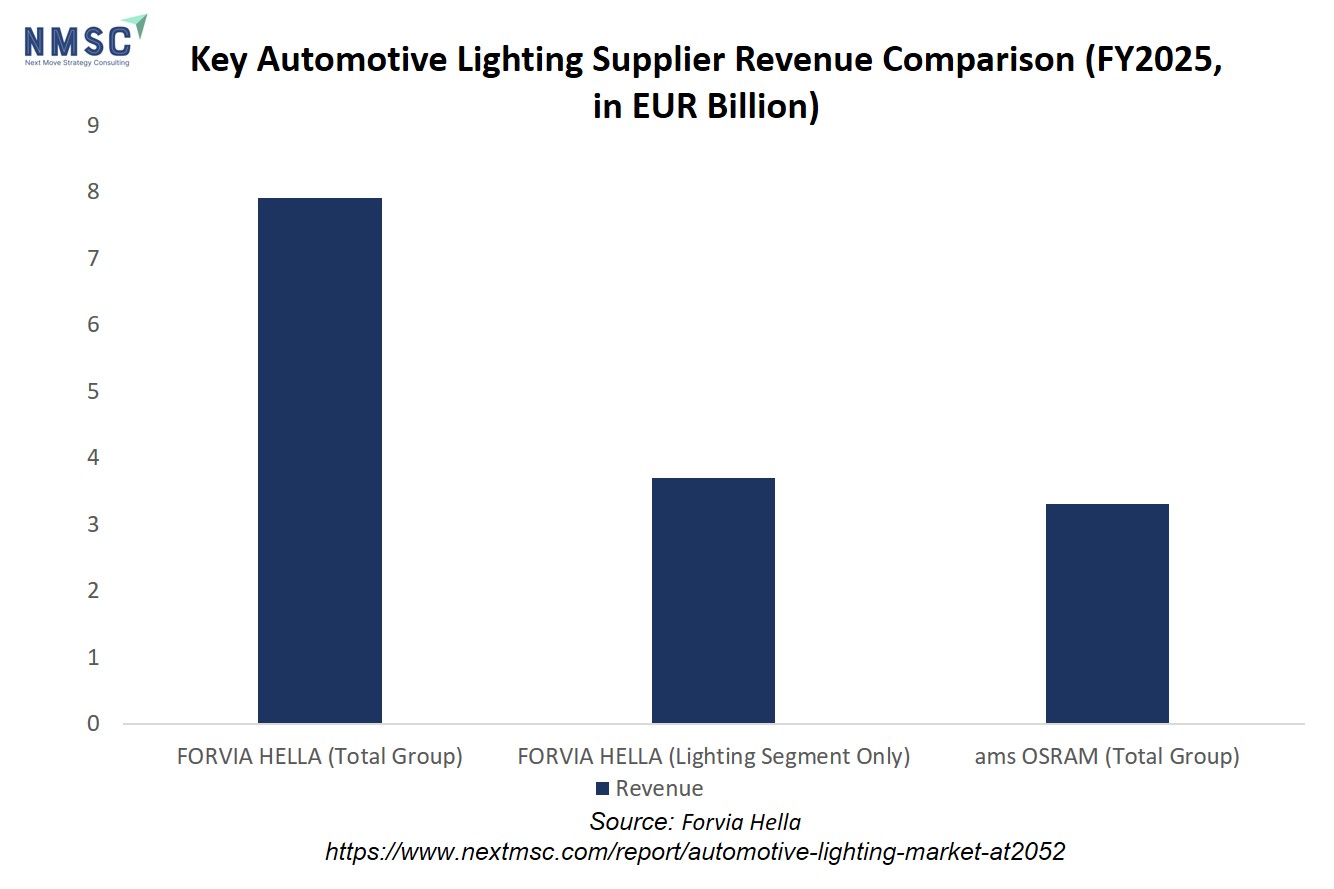
Firms such as ams OSRAM and Marelli are developing high-density LED matrices with tens of thousands of controllable pixels, enabling headlights to function as low-resolution projectors that broadcast information into the driving environment.
The Branding Dimension: Lighting as a Competitive Differentiator
In an era where electric vehicles share similar architectures and near-silent drivetrains, visual identity has become a crucial differentiator. Distinctive daytime running lights and taillight signatures now function as nocturnal brand identifiers, with vehicles greeting drivers through animated welcome sequences and choreographed light displays during charging. FORVIA (HELLA) has expanded OLED taillight production for premium vehicle platforms, positioning OLED-based signature lighting as a structural alternative to conventional LED arrays for automakers prioritizing styling differentiation alongside energy efficiency.
Section Summary: Regulatory mandates, large-scale supplier capital investment, and the growing strategic importance of lighting as a brand differentiator are collectively reshaping the competitive dynamics of the automotive lighting industry.
Key Takeaways:
-
NHTSA and UNECE regulatory frameworks are structurally reinforcing LED and adaptive lighting adoption across North America and Europe.
-
Valeo's 45+ million euro investment at its Angers plant (2023–2026) reflects Tier-1 supplier confidence in the long-term growth trajectory.
-
OLED signature lighting is transitioning from a premium novelty to a structural product category as automakers prioritize visual brand identity.
-
Compliance risk management is becoming a core competency for suppliers deploying pixel-based and projection-capable lighting systems.
Pros and Cons of Recent Market Developments
|
Recent Development |
Pros |
Cons |
|
Pixel-Dense ADB Headlamp Commercialization |
Dramatically improves nighttime safety; enables road projection and vehicle-to-pedestrian communication; creates high-value contract opportunities for Tier-1 suppliers |
High unit cost limits near-term adoption to premium segments; requires complex sensor integration and software calibration |
|
OLED/Micro-LED Signature Lighting Expansion |
Enables distinctive brand identity; improves energy efficiency vs. conventional LED arrays; supports styling differentiation in EV platforms |
Higher manufacturing cost than standard LED; limited supplier base with proven OLED automotive production capability |
|
Software-Defined Lighting Controls |
Enables over-the-air feature updates post-sale; supports personalization and ambient cabin differentiation; aligns with software-defined vehicle architecture |
Increases cybersecurity exposure; raises regulatory complexity across markets with differing standards for dynamic lighting behavior |
|
Laser Headlight Adoption in Premium Vehicles |
Extends illumination range well beyond LED systems; reduces power consumption relative to output; supports high-speed highway safety |
Significant cost premium restricts adoption to flagship vehicle trims; regulatory approval remains inconsistent across markets |
|
Integrated Lighting-Sensor Module Development |
Reduces wiring harness complexity; supports EV platform weight reduction goals; creates recurring contract volume for capable suppliers |
Requires deep cross-disciplinary engineering capability; increases supplier qualification timelines for automaker programs |
|
Aftermarket LED Retrofit Market Expansion |
Addresses large installed base of halogen-equipped vehicles; generates incremental revenue without new vehicle purchase dependency |
Compliance risk from non-certified retrofit products; potential for market fragmentation among low-quality regional suppliers |
NMSC Automotive Lighting Market — Regional Outlook (2025–2035)
|
Region |
2025 Market Size (USD) |
2035 Market Size (USD) |
CAGR (2026–2035) |
Primary Growth Driver |
|
Asia-Pacific |
USD 14.61 Billion |
USD 28.15 Billion |
6.9% |
Passenger vehicle production growth and LED penetration |
|
Europe |
USD 9.86 Billion |
USD 15.01 Billion |
4.1% |
UNECE regulation compliance and premium adoption |
|
North America |
USD 8.76 Billion |
USD 13.14 Billion |
4.0% |
EV platform lighting redesign |
|
Latin America |
USD 1.46 Billion |
USD 2.51 Billion |
5.6% |
Growing passenger vehicle sales and safety regulation |
|
Middle East & Africa |
USD 1.83 Billion |
USD 3.75 Billion |
7.7% |
Expanding vehicle fleet and aftermarket LED demand |
|
Total Market |
USD 36.52 Billion |
USD 62.56 Billion |
5.53% |
|
Future Outlook & Forecast
Market Trajectory: USD 62.56 Billion by 2035
According to NMSC, the global automotive lighting market is forecast to expand from USD 38.54 billion in 2026 to USD 62.56 billion by 2035, representing a 5.53% CAGR and an absolute dollar opportunity of USD 24.02 billion over the forecast period. This growth trajectory is broad-based across every segmentation axis, with LED adoption and OLED/Micro-LED innovation driving the dominant structural shifts.
OLED/Micro-LED: The Fastest-Growing Technology Category
The OLED/Micro-LED segment is projected to grow at a 26.1% CAGR from 2026 to 2035, expanding from USD 1.10 billion in 2025 to USD 9.38 billion by 2035. This growth is underpinned by automakers' accelerating demand for brand-specific lighting signatures and the alignment of OLED technology with software-defined vehicle architectures. Suppliers integrating OLED lighting with autonomous vehicle perception systems are particularly well-positioned, as software-defined lighting platforms create a mechanism for external communication signals between autonomous vehicles and pedestrians or traffic infrastructure.
Interior and Cargo Lighting: The Underappreciated Growth Pocket
Interior and Cargo Lighting is the fastest-growing application segment at a 9.8% CAGR through 2035, expanding from USD 5.11 billion in 2025 to USD 12.51 billion by 2035. This growth reflects the expanding role of programmable, multi-zone ambient lighting in vehicle cabin differentiation — a trend reinforced by Hyundai Mobis's expansion of programmable mood lighting systems synchronized with infotainment and driver alertness cues.
Regional Dynamics: Asia-Pacific Leads, Middle East & Africa Accelerates
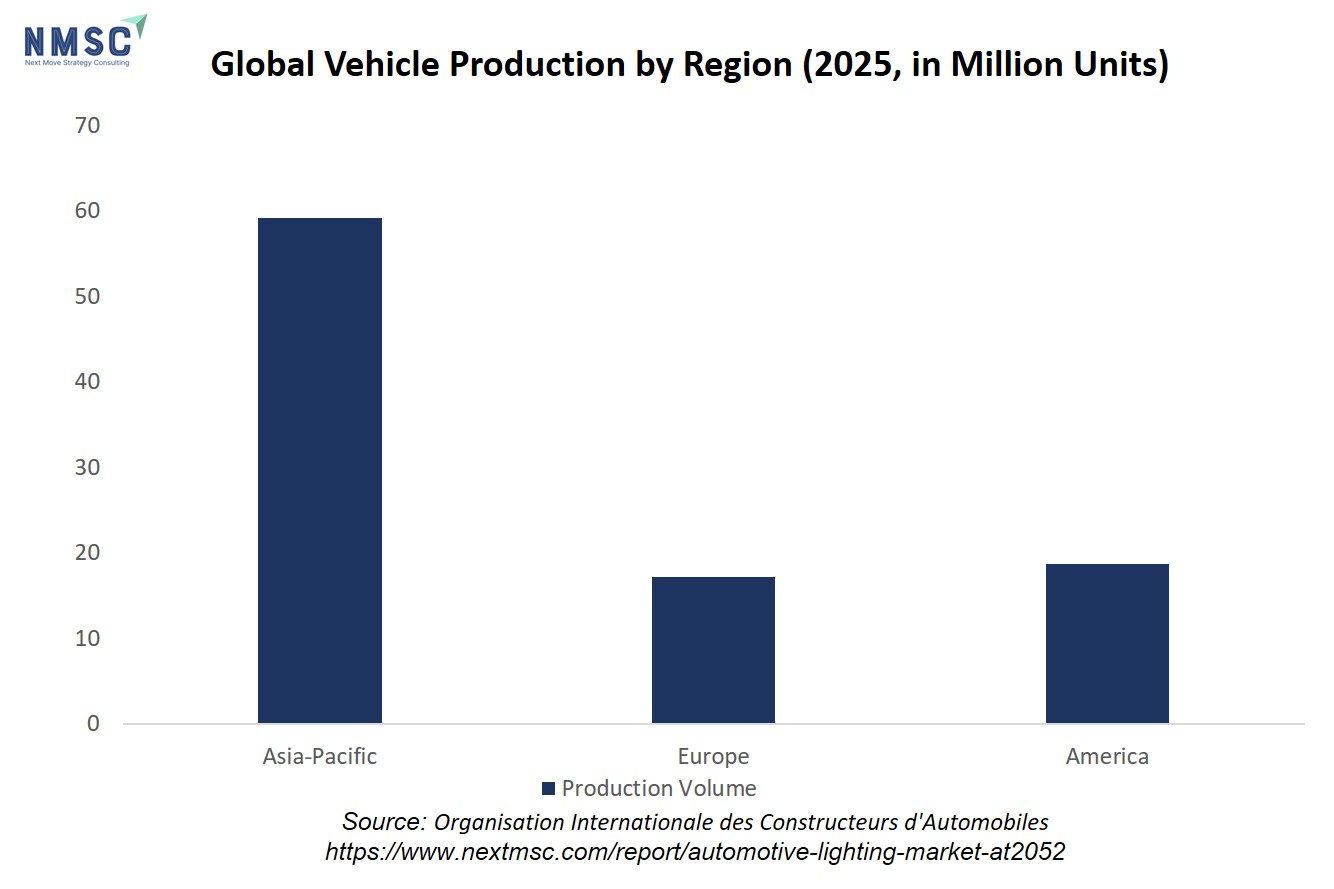
Asia-Pacific maintains its position as the dominant region with approximately 40% revenue share (USD 14.61 billion in 2025), driven by expanding passenger vehicle production in China and India and rising LED penetration. India is the fastest-growing country at an 11.2% CAGR through 2035, reflecting rising passenger and two-wheeler vehicle production and expanding LED replacement of halogen systems. The Middle East & Africa region is the fastest-growing globally at a 7.7% CAGR, driven by expanding vehicle fleets and rising aftermarket LED retrofit demand in Saudi Arabia and the UAE.
Visible Light Communication: The Next Frontier
Researchers are exploring visible light communication (VLC), in which modulated LED beams transmit data while simultaneously illuminating the road. In such systems, headlights or streetlights could relay navigation updates, hazard warnings, or traffic information directly to nearby vehicles — a development that would fundamentally expand the functional scope of automotive lighting beyond safety and aesthetics into active vehicle-to-infrastructure communication.
Section Summary: The automotive lighting market's growth through 2035 will be driven by OLED/Micro-LED technology adoption, interior lighting expansion, and accelerating demand from Asia-Pacific and Middle East & Africa markets, with visible light communication representing the next major technology frontier.
Key Takeaways:
-
The global automotive lighting market is projected to reach USD 62.56 billion by 2035 at a 5.53% CAGR, per NMSC.
-
OLED/Micro-LED is the fastest-growing technology segment at 26.1% CAGR — the highest growth rate across all technology categories.
-
Interior and Cargo Lighting is the fastest-growing application at 9.8% CAGR, reflecting the expanding role of ambient lighting in cabin differentiation.
-
India (11.2% CAGR) and Middle East & Africa (7.7% CAGR) represent the highest-growth geographic opportunities through 2035.
Next Steps for Stakeholders
For Tier-1 Suppliers and Technology Vendors:
Prioritize investment in adaptive lighting control software and OLED/Micro-LED production capability. Suppliers without advanced optics research capability face a growing risk of exclusion from next-generation vehicle program shortlists. Strategic alliances with semiconductor and sensor technology providers are an increasingly important positioning lever, particularly for mid-sized suppliers seeking to compete for integrated lighting-sensor module contracts on EV platforms.
For Automotive OEMs:
Accelerate the specification of adaptive and matrix LED lighting systems across mid-tier vehicle trims, not only flagship models. The democratization of advanced lighting features is a proven mechanism for margin expansion and brand differentiation in a market where EV platforms are converging on similar architectures. Engage lighting suppliers early in platform development cycles to ensure integrated lighting-sensor module compatibility with next-generation wiring harness architectures.
For Institutional Investors and Financial Analysts:
The OLED/Micro-LED segment's 26.1% CAGR and the Interior and Cargo Lighting segment's 9.8% CAGR represent the highest-conviction growth pockets within the broader automotive lighting market. Capital allocation toward suppliers with proprietary optics, adaptive lighting control software, and scaled manufacturing capacity in Asia-Pacific is most aligned with the market's structural growth trajectory. The Middle East & Africa region's 7.7% CAGR also warrants attention as an underappreciated geographic opportunity, particularly for aftermarket LED retrofit distributors.
For Aftermarket Distributors:
The large installed base of halogen-equipped vehicles represents a significant, underpenetrated opportunity for certified LED retrofit products. Distributors that establish compliance-verified product lines and regional partnerships with global lighting suppliers are best positioned to capture incremental revenue from cost-conscious vehicle owners seeking LED upgrades without new vehicle purchase.
For Policymakers and Regulatory Bodies:
The rapid advancement of pixel-based and projection-capable lighting systems is outpacing existing regulatory frameworks in most markets. Proactive engagement with UNECE and NHTSA standard-setting processes — particularly around dynamic beam behavior, road projection standards, and visible light communication protocols — will be essential to ensure that innovation and road safety remain aligned.
Conclusion
The automotive lighting market has entered a period of structural transformation that is simultaneously technological, regulatory, and strategic in nature. The commercial arrival of pixel-dense adaptive driving beam systems, the accelerating adoption of OLED signature lighting, and the integration of illumination with sensing and communication functions are collectively redefining what automotive lighting means — and what it is worth. Against this backdrop, NMSC projects the market to expand from USD 38.54 billion in 2026 to USD 62.56 billion by 2035, underpinned by a USD 24.02 billion absolute dollar opportunity that will accrue disproportionately to suppliers with diversified, next-generation technology portfolios.
For executives and investors navigating this landscape, the strategic imperative is clear: the automotive lighting market rewards those who move early on OLED/Micro-LED capability, integrated lighting-sensor module development, and geographic positioning in Asia-Pacific and the Middle East & Africa. Those who remain anchored to legacy halogen and xenon production without a credible transition roadmap face a structurally declining revenue base. The light is changing — and the window to reposition is narrowing.
About the Author
 Sanyukta Deb
— Sanyukta Deb is Digital Marketing Team Lead at Next Move Strategy Consulting, where she has led content strategy and technical SEO for the firm's B2B market research publications for over 2 years. Her editorial process translates NextMSC's primary and secondary research — spanning technology, industrial, and consumer sectors — into commercial narratives, backed by search-intent, keyword, and competitive analysis. She brings 5 years of overall experience in digital marketing and content strategy.
Sanyukta Deb
— Sanyukta Deb is Digital Marketing Team Lead at Next Move Strategy Consulting, where she has led content strategy and technical SEO for the firm's B2B market research publications for over 2 years. Her editorial process translates NextMSC's primary and secondary research — spanning technology, industrial, and consumer sectors — into commercial narratives, backed by search-intent, keyword, and competitive analysis. She brings 5 years of overall experience in digital marketing and content strategy.
About the Reviewer
 Debashree Dey
— Debashree Dey is Assistant Manager at Next Move Strategy Consulting, where she supports cross-vertical market content and communications across diverse industries for 6 years. Her professional background includes senior content writing, communications, and published manuscript authorship, with experience developing audience-focused business narratives and maintaining clear, consistent messaging. Her role supports research-led content development and editorial quality across NextMSC publications.
Debashree Dey
— Debashree Dey is Assistant Manager at Next Move Strategy Consulting, where she supports cross-vertical market content and communications across diverse industries for 6 years. Her professional background includes senior content writing, communications, and published manuscript authorship, with experience developing audience-focused business narratives and maintaining clear, consistent messaging. Her role supports research-led content development and editorial quality across NextMSC publications.

















Add Comment