Advanced Metering Infrastructure Market: Why Software Is Gaining | NextMSC
Introduction
On October 26, 2026, Landis+Gyr Group AG announced a contract with a leading U.S. investor-owned electric utility covering more than 3 million advanced metering endpoints, including Revelo meters, network and head-end technology, security solutions and software services. On October 29, 2026, the company reported first-half order intake of USD 337.3 million, a book-to-bill ratio of 0.7x, and a major contract award after the period close that alone produced USD 509 million of order intake in October. The sequence shows how the advanced metering infrastructure market now behaves: hardware revenue arrives in large, irregular deployment blocks, while the contracts that anchor those blocks increasingly bundle software, security and managed services.
According to Next Move Strategy Consulting's Advanced Metering Infrastructure Market report, the global advanced metering infrastructure market was valued at USD 22.07 billion in 2023 and is projected to reach USD 45.15 billion by 2030, growing at a CAGR of 10.7% from 2024 to 2030. The question for utilities, investors and suppliers is no longer whether smart meters will be installed, but who captures value as deployment shifts from first-time installation toward replacement, communications upgrades, analytics and managed services.
For More Information: Download FREE Sample on Advanced Metering Infrastructure Market Report
This article reviews company results, regulatory actions and national programmes published between July and November 2026 in Germany, Great Britain, India and the Philippines, with every source named in the text.
Landis+Gyr's 3 Million-Endpoint Award Signals a New Phase for the Advanced Metering Infrastructure Market
Landis+Gyr: Irregular Orders, Record Margins
Landis+Gyr Group AG's first-half results show how uneven AMI hardware demand can be even when strategy is working. Net revenue for the half-year ended September 30, 2026 fell 6.3% to USD 501.4 million, which the company attributed to project transition timing between two major customer deployments. Over the same period, adjusted gross margin rose 370 basis points to 37.7%, and the second quarter delivered a record adjusted gross margin of 38.0% on net revenue of USD 269.2 million. The company raised its adjusted EBITDA margin guidance for fiscal year 2026 to between 15.0% and 16.0%.
The mechanism matters for suppliers. A multi-million-endpoint award converts to revenue only as meters ship and networks are commissioned, so a half-year without a new anchor award can show a book-to-bill ratio below 1.0x. The USD 509 million booked in October exceeded the whole first-half intake of USD 337.3 million by USD 171.7 million. Chief Financial Officer Davinder Athwal said the company expects a strong second half, supported by the ramp-up of new customer deployments.
Itron: Recurring Revenue Rises as Network Revenue Pauses
Itron, Inc. reported third-quarter 2026 results on October 27, 2026 that show the same divergence from a different angle. Revenue rose 3% to USD 599 million, annual recurring revenue increased 25% to USD 423 million, bookings reached USD 482 million and total backlog stood at USD 4.3 billion. Yet Networked Solutions revenue decreased 1% in the quarter because of the timing of project deployments, and totalled USD 1,079.4 million over the first nine months of 2026 against USD 1,205.4 million a year earlier. Outcomes revenue, which is led by services, rose to USD 284.6 million from USD 247.9 million over the same nine months.
Service revenues rose to USD 110.3 million in the quarter from USD 87.3 million, and adjusted gross margin increased 350 basis points to 41.3% on customer and product mix and operational efficiencies. Chief Executive Officer Tom Deitrich said an expanding software and services portfolio is supporting recurring revenue growth.
Badger Meter: Water AMI Pacing Slows While Software Offsets
Water AMI shows the pattern in miniature. Badger Meter, Inc. reported third-quarter 2026 sales of USD 235.9 million on October 22, 2026, against USD 235.7 million a year earlier. Excluding its UDlive acquisition, utility water sales rose 5% from the second quarter but declined 3% year on year, which the company attributed to uneven AMI project pacing partially offset by higher software revenue. NextMSC primary research and analysis reads the disclosure as a separation of two forces that headline revenue blends: the timing of utility procurement, and the steady growth of software attached to meters already in service.
India and the Philippines: Asia's Deployment Volume
According to the Ministry of Power of the Government of India, in a written reply to Parliament reported by T&D India on August 6, 2026, 7.24 crore (72.4 million) smart meters had been installed nationwide as of June 30, 2026, including 5.73 crore (57.3 million) under the Revamped Distribution Sector Scheme (RDSS). The scheme has sanctioned 20.33 crore (203.3 million) smart meters, comprising 19.79 crore consumer meters, 52.53 lakh distribution transformer meters and 2.05 lakh feeder meters, and its sunset date is currently March 31, 2028. The ministry's reply cited delays in model tender documents, tendering and awarding of works, contract signing and consumer engagement as reasons for slower progress.
In the Philippines, BusinessWorld reported on November 2, 2026 that Manila Electric Company (Meralco) plans to install 280,000 to 420,000 smart meters in 2027 at an estimated cost of PHP 4 billion to PHP 4.6 billion. The plan sits within an AMI programme for which the Energy Regulatory Commission approved about PHP 33.4 billion of investment for the regulatory period from July 2026 to June 2030. Meralco's Chief Operating Officer, Ronnie L. Aperocho, said the spending also covers communications, systems and cybersecurity infrastructure. The programme targets about 12 million smart meters over the next decade, against about 196,000 deployed today.
NMSC Strategic Perspective: Why Value Is Migrating Toward Software and Services in the Advanced Metering Infrastructure Market
NextMSC primary research and analysis identifies three linked shifts in the October and November 2026 evidence. The first is timing. Landis+Gyr's first-half order intake of USD 337.3 million against a USD 509 million October award, Itron's nine-month Networked Solutions revenue of USD 1,079.4 million against USD 1,205.4 million a year earlier, and Badger Meter's 3% year-on-year decline in utility water sales excluding its acquisition all point to project-driven hardware revenue that is irregular by construction. NextMSC's forecast of USD 45.15 billion by 2030 spans meters, AMI network infrastructure, communication modules, software and services, so a pause in one supplier's hardware shipments can coexist with growth in another category.
The second shift is mix. Itron's service revenues rose from USD 87.3 million to USD 110.3 million in the quarter and its annual recurring revenue grew 25%, while Badger Meter's software revenue offset part of its AMI product decline. In NextMSC's offering segmentation, software, which spans head-end systems, meter data management, analytics, customer portals, prepayment and cybersecurity, and services, which span consulting, integration, installation, managed services and maintenance, are positioned to capture a larger share of each deployment dollar even where meter volumes are flat.
The third shift is geography. NextMSC primary research and analysis identifies North America as the largest regional market and Asia-Pacific as the fastest-growing, a split the evidence supports. The U.S. award at Landis+Gyr anchors North American demand, while India's 57.3 million RDSS installations and Meralco's 12 million-meter programme anchor Asia-Pacific volume.
Section Summary:
Company results from October 2026 show hardware revenue timing diverging from software and services growth, while Asian programmes supply deployment volume.
-
Landis+Gyr Group AG booked USD 509 million of order intake in October 2026 after a first half with a 0.7x book-to-bill ratio.
-
Itron, Inc. grew annual recurring revenue 25% to USD 423 million while nine-month Networked Solutions revenue fell to USD 1,079.4 million.
-
India reached 7.24 crore installed smart meters by June 30, 2026, and Meralco plans up to 420,000 installations in 2027.
Industry Impact Analysis: Regulation Moves From Mandates to Enforcement
Germany: Penalty Payments Put a Price on Missed Quotas
On November 16, 2026, the Bundesnetzagentur, Germany's federal network agency, reported penalty payments totalling about EUR 1.4 million against 72 basic metering point operators that had not met the statutory quota of equipping 20% of end consumers with annual consumption between 6,000 and 100,000 kilowatt-hours with smart meters, as relayed by the dpa-AFX news agency. The agency had asked 438 operators since March to complete mandatory installations by the end of September, and more than 80% of the defaulting companies met the quota within that period. At the end of June 2026, smart meters were installed at 5.9% of just over 54 million metering points, a rate well behind other EU states.
Enforcement is also reshaping who performs the work. On November 17, 2026, ZfK reported that two competitive operators, Energy Metering and Metrify, are offering to run the rollout for municipal utilities and equip their mandatory-installation cases within three months, starting with Stadtwerke Wunsiedel, which has about 14,000 metering points.
Great Britain: Powers Extended to 2033 as Replacements Overtake New Installations
On November 4, 2026, the Department for Energy Security and Net Zero published a factsheet on the Energy Independence Bill that extends the government's smart metering powers by five years, from November 1, 2028 to November 1, 2033. The department said the extension aligns with a 2030 policy framework that plans to complete the rollout by the end of 2030 and move industry onto the 4G communications network by 2033. It estimates that the rollout will deliver a GBP 6 billion net benefit after all costs.
The installed base is already large. According to the department's statistical bulletin published on August 27, 2026, there were 42 million smart and advanced meters in homes and small businesses across Great Britain at the end of June 2026, equal to 72% of all meters, and 92% of the 40 million smart meters were operating in smart mode, meaning they communicate remotely with the supplier.
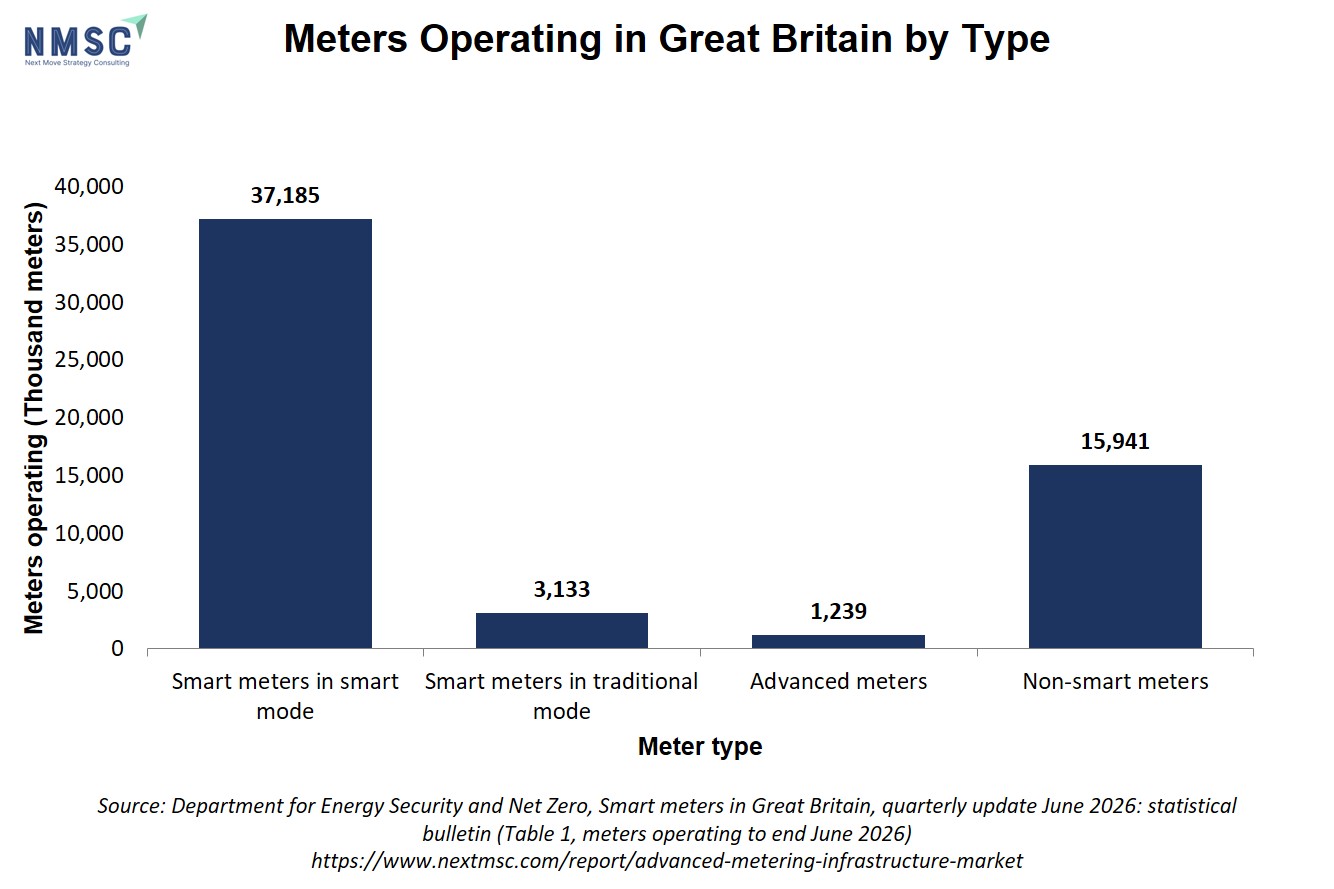
Table 1 of the Department for Energy Security and Net Zero's June 2026 statistical bulletin reports 37,185,000 smart meters in smart mode, 3,133,000 smart meters in traditional mode, 1,239,000 advanced meters and 15,941,000 non-smart meters, for 57,498,000 meters in total. The figures combine large suppliers at the end of June 2026 with small suppliers at the end of December 2025, the latest data available for small suppliers, and are rounded to the nearest thousand by the source.
The mix of work has changed more than the volume. Large suppliers carried out 1,067,000 domestic installations in the second quarter of 2026, consistent with about 1.0 million a quarter since 2022, but 564,000 of them, or 53%, were replacements of existing smart or advanced meters, up from 14% in the first quarter of 2022 and 30% in the second quarter of 2025. Replacements maintain smart service when meters reach the end of their operational life or need compatibility with the latest communications technology.
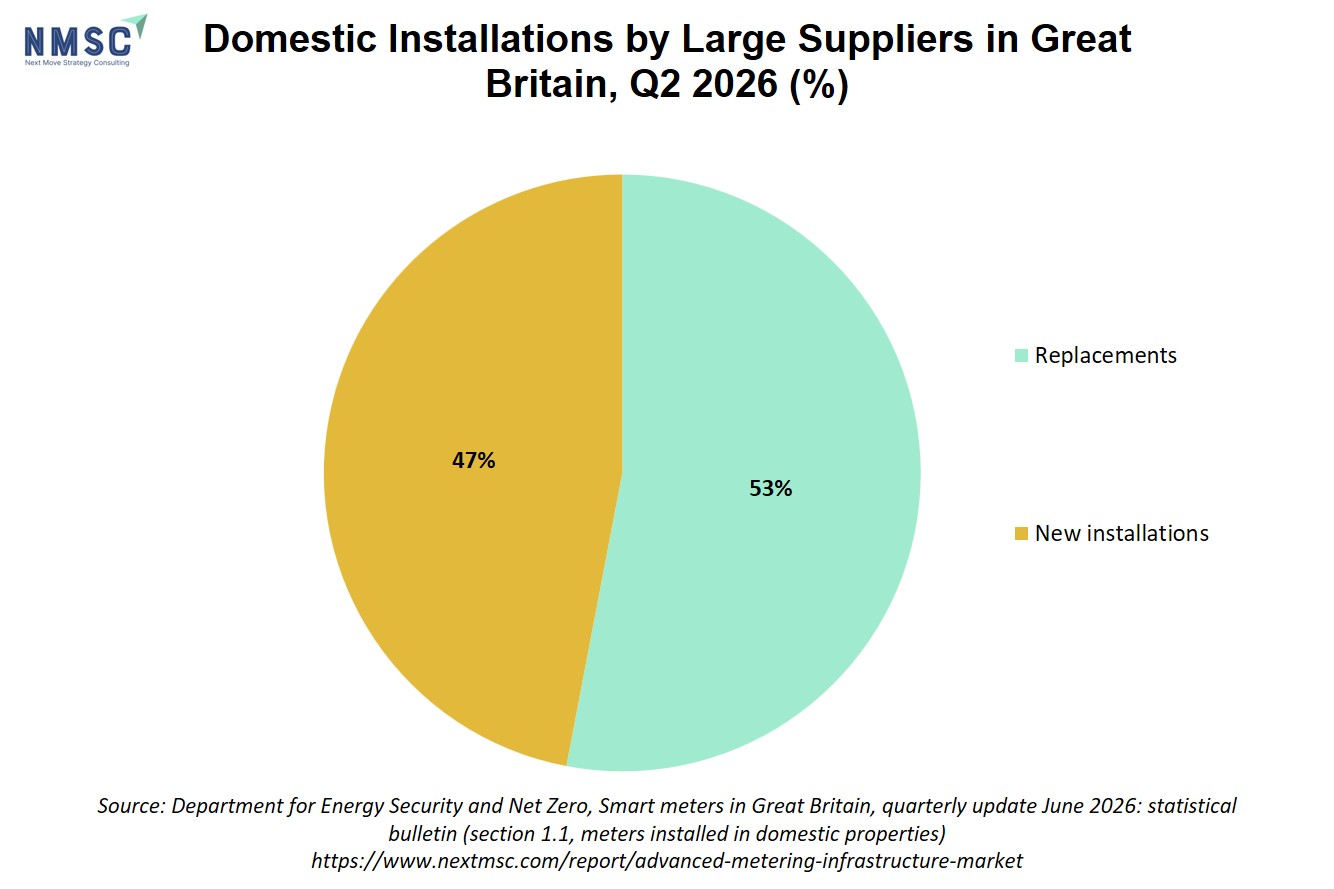
The department reports 1,067,000 domestic installations by large energy suppliers in the second quarter of 2026, of which 503,000 were new installations and 564,000 were replacements, and states that replacements were 53% of all installations. The new-installation share of 47% is the remainder of 100% after the published replacement share. The same bulletin reports that replacements were 14% of installations in the first quarter of 2022 and 30% in the second quarter of 2025.
NextMSC primary research and analysis sees a commercial consequence. Replacement demand does not depend on new customer connections or on a one-time mandate; it follows device lifetimes, communications migration and regulatory deadlines. That makes volumes more predictable and raises the value of software that manages mixed fleets of old and new meters.
Electricity Demand: Utilities Need Interval Data
The International Energy Agency's Electricity Mid-Year Update 2026, published on July 23, 2026, forecasts global electricity demand growth of 3.6% in 2026 and 3.8% in 2027, up from 3% in 2025, with 2026 growth of 5.5% in China, 7% in India and close to 2% in both the United States and the European Union. Average spot electricity prices in the European Union and Japan also rose by more than 30% year on year in the second quarter of 2026. Time-of-use billing, demand-response dispatch and outage detection rely on the interval readings that AMI collects, so rising demand and volatile prices raise the value of that data.
Section Summary:
Regulators in Germany and Great Britain are tightening delivery, and replacement work is becoming a larger share of installations.
-
The Bundesnetzagentur set penalty payments of about EUR 1.4 million against 72 operators on November 16, 2026.
-
The Department for Energy Security and Net Zero extended smart metering powers to November 1, 2033.
-
Replacements made up 53% of domestic installations by large suppliers in Great Britain in the second quarter of 2026.
-
The International Energy Agency forecasts global electricity demand growth of 3.6% in 2026.
Pros and Cons of Recent Market Developments
|
Pros |
Cons |
|
Landis+Gyr Group AG's October 2026 award covering more than 3 million endpoints, with USD 509 million of order intake, adds multi-year deployment visibility. |
Landis+Gyr's first-half net revenue fell 6.3% to USD 501.4 million and its book-to-bill ratio was 0.7x, showing how irregular hardware orders are. |
|
Itron, Inc.'s annual recurring revenue rose 25% to USD 423 million, and its backlog reached USD 4.3 billion. |
Itron's Networked Solutions revenue totalled USD 1,079.4 million over nine months against USD 1,205.4 million a year earlier. |
|
Replacement work in Great Britain, at 53% of domestic installations in the second quarter of 2026, sustains volume without new connections. |
Replacements add cost without adding customers, and 92% of smart meters were operating in smart mode, leaving a remaining share to remediate. |
|
India's 7.24 crore installed smart meters and Meralco's 12 million-meter programme provide long deployment runways. |
India's 5.73 crore RDSS installations compare with 20.33 crore sanctioned, and the scheme's sunset date is March 31, 2028. |
|
German enforcement, with penalty payments of about EUR 1.4 million against 72 operators, accelerates deliveries. |
Smart meters covered only 5.9% of German metering points at the end of June 2026. |
Key Data & Statistics
AMI Supplier and Utility Programme Data, October to November 2026
|
Organisation |
Date |
Metric |
Reported Figure |
|
Landis+Gyr Group AG |
October 29, 2026 |
First-half net revenue; order intake; backlog |
USD 501.4 million; USD 337.3 million; USD 3.7 billion |
|
Landis+Gyr Group AG |
October 26, 2026 |
Contract scope, U.S. investor-owned utility |
More than 3 million endpoints |
|
Itron, Inc. |
October 27, 2026 |
Third-quarter revenue; annual recurring revenue; bookings |
USD 599 million; USD 423 million; USD 482 million |
|
Itron, Inc. |
October 27, 2026 |
Nine-month Networked Solutions revenue |
USD 1,079.4 million (USD 1,205.4 million a year earlier) |
|
Badger Meter, Inc. |
October 22, 2026 |
Third-quarter total sales |
USD 235.9 million (USD 235.7 million a year earlier) |
AMI Policy and Deployment Data by Region
|
Region |
Date |
Metric |
Reported Figure |
|
Great Britain |
August 27, 2026 |
Smart and advanced meters, end June 2026 |
42 million (72% of all meters) |
|
Great Britain |
August 27, 2026 |
Replacements share of domestic installations, Q2 2026 |
53% |
|
Great Britain |
November 4, 2026 |
End date of government smart metering powers |
November 1, 2033 (previously November 1, 2028) |
|
Germany |
November 16, 2026 |
Smart meter share of metering points, end June 2026 |
5.9% |
|
India |
August 6, 2026 |
Smart meters installed, June 30, 2026 |
7.24 crore (5.73 crore under RDSS) |
Future Outlook & Forecast: Where the Advanced Metering Infrastructure Market Goes From Here
NextMSC primary research and analysis projects the global advanced metering infrastructure market to grow from USD 22.07 billion in 2023 to USD 45.15 billion by 2030 at a CAGR of 10.7% over 2024 to 2030, with North America holding the largest regional share and Asia-Pacific growing fastest. The late-2026 evidence supports that trajectory on three counts: committed programmes with defined end dates, regulators moving from targets to penalties, and rising software and services content in each deployment.
Programme calendars set the pace through 2030. India's RDSS has a sunset date of March 31, 2028, and by NextMSC's calculation from the ministry's figures, 14.60 crore (146.0 million) sanctioned smart meters were still to be installed at June 30, 2026. Meralco's regulatory period runs to June 2030 against a 12 million-meter decade-long target. Great Britain aims to complete its rollout by the end of 2030, and German operators face quotas backed by penalties. Each calendar converts into a procurement schedule for meters, communication modules, head-end systems and integration services.
The risks are specific. Hardware timing can depress a supplier's reported revenue, as Landis+Gyr's 6.3% half-year decline and Badger Meter's 3% decline in utility water sales excluding its acquisition show. India's ministry cites tendering and contract delays, and NextMSC identifies installation and maintenance cost as the main restraint on the advanced metering infrastructure market.
NextMSC primary research and analysis reads the evidence as favouring vendors that combine metering hardware with communications, analytics and managed services, a group that includes Itron, Landis+Gyr and Badger Meter among the companies profiled in NextMSC's report.
Section Summary:
The forecast rests on dated programmes and enforced mandates, with value shifting toward recurring services.
-
NextMSC projects USD 45.15 billion by 2030 at a 10.7% CAGR, from USD 22.07 billion in 2023.
-
India had 14.60 crore sanctioned smart meters outstanding at June 30, 2026, against a March 31, 2028 sunset date.
-
Supplier revenue timing remains the principal short-term risk to reported results.
Next Steps for Stakeholders
The evidence supports specific actions for C-level executives and institutional investors.
-
Utility chief executives and chief financial officers: build procurement calendars around fixed regulatory dates, such as India's March 31, 2028 RDSS sunset, Meralco's regulatory period to June 2030 and Great Britain's end-2030 completion target, and contract security, software and managed services with the meters.
-
Utility operations leaders: plan replacement cycles now. Replacements reached 53% of domestic installations in Great Britain in the second quarter of 2026.
-
Suppliers and integrators: report recurring revenue and backlog beside shipments, as Itron does, so that investors can separate deployment timing from underlying demand.
-
Institutional investors: track order intake, backlog and book-to-bill ratios across several quarters. Landis+Gyr's 0.7x half-year ratio and USD 509 million October award show why single-period revenue misleads.
-
Regulators and policy teams: pair quotas with delivery support. Germany's 5.9% coverage and 72 penalty cases show the cost of mandates that outrun installer capacity.
Conclusion
The advanced metering infrastructure market enters the final weeks of 2026 with strong demand signals and uneven supplier revenue. Landis+Gyr's USD 509 million October order intake, Itron's 25% rise in annual recurring revenue, Great Britain's 53% replacement share and the Bundesnetzagentur's penalty payments describe a sector maturing from first-time installation toward replacement, enforcement and software. NextMSC's forecast of USD 45.15 billion by 2030 at a 10.7% CAGR is consistent with that shift, and stakeholders that plan around dated programmes rather than single quarters of hardware revenue are best placed to benefit.
About the Author
 Sanyukta Deb
— Sanyukta Deb is Digital Marketing Team Lead at Next Move Strategy Consulting, where she has led content strategy and technical SEO for the firm's B2B market research publications for over 2 years. Her editorial process translates NextMSC's primary and secondary research — spanning technology, industrial, and consumer sectors — into commercial narratives, backed by search-intent, keyword, and competitive analysis. She brings 5 years of overall experience in digital marketing and content strategy.
About the Reviewer
 Debashree Dey
— Debashree Dey is Assistant Manager at Next Move Strategy Consulting, where she supports cross-vertical market content and communications across diverse industries for 6 years. Her professional background includes senior content writing, communications, and published manuscript authorship, with experience developing audience-focused business narratives and maintaining clear, consistent messaging. Her role supports research-led content development and editorial quality across NextMSC publications.












Add Comment