Optical Sensors on a Chip: Photonic Microresonator Breakthrough
Optical Sensors Shrinking Light onto Semiconductor Chips
Researchers at the University of Colorado Boulder have developed ultra-efficient optical microresonators that allow light to circulate within microscopic chip structures. These devices are designed with smooth curves that guide light along a controlled path, reducing energy loss and enabling photons to remain inside the resonator for longer periods. The extended circulation of light increases interaction between the optical field and surrounding materials, which significantly improves sensing sensitivity.
The design of these resonators is based on Euler curves, which create gradual transitions in the waveguide path. This approach reduces bending loss that typically occurs when light changes direction in optical circuits. By minimizing this loss, the resonator can sustain higher optical intensity, which is essential for applications such as chemical detection and precision measurement.
Fabrication of the devices takes place in specialized cleanroom environments using electron-beam lithography. This technique enables extremely precise patterning at the nanometer scale, which is necessary because even tiny imperfections can disrupt how light travels through photonic components.
Key Characteristics of Chip-Scale Optical Sensors
|
Feature |
Description |
|
Structure |
Racetrack-shaped microresonator |
|
Fabrication |
Electron-beam lithography |
|
Design concept |
Smooth Euler curves to reduce bending loss |
|
Potential applications |
Chemical sensing, navigation, microlasers |
These chip-scale resonators demonstrate how photonic engineering can significantly enhance optical sensor performance while reducing device size.
VCSEL Optical Sensors Improving Detection Precision
High-Precision Reflective Optical Sensors Using VCSEL Technology
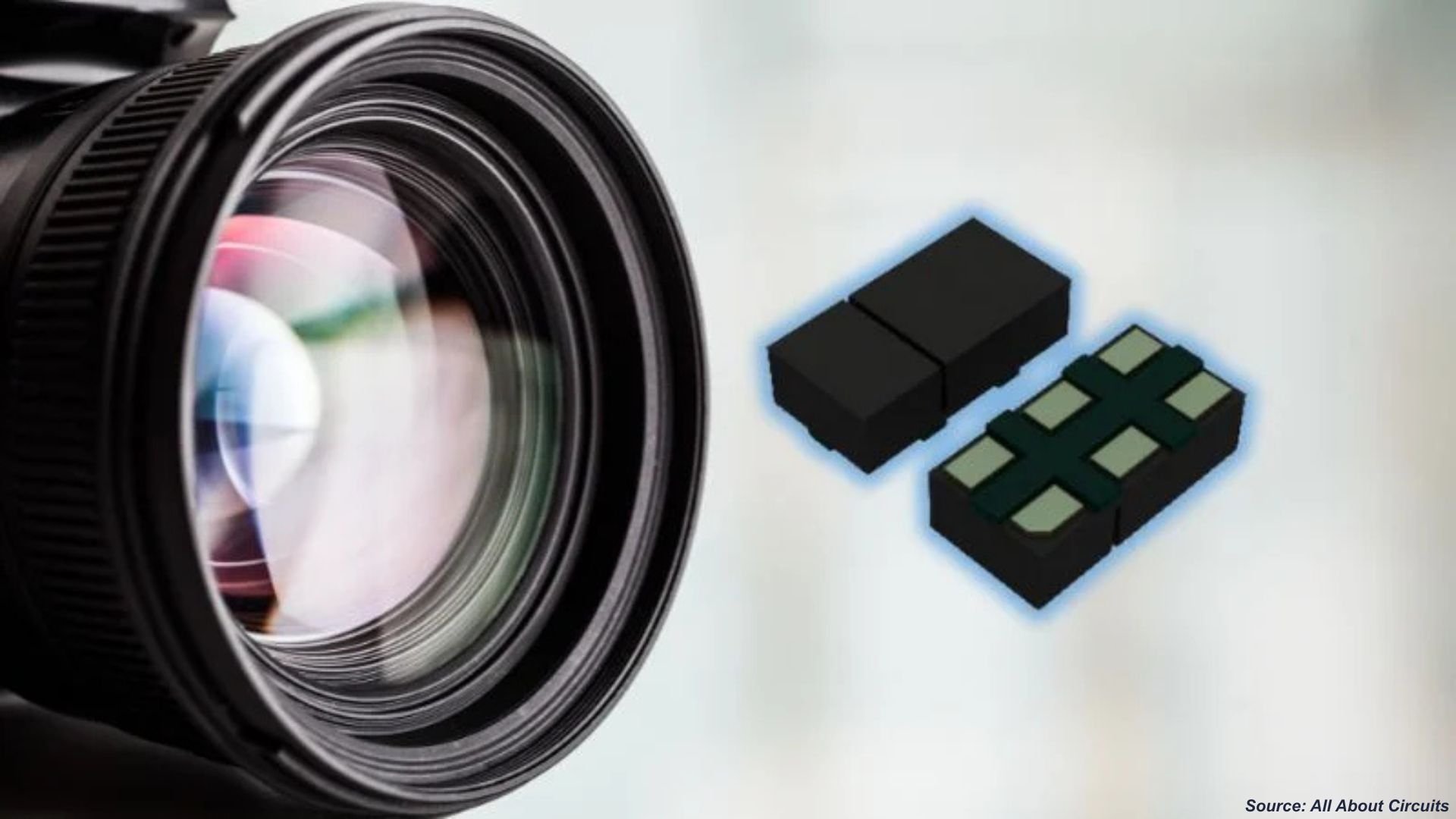
In another significant development, ROHM Semiconductor introduced the RPR-0730 reflective optical sensor, which incorporates a 940-nm VCSEL transmitter and a phototransistor receiver. VCSEL technology produces a highly directional beam of light, allowing more precise object detection compared with conventional LED-based optical sensors.
The narrow beam emitted by the VCSEL enables the sensor to detect very small objects and fine printed lines. This capability is particularly valuable in equipment that requires accurate positioning or material detection, such as printers, inspection devices, and industrial automation systems.
The RPR-0730 sensor is designed in an ultra-compact package measuring 2.0 mm × 1.0 mm × 0.55 mm, making it suitable for space-constrained electronic devices. It also offers a fast response time of 10 microseconds, enabling rapid detection in high-speed applications.
Sensor Performance Specifications
|
Specification |
Value |
|
Package size |
2.0 mm × 1.0 mm × 0.55 mm |
|
Response time |
10 µs |
|
Maximum detection distance |
10 mm |
|
Minimum detectable line width |
0.1 mm |
To ensure stable performance in real-world environments, the sensor includes a visible-light cutoff filter and an internal micro-slit structure. These features help reduce interference from ambient light, improving reliability in industrial settings.
Emerging Design Trends in Optical Sensors
Recent research and product developments indicate a broader shift in optical sensing technology toward higher efficiency and miniaturization. Two key innovations—photonic microresonators and VCSEL-based sensors—illustrate how advances in photonics and semiconductor engineering are shaping the next generation of sensing systems.
Photonic microresonators focus on improving how light is confined and manipulated inside integrated circuits. By keeping photons circulating inside a micro-scale loop, these structures amplify light intensity and increase interaction with materials. This characteristic makes them highly suitable for sensitive detection tasks such as chemical monitoring or precision navigation.
In contrast, VCSEL-based optical sensors emphasize detection accuracy and speed. Because VCSEL emitters produce narrow and well-controlled beams, they enable highly precise reflective sensing in compact electronic devices. Their fast switching capability also supports applications that require rapid detection cycles.
Comparison of Emerging Optical Sensor Technologies
|
Technology |
Core Advantage |
Typical Applications |
|
Photonic microresonators |
High sensitivity and low optical loss |
Chemical sensing, navigation systems |
|
VCSEL-based sensors |
Precise and high-speed detection |
Industrial automation, object detection |
These advancements collectively demonstrate that optical sensors are moving toward integrated photonic systems capable of delivering higher performance within increasingly smaller devices.
According to Next Move Strategy Consulting: Industry Impact
According to Next Move Strategy Consulting, the latest developments in chip-scale photonic resonators and VCSEL-based sensors signal an important transition in the optical sensing industry. The convergence of photonics and semiconductor manufacturing is enabling sensors that are both compact and highly efficient.
The chip-scale resonator innovation highlights the growing role of integrated photonics in sensing systems. By confining light within microscopic structures, photonic sensors can achieve greater measurement sensitivity while consuming less power. This capability is expected to influence future sensor architectures used in scientific instrumentation and advanced electronics.
Similarly, VCSEL-based optical sensors demonstrate how laser-driven detection systems can improve precision in automation environments. The directional nature of VCSEL emitters allows sensors to detect small objects and fine patterns with greater accuracy, which is increasingly important for modern manufacturing processes.
From an industry perspective, these developments suggest that optical sensing technologies will continue to evolve through the integration of photonics, laser emitters, and advanced nanofabrication techniques. As these innovations mature, they are likely to expand the use of optical sensors across industrial, scientific, and consumer electronics applications.
Next Steps for Technology and Industry Stakeholders
Advancements in optical sensing technology present several practical opportunities for manufacturers, technology developers, and research organizations.
-
Invest in Integrated Photonics: Companies developing sensing systems should explore chip-scale photonic integration to achieve compact and energy-efficient sensor designs.
-
Adopt VCSEL-Based Detection Systems: Industries requiring high-precision object detection can benefit from VCSEL-powered optical sensors due to their directional beam and fast response time.
-
Expand High-Sensitivity Applications: Optical microresonators open new possibilities for chemical sensing, environmental monitoring, and precision measurement systems.
-
Strengthen Semiconductor-Photonics Collaboration: Future optical sensor innovations will depend on collaboration between semiconductor manufacturers and photonics researchers.
About the Author
 Joydeep Dey
— Joydeep Dey is a content writer and analyst fueled by creativity, research, and continuous learning. He combines compelling storytelling with market insights to turn complex information into engaging, impactful content. Passionate about emerging trends, digital strategy, and innovation-driven communication, he believes curiosity and consistent growth are key to creating meaningful influence in every project.
Joydeep Dey
— Joydeep Dey is a content writer and analyst fueled by creativity, research, and continuous learning. He combines compelling storytelling with market insights to turn complex information into engaging, impactful content. Passionate about emerging trends, digital strategy, and innovation-driven communication, he believes curiosity and consistent growth are key to creating meaningful influence in every project.
About the Reviewer
 Sanyukta Deb
— Sanyukta Deb is Digital Marketing Team Lead at Next Move Strategy Consulting, where she has led content strategy and technical SEO for the firm's B2B market research publications for over 2 years. Her editorial process translates NextMSC's primary and secondary research — spanning technology, industrial, and consumer sectors — into commercial narratives, backed by search-intent, keyword, and competitive analysis. She brings 5 years of overall experience in digital marketing and content strategy.
Sanyukta Deb
— Sanyukta Deb is Digital Marketing Team Lead at Next Move Strategy Consulting, where she has led content strategy and technical SEO for the firm's B2B market research publications for over 2 years. Her editorial process translates NextMSC's primary and secondary research — spanning technology, industrial, and consumer sectors — into commercial narratives, backed by search-intent, keyword, and competitive analysis. She brings 5 years of overall experience in digital marketing and content strategy.


















Add Comment