AI-Ready Cobots Reshape the Future of Industrial Automation | NextMSC
Introduction
The global collaborative robot market is undergoing a structural transformation — one that is redefining the boundaries between human labor and machine precision across virtually every industrial sector. Cobots, once confined to light-duty assembly tasks in large automotive plants, are now being deployed in pharmaceutical cleanrooms, commercial kitchens, semiconductor fabs, and logistics hubs, driven by a convergence of AI integration, evolving safety standards, and the urgent need to address persistent labor shortages in high-wage economies.
According to Next Move Strategy Consulting's Collaborative Robot Market report, the global collaborative robot market is projected to reach USD 12.71 billion by 2030, growing at a CAGR of 32.6% from 2024 to 2030. This trajectory reflects not merely incremental adoption, but a fundamental shift in how manufacturers, healthcare providers, and logistics operators conceptualize human-machine collaboration on the shop floor and beyond.
The urgency of this shift is underscored by the International Federation of Robotics (IFR), whose World Robotics 2026 Report, released on September 24, 2026, confirmed that the global operational stock of industrial robots surged 9% to a record 5 million units in 2025, with factories worldwide installing more than 600,000 new units over the year — the highest annual installation figure ever recorded.
For More Information: Download FREE Sample on Collaborative Robot Market Report
From Factory Floors to Frontlines: The Cobot Inflection Point of 2026
The Gen 7 Moment: Universal Robots Redefines the Cobot Platform
The most consequential product launch in the collaborative robot market this year arrived on September 14, 2026, when Universal Robots (UR) — the world's leading manufacturer of collaborative industrial robots — unveiled its seventh-generation robotics platform, Gen 7, at the IMTS tradeshow in Chicago. The launch is not a product refresh; it is an architectural overhaul that repositions cobots as the primary deployment vehicle for physical AI in industrial operations.
Gen 7 introduces three new g-Series robot arms — the UR10g-1750, UR17g-1300, and UR18g-950 — each named after their payload capacity (kg) and reach (mm). The platform's CB7 Core controller delivers 40% more compute power in a 30% smaller footprint than previous generations, enabling multi-network communication across PLCs, HMIs, MES platforms, and vision systems without external switches. The new AI-ready tool flange delivers data, power, and safety signals directly to the end effector, eliminating cabling complexity that has historically slowed AI-enabled deployments.
"The robots of the AI era must be advanced, not complicated," said Jean-Pierre Hathout, President of the Teradyne Robotics Group, at the IMTS launch event on September 14, 2026. "Built on what we have learned from over 20 years of cobot innovation and more than 100,000 industrial deployments worldwide, Gen 7 is an end-to-end redesign of our platform that reduces integration friction and dramatically expands application capabilities."
The Gen 7 platform's PolyScope X operating system incorporates ISO 10218-1 safety functionality and IEC 62443-4-1 ML3 cybersecurity certification — a direct response to the updated ISO 10218-1:2025 and ISO 10218-2:2025 standards that came into force on April 1, 2025, representing the first revision to the core robot-safety framework in over a decade.
FANUC's Cobot and Go Strategy: Standardizing Rapid Deployment
Simultaneously, FANUC America debuted its dedicated "Cobot and Go" booth at Automate 2026 (June 22–26, McCormick Place, Chicago), showcasing pre-engineered CRX-series collaborative robot systems designed for rapid, standardized deployment without permanent infrastructure changes. The exhibit featured nine application-ready cells — spanning AI-driven inspection, collaborative welding, CNC machine tending, and e-commerce order picking — each built on mobile carts with standard power requirements and intuitive drag-and-drop programming interfaces.
"Many manufacturers want to automate but are hesitant to take on complex, fixed systems," said Simon Kenworthy, General Manager, Authorized System Integrator Sales, FANUC America, in a press release dated May 27, 2026. "The Cobot and Go approach shows how collaborative out-of-the-box robot solutions can make automation more accessible, scalable and achievable on the shop floor."
This strategic pivot — from bespoke automation projects to repeatable, plug-and-play deployment models — directly addresses the primary barrier to cobot adoption among small and medium-sized enterprises (SMEs): the perceived complexity and cost of integration.
ABB's AVR™ Vision: Cobots as the AI Innovation Platform
ABB Robotics has articulated six defining cobot trends for 2026, with the most consequential being the emergence of cobots as the primary platform for AI innovation. ABB's Autonomous Versatile Robotics (AVR™) framework leverages generative AI to enable cobots to move beyond pre-defined programming toward autonomous learning, multi-task execution, and real-time decision-making through 3D AI vision, force sensing, and natural language interfaces.
ABB also identifies the expansion of cobots into non-traditional environments — clinical and diagnostic laboratories, pharmaceutical workflows, commercial kitchens, and research facilities — as a defining structural shift, driven by cobots' compact size, quiet operation, and inherently safe design.
NMSC Strategic Perspective: Why This Inflection Point Is Structurally Different
NextMSC primary research and analysis indicates that the current phase of collaborative robot market growth is qualitatively distinct from prior adoption cycles. Three structural mechanisms are converging simultaneously:
First, the AI-readiness of next-generation cobot platforms — exemplified by Universal Robots' Gen 7 — is collapsing the integration timeline from months to days for AI-enabled applications, directly expanding the addressable market beyond manufacturers with dedicated robotics engineering teams.
Second, the enforcement of ISO 10218-1:2025 and ISO 10218-2:2025 from April 2025, combined with the EU Machinery Regulation (EU 2023/1230) compliance deadline approaching in 2027, is compelling European manufacturers to upgrade legacy automation infrastructure, creating a replacement-driven demand cycle that is additive to greenfield deployments.
Third, the diversification of cobot demand beyond automotive OEMs — into life sciences, semiconductors, food processing, and logistics — is reducing the market's cyclical sensitivity to any single end-market downturn, as evidenced by Q1 2026 order data from the Association for Advancing Automation (A3).
Section Summary: The collaborative robot market's current trajectory is being shaped by three simultaneous forces: AI-native platform redesigns (Universal Robots Gen 7), standardized rapid-deployment strategies (FANUC Cobot and Go), and the expansion of cobot applications into non-traditional sectors. These are not incremental improvements — they represent a structural broadening of the cobot addressable market.
Key Takeaways:
-
Universal Robots' Gen 7, launched September 14, 2026 at IMTS, delivers 40% more compute power and an AI-ready tool flange, reducing physical AI deployment timelines from months to days.
-
FANUC America's Cobot and Go initiative at Automate 2026 demonstrates a shift from custom automation projects to standardized, portable, plug-and-play cobot cells.
-
ABB's AVR™ framework positions cobots as the primary environment for developing and scaling generative AI-driven robotic capabilities.
-
Updated ISO 10218-1:2025 and ISO 10218-2:2025 standards, in force since April 2025, are accelerating compliance-driven cobot upgrades across European manufacturing.
Industry Impact Analysis
Demand Diversification: The Q1 2026 Signal
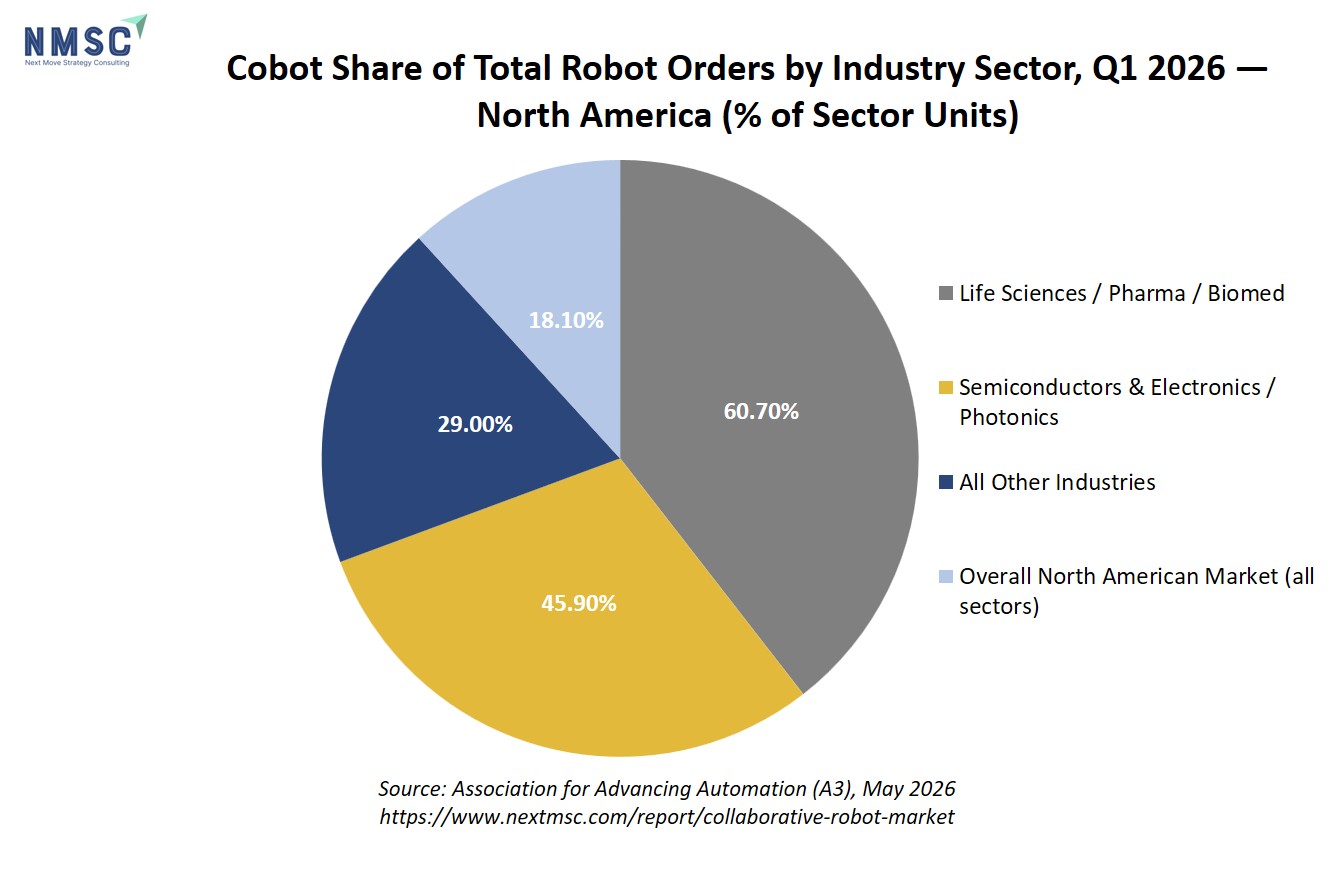
The Association for Advancing Automation (A3) released Q1 2026 North American robot order data on May 12, 2026, revealing a market undergoing significant structural diversification. North American companies ordered 9,055 robots valued at USD 543 million in Q1 2026. Within this total, collaborative robots were the standout performer: 1,637 cobots were ordered, valued at USD 69.8 million — representing a 55.6% increase in units and a 78.2% increase in revenue compared to Q1 2025. Cobots accounted for 18.1% of all robot units ordered during the quarter.
The sectoral breakdown is particularly instructive. In life sciences, pharmaceuticals, and biomedical applications, cobots accounted for 60.7% of total robot orders — a penetration rate that reflects the sector's specific requirements for precision, cleanliness, and safe human-robot proximity. In semiconductors and electronics, cobots represented 45.9% of sector orders, driven by the fine-pitch assembly and inspection demands of advanced chip packaging.
"Collaborative robots are one example of how the robotics market continues to evolve," said Alex Shikany, Executive Vice President at the Association for Advancing Automation (A3), in the organization's Q1 2026 data release on May 12, 2026. "The broader takeaway from the first quarter is that automation demand is becoming more diverse in terms of industries, applications and deployment models. That is an important signal for the long-term health of the market."
The IFR's Five-Million-Robot Milestone and Its Cobot Implications
The IFR's World Robotics 2026 Report confirms that the global operational stock of industrial robots reached 5 million units in 2025 — more than double the figure recorded seven years prior. China installed 354,000 industrial robots in 2025, accounting for 59% of global deployments and growing 20% year-on-year. The United States surpassed Japan to become the world's second-largest robot market, with 38,500 installations — a 12% increase and the third-highest annual figure in the history of these statistics. India installed approximately 10,500 units in 2025, up 15%, with a compound annual growth rate of 27% between 2020 and 2025.
The IFR's World Robotics 2025 Report, published in September 2025, recorded 64,542 cobot installations in 2024 — a 12% increase year-on-year — with cobots' share of total industrial robot installations continuing to expand as their payload capacities and application versatility increase.
The IFR projects global robot installations will rise a further 9% to 655,000 units in 2026, with the long-term trajectory reaching 806,000 units by 2029. The IFR explicitly identifies advances in AI, machine vision, and sensing — alongside easier programming and reduced deployment costs — as the primary mechanisms expanding the range of economically viable robot applications.
Regulatory Tailwinds: ISO 10218:2025 and EU Machinery Regulation
The enforcement of ISO 10218-1:2025 and ISO 10218-2:2025 from April 1, 2025 — the first revision to the core robot-safety standard in over a decade — is reshaping procurement decisions across European and North American manufacturers. The updated standards introduce more granular requirements for AI-enabled robotic behaviors, shared workspaces, sensor-based environmental awareness, and mobile manipulator safety, providing the regulatory clarity that risk-averse procurement teams require before committing to large-scale cobot deployments.
The EU Machinery Regulation (EU 2023/1230), which supersedes the Machinery Directive 2006/42/EC, requires full compliance before 2027. This deadline is compelling European manufacturers to audit and upgrade existing automation infrastructure, creating a compliance-driven replacement cycle that is generating incremental cobot demand independent of organic production growth.
Section Summary: The collaborative robot market's demand base is broadening structurally, with life sciences and semiconductor sectors now absorbing cobots at penetration rates that rival traditional automotive applications. Simultaneously, regulatory frameworks in both the US and Europe are creating compliance-driven demand cycles that are additive to organic growth.
Key Takeaways:
-
Cobot orders in North America grew 55.6% in units and 78.2% in revenue in Q1 2026 vs. Q1 2025, per A3 data released May 12, 2026.
-
Life sciences/pharma/biomed now sources 60.7% of its robot orders from cobots — the highest sectoral penetration rate recorded.
-
The IFR projects global robot installations will reach 655,000 units in 2026 and 806,000 by 2029, with AI and sensing advances as the primary demand catalysts.
-
ISO 10218-1:2025 and EU Machinery Regulation (EU 2023/1230) compliance requirements are generating a replacement-driven demand cycle in European manufacturing.
Key Data & Statistics
Collaborative Robot Market — Recent Industry Benchmarks (2025–2026)
|
Metric |
Value |
|
Global operational stock of industrial robots |
5 million units (record high, +9% YoY) |
|
Global annual robot installations (2025) |
600,000+ units (+11% YoY) |
|
China's share of global robot installations (2025) |
59% (354,000 units, +20% YoY) |
|
US robot installations (2025) |
~38,500 units (+12% YoY) |
|
India robot installations (2025) |
~10,500 units (+15% YoY; 27% CAGR 2020–2025) |
|
Global cobot installations (2024) |
64,542 units (+12% YoY) |
|
North American cobot orders, Q1 2026 |
1,637 units / USD 69.8M (+55.6% units, +78.2% revenue YoY) |
|
Cobot share of total North American robot orders, Q1 2026 |
18.1% of units / 12.9% of revenue |
|
Cobot share of life sciences robot orders, Q1 2026 |
60.7% of sector units |
|
Cobot share of semiconductor/electronics robot orders, Q1 2026 |
45.9% of sector units |
|
IFR global robot installation forecast (2026) |
655,000 units (+9% YoY) |
Future Outlook & Forecast
NMSC Forecast: A USD 12.71 Billion Market by 2030
NextMSC primary research and analysis projects the global collaborative robot market will grow from USD 1.77 billion in 2023 to USD 12.71 billion by 2030, at a CAGR of 32.6%. This trajectory is underpinned by three demand mechanisms that NMSC's model — which applies bottom-up segment analysis across 22 countries, eight industry verticals, and three payload categories — identifies as structurally durable through the forecast period.
Mechanism 1 — AI-Driven Application Expansion: The integration of physical AI capabilities into cobot platforms, exemplified by Universal Robots' Gen 7 and ABB's AVR™ framework, is expanding the addressable application set beyond repetitive pick-and-place tasks into dexterous manipulation, force-sensitive assembly, and autonomous multi-step workflows. Each new application category represents an incremental revenue pool that did not exist in prior cobot generations.
Mechanism 2 — SME Penetration via Standardized Deployment: FANUC's Cobot and Go model and analogous initiatives from other OEMs are systematically reducing the integration cost and complexity that has historically confined cobot adoption to large enterprises. As standardized, application-ready cobot cells become commercially available at accessible price points, the SME segment — which represents the majority of manufacturing establishments globally — becomes a viable and scalable demand source.
Mechanism 3 — Regulatory and Demographic Tailwinds: The IFR's World Robotics 2026 Report explicitly identifies demographic change and labor shortages in high-wage economies as structural demand drivers that will persist regardless of macroeconomic cycles. The EU Machinery Regulation's 2027 compliance deadline and the updated ISO 10218:2025 standards are creating a time-bound replacement cycle in Europe that will generate concentrated demand through 2027 and sustain elevated replacement rates thereafter.
Regional Outlook
North America retains its position as the dominant collaborative robot market according to NMSC. U.S. robotics research has also received support through the National Robotics Initiative, a multi-agency program focused on collaborative robotic and the U.S. market's emergence as the world's second-largest robot installation market in 2025, per IFR data. The A3's Q1 2026 data confirms that demand diversification across life sciences, semiconductors, and food processing is reducing the market's dependence on automotive OEM cycles.
Asia Pacific is the fastest-growing region, with China's 20% year-on-year growth in robot installations in 2025 and India's 27% CAGR between 2020 and 2025 providing the volume base for sustained cobot demand. The World Economic Forum's identification of China as host to 44% of new Industry 4.0 lighthouse factories underscores the region's structural commitment to advanced manufacturing automation.
Europe faces a more complex near-term environment, with Germany's robot installations declining 8% in 2025 and Italy's falling 11%, per IFR data. However, the EU Machinery Regulation compliance deadline and the updated ISO 10218:2025 standards are expected to generate a compliance-driven demand recovery through 2027.
Section Summary: NMSC's forecast of USD 12.71 billion by 2030 at a 32.6% CAGR is supported by three structurally durable demand mechanisms: AI-driven application expansion, SME penetration via standardized deployment, and regulatory and demographic tailwinds. Regional growth patterns are diverging, with Asia Pacific accelerating and Europe facing a compliance-driven recovery cycle.
Key Takeaways:
-
The collaborative robot market is projected to grow 7.2x from its 2023 base to USD 12.71 billion by 2030, per NextMSC primary research and analysis.
-
AI-native cobot platforms are expanding the addressable application set into dexterous manipulation and autonomous multi-step workflows — application categories that did not exist in prior cobot generations.
-
China's 20% YoY growth in robot installations in 2025 and India's 27% CAGR (2020–2025) confirm Asia Pacific as the volume engine of global cobot demand.
-
Europe's compliance-driven replacement cycle, triggered by ISO 10218:2025 and EU Machinery Regulation (EU 2023/1230), is expected to generate concentrated demand through 2027.
Next Steps for Stakeholders
For C-Level Executives and Operations Leaders:
1. Audit AI-readiness of existing cobot infrastructure. Universal Robots' Gen 7 and ABB's AVR™ framework establish a new baseline for AI-enabled cobot performance. Executives should assess whether current cobot fleets can support real-time AI model execution at the tool flange, or whether a platform upgrade is required to remain competitive in high-precision applications.
2. Prioritize life sciences and semiconductor cobot deployments. A3's Q1 2026 data confirms that cobots now account for 60.7% of robot orders in life sciences and 45.9% in semiconductors — sectors where cobot-specific attributes (precision, cleanliness, safe human proximity) deliver measurable competitive advantage. Executives in these sectors who have not yet deployed cobots are operating with a structural productivity gap relative to early adopters.
3. Accelerate EU Machinery Regulation compliance planning. The 2027 compliance deadline for EU Machinery Regulation (EU 2023/1230) is approaching. Manufacturers with European operations should initiate compliance audits immediately to avoid procurement bottlenecks as demand for compliant cobot systems concentrates in 2026–2027.
4. Evaluate standardized deployment models for SME operations. FANUC's Cobot and Go initiative demonstrates that pre-engineered, application-ready cobot cells can deliver measurable automation value without permanent infrastructure investment. SME operators should evaluate whether standardized deployment models can accelerate their automation timelines relative to bespoke integration projects.
For Institutional Investors:
5. Monitor cobot OEM platform differentiation. The Gen 7 launch establishes AI-readiness as the new competitive baseline for cobot platforms. Investors should assess which OEMs have the software ecosystem depth — open APIs, ROS2 communication, certified AI partner networks — to sustain platform lock-in as physical AI applications scale.
6. Track demand diversification as a leading indicator. The shift of cobot demand from automotive OEMs to life sciences, semiconductors, and food processing reduces cyclical risk and improves revenue visibility. Investors should weight demand diversification metrics alongside traditional unit shipment data when evaluating cobot OEM and integrator valuations.
Conclusion
The collaborative robot market is at a structural inflection point that is qualitatively different from prior growth cycles. The simultaneous arrival of AI-native cobot platforms (Universal Robots Gen 7), standardized rapid-deployment models (FANUC Cobot and Go), updated global safety standards (ISO 10218:2025), and a broadening demand base across life sciences, semiconductors, and food processing has created a market dynamic where growth is no longer dependent on any single industry vertical or geographic region.
The IFR's confirmation of 5 million robots in global operation, combined with A3's data showing a 55.6% unit increase in North American cobot orders in Q1 2026, provides empirical validation of the trajectory that NextMSC primary research and analysis has modeled: a collaborative robot market growing from USD 1.77 billion in 2023 to USD 12.71 billion by 2030 at a 32.6% CAGR. For executives and investors seeking to position ahead of this curve, the window for strategic action — before AI-enabled cobot deployments become table stakes rather than competitive differentiators — is narrowing.
About the Author
 Sanyukta Deb
— Sanyukta Deb is Digital Marketing Team Lead at Next Move Strategy Consulting, where she has led content strategy and technical SEO for the firm's B2B market research publications for over 2 years. Her editorial process translates NextMSC's primary and secondary research — spanning technology, industrial, and consumer sectors — into commercial narratives, backed by search-intent, keyword, and competitive analysis. She brings 5 years of overall experience in digital marketing and content strategy.
Sanyukta Deb
— Sanyukta Deb is Digital Marketing Team Lead at Next Move Strategy Consulting, where she has led content strategy and technical SEO for the firm's B2B market research publications for over 2 years. Her editorial process translates NextMSC's primary and secondary research — spanning technology, industrial, and consumer sectors — into commercial narratives, backed by search-intent, keyword, and competitive analysis. She brings 5 years of overall experience in digital marketing and content strategy.
About the Reviewer
 Debashree Dey
— Debashree Dey is Assistant Manager at Next Move Strategy Consulting, where she supports cross-vertical market content and communications across diverse industries for 6 years. Her professional background includes senior content writing, communications, and published manuscript authorship, with experience developing audience-focused business narratives and maintaining clear, consistent messaging. Her role supports research-led content development and editorial quality across NextMSC publications.
Debashree Dey
— Debashree Dey is Assistant Manager at Next Move Strategy Consulting, where she supports cross-vertical market content and communications across diverse industries for 6 years. Her professional background includes senior content writing, communications, and published manuscript authorship, with experience developing audience-focused business narratives and maintaining clear, consistent messaging. Her role supports research-led content development and editorial quality across NextMSC publications.


















Add Comment