7 Powerful Generative AI for Fraud Detection Trends Reshaping Finance

Introduction
Financial crime has entered a new era—one defined not by the ingenuity of individual fraudsters, but by the industrial-scale deployment of generative artificial intelligence as an attack tool. The same technology that is transforming enterprise productivity is simultaneously enabling criminals to manufacture synthetic identities, generate convincing deepfakes, and automate social engineering campaigns at a speed and volume that legacy fraud defenses were never designed to withstand.
The response from the financial services industry has been equally decisive. The generative AI for fraud detection market is scaling rapidly as banks, payment networks, insurers, and e-commerce platforms race to deploy AI-native defenses capable of matching the sophistication of AI-enabled threats. According to Next Move Strategy Consulting (NMSC), the global Generative AI for Fraud Detection Market was valued at USD 4.1 billion in 2025 and is projected to reach USD 44.8 billion by 2035, expanding at a compound annual growth rate (CAGR) of 26.9% from 2026 to 2035. This trajectory reflects a structural shift in how financial institutions conceptualize fraud risk—not as a compliance cost to be minimized, but as a technology arms race that demands continuous, AI-powered investment.
For More Information: Download FREE Sample on Generative AI for Fraud Detection Market Report
The Fraud Escalation Crisis: Why Generative AI for Fraud Detection Is Now a Strategic Imperative
FBI IC3 2025 Annual Report: A Record-Breaking Year for Financial Crime
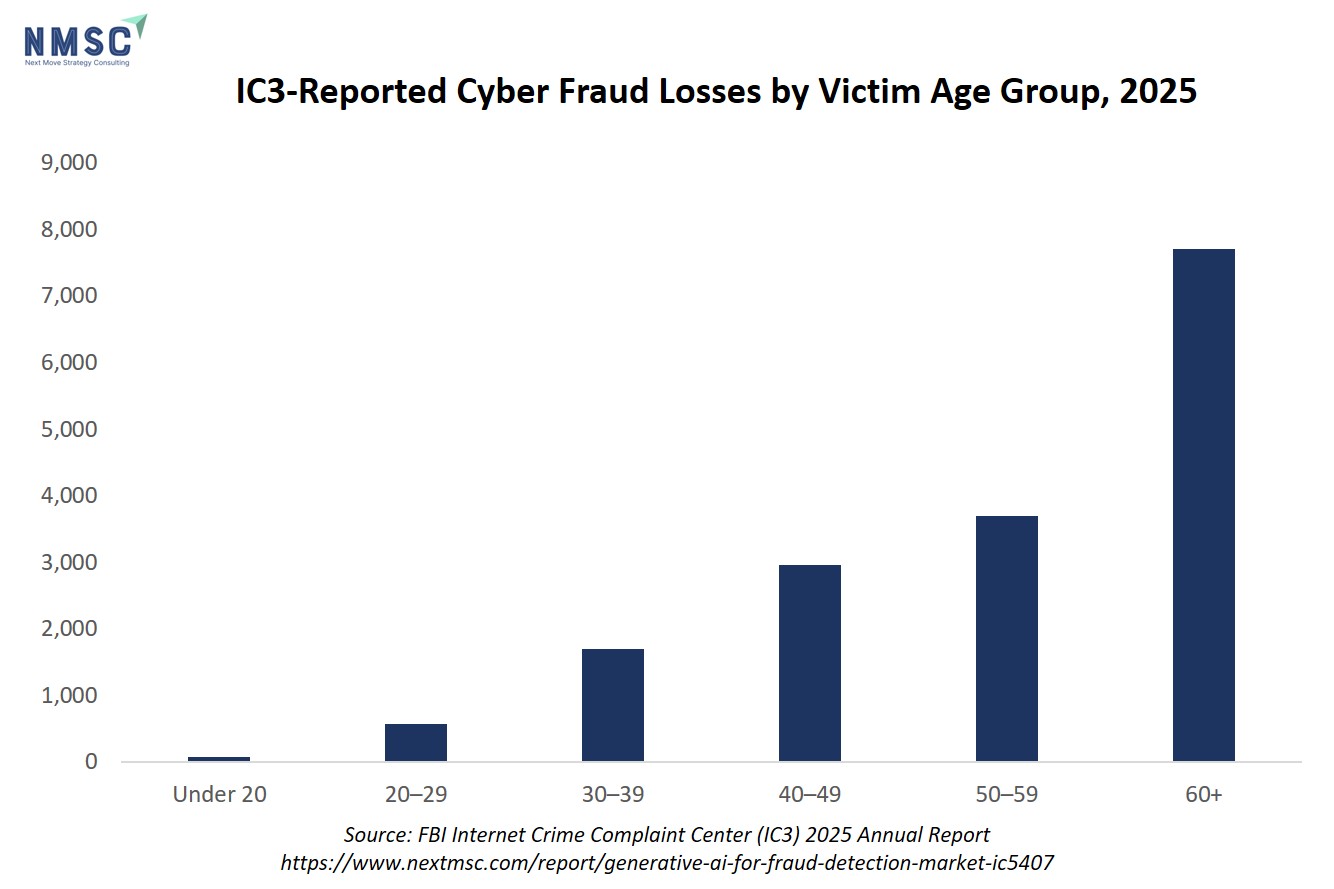
The scale of the fraud crisis confronting financial institutions in 2026 is without precedent. The FBI's Internet Crime Complaint Center (IC3) 2025 Annual Report, published in 2026, recorded 1,008,597 complaints with total reported losses surpassing USD 20.877 billion—a 26% increase in losses from 2024. Cyber-enabled fraud alone accounted for 85% of all losses reported to IC3 in 2025, totaling USD 17.697 billion across 452,868 complaints.
Most critically for the generative AI for fraud detection market, the FBI's 2025 report documented 22,364 complaints with a confirmed AI nexus, generating adjusted losses of USD 893.3 million. Investment fraud complaints with a reported AI nexus alone surpassed USD 632 million in losses, while business email compromise (BEC) scams involving AI generated losses exceeding USD 30.2 million. The FBI explicitly noted that overall investment scam losses exceeded USD 8 billion, with many victims unaware of the extent to which AI was involved in the schemes targeting them.
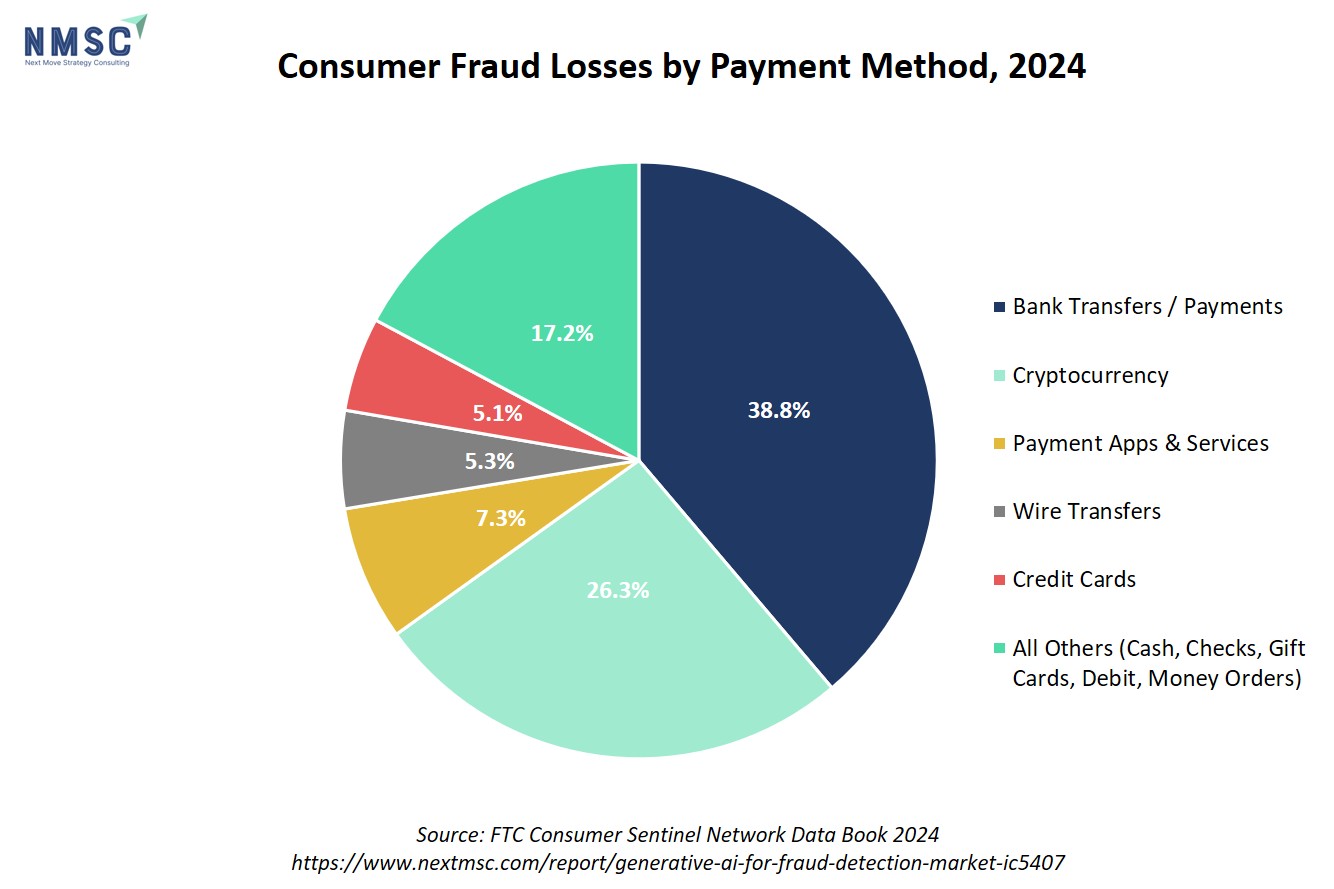
Separately, the Federal Trade Commission (FTC) reported that consumers lost approximately USD 15.9 billion to fraud in 2025—the highest figure on record and an increase of roughly 25% from the prior year—with imposter scams alone accounting for USD 3.5 billion of those losses.
IBM Safer Payments and the MCP Revolution: Agentic AI Enters Fraud Operations
In March 2026, IBM introduced agentic AI-enabled capabilities within IBM Safer Payments through the Model Context Protocol (MCP), enabling AI agents to securely query IBM Safer Payments APIs directly, grounding their reasoning in real-time fraud intelligence to improve payment fraud detection and response. This development represents a landmark moment for the generative AI for fraud detection market: for the first time, autonomous AI agents can access live risk data, pull transaction context, and generate investigator-ready case narratives without human initiation—compressing investigation timelines from hours to seconds.
The MCP integration reflects a broader industry shift toward agentic investigation architectures. Rather than requiring fraud analysts to manually query multiple systems and synthesize disparate data sources, AI agents now perform this work autonomously, allowing human investigators to focus on high-complexity cases and final disposition decisions. This capability directly addresses one of the most acute operational challenges facing financial institutions: the inability to scale investigator headcount proportionally with rising fraud case volumes.
Federal Reserve Financial Services: Generative AI as the Industry's Top Priority
In July 2026, Federal Reserve Financial Services published a detailed analysis of generative AI's role in fraud detection, citing a 2025 KPMG study finding that 76% of surveyed financial institutions view fraud-related use cases as their most valuable generative AI opportunity. The Federal Reserve's own 2026 Risk Officer Report identified AI image analysis and machine learning as priority solutions for detecting anomalies and mitigating check and ACH fraud losses.
The Federal Reserve's analysis also documented the dual-use challenge that defines the current market environment: generative AI is simultaneously enabling criminals to mass-produce phishing content, generate synthetic identities, create forged documents, and simulate normal transaction behavior to evade risk scoring models—while also providing financial institutions with the tools to detect and counter these exact threats. This dual-use dynamic is the single most important structural driver of sustained investment in the generative AI for fraud detection market.
FinCEN Regulatory Action: Deepfakes as a Systemic Financial Crime Risk
The Financial Crimes Enforcement Network (FinCEN) issued a formal alert in November 2024 on fraud schemes involving deepfake media targeting financial institutions, documenting an increase in suspicious activity reports from financial institutions describing the suspected use of AI-generated synthetic media to circumvent identity verification, authentication, and due diligence controls. FinCEN's alert identified specific typologies—including deepfake identity documents detected during enhanced due diligence on account openings—and provided red flag indicators to assist financial institutions in identifying and reporting suspicious activity.
Most recently, on September 3, 2026, FinCEN issued a new alert (FIN-2026-Alert005) addressing fraud schemes linked to scam centers, explicitly cross-referencing the 2024 deepfake alert as part of the evolving AI-enabled financial crime landscape. The U.S. Treasury's January 2026 AI Use Case Inventory and the White House's OMB M-25-21 directive on accelerating federal AI use further underscore the institutional commitment to AI-driven financial crime prevention at the highest levels of the U.S. government.
NMSC Strategic Perspective: The Dual-Use Inflection Point
From Next Move Strategy Consulting's analytical standpoint, the convergence of record-breaking fraud losses, IBM's MCP-enabled agentic AI launch, the Federal Reserve's institutional endorsement of generative AI fraud detection, and FinCEN's escalating regulatory alerts represents a structural inflection point for the market. The generative AI for fraud detection market is no longer growing because of incremental technology adoption—it is growing because the threat environment has fundamentally changed, and rules-based and traditional machine learning systems are demonstrably insufficient to address it.
NMSC identifies rising deepfake and synthetic identity fraud losses as the primary market driver, contributing an estimated +5.8% impact on the market's CAGR, followed by expanding agentic AI adoption for autonomous fraud investigation (+4.6%) and growing real-time payment volumes requiring millisecond-level fraud scoring (+3.9%). The USD 39.5 billion absolute dollar opportunity between 2026 and 2035 is not speculative—it is anchored in documented, escalating fraud losses that financial institutions have no choice but to address.
Section Summary:
The generative AI for fraud detection market is being driven by a documented, escalating fraud crisis that has overwhelmed legacy defenses, combined with landmark technology deployments and regulatory actions that are accelerating institutional adoption of AI-native fraud controls.
-
The FBI IC3 2025 Annual Report recorded USD 20.877 billion in total losses—a 26% increase from 2024—with AI-related fraud generating USD 893.3 million in documented losses across 22,364 complaints.
-
The FTC reported USD 15.9 billion in consumer fraud losses in 2025, the highest figure on record, with imposter scams accounting for USD 3.5 billion.
-
IBM's March 2026 MCP-enabled agentic AI launch in Safer Payments marks the operational arrival of autonomous fraud investigation at enterprise scale.
-
FinCEN's deepfake alert (November 2024) and new September 2026 scam center alert signal sustained and escalating regulatory pressure on financial institutions to deploy advanced AI fraud controls.
Industry Impact Analysis
The BFSI Sector: Bearing the Greatest Fraud Burden
The banking, financial services, and insurance (BFSI) sector remains the primary battleground for AI-enabled fraud, and consequently the dominant end-user segment for generative AI fraud detection solutions. The FBI IC3 2025 data shows that investment fraud—the crime type most heavily targeting financial services customers—generated USD 8.648 billion in losses in 2025, a 31.6% increase from USD 6.571 billion in 2024. Business email compromise, which directly targets corporate financial operations, generated USD 3.047 billion in losses in 2025.
Mastercard's response to this environment illustrates the scale of investment that payment networks are making in generative AI fraud defenses. The company's Decision Intelligence Pro platform, which uses a generative AI model trained on trillions of transaction data points, has demonstrated an average 20% improvement in fraud detection accuracy, with some issuers experiencing gains of up to 300%. This performance differential—between generative AI-enabled detection and traditional systems—is the commercial case that is driving enterprise procurement decisions across the BFSI sector.
Real-Time Payments: The Fraud Surface Expanding Fastest
The global expansion of real-time and instant payment infrastructure is creating the fastest-growing fraud surface in the financial system. As payment networks process transactions in milliseconds, the window for fraud detection has compressed to a timeframe that only AI-native systems can operate within. The Federal Reserve's FedNow Service, which has been expanding its participant base throughout 2025 and 2026, exemplifies the infrastructure trend that is simultaneously creating new fraud exposure and new demand for generative AI fraud scoring.
The FBI IC3 2025 data documents the consequences of inadequate real-time fraud controls: tech and customer support scams—which often exploit real-time payment channels—generated USD 2.135 billion in losses in 2025, a 45.8% increase from USD 1.465 billion in 2024. Account takeover fraud, which increasingly leverages AI-generated deepfakes to bypass authentication, generated USD 359.7 million in losses across approximately 4,700 complaints in 2025.
Regulatory Pressure: From Guidance to Enforcement
The regulatory environment for AI-driven fraud controls is transitioning from voluntary guidance to active enforcement expectations. The White House's OMB M-25-21 directive, issued in February 2025, mandates accelerating federal use of AI through innovation, governance, and public trust—a directive that directly shapes how federal financial regulators approach AI adoption requirements for supervised institutions. In Europe, the Digital Operational Resilience Act (DORA) and PSD2 payment authentication requirements are creating binding compliance obligations that favor vendors with proven, explainable AI fraud detection capabilities.
The Federal Reserve's 2026 Risk Officer Report's explicit identification of AI image analysis and machine learning as fraud mitigation solutions signals that regulatory examiners are increasingly evaluating financial institutions' AI fraud capabilities as part of standard supervisory assessments. This regulatory dynamic is compressing procurement timelines for generative AI fraud detection solutions, as institutions that delay adoption risk both financial losses and supervisory criticism.
Section Summary:
The generative AI for fraud detection market is being shaped by three concurrent industry forces: escalating BFSI fraud losses that are creating urgent procurement demand, real-time payment infrastructure expansion that is creating new fraud surfaces requiring AI-native defenses, and a regulatory environment that is transitioning from guidance to enforcement expectations.
-
Investment fraud losses grew 31.6% from 2024 to 2025 (USD 6.571B to USD 8.648B), per the FBI IC3 2025 Annual Report, creating acute demand for AI-powered detection in BFSI.
-
Mastercard's Decision Intelligence Pro demonstrates a 20% average improvement in fraud detection accuracy, with gains up to 300% in some instances—establishing the commercial benchmark for generative AI fraud detection performance.
-
Tech and customer support scam losses grew 45.8% year-over-year in 2025, reflecting the inadequacy of legacy fraud controls against AI-enabled attack vectors.
-
OMB M-25-21 (February 2025) and DORA (Europe) are creating binding regulatory frameworks that are accelerating enterprise adoption of compliant, explainable generative AI fraud detection solutions.
Key Data & Statistics
Key Industry Developments Impacting the Generative AI for Fraud Detection Market (2024–2026)
|
Date |
Organization |
Development |
Market Significance |
|
November 2024 |
FinCEN (U.S. Treasury) |
Issued formal alert on fraud schemes involving deepfake media targeting financial institutions; documented increase in suspicious activity reports on AI-generated synthetic media |
First major U.S. regulatory alert specifically addressing generative AI as a fraud attack vector; accelerates enterprise investment in deepfake detection |
|
February 2025 |
White House / OMB |
OMB M-25-21: Accelerating Federal Use of AI Through Innovation, Governance, and Public Trust |
Establishes federal AI governance framework; shapes regulatory expectations for AI fraud controls across supervised financial institutions |
|
May 2024 |
Mastercard |
Expanded Decision Intelligence Pro generative AI platform; demonstrated 20% average fraud detection improvement, up to 300% in some instances |
Establishes commercial performance benchmark for generative AI fraud detection; validates network-scale data advantage as competitive moat |
|
March 2026 |
IBM |
Introduced agentic AI-enabled capabilities in IBM Safer Payments via Model Context Protocol (MCP); AI agents query live fraud intelligence APIs autonomously |
First major enterprise deployment of MCP-enabled agentic fraud investigation; signals shift from AI-assisted to AI-autonomous fraud operations |
|
June 2026 |
U.S. Federal Trade Commission |
Released 2025 fraud data: USD 15.9 billion in consumer fraud losses (highest on record); imposter scams: USD 3.5 billion |
Validates scale of fraud crisis; accelerates regulatory and institutional urgency for advanced AI fraud detection investment |
|
July 2026 |
Federal Reserve Financial Services |
Published analysis citing 76% of institutions prioritizing fraud as top generative AI use case (2025 KPMG study); 2026 Risk Officer Report endorses AI image analysis for fraud mitigation |
Federal Reserve institutional endorsement of generative AI fraud detection as a supervisory priority; compresses procurement timelines |
|
September 2026 |
FinCEN (U.S. Treasury) |
Issued FIN-2026-Alert005 on scam center fraud schemes; cross-references deepfake alert as part of evolving AI-enabled financial crime landscape |
Signals sustained and escalating regulatory pressure on financial institutions to deploy advanced AI fraud controls |
Future Outlook & Forecast
NMSC Market Forecast: A USD 44.8 Billion Opportunity by 2035
According to Next Move Strategy Consulting, the global generative AI for fraud detection market is projected to grow from USD 4.1 billion in 2025 to USD 44.8 billion by 2035, at a CAGR of 26.9%—representing an absolute dollar opportunity of USD 39.5 billion over the forecast period. This growth trajectory is underpinned by three structural forces: the sustained escalation of deepfake and synthetic identity fraud losses, the accelerating adoption of agentic AI for autonomous fraud investigation, and the global expansion of real-time payment infrastructure that demands millisecond-level AI fraud scoring.
North America will maintain its dominant position throughout the forecast period, driven by the concentration of major card networks, early enterprise agentic AI adoption, and sustained FinCEN regulatory pressure on AI-driven fraud controls. The U.S. market alone is projected to grow from USD 1.40 billion in 2025 to USD 11.83 billion by 2035, at a 23.8% CAGR.
Asia-Pacific is projected to deliver the strongest growth among major regions, expanding at a 30.6% CAGR from 2026 to 2035, driven by rapid digital payment growth and expanding e-commerce fraud exposure across China, India, and Japan. India is the fastest-growing individual country market, projected to expand at a 34.6% CAGR, reflecting rapidly expanding digital payment volumes under the Reserve Bank of India's oversight and growing UPI-linked fraud exposure.
Agentic AI: The Technology Segment Defining the Next Decade
The technology trajectory of the generative AI for fraud detection market through 2035 will be defined by the ascendancy of agentic AI. While LLM-based technology currently leads the market with USD 1.31 billion in 2025 revenue, agentic AI is the fastest-growing technology segment, projected to expand at a 33.2% CAGR from 2026 to 2035—growing from USD 0.74 billion in 2025 to USD 12.99 billion by 2035. IBM's March 2026 MCP launch has validated the operational readiness of agentic fraud investigation at enterprise scale, and the Federal Reserve's institutional endorsement of AI-driven fraud controls signals that regulatory frameworks will increasingly accommodate—rather than constrain—agentic deployment.
Healthcare: The Fastest-Growing End-User Segment
While BFSI will remain the dominant end-user segment throughout the forecast period, healthcare is projected to be the fastest-growing end-user category, expanding at a 37.2% CAGR from 2026 to 2035—growing from USD 0.25 billion in 2025 to USD 5.82 billion by 2035. This growth reflects rising synthetic identity fraud targeting insurance claims and patient onboarding processes—a threat vector that is directly enabled by the same generative AI tools documented in FinCEN's deepfake alert. The convergence of healthcare digitalization and AI-enabled identity fraud is creating a new, high-growth demand center for generative AI fraud detection solutions outside the traditional BFSI market.
Section Summary:
The generative AI for fraud detection market is on a clear trajectory toward USD 44.8 billion by 2035, with agentic AI and healthcare emerging as the defining growth vectors beyond the established BFSI and LLM-dominated landscape.
-
NMSC projects a 26.9% CAGR from 2026 to 2035, with the market reaching USD 44.8 billion and generating a USD 39.5 billion absolute dollar opportunity over the forecast period.
-
Agentic AI is the fastest-growing technology segment at 33.2% CAGR, growing from USD 0.74 billion in 2025 to USD 12.99 billion by 2035—validated by IBM's March 2026 MCP deployment.
-
India is the fastest-growing country market at 34.6% CAGR; Asia-Pacific is the fastest-growing major region at 30.6% CAGR, driven by digital payment expansion and e-commerce fraud exposure.
-
Healthcare is the fastest-growing end-user segment at 37.2% CAGR, reflecting the convergence of healthcare digitalization and AI-enabled synthetic identity fraud targeting insurance and patient onboarding systems.
Next Steps for Stakeholders
For C-Level Executives and Financial Institution Leaders:
-
Prioritize investment in agentic AI investigation platforms as the primary technology differentiator through 2035. IBM's MCP-enabled Safer Payments deployment and Feedzai's 2025 agentic AI launch establish the operational template; institutions that delay adoption risk falling behind on investigator productivity and case resolution speed.
-
Develop a formal generative AI governance framework that addresses model explainability, data privacy, and bias mitigation—requirements that are increasingly embedded in regulatory expectations from FinCEN, the Federal Reserve, and European DORA compliance.
-
Treat deepfake detection as a core identity verification requirement, not a specialized add-on. FinCEN's November 2024 alert and September 2026 scam center alert signal that regulators view deepfake-enabled fraud as a systemic risk requiring dedicated controls.
For Technology Vendors and Product Teams:
-
Invest in multimodal deepfake detection capabilities integrated directly into onboarding and authentication workflows. The identity verification market is being reshaped by voice and video-based social engineering attacks, and vendors without credible multimodal detection capability risk exclusion from enterprise procurement shortlists.
-
Pursue cloud marketplace distribution strategies to capture the small and medium enterprise segment, which is projected to grow at 33.1% CAGR through 2035—the fastest among organization size segments—as consumption-based pricing lowers adoption barriers.
-
Build explainability and model transparency into product architecture from the outset. European DORA requirements and evolving U.S. regulatory expectations are making explainability a procurement prerequisite, not a differentiator.
For Investors and Financial Analysts:
-
The generative AI for fraud detection market's 26.9% CAGR through 2035 represents one of the most compelling risk-adjusted growth opportunities in enterprise software, anchored in documented, escalating fraud losses that financial institutions have regulatory and commercial obligations to address.
-
Focus on vendors demonstrating validated accuracy improvements—Mastercard's 20% average improvement benchmark is the commercial standard—combined with agentic investigation capability and network-scale data advantage.
-
Monitor India (34.6% CAGR), Middle East & Africa (31.4% CAGR), and healthcare end-user (37.2% CAGR) as the highest-growth investment vectors within the market through 2035.
For Compliance and Risk Officers:
-
Align fraud technology investment with the specific threat typologies documented in FinCEN's deepfake alert and the FBI IC3 2025 Annual Report. Investment fraud with AI nexus (USD 632 million in 2025 losses) and BEC with AI (USD 30.2 million) are the highest-priority threat categories requiring generative AI-specific detection controls.
-
Engage proactively with the Federal Reserve's 2026 Risk Officer Report framework, which explicitly identifies AI image analysis and machine learning as supervisory priorities for fraud mitigation. Institutions that can demonstrate alignment with this framework will be better positioned in regulatory examinations.
Conclusion
The generative AI for fraud detection market is not growing because of technology enthusiasm—it is growing because the fraud crisis is real, documented, and escalating at a pace that legacy systems cannot match. The FBI's record USD 20.877 billion in reported losses in 2025, the FTC's USD 15.9 billion in consumer fraud losses, and FinCEN's escalating regulatory alerts on deepfake-enabled financial crime collectively establish an incontrovertible case for urgent, sustained investment in generative AI fraud defenses.
With the global market projected to reach USD 44.8 billion by 2035 at a 26.9% CAGR, according to Next Move Strategy Consulting, the strategic imperative for financial institutions, technology vendors, and investors is clear: the organizations that invest now in agentic AI investigation, multimodal deepfake detection, and explainable AI fraud architectures will define the competitive landscape of financial crime prevention for the next decade. Those that do not will find themselves defending against threats their systems were never designed to detect.
About the Author
 Sanyukta Deb
— Sanyukta Deb is Digital Marketing Team Lead at Next Move Strategy Consulting, where she has led content strategy and technical SEO for the firm's B2B market research publications for over 2 years. Her editorial process translates NextMSC's primary and secondary research — spanning technology, industrial, and consumer sectors — into commercial narratives, backed by search-intent, keyword, and competitive analysis. She brings 5 years of overall experience in digital marketing and content strategy.
Sanyukta Deb
— Sanyukta Deb is Digital Marketing Team Lead at Next Move Strategy Consulting, where she has led content strategy and technical SEO for the firm's B2B market research publications for over 2 years. Her editorial process translates NextMSC's primary and secondary research — spanning technology, industrial, and consumer sectors — into commercial narratives, backed by search-intent, keyword, and competitive analysis. She brings 5 years of overall experience in digital marketing and content strategy.
About the Reviewer
 Debashree Dey
— Debashree Dey is Assistant Manager at Next Move Strategy Consulting, where she supports cross-vertical market content and communications across diverse industries for 6 years. Her professional background includes senior content writing, communications, and published manuscript authorship, with experience developing audience-focused business narratives and maintaining clear, consistent messaging. Her role supports research-led content development and editorial quality across NextMSC publications.
Debashree Dey
— Debashree Dey is Assistant Manager at Next Move Strategy Consulting, where she supports cross-vertical market content and communications across diverse industries for 6 years. Her professional background includes senior content writing, communications, and published manuscript authorship, with experience developing audience-focused business narratives and maintaining clear, consistent messaging. Her role supports research-led content development and editorial quality across NextMSC publications.


















Add Comment