Artificial Intelligence Moves from Innovation to Large-Scale Commercial Adoption

The global Artificial Intelligence (AI) Market is entering a rapid expansion phase as organizations increase investment across AI infrastructure, foundation models, cloud platforms, enterprise applications, intelligent agents, and professional services. The market was valued at USD 629.97 billion in 2026 and is estimated at USD 809.24 billion in 2027, before reaching USD 3,796.05 billion by 2035, advancing at a 21.3% CAGR from 2027 to 2035. North America accounted for approximately 42% of global revenue in 2026, while Hardware represented the largest offering segment at about 34% of market revenue.
NMSC’s analysis indicates that competitive activity in the AI Market is increasingly shaped by full-stack capabilities rather than standalone model development. NVIDIA is expanding the computing infrastructure required for large-scale AI workloads; Alphabet is integrating Gemini across Search, consumer products, cloud services, and enterprise workflows; Microsoft is extending Copilot and agent capabilities across its software ecosystem; Amazon is scaling AI infrastructure, custom silicon, and managed AI services through AWS; and OpenAI is expanding frontier models into consumer, enterprise, developer, and specialized industry applications. These strategies are widening the commercial scope of AI beyond model training into persistent, production-scale deployment.
Want Insights on the Artificial Intelligence (AI) Market? Access a FREE Sample Instantly.
Key Takeaway
The competitive structure of the AI Market is being shaped by the ability of leading technology companies to build and scale capabilities across different layers of the AI ecosystem. NVIDIA is strengthening the computing foundation through advanced accelerators and AI infrastructure, while Alphabet is extending Gemini across Search, applications, devices, and cloud services. Microsoft is embedding AI into enterprise workflows through Copilot, Foundry, and agent platforms, whereas Amazon is combining AWS infrastructure, custom AI chips, Bedrock, and strategic investments to support large-scale AI deployment. OpenAI is advancing frontier models while expanding their availability across consumer, enterprise, and developer environments.
NMSC’s evaluation finds that these developments reflect a broader shift in competitive dynamics, with market leadership increasingly influenced by the ability to connect computing infrastructure, model capabilities, cloud platforms, enterprise applications, and intelligent agents within scalable commercial ecosystems. This convergence is expanding the addressable scope of AI adoption while creating greater differentiation among companies based on technology depth, deployment reach, ecosystem integration, and application development capabilities.
Artificial Intelligence (AI) Market by Offering, 2026–2035 (USD Billion)
|
Offering |
2026 |
2035 |
CAGR |
|
Hardware |
214.19 |
835.13 |
18.5% |
|
Cloud Infrastructure |
163.79 |
911.05 |
23.9% |
|
Applications and Agents |
113.39 |
1,062.89 |
32.3% |
|
Models and Platforms |
100.80 |
759.21 |
28.7% |
|
Professional Services |
37.80 |
227.76 |
25.2% |
|
Total Artificial Intelligence (AI) Market |
629.97 |
3,796.05 |
21.3% |
NVIDIA Corporation
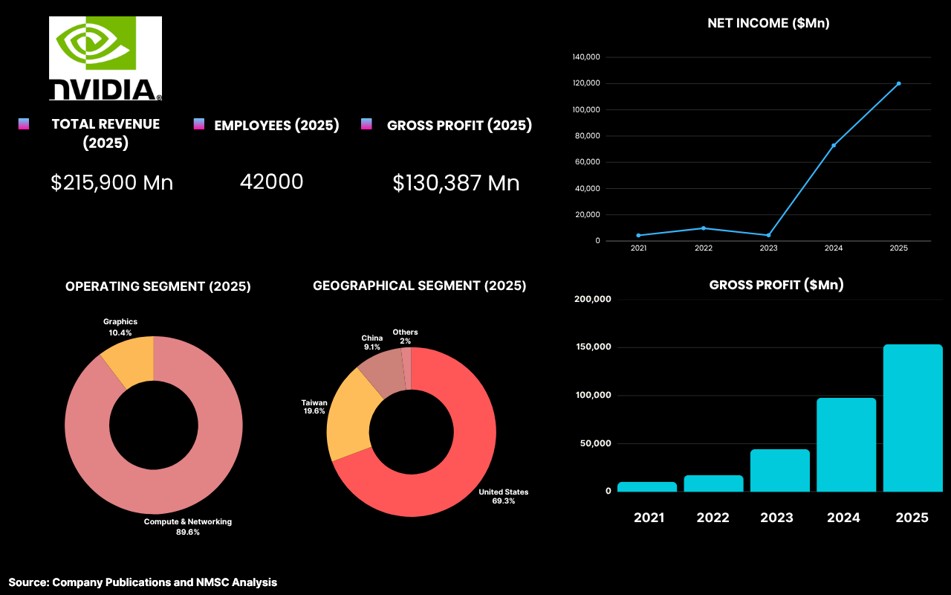
NVIDIA Corporation is a technology company focused on accelerated computing, graphics processing, data-center infrastructure, networking, and artificial intelligence. Its AI portfolio spans GPUs, CPUs, networking platforms, AI software, inference technologies, and full-stack computing systems used across cloud providers, AI developers, enterprises, scientific research, and physical AI applications.
NVIDIA’s most recent major AI infrastructure development came in August 2026, when NVIDIA and Amazon Web Services announced an expanded strategic collaboration to deploy 2 million additional NVIDIA GPUs across AWS’s global infrastructure. The agreement also extends cooperation across NVIDIA Vera CPUs, networking, open models, data processing, AI factories, and robotics, reinforcing the role of accelerated computing infrastructure in scaling agentic and physical AI workloads.
The scale of this infrastructure expansion aligns with NVIDIA’s latest operating performance. In the second quarter of fiscal 2027, NVIDIA reported USD 96.2 billion in total revenue, including USD 89.0 billion in Data Center revenue, which increased 117% year over year. NVIDIA’s strategy therefore extends across the Hardware and Cloud Infrastructure layers of the AI Market, with its computing platforms supporting model training, inference, agentic workloads, scientific computing, and physical AI applications.
Alphabet Inc.
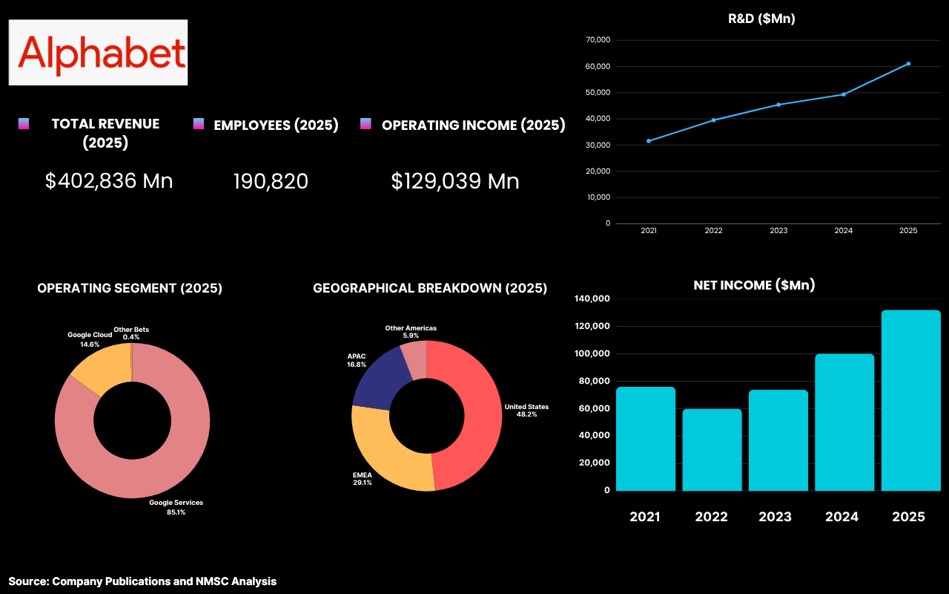
Alphabet Inc. operates one of the broadest AI ecosystems through Google Search, Google Cloud, Gemini, Android, Google Workspace, YouTube, and its AI research and infrastructure platforms. Its AI portfolio combines proprietary models, cloud-based AI infrastructure, consumer applications, enterprise tools, and AI-enabled search experiences.
A major August 2026 milestone came when Google announced that the Gemini app surpassed 1 billion monthly active users, representing a substantial expansion from the more than 900 million users reported in May 2026. Google also reported that Gemini generates more than 150 million images per day, while Android users have access to automation across more than 40 popular applications.
This momentum follows Google’s broader 2026 expansion of Gemini across Search, AI Mode, consumer applications, and enterprise platforms. In June 2026, Alphabet reported that AI Overviews had more than 2.5 billion monthly users, while AI Mode had exceeded 1 billion monthly users. Alphabet’s approach demonstrates the expanding role of Applications and Agents within the AI Market, with Gemini increasingly embedded into search, productivity, consumer services, and software ecosystems rather than operating solely as a standalone chatbot.
Microsoft Corporation
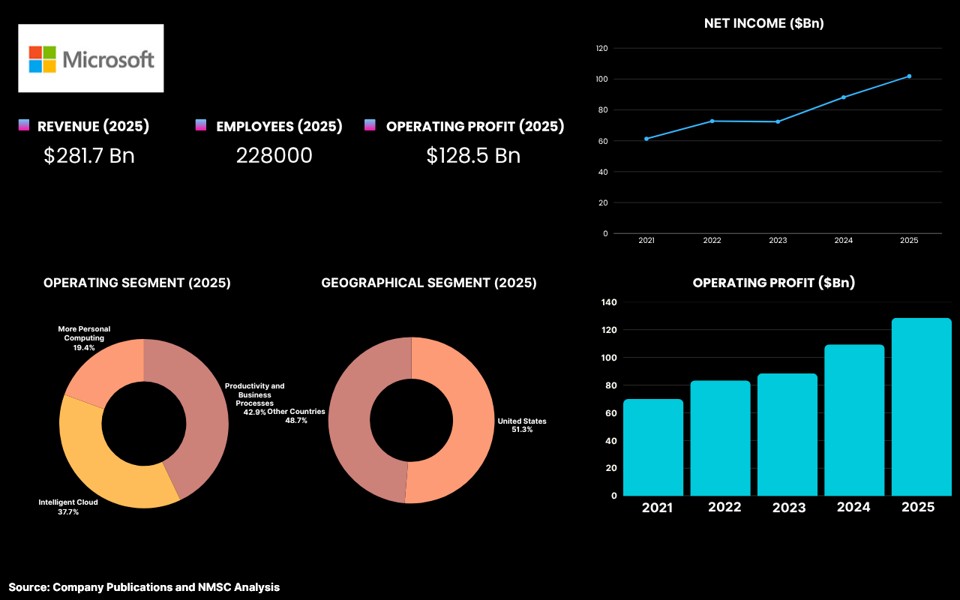
Microsoft Corporation has built an integrated AI ecosystem spanning Azure, Microsoft 365 Copilot, GitHub Copilot, Microsoft Foundry, Copilot Studio, and enterprise agent platforms. The company combines cloud infrastructure, foundation-model access, developer tooling, business applications, data services, and governance capabilities within its broader enterprise software ecosystem.
In June 2026, Microsoft announced the worldwide general availability of Copilot Cowork, an agentic AI experience designed to execute complex, long-running, multi-tool tasks across enterprise workflows. Microsoft reported that, after three months in preview, more than half of Fortune 500 companies were already using Copilot Cowork. The company also stated that Cowork was the fastest-growing feature in the history of its Frontier program.
Microsoft’s broader AI platform has also expanded rapidly. Its current Microsoft Foundry platform states that it is used by developers at more than 80,000 enterprises and digital-native organizations, including 80% of Fortune 500 companies, with more than 11,000 models available through the platform. Microsoft’s market strategy is therefore closely aligned with the rapid expansion of Applications and Agents, while its Azure and Foundry platforms extend its reach into Cloud Infrastructure and Models and Platforms.
Amazon.com, Inc.
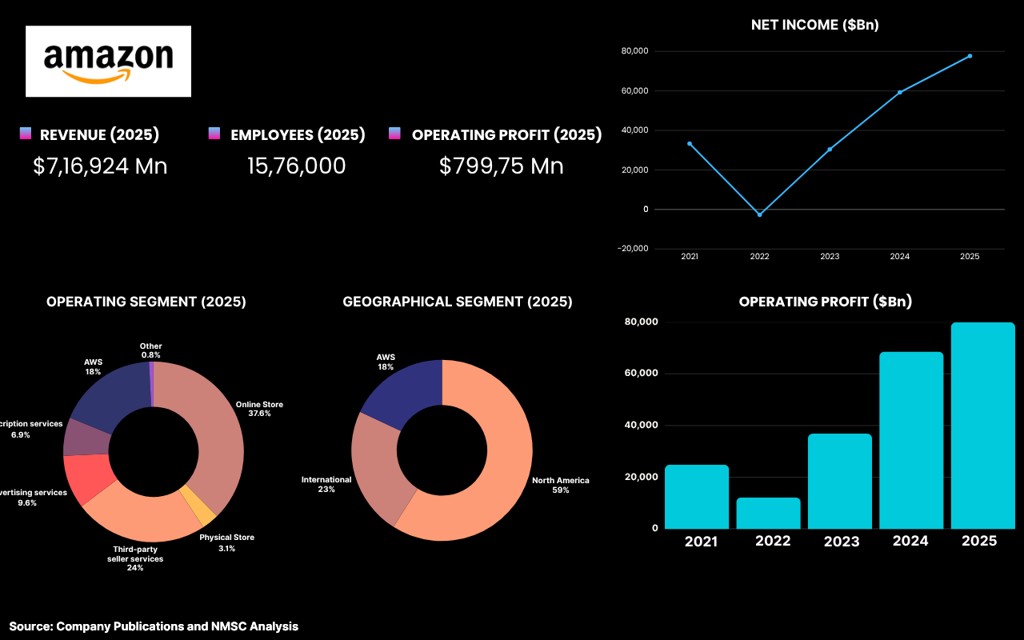
Amazon.com, Inc. participates in the AI Market primarily through Amazon Web Services, custom AI silicon, foundation models, cloud infrastructure, and managed AI services. AWS provides Amazon Bedrock, Amazon SageMaker, Amazon Nova, Trainium, Inferentia, and a growing ecosystem of AI development and deployment technologies.
A major June 2026 development was Amazon’s announcement of an additional USD 13 billion investment in AI and cloud infrastructure in India, taking its planned investment in the country to USD 48 billion between 2026 and 2030. Amazon stated that the new investment will expand AWS data-center capacity in Mumbai and Hyderabad and provide access to custom AI chips, managed AI services, secure cloud technologies, and developer tools.
The expansion follows a broader increase in enterprise AI activity across AWS. In the first quarter of 2026, Amazon stated that customer spending on Amazon Bedrock grew 170% quarter over quarter, while Bedrock processed more tokens during that quarter than across all prior years combined. Amazon’s position in the AI Market combines infrastructure scale with custom silicon, model availability, and managed services. This approach strengthens AWS’s role across the Cloud Infrastructure layer while extending into Models and Platforms and Applications and Agents.
OpenAI Group PBC
OpenAI Group PBC is focused on developing and deploying frontier artificial intelligence through GPT models, ChatGPT, Codex, APIs, enterprise products, and specialized AI systems. Its ecosystem spans consumer AI, enterprise workflows, developer platforms, advanced reasoning, multimodal capabilities, and increasingly specialized industry solutions.
OpenAI introduced GPT-6 Astra in September 2026, describing it as its most capable broadly deployed model. The model was introduced across areas including computer use, software engineering, cybersecurity, science, browsing, and professional work, with broader availability expanding across ChatGPT plans, the API, Microsoft Azure, and Amazon Bedrock.
The company’s deployment scale has also expanded materially. OpenAI stated in September 2026 that its products reach more than 1 billion weekly active users and 2.5 million businesses, reflecting growing usage across consumer and enterprise environments. OpenAI separately reported in August 2026 that ChatGPT Ads had reached a USD 1 billion annualized revenue run rate in less than 200 days after launch.
OpenAI’s continued model development and broad deployment demonstrate the rising importance of Models and Platforms alongside Applications and Agents. The company’s expansion into enterprise, specialized workflows, and developer environments is broadening the commercial footprint of frontier AI.
Band Title: Understand the Competitive Structure of the Artificial Intelligence (AI) Market
Band Subline: Access market sizing, segment-level forecasts, regional analysis, competitive positioning, and strategic insights across the global Artificial Intelligence (AI) Market.
Band Button: Explore the Full Report
Market Outlook: AI Companies Shift from Model Development Toward Full-Stack Deployment and Agentic Workflows
The Artificial Intelligence (AI) Market is moving toward a more interconnected ecosystem, where computing infrastructure, foundation models, cloud platforms, applications, intelligent agents, and enterprise services increasingly contribute to a unified technology stack. Hardware continues to account for a significant portion of market revenue; however, the strongest expansion is emerging in Applications and Agents, with the segment projected to increase from USD 113.39 billion in 2026 to USD 1,062.89 billion by 2035, representing a 32.3% CAGR.
Competitive differentiation is consequently extending beyond model development toward the ability to deploy AI at scale across diverse commercial environments. NVIDIA is expanding accelerator infrastructure and AI factory capabilities, Alphabet is embedding Gemini across Search, consumer products, and enterprise services, Microsoft is integrating AI agents into productivity and business workflows, Amazon is strengthening its position through AI infrastructure, custom silicon, and managed services, and OpenAI is extending frontier models across consumer, enterprise, and developer use cases. These developments illustrate how leading companies are pursuing distinct routes to capture value across the expanding AI ecosystem.
NMSC’s analysis indicates that the next phase of AI market development will depend on how effectively companies connect model capabilities with computing resources, cloud infrastructure, enterprise systems, intelligent agents, and application-specific requirements. The global market is projected to expand from USD 629.97 billion in 2026 to USD 3,796.05 billion by 2035, while the rapid growth of Applications and Agents is broadening AI deployment beyond foundational technology toward increasingly practical and scalable business applications. This evolution is creating a competitive environment in which technology depth, deployment scale, ecosystem integration, and the ability to translate AI capabilities into measurable business use cases are becoming increasingly important.
About the Author
 Mayurima Roy
— Mayurima Roy is Research Analyst at Next Move Strategy Consulting, where she has spent 4 years working across the firm's full industry coverage rather than a single fixed vertical. Her work centers on structured research, ongoing trend tracking, competitive assessment, and insight-led content development, translating complex market data into clear, decision-ready narratives that support informed client decision-making across diverse global industries, market sectors, and world regions every day.
Mayurima Roy
— Mayurima Roy is Research Analyst at Next Move Strategy Consulting, where she has spent 4 years working across the firm's full industry coverage rather than a single fixed vertical. Her work centers on structured research, ongoing trend tracking, competitive assessment, and insight-led content development, translating complex market data into clear, decision-ready narratives that support informed client decision-making across diverse global industries, market sectors, and world regions every day.
About the Reviewer
 Supradip Baul
— Supradip Baul is an accomplished business consultant and strategist with over a decade of rich experience in market intelligence, strategy, technology, and business transformation. His work has included rigorous qualitative and quantitative analysis across multiple industries, helping clients shape investment decisions and long-term roadmaps. Earlier in his career, he was associated with Gartner, where he contributed to industry-leading reports and market share analyses. He has worked with leading global companies and holds an MBA with a dual specialization in Marketing and Finance.
Supradip Baul
— Supradip Baul is an accomplished business consultant and strategist with over a decade of rich experience in market intelligence, strategy, technology, and business transformation. His work has included rigorous qualitative and quantitative analysis across multiple industries, helping clients shape investment decisions and long-term roadmaps. Earlier in his career, he was associated with Gartner, where he contributed to industry-leading reports and market share analyses. He has worked with leading global companies and holds an MBA with a dual specialization in Marketing and Finance.


















Add Comment