Air Handling Unit (AHU) Market: Why Data Centers Reset Demand | NextMSC
Introduction
On October 29, 2026, Carrier Global Corporation reported that its data center orders rose about 300% in the third quarter, lifting its backlog above USD 8.5 billion, and on the same day Trane Technologies plc reported a backlog of USD 12.5 billion, up 73%. Two days earlier, Johnson Controls International plc disclosed a record backlog of USD 23.0 billion. Together, these three filings show that commercial HVAC demand, the category that includes the large central air handling units serving hospitals, factories and server halls, is now being pulled by mission-critical buildings as much as by office and retail construction.
According to Next Move Strategy Consulting's Air Handling Unit (AHU) Market report, the global air handling unit (AHU) market was valued at USD 12.47 billion in 2023 and is projected to reach USD 18.47 billion by 2030, growing at a CAGR of 5.2% from 2024 to 2030. This trajectory reflects a product category that now underpins data center cooling, healthcare air quality and energy-recovery retrofits, with Asia-Pacific holding the largest regional share in 2023 and the highest projected regional CAGR of 6.4% through 2030.
For More Information: Download FREE Sample on Air Handling Unit (AHU) Market Report
Data Centers and Record Backlogs: How October 2026 Earnings Reset the Air Handling Unit (AHU) Market
Carrier Global: Data Center Orders Up About 300%
In its third quarter 2026 earnings release dated October 29, 2026, Carrier Global Corporation reported that organic orders rose about 35%, Commercial HVAC orders rose about 60% and data center orders rose about 300%, excluding NORESCO. Backlog exceeded USD 8.5 billion, up 60% year over year. Climate Solutions Americas sales reached USD 3,354 million, up 24%, with segment operating profit of USD 745 million.
"We delivered strong third quarter performance, with orders, sales and adjusted EPS all up between 15% and 35%," said David Gitlin, Chairman and Chief Executive Officer of Carrier Global Corporation, in the company's release dated October 29, 2026.
Europe presented a mixed picture rather than a broad decline in performance. Climate Solutions Europe sales reached USD 1,335 million, up 3% year over year (12% organically), while segment operating profit increased 40% to USD 168 million and the operating margin improved to 12.6% from 9.3%. However, Carrier recorded a USD 3.1 billion non-cash goodwill impairment related to its Climate Solutions Europe reporting unit. This impairment highlights a reassessment of the business's goodwill value, but does not indicate a decline in its third-quarter sales or operating profitability. The contrast with stronger North American data center demand highlights differences in regional demand patterns and business conditions.
Trane Technologies: A USD 12.5 Billion Backlog and Faster EMEA Bookings
In its third quarter 2026 earnings release dated October 29, 2026, Trane Technologies plc reported total bookings of USD 7,248 million, against USD 5,979 million a year earlier, and a backlog of USD 12.5 billion, up 73%. The release states that Americas Commercial HVAC backlog was up about 80%. Dave Regnery, Chair and Chief Executive Officer of Trane Technologies plc, said the company delivered strong performance in the quarter.
Segment bookings show where orders are landing. Americas bookings rose from USD 4,814.6 million to USD 5,681.4 million, Europe, Middle East and Africa (EMEA) bookings rose from USD 791.1 million to USD 1,109.4 million, and Asia Pacific bookings rose from USD 373.4 million to USD 457.1 million. The EMEA increase, from a smaller base, is the fastest of the three and indicates that orders for commercial air systems are not confined to the United States.
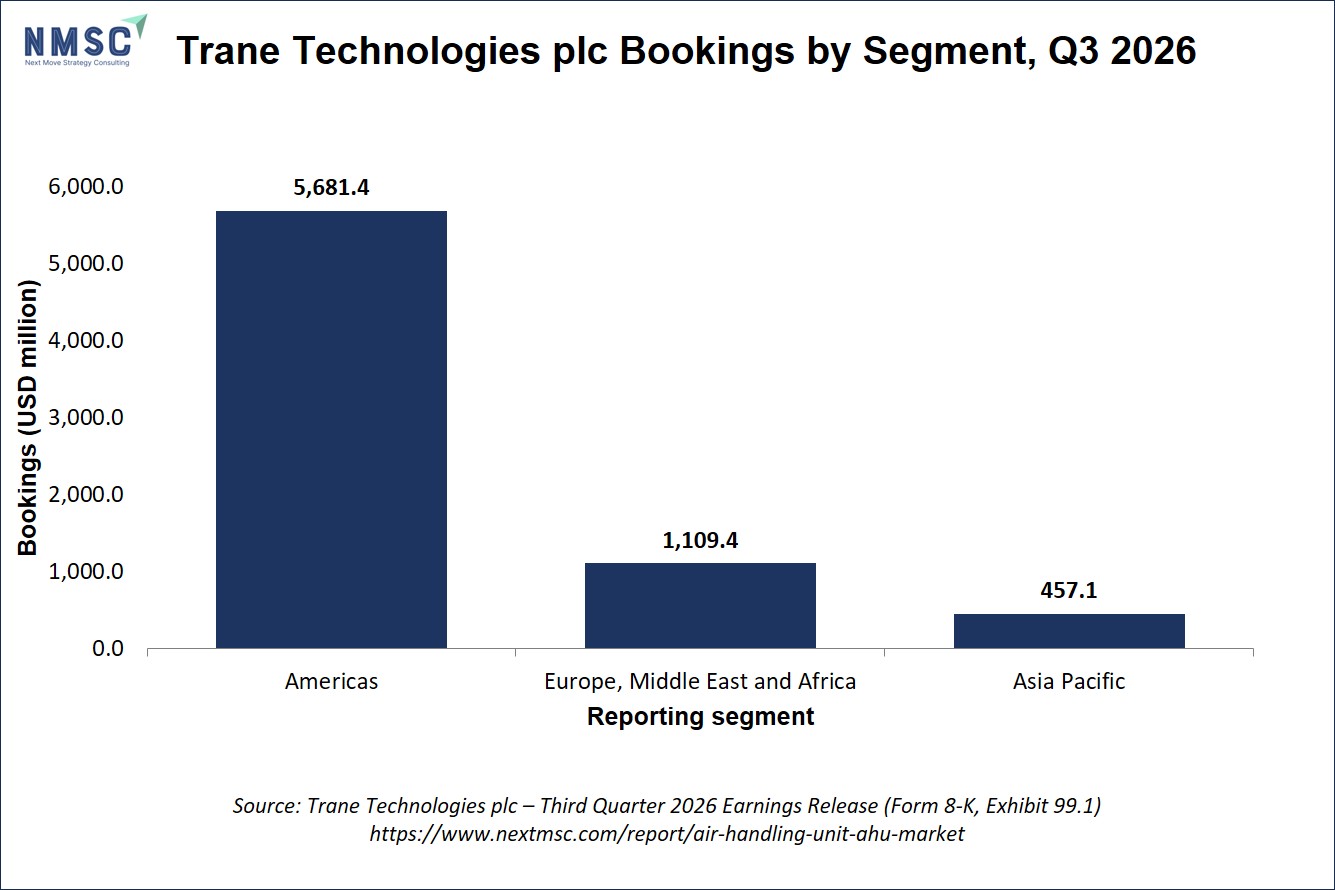
Trane Technologies plc's third quarter 2026 earnings release, dated October 29, 2026, reports bookings of USD 5,681.4 million in Americas, USD 1,109.4 million in Europe, Middle East and Africa and USD 457.1 million in Asia Pacific. The three segments sum to the company's total bookings of USD 7,248 million.
Johnson Controls: Record USD 23.0 Billion Backlog Entering Fiscal 2027
In its fiscal fourth quarter 2026 earnings release dated October 27, 2026, Johnson Controls International plc reported a record backlog of USD 23.0 billion, up 43% organically, with fourth quarter orders up 44% organically. Americas orders rose 58% excluding acquisitions, divestitures and currency effects, and Americas backlog reached USD 17.8 billion, up 54%. The release attributes the Americas performance in part to sustained data center demand.
"We finished fiscal 2026 with significant momentum," said Joakim Weidemanis, Chief Executive Officer of Johnson Controls International plc, in the company's release dated October 27, 2026. Regional sales diverged: Americas fourth quarter sales were USD 4.93 billion, up 14%, EMEA sales were USD 1.31 billion, down 2% (up 3% organically), and Asia Pacific sales were USD 871 million, up 12% (up 13% organically). Johnson Controls International plc guided fiscal 2027 organic sales growth of 11% to 12%.
Daikin Applied: Tripling Modular Factory Space in Phoenix
On October 14, 2026, Daikin Applied announced the expansion of its Modular Solutions facility in Phoenix, Arizona, from 58,000 square feet to 191,000 square feet, raising capacity for custom hydronic and electric systems by about 150%. The site also produces Chilldyne direct-to-chip liquid cooling distribution units and DDC Solutions S-Series rack containment systems. "This expansion represents an important step in the continued growth of our Modular Solutions business," said Stephen McGee, General Manager of Modular Solutions at Daikin Applied, in the company's announcement dated October 15, 2026.
Systemair: North America Grows 14% While Western Europe Holds Its Share
Systemair AB, a Sweden-based ventilation and air handling manufacturer, reported on August 27, 2026, in its Interim Report Q1 2026/27 (May to July), net sales of SEK 3,281 million against SEK 3,094 million a year earlier, up 6%. North America sales rose 14% (15% organic), Eastern Europe and CIS sales rose 12%, Nordic region sales rose 10% and Western Europe sales rose 3%.
Robert Larsson, President and Chief Executive Officer of Systemair AB, said that all regions contributed positively to organic growth in the quarter and that North America and Eastern Europe continued to post double-digit organic growth, in the company's report dated August 27, 2026. Western Europe remained the largest region at 44% of net sales.
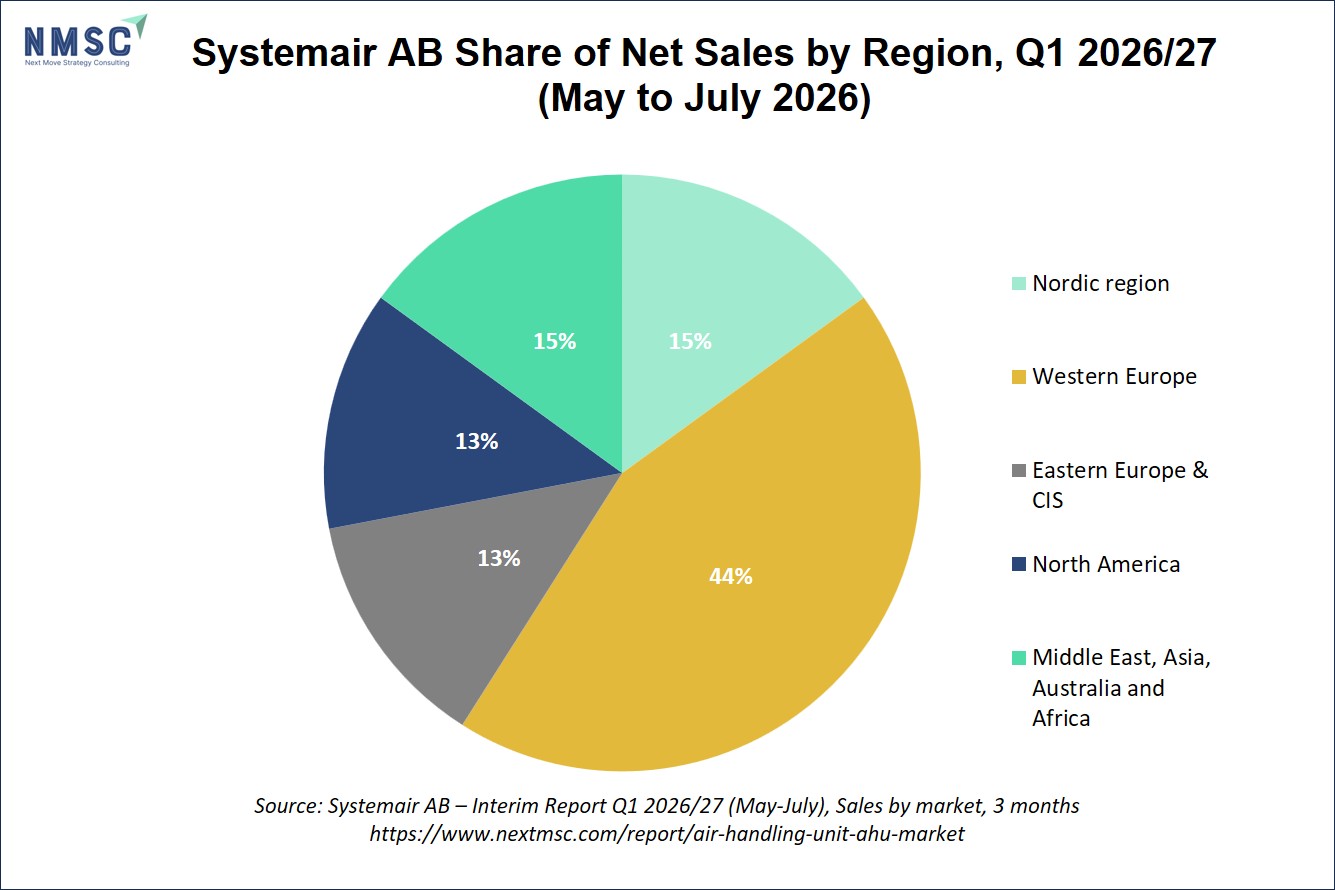
Systemair AB's Interim Report Q1 2026/27 (May to July), dated August 27, 2026, reports the share of net sales by region as follows: Nordic region 15%, Western Europe 44%, Eastern Europe and CIS 13%, North America 13% and Middle East, Asia, Australia and Africa 15%. The shares total 100%.
NMSC Strategic Perspective: Why Backlog, Not Shipments, Is the New Signal in the Air Handling Unit (AHU) Market
NextMSC primary research and analysis reads the October 2026 filings as evidence that the industrial application segment, which in the NextMSC segmentation spans healthcare, data centers and food and beverage facilities, is gaining weight within an air handling unit market that was historically anchored by commercial and residential construction. Backlog growth of 43% to 73% at three of the largest suppliers of commercial HVAC equipment indicates that demand has moved ahead of factory output, and that delivery lead times and production capacity are now as influential as price.
This has direct implications for segmentation. Modular and custom product types, which NextMSC tracks alongside packaged units, are positioned to capture a growing share of data center projects, as the Daikin Applied expansion illustrates. Smart AHUs with embedded sensors benefit from operators who must verify airflow and energy performance continuously, and Asia-Pacific, with the highest projected regional CAGR of 6.4% through 2030 in NextMSC analysis, offers a second growth axis less dependent on a single customer type.
Section Summary:
Five company disclosures between August and October 2026 show demand for commercial air systems concentrating in data centers and Americas projects.
-
Carrier Global Corporation reported data center orders up about 300% and backlog above USD 8.5 billion on October 29, 2026.
-
Trane Technologies plc reported a USD 12.5 billion backlog, with EMEA bookings rising from USD 791.1 million to USD 1,109.4 million.
-
Johnson Controls International plc reported a record USD 23.0 billion backlog, with Americas backlog at USD 17.8 billion.
-
Daikin Applied expanded its Phoenix modular facility from 58,000 to 191,000 square feet, and Systemair AB reported North America sales up 14%.
Industry Impact Analysis
Electricity Demand and Cooling Load: The IEA View
The International Energy Agency (IEA), in its Electricity Mid-Year Update 2026 published in July 2026, states that global electricity consumption is set to increase strongly in 2026 and lists data centres and cooling needs among the drivers of that rise. For air handling unit suppliers, the link is physical: every megawatt of server load becomes heat that must be removed, and the air side of that system, including fans, coils, filters and controls, is sized to the load. Rising electricity costs also raise the value of fan efficiency and heat recovery.
Refrigerant Regulation in Europe: The EEA Data
The European Environment Agency (EEA), in ETC CM Report 2026/02, Fluorinated greenhouse gases 2026, as reported by Cooling Post on November 13, 2026, found that hydrofluorocarbons (HFCs) placed legitimately on the European market in 2025 were 2% below the maximum allowed under the F-gas Regulation, and that HFC supply fell 15% compared with 2024. Refrigeration, air conditioning and heat pumps accounted for more than 70% of F-gas use by tonnes in 2025, and imports of equipment pre-charged with HFCs rose about 12% in CO2 equivalent. The impact on air handling is indirect: air handling units are specified together with chillers and heat pumps whose refrigerants are being phased down, so replacement projects often renew the air side in the same package.
Regional Divergence: Americas Lead, EMEA Recovers, Asia Pacific Expands
The October 2026 filings agree on direction but differ in magnitude. Johnson Controls International plc reported Americas orders up 58% while its EMEA sales fell 2%. Carrier Global Corporation reported Climate Solutions Americas sales up 24% against Climate Solutions Europe sales up 3%. Trane Technologies plc reported EMEA bookings up faster than Americas bookings, from a smaller base. For suppliers, regional capacity planning matters: Americas factories are filling with data center work, while European and Asian plants depend more on retrofit and industrial demand.
Raw Materials and Component Dependence
NextMSC primary research and analysis identifies reliance on third-party raw materials and components, such as coils, fans, filters and electronics, as the main restraint on the air handling unit market, since supply disruptions and cost increases flow directly into delivery schedules. Record backlogs sharpen this risk: a supplier with USD 23.0 billion of orders on its books cannot absorb a coil or motor shortage without pushing delivery dates.
Section Summary:
Electricity demand, refrigerant rules and regional order patterns are shaping which air handling products win projects.
-
The IEA names data centres and cooling needs among the drivers of rising electricity consumption in 2026, which raises the value of efficient fans and heat recovery.
-
EEA data reported on November 13, 2026 show HFC supply down 15% in 2025, supporting bundled equipment replacement in Europe.
-
Americas orders are growing fastest, but EMEA bookings at Trane Technologies plc rose from USD 791.1 million to USD 1,109.4 million.
-
Component supply is the main restraint on delivery as backlogs lengthen.
Pros and Cons of Recent Market Developments
|
Pros |
Cons |
|
Backlogs of USD 8.5 billion (Carrier Global Corporation), USD 12.5 billion (Trane Technologies plc) and USD 23.0 billion (Johnson Controls International plc) give suppliers multi-quarter revenue visibility. |
Order growth is concentrated in the Americas and in data centers, so a slowdown in hyperscale spending would hit the same suppliers at once. |
|
Daikin Applied's Phoenix expansion to 191,000 square feet adds factory-built capacity for custom hydronic and electric systems. |
Carrier Global Corporation recorded a USD 3.1 billion non-cash goodwill impairment related to its Climate Solutions Europe reporting unit, highlighting valuation concerns despite positive quarterly sales and operating profit growth. |
|
Systemair AB reported growth in every region, with North America up 14% and Eastern Europe and CIS up 12%. |
Dependence on third-party coils, fans and electronic components lengthens lead times as backlogs grow. |
|
Falling HFC supply in Europe (down 15% in 2025) pushes owners toward bundled replacement of air and refrigeration equipment. |
Refrigerant and efficiency rules raise engineering and certification costs for smaller manufacturers. |
Key Data & Statistics
Key Industry Events and Quantified Market Impact (2026)
|
Company |
Date |
Quantified Impact |
|
Carrier Global Corporation (Q3 2026) |
October 29, 2026 |
Data center orders up about 300%; Commercial HVAC orders up about 60%; backlog above USD 8.5 billion, up 60% |
|
Trane Technologies plc (Q3 2026) |
October 29, 2026 |
Bookings USD 7,248 million (USD 5,979 million prior year); backlog USD 12.5 billion, up 73% |
|
Johnson Controls International plc (Q4 FY26) |
October 27, 2026 |
Backlog USD 23.0 billion, up 43% organically; Americas orders up 58%; Americas backlog USD 17.8 billion |
|
Daikin Applied (Phoenix expansion) |
October 15, 2026 |
Facility from 58,000 to 191,000 square feet; capacity up about 150% |
|
Systemair AB (Q1 2026/27) |
August 27, 2026 |
Net sales SEK 3,281 million, up 6%; North America up 14% |
Regional Performance Indicators, Latest Reported Quarter
|
Indicator |
Value |
Basis |
|
Trane Technologies plc Americas bookings |
USD 5,681.4 million (USD 4,814.6 million prior year) |
Q3 2026 earnings release, October 29, 2026 |
|
Trane Technologies plc EMEA bookings |
USD 1,109.4 million (USD 791.1 million prior year) |
Q3 2026 earnings release, October 29, 2026 |
|
Johnson Controls International plc APAC sales |
USD 871 million, up 12% |
Q4 FY26 earnings release, October 27, 2026 |
|
Systemair AB Western Europe share of net sales |
44% |
Interim Report Q1 2026/27, August 27, 2026 |
|
HFC supply change in Europe, 2025 versus 2024 |
Down 15% |
European Environment Agency, reported November 13, 2026 |
Section Summary:
Company filings quantify a demand cycle led by the Americas and data centers, with every major region reporting growth.
-
Backlogs at three large HVAC suppliers range from USD 8.5 billion to USD 23.0 billion.
-
Trane Technologies plc posted bookings growth in all three of its segments.
-
Systemair AB reported positive organic growth in all regions.
Future Outlook & Forecast
The Road to USD 18.47 Billion: Three Forces Behind the Air Handling Unit (AHU) Market's 5.2% CAGR
According to NextMSC primary research and analysis, the global air handling unit (AHU) market is projected to reach USD 18.47 billion by 2030, growing at a CAGR of 5.2% from 2024 to 2030. Three structural forces underpin this trajectory.
1. Mission-critical cooling demand: Data center orders at Carrier Global Corporation (up about 300%) and Americas backlog at Johnson Controls International plc (USD 17.8 billion) show that operators are committing capital ahead of delivery. NextMSC treats the industrial application segment, which includes data centers and healthcare, as the part of the market with the clearest upside, because these buildings run air systems continuously and favor larger, specified units over standard packaged equipment.
2. Product mix shift toward modular, custom and smart units: The NextMSC segmentation separates packaged, modular and custom AHUs, and separates single flux, double flux (energy recovery) and smart AHUs. Factory-built capacity such as the Daikin Applied Phoenix expansion supports faster delivery of modular and custom designs, while fan efficiency and energy recovery gain value as the IEA highlights rising electricity consumption.
3. Efficiency, indoor air quality and refrigerant rules: NextMSC primary research and analysis identifies stricter indoor air quality and energy efficiency standards as a core driver. In Europe, EEA data showing HFC supply down 15% in 2025 indicates that refrigerant-linked equipment replacement is under way.
Asia-Pacific: The Largest Region and the Fastest to Grow
NextMSC regional analysis finds that Asia-Pacific dominated the air handling unit market in 2023, expects it to hold that position through 2030, and projects the highest regional CAGR of 6.4% over the period. Company disclosures are consistent with continued momentum: Johnson Controls International plc reported Asia Pacific sales of USD 871 million, up 12% (13% organic).
Risks to the Forecast
Three risks could slow the trajectory. First, backlog concentration: a large share of recent order growth comes from the Americas and from data centers, so any pause in hyperscale capital spending would affect the same suppliers at once. Second, supply chain exposure: reliance on third-party raw materials and components can delay deliveries and raise costs, as NextMSC primary research and analysis identifies. Third, regional valuation risk: Carrier Global Corporation recorded a USD 3.1 billion non-cash goodwill impairment related to its Climate Solutions Europe reporting unit in Q3 2026. Although the segment reported 3% sales growth and 40% operating profit growth, the impairment highlights valuation-related uncertainty and the importance of distinguishing reported asset values from current operating performance.
Section Summary:
NextMSC projects the market to reach USD 18.47 billion by 2030 at a 5.2% CAGR.
-
Data center and healthcare demand favors larger, specified air handling units.
-
Modular, custom and smart units lift average selling prices as factory-built capacity expands.
-
Asia-Pacific holds the largest share in NextMSC analysis and the highest regional CAGR of 6.4%.
-
Backlog concentration and component supply are the main risks to timing.
Next Steps for Stakeholders
For Manufacturers and OEMs
-
Secure component supply before committing delivery dates. With backlogs of USD 12.5 billion at Trane Technologies plc and USD 23.0 billion at Johnson Controls International plc, coils, fans and electronics are the constraint most likely to delay shipments. Negotiate multi-quarter supply agreements and qualify second sources for fans and heat exchanger coils.
-
Invest in modular and custom production lines. The Daikin Applied expansion from 58,000 to 191,000 square feet shows how large suppliers are positioning for factory-built cooling systems. Smaller manufacturers can compete on specialization, such as cleanroom or healthcare air handlers.
For Data Center Developers and Building Owners
-
Reserve air handling capacity at the design stage. Lead times are lengthening as backlogs build, so specifying air handling equipment early and confirming production slots reduces commissioning risk. Request fan efficiency and energy recovery data in tenders.
For Investors and Analysts
-
Track backlog conversion, not only orders. Carrier Global Corporation, Trane Technologies plc and Johnson Controls International plc all report backlog growth of 43% or more. The next quarterly releases will show how quickly that backlog turns into revenue.
-
Watch regional divergence. The gap between Americas strength and European profitability, visible in the Carrier Global Corporation goodwill impairment, suggests that regional exposure will influence results as much as product mix. Systemair AB, with 44% of net sales in Western Europe and North America up 14%, provides a useful read on both.
Conclusion
The Air Handling Unit (AHU) Market is being reshaped by where buildings are being built and what they must protect. Carrier Global Corporation's data center orders up about 300%, Trane Technologies plc's USD 12.5 billion backlog and Johnson Controls International plc's record USD 23.0 billion backlog show demand running ahead of supply, while Daikin Applied's Phoenix expansion shows suppliers adding capacity where orders are strongest.
According to NextMSC primary research and analysis, the market is projected to reach USD 18.47 billion by 2030 at a 5.2% CAGR, a forecast that reflects data center and healthcare demand, the shift toward modular and smart units and the efficiency and refrigerant rules that are renewing building equipment. Stakeholders who secure supply, align capacity with regional demand and specify efficient equipment early will be best positioned as the market scales toward 2030.
About the Author
 Priyanshu Das
— Priyanshu Das is SEO Executive at Next Move Strategy Consulting, where he has led on-page and off-page SEO, keyword research, and SEO audits for the firm's B2B market research publications for 2 years. His audit process combines technical crawl analysis, backlink profile review, and competitor keyword gap mapping — using tools including Screaming Frog and Google Search Console — to prioritize fixes by organic search-visibility impact, informed by his own prior in-house and agency SEO experience.
About the Reviewer
 Debashree Dey
— Debashree Dey is Assistant Manager at Next Move Strategy Consulting, where she supports cross-vertical market content and communications across diverse industries for 6 years. Her professional background includes senior content writing, communications, and published manuscript authorship, with experience developing audience-focused business narratives and maintaining clear, consistent messaging. Her role supports research-led content development and editorial quality across NextMSC publications.
















Add Comment