Airport Stands Equipment Market: Why Gate Spending Defies Traffic | NextMSC
Introduction
On 21 September 2026, Brussels Airport Company began a programme to refurbish all 33 passenger boarding bridges in Pier A, the terminal that serves Schengen flights, with completion scheduled for 2031. The announcement arrived while air travel was weakening: the International Air Transport Association (IATA) reported on 30 September 2026 that global passenger demand fell 0.8% in August 2026 compared with August 2025. That divergence between gate-equipment spending and near-term traffic defines this quarterly update on the airport stands equipment market.
According to Next Move Strategy Consulting's Airport Stands Equipment Market report, the global airport stands equipment market was valued at USD 1.25 billion in 2019 and is projected to reach USD 2.00 billion by 2030, growing at a CAGR of 4.30% from 2020 to 2030. The report segments the market into boarding bridges, preconditioned air units, ground power units and stand entry guidance systems, and NextMSC primary research and analysis places North America as the largest regional market throughout the forecast period.
For More Information: Download FREE Sample on Airport Stands Equipment Market Report
The fourth quarter of 2026 is a decision window for gate infrastructure. United States grant agreements are due by 30 October 2026, the European Commission is expected to propose revised alternative fuels infrastructure rules that cover electricity supply to parked aircraft, Dubai Airports plans Dh55 billion of contract awards before year-end, and Poland's new central airport is moving a 92-bridge tender toward an early 2027 award.
Quarterly Airport Stands Equipment Market Update: Q4 2026 Opens With Funded Retrofits and Mega-Tenders
The quarter's defining event is the FAA's 18 May 2026 selection of fiscal year 2026 Airport Terminal Program grants. The sections below show how funding, refurbishment, procurement and Gulf construction fit together.
FAA Awards USD 970 Million in Its Final Terminal Grant Round, With Gate Equipment Inside the Scope
On 18 May 2026, the Federal Aviation Administration (FAA) published its list of fiscal year 2026 Airport Terminal Program selections. According to the American Association of Airport Executives, in its regulatory alert of 18 May 2026, the final round distributes USD 970 million and drew 588 applications requesting USD 7.1 billion, so applicants sought more than seven times the funds available.
Gate equipment sits inside the funded scope. The FAA's selections list includes the final phase of replacing approximately 13 passenger boarding bridges at Tampa International Airport, replacement of approximately six bridges at Daytona Beach International Airport, and five bridges for a relocated terminal at Monterey Regional Airport. The office of U.S. Senator Kirsten Gillibrand reported that Buffalo Niagara International Airport received USD 8.7 million to replace up to eight bridges together with new ground power units and preconditioned air units, an award that bundles all three equipment types.
Timing matters for the fourth quarter. Under the FAA's notice of funding opportunity of 8 December 2025, sponsors must execute grant agreements by 30 October 2026, so funded projects enter procurement in the final weeks of the year. The American Association of Airport Executives adds that no new Infrastructure Investment and Jobs Act airport funding is scheduled after fiscal year 2026.
Brussels Airport Chooses Refurbishment Over Replacement for 33 Bridges
On 21 September 2026, Brussels Airport Company announced renovation works on the passenger boarding bridges in Pier A. As reported by the Belga news agency the same day, all 33 bridges will be renovated by 2031, and the oldest date from 2002. Travel Tomorrow reported a programme cost of about EUR 25 million.
The scope is refurbishment, not replacement. Each bridge receives a new control system, components are overhauled or replaced after individual assessment, and the movable section is transported to the manufacturer. Brussels Airport states that the works allow the bridges to operate for at least another fifteen years, with no more than three bridges out of service at once.
In supply terms, the programme shifts revenue toward controls, drive components and factory refurbishment capacity, and away from new-unit supply, for the 33 gates concerned. The NextMSC report names the long shelf-life of airport ground support equipment as a restraint, and Brussels shows an operator converting that shelf-life into a planned fifteen-year extension.
Poland's New Central Airport Narrows Its 92-Bridge Tender to Two Bidders
On 30 July 2026, aeroTELEGRAPH reported that the tender run by Centralny Port Komunikacyjny for passenger boarding bridges at Poland's new central airport had reached the competitive dialogue stage. Adelte Airport Technologies and TK Airport Solutions are the two companies remaining after pre-selection. The contract covers up to 92 bridges, of which 72 are firm and 20 are optional, and the award is planned for early 2027.
A single award of this size concentrates a multi-year order book with one supplier. It also contrasts with Brussels: the Polish contract is a greenfield programme with a long lead time, whereas the Belgian work is a brownfield programme already under way. The NextMSC report names both new airport construction and the upgrading of existing airports among the forces behind the market.
Gulf Airports Keep Awarding Contracts While Traffic Contracts
The Iran war that began in February 2026 disrupted aviation across the Gulf. Fortune reported on 1 September 2026 that Dubai International Airport handled 31.5 million passengers in the first six months of 2026, down 31.3% from the same period of 2025, while aircraft movements fell 32.1% to 150,600.
Capital spending did not follow traffic downward. The National reported on 26 August 2026 that Dubai Airports had awarded Dh13 billion of contracts in 2026 for the new Al Maktoum International Airport terminal and planned a further Dh55 billion (USD 14.9 billion) by year-end. Asked whether construction had slowed during the war, Dubai Airports Chief Executive Paul Griffiths answered "no". The first phase is due in 2032 with capacity for 150 million passengers a year, and contact stands for a terminal of that scale will be specified years before opening.
TK Elevator, the parent of TK Airport Solutions, reported on 28 August 2026 that third-quarter fiscal 2026 order intake rose 12% on a foreign-exchange-adjusted basis to EUR 2.5 billion, with strong Middle East order growth in every quarter. The figures cover the whole group, so they indicate regional order momentum and not an airport-only measure.
IATA August Data Shows Why Stand Utilisation Differs by Region
IATA's August 2026 data, released on 30 September 2026, shows why gate demand timing differs by region. Global revenue passenger kilometres fell 0.8% year on year and rose 0.6% excluding Middle Eastern carriers. Middle Eastern carriers fell 14.6%, while Latin American carriers rose 5.3%, African carriers 4.4%, Asia-Pacific carriers 1.4% and European carriers 0.7%. North American carriers declined 2.2%. IATA also reported that European carriers' Europe-Asia traffic grew 12.2% while their transatlantic traffic fell 2.4%.
Load factor is the metric most closely tied to stand productivity, because each additional point of seats filled raises the passengers passing through a boarding bridge on every turnaround. European carriers recorded the highest load factor at 87.5%, while Middle Eastern carriers recorded 78.9%, ahead of only African carriers at 77.5%. The global load factor was 85.1%, down 0.9 percentage points from August 2025.
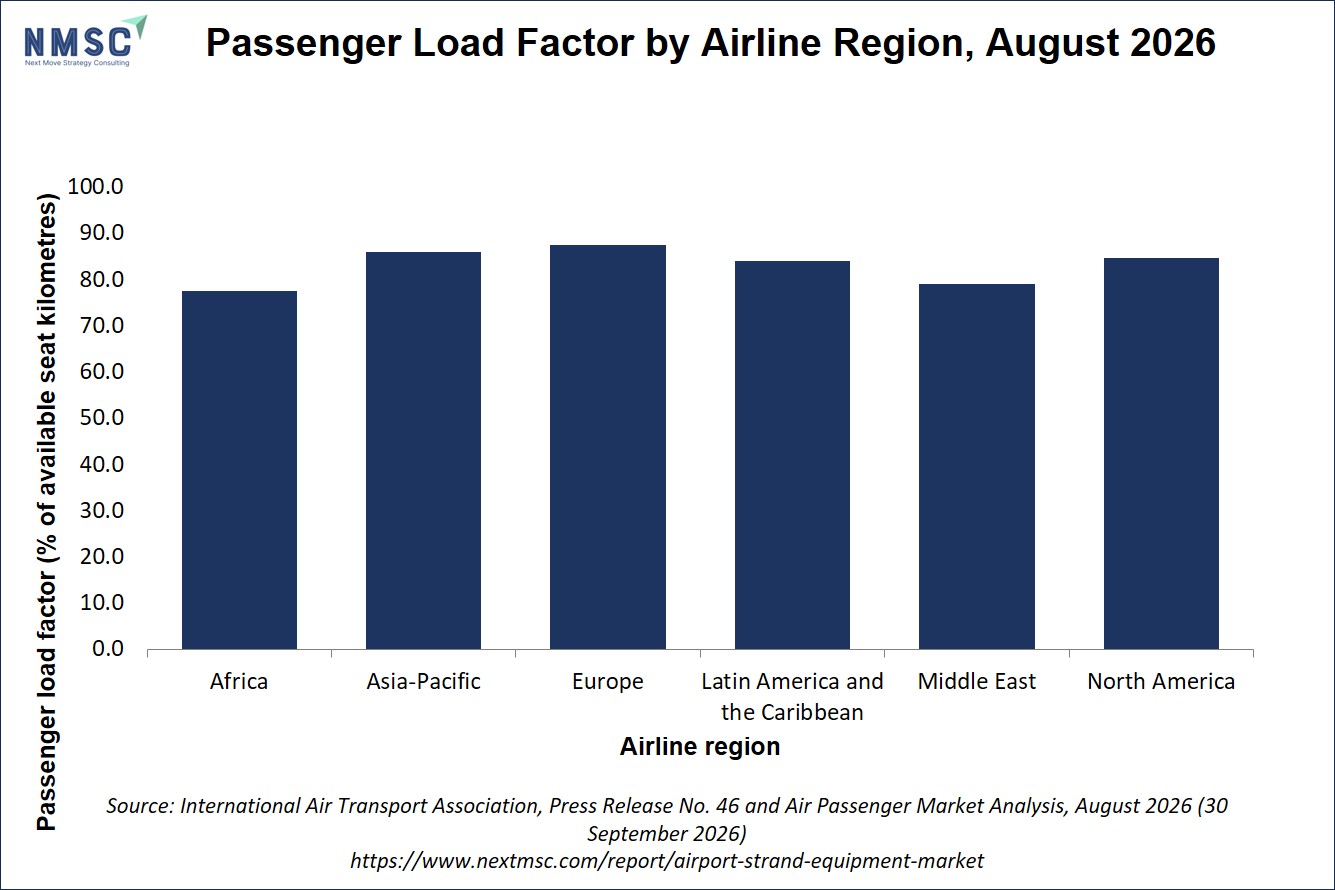
IATA's August 2026 data reports passenger load factors of 87.5% for European carriers, 85.9% for Asia-Pacific carriers, 84.6% for North American carriers, 84.0% for Latin American and Caribbean carriers, 78.9% for Middle Eastern carriers and 77.5% for African carriers. The global load factor was 85.1%, which was 0.9 percentage points lower than in August 2025. IATA labels all figures as provisional.
IATA's chief economist, Marie Owens Thomsen, said in the press release of 30 September 2026 that October schedules show "cautious optimism", with available seats up 2.0%, while higher energy prices have reduced travellers' purchasing power.
NMSC Strategic Perspective: Capital Programmes Are Decoupling From Quarterly Traffic
NextMSC primary research and analysis reads this quarter as evidence that capital programmes for airport stands are decoupling from monthly traffic. The NextMSC report names airport expansion and upgrading, new airport construction and demand for new aircraft as forces behind its 4.30% CAGR, and names the long shelf-life of equipment and a shortage of skilled workers as restraints. This quarter shows those forces acting together.
The mechanism is procurement timing. Grant agreements, tender calendars and multi-year construction budgets fix when equipment is ordered, while passenger volumes enter only at the planning stage. The FAA's 30 October 2026 deadline, Dubai Airports' year-end award plan and the Polish award planned for early 2027 are dates set by capital calendars, while IATA shows traffic falling in the Middle East and North America. Supplier order books therefore lag the monthly traffic data by quarters to years.
NextMSC's analytical view is that the specification trend to monitor is the bundling of ground power and preconditioned air with bridge programmes, as at Buffalo Niagara, because a bundled award raises the value of each stand package. Cavotec's Q2 2026 report adds a supplier signal: it reported a record-high order backlog with order intake driven primarily by shore power systems, which shows power-transfer engineering capacity also being committed to ports.
Section Summary:
Gate equipment demand is running on capital calendars and refurbishment cycles rather than on monthly passenger data. Funded US retrofits, a Belgian refurbishment programme, a Polish new-build tender and Gulf construction are all proceeding even where traffic is flat or falling.
-
FAA grant agreements must be executed by 30 October 2026, which converts selections into procurement.
-
Brussels Airport's programme shows operators extending bridge life by at least fifteen years rather than replacing units.
-
Dubai Airports plans Dh55 billion of awards by the end of 2026 although Dubai International traffic fell 31.3% in the first half.
Industry Impact Analysis: Funding Cliffs, Electrification Rules and Conflict Reshape Priorities
Four external forces now shape planning in the airport stands equipment market: grant funding, European electrification rules, regional conflict and supplier capacity.
Funding is the first force. The fiscal year 2026 round is the last under the Infrastructure Investment and Jobs Act, according to the American Association of Airport Executives, and applicants requested USD 7.1 billion against USD 970 million available. Suppliers should treat the funded projects as a finite wave and expect United States order visibility after fiscal year 2026 to depend on Congress extending airport programmes.
Regulation is the second force. The European Commission describes Regulation (EU) 2023/1804, the Alternative Fuels Infrastructure Regulation, as setting mandatory targets that include electricity supply to stationary aircraft, with all contact stands due by 2025 and all remote stands by 2030. Its review consultation ran from 11 May to 3 August 2026, according to the ALICE technology platform, and a proposal is expected before the end of 2026. The Commission's Alternative Fuels Observatory notes that the review asks whether battery-electric and hydrogen aircraft infrastructure should be addressed more explicitly. NextMSC reads remote stands as the more demanding installation task, because they need pit systems, cabling and mobile ground power across wider apron areas.
Conflict is the third force and acts unevenly. IATA reports Middle Eastern carrier demand down 14.6% in August 2026, yet Dubai Airports continues to award contracts. The National reported on 26 August 2026 that Dubai Airports describes supply-chain bottlenecks as a global phenomenon and is mobilising suppliers from around the world, which points to procurement capacity as a constraint alongside demand.
Supplier capacity is the fourth force. TK Elevator reported nine-month fiscal 2026 order intake up 9% to EUR 7.3 billion, and Cavotec's January to June 2026 report shows a record order backlog driven by shore power. Neither disclosure isolates airport orders, so NextMSC treats them as indicators of manufacturing load and not of airport demand. Workforce capacity compounds the constraint. The NextMSC report names a shortage of skilled workers as a restraint, and refurbishment such as Brussels Pier A requires each bridge to be assessed, detached and reinstalled, which Brussels spreads across the programme period by limiting simultaneous outages.
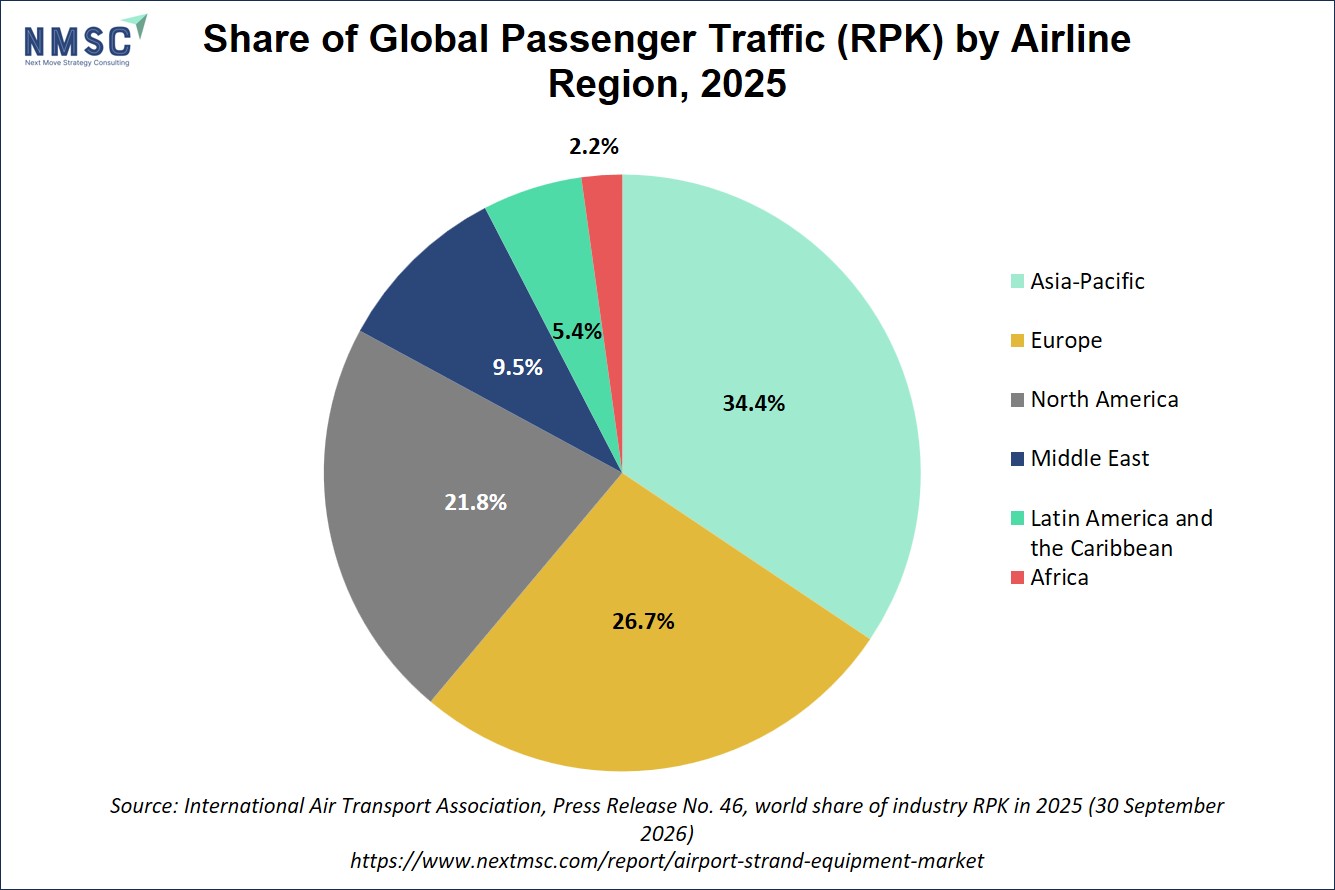
IATA reports that Asia-Pacific carriers accounted for 34.4% of industry revenue passenger kilometres in 2025, ahead of Europe at 26.7% and North America at 21.8%. Middle Eastern carriers held 9.5%, Latin America and the Caribbean 5.4% and Africa 2.2%. The six shares total 100.0%.
IATA's 2025 data places Asia-Pacific carriers at 34.4% of industry revenue passenger kilometres, ahead of Europe at 26.7% and North America at 21.8%. NextMSC's analysis nonetheless places North America as the largest equipment market, which indicates that spending follows infrastructure programmes and installed-base renewal as well as passenger volumes.
Section Summary:
Funding, regulation, conflict and supplier capacity each move on a different calendar, and none is set by the latest monthly traffic figure. Order timing in the airport stands equipment market is therefore best forecast from procurement milestones.
-
United States order visibility after fiscal year 2026 depends on Congress extending airport programmes.
-
European remote-stand electrification is the more demanding installation task and is under review by the European Commission.
-
Gulf hub operators continue capital awards despite a 14.6% August fall in Middle Eastern carrier demand.
Pros and Cons of Recent Market Developments
The table below sets this quarter's benefits against the constraints that stakeholders should price in.
|
Pros |
Cons |
|
FY2026 FAA grants fund bridge replacement with ground power and preconditioned air, as at Buffalo Niagara. |
The FAA terminal programme ends with fiscal year 2026, and no new airport funding is scheduled under the law. |
|
Brussels Airport's refurbishment extends Pier A bridge life by at least fifteen years. |
Refurbishment replaces new-unit sales with smaller retrofit contracts, a restraint NextMSC links to equipment shelf-life. |
|
Poland's central airport tender covers up to 92 bridges and has narrowed to two bidders. |
The award is planned for early 2027, outside 2026 revenue. |
|
Dubai Airports plans Dh55 billion of awards by the end of 2026. |
Dubai International traffic fell 31.3% in the first half of 2026. |
|
The Commission's AFIR review may extend rules to battery-electric and hydrogen aircraft. |
The revised text is unpublished, leaving remote-stand specifications open. |
Key Data & Statistics
Two tables consolidate verified figures: FAA gate-equipment awards and IATA regional traffic for August 2026.
Selected FY2026 Airport Terminal Program awards covering gate equipment
|
Airport |
Funded gate-equipment scope |
|
Buffalo Niagara International Airport |
Replacement of up to eight passenger boarding bridges, with new ground power units and preconditioned air units (USD 8.7 million) |
|
Tampa International Airport |
Final phase of replacement of approximately 13 passenger boarding bridges |
|
Daytona Beach International Airport |
Replacement of approximately six passenger boarding bridges |
|
Monterey Regional Airport |
Acquisition and installation of five passenger boarding bridges for a relocated terminal |
|
Hector International Airport, Fargo |
Installation of passenger boarding bridges as part of a terminal expansion (USD 1 million) |
Passenger demand and load factor by airline region, August 2026
|
Airline region |
Share of 2025 industry RPK |
RPK change vs August 2025 |
Load factor, August 2026 |
|
Africa |
2.2% |
+4.4% |
77.5% |
|
Asia-Pacific |
34.4% |
+1.4% |
85.9% |
|
Europe |
26.7% |
+0.7% |
87.5% |
|
Latin America and the Caribbean |
5.4% |
+5.3% |
84.0% |
|
Middle East |
9.5% |
-14.6% |
78.9% |
|
North America |
21.8% |
-2.2% |
84.6% |
|
Total market |
100% |
-0.8% |
85.1% |
Future Outlook & Forecast: Airport Stands Equipment Market Through 2030
NextMSC primary research and analysis projects that the global airport stands equipment market will reach USD 2.00 billion by 2030, growing at a CAGR of 4.30% from 2020 to 2030, from USD 1.25 billion in 2019. NextMSC expects North America to hold the largest share throughout the forecast period and Asia-Pacific to gain share as India and China add airports and international transport expands.
The near-term outlook is set by dated events. On 30 October 2026, the FAA deadline will show how quickly funded projects such as Buffalo Niagara and Tampa reach procurement. Before the end of 2026, the Commission's proposal will show whether electricity supply to stationary aircraft is tightened, and Dubai Airports' Dh55 billion plan will show how much of the Al Maktoum terminal package is committed. In early 2027, the Polish award will fix the supplier for up to 92 bridges. Brussels Airport's programme runs to 2031 and Al Maktoum's first phase is due in 2032.
Traffic risk remains. IATA reported cautious optimism for October, but its chief economist noted that higher energy prices and geopolitical instability may discourage travel. If Middle Eastern traffic stays below its year-earlier level, hub operators may re-phase later stages, and suppliers would see the effect in order calendars before traffic statistics.
NextMSC's view is that the market will keep a two-speed profile: refurbishment in mature networks gives steady, shorter-cycle revenue, while new-build programmes in the Gulf, Poland and Asia-Pacific give larger but later orders. NextMSC expects operators that bundle ground power and preconditioned air with bridge work, as in the Buffalo Niagara award, to capture more value per stand.
Section Summary:
NextMSC projects growth to USD 2.00 billion by 2030 at a CAGR of 4.30%, and the next two quarters will show how much of that growth is already committed through grants, tenders and construction contracts.
-
Watch the FAA's 30 October 2026 grant-agreement deadline for United States procurement starts.
-
Watch the European Commission's expected proposal on alternative fuels infrastructure before the end of 2026.
-
Watch Dubai Airports' Dh55 billion award programme and Poland's early 2027 bridge award for new-build momentum.
Next Steps for Stakeholders
The developments above translate into specific actions for executives and investors.
-
Equipment manufacturers: build a retrofit and controls offer for operators that extend bridge life, as at Brussels Pier A, and prepare for competitive dialogue formats like the Polish tender.
-
United States airport operators: confirm grant agreements are executed by 30 October 2026 and align procurement with the funded scope, including ground power and preconditioned air.
-
European airport operators: assess remote-stand electricity supply against the 2030 requirement in Regulation (EU) 2023/1804 before locking specifications.
-
Gulf hub operators and suppliers: secure supply-chain capacity ahead of construction milestones, since Dubai Airports identifies it as a global constraint.
-
Investors: track order backlogs, grant execution dates and tender awards alongside monthly IATA traffic data, because capital calendars lead equipment revenue.
-
Policy teams: contribute to the Commission's legislative process on electricity supply to stationary aircraft and to the United States debate on extending airport programmes in fiscal year 2027.
Conclusion
This quarterly update shows an airport stands equipment market whose orders follow capital calendars more closely than passenger statistics. Funded United States retrofits, a Belgian refurbishment programme, a Polish new-build tender and Dubai's contract awards are moving ahead while IATA reports weaker global demand in August 2026. NextMSC's outlook of USD 2.00 billion by 2030 at a CAGR of 4.30% rests on those infrastructure programmes, and stakeholders who track procurement milestones will read the market earlier than those who track traffic alone. The next two quarters will test that reading against grant execution, regulatory proposals and tender awards.
About the Author
 Sanyukta Deb
— Sanyukta Deb is Digital Marketing Team Lead at Next Move Strategy Consulting, where she has led content strategy and technical SEO for the firm's B2B market research publications for over 2 years. Her editorial process translates NextMSC's primary and secondary research — spanning technology, industrial, and consumer sectors — into commercial narratives, backed by search-intent, keyword, and competitive analysis. She brings 5 years of overall experience in digital marketing and content strategy.
About the Reviewer
 Debashree Dey
— Debashree Dey is Assistant Manager at Next Move Strategy Consulting, where she supports cross-vertical market content and communications across diverse industries for 6 years. Her professional background includes senior content writing, communications, and published manuscript authorship, with experience developing audience-focused business narratives and maintaining clear, consistent messaging. Her role supports research-led content development and editorial quality across NextMSC publications.














Add Comment