Electric Aviation Market: 7 Powerful Trends Reshaping Global Air Mobility in 2026
Introduction
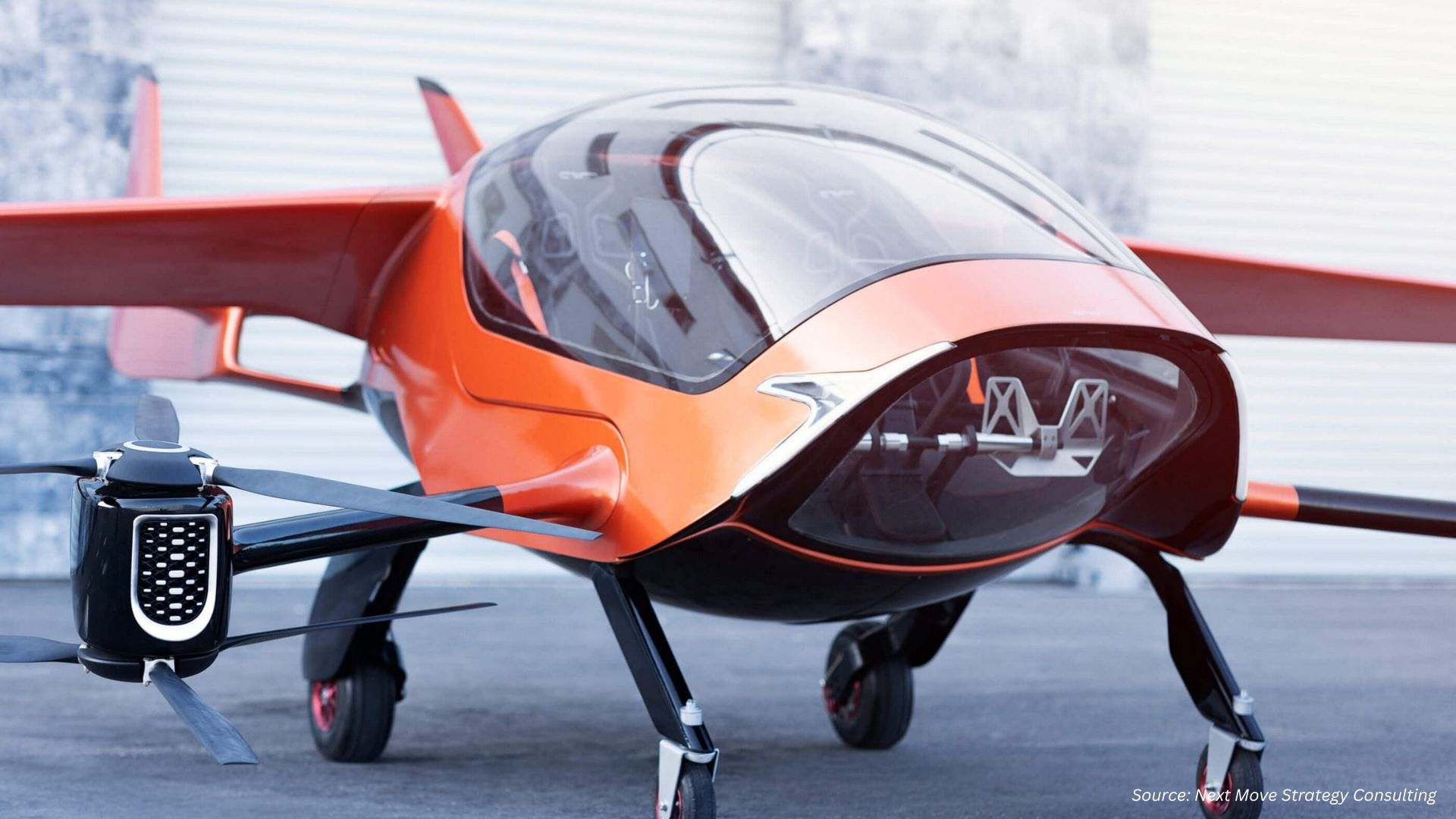
The electric aviation market is no longer a distant vision confined to aerospace laboratories and investor pitch decks — it is actively reshaping the global transportation landscape in real time. From the skies above New York City to the deserts of Dubai, electric vertical takeoff and landing (eVTOL) aircraft are completing milestone flights, securing regulatory approvals, and entering the final stages of commercial certification. The convergence of decarbonization mandates, advancing battery technology, and unprecedented government-backed pilot programs has created a structural inflection point that institutional investors, aerospace executives, and policymakers can no longer afford to overlook.
According to Next Move Strategy Consulting (NMSC), the global electric aviation market was valued at USD 1.85 billion in 2025 and is estimated at USD 2.51 billion in 2026, with a forecast to reach USD 48.60 billion by 2035, expanding at a 39.0% CAGR between 2026 and 2035. This trajectory represents an absolute dollar opportunity of USD 46.09 billion over the forecast period — a figure that underscores the scale of transformation underway across the global aviation value chain. The forces driving this growth are not speculative; they are grounded in regulatory action, commercial agreements, and flight-test milestones that have materialized within the past six months alone.
For More Information: Download FREE Sample on Electric Aviation Market Report
From Pilot Programs to Passenger Flights: The Defining Trends of 2026
The U.S. Government Launches the Most Ambitious eVTOL Integration Program in History
In one of the most consequential regulatory developments in the history of the electric aviation market, U.S. Transportation Secretary Sean P. Duffy and the Federal Aviation Administration (FAA) announced on March 9, 2026, the selection of eight proposals under the brand-new eVTOL and Advanced Air Mobility Integration Pilot Program (eIPP). The program, established under President Trump's Executive Order on Unleashing American Drone Dominance, spans 26 states and involves leading aircraft manufacturers, operators, and state partners across a range of operational concepts — including urban air taxi services, regional passenger transportation, cargo and logistics networks, emergency medical response, and autonomous flight technologies.
The eight selected projects include partnerships with Archer Aviation, Joby Aviation, BETA Technologies, Electra, and Wisk, among others, covering major metropolitan corridors in New York, Texas, Florida, and North Carolina. The U.S. Department of Transportation confirmed that the American public would begin to see operations under this program by summer 2026. This is not a research exercise — it is a live, multi-state deployment framework designed to generate the regulatory data the FAA needs to develop binding standards for electric aircraft integration into the National Airspace System.
Simultaneously, Archer Aviation reached a landmark milestone in April 2026, becoming the first eVTOL company to close Phase 3 of the FAA's 4-phase Type Certification process for its Midnight aircraft. The company reported strong liquidity of approximately USD 1.8 billion at the end of Q1 2026 and confirmed that U.S. operations are expected to begin in 2026, in part to serve as the Official Air Taxi Provider of the LA28 Olympic Games.
Joby Aviation, for its part, completed New York City's first point-to-point eVTOL air-taxi demonstration flights in April 2026, including operations connecting John F. Kennedy International Airport with existing heliport infrastructure across the city. In December 2025, Joby had already capped a year of more than 850 flights across its fleet, covering over 50,000 cumulative miles and completing thousands of test points across the USA, UAE, and Japan—representing a 2.6x increase in operational tempo over the prior year.
In July 2026, Archer Aviation, BETA Technologies, and Macquarie Capital launched America's Consortium for Electric Skyways (ACES), a landmark infrastructure initiative aimed at electrifying more than 250 aviation sites across the United States by 2030, including major airports and metropolitan areas. The consortium adopts an industry-standard charging protocol to ensure interoperability across all operators — a critical step toward commercial scalability.
NMSC's Strategic Perspective: Certification Milestones Are the New Market Catalyst
From NMSC's analytical standpoint, the current phase of the electric aviation market is defined by a decisive shift from prototype development to commercial certification — and the pace of that shift is accelerating faster than most institutional forecasts anticipated. The eIPP program represents a structural catalyst that compresses the traditional regulatory timeline by generating real-world operational data across 26 states simultaneously, rather than relying solely on manufacturer-submitted certification evidence.
NMSC's analysis indicates that aircraft developers are increasingly pairing FAA and EASA certification milestones with airline pre-order commitments to de-risk commercialization, a shift that favors vertically integrated manufacturers over component-only suppliers as multiple eVTOL and fixed-wing programs approach entry into service through 2035. The concentration of capital among a small number of well-funded developers — Joby Aviation, Archer Aviation, and BETA Technologies — is not a market weakness; it is a consolidation signal that mirrors the early commercialization phases of other transformative transportation technologies.
The GAO's May 2026 report on electric aircraft certification reinforces this view. As of March 2026, the FAA had received 23 aviation products with electric propulsion for certification since 2018, and had issued special conditions for four of those products — covering engine models from Safran, magniX, BETA Technologies, and ZeroAvia. Manufacturers that have already secured special conditions are positioned to reach commercial launch ahead of the broader field, creating a first-mover advantage that will be difficult to replicate once airline partnerships and vertiport infrastructure are locked in.
Section Summary: The electric aviation market is transitioning from a development-stage industry to a commercially operational one, driven by the U.S. government's eIPP program, record FAA certification progress from Archer and Joby, and the launch of the ACES infrastructure consortium. These developments collectively represent the most concentrated period of regulatory and commercial advancement in the sector's history.
Key Takeaways:
-
The FAA's eIPP program, spanning 26 states, is the largest real-world testing environment for next-generation aircraft ever assembled in the United States.
-
Archer Aviation became the first eVTOL company to close Phase 3 of the FAA's 4-phase Type Certification process in April 2026.
-
Joby Aviation completed NYC's first point-to-point eVTOL demonstration flights and logged over 9,000 miles of flight in 2025.
-
The ACES consortium targets 250+ interoperable electric aviation charging sites across the U.S. by 2030.
Industry Impact Analysis
Regulatory Gaps Create Both Risk and Opportunity
The GAO's landmark report, published May 27, 2026, provides the most authoritative public assessment of the electric aviation market's regulatory landscape to date. The report confirms that as of March 2026, the FAA has not yet issued a type certification for any manned electric aircraft, and that the timeline for commercial operations remains unclear. The FAA is currently evaluating designs on a case-by-case basis and is considering regulatory changes — including the development of dedicated airworthiness standards for eVTOL aircraft — that could standardize its approach over the long term.
Derrick Collins, Director of GAO's Physical Infrastructure team, noted in a June 2026 interview that the primary challenge for the FAA is ensuring it has sufficient in-house expertise in electric propulsion to manage the certification process at scale. The agency has been hiring engineers in propulsion disciplines, but the pace of industry development is outrunning the regulatory framework's capacity to keep up.
Infrastructure constraints compound the regulatory challenge. According to the FAA, as of December 2025, only 47 airports in the United States had identified charging stations for electric aircraft in their airport plans — the majority of which are part of BETA Technologies' proprietary charging network. Airports face significant barriers to infrastructure deployment, including high startup costs, uncertainty about demand, and the need for dedicated electric transformers or large-scale battery energy storage systems.
Sustainability Mandates Are Accelerating Market Demand
The World Economic Forum's Global Aviation Sustainability Outlook 2026 confirms that the aviation industry remains committed to the International Civil Aviation Organization's (ICAO) goal of net-zero aviation by 2050, despite rising clean-technology costs, geopolitical disruptions, and trade tensions. The aviation sector is responsible for approximately 2% of total global CO2 emissions, and industry leaders are under mounting pressure to demonstrate credible decarbonization pathways.
The WEF report highlights that hydrogen-electric propulsion, integrated from the ground up in clean-sheet aircraft, offers one of the most viable pathways for sustainable aviation. This aligns directly with NMSC's finding that Hydrogen-Electric Propulsion is the fastest-growing propulsion sub-segment in the electric aviation market, expanding at a 50.6% CAGR from 2026 to 2035.
The European Union's aviation emissions trading scheme has also intensified market pressure. Free allocation to aircraft operators was reduced by 50% in 2025, with a trajectory toward full auctioning — a policy shift that materially increases the operating cost of conventional jet-fuel-powered aircraft and strengthens the economic case for electric alternatives on short- and medium-range routes.
Asia-Pacific Emerges as the Fastest-Growing Regional Market
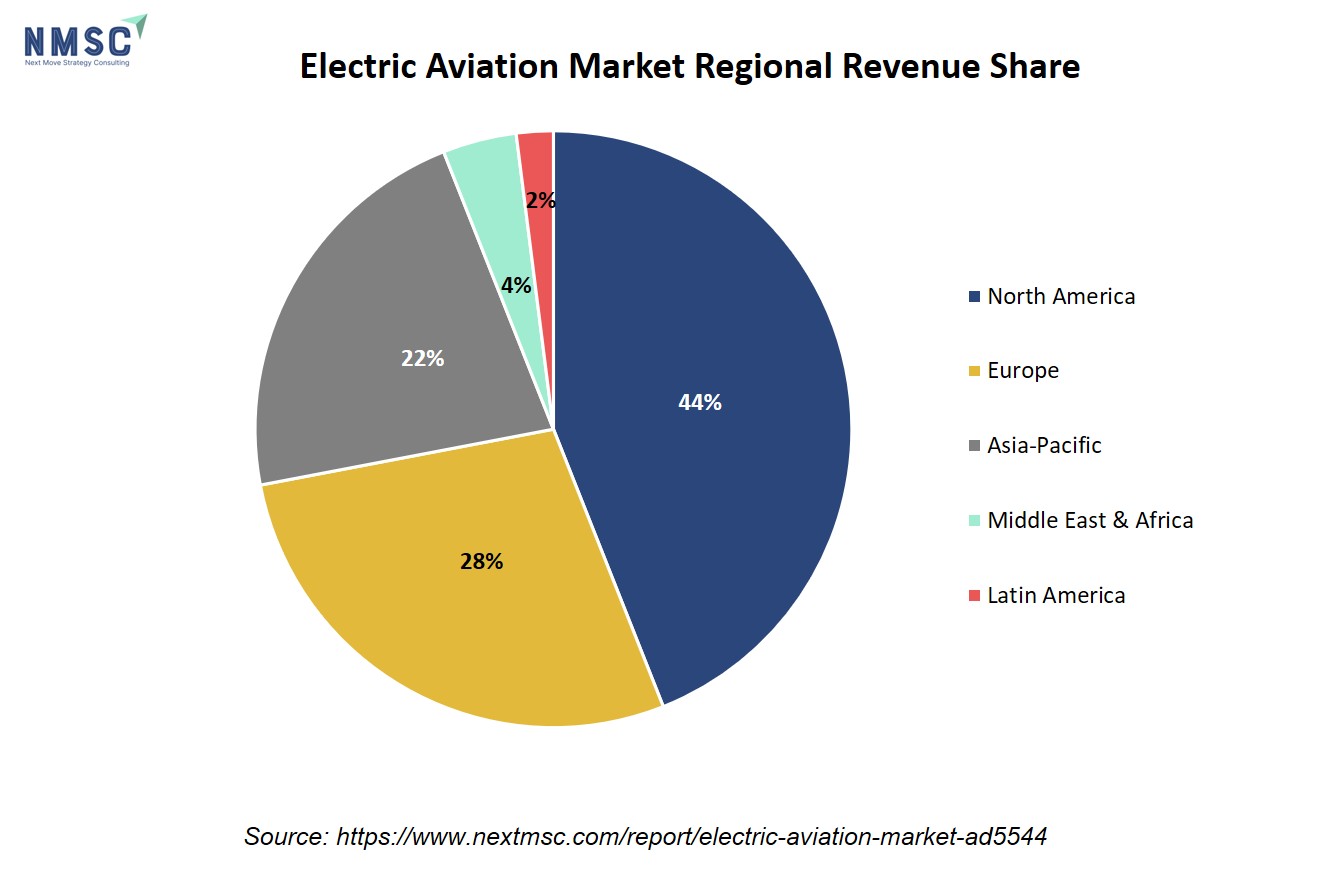
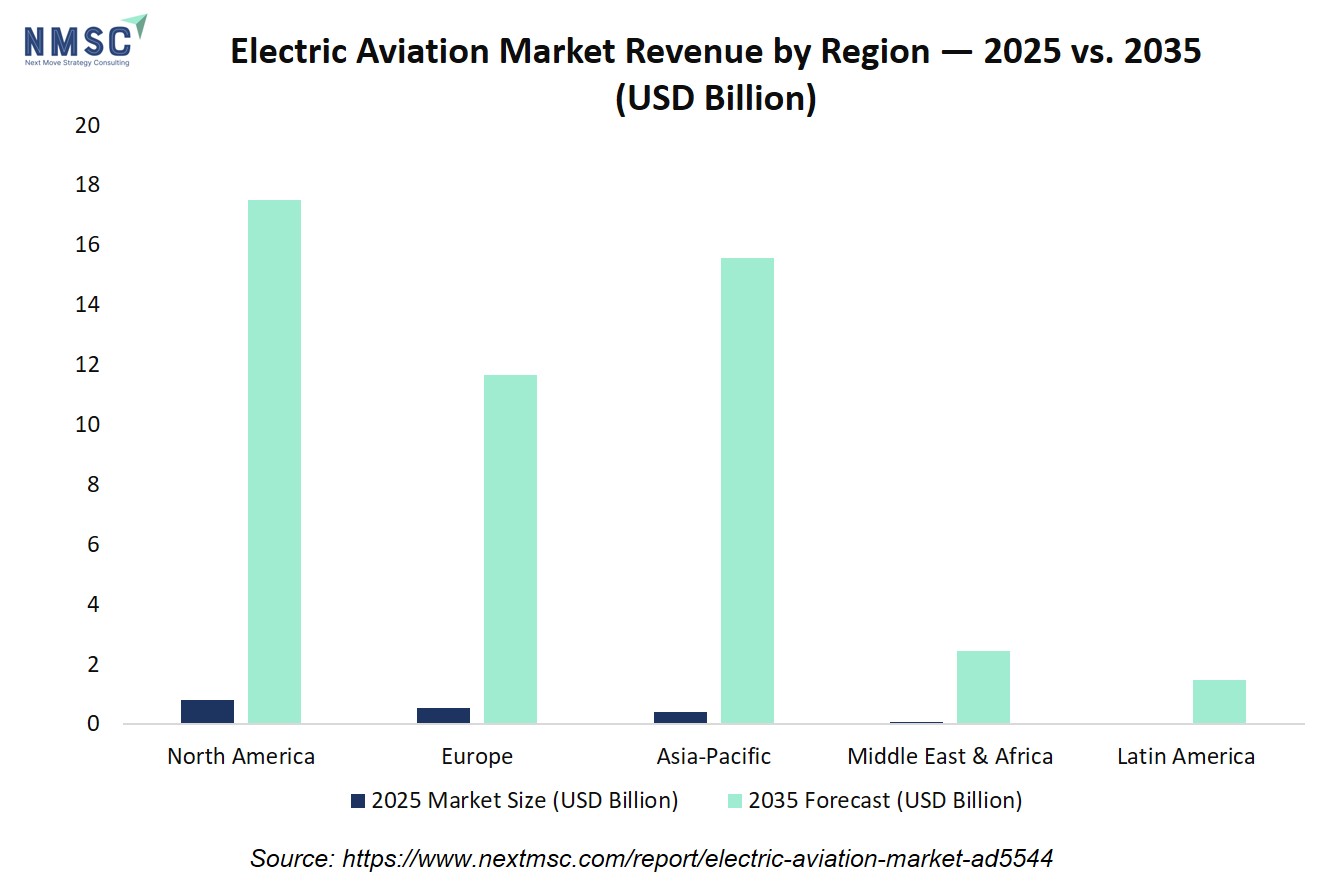
China's national low-altitude economy policy is driving a structural acceleration in Asia-Pacific's electric aviation market. EHang Holdings, the Chinese eVTOL manufacturer, has advanced its commercial passenger-carrying certification under national aviation authority frameworks, while domestic manufacturing capacity is scaling rapidly. NMSC projects Asia-Pacific to register the highest regional CAGR of 44.8% from 2026 to 2035, with India emerging as the fastest-growing individual country at 45.2% CAGR.
Section Summary: The electric aviation market faces a dual dynamic: regulatory frameworks are lagging behind commercial development, creating near-term uncertainty, while sustainability mandates and Asia-Pacific policy support are generating structural long-term demand. The gap between industry readiness and regulatory capacity is the defining risk factor for the 2026–2028 period.
Key Takeaways:
-
The FAA has not yet certified any manned electric aircraft as of March 2026, with certification timelines remaining uncertain.
-
Only 47 U.S. airports had planned charging infrastructure for electric aircraft as of December 2025.
-
The EU's aviation ETS moved to 50% auctioning in 2025, strengthening the economic case for electric aircraft on short-haul routes.
-
Asia-Pacific is projected to grow at a 44.8% CAGR through 2035, led by China's low-altitude economy policy and India's accelerating adoption.
Pros and Cons of Recent Market Developments
|
Recent Development |
Pros |
Cons |
|
FAA eIPP Program (March 2026) |
Creates the largest real-world testing environment for eVTOL aircraft in U.S. history; accelerates regulatory data collection across 26 states |
Program is a 3-year pilot; binding commercial regulations may still be years away from finalization |
|
Archer Aviation Phase 3 Certification Closure (April 2026) |
First eVTOL company to reach this milestone; validates commercial launch timeline for 2026 |
Phase 4 compliance testing remains ongoing; full type certification not yet achieved |
|
ACES Infrastructure Consortium (July 2026) |
Establishes interoperable charging standard across 250+ sites; distributes infrastructure cost across multiple operators |
Dependent on continued private investment; 2030 target leaves a near-term infrastructure gap |
|
GAO Report on FAA Certification (May 2026) |
Provides authoritative public assessment; prompts FAA to accelerate workforce hiring and standardization |
Confirms no manned electric aircraft has been certified; highlights FAA expertise shortfall in electric propulsion |
|
EU ETS Full Auctioning Trajectory |
Strengthens economic case for electric aircraft on short-haul European routes |
Increases near-term operating costs for conventional carriers, potentially constraining capital available for fleet electrification investment |
|
Joby Aviation NYC Demonstration (April 2026) |
Validates urban air taxi operations in the world's most complex airspace; builds public and investor confidence |
Demonstration flights do not constitute commercial service; revenue generation remains contingent on full FAA certification |
Future Outlook & Forecast
A USD 48.60 Billion Market Built on Three Converging Growth Pathways
According to NMSC's proprietary analysis, the electric aviation market is projected to expand from USD 2.51 billion in 2026 to USD 48.60 billion by 2035, at a 39.0% CAGR — representing an absolute dollar opportunity of USD 46.09 billion over the forecast period. This growth is not driven by a single technology or geography; it is broad-based across every segmentation axis, with three structural pathways converging to define the market's long-term trajectory.
Pathway 1: eVTOL Certification and Urban Air Taxi Commercialization. eVTOL Aircraft is both the largest and fastest-growing platform type, projected to expand from USD 0.78 billion in 2025 to USD 26.24 billion by 2035 at a 42.9% CAGR. The Urban Air Mobility and Air Taxi application segment mirrors this trajectory, growing at a 42.6% CAGR to reach USD 18.47 billion by 2035. As Joby Aviation, Archer Aviation, and BETA Technologies advance through the final stages of FAA certification, the commercial air taxi market will transition from demonstration flights to revenue-generating passenger operations across major metropolitan markets.
Pathway 2: Hydrogen-Electric Propulsion for Regional Routes. Hydrogen-Electric Propulsion is the fastest-growing propulsion sub-segment at a 50.6% CAGR, projected to reach USD 9.72 billion by 2035. Joby Aviation's 523-mile hydrogen-electric flight in July 2025 set a new distance record for zero-emission VTOL aircraft, demonstrating regional-range viability that extends the addressable market well beyond battery-limited short hops. The WEF's 2026 sustainability outlook identifies hydrogen-electric propulsion as one of the most viable pathways for sustainable aviation at scale.
Pathway 3: Vertiport and Charging Infrastructure Build-Out. The ACES consortium's commitment to 250+ interoperable charging sites by 2030 addresses the infrastructure constraint most likely to bottleneck commercial scaling even after aircraft certification is achieved. NMSC's analysis indicates that operators are increasingly conditioning service launch timelines on confirmed vertiport and charging infrastructure availability alongside aircraft certification status.
Long-Range Platforms Over 500 km represent the fastest-growing range category at a 51.6% CAGR from 2026 to 2035, reflecting the market's structural shift from short-range urban applications toward regional connectivity as propulsion technology matures.
Section Summary: The electric aviation market's USD 48.60 billion forecast by 2035 is underpinned by three converging growth pathways: eVTOL commercialization, hydrogen-electric propulsion for regional routes, and vertiport infrastructure development. The market's 39.0% CAGR reflects a structural transformation in global air mobility, not a cyclical upturn.
Key Takeaways:
-
The electric aviation market is projected to reach USD 48.60 billion by 2035, growing at a 39.0% CAGR from 2026, per NMSC.
-
eVTOL Aircraft is the largest and fastest-growing platform type, projected to reach USD 26.24 billion by 2035 at a 42.9% CAGR.
-
Hydrogen-Electric Propulsion is the fastest-growing propulsion sub-segment at a 50.6% CAGR, driven by range extension demand.
-
Asia-Pacific will register the highest regional CAGR of 44.8%, with India emerging as the fastest-growing individual country at 45.2% CAGR.
Next Steps for Stakeholders
For C-Level Executives at Aerospace OEMs and Tier-1 Suppliers:
The certification pipeline is narrowing. With the FAA having issued special conditions for only four of 23 electric propulsion products submitted since 2018, manufacturers that have not yet secured regulatory engagement should prioritize FAA and EASA relationship-building immediately. Executives should evaluate whether their current product roadmaps are aligned with the propulsion categories — battery-electric for near-term certification, hydrogen-electric for long-range differentiation — that NMSC identifies as the dominant growth vectors through 2035.
For Institutional Investors and Private Equity:
Capital concentration among a small number of well-funded, certification-stage developers is accelerating. NMSC's analysis indicates that fewer than a handful of the more than 800 active electric aircraft programs identified at end-2024 possess the USD 1 to 2 billion in capital required for full certification and industrialization. Investment theses should focus on vertically integrated manufacturers with binding airline pre-order agreements, demonstrated FAA certification progress, and infrastructure partnerships — the three variables most predictive of commercial launch success.
For Airport Operators and Infrastructure Developers:
The ACES consortium's interoperable charging standard creates a first-mover opportunity for airports willing to invest in electric aircraft infrastructure ahead of commercial service launches. With only 47 U.S. airports having planned charging stations as of December 2025, the infrastructure gap is significant — and the operators that close it earliest will capture recurring revenue from multiple eVTOL operators sharing standardized charging networks.
For Government and Regulatory Bodies:
The GAO's recommendation that the FAA conduct quantitative, mission-critical skill gap assessments for its electric propulsion workforce remains unimplemented. Regulatory bodies should accelerate the development of dedicated airworthiness standards for eVTOL aircraft to replace the current case-by-case approach, which creates uncertainty for manufacturers and investors alike. The eIPP program's operational data, expected to begin flowing from summer 2026, should be treated as a priority input for rulemaking timelines.
For Regional Airlines and Cargo Operators:
The cargo and logistics transport segment is projected to grow at a 40.0% CAGR to reach USD 9.23 billion by 2035, offering regional carriers a lower-complexity entry point into electric aviation relative to passenger certification requirements. Operators should evaluate feeder route electrification strategies now, before fixed-wing eCTOL manufacturers lock in long-term supply agreements with early-mover partners.
Conclusion
The electric aviation market has entered its most consequential phase of development. The convergence of the U.S. government's eIPP program, record FAA certification progress from Archer and Joby Aviation, the launch of the ACES infrastructure consortium, and the WEF's reaffirmation of the aviation sector's net-zero commitment has created a structural foundation for the market's projected expansion from USD 2.51 billion in 2026 to USD 48.60 billion by 2035.
The electric aviation market's growth will not be linear, and the risks are real: regulatory timelines remain uncertain, infrastructure deployment lags commercial ambition, and capital intensity is eliminating underfunded programs at an accelerating pace. However, for stakeholders who position themselves at the intersection of certification progress, airline partnerships, and infrastructure development, the USD 46.09 billion absolute dollar opportunity between 2026 and 2035 represents one of the most compelling long-term investment cases in the global aerospace sector. The question is no longer whether electric aviation will transform global air mobility — it is which organizations will be positioned to lead that transformation when commercial operations scale.
About the Author
 Sanyukta Deb
— Sanyukta Deb is Digital Marketing Team Lead at Next Move Strategy Consulting, where she has led content strategy and technical SEO for the firm's B2B market research publications for over 2 years. Her editorial process translates NextMSC's primary and secondary research — spanning technology, industrial, and consumer sectors — into commercial narratives, backed by search-intent, keyword, and competitive analysis. She brings 5 years of overall experience in digital marketing and content strategy.
Sanyukta Deb
— Sanyukta Deb is Digital Marketing Team Lead at Next Move Strategy Consulting, where she has led content strategy and technical SEO for the firm's B2B market research publications for over 2 years. Her editorial process translates NextMSC's primary and secondary research — spanning technology, industrial, and consumer sectors — into commercial narratives, backed by search-intent, keyword, and competitive analysis. She brings 5 years of overall experience in digital marketing and content strategy.
About the Reviewer
 Debashree Dey
— Debashree Dey is Assistant Manager at Next Move Strategy Consulting, where she supports cross-vertical market content and communications across diverse industries for 6 years. Her professional background includes senior content writing, communications, and published manuscript authorship, with experience developing audience-focused business narratives and maintaining clear, consistent messaging. Her role supports research-led content development and editorial quality across NextMSC publications.
Debashree Dey
— Debashree Dey is Assistant Manager at Next Move Strategy Consulting, where she supports cross-vertical market content and communications across diverse industries for 6 years. Her professional background includes senior content writing, communications, and published manuscript authorship, with experience developing audience-focused business narratives and maintaining clear, consistent messaging. Her role supports research-led content development and editorial quality across NextMSC publications.
















Add Comment