Allergy Diagnostics and Therapeutics: Why Precision Testing Leads | NextMSC
Introduction
On July 31, 2026, Stallergenes Greer withdrew Palforzia, the first and only U.S. FDA-approved oral immunotherapy for peanut allergy, from commercial distribution in the United States. The product's program notice states that no new patients may start treatment and that the Palforzia risk evaluation and mitigation program is closed to new enrolments. The Allergy & Asthma Network reported on August 3, 2026 that Stallergenes Greer described the decision as unrelated to safety, quality or efficacy. The exit leaves omalizumab as the only FDA-approved food allergy therapy and sets a patch, a tablet and a biologic against each other to define the next standard of peanut allergy care.
The therapeutic reset is unfolding on top of a diagnostics base that continues to expand. According to Next Move Strategy Consulting's Allergy Diagnostics and Therapeutics Market report, the global allergy diagnostics and therapeutics market was valued at USD 33.69 billion in 2022 and is projected to reach USD 55.25 billion by 2030, growing at a CAGR of 6.38% from 2023 to 2030. NextMSC primary research and analysis indicates that the next leg of growth depends less on any single product launch than on how accurately clinicians identify which patients qualify for which therapy, a theme that the events of the past six months made concrete.
For More Information: Download FREE Sample on Allergy Diagnostics and Therapeutics Market Report
From Peanut Powder to Patch and Tablet: How Allergy Care Resets After Palforzia
Palforzia's Exit Leaves Omalizumab as the Only Approved Food Allergy Therapy
Palforzia won FDA approval in 2020 and treated peanut allergy in children aged 1 through 17, according to the Allergy & Asthma Network's update of August 3, 2026. The product passed from Aimmune to Nestlé Health Science and then to Stallergenes Greer. Its program notice shows how heavy the delivery model was: the withdrawal ended certifications for pharmacies, wholesale distributors, health care professionals and health care settings, and no new patient may initiate treatment.
With Palforzia gone, omalizumab, the injectable anti-IgE antibody sold as Xolair, is the only FDA-approved food allergy therapy. The FDA cleared it in February 2024 for adults and children aged 1 through 17 with IgE-mediated food allergy, to reduce reactions after accidental exposure, as the Allergy & Asthma Network describes. Office-based oral immunotherapy with food-grade protein and sublingual immunotherapy remain clinical options but carry no FDA approval.
OUtMATCH Stage 2: Omalizumab Monotherapy Holds Its Ground Against Immunotherapy
Stanford Medicine reported on July 27, 2026 that stage 2 of the OUtMATCH trial, published the same day in JAMA Pediatrics, compared a year of omalizumab with eight weeks of omalizumab followed by multi-allergen oral immunotherapy for the rest of the year. The trial enrolled 117 participants, each with a peanut allergy and at least two other food allergies, and the success test was eating a 2,000 mg serving of each of three triggering foods, including peanut, at the end of the year.
Among participants on omalizumab alone, 36% met that test, against 19% in the immunotherapy group. Stanford Medicine attributed most of the gap to higher dropout in the immunotherapy group, where side effects led more participants to stop, and reported that participants who completed the combined approach matched the success of the omalizumab-only group. NextMSC primary research and analysis reads this as evidence that adherence, rather than immune response, separates the two routes, which keeps both clinically viable even though the pool of approved products has narrowed.
DBV Technologies Files a Peanut Patch While ALK-Abelló Awaits FDA Guidance on a Peanut Tablet
On September 29, 2026, DBV Technologies submitted a Biologics License Application to the FDA for the Viaskin Peanut patch in children aged 4 through 7 and requested Priority Review, according to its Form 10-Q and third quarter 2026 results. The filing rests on the phase 3 VITESSE trial of 654 children. The FDA has 60 days from submission to decide whether the application is complete enough for substantive review. DBV Technologies reported USD 165.7 million of cash and equivalents at September 30, 2026, which it expects to fund operations into the third quarter of 2027, and it expects a toddler application for ages 1 through 3 in 2027.
ALK-Abelló is pursuing the same indication through a sublingual route. Its November 17, 2026 interim report states that ALK has submitted a clinical trial application to the FDA for phase 3 development of its peanut allergy tablet and is awaiting feedback before starting the trial.
ALK-Abelló's Third Quarter: Tablets Pull Ahead of Drops
ALK-Abelló reported third quarter 2026 revenue of DKK 1,764 million, up 15% in local currencies from DKK 1,530 million. Tablet sales rose 35% to DKK 999 million from DKK 737 million, with growth of 33% in Europe, 32% in North America and 47% in International markets, supported by the paediatric roll-out. SCIT/SLIT drop sales fell 6% to DKK 527 million from DKK 557 million because of lower SCIT shipments to China, and Anaphylaxis and other products edged up 1% to DKK 238 million.
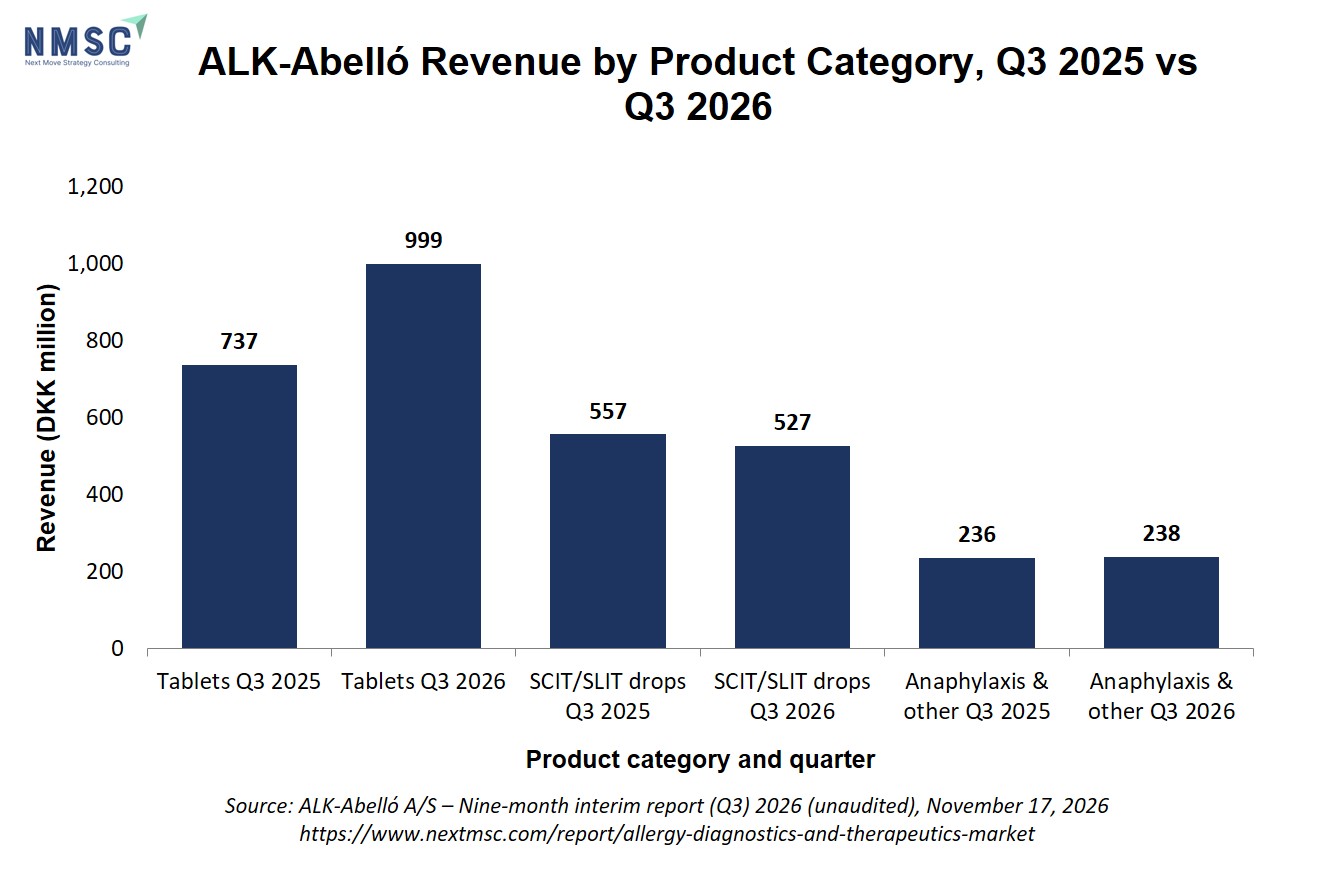
The chart compares ALK-Abelló's third quarter 2025 and third quarter 2026 revenue in three product categories, all taken from the company's November 17, 2026 interim report. Tablet sales rose from DKK 737 million to DKK 999 million, while SCIT/SLIT drop sales moved from DKK 557 million to DKK 527 million.
ALK-Abelló confirmed full-year revenue growth of 16% to 17% in local currencies and an EBIT margin of around 27%. It also expanded its partnership with Catalent to lift annual tablet manufacturing capacity to 1.1 billion from the early 2030s, and noted that neffy was launched in 14 markets by the end of September.
Needle-Free Epinephrine: neffy Scales While Anaphylm Awaits Its Review Date
ARS Pharmaceuticals reported on November 5, 2026 that total third quarter revenue reached USD 37.7 million, including USD 33.4 million of U.S. net product revenue for neffy, the epinephrine nasal spray, against USD 31.3 million a year earlier. Total U.S. market share reached 5%, up from 4% in the third quarter of 2025, and unique prescribers rose 49% to 19,605. ARS Pharmaceuticals reported 9% share in field-targeted accounts against 2% in non-targeted accounts, and it cut third quarter SG&A expenses to USD 43.5 million from USD 74.8 million by ending linear television and broad consumer advertising.
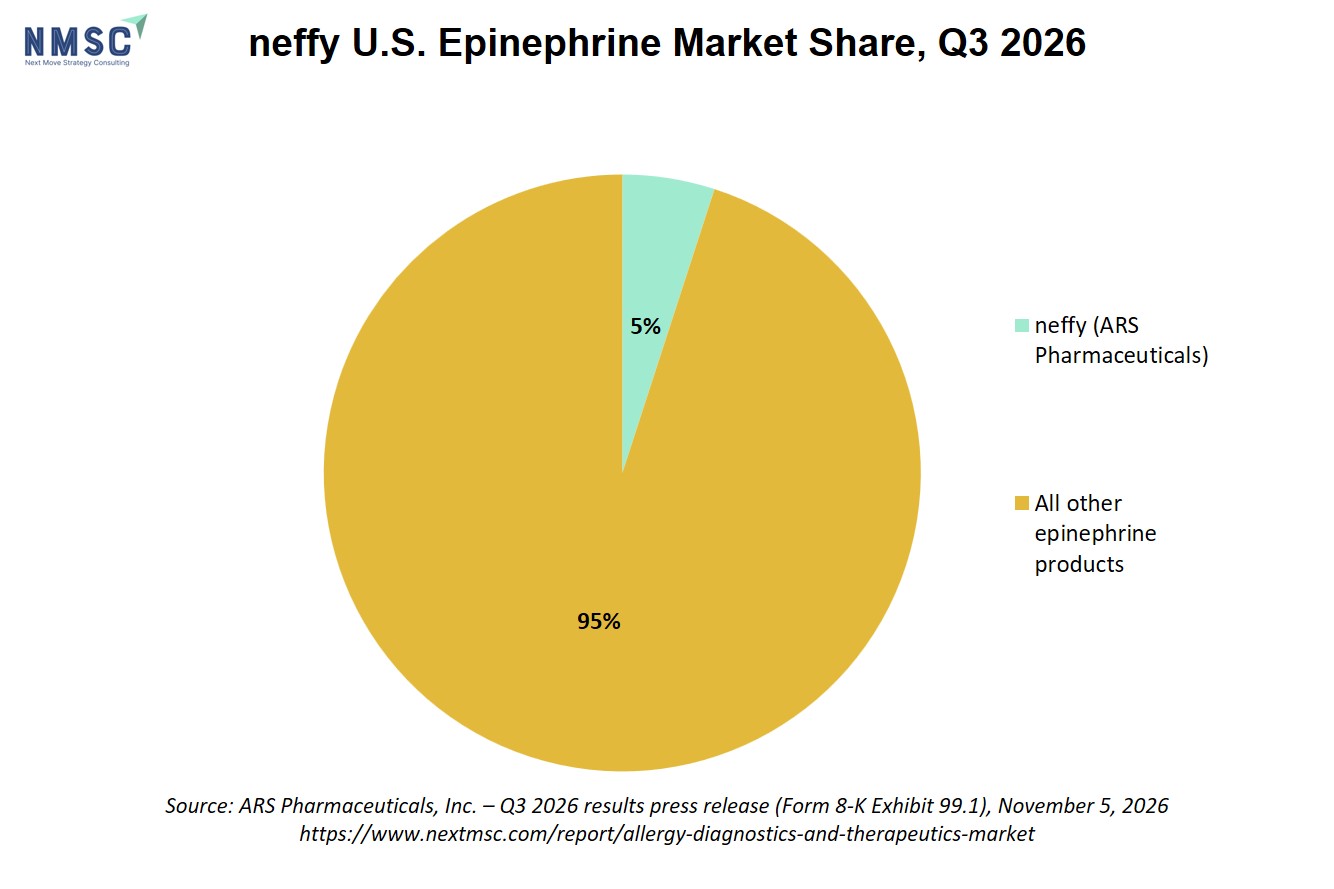
ARS Pharmaceuticals reported a 5% total U.S. market share for neffy in the third quarter of 2026. The remaining 95% is calculated as 100 minus that reported share and covers all other epinephrine products.
Aquestive Therapeutics is pursuing a sublingual film. After the FDA issued a complete response letter on January 30, 2026, Aquestive Therapeutics resubmitted the Anaphylm new drug application on September 16, 2026, and on October 15, 2026 announced that the FDA had accepted it as a complete Class 2 response with a target action date of March 16, 2027. ARS Pharmaceuticals management said end-user demand for neffy rose 42% year over year in the quarter, while U.S. net product revenue rose from USD 31.3 million to USD 33.4 million.
Diagnostics Under Scrutiny: ACAAI Panel Data and Automated IgE Platforms
The sharpest diagnostic signal came from the ACAAI meeting in Phoenix on November 12 to 16, 2026. Researchers surveyed 300 clinicians who had ordered at least one food allergy panel in 2024, and 43 responded. Of those, 85% recognised that broad food allergy panels carry high false positive rates, and 44% had learned about the panels only after their training. Respondents still reported ordering panels for indications that guidelines do not support, and 21% said they ordered at a patient or family request. The institution studied ordered more than 1,700 panels in 2024, according to the American College of Allergy, Asthma and Immunology news release of November 12, 2026. The 43 responses make the sample small, but the gap between awareness and practice is the finding.
Laboratory suppliers are positioning around targeted rather than broad testing. In a June 22, 2026 SelectScience industry report, EUROIMMUN and Immunodiagnostic Systems (IDS) described fully automated chemiluminescence immunoassays for quantitative specific IgE on random-access IDS analyzers. In August 2026, Thermo Fisher Scientific published guidance on clinically relevant ImmunoCAP Specific IgE allergen profiles for first-line testing in primary care.
NMSC Strategic Perspective: Why Precision Testing Gates the Allergy Diagnostics and Therapeutics Market
NextMSC primary research and analysis draws one conclusion from these events: diagnosis now sets the ceiling on therapeutic demand. Every route that gained evidence or regulatory traction in 2026, whether omalizumab, a peanut patch or tablet, or needle-free epinephrine, treats a patient whose IgE-mediated allergy has been confirmed and characterised. When Palforzia left the market, the number of approved food allergy products fell to one, so the value of selecting the right patient for that product rose rather than fell.
The ACAAI data show where value leaks. Broad panels that return false positives generate avoidance, referrals and repeat visits without producing a treatable diagnosis, so NextMSC expects laboratory spending to move from broad panels toward targeted profiles, component-resolved assays and automated platforms that deliver quantitative results at throughput. The same logic favours suppliers that pair testing with an interpretation pathway, because a result that a primary care clinician cannot act on does not create therapeutic demand. ALK-Abelló's 47% International tablet growth in the third quarter suggests that the sequence of testing first and treating second is also taking hold outside North America and Europe.
Section Summary:
The 2026 evidence points to a therapeutic reset that raises the importance of precise diagnosis.
-
Palforzia's withdrawal on July 31, 2026 left omalizumab as the only FDA-approved food allergy therapy.
-
OUtMATCH stage 2 recorded 36% versus 19% success on a three-food, 2,000 mg endpoint, with dropout explaining most of the gap.
-
DBV Technologies' September 29, 2026 filing and Aquestive Therapeutics' March 16, 2027 target date set the next regulatory milestones.
-
ACAAI survey data link broad food allergy panels to false positives, which favours targeted testing.
Industry Impact Analysis
Regulatory Calendar: FDA Milestones Cluster Between Now and March 2027
The regulatory map for the next four months is unusually dense. The FDA's 60-day filing review of the DBV Technologies patch application falls in late November 2026, and Priority Review, if granted, would shorten the clock that follows. Aquestive Therapeutics' Anaphylm target action date is March 16, 2027, and ALK-Abelló awaits FDA feedback on its peanut tablet phase 3 plan. Each decision changes the treatment menu available to a clinician who has just confirmed a food allergy diagnosis, which is why diagnostic workflows and therapeutic launches now need to be planned together.
Allergen Labelling: A WAO Consensus Points Toward Dose-Based Thresholds
In August 2026, a World Allergy Organization ACT-UP! e-Delphi panel reached consensus on 33 of 35 statements about precautionary allergen labelling across three rounds. The panel agreed that 'may contain' warnings should apply only when unintended allergen presence exceeds an action level set through a mandatory, preferably quantitative, risk assessment, and it favoured eliciting-dose reference values over fixed concentration cut-offs.
Dose-based thresholds raise the analytical bar for food manufacturers and testing laboratories, since a quantitative action level requires quantitative detection. NextMSC primary research and analysis therefore treats food allergen testing as a secondary demand pool within allergy diagnostics. The consensus remains a recommendation, however, and precautionary labelling stays voluntary and unregulated in most countries.
Access Gaps: World Allergy Week and School Epinephrine Data
The World Allergy Organization used World Allergy Week, held June 21 to 27, 2026 under the theme Allergy Care Is Essential Care, to call for more trained allergy specialists and wider access to allergy diagnostics, treatments and adrenaline delivery methods.
School data from the ACAAI meeting quantify one gap. A national survey completed by 349 school nurses found that 87.3% of schools kept stock epinephrine and 73.6% required students with food allergy to bring personal devices. 10% of nurses reported that epinephrine was unavailable during a real allergic emergency, and schools without stock epinephrine were 4.42 times more likely to report that problem, according to the American College of Allergy, Asthma and Immunology.
Section Summary:
Regulation, labelling and access each influence how quickly new products convert into patient use.
-
FDA decisions cluster between late November 2026 and March 16, 2027.
-
The World Allergy Organization consensus favours quantitative, dose-based allergen labelling thresholds.
-
School survey data link stock epinephrine to fewer emergencies without a device.
Pros and Cons of Recent Market Developments
|
Pros |
Cons |
|
ALK-Abelló's tablet sales rose 35% to DKK 999 million in the third quarter of 2026, with paediatric use contributing to growth. |
Palforzia's withdrawal on July 31, 2026 removed the only FDA-approved peanut oral immunotherapy and left one approved food allergy therapy. |
|
OUtMATCH stage 2 showed 36% of participants on omalizumab alone tolerating full servings of three foods. |
In the same trial, 19% of the immunotherapy group reached the endpoint, and side effects drove more dropouts. |
|
Needle-free epinephrine reached 5% U.S. market share, and ALK-Abelló launched neffy in 14 markets by the end of September 2026. |
ARS Pharmaceuticals' U.S. net product revenue rose from USD 31.3 million to USD 33.4 million, while demand grew 42%. |
|
Automated specific IgE platforms from EUROIMMUN and IDS add throughput and quantitative results. |
85% of surveyed clinicians knew broad food allergy panels give false positives, and 21% reported ordering one at a patient or family request. |
|
The WAO consensus on dose-based labelling thresholds gives laboratories and food manufacturers a clearer technical target. |
Precautionary allergen labelling remains voluntary in most countries, so the consensus does not yet bind manufacturers. |
Key Data & Statistics
Key Allergy Developments and Quantified Impact (July to November 2026)
|
Event |
Date |
Quantified Impact |
|
Palforzia withdrawn from the U.S. market |
July 31, 2026 |
Only FDA-approved peanut oral immunotherapy removed; omalizumab remains the sole approved food allergy therapy |
|
OUtMATCH stage 2 published in JAMA Pediatrics |
July 27, 2026 |
117 participants; 36% (omalizumab alone) versus 19% (immunotherapy) met the three-food, 2,000 mg endpoint |
|
DBV Technologies submits Viaskin Peanut BLA |
September 29, 2026 |
Children aged 4 through 7; phase 3 VITESSE of 654 children; cash of USD 165.7 million |
|
ARS Pharmaceuticals third quarter results |
November 5, 2026 |
Revenue USD 37.7 million; neffy U.S. net product revenue USD 33.4 million; 5% U.S. share |
|
ACAAI food allergy panel survey |
November 12, 2026 |
300 clinicians surveyed, 43 responses; 85% aware of high false positive rates; more than 1,700 panels ordered in 2024 at one institution |
|
ALK-Abelló nine-month interim report |
November 17, 2026 |
Revenue DKK 1,764 million; tablet sales DKK 999 million, up 35% |
Operating and Access Reference Points (Third Quarter 2026)
|
Indicator |
Value |
Basis |
|
ALK-Abelló tablet sales |
DKK 999 million (DKK 737 million in Q3 2025) |
ALK-Abelló interim report, November 17, 2026 |
|
ALK-Abelló full-year 2026 outlook |
Revenue growth of 16% to 17%; EBIT margin around 27% |
ALK-Abelló interim report, November 17, 2026 |
|
neffy unique U.S. prescribers |
19,605, up 49% year over year |
ARS Pharmaceuticals, November 5, 2026 |
|
Schools with stock epinephrine |
87.3% (349 school nurse responses) |
ACAAI school nurse survey, November 2026 |
Future Outlook & Forecast
The Road to USD 55.25 Billion: What Must Hold for a 6.38% CAGR
NextMSC primary research and analysis projects the global allergy diagnostics and therapeutics market to expand from USD 33.69 billion in 2022 to USD 55.25 billion by 2030, a CAGR of 6.38% from 2023 to 2030. The NextMSC report segments the market by type, product (instruments, consumables and services), test (in vivo and in vitro), allergen (inhaled, food, drug and other), drug class and end user (hospitals, diagnostic laboratories and academic research). That structure matters because the 2026 events act on different segments: Palforzia's exit and the pipeline filings act on food allergen and immunotherapy segments, while the ACAAI panel data and automated IgE platforms act on in vitro testing and consumables.
Three conditions must hold for that trajectory to stay intact. First, tablet immunotherapy must keep converting paediatric prescriptions at the rate ALK-Abelló reported in the third quarter, which depends on manufacturing capacity. Second, epinephrine delivery formats must widen access at a price that payers will cover, a test that neffy's 5% share and the March 2027 Anaphylm decision will inform. Third, diagnostic workflows must shift from broad panels to targeted, quantitative testing so that therapy follows confirmed allergy.
Regional Outlook: North America and Asia-Pacific in the Allergy Diagnostics and Therapeutics Market
NextMSC's report identifies North America as the predominant region and expects it to remain so, citing personalised medicine uptake and provider partnerships. The 2026 evidence supports that view, since DBV Technologies, Aquestive Therapeutics and ARS Pharmaceuticals all directed their lead programmes at the FDA. Asia-Pacific is the faster-moving counterweight, with a large population and rising pollution driving allergy prevalence. ALK-Abelló's International tablet sales grew 47% in the third quarter of 2026, and ALK and its Chinese partner GenSci expect to file ACARIZAX in China in the first half of 2027.
Section Summary:
NextMSC projects USD 55.25 billion by 2030 at a 6.38% CAGR, with testing precision, tablet capacity and epinephrine access as the variables to watch.
-
Tablet capacity and paediatric prescribing sustain immunotherapy revenue, as ALK-Abelló's 35% third quarter tablet growth shows.
-
FDA decisions through March 16, 2027 define the food allergy treatment menu.
-
Targeted, quantitative testing converts diagnosis into therapy while limiting false positives.
Next Steps for Stakeholders
For C-Level Executives and Laboratory Leaders
Executives at diagnostics suppliers and clinical laboratories should audit panel-ordering patterns against society guidance now, because the ACAAI survey shows that awareness of false positives does not by itself change ordering behaviour. Laboratories can build ordering guides around targeted profiles and attach interpretive comments that tell primary care clinicians when to refer. Therapeutic developers should map the patient-identification step before launch, since the Palforzia withdrawal showed how delivery complexity can outweigh regulatory success.
For Institutional Investors
Investors should track dated catalysts rather than themes: the FDA filing decision on the DBV Technologies application due in late November 2026, ALK-Abelló's response from the FDA on its peanut tablet plan, and Aquestive Therapeutics' March 16, 2027 target action date. Balance-sheet runway matters alongside regulatory milestones, and DBV Technologies expects its USD 165.7 million of cash to fund operations into the third quarter of 2027.
Conclusion
The allergy diagnostics and therapeutics market entered the final quarter of 2026 with fewer approved food allergy products, more late-stage filings and sharper questions about testing quality than it faced in July. NextMSC's USD 55.25 billion projection for 2030 depends on converting those filings into patient use through accurate diagnosis, adequate tablet and epinephrine supply, and payer-ready evidence. Stakeholders who plan diagnostic and therapeutic strategy together are best placed to benefit from the 6.38% CAGR that the NextMSC report projects.
About the Author
 Priyanshu Das
— Priyanshu Das is SEO Executive at Next Move Strategy Consulting, where he has led on-page and off-page SEO, keyword research, and SEO audits for the firm's B2B market research publications for 2 years. His audit process combines technical crawl analysis, backlink profile review, and competitor keyword gap mapping — using tools including Screaming Frog and Google Search Console — to prioritize fixes by organic search-visibility impact, informed by his own prior in-house and agency SEO experience.
About the Reviewer
 Sanyukta Deb
— Sanyukta Deb is Digital Marketing Team Lead at Next Move Strategy Consulting, where she has led content strategy and technical SEO for the firm's B2B market research publications for over 2 years. Her editorial process translates NextMSC's primary and secondary research — spanning technology, industrial, and consumer sectors — into commercial narratives, backed by search-intent, keyword, and competitive analysis. She brings 5 years of overall experience in digital marketing and content strategy.














Add Comment