Alternative Protein Market: Trends, Regulations & Forecasts for 2026

Introduction
The global alternative protein market is undergoing one of the most consequential structural transformations in the history of the food industry. Driven by mounting environmental pressures, shifting consumer preferences, and accelerating biotechnology innovation, the sector is no longer a niche experiment — it is a multi-billion-dollar commercial reality attracting institutional capital, government policy, and strategic corporate investment at scale.
What makes this moment particularly significant is the convergence of forces reshaping the protein supply chain simultaneously: regulatory frameworks are tightening and diverging across jurisdictions, investment capital is recalibrating toward commercially proven models, and ingredient technology is advancing faster than market adoption in several sub-segments. For C-level executives, institutional investors, and food industry strategists, understanding the precise dynamics of the alternative protein market — its growth vectors, regulatory headwinds, and segment-level opportunities — is no longer optional. It is a prerequisite for competitive positioning through 2035.
For More Information: Download FREE Sample on Alternative Protein Market Report
Regulatory Turbulence and Investment Recalibration: The Forces Reshaping the Alternative Protein Market
A Wave of U.S. State Legislation Redraws the Cultivated Meat Landscape
One of the most globally impactful developments in the alternative protein market over the past twelve months has been the sweeping wave of U.S. state-level legislation targeting cultivated meat. In 2025 alone, Indiana, Mississippi, Montana, Nebraska, and Texas enacted laws banning the manufacture, sale, or distribution of cell-cultured protein products within their borders. Nebraska's legislation went a step further, formally outlawing the commercial rollout of these products and subjecting any structural violations to enforcement and civil fines under the state's Uniform Deceptive Trade Practices Act.
Simultaneously, a parallel track of labeling legislation has emerged. States including Colorado, Oklahoma, South Dakota, Utah, and Wyoming enacted disclosure requirements mandating that cell-cultured and plant-based products carry prominent qualifying terms — such as "cell-cultivated," "lab-grown," or "plant-based" — in close proximity to any traditional meat terminology on packaging. At the federal level, the U.S. FDA and USDA continue to operate under a joint oversight framework established through a 2019 memorandum of understanding, with FDA governing the pre-harvest phase and USDA's Food Safety and Inspection Service overseeing processing, packaging, and labeling of cultivated meat from livestock and poultry.
This regulatory fragmentation is creating a bifurcated commercial environment: plant-based and fermentation-derived proteins are advancing through established regulatory channels with relative clarity, while cultivated meat faces a patchwork of state-level prohibitions that materially constrain near-term commercialization in the United States.
Investment Capital Recalibrates Toward Commercial Readiness
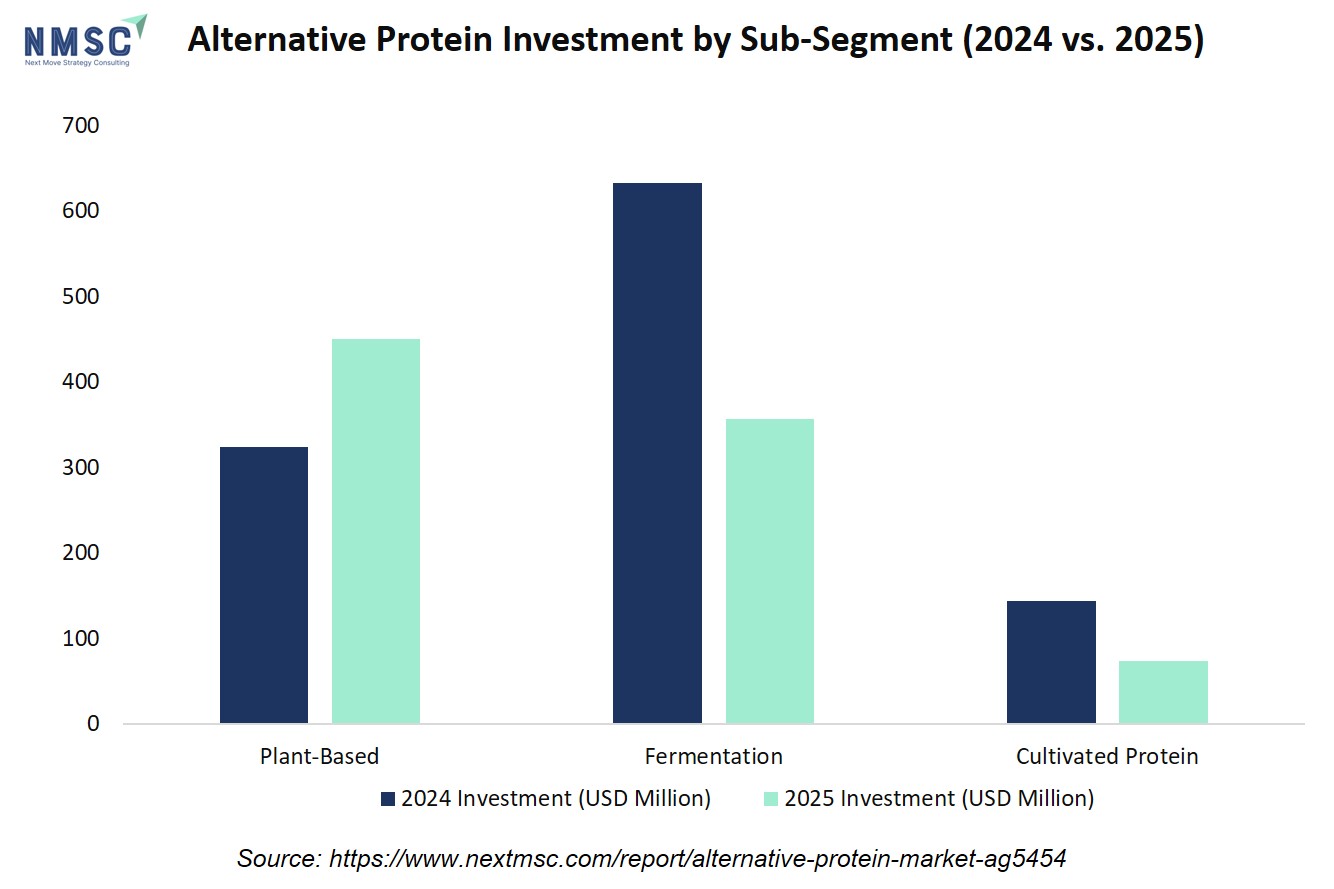
The investment landscape for the alternative protein market has undergone a decisive recalibration. Total investment in alternative protein companies fell to $881 million in 2025 from $1.1 billion in 2024, according to analysis by the Good Food Institute. However, the pullback was highly uneven across sub-segments: plant-based funding rose 39% to $450 million, while fermentation dropped 43% to $357 million and cultivated protein fell 48% to $74 million.
The alternative protein industry has raised over $19.5 billion in total investments since 2017, with $359 million raised in H1 2026 alone. In Q2 2026, fermentation companies led with $132 million raised, followed by plant-based companies at $41 million and cultivated companies at $25 million.
The divergence signals a structural shift in investor priorities. As Daniel Gertner, lead economic and industry analyst at GFI, noted, "The market appears to be entering a phase defined by leaner operations, more targeted commercialization and phased scale-up better aligned with near-term demand." Companies demonstrating measurable commercial traction — such as The EVERY Company, which raised $55 million to scale precision fermentation-derived egg proteins, and MATR Foods, which raised $23.2 million to expand fungal-fermented meat alternatives — are attracting capital, while early-stage players without proven scale-up pathways face financing constraints.
NMSC Strategic Perspective: What This Market Shift Means for Stakeholders
According to Next Move Strategy Consulting's analysis, the current investment recalibration is not a signal of sector decline — it is a maturation event. The alternative protein market is transitioning from a phase of speculative capital deployment into one defined by commercial discipline and infrastructure buildout. Ingredient suppliers that have established toll manufacturing arrangements and licensing platforms are structuring commercial volume without bearing the full cost of dedicated production infrastructure, a model that NMSC identifies as increasingly central to fermentation and cultivated protein commercialization through 2035.
NMSC's assessment further indicates that the regulatory divergence across U.S. states, while creating near-term uncertainty for cultivated meat, is simultaneously accelerating investment concentration into plant-based and fermentation-derived categories — both of which operate within more established regulatory frameworks. Stakeholders that position their ingredient and finished-food portfolios around these two categories while maintaining optionality in cultivated platforms stand to capture the broadest share of the market's projected USD 28.86 billion absolute dollar opportunity between 2026 and 2035.
Section Summary: The alternative protein market is navigating a pivotal inflection point defined by regulatory fragmentation and investment recalibration. The convergence of U.S. state-level cultivated meat bans, shifting capital flows, and the emergence of commercially proven fermentation platforms is fundamentally restructuring competitive dynamics across the value chain.
Key Takeaways:
-
Multiple U.S. states enacted cultivated meat bans and labeling mandates in 2025, creating a fragmented regulatory environment that materially constrains near-term commercialization.
-
Total alternative protein investment fell to $881 million in 2025, but plant-based funding rose 39%, signaling selective capital concentration rather than sector-wide retreat.
-
Fermentation companies led Q2 2026 fundraising at $132 million, reflecting growing investor confidence in precision fermentation's commercial scalability.
-
NMSC identifies toll manufacturing and licensing platforms as the most capital-efficient commercialization pathways for fermentation and cultivated protein developers through 2035.
Industry Impact Analysis
Environmental Imperatives Intensify Demand for Protein Diversification
The macro-level case for alternative proteins continues to strengthen. According to the OECD-FAO Agricultural Outlook 2025–2034, GHG emissions from livestock are projected to rise by 6% from 3.4 Gt CO₂eq in the base period to 3.5 Gt CO₂eq by 2034, even as productivity improvements moderate the rate of increase relative to the 13% growth in meat output projected over the same period. In high-income countries, consumers are increasingly sensitive to animal welfare, environmental, and health concerns, leading in some instances to stagnating or declining per capita meat consumption.
Total growth in global meat consumption is projected at 47.9 Mt over the next decade, with annual per capita consumption rising by just 0.9 kg per capita per year — approximately half the growth rate of the previous decade. This deceleration in conventional meat demand growth, concentrated in high-income markets, is structurally favorable for alternative protein adoption across retail and foodservice channels.
Corporate Innovation Accelerates Across Ingredient and Finished-Food Categories
At the product level, the alternative protein market is witnessing accelerating innovation. In April 2026, dsm-firmenich launched Vertis Textured Vegetable Proteins (TVPs) featuring integrated ModulaSENSE taste-modulation technology at the extrusion stage — a next-generation pea protein solution designed to naturally eliminate bitterness and beany off-notes, enabling manufacturers to simplify labels and improve taste outcomes in plant-based and hybrid meat applications. In January 2026, Impossible Foods announced the expansion of its retail and foodservice footprint with a new line of whole-cut plant-based chicken and steak alternatives, leveraging proprietary fermentation and binding technologies to scale production and reduce overall costs.
These developments reflect a broader industry shift: the competitive battleground is moving from category creation to taste and texture parity with conventional animal-derived products, a transition that is critical for driving mainstream consumer adoption beyond early-adopter segments.
Aquafeed and Feed Applications Emerge as High-Growth Adjacent Markets
Beyond human food, the alternative protein market is expanding rapidly into aquafeed and pet food applications. Insect meal and algae-based ingredients are emerging as sustainable feed substitutes for aquaculture operators facing fishmeal supply constraints. The OECD-FAO Outlook projects that global meat production growth will be driven significantly by Asia and Latin America, with aquaculture playing an increasingly central role in protein supply — a dynamic that is directly expanding demand for alternative protein feed ingredients across the Asia-Pacific region.
[INSERT PIE CHART HERE: Showing Alternative Protein Market Share by Source Technology in 2025: Plant-Based 55%, Fermentation Derived 17%, Insect Based 11%, Algae Based 9%, Cultivated 4%, Hybrid 4%. DESIGN NOTE: Use exact palette: Sky blue (#A0ECD0), Warning (#E2B93B), Grey (#808081), Option 1 (#2B467B), Hover (#1D3360), and Error (#EB5757)]
Section Summary: The industry impact of current market developments spans environmental policy, corporate innovation, and adjacent feed applications. The structural deceleration of conventional meat demand in high-income markets, combined with accelerating ingredient innovation and expanding aquafeed applications, is broadening the commercial addressable market for alternative protein producers.
Key Takeaways:
-
OECD-FAO projects livestock GHG emissions will rise 6% by 2034, sustaining regulatory and consumer pressure to diversify protein sourcing.
-
dsm-firmenich's April 2026 launch of Vertis TVPs with ModulaSENSE technology signals a new competitive standard for taste parity in plant-based formulations.
-
Aquafeed applications represent a structurally high-growth adjacent market, particularly across Asia-Pacific where fishmeal substitution demand is accelerating.
-
Per capita meat consumption growth is decelerating in high-income markets, creating a structural demand gap that alternative proteins are positioned to fill.
Pros and Cons of Recent Market Developments
|
Recent Development |
Pros |
Cons |
|
U.S. State Cultivated Meat Bans (2025) |
Drives investment concentration into plant-based and fermentation categories with clearer regulatory pathways |
Creates market fragmentation; restricts cultivated meat commercialization in major agricultural states |
|
Investment Recalibration Toward Commercial Readiness |
Filters out undercapitalized players; strengthens long-term sector credibility with institutional investors |
Reduces early-stage funding availability; constrains innovation pipeline for pre-commercial technologies |
|
Precision Fermentation Scale-Up (e.g., The EVERY Company, MATR Foods) |
Lowers per-unit production costs; enables functional protein supply without animal inputs |
High bioreactor capital expenditure; regulatory approval timelines remain lengthy in several jurisdictions |
|
dsm-firmenich Vertis TVP Launch (April 2026) |
Addresses taste and texture parity gap; simplifies labeling for manufacturers |
Adoption dependent on reformulation investment by finished-food brands |
|
Impossible Foods Whole-Cut Expansion (January 2026) |
Broadens retail and foodservice distribution; validates consumer demand for premium plant-based formats |
Competitive pricing pressure from conventional meat remains a structural barrier to mass-market penetration |
|
OECD-FAO Livestock GHG Projections |
Strengthens policy and ESG investment case for alternative proteins |
Regulatory implementation of carbon pricing on meat remains uneven across jurisdictions |
|
Asia-Pacific Aquafeed Demand Growth |
Opens large-volume, price-competitive market for insect and algae ingredients |
Regulatory harmonization for novel feed ingredients across APAC markets remains incomplete |
Future Outlook & Forecast
Market Trajectory: From USD 17.35 Billion in 2026 to USD 46.21 Billion by 2035
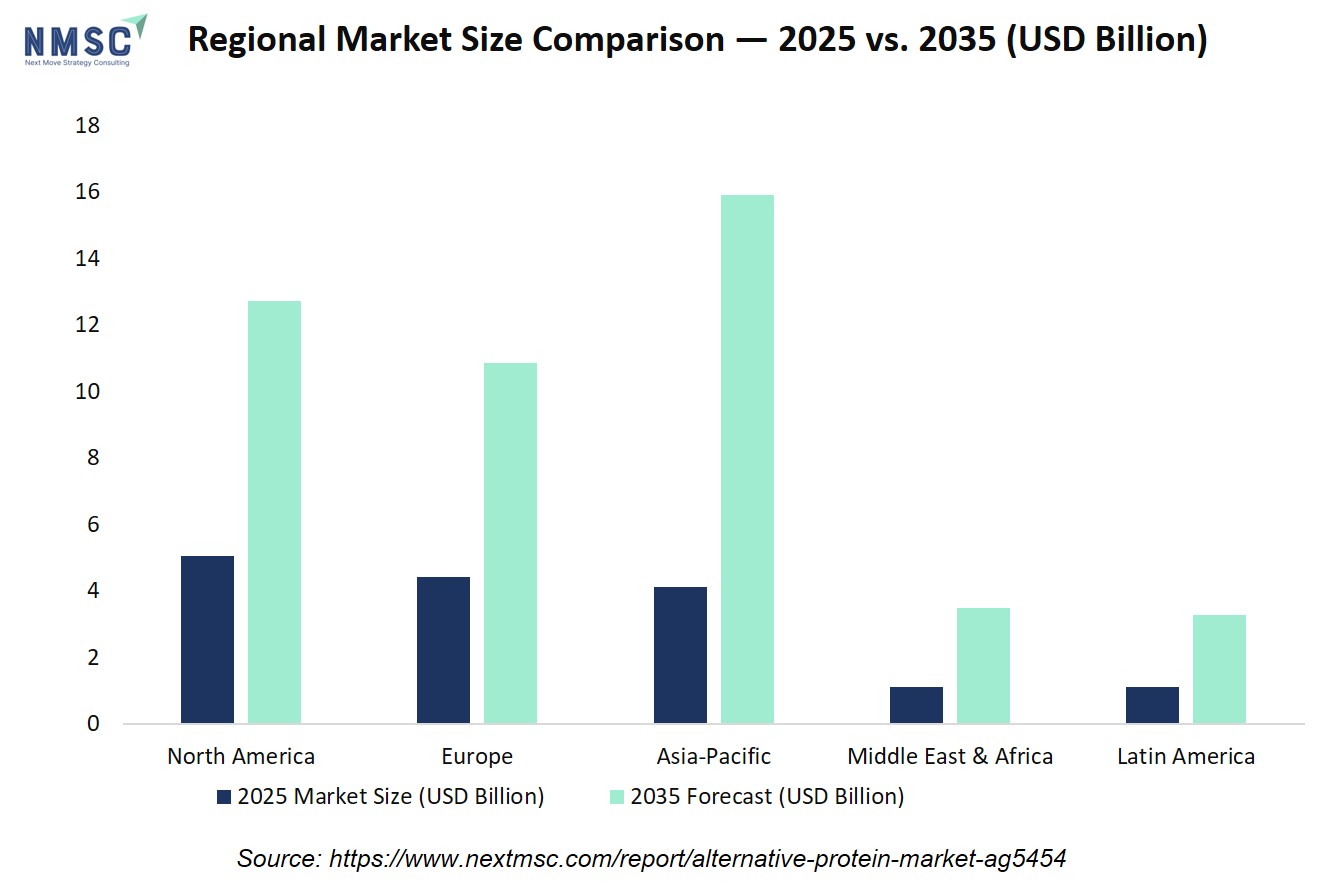
According to Next Move Strategy Consulting, the global alternative protein market was valued at USD 15.80 billion in 2025 and is estimated at USD 17.35 billion in 2026, with a forecast to reach USD 46.21 billion by 2035, expanding at an 11.5% CAGR between 2026 and 2035. The market is projected to create an absolute dollar opportunity of USD 28.86 billion between 2026 and 2035, presenting significant investment potential across fermentation-derived proteins, cultivated cell mass platforms, and finished-food innovation across the value chain.
Cultivated Cell Mass: The Fastest-Growing Sub-Segment at 24% CAGR
Cultivated Cell Mass is the fastest-growing B2B ingredient category at 24% CAGR from 2026 to 2035, driven by expanding regulatory approvals and early commercial-scale bioreactor deployments across cultivated meat and seafood applications. Despite near-term headwinds from U.S. state-level bans, international markets — particularly Singapore, which was the first country to approve cultivated meat for commercial sale — and the European Union's evolving novel food authorization framework are expected to sustain long-term growth momentum in this sub-segment.
Asia-Pacific: The Fastest-Growing Region at 16.2% CAGR
Asia-Pacific is the fastest-growing region at 16.2% CAGR from 2026 to 2035, propelled by rising aquafeed demand, urbanization, and expanding middle-class protein consumption. India is the fastest-growing country market at 18.5% CAGR, supported by government food security initiatives and rising plant protein ingredient production. China's market is projected to expand from USD 1.55 billion in 2025 to USD 6.27 billion by 2035 at a 16.8% CAGR, driven by rapid urbanization and aquafeed demand.
Fermentation Proteins: The Strategic Bridge Between Plant-Based and Cultivated
Fermentation Proteins are growing at 16.5% CAGR — notably faster than the 9% CAGR of Plant Protein Ingredients — positioning precision fermentation as the strategic bridge between the established plant-based category and the longer-horizon cultivated meat opportunity. The GFI's public investment data confirms that governments globally have committed at least $2.5 billion as of 2025 to advance alternative proteins, with fermentation platforms receiving a growing share of this public capital.
E-Commerce as the Fastest-Growing Distribution Channel
E-commerce is the fastest-growing distribution channel at 17.7% CAGR from 2026 to 2035, as premium alternative protein brands build direct-to-consumer fulfillment infrastructure to bypass retail shelf-space constraints and develop subscription-based customer relationships. This channel shift has significant implications for brand strategy and margin structure across the finished-food segment.
Section Summary: The alternative protein market's long-term trajectory is firmly positive, anchored by durable sustainability-driven demand tailwinds, accelerating fermentation technology commercialization, and expanding Asia-Pacific market penetration. The market's 11.5% CAGR through 2035 reflects structural rather than cyclical growth drivers.
Key Takeaways:
-
The global alternative protein market is forecast to reach USD 46.21 billion by 2035 at an 11.5% CAGR, per NMSC, representing a USD 28.86 billion absolute dollar opportunity from 2026 to 2035.
-
Cultivated Cell Mass is the fastest-growing B2B ingredient sub-segment at 24% CAGR, while Fermentation Proteins grow at 16.5% CAGR — both outpacing the overall market rate.
-
Asia-Pacific leads regional growth at 16.2% CAGR, with India emerging as the fastest-growing country market at 18.5% CAGR.
-
E-commerce is the fastest-growing distribution channel at 17.7% CAGR, reshaping brand strategy and margin dynamics across the finished-food segment.
Next Steps for Stakeholders
For C-Level Executives and Food Manufacturers:
-
Prioritize fermentation and pea protein ingredient development as the highest-return near-term investment within the alternative protein value chain. Fermentation Proteins' 16.5% CAGR significantly outpaces the broader market, and ingredient buyers are actively seeking functional dairy and egg protein alternatives that do not compromise taste or texture.
-
Audit your regulatory exposure across U.S. state markets. The patchwork of cultivated meat bans and labeling mandates enacted in 2025 requires immediate legal and commercial review of product positioning, labeling compliance, and distribution strategy across affected states.
-
Invest in taste and texture parity R&D. The dsm-firmenich Vertis TVP launch in April 2026 has raised the competitive bar for plant-based formulation. Manufacturers that do not close the sensory gap with conventional animal products risk losing shelf space to more technically advanced competitors.
-
Develop Asia-Pacific market entry strategies now. With the region growing at 16.2% CAGR and India at 18.5% CAGR, early-mover advantage in localized, price-tiered ingredient portfolios will be decisive for capturing disproportionate market share through 2035.
For Institutional Investors and Financial Analysts:
-
Concentrate capital in companies demonstrating industrial readiness. The GFI's investment data confirms that the capital gap between commercially proven and pre-commercial alternative protein companies is widening. Prioritize companies with contracted revenue, scalable operations, and credible offtake agreements.
-
Evaluate fermentation platform companies as the highest-conviction near-term opportunity. Fermentation companies led Q2 2026 fundraising at $132 million, reflecting growing institutional confidence in precision fermentation's commercial scalability and ESG alignment.
-
Monitor cultivated meat regulatory developments internationally. While U.S. state-level bans create near-term headwinds, international regulatory progress — particularly in Singapore, the EU, and select Asia-Pacific markets — may unlock significant long-term value for cultivated protein platform companies.
-
Incorporate ESG metrics into alternative protein investment theses. Manufacturers expanding fermentation and plant-based ingredient lines align with greenhouse gas reduction commitments and sustainable sourcing mandates, making them increasingly attractive to ESG-mandated institutional portfolios.
Conclusion
The alternative protein market stands at a defining inflection point in 2026. The convergence of U.S. regulatory fragmentation, a maturing investment environment, accelerating fermentation technology, and structurally favorable macro-level demand drivers is reshaping the competitive landscape with a speed and complexity that demands strategic clarity from all stakeholders.
The market's projected expansion from USD 17.35 billion in 2026 to USD 46.21 billion by 2035 — at an 11.5% CAGR — is not contingent on speculative technology breakthroughs. It is grounded in the commercial maturation of plant-based and fermentation-derived protein categories, the structural deceleration of conventional meat demand in high-income markets, and the rapid expansion of aquafeed and adjacent applications across Asia-Pacific. The USD 28.86 billion absolute dollar opportunity between 2026 and 2035 is real, traceable, and accessible — but only to stakeholders who align their capital, regulatory strategy, and innovation investment with the market's actual growth architecture rather than its most publicized narratives.
About the Author
 Sanyukta Deb
— Sanyukta Deb is Digital Marketing Team Lead at Next Move Strategy Consulting, where she has led content strategy and technical SEO for the firm's B2B market research publications for over 2 years. Her editorial process translates NextMSC's primary and secondary research — spanning technology, industrial, and consumer sectors — into commercial narratives, backed by search-intent, keyword, and competitive analysis. She brings 5 years of overall experience in digital marketing and content strategy.
Sanyukta Deb
— Sanyukta Deb is Digital Marketing Team Lead at Next Move Strategy Consulting, where she has led content strategy and technical SEO for the firm's B2B market research publications for over 2 years. Her editorial process translates NextMSC's primary and secondary research — spanning technology, industrial, and consumer sectors — into commercial narratives, backed by search-intent, keyword, and competitive analysis. She brings 5 years of overall experience in digital marketing and content strategy.
About the Reviewer
 Debashree Dey
— Debashree Dey is Assistant Manager at Next Move Strategy Consulting, where she supports cross-vertical market content and communications across diverse industries for 6 years. Her professional background includes senior content writing, communications, and published manuscript authorship, with experience developing audience-focused business narratives and maintaining clear, consistent messaging. Her role supports research-led content development and editorial quality across NextMSC publications.
Debashree Dey
— Debashree Dey is Assistant Manager at Next Move Strategy Consulting, where she supports cross-vertical market content and communications across diverse industries for 6 years. Her professional background includes senior content writing, communications, and published manuscript authorship, with experience developing audience-focused business narratives and maintaining clear, consistent messaging. Her role supports research-led content development and editorial quality across NextMSC publications.

















Add Comment