
Alternative Protein Market Size, Share, Trends and Growth Analysis, By B2B Ingredients and Inputs (Plant Protein Ingredients, Fermentation Proteins, Cultivated Cell Mass, Insect Ingredients, and Algae Ingredients), By Finished Foods (Meat Alternatives, Dairy Alternatives, and Others), By Feed Ingredients, By Platforms and Services, By Source Technology, By Protein Source, By Product Form, By Distribution Channel, By End Use, and Region — Global Industry Report and Forecast, 2026–2035
Industry: Agriculture | Publishing Date: July 29, 2026 | Last Updated: September 30, 2026 | No of Pages: N/A | No. of Tables: N/A | No. of Figures: N/A | Format: PDF | Report Code: AG5454
What Is the Alternative Protein Market Size?
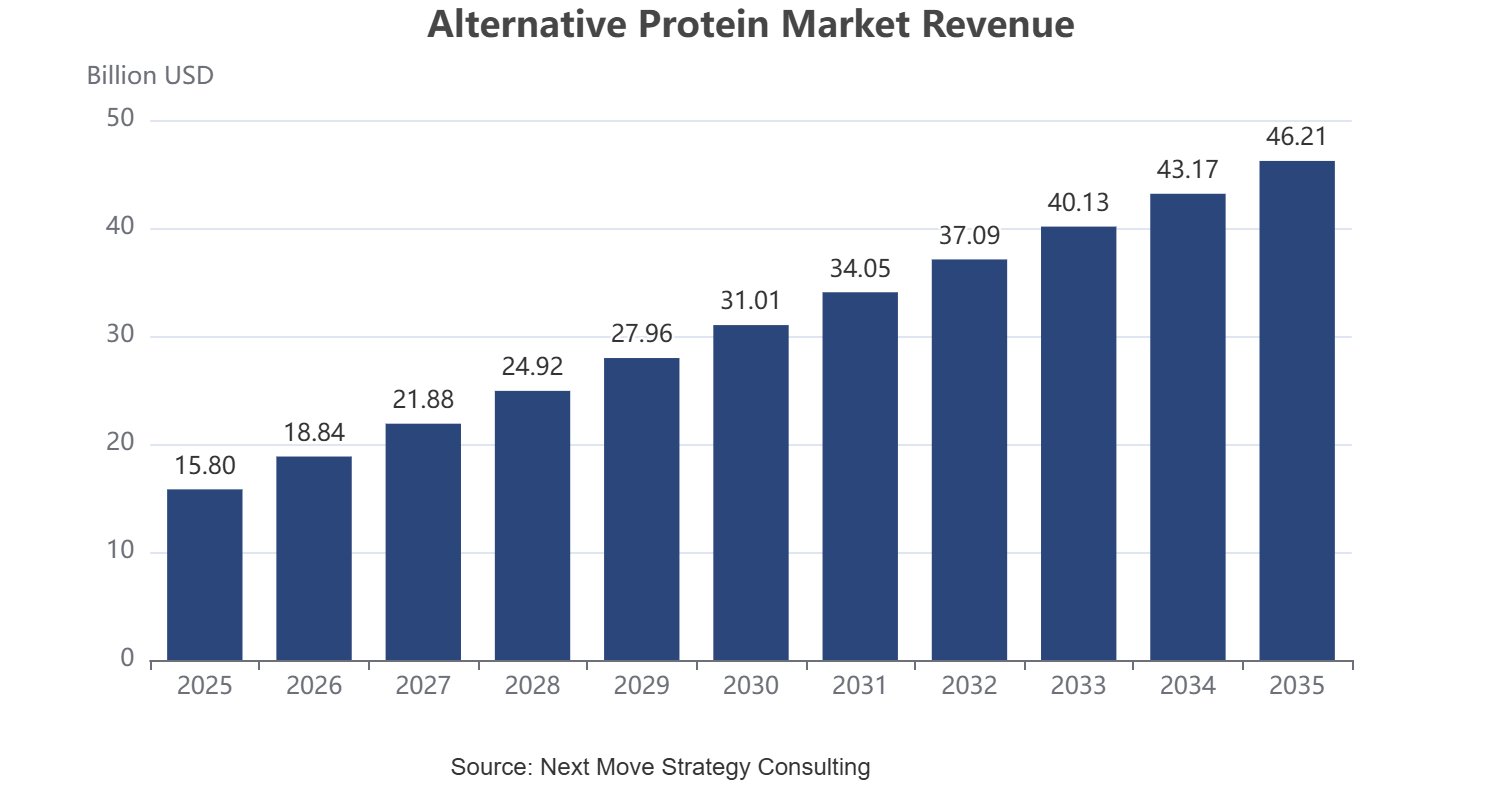
The global Alternative Protein Market size was valued at USD 15.80 Billion in 2025 and is estimated at USD 17.35 Billion in 2026, forecast to reach USD 46.21 Billion by 2035, expanding at an 11.5% CAGR between 2026 and 2035. North America leads with approximately 32% share, while Plant Protein Ingredients dominate the B2B ingredients segmentation with approximately 52% share.
We observed that growth is broadest across fermentation-derived and cultivated protein categories, even as plant-based ingredients continue to anchor absolute market revenue through 2035.
|
Key Takeaways |
|
By B2B Ingredients and Inputs: Plant Protein Ingredients held the largest share of approximately 52% (USD 8.22 Billion) in 2025; Cultivated Cell Mass is the fastest-growing category at 24% CAGR from 2026–2035. |
|
By Finished Foods: Meat Alternatives held the largest share of approximately 42% (USD 6.64 Billion) in 2025; Seafood Alternatives is the fastest-growing sub-segment at 16.1% CAGR from 2026–2035. |
|
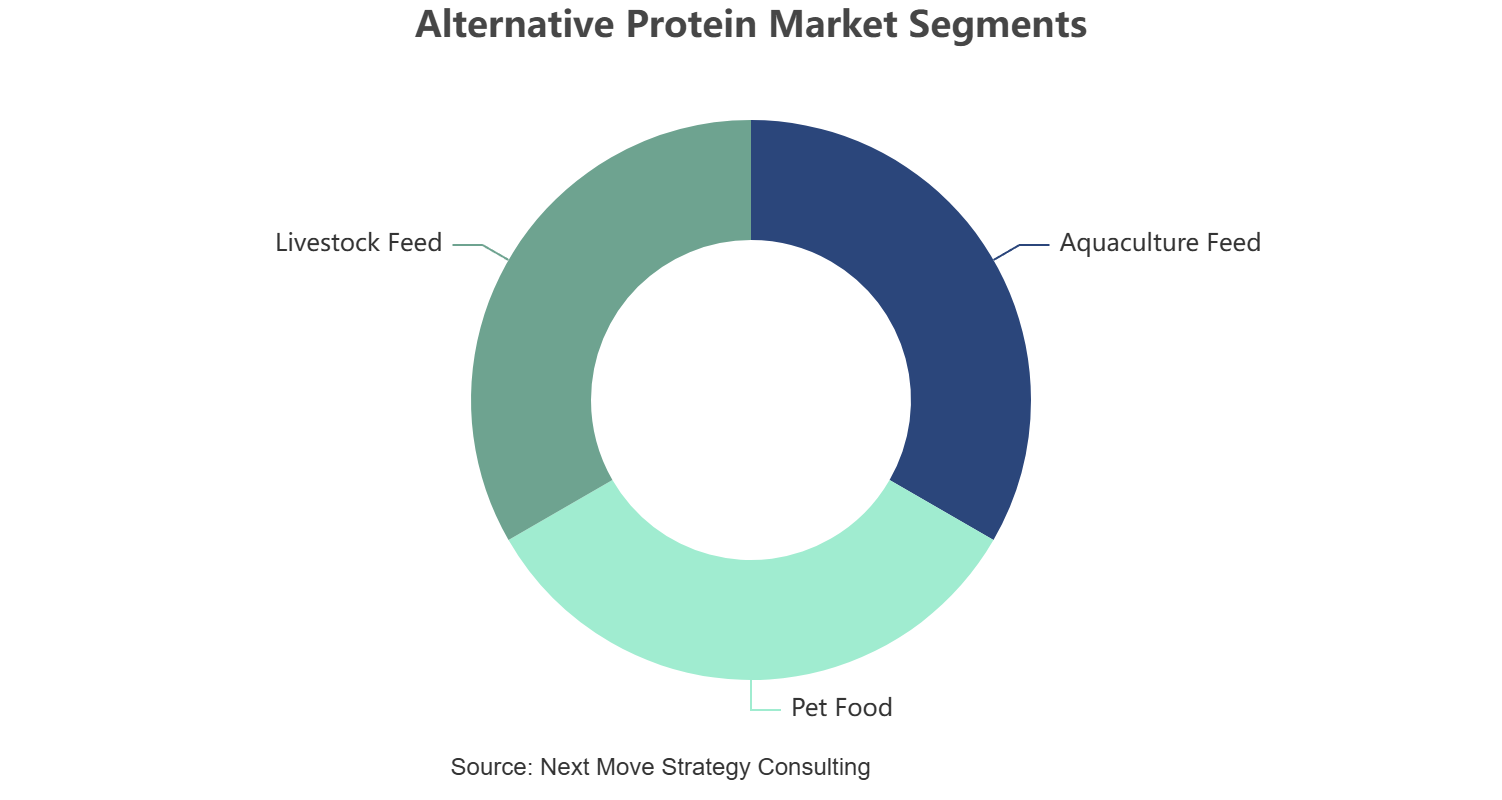
By Feed Ingredients: Aquaculture Feed held the largest share of approximately 48% (USD 7.58 Billion) in 2025; Aquaculture Feed is also the fastest-growing category at 13.9% CAGR from 2026–2035. |
|
By Platforms and Services: Licensing held the largest share of approximately 44% (USD 6.95 Billion) in 2025; Development Services is the fastest-growing sub-segment at 15% CAGR from 2026–2035. |
|
By Source Technology: Plant-Based held the largest share of approximately 55% (USD 8.69 Billion) in 2025; Cultivated is the fastest-growing sub-segment at 23.9% CAGR from 2026–2035. |
|
By Protein Source: Soy held the largest share of approximately 36% (USD 5.69 Billion) in 2025; Pea is the fastest-growing sub-segment at 16% CAGR from 2026–2035. |
|
By Product Form: Frozen held the largest share of approximately 28% (USD 4.42 Billion) in 2025; Dry is the fastest-growing sub-segment at 14.3% CAGR from 2026–2035. |
|
By Distribution Channel: Retail held the largest share of approximately 40% (USD 6.32 Billion) in 2025; E-commerce is the fastest-growing sub-segment at 17.7% CAGR from 2026–2035. |
|
By Buyer Type: Consumer Brand Owner held the largest share of approximately 38% (USD 6.00 Billion) in 2025; Feed Mill is the fastest-growing sub-segment at 13.8% CAGR from 2026–2035. |
|
By End Use: Human Food held the largest share of approximately 78% (USD 12.32 Billion) in 2025; Aquaculture is the fastest-growing sub-segment at 15.2% CAGR from 2026–2035. |
|
Dominant Region: North America dominated with approximately 32% revenue share (USD 5.06 Billion) in 2025. |
|
Fastest-Growing Region: Asia-Pacific is expected to register the highest CAGR of 16.2% during 2026–2035. |
|
Dominant Country: U.S. led with approximately USD 3.85 Billion in 2025. |
|
Fastest-Growing Country: India is the fastest-growing country at approximately 18.5% CAGR from 2026–2035. |
Market Opportunity: The alternative protein market is expected to create an absolute dollar opportunity of USD 28.86 billion between 2026 and 2035, presenting significant investment potential across fermentation-derived proteins, cultivated cell mass platforms, and finished-food innovation across the value chain.
According to Next Move Strategy Consulting analysis, ingredient suppliers are increasingly structuring licensing and toll manufacturing arrangements with finished-food brands, a shift that lets fermentation and cultivated protein developers scale commercial volume without directly bearing the full cost of dedicated production infrastructure.
Alternative Protein Market Overview
What Does the Alternative Protein Market Encompass?
The alternative protein market encompasses B2B ingredients and inputs, including plant protein isolates, fermentation-derived proteins, cultivated cell mass, insect ingredients, and algae ingredients, alongside finished foods such as meat, dairy, egg, and seafood alternatives sold through retail, foodservice, and e-commerce channels. Our assessment indicates that the scope also extends to feed ingredients for aquaculture, pet food, and livestock, plus licensing, toll manufacturing, and development service platforms that support ingredient commercialization across consumer brand owners, food manufacturers, and foodservice operators.
Regulatory frameworks such as the U.S. FDA's novel food and GRAS (Generally Recognized as Safe) determinations and the European Food Safety Authority's novel food authorization process shape ingredient approval timelines, particularly for cultivated cell mass and insect-based proteins. We observed that technology adoption is shifting toward precision fermentation platforms capable of producing functional dairy and egg proteins without animal inputs. Next Move Strategy Consulting's analysis indicates that this structural shift, combined with expanding pea and oat protein sourcing, is redefining ingredient economics across the alternative protein market.
Adjacent aquafeed applications, including the Aquafeed Market, continue to absorb a growing share of alternative protein ingredient volume as aquaculture operators seek sustainable substitutes for fishmeal-based feed formulations.
|
Parameters |
Details |
|
Market Size in 2025 |
USD 15.80 Billion |
|
Market Size in 2026 |
USD 17.35 Billion |
|
Revenue Forecast in 2035 |
USD 46.21 Billion |
|
Growth Rate |
CAGR of 11.5% from 2026 to 2035 |
|
Analysis Period |
2025–2035 |
|
Base Year Considered |
2025 |
|
Forecast Period |
2026–2035 |
|
Market Size Estimation |
Revenue (USD Billion) |
|
Companies Profiled |
20 |
|
Countries Covered |
33 |
|
Market Share |
Available for Top 10 Companies |
Key Emerging Trends in the Alternative Protein Market
Based on research conducted by Next Move Strategy Consulting, we found that four structural trends are reshaping ingredient development, distribution, and stakeholder engagement across the industry.
How Is Precision Fermentation Transforming Functional Protein Supply?
Precision fermentation platforms are enabling production of dairy and egg proteins identical to their animal-derived counterparts without livestock inputs. We observed that Perfect Day's whey protein platform uses engineered microorganisms to ferment functional dairy proteins at commercial scale, reducing land and water intensity relative to conventional dairy production. Ingredient buyers are adopting these proteins to replace conventional whey in nutrition and dairy-alternative formulations without altering taste or texture profiles.
Why Are Pea and Oat Proteins Gaining Share Over Soy-Based Ingredients?
Pea and oat protein ingredients are gaining formulation share as brands seek allergen-friendly, non-genetically modified sourcing alternatives to soy. Our findings suggest that ingredient suppliers such as Roquette Frères are expanding pea protein isolate capacity to meet rising demand from meat- and dairy-alternative manufacturers. This shift is reshaping protein-source sourcing strategy across the broader ingredient supply base heading into 2035.
How Is Retail and Foodservice Channel Expansion Reshaping Finished-Food Distribution?
Retail private-label expansion and foodservice menu integration are broadening finished-food distribution beyond specialty channels. We observed that several quick-service restaurant chains now list plant-based meat alternatives as permanent menu items rather than limited-time offerings. This trend is elevating demand for foodservice-ready formats among ingredient and finished-food suppliers, while retail buyers negotiate direct sourcing arrangements to secure shelf-stable supply.
What Role Does Insect and Algae Ingredient Innovation Play in Feed Applications?
Insect meal and algae-based ingredients are emerging as sustainable feed substitutes for aquaculture and pet food formulations facing fishmeal supply constraints. Our analysis shows that manufacturers in the insect-ingredient segment are scaling whole insect and meal production to support commercial aquafeed volume. Ynsect's industrial-scale insect protein facility exemplifies this direction, engineered for continuous supply to feed formulators across Europe.
Consumer Behavior Analysis of the Alternative Protein Market
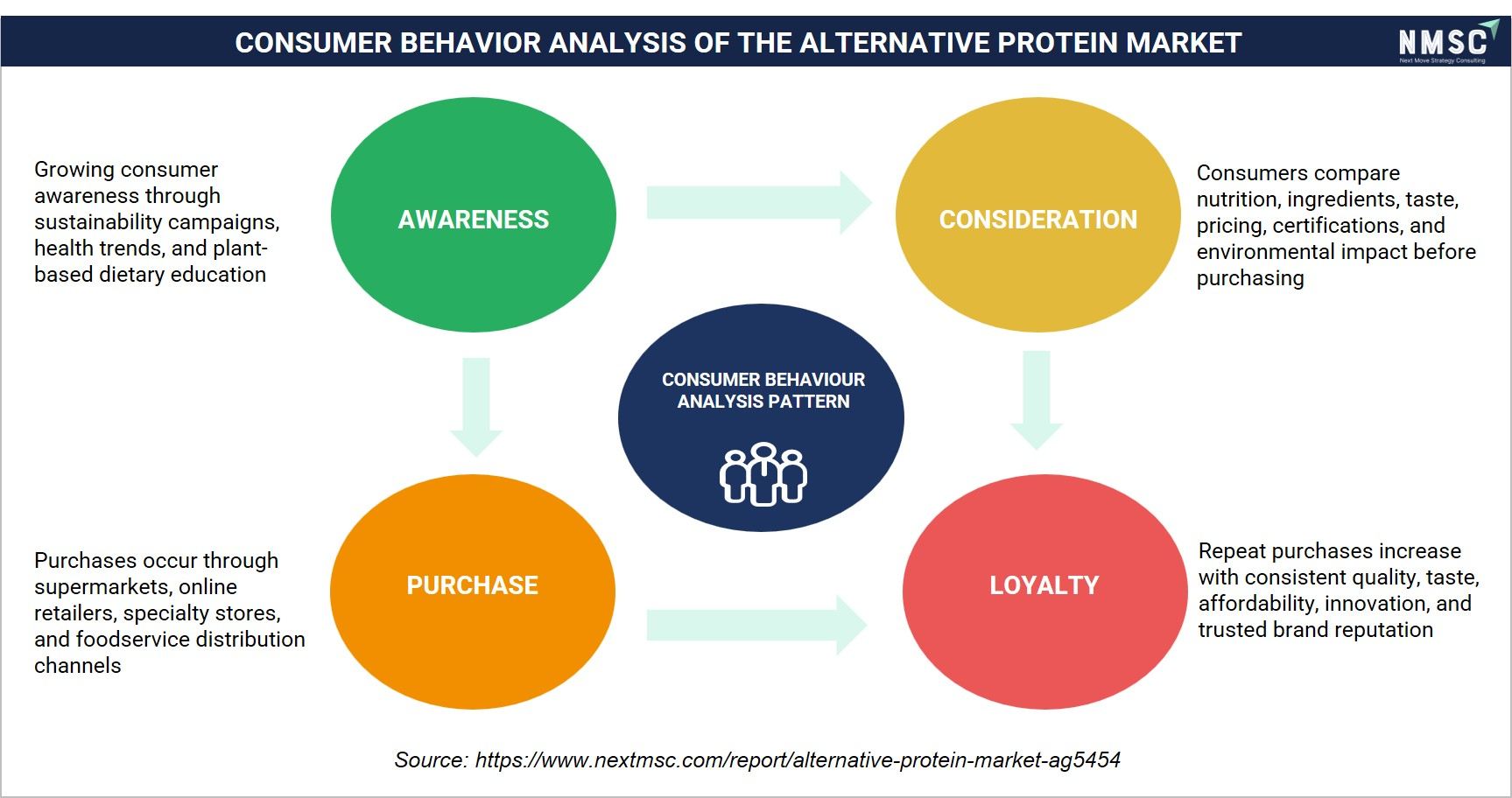
Based on our consumer assessment, we identified that awareness, product evaluation, purchasing decisions, and brand loyalty collectively shape the alternative protein market. Furthermore, our market analysis indicates that sustainability awareness, nutritional preferences, product transparency, retail accessibility, competitive pricing, and continuous product innovation influence purchasing behavior, strengthen consumer confidence, encourage repeat purchases, and accelerate long-term market adoption.
Growth Drivers & Restraints
Growth Catalyst & Risk Assessment Matrix
|
Factors |
Type |
(+/−) % Impact on CAGR |
Geographic Relevance |
Impact Timeline |
|
Rising consumer demand for sustainable protein sources |
Driver |
+2.4% |
Global |
2026–2035 |
|
Expansion of precision fermentation production capacity |
Driver |
+2.0% |
North America, Europe |
2026–2035 |
|
Growing retail and foodservice channel penetration |
Driver |
+1.5% |
Global |
2026–2032 |
|
Rising aquafeed demand for sustainable protein substitutes |
Driver |
+1.2% |
Asia-Pacific, Europe |
2026–2035 |
|
Government-backed novel food regulatory pathways |
Driver |
+1.0% |
North America, Europe |
2026–2030 |
|
Expansion of pea and oat protein sourcing capacity |
Driver |
+0.9% |
Global |
2026–2033 |
|
High production cost of cultivated cell mass platforms |
Restraint |
−1.6% |
Global |
2026–2032 |
|
Regulatory uncertainty around novel food approvals |
Restraint |
−1.1% |
Europe, Asia-Pacific |
2026–2030 |
|
Consumer taste and texture perception gaps |
Restraint |
−0.8% |
Global |
2026–2030 |
What Is the Primary Growth Driver?
The primary growth driver is rising consumer demand for sustainable protein sources amid growing environmental awareness. According to the United Nations Food and Agriculture Organization, livestock production accounts for a significant share of global greenhouse gas emissions, prompting food manufacturers to diversify protein sourcing. We observed that this sustainability driver is expanding fastest across North America and Europe, sustaining structural demand for plant-based and fermentation-derived proteins through 2035.
How Is Precision Fermentation Capacity Expansion Driving the Market Growth?
Precision fermentation capacity expansion is accelerating market growth as manufacturers scale bioreactor infrastructure to meet rising functional protein demand. Our findings suggest that this capacity buildout has lowered per-unit production costs for fermentation-derived dairy and egg proteins, encouraging ingredient buyers to substitute conventional animal-derived proteins in nutrition, dairy-alternative, and bakery applications across both developed and emerging markets.
What Is Restraining the Market Growth?
The primary restraint is the high production cost of cultivated cell mass platforms relative to conventional and plant-based protein sources. Our assessment indicates that bioreactor scale-up and cell culture media costs remain a meaningful barrier to commercial-scale adoption, particularly across price-sensitive Asia-Pacific and Latin American markets, where cultivated meat and seafood remain confined largely to pilot-scale production and limited retail availability.
Segmentation Analysis
Segment Sizing: By B2B Ingredients and Inputs
|
Segment |
2025 (USD) |
2035 (USD) |
CAGR% (2026–2035) |
|
Plant Protein Ingredients |
USD 8.22 Billion |
USD 17.90 Billion |
9% |
|
Fermentation Proteins |
USD 2.84 Billion |
USD 11.28 Billion |
16.5% |
|
Cultivated Cell Mass |
USD 0.79 Billion |
USD 5.49 Billion |
24% |
|
Insect Ingredients |
USD 2.05 Billion |
USD 6.59 Billion |
13.8% |
|
Algae Ingredients |
USD 1.90 Billion |
USD 4.95 Billion |
11.2% |
|
Total |
USD 15.80 Billion |
USD 46.21 Billion |
11.5% |
Which B2B Ingredient Category Dominates and Which Is Growing Fastest?
Plant Protein Ingredients dominate the B2B segmentation, valued at USD 8.22 Billion in 2025, supported by established extraction infrastructure and broad formulation compatibility across finished-food categories. Cultivated Cell Mass is the fastest-growing sub-segment at 24% CAGR from 2026–2035, driven by expanding regulatory approvals and early commercial-scale bioreactor deployments across cultivated meat and seafood applications.
Segment Sizing: By Finished Foods
|
Segment |
2025 (USD) |
2035 (USD) |
CAGR% (2026–2035) |
|
Meat Alternatives |
USD 6.64 Billion |
USD 18.12 Billion |
11.8% |
|
Dairy Alternatives |
USD 4.74 Billion |
USD 12.42 Billion |
11.3% |
|
Egg Alternatives |
USD 0.95 Billion |
USD 3.19 Billion |
14.4% |
|
Seafood Alternatives |
USD 1.11 Billion |
USD 4.23 Billion |
16.1% |
|
Nutrition and Snacks |
USD 2.37 Billion |
USD 8.24 Billion |
14.9% |
|
Total |
USD 15.80 Billion |
USD 46.21 Billion |
11.5% |
Which Finished Food Category Dominates and Which Is Growing Fastest?
Meat Alternatives dominate the finished foods segmentation, valued at USD 6.64 Billion in 2025, reflecting broad retail and foodservice distribution built over more than a decade of category development. Seafood Alternatives is the fastest-growing sub-segment at 16.1% CAGR from 2026–2035, as manufacturers expand plant-based and fermentation-derived seafood formats. Complementary demand is also emerging within the Sports Nutrition Market, where alternative protein ingredients increasingly substitute for whey in bars, shakes, and powders.
Segment Sizing: By Source Technology
|
Segment |
2025 (USD) |
2035 (USD) |
CAGR% (2026–2035) |
|
Plant-Based |
USD 8.69 Billion |
USD 19.75 Billion |
9.6% |
|
Fermentation Derived |
USD 2.69 Billion |
USD 10.52 Billion |
16.4% |
|
Cultivated |
USD 0.63 Billion |
USD 4.35 Billion |
23.9% |
|
Insect Based |
USD 1.74 Billion |
USD 5.59 Billion |
13.9% |
|
Algae Based |
USD 1.42 Billion |
USD 3.75 Billion |
11.4% |
|
Hybrid |
USD 0.63 Billion |
USD 2.25 Billion |
15.2% |
|
Total |
USD 15.80 Billion |
USD 46.21 Billion |
11.5% |
Which Source Technology Dominates and Which Is Growing Fastest?
Plant-Based source technology dominates with USD 8.69 Billion in 2025, reflecting the still-large installed base of extraction and formulation infrastructure built around soy, pea, and wheat proteins. Cultivated is the fastest-growing sub-segment at 23.9% CAGR from 2026–2035, as regulatory clearances expand and manufacturers scale bioreactor capacity beyond pilot-scale production runs.
Growth Opportunities
Beyond current segmentation performance, three forward-looking whitespace opportunities stand out for stakeholders positioning within the alternative protein market.
Can Toll Manufacturing Partnerships Accelerate Fermentation Protein Commercialization?
Toll manufacturing partnerships allow fermentation protein developers to scale commercial volume without building dedicated bioreactor infrastructure. Ingredient suppliers that establish contract-manufacturing capacity stand to capture demand from smaller finished-food brands seeking functional dairy and egg protein alternatives without upfront capital investment.
Can Algae-Based Ingredients Unlock New Aquafeed and Nutrition Applications?
Algae-based ingredients offer a dual-application pathway across aquafeed and human nutrition formulations, given their favorable amino acid and omega-3 profiles. Manufacturers that develop algae ingredient platforms spanning both end uses stand to capture demand from feed mills and nutrition brands simultaneously.
Can Direct-to-Consumer Channels Expand Access to Premium Alternative Protein Brands?
Direct-to-consumer distribution allows premium alternative protein brands to bypass retail shelf-space constraints and build subscription-based customer relationships. Consumer brand owners that build direct fulfillment infrastructure stand to benefit as e-commerce penetration continues to expand across the finished-food distribution channel mix.
Regional Outlook
|
Region |
2025 (USD) |
2035 (USD) |
CAGR% (2026–2035) |
Key Driver |
|
North America |
USD 5.06 Billion |
USD 12.71 Billion |
10.8% |
Retail and foodservice channel maturity |
|
Europe |
USD 4.42 Billion |
USD 10.85 Billion |
10.5% |
Novel food regulatory reform |
|
Asia-Pacific |
USD 4.11 Billion |
USD 15.90 Billion |
16.2% |
Aquafeed demand and urbanization |
|
Middle East & Africa |
USD 1.11 Billion |
USD 3.49 Billion |
13.6% |
Government sustainability initiatives |
|
Latin America |
USD 1.11 Billion |
USD 3.27 Billion |
12.8% |
Expanding retail distribution |
|
Total |
USD 15.80 Billion |
USD 46.21 Billion |
11.5% |
— |
North America Alternative Protein Market
North America leads the alternative protein market with mature retail and foodservice distribution infrastructure built over more than a decade of category development. We observed that the region benefits from established venture capital funding, expanding precision fermentation production capacity, and strong consumer sustainability awareness. Regulatory clarity from the U.S. Food and Drug Administration continues to shape novel food approval timelines, sustaining the region's approximately 32% global revenue share through 2035.
Europe Alternative Protein Market
Europe's alternative protein market is shaped by the European Food Safety Authority's novel food authorization framework and strong governmental sustainability commitments. Our assessment indicates that Germany, the UK, and France anchor regional demand, supported by well-developed plant-based retail categories and expanding fermentation protein production. Technology adoption favors pea and oat protein sourcing as manufacturers respond to allergen-conscious consumer preferences across the region.
Asia-Pacific Alternative Protein Market
Asia-Pacific is the fastest-growing region at 16.2% CAGR, propelled by rising aquafeed demand, urbanization, and expanding middle-class protein consumption. We found that China, India, and Japan collectively anchor regional volume, while manufacturers localize price-tiered ingredient portfolios to address wide affordability gaps. Regulatory harmonization efforts across the region are gradually easing market entry for multinational ingredient suppliers.
Middle East & Africa Alternative Protein Market
The Middle East & Africa alternative protein market benefits from government-led food security and sustainability initiatives across Gulf Cooperation Council countries. Our analysis shows that Saudi Arabia and the UAE lead regional adoption, supported by expanding retail infrastructure and rising private investment in ingredient manufacturing, while South Africa anchors demand across the broader African continent.
Latin America Alternative Protein Market
Latin America's alternative protein market is expanding on the back of rising retail distribution and growing consumer awareness of sustainable protein sourcing among urban populations. We observed that Brazil anchors regional demand, supported by an expanding plant-based finished-food category, while Argentina shows steady adoption growth. Affordability remains a structural constraint keeping conventional protein sources dominant across broader rural populations.
U.S. Alternative Protein Market
Based on our estimates, U.S.'s alternative protein market was valued at approximately USD 3.85 Billion in 2025 and is projected to reach approximately USD 8.79 Billion by 2035, expanding at a 9.6% CAGR from 2026 to 2035. Demand structure favors retail-distributed meat and dairy alternatives alongside rapidly scaling precision fermentation ingredient supply, with high foodservice channel penetration and intense competitive activity among global manufacturers.
Canada Alternative Protein Market
The market in Canada was valued at approximately USD 0.79 Billion in 2025 and is projected to reach approximately USD 1.88 Billion by 2035, expanding at a 10.1% CAGR from 2026 to 2035. Adoption is concentrated in urban retail channels, with strong plant protein ingredient production capacity supporting both domestic consumption and export supply to U.S. finished-food manufacturers.
UK Alternative Protein Market
As per our estimate, UK's alternative protein market was valued at approximately USD 1.05 Billion in 2025 and is projected to reach approximately USD 2.32 Billion by 2035, expanding at a 9.2% CAGR from 2026 to 2035. Retail private-label expansion anchors a significant share of category growth, while foodservice chains increasingly list plant-based meat alternatives as permanent rather than limited-time menu items.
Germany Alternative Protein Market
According to our analysis, Germany's alternative protein market was valued at approximately USD 1.28 Billion in 2025 and is projected to reach approximately USD 2.78 Billion by 2035, expanding at a 9% CAGR from 2026 to 2035. A well-established plant-based retail category and strong domestic pea protein ingredient supply support broad market access across both mainstream and specialty grocery channels.
France Alternative Protein Market
Based on our estimates, France's alternative protein market was valued at approximately USD 0.82 Billion in 2025 and is projected to reach approximately USD 1.84 Billion by 2035, expanding at a 9.4% CAGR from 2026 to 2035. Regulatory engagement with novel food authorization has shaped ingredient approval timelines, while retail adoption of dairy and meat alternatives continues to expand across major supermarket chains.
China Alternative Protein Market
The market in China was valued at approximately USD 1.55 Billion in 2025 and is projected to reach approximately USD 6.27 Billion by 2035, expanding at a 16.8% CAGR from 2026 to 2035. Rapid urbanization and rising aquafeed demand are driving ingredient consumption, though price sensitivity keeps conventional plant protein formats prevalent outside premium retail channels.
India Alternative Protein Market
As per our estimate, India's alternative protein market was valued at approximately USD 0.62 Billion in 2025 and is projected to reach approximately USD 2.86 Billion by 2035, expanding at a 18.5% CAGR from 2026 to 2035. Government food security initiatives and rising plant protein ingredient production are expanding access, with strong growth momentum in pea and other pulse-based protein sourcing.
Japan Alternative Protein Market
According to our analysis, Japan's alternative protein market was valued at approximately USD 0.72 Billion in 2025 and is projected to reach approximately USD 1.84 Billion by 2035, expanding at a 11% CAGR from 2026 to 2035. A mature foodservice sector and strong consumer interest in functional nutrition sustain steady structural demand for fermentation-derived and plant-based protein ingredients.
South Korea Alternative Protein Market
Based on our estimates, South Korea's alternative protein market was valued at approximately USD 0.38 Billion in 2025 and is projected to reach approximately USD 1.16 Billion by 2035, expanding at a 13.2% CAGR from 2026 to 2035. Rising disposable income and government-backed food technology investment are supporting adoption of precision fermentation and plant-based finished-food categories among urban consumers.
Australia Alternative Protein Market
The market in Australia was valued at approximately USD 0.34 Billion in 2025 and is projected to reach approximately USD 0.91 Billion by 2035, expanding at a 11.6% CAGR from 2026 to 2035. An established plant protein ingredient export base supports both domestic finished-food manufacturing and regional supply to broader Asia-Pacific markets.
UAE Alternative Protein Market
As per our estimate, UAE's alternative protein market was valued at approximately USD 0.22 Billion in 2025 and is projected to reach approximately USD 0.71 Billion by 2035, expanding at a 13.9% CAGR from 2026 to 2035. Expanding private investment in food technology and rising awareness campaigns are driving adoption of premium alternative protein finished foods among a growing urban population.
Saudi Arabia Alternative Protein Market
According to our analysis, Saudi Arabia's alternative protein market was valued at approximately USD 0.26 Billion in 2025 and is projected to reach approximately USD 0.79 Billion by 2035, expanding at a 13.2% CAGR from 2026 to 2035. Government-backed food security initiatives under national sustainability programs are expanding retail infrastructure and ingredient manufacturing investment across urban centers.
South Africa Alternative Protein Market
Based on our estimates, South Africa's alternative protein market was valued at approximately USD 0.18 Billion in 2025 and is projected to reach approximately USD 0.45 Billion by 2035, expanding at a 10.8% CAGR from 2026 to 2035. Adoption remains concentrated in urban retail and foodservice channels, with affordability constraints limiting penetration across broader rural populations.
Brazil Alternative Protein Market
The market in Brazil was valued at approximately USD 0.52 Billion in 2025 and is projected to reach approximately USD 1.49 Billion by 2035, expanding at a 12.4% CAGR from 2026 to 2035. An expanding plant-based finished-food category and growing retail distribution network are driving adoption, with soy protein ingredient supply anchoring domestic manufacturing capacity.
Argentina Alternative Protein Market
As per our estimate, Argentina's alternative protein market was valued at approximately USD 0.19 Billion in 2025 and is projected to reach approximately USD 0.49 Billion by 2035, expanding at a 11.1% CAGR from 2026 to 2035. Steady demand growth is supported by expanding retail distribution and rising awareness of sustainable protein sourcing among the country's urban population.
PESTEL Analysis of the Alternative Protein Market
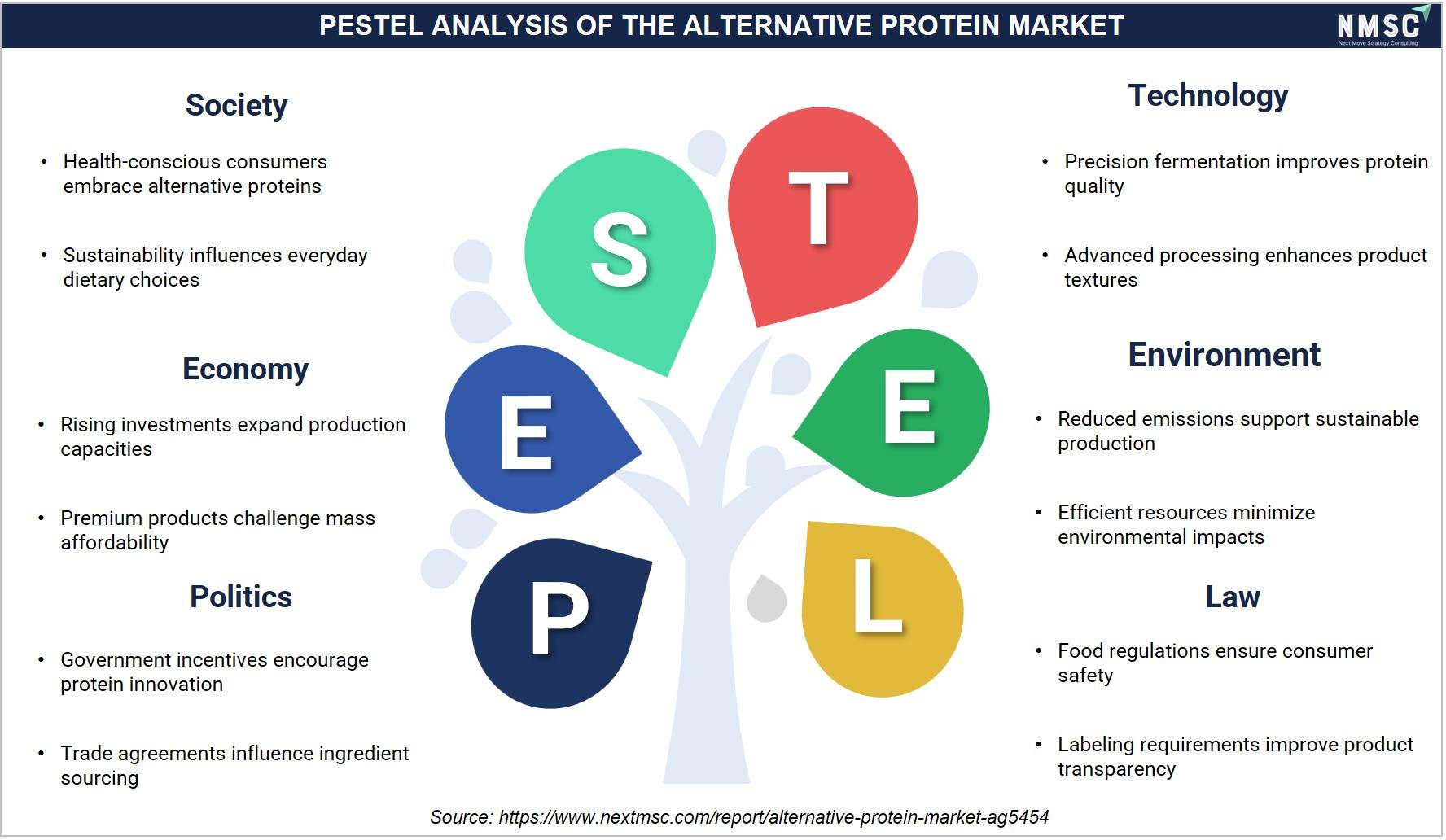
Based on our PESTEL assessment, we observed that political support, economic conditions, evolving consumer preferences, technological innovation, environmental sustainability, and regulatory compliance collectively influence the alternative protein market. Moreover, our industry evaluation highlights that government incentives, investment growth, biotechnology advancements, climate-focused initiatives, food safety regulations, and changing dietary patterns drive innovation, strengthen production capabilities, improve market acceptance, and support sustainable industry expansion.
Competitive Landscape
Next Move Strategy Consulting's analysis indicates that the alternative protein industry is moderately fragmented, with global food conglomerates competing alongside specialized ingredient and finished-food innovators.
|
Attribute |
Details |
|
Market Structure |
Moderately fragmented, spanning vertically integrated global food conglomerates and specialized fermentation, cultivated, and plant-protein innovators |
|
Innovation Focus |
Precision fermentation scale-up, cultivated cell mass process optimization, and pea and oat protein ingredient development |
|
M&A Activity |
Selective acquisitions of specialized ingredient technology providers to strengthen fermentation and cultivated protein capabilities |
How Do Companies Compete in the Alternative Protein Industry?
Companies compete primarily on ingredient functionality, production cost efficiency, and retail and foodservice distribution reach. Our findings suggest that brand recognition and shelf-space negotiation remain decisive competitive levers for finished-food manufacturers, while ingredient suppliers differentiate through protein extraction technology and supply-chain scale that supports consistent formulation performance.
Which Competitive Archetypes Dominate the Alternative Protein Market?
Two archetypes dominate: large diversified food conglomerates that leverage existing manufacturing and distribution infrastructure to scale finished-food brands, and specialized technology innovators focused on fermentation, cultivated, or novel ingredient platforms. We observed that the first archetype captures broad retail and foodservice volume, while the second drives category innovation through proprietary production technology.
What Innovation and Differentiation Strategies Define Competition?
Innovation strategy centers on improving taste and texture parity with conventional animal-derived products while reducing per-unit ingredient production costs. Our analysis shows that leading companies invest heavily in fermentation strain optimization and pea protein isolate refinement to differentiate finished-food formulations, positioning functional performance as a key driver of repeat retail purchase.
What M&A Activity Is Shaping the Competitive Landscape?
M&A activity has concentrated on acquiring specialized fermentation and ingredient technology providers to strengthen proprietary production capabilities. Our assessment indicates that large food conglomerates are prioritizing bolt-on acquisitions of innovative ingredient developers over large-scale consolidation, reflecting a strategic focus on securing differentiated technology platforms ahead of broader category maturation.
Key Market Players
Based on research conducted by Next Move Strategy Consulting, the following companies represent the validated set of key players shaping the alternative protein market.
-
Archer-Daniels-Midland Company.
-
Cargill, Incorporated.
-
Nestlé S.A.
-
Danone S.A.
-
Ingredion Incorporated.
-
Roquette Frères.
-
dsm-firmenich AG.
-
Kerry Group plc.
-
Oatly Group AB.
-
Vitasoy International Holdings Limited.
-
SunOpta Inc.
-
Blue Diamond Growers.
-
Beyond Meat
-
Impossible Foods Inc.
-
Tyson Foods
-
Conagra Brands,
-
Maple Leaf Foods
-
Marlow Foods Limi
-
Eat Just, Inc.
-
Viv
Latest Developments
Our assessment indicates that recent product launches and regulatory milestones underscore accelerating innovation across the alternative protein industry.
|
Date |
Event |
|
April 2026 |
dsm-firmenich launched Vertis Textured Vegetable Proteins (TVPs) featuring integrated ModulaSENSE taste-modulation technology at the extrusion stage. This next-generation pea protein solution naturally eliminates bitterness and beany off-notes, helping manufacturers simplify labels and improve taste outcomes in plant-based and hybrid meat applications. |
|
January 2026 |
Impossible Foods announced the expansion of its retail and foodservice footprint with a new line of whole-cut plant-based chicken and steak alternatives, leveraging proprietary fermentation and binding technologies to scale production and reduce overall costs. |
Investment Opportunities
Where Are Capital Inflows Concentrated Within the Alternative Protein Market?
Capital inflows are concentrated in precision fermentation bioreactor capacity, cultivated cell mass process development, and pea protein ingredient extraction infrastructure. Our findings suggest that strategic investors favor companies combining ingredient production scale with finished-food brand distribution, reflecting a broader shift toward vertically integrated business models across the industry.
How Is Infrastructure Investment Supporting Market Expansion?
Infrastructure investment is expanding fermentation and extraction production capacity across underserved regions, particularly in Asia-Pacific and Latin America. We observed that government-backed food security initiatives are catalyzing complementary private investment in ingredient manufacturing infrastructure to support rising finished-food demand.
What ESG Considerations Are Shaping Investment Decisions?
ESG considerations increasingly influence investment decisions through greenhouse gas reduction commitments and sustainable sourcing mandates. Our analysis shows that manufacturers expanding fermentation and plant-based ingredient lines align with environmental-impact investment theses, while land and water use reduction metrics address governance expectations tied to conventional protein production comparisons.
Key Benefits for Stakeholders
How Does This Report Benefit Industry Leaders and Manufacturers?
Industry leaders gain access to detailed segmentation, regional forecasts, and competitive benchmarking that inform product roadmap and channel-investment decisions. Our analysis, data, and strategic insights help manufacturers prioritize fermentation and cultivated ingredient development to align with the fastest-growing sub-segments identified across the forecast period.
How Does This Report Benefit Investors and Financial Analysts?
Investors and financial analysts benefit from consolidated market-sizing, CAGR, and regional opportunity data that support capital-allocation decisions across the alternative protein value chain. The report's forecasts and competitive landscape analysis help identify companies best positioned to capture disproportionate share of the projected market opportunity.
How Does This Report Benefit Technology Vendors and Product Teams?
Technology vendors and product teams gain insight into fermentation, cultivated, and plant protein sourcing trends shaping ingredient specifications. The report's segmentation and emerging-trends analysis support prioritization of engineering investment toward the sub-segments demonstrating the strongest structural growth momentum.
Key Market Segments
By B2B Ingredients and Inputs
-
Plant Protein Ingredients
-
Isolates
-
Concentrates
-
Textured Ingredients
-
Blends
-
Hydrolysates and Functional Systems
-
-
Fermentation Proteins
-
Precision Fermentation
-
Biomass Fermentation
-
-
Cultivated Cell Mass
-
Cultivated Meat
-
Cultivated Seafood
-
-
Insect Ingredients
-
Meal
-
Oil
-
Whole Insect
-
-
Algae Ingredients
-
Microalgae
-
Macroalgae
-
By Finished Foods
-
Meat Alternatives
-
Beef
-
Pork
-
Poultry
-
Lamb and Other Meat
-
Blends and Hybrid
-
-
Dairy Alternatives
-
Milk
-
Yogurt
-
Cheese
-
Creamers and Spreads
-
Ice Cream and Desserts
-
-
Egg Alternatives
-
Liquid
-
Powder
-
Prepared Egg
-
-
Seafood Alternatives
-
Fish
-
Shrimp and Shellfish
-
Other Seafood
-
-
Nutrition and Snacks
-
Bars and Snacks
-
Ready Meals
-
Shakes and Powders
-
Meat Snacks
-
Other Novel Formats
-
By Feed Ingredients
-
Aquaculture Feed
-
Pet Food
-
Livestock Feed
By Platforms and Services
-
Licensing
-
Toll Manufacturing
-
Development Services
By Source Technology
-
Plant-Based
-
Fermentation Derived
-
Cultivated
-
Insect Based
-
Algae Based
-
Hybrid
By Protein Source
-
Soy
-
Wheat
-
Pea
-
Oats
-
Other Sources
By Product Form
-
Fresh
-
Chilled
-
Frozen
-
Shelf Stable
-
Dry
-
Liquid
By Distribution Channel
-
Retail
-
Foodservice
-
Direct
-
E-commerce
-
Distributor
By Buyer Type
-
Consumer Brand Owner
-
Food Manufacturer
-
Foodservice Operator
-
Feed Mill
-
Distributor
By End Use
-
Human Food
-
Aquaculture
-
Pet Food
-
Livestock Feed
By Region
-
North America: U.S., Canada, Mexico
-
Europe: UK, Germany, France, Italy, Spain, Sweden, Denmark, Finland, Netherlands, Rest of Europe
-
Asia-Pacific: China, India, Japan, South Korea, Taiwan, Indonesia, Vietnam, Australia, Philippines, Malaysia, Rest of APAC
-
Middle East & Africa: Saudi Arabia, UAE, Egypt, Israel, Turkey, Nigeria, South Africa, Rest of MEA
-
Latin America: Brazil, Argentina, Chile, Colombia, Rest of LATAM
Conclusion & Recommendations
What Is the Long-Term Outlook for the Alternative Protein Market?
The long-term outlook remains firmly positive, with the market forecast to expand from USD 17.35 Billion in 2026 to USD 46.21 Billion by 2035 at an 11.5% CAGR. We observed that structural demand drivers, including sustainability commitments and expanding retail distribution, are durable rather than cyclical, supporting sustained double-digit growth across fermentation and cultivated sub-segments through the forecast horizon.
What Strategic Positioning Should Manufacturers Pursue?
Manufacturers should prioritize fermentation and cultivated ingredient development while strengthening retail, foodservice, and direct-to-consumer distribution capabilities. Our findings suggest that companies integrating ingredient production with finished-food brand ownership are best positioned to defend margin and capture the fastest-growing distribution channels through 2035.
How Attractive Is the Market for New Investment?
Investment attractiveness is high given the absolute dollar opportunity of USD 28.86 billion between 2026 and 2035 and the market's exposure to durable sustainability-driven demand tailwinds. Our analysis shows that capital deployed toward fermentation capacity and emerging-market retail infrastructure carries favorable risk-adjusted return potential relative to more mature food ingredient categories.
What Are the Key Market Shifts and Risks to Monitor?
Key shifts include accelerating precision fermentation cost reduction and rising competitive intensity from diversified food conglomerates entering the category. Our assessment indicates that novel food regulatory uncertainty and persistent taste and texture perception gaps remain the principal risks to monitor across the 2026–2035 forecast period.
What Growth Pathways Offer the Strongest Return Potential?
The strongest growth pathways lie in precision fermentation platforms, pea and oat protein ingredient expansion, and finished-food distribution into underpenetrated Asia-Pacific and Latin American markets. We found that manufacturers combining these pathways with toll manufacturing partnerships stand to outperform the broader market's baseline growth trajectory through 2035.
About the Author
 Saista Faiyaz
— Saista Faiyaz is Research Associate at Next Move Strategy Consulting, where she has covered consumer markets and healthcare technologies for 3 years. Her work includes primary interview review, secondary-source validation, market sizing, and structured analysis of company and industry data. She supports research by comparing evidence across sources, organizing findings into market narratives, and documenting assumptions used in analysis. Her scope includes cross-market benchmarking, and reports.
Saista Faiyaz
— Saista Faiyaz is Research Associate at Next Move Strategy Consulting, where she has covered consumer markets and healthcare technologies for 3 years. Her work includes primary interview review, secondary-source validation, market sizing, and structured analysis of company and industry data. She supports research by comparing evidence across sources, organizing findings into market narratives, and documenting assumptions used in analysis. Her scope includes cross-market benchmarking, and reports.
About the Reviewer
 Supradip Baul
— Supradip Baul is an accomplished business consultant and strategist with over a decade of rich experience in market intelligence, strategy, technology, and business transformation. His work has included rigorous qualitative and quantitative analysis across multiple industries, helping clients shape investment decisions and long-term roadmaps. Earlier in his career, he was associated with Gartner, where he contributed to industry-leading reports and market share analyses. He has worked with leading global companies and holds an MBA with a dual specialization in Marketing and Finance.
Supradip Baul
— Supradip Baul is an accomplished business consultant and strategist with over a decade of rich experience in market intelligence, strategy, technology, and business transformation. His work has included rigorous qualitative and quantitative analysis across multiple industries, helping clients shape investment decisions and long-term roadmaps. Earlier in his career, he was associated with Gartner, where he contributed to industry-leading reports and market share analyses. He has worked with leading global companies and holds an MBA with a dual specialization in Marketing and Finance.
At Next Move Strategy Consulting, we understand that insightful market research is the cornerstone of successful business decisions. That's why we employ a robust and multifaceted approach, combining various methodologies to deliver the most accurate and actionable data for our clients.

Research Landscape
We navigate the world of research with two primary approaches:
Qualitative Approach
Our qualitative research methodologies involve immersive techniques such as in-depth interviews, focus groups, and observational studies. By engaging directly with individuals and stakeholders, we uncover valuable insights that quantitative data alone may overlook.

Quantitative Research
In tandem with qualitative methodologies, NMSC leverages the power of Quantitative Research to provide a robust foundation of numerical insights. Through systematic data collection and analysis, we quantify patterns, preferences, and market trends, offering a comprehensive view of the business landscape.
Our quantitative research approach employs diverse tools, including surveys, experiments, and statistical modelling. These methodologies enable us to gather data from a large and representative sample, ensuring the statistical significance of our findings. By employing structured questionnaires and standardized data collection methods, we guarantee the reliability and validity of the information we present to our clients.
Quantitative research is particularly effective in measuring the prevalence of trends, assessing market size, and gauging the impact of various factors on consumer behavior. The numerical precision attained through this approach equips our clients with actionable insights, facilitating data-driven decision-making and strategy formulation.


Our Specialized Toolbox for Industry-Specific Market Research
We deploy a specialized arsenal of techniques tailored to meet your unique requirements. Here's a glimpse into our comprehensive toolbox:

Information Procurement
The stage entails acquiring market data or relevant information through various sources and methodologies.


Market Research Approach
We utilize both top-down and bottom-up approaches in market research analysis to achieve a comprehensive understanding of the market dynamics, leveraging the broad perspective of industry trends and macroeconomic factors alongside detailed insights from specific segments and individual companies.

Porters Five Forces Analysis
We conduct Porter's Five Forces analysis to evaluate the competitive landscape of an industry, providing us with insights into factors that affect profitability and strategic positioning.

SWOT Analysis

Forecasting
We utilize a forecasting model to predict future consumption by considering parameters like population, economics, regulations, market competition, drivers, constraints, technology, and pricing. We also employ statistical techniques such as multilinear regression, exponential smoothing, moving average, ARIMA, and Monte Carlo simulations for accurate predictions. In econometric forecasting, we analyzed short-term and long-term event impacts, attributing values based on regulatory frameworks, economic factors, and market events.





 Speak to Our Analyst