Ambulatory Services Market: Why Surgery Is Leaving Hospital Wards | NextMSC

Introduction
On November 4, 2026, the Centers for Medicare & Medicaid Services finalized its calendar year 2027 payment rule for hospital outpatient departments and ambulatory surgical centers, removing 637 more services from the Medicare inpatient-only list and setting a 2.3% payment update. Five days later, Surgery Partners announced an amended agreement to be acquired by HealthSpan Partners, an affiliate of Bon Secours Mercy Health, at USD 25.00 per share, an enterprise value of up to USD 6.0 billion, after its board judged a competing USD 28.00 per share proposal not to be superior. Regulators and buyers are now pulling surgical care out of the hospital ward at the same time.
According to Next Move Strategy Consulting's Ambulatory Services Market report, the global ambulatory services market was valued at USD 2,316.63 billion in 2024 and is projected to reach USD 3,398.45 billion by 2030, growing at a CAGR of 5.6%. NextMSC primary research and analysis identifies North America as the leading region, while Asia-Pacific is expanding steadily on outpatient cataract and lens surgery.
For More Information: Download FREE Sample on Ambulatory Services Market Report
This analysis tests that outlook against the 2026 record: the final CMS rule, the Medicare Payment Advisory Commission's March 2026 status report, Tenet Healthcare Corporation's third quarter results, the Ascension and Surgery Partners transactions and IHH Healthcare's day-surgery strategy in Asia.
From Inpatient Ward to Surgery Center: What the 2026 Rule and Deal Wave Mean for the Ambulatory Services Market
CMS Finalizes a 637-Service Migration Out of the Inpatient-Only List
The Centers for Medicare & Medicaid Services (CMS) issued the final rule, designated CMS-1850-F, on November 4, 2026. According to the agency's fact sheet of that date, the payment updates affect about 3,500 hospitals and about 6,400 ambulatory surgical centers, and both payment systems receive a 2.3% update, built from a 3.2% hospital market basket increase less a 0.9 percentage point productivity adjustment. The American College of Cardiology reported on July 2, 2026 that CMS had proposed a 2.4% increase, so the final update is one-tenth of a percentage point lower than the draft.
The structural change sits in the inpatient-only list, which names procedures Medicare historically paid for only in a hospital. CMS removed 637 services from that list for 2027, the second year of a three-year phase-out, across digestive, urinary, respiratory, endocrine, male and female genital, and other clinical families. The Missouri Hospital Association's November 9, 2026 analysis of the rule records that 1,438 services remained on the list before this removal and that CMS added 618 procedures to the ASC covered procedures list, plus one further code, CPT 64629. The Missouri Hospital Association also records that CMS estimates total Medicare payments to surgery centers at about USD 9.9 billion in 2027, an increase of about USD 560 million. The Medicare Payment Advisory Commission's September 3, 2026 workplan presentation adds that the 2026 rule had already moved 271 former inpatient-only codes and another 276 codes onto that list, which now covers more than 4,300 procedures.
MedPAC Data Shows Complexity Already Migrating to Surgery Centers
The Medicare Payment Advisory Commission (MedPAC) published its status report on ambulatory surgical centers on March 12, 2026. It counts 6,436 Medicare-certified centers in 2024, a net gain of 140 after 248 openings and 108 closures or mergers, and records fee-for-service Medicare payments to these facilities of USD 7.5 billion, up from USD 6.6 billion in 2023. Payments per beneficiary rose 15.9% in 2024, which MedPAC attributes to a 3.2% higher conversion factor, 0.8% higher per-capita volume, an 8.4% higher average relative weight of services provided and a 0.4% effect from separately paid drugs.
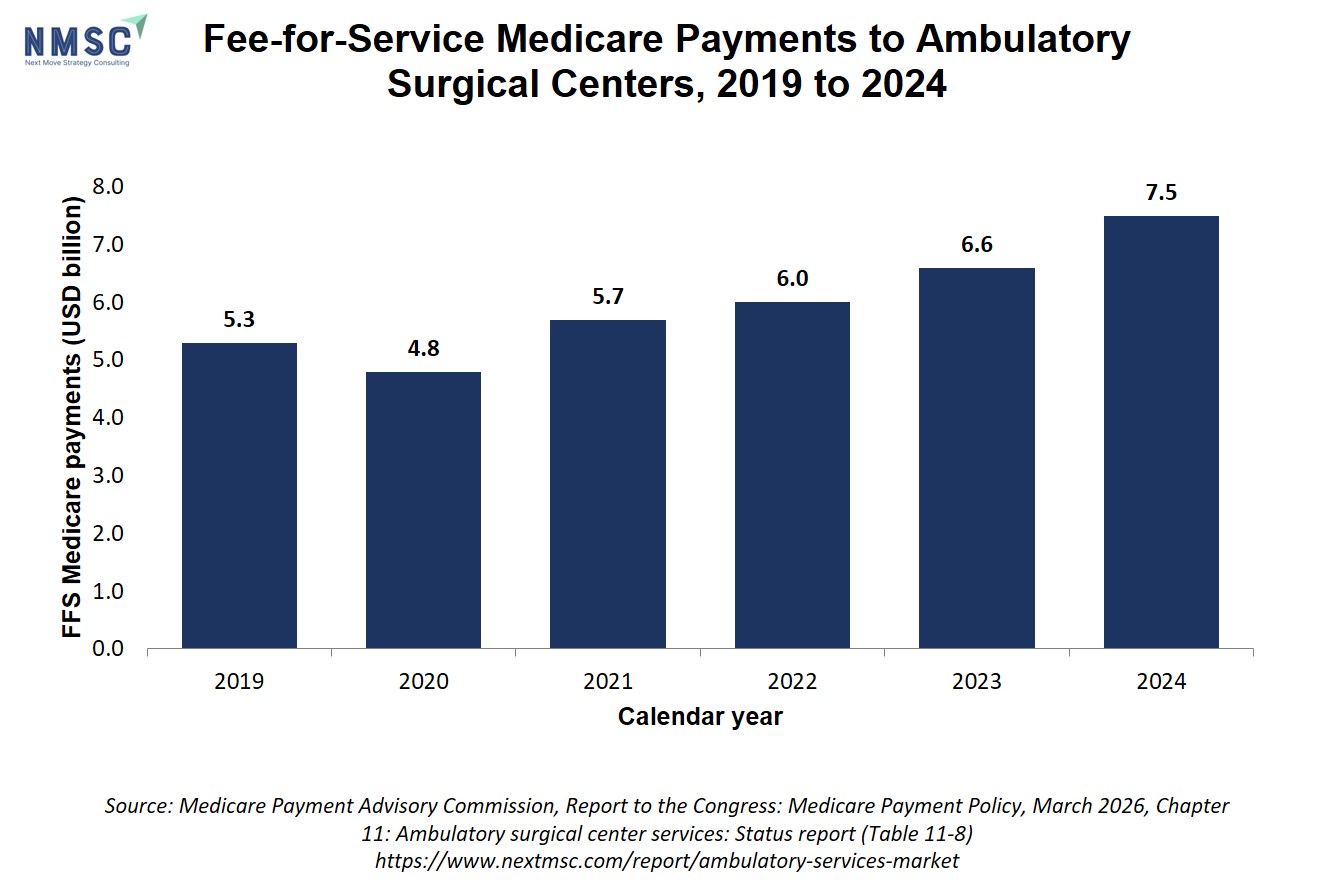
The Medicare Payment Advisory Commission's March 2026 report records fee-for-service Medicare payments to ambulatory surgical centers, including program spending and beneficiary cost sharing for facility services, at USD 5.3 billion in 2019, USD 4.8 billion in 2020, USD 5.7 billion in 2021, USD 6.0 billion in 2022, USD 6.6 billion in 2023 and USD 7.5 billion in 2024. The 2024 value is the highest in the series, and the 2020 value is the lowest.
The procedure mix supports the same reading. MedPAC reports that total knee arthroplasty volume in surgery centers grew 27.6% and total hip arthroplasty volume grew 28.7% in 2024. Knee replacements billed to fee-for-service Medicare in these centers rose from about 10,800 in 2020 to 49,258 in 2024, and total shoulder arthroplasty, first covered in 2024, reached 11,047 procedures in its first year.
Ascension, Surgery Partners and the Race for Outpatient Surgical Scale
Ascension announced on June 4, 2026 that it had completed its USD 3.9 billion acquisition of AmSurg, lifting its surgery-center network from 58 to more than 300 centers across 34 states. The Federal Trade Commission published a consent order on June 2, 2026 requiring Ascension to divest seven AmSurg centers in Tennessee, Florida, Oklahoma, Texas and Kansas, and to give the agency prior notice of any surgery-center acquisition in the surrounding metropolitan areas for 10 years. In its fiscal 2026 results of September 16, 2026, Ascension reported 312 or more centers across 36 states.
On October 26, 2026, HealthSpan Partners signed a definitive agreement to acquire Surgery Partners at USD 23.50 per share, an enterprise value of about USD 5.7 billion. Surgery Partners' November 9, 2026 announcement raised the consideration to USD 25.00 per share, an enterprise value of up to about USD 6.0 billion, and added a ticking fee of 10% a year, worth up to USD 1.61 per share, if closing slips past March 1, 2027. The company's board and special committee concluded that an unsolicited USD 28.00 per share proposal, received on November 3, 2026 and updated on November 8, was not a superior proposal because it would take materially longer to close, carried greater regulatory risk and lacked contractual protections. Closing is targeted for the first quarter of 2027, and Bain Capital, which holds about 39% of the shares, will roll over its stake.
Tenet's Third Quarter: Fewer Cases, Higher Revenue per Case
Tenet Healthcare Corporation reported third quarter 2026 results on October 29, 2026. Its Ambulatory Care segment, which consists of United Surgical Partners International, held interests in 535 surgery centers, 406 of them consolidated, and 25 surgical hospitals in 37 states on September 30, 2026. Segment Adjusted EBITDA rose 9.1% to USD 537 million at a margin of 39.2%, while same-facility system-wide surgical cases fell 1.5% and net revenue per case rose 6.1%. Tenet's hospital segment recorded an Adjusted EBITDA margin of 19.2% in the same quarter.
NMSC Strategic Perspective: Why Reimbursement Policy Now Sets the Pace of the Ambulatory Services Market
NextMSC primary research and analysis reads these developments as one mechanism rather than separate events. Medicare pays surgery centers about 46% less than hospital outpatient departments for most services covered in both settings, according to MedPAC's March 2026 report, so each procedure that moves lowers program spending and beneficiary cost sharing. CMS has now aligned three levers behind that economics: the inpatient-only list phase-out, the expansion of the ASC covered procedures list and site-neutral payment for off-campus hospital departments. Tenet's quarter shows what follows for operators: fewer cases, higher revenue per case and a 39.2% segment margin point to a case mix moving toward higher-value procedures, which is consistent with the migration the list changes enable.
For the segments covered in the NMSC report, this analysis points to a clear sequence. Freestanding ambulatory surgical centers and surgical services gain first, because newly eligible procedures such as the 49,258 knee replacements MedPAC counted in 2024 can be standardized around dedicated device, anesthesia and recovery workflows. Hospital-based centers and outpatient departments gain more slowly and face payment pressure from site-neutral policy, while diagnostic services depend on how far imaging payments converge on physician-office rates. The behavior of buyers corroborates the sequence: health systems that purchased AmSurg and are now buying Surgery Partners are paying for procedure volume and physician relationships ahead of the list changes taking effect.
Section Summary:
The 2026 record shows regulation, payment rates and capital aligned toward outpatient surgery.
-
CMS removed 637 services from the inpatient-only list for 2027 and added 618 procedures to the ASC covered procedures list.
-
MedPAC reports USD 7.5 billion in fee-for-service Medicare payments to surgery centers in 2024 and 6,436 certified centers.
-
Tenet's Ambulatory Care Adjusted EBITDA margin of 39.2% compares with 19.2% for its hospital segment in the third quarter of 2026.
-
Ascension and the HealthSpan Partners agreement for Surgery Partners show hospital systems buying outpatient scale.
Industry Impact Analysis: Payment Reform, Consolidation and Regulatory Friction in the Ambulatory Services Market
Site-Neutral Payment and 340B Cuts Rebalance Outpatient Economics
The CMS fact sheet of November 4, 2026 shows that the final rule is as much about hospital outpatient revenue as about surgery centers. CMS will pay 340B-acquired drugs at average sales price minus 28%, which it projects will reduce Original Medicare drug payments by USD 4.35 billion and beneficiary drug payments by USD 1.1 billion in 2027, and which statute requires to be offset by equal increases in payments for non-drug services. CMS also raised the annual offset tied to the 340B remedy from 0.5% to 2% until USD 7.8 billion is recovered, a point it expects to reach in 2031.
Site-neutral payment widens in parallel. CMS will pay imaging without contrast at excepted off-campus hospital departments at the physician fee schedule equivalent rate, a change it projects will cut Part B expenditures by USD 260 million in the first year. The mechanism is direct: when a hospital outpatient department earns the same payment as a physician office for a service, the price advantage that sustained hospital-based volume disappears and the lower-cost site gains relative margin. CMS adds that the average beneficiary receiving a qualifying drug will save USD 900 in 2027.
Consolidation Meets Antitrust Scrutiny
MedPAC's March 2026 report shows how concentrated ownership has become at the top of an otherwise fragmented sector. Five corporate entities, United Surgical Partners International, AmSurg, HCA Healthcare, Surgery Partners Holdings and Surgical Care Affiliates, held an ownership stake in 1,372 centers in 2024, or 21.5% of the total, up from 1,152 centers and 20.0% in 2019. The Federal Trade Commission's Ascension order, with seven divestitures and a 10-year notice obligation, shows regulators testing concentration market by market through targeted remedies rather than blocking the transaction.
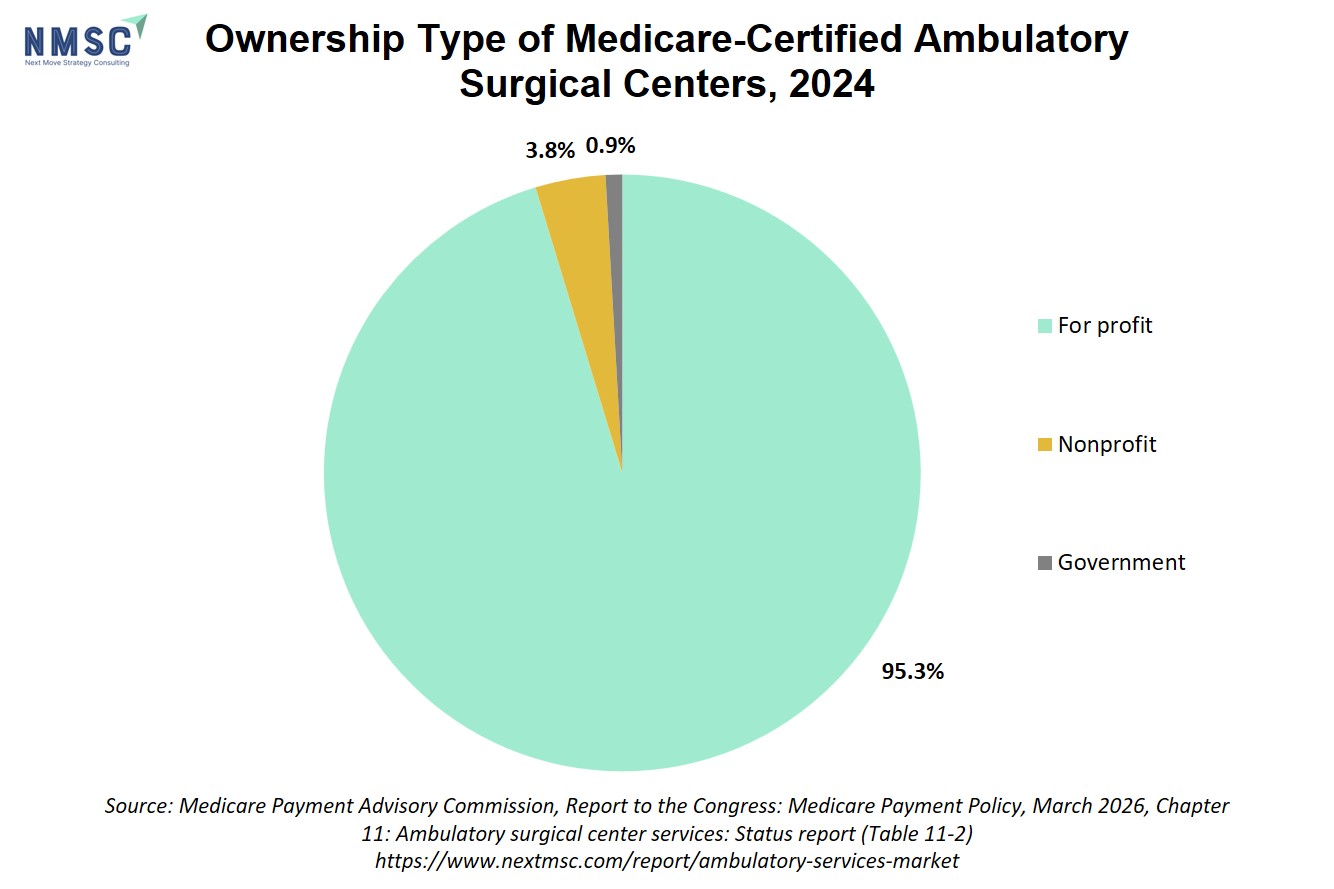
MedPAC's analysis of the CMS Provider of Services file shows that 95.3% of Medicare-certified ambulatory surgical centers were for profit in 2024, 3.8% were nonprofit and 0.9% were government owned. Among centers that opened in 2024, 95.0% were for profit and 5.0% were nonprofit.
The Surgery Partners agreement adds a timing dimension. Its chief executive, Eric Evans, described the HealthSpan Partners terms in the November 9, 2026 announcement as offering regulatory certainty and a near-term closing. The board therefore preferred a headline price USD 3.00 per share below the rival proposal, plus ticking fees of up to USD 1.61 per share, for greater certainty on timing and regulatory approval.
Asia-Pacific: IHH Healthcare Builds a Daycare Pathway
The shift is not confined to the United States. IHH Healthcare's media release of May 26, 2026 reported first quarter core revenue growth of 16% on a constant currency basis, citing higher inpatient and daycase volumes and a capital-efficient daycare model that Malaysia is expanding. In Singapore, where the group said patient volumes are moving toward public healthcare, IHH listed daycare and ambulatory care expansion as part of an out-of-hospital strategy. NextMSC primary research and analysis expects Asia-Pacific operators to use day-surgery capacity to protect inpatient beds for complex cases, which is consistent with the outpatient cataract and lens surgery growth in the NMSC report.
MedPAC's Cost-Data Recommendation Is a Regulatory Overhang
MedPAC has long recommended that Congress require surgery centers to submit cost data, because Medicare derives their rates from hospital outpatient weights rather than from their own costs. It points to Pennsylvania, where centers report to a state agency and where the Pennsylvania Health Care Cost Containment Council's data show a 2024 operating margin of 29.5%, above the 22.3% to 25.6% range of 2015 through 2023. MedPAC also reports that 12 procedures generated 50% of fee-for-service Medicare surgical revenue in surgery centers in 2024, which concentrates payment-rate risk in a short list of services. For operators, a future cost-based reset is a principal policy risk that the 2027 payment update does not address.
Section Summary:
Payment policy, ownership structure and cost transparency now determine who captures the migration of surgical volume.
-
The 340B cut and site-neutral imaging payment narrow the revenue advantage of hospital outpatient departments.
-
Five corporate entities held stakes in 21.5% of surgery centers in 2024, and the FTC is using divestitures to manage concentration.
-
MedPAC's cost-data recommendation and 12-procedure revenue concentration are the main rate risks for operators.
Pros and Cons of Recent Market Developments
|
Pros |
Cons |
|
CMS removed 637 services from the inpatient-only list and added 618 procedures to the ASC covered procedures list. |
The final 2.3% update is below the 2.4% CMS proposed, and rates are not built from surgery-center cost data. |
|
Tenet's Ambulatory Care Adjusted EBITDA margin was 39.2% in the third quarter of 2026, against 19.2% for its hospital segment. |
Tenet's same-facility surgical cases fell 1.5% in the third quarter of 2026, so growth relied on revenue per case. |
|
Surgery Partners' agreed price rose to USD 25.00 per share, an enterprise value of up to USD 6.0 billion. |
A rival USD 28.00 per share proposal and regulatory timing risk show how contested large transactions have become. |
|
Surgery-center rates sit about 46% below hospital outpatient rates for most services, lowering Medicare spending. |
Revenue is concentrated: 12 procedures produced 50% of fee-for-service surgical revenue in 2024. |
|
IHH Healthcare's daycare expansion in Malaysia and Singapore shows outpatient models spreading in Asia-Pacific. |
The Federal Trade Commission required seven divestitures and a 10-year notice duty for Ascension's AmSurg purchase. |
Key Data & Statistics
CMS calendar year 2027 OPPS/ASC final rule: parameters relevant to ambulatory care
|
Parameter |
Final rule value |
Context |
|
Payment update, OPPS and ASC |
2.3% |
3.2% market basket less 0.9 percentage point productivity adjustment |
|
Inpatient-only list removals |
637 services |
Second year of a three-year phase-out |
|
ASC covered procedures list additions |
618 procedures plus CPT 64629 |
Procedures removed from the inpatient-only list, plus one more code |
|
340B-acquired drug payment |
Average sales price minus 28% |
Reduces Original Medicare drug payments by USD 4.35 billion in 2027 |
|
Off-campus imaging without contrast |
Physician fee schedule equivalent rate |
Cuts Part B expenditures by USD 260 million in the first year |
Tenet Healthcare Corporation Ambulatory Care segment, third quarter 2025 and 2026
|
Metric |
Q3 2025 |
Q3 2026 |
|
Adjusted EBITDA (USD million) |
492 |
537 |
|
Adjusted EBITDA margin |
38.6% |
39.2% |
|
Same-facility system-wide surgical cases, change |
2.1% |
-1.5% |
|
Net revenue per case, change |
6.1% |
6.1% |
Future Outlook & Forecast: Where the Ambulatory Services Market Goes From Here
NextMSC primary research and analysis projects the global ambulatory services market to reach USD 3,398.45 billion by 2030 from USD 2,316.63 billion in 2024, an increase of USD 1,081.82 billion at a CAGR of 5.6%. The 2026 record supports that trajectory in three ways: regulation is widening the procedures eligible for outpatient payment, operators with scale are reporting margins well above hospital levels, and acquirers are paying premium prices for platforms.
The policy calendar is specific. CMS removed 637 of the 1,438 remaining inpatient-only services for 2027, which leaves 801 for the final phase, and MedPAC records that the phase-out ends on January 1, 2029. Prior authorization for eight additional botulinum toxin injection codes in hospital outpatient departments applies from July 1, 2027, and from January 1, 2028 Medicare will pay off-campus outpatient departments only if they bill under a separate National Provider Identifier and their parent provider files an attestation, according to the Missouri Hospital Association's analysis. Surgery Partners expects its merger to close in the first quarter of 2027, with an outside date of October 23, 2027.
Three indicators will decide whether the NMSC forecast is met or exceeded. The first is case volume: Tenet's same-facility surgical cases fell 1.5% in the third quarter of 2026, and revenue per case cannot rise indefinitely without volume support. The second is rate adequacy: a 2.3% update, set against MedPAC's finding that payment rates are not derived from surgery-center costs, leaves room for a cost-data requirement to reset rates. The third is closing risk: the HealthSpan Partners transaction and the Federal Trade Commission's divestiture approach to Ascension set the template for how much consolidation regulators will permit.
Section Summary:
Policy dates are fixed through 2029, so the forecast now depends on volume, rate adequacy and deal execution.
-
NextMSC projects USD 3,398.45 billion by 2030, an increase of USD 1,081.82 billion from the 2024 base.
-
The inpatient-only list phase-out has 801 services left for its final phase and ends on January 1, 2029.
-
Case volume, a possible surgery-center cost-data requirement and merger closings are the three variables to track.
Next Steps for Stakeholders
The 2026 record turns the policy shift into concrete decisions, and each stakeholder group faces a different set of priorities and deadlines.
-
Hospital and health system executives: map the 637 services leaving the inpatient-only list against current surgical volume, decide which service lines to move into owned or joint-venture surgery centers before the final phase, and model site-neutral imaging at the physician fee schedule rate.
-
Surgery-center operators: prioritize device-intensive orthopedic, digestive and urologic cases, benchmark revenue per case against Tenet's 6.1% growth, and prepare cost documentation in anticipation of MedPAC's cost-data recommendation.
-
Investors: benchmark valuations against the USD 25.00 per share Surgery Partners agreement, an enterprise value of up to USD 6.0 billion, and the USD 3.9 billion Ascension purchase, and price in antitrust remedies and closing timelines.
-
Device and drug manufacturers: track the nine devices that CMS granted pass-through payment status for 2027, because coverage for these technologies now extends into outpatient surgical settings.
-
Asia-Pacific operators: follow IHH Healthcare in expanding daycare and ambulatory capacity as part of an out-of-hospital strategy that frees inpatient beds for complex cases.
Conclusion
The ambulatory services market entered the final quarter of 2026 with policy, operating data and capital pointing in the same direction. CMS removed 637 services from the inpatient-only list, MedPAC documented a sector growing in facilities and in procedure complexity, Tenet reported a 39.2% segment margin, and two health systems committed billions of dollars to acquire surgery-center platforms. NextMSC's projection of USD 3,398.45 billion by 2030 at a CAGR of 5.6% is consistent with that evidence, with payment-rate transparency, case volume and antitrust outcomes as the factors to monitor. Executives and investors who plan around those factors, rather than around the headline growth rate alone, will be better positioned to benefit.
About the Author
 Sanyukta Deb
— Sanyukta Deb is Digital Marketing Team Lead at Next Move Strategy Consulting, where she has led content strategy and technical SEO for the firm's B2B market research publications for over 2 years. Her editorial process translates NextMSC's primary and secondary research — spanning technology, industrial, and consumer sectors — into commercial narratives, backed by search-intent, keyword, and competitive analysis. She brings 5 years of overall experience in digital marketing and content strategy.
About the Reviewer
 Debashree Dey
— Debashree Dey is Assistant Manager at Next Move Strategy Consulting, where she supports cross-vertical market content and communications across diverse industries for 6 years. Her professional background includes senior content writing, communications, and published manuscript authorship, with experience developing audience-focused business narratives and maintaining clear, consistent messaging. Her role supports research-led content development and editorial quality across NextMSC publications.















Add Comment