AMMR Market: Why Grasping Skill Is Drawing Capital to Robots | NextMSC
Introduction
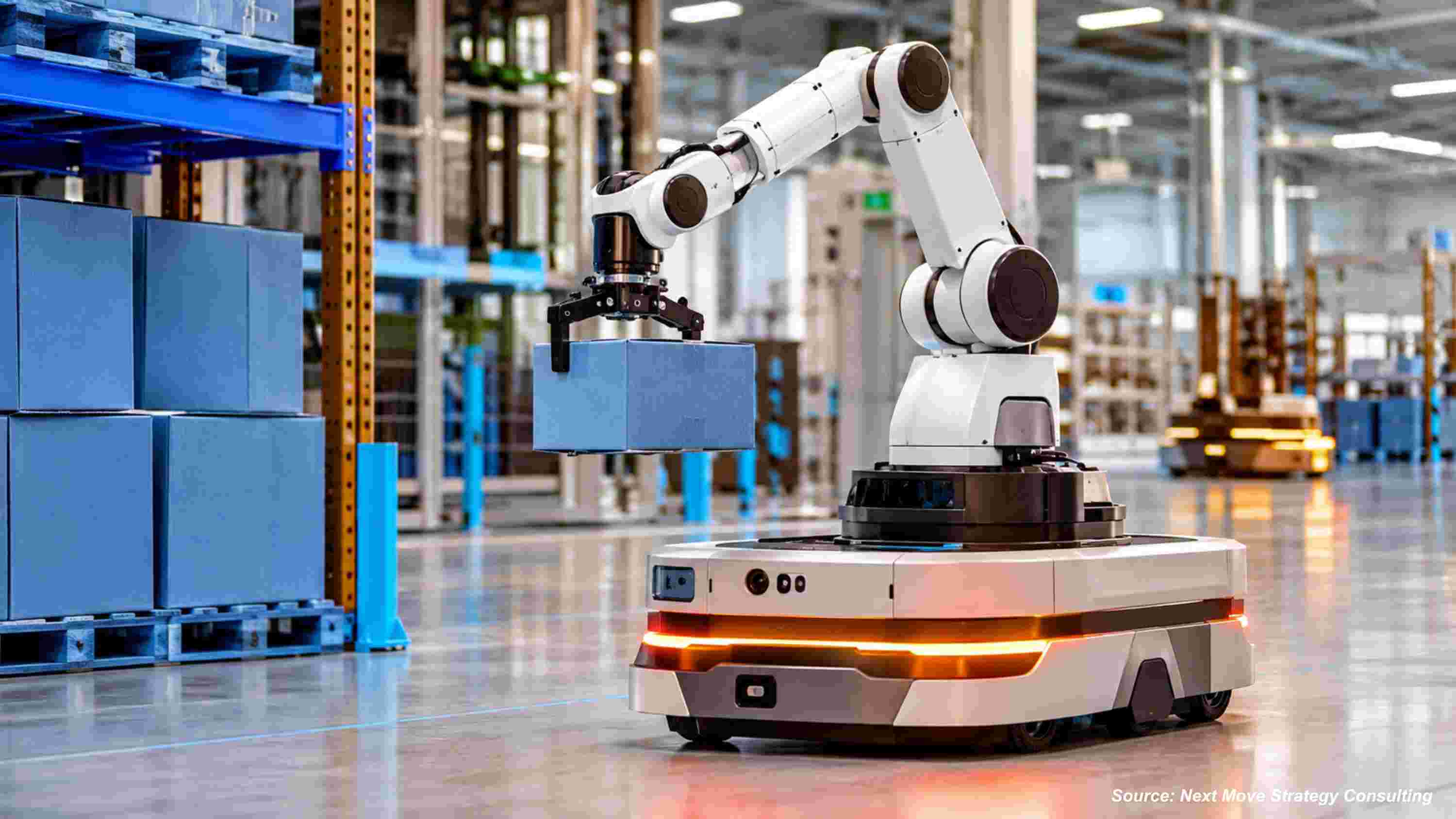
On May 19, 2026, Locus Robotics announced the acquisition of Nexera Robotics, a Vancouver-based developer of the NeuraGrasp soft-membrane gripper, on undisclosed terms. Locus Robotics, which positions itself as a leader in flexibility-first warehouse automation, was not buying a larger fleet or a better mobile base. It was buying grasping intelligence, a signal that the binding constraint on autonomous mobile manipulation has moved from navigating a warehouse to picking millions of different items reliably once the robot arrives.
According to Next Move Strategy Consulting's AMMR Market report, the global autonomous mobile manipulator robots (AMMR) market was valued at USD 0.30 billion in 2023 and is projected to reach USD 2.57 billion by 2030, growing at a CAGR of 36.3% from 2024 to 2030.
For More Information: Download FREE Sample on AMMR Market Report
This article reads the AMMR market through the events of the last six months: the Locus Robotics acquisition of Nexera Robotics, the USD 100 million Series A raised by Maven Robotics, the International Federation of Robotics World Robotics 2026 data, the third-quarter results of Teradyne and the Association for Advancing Automation, and the United States proclamation on robotics imports of October 28, 2026. Each is examined for what it reveals about where AMMR value is moving and where executives and investors should act.
Locus Robotics Bought Its Grasp: How Mobile Manipulation Moved From Demonstration to Deal Flow
Locus Robotics and Nexera Robotics: Paying for the Gripper
Locus Robotics announced the acquisition on May 19, 2026 in a Business Wire release. Nexera Robotics will operate as a wholly owned unit, with its team and leadership joining Locus Robotics. According to the release, NeuraGrasp combines AI-driven grasping intelligence, onboard sensing, computer vision and a patented soft membrane so that one gripper adapts to different shapes, textures, materials, porosity and weights. The release names porous textiles, loosely bagged items, perforated polybags and delicate goods among the products it should open up for Locus Array, the company's robots-to-goods mobile picking platform.
Robotics 24/7 reported on May 19, 2026 that Locus Robotics said the purchase strengthens its intellectual property position in mobile manipulation, and that NeuraGrasp has been validated through thousands of hours and tens of millions of picks across six hardware generations. Locus Robotics expects the technology to reach Locus Array customers in the coming months. Chief Executive Officer Rick Faulk described AI-driven mobile manipulation at enterprise scale as the frontier of warehouse robotics, which explains the choice to acquire proven grasping technology rather than build it.
Maven Robotics: USD 100 Million for Mobile Manipulation at Production Scale
On September 10, 2026, Maven Robotics emerged from stealth with a USD 100 million Series A led by RoboStrategy, with LocalGlobe, Vine Ventures and XTX Ventures also investing, according to the company's GlobeNewswire announcement. SiliconANGLE reported that the Santa Clara company, founded in 2024, began with mixed-case palletizing and tote handling, which Maven Robotics sizes at USD 80 billion. Its robots carry two vacuum-gripper arms that lift up to 30 kilograms from a wheeled base capable of 10 miles per hour, and the proceeds will pay for 250 third-generation robots.
Maven Robotics Chief Executive Officer Hamza Derbas said that as many as eight robots are deployed in total at a Fortune 250 consumer packaged goods customer, with uptime of 99% or better across 16-hour working days, as SiliconANGLE reported on September 10, 2026. Maven Robotics expects more than 100,000 autonomous operating hours by the end of 2026 and more than 1 million by the end of 2027. RoboStrategy principal Jack Pearson said in the same announcement that a wide gap separates a robot that demonstrates well from one that survives three production shifts a day, seven days a week. The figures are company-reported and small in absolute terms, which is why they matter: investors are financing a 250-robot build plan on multi-shift reliability evidence rather than laboratory demonstrations.
International Federation of Robotics: The Installed Base Behind the Forecast
The International Federation of Robotics published World Robotics 2026 on September 24, 2026. It reports that the global operational stock of industrial robots rose 9% to a record 5 million units in 2025, with annual installations up 11% to more than 600,000 units, and forecasts 655,000 installations in 2026 and 806,000 in 2029. Its September 30, 2026 service robot release adds that professional service robot shipments, a count that includes autonomous mobile robots according to its press conference presentation, rose 24% to almost 250,000 units, with transportation and logistics leading at 117,500 units and a 47% share. Neither dataset isolates mobile manipulators, so NextMSC treats both as demand context.
Teradyne and the Association for Advancing Automation: Profitability and Order Breadth
On October 27, 2026, Teradyne reported third-quarter revenue of USD 1,306 million, of which USD 96 million came from Robotics, the business that includes collaborative robots and mobile robots. Teradyne stated that Robotics delivered its highest third-quarter revenue to date and achieved profitability. The same day, the Association for Advancing Automation reported that North American companies ordered 10,989 robots valued at USD 723.5 million in the third quarter of 2026, up 24.8% in units and 26.1% in value, the strongest quarter of the year so far.
Proclamation 11077: Trade Policy Reaches the Robotics Supply Chain
On October 28, 2026, the President of the United States signed Proclamation 11077 under Section 232 of the Trade Expansion Act of 1962, concurring with a Commerce Department finding that imports of robotics, industrial machinery and their parts and components threaten to impair national security. The Next Web reported on October 31, 2026 that the proclamation sets no tariffs for now, directs the Secretary of Commerce and the United States Trade Representative to negotiate with trading partners, and requires an update within 180 days, after which tariffs, quotas, fees or an investment programme remain possible.
NMSC Strategic Perspective: Why Grasp Reliability, Not Mobility, Now Sets the Pace
NextMSC primary research and analysis reads these events as one pattern. The 36.3% CAGR that NextMSC projects for 2024 to 2030 depends on mobile bases and manipulators performing as one dependable system, and 2026 shows where that dependability is being bought: in grasping intelligence at Locus Robotics, in multi-shift uptime at Maven Robotics, and in vendor economics, as Teradyne's profitable Robotics business suggests. The unit economics are direct. Every stock-keeping unit that a gripper cannot handle returns to a human picker and lowers the robot's utilisation, so each increment of grasping range raises the share of orders one robot completes alone.
Three implications follow. First, value is migrating toward end effectors, perception and manipulation software, which explains why Locus Robotics paid for intellectual property rather than expanding its fleet. Second, capital rewards reliability evidence: Maven Robotics' uptime claim and 100,000-hour target sit behind its round, and its 30-kilogram lift falls inside the 20-40 kg band of NextMSC's payload segmentation, which runs from up to 5 kg to 40 kg and above. Third, trade policy turns sourcing into a strategic decision: during the 180-day negotiation window, buyers of imported manipulators or components face tariff risk they cannot yet price, while United States assemblers such as Maven Robotics and Locus Robotics may gain a procurement argument.
Section Summary:
The 2026 events show AMMR spending moving toward grasping capability, proven uptime and supply-chain resilience.
-
Locus Robotics acquired Nexera Robotics on May 19, 2026 to extend the range of items Locus Array can pick.
-
Maven Robotics raised USD 100 million on September 10, 2026 to build 250 robots on reported multi-shift uptime.
-
Proclamation 11077 opens a 180-day negotiation window on robotics imports before tariffs, quotas or fees can follow.
Industry Impact Analysis
Trade Policy: A 180-Day Window for Sourcing Decisions
The International Federation of Robotics reported on September 24, 2026 that the United States installed 38,500 industrial robots in 2025, up 12%, and that most robots in the United States are still imported from Japan and Europe. The White House fact sheet accompanying Proclamation 11077 makes the same point about robotics, industrial machinery and their parts and components. Because the proclamation covers components as well as finished machines, an AMMR assembled domestically can still carry tariff exposure through imported arms, actuators or sensors, and buyers cannot price that exposure until the 180-day update.
Demand Diversification: From Automotive to Logistics, Food and Electronics
The International Federation of Robotics attributes the United States rebound to food, warehousing, logistics and medical applications, with automotive stable as the largest customer. Automotive installations were 13,500 units in 2025, down 1%, metal and machinery 3,000 units, down 15%, and food and beverage 2,900 units, up 30%. Automation concentrated in a few vehicle plants leaves a long tail of warehouse, food and electronics sites that fixed cells serve poorly, and that tail is where mobile manipulators compete.
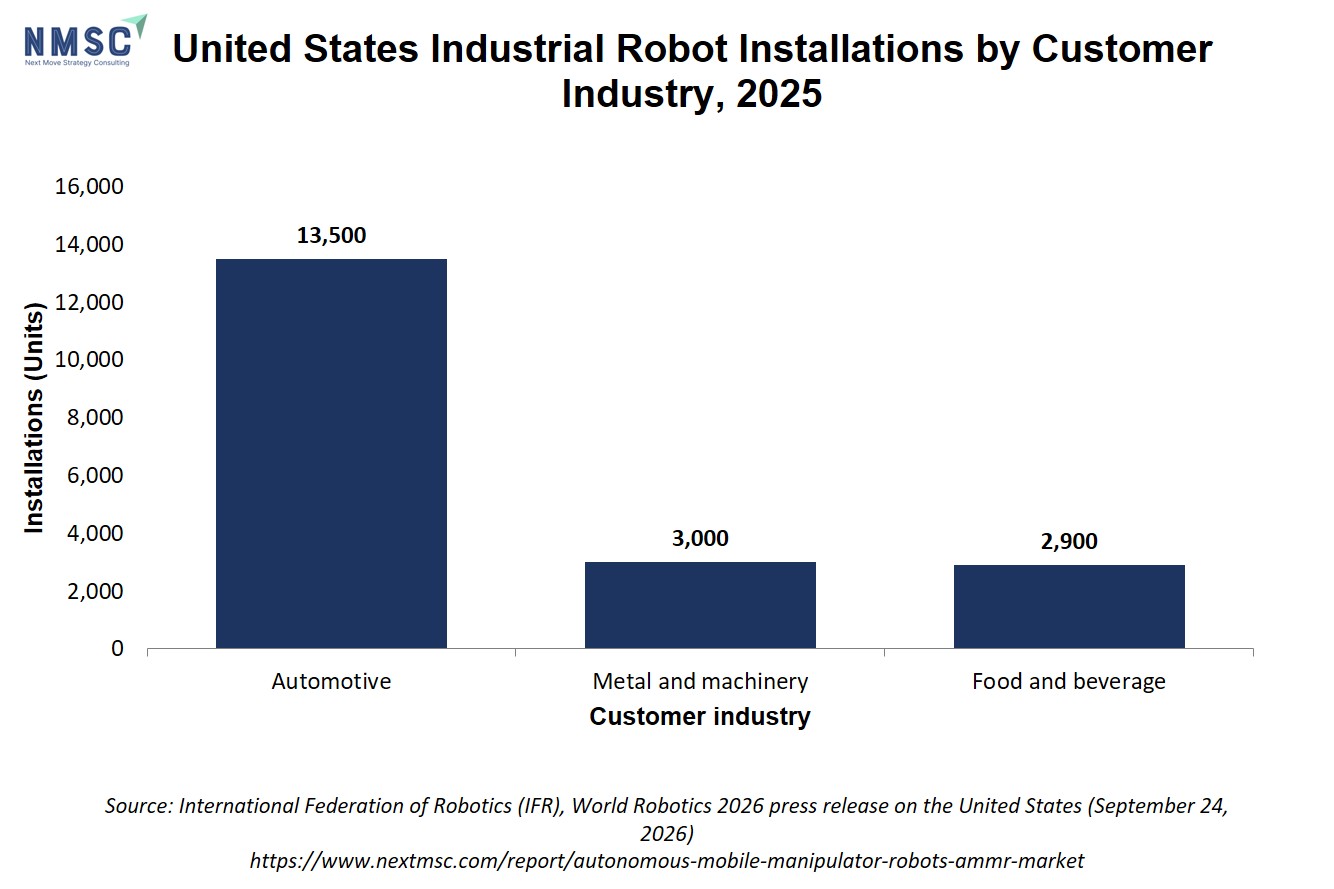
The International Federation of Robotics reports that the United States installed 38,400 industrial robots in 2025, a 12% increase. Automotive remained the largest customer with 13,500 installations, a 1% decrease, followed by metal and machinery with 3,000 installations, a decrease of 15%, and food and beverage with 2,900 installations, an increase of 30%.
Association for Advancing Automation data confirms the broadening. In the third quarter of 2026, North American unit orders rose 97.6% in semiconductors, electronics and photonics, 90.4% among automotive component makers, 67.7% in plastics and rubber, 38.7% in life sciences and 37.0% in metals, while food and consumer goods orders fell 23.7%. Automotive original equipment manufacturer orders grew 7.5% in the quarter but remained 17% below the prior-year level for the first nine months. Demand spread across industries with different payloads and shift patterns favours configurable mobile manipulators over single-purpose cells.
Collaborative arms, one of the manipulator categories that can be mounted on autonomous bases, now form a measurable share of orders. The Association for Advancing Automation reported 4,605 collaborative robot orders in North America in the first nine months of 2026.
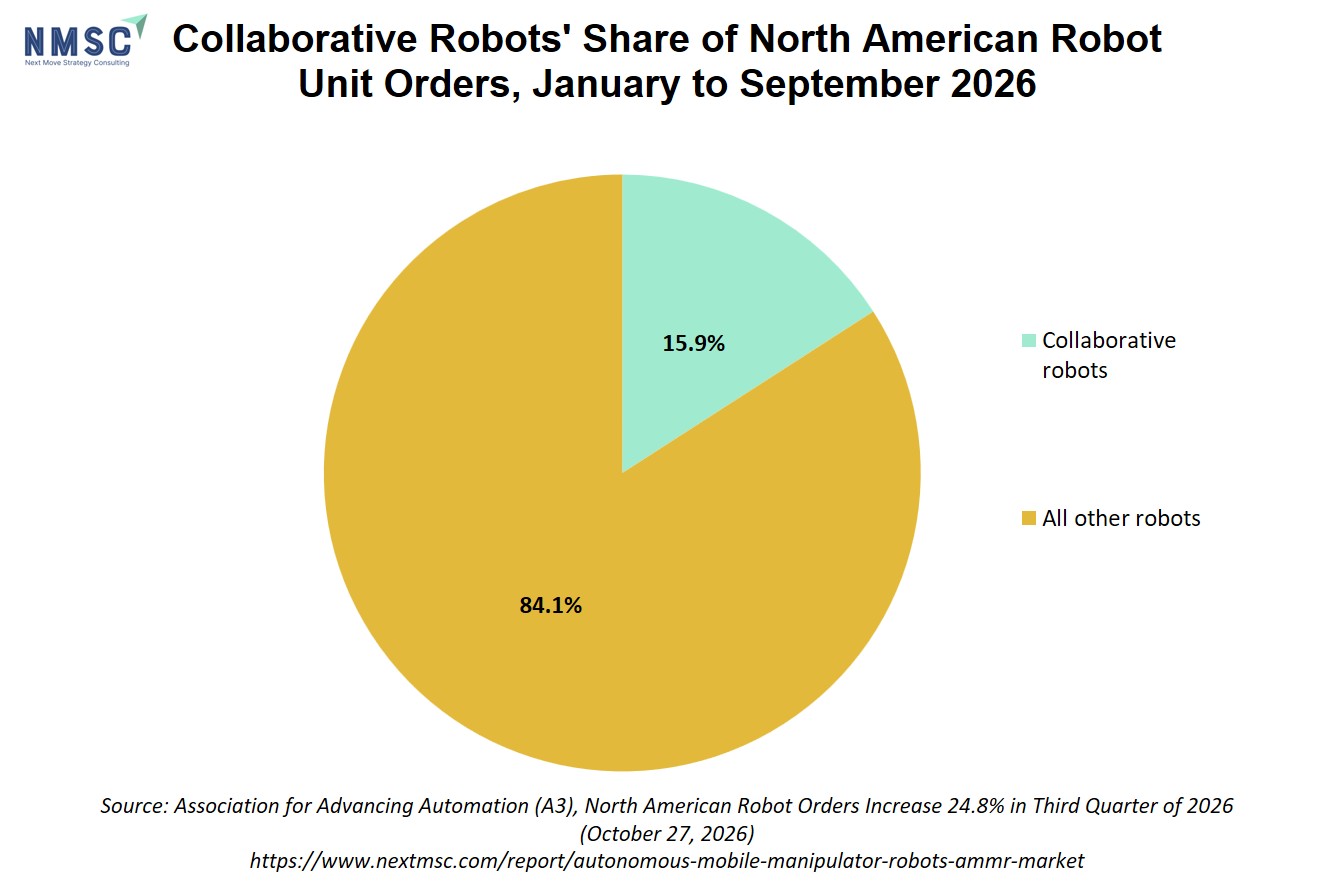
The Association for Advancing Automation reports that North American companies ordered 4,605 collaborative robots in the first nine months of 2026, equal to 15.9% of total robot units and 9.4% of total order value. The remaining 84.1% of robot units ordered were other robot types.
Regional Dynamics: Europe's Lead in the AMMR Market Against a Softer Installation Base
NextMSC regional analysis identifies Europe as the leading AMMR market region today, supported by manufacturers such as Rheinmetall, KUKA and ABB. The International Federation of Robotics paints a more cautious picture of the wider base: Germany, with 41% of European Union installations, saw sales fall 8% to fewer than 25,000 units in 2025, Italy fell 11%, France 8% and Spain 15%, while China installed 354,000 units, 59% of global deployments.
The International Federation of Robotics expects 2026 installation growth of 11% in Asia, 0% in Europe and 2% in the Americas, and compound growth for 2027 to 2029 of 8%, 6% and 2% respectively. The datasets measure different quantities, since NextMSC measures AMMR revenue and the International Federation of Robotics counts installations, but together they suggest that a regional lead in AMMR revenue does not guarantee growth momentum, which the International Federation of Robotics places in Asia.
Section Summary:
Policy, demand breadth and regional momentum are redrawing the AMMR opportunity map.
-
Proclamation 11077 covers components, so imported arms, actuators and sensors can create tariff exposure for domestic assemblies.
-
Association for Advancing Automation data shows third-quarter order growth in semiconductors, plastics, life sciences and metals.
-
Europe leads NextMSC's regional analysis, yet the International Federation of Robotics places 2026 installation growth at 11% in Asia against 0% in Europe.
Pros and Cons of Recent Market Developments
|
Pros |
Cons |
|
Locus Robotics will integrate NeuraGrasp into Locus Array, widening the items one gripper can pick (Locus Robotics, May 19, 2026). |
Terms were not disclosed and availability is expected only in the coming months, so live performance evidence is pending. |
|
Maven Robotics raised USD 100 million to build 250 third-generation robots (GlobeNewswire, September 10, 2026). |
Reported deployment is as many as eight robots at one customer, so the evidence base is narrow and company-reported (SiliconANGLE). |
|
North American robot orders rose 24.8% in units in the third quarter of 2026 (Association for Advancing Automation). |
Food and consumer goods orders fell 23.7%, and automotive original equipment manufacturer orders trail the prior year by 17% over nine months. |
|
Teradyne's Robotics business achieved profitability on USD 96 million of third-quarter revenue. |
That revenue is small against Teradyne's USD 1,306 million total, so profitability has been reached at modest scale. |
|
Proclamation 11077 directs negotiations rather than immediate tariffs, giving buyers 180 days to plan sourcing. |
Tariffs, quotas and fees remain possible afterwards, and parts and components are covered. |
Key Data & Statistics
The tables below consolidate the dated events and demand reference points used in this analysis, each taken from the named organisation's own publication.
Key AMMR-Relevant Events and Quantified Detail, May to October 2026
|
Event |
Date |
Quantified Detail |
|
Locus Robotics acquires Nexera Robotics |
May 19, 2026 |
Terms undisclosed; NeuraGrasp validated across tens of millions of picks |
|
Maven Robotics Series A |
September 10, 2026 |
USD 100 million; 250 third-generation robots; 30 kg lift |
|
International Federation of Robotics, industrial robots |
September 24, 2026 |
5 million operational stock, up 9%; installations up 11% |
|
International Federation of Robotics, service robots |
September 30, 2026 |
Almost 250,000 professional units, up 24%; logistics 47% share |
|
Teradyne third-quarter results |
October 27, 2026 |
Robotics revenue USD 96 million; profitable |
|
Association for Advancing Automation orders |
October 28, 2026 |
10,989 robots, USD 723.5 million; up 24.8% in units |
|
Proclamation 11077 |
October 28, 2026 |
No immediate tariffs; 180-day update |
Robot Installation Reference Points
|
Indicator |
Value |
|
Global installation forecast, 2026 |
655,000 units |
|
Global installation forecast, 2029 |
806,000 units |
|
China installations, 2025 |
354,000 units; 59% of global |
|
United States installations, 2025 |
38,400 units, up 12% |
|
Japan installations, 2025 |
36,219 units, down 19% |
Future Outlook & Forecast
The Road to USD 2.57 Billion: Three Forces Behind the AMMR Market's 36.3% CAGR
According to NextMSC primary research and analysis, the global AMMR market is projected to reach USD 2.57 billion by 2030 from USD 0.30 billion in 2023, a CAGR of 36.3% over 2024 to 2030 and an expansion of more than eightfold. While the International Federation of Robotics forecasts 806,000 industrial robot installations in 2029, NextMSC's model, which combines top-down and bottom-up estimation with statistical forecasting techniques, projects the AMMR market at USD 2.57 billion by 2030. The two measure different quantities, units versus revenue, yet both point toward sustained expansion.
-
Grasp capability as the gating factor: The Locus Robotics and Nexera Robotics transaction puts grasping range at the centre of mobile manipulation economics. As NeuraGrasp reaches customers, NextMSC expects vendors to compete on the share of stock-keeping units a robot handles without intervention, making grasp success rate a procurement metric.
-
Demand breadth beyond automotive: Association for Advancing Automation data shows orders strengthening in electronics, life sciences, metals and plastics, and the International Federation of Robotics credits food, warehousing, logistics and medical sectors for United States growth. Each added industry widens the payload and shift-pattern requirements that mobile manipulators must meet.
-
Capital and policy alignment: Maven Robotics' USD 100 million round shows capital available for production-scale fleets, while Proclamation 11077 introduces a negotiation window that will shape where fleets are assembled and which components they use.
Risks That Could Slow the Trajectory
NextMSC primary research identifies the high cost of installing and programming these robots as the principal restraint on the market. The International Federation of Robotics adds cautious investment decisions and trade restrictions, and notes that humanoid robots, of which about 7,000 full-size units were sold in 2025, still face challenges in safety, reliability and economic viability, while its presentation expects humanoid innovation to spill over to established robot forms. NextMSC reads that spillover as more likely to strengthen wheeled mobile manipulators in the near term than to displace them.
Section Summary:
NextMSC projects the AMMR market to reach USD 2.57 billion by 2030 at a 36.3% CAGR, with grasp capability, demand breadth and policy alignment as the deciding forces.
-
Grasp success rate across item classes is becoming a procurement metric as well as an engineering metric.
-
Demand is broadening from automotive toward electronics, life sciences, metals, plastics, food and logistics.
-
Installation and programming cost remains the principal restraint, and trade conditions add a second layer of uncertainty.
Next Steps for Stakeholders
For C-Level Executives and Operations Leaders
Specify grasp performance by item class, not payload alone. A robot's usefulness depends on the share of your stock-keeping units it can pick. Ask vendors for success rates on your own porous, bagged, irregular and delicate items, and pilot with those items rather than clean cartons.
Treat the 180-day window as a sourcing deadline. Map the origin of arms, actuators, sensors and compute in every AMMR you evaluate, and write tariff-sharing clauses into supply agreements before the update to the President is due.
Demand reliability evidence in the contract. Maven Robotics cites 99% or better uptime over 16-hour days as its headline metric. Require equivalent multi-shift uptime and intervention-rate reporting from every vendor, and tie payment milestones to those measures.
For Institutional Investors
Underwrite end-effector and manipulation intellectual property, not only fleets. Locus Robotics disclosed no price for Nexera Robotics, so no public benchmark exists, but the transaction suggests that grasping technology carries strategic value. Test how defensible a gripper design and its training data are.
Track utilisation disclosures as the leading indicator. Compare Maven Robotics' targets of 100,000 operating hours by the end of 2026 and 1 million by the end of 2027 with reported figures at each financing, and watch whether Teradyne Robotics sustains the profitability it reached in the third quarter of 2026.
Price policy risk explicitly. Model a scenario in which tariffs follow the negotiation window, and favour companies whose bills of materials are diversified across suppliers and jurisdictions.
Conclusion
The AMMR market is being redefined by a shift in what customers buy. The Locus Robotics acquisition of Nexera Robotics, Maven Robotics' USD 100 million round, the International Federation of Robotics data on a record installed base, the third-quarter evidence from Teradyne and the Association for Advancing Automation, and Proclamation 11077 all point to one conclusion: grasp reliability, multi-shift uptime and supply-chain resilience now separate credible mobile manipulation from demonstration.
According to NextMSC primary research and analysis, the global AMMR market is projected to reach USD 2.57 billion by 2030 at a 36.3% CAGR from a USD 0.30 billion base in 2023. Executives who specify grasp performance, secure component sourcing and demand reliability evidence, and investors who underwrite intellectual property and utilisation rather than unit counts, will be best placed to capture that expansion.
About the Author
 Priyanshu Das
— Priyanshu Das is SEO Executive at Next Move Strategy Consulting, where he has led on-page and off-page SEO, keyword research, and SEO audits for the firm's B2B market research publications for 2 years. His audit process combines technical crawl analysis, backlink profile review, and competitor keyword gap mapping — using tools including Screaming Frog and Google Search Console — to prioritize fixes by organic search-visibility impact, informed by his own prior in-house and agency SEO experience.
About the Reviewer
 Sanyukta Deb
— Sanyukta Deb is Digital Marketing Team Lead at Next Move Strategy Consulting, where she has led content strategy and technical SEO for the firm's B2B market research publications for over 2 years. Her editorial process translates NextMSC's primary and secondary research — spanning technology, industrial, and consumer sectors — into commercial narratives, backed by search-intent, keyword, and competitive analysis. She brings 5 years of overall experience in digital marketing and content strategy.















Add Comment