Augmented Reality Market: Why Glasses Are Overtaking Headsets | NextMSC
Introduction
On October 21, 2026, Meta Platforms reported that Reality Labs revenue fell 6% to USD 443 million in the third quarter, and its Form 10-Q for the quarter ended September 30, 2026 attributes the decline to lower Meta Quest sales that higher sales of AI glasses only partly offset. The filing marks a turning point for the augmented reality market: the hardware cycle that began with bulky headsets is now being led by eyewear that buyers already know how to wear, and that shift is changing who earns revenue, who regulates the technology and who funds the next generation of displays.
According to Next Move Strategy Consulting's Augmented Reality Market report, the global augmented reality market was valued at USD 34.63 billion in 2022 and is projected to reach USD 515.51 billion by 2030, growing at a CAGR of 40.2% from 2023 to 2030. NextMSC primary research and analysis links that trajectory to rising demand for immersive experiences in gaming, entertainment and education, wider availability of high-speed connectivity and sustained research and development spending by device makers.
For More Information: Download FREE Sample on Augmented Reality Market Report
This analysis tests that trajectory against the evidence of the last six months. It draws on filings and announcements from Meta Platforms, EssilorLuxottica, Google, Snap Inc. and Vuzix Corporation, on statements from the European Data Protection Board and the Norwegian government, and on a Government Accountability Office assessment of the United States Army's headset program. The pattern across these sources is consistent: capital is moving from immersive headsets toward lightweight glasses, regulators are drawing the first boundaries around camera-equipped eyewear, and defense buyers now demand proof of field performance before they order at volume.
From Headsets to Eyewear: How Glasses Are Rewriting the Augmented Reality Market
Meta Reality Labs: Headset Revenue Falls While Glasses Carry the Growth
On October 21, 2026, Meta Platforms chief financial officer Susan Li told investors during the company's third-quarter earnings call that Reality Labs revenue had declined because of lower Quest headset sales, partly offset by continued strong growth in AI glasses revenue. Reality Labs generated USD 443 million in the quarter against USD 470 million a year earlier, according to Meta Platforms' Form 10-Q, and the division reported an operating loss of USD 4.13 billion. Across the first nine months of 2026, Reality Labs revenue rose by USD 24 million, or 2%, to USD 1,276 million, and the filing credits higher AI glasses sales for that increase, partly offset by lower Quest sales.
The scale matters as much as the direction. Reality Labs accounted for less than 1% of Meta Platforms' total quarterly revenue of USD 64.60 billion, yet it absorbed a multi-billion-dollar loss. Meta Platforms management also reaffirmed that new virtual reality headsets must deliver major breakthroughs before they reach production, which signals that the company will fund glasses ahead of further Quest iterations.
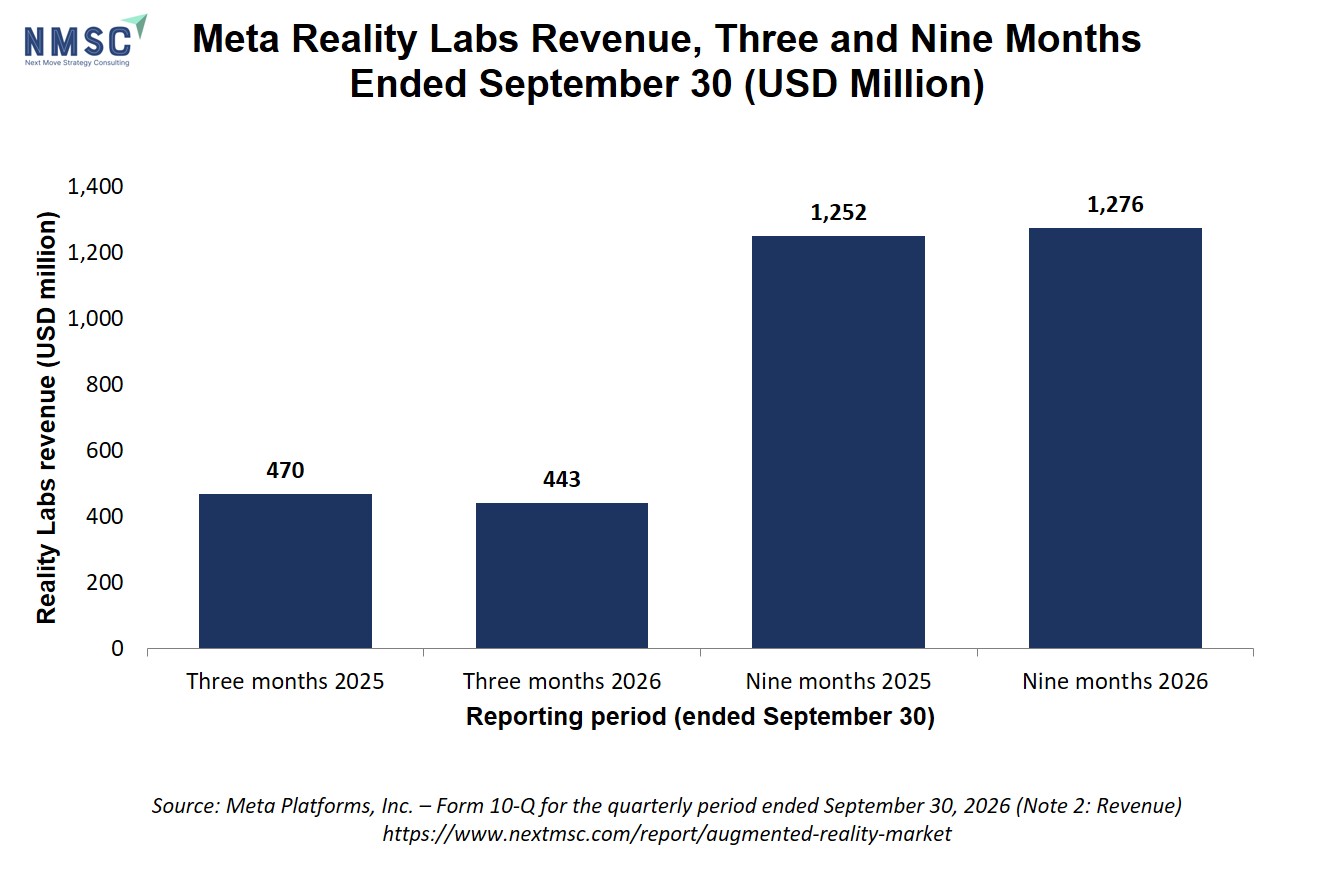
Meta Platforms' Form 10-Q reports Reality Labs revenue of USD 470 million for the three months ended September 30, 2025 and USD 443 million for the same period of 2026. For the nine months ended September 30, revenue was USD 1,252 million in 2025 and USD 1,276 million in 2026. The quarterly decline and the nine-month increase are both reported in the same filing, which attributes the quarterly decline to lower Meta Quest sales and the nine-month increase to higher sales of AI glasses.
EssilorLuxottica: Wearables Revenue Reaches EUR 486 Million
On October 20, 2026, EssilorLuxottica, the eyewear group that manufactures Ray-Ban Meta and Oakley Meta glasses, published its third-quarter revenue release. Group revenue reached EUR 7,486 million, and the wearables category, which combines AI glasses with Nuance Audio hearing glasses, grew 20% at constant exchange rates. The company reported wearables revenue of EUR 486 million for the quarter against EUR 402 million a year earlier, and EUR 1,261 million over the first nine months of 2026.
Two cautions apply when reading these figures together. First, EssilorLuxottica books frame and glasses sales while Meta Platforms books Reality Labs sales, so the numbers overlap in economic terms and cannot be added. Second, the 20% growth rate reflects a tougher comparison base than in earlier quarters, according to the company's own commentary, and EssilorLuxottica's executives pointed to new AI glasses launches and the rollout of Nuance Audio Plus, introduced in mid-September, as the drivers for the holiday season.
Google and XREAL: Android XR Reaches Consumers at USD 1,099
On October 28, 2026, Google announced with XREAL the launch of XREAL AURA, which Google describes as the first wired XR glasses powered by Android XR. The glasses weigh under 95 grams because processing, battery and the new Snapdragon Reality Elite platform from Qualcomm Technologies sit in a portable compute puck connected by cable. They offer a 70-degree field of view and support Gemini assistance, and Google states that more than 150 apps made for XR are available alongside the wider Google Play catalog.
Launch pricing starts at USD 1,099 through the end of 2026, with orders open in the United States, Canada and Korea from October 28 and in Japan from November 2, and shipments beginning in mid-November. Google also directed business buyers to Android Enterprise deployment options, which indicates that the platform is being positioned for managed workplace use as well as consumer entertainment.
Snap SPECS: A USD 2,195 Bet on Standalone See-Through Glasses
On June 16, 2026, Snap Inc. chief executive Evan Spiegel unveiled the consumer version of SPECS at the Augmented World Expo in Long Beach, California, pricing the standalone augmented reality glasses at USD 2,195 and opening preorders with a refundable USD 200 deposit, as TechCrunch reported on the same day. Shipments were scheduled for the fall in the United States, the United Kingdom and France.
On Snap Inc.'s third-quarter call on November 4, 2026, Spiegel said the company had run more than 10,000 demonstrations at its Los Angeles pop-up location and expected to begin SPECS shipments later in the fall, while the company's fourth-quarter guidance includes planned SPECS investment. Snap Inc. reported third-quarter revenue of USD 1,722 million, up 14% year over year, which gives the hardware program a funded but finite runway.
Apple: Bloomberg Places the First Glasses at WWDC in June 2027
On November 15, 2026, Bloomberg's Mark Gurman reported that Apple plans to unveil its first smart glasses at its Worldwide Developers Conference in June 2027 and to begin shipping before the end of that year, according to Bloomberg. Bloomberg had earlier reported that the device, codenamed N50, was originally planned for a late 2026 reveal. Apple has made no public statement about the product, so its timeline remains a reported plan rather than a confirmed commitment.
NMSC Strategic Perspective: Why Form Factor Now Sets the Pace
NextMSC primary research and analysis reads these five developments as evidence that form factor, rather than display technology, now determines how fast the augmented reality market converts demand into revenue. The Meta Platforms filing shows that a headset-led product line can shrink even as the category expands, while EssilorLuxottica's results show that a conventional frame with cameras, microphones and an assistant can scale through existing optical retail channels. The price points announced in 2026, from USD 1,099 for XREAL AURA to USD 2,195 for Snap SPECS, indicate that true see-through displays are still priced as premium devices.
This distinction is central to the NextMSC forecast of USD 515.51 billion by 2030. A CAGR of 40.2% cannot be reached through headset volumes alone, so it depends on three conditions: displays that fit into frames of roughly everyday weight, application platforms such as Android XR and Snap's Lens ecosystem that give buyers a reason to wear them, and enterprise and defense programs that convert pilots into recurring orders. Each of these conditions is visible in the evidence above, and each is still unproven at scale.
Section Summary:
Five 2026 events show the augmented reality market shifting from headset sales toward glasses, with platform owners and eyewear manufacturers now setting the pace.
-
Meta Platforms reported Reality Labs revenue of USD 443 million for the third quarter, down 6%, as lower Quest sales outweighed higher AI glasses sales.
-
EssilorLuxottica's wearables revenue reached EUR 486 million in the third quarter, up 20% at constant exchange rates.
-
Google and XREAL launched AURA at a USD 1,099 launch price on October 28, 2026, bringing Android XR to consumers.
-
Snap Inc. priced SPECS at USD 2,195, and Bloomberg reported that Apple's first glasses are planned for a June 2027 unveiling.
Industry Impact Analysis
Privacy Regulation: Norway's Proposed Ban and the EDPB Statement
On October 5, 2026, the Norwegian government announced that it would ask parliament to approve a temporary ban on AI-enabled smart glasses in selected public places, according to the Associated Press. Officials stated that they were not seeking a blanket ban and said the measure would give authorities time to examine devices that can photograph, record conversations and livestream without bystanders knowing. The proposal is not yet law, and the government said it would take the measure to parliament as soon as possible.
On October 13, 2026, the European Data Protection Board adopted statement 01/2026 on smart glasses at its Brussels plenary. The board asked manufacturers to make recording obvious through indicator lights, audio signals or phone notifications, and it identified settings such as hospitals, schools and workplaces as higher risk. EDPB Chair Anu Talus said individuals deserve clear warnings rather than hidden surprises. The statement is non-binding, but it gives national regulators a common reference when they assess devices sold across the European Union.
The commercial effect is concrete. Recording indicators add components and industrial design constraints to every camera-equipped model, venue-level bans shrink the places where a device can be used, and enterprise buyers must now write wearable-camera policies before large deployments. Apple's reported timeline reinforces the point, because Bloomberg's Mark Gurman reported on July 26, 2026 that privacy design work was a reason the N50 glasses had moved to a 2027 reveal.
Defense: The GAO Assessment of IVAS and the Move to SBMC
In its annual weapons systems assessment, reported by Military Times on July 8, 2026, the United States Government Accountability Office found that three versions of the Integrated Visual Augmentation System goggles developed between 2018 and 2025 were not ready for fielding, leaving nearly 10,000 produced units obsolete and in storage. After an investment of nearly USD 2 billion, an Army evaluation cited in the report found that soldiers considered the headsets difficult to wear and that they did not outperform existing equipment. Some 400 version 1.2 units will inform the successor Soldier Borne Mission Command program, now held by Anduril.
For suppliers, the lesson is procurement discipline. The Government Accountability Office faulted the program for moving to production with limited operational testing, and the new program relies on continuous assessments with Army brigades. Defense revenue in augmented reality will therefore arrive in smaller, evidence-gated tranches rather than in a single large fielding order.
Component Suppliers: Vuzix Pivots Toward Waveguides and Defense
On November 12, 2026, Vuzix Corporation reported third-quarter total sales of USD 0.7 million, down 38% from USD 1.2 million, with product sales falling 45% after the company discontinued several enterprise smart glasses models at the end of 2025. The company reported a net loss of USD 8.4 million, held USD 9.2 million in cash with no debt, and disclosed just under USD 1.0 million in new OEM defense orders received so far in the fourth quarter. Its SHRIKE Defense Display Platform is shipping for customer evaluation, and its Rochester waveguide facility upgrades are operational.
The Vuzix results show where value is migrating. A pure-play enterprise glasses maker is shrinking while larger platform owners ship at scale, so smaller optics specialists are repositioning around waveguides, defense displays and, in the case of the Vuzix Causeway platform, optical interconnects for AI data centers, where the company reports engagement with more than 10 companies.
Section Summary:
Regulation, defense procurement and supplier economics are each reshaping how augmented reality hardware is designed, sold and financed.
-
Norway's proposed ban and the EDPB statement make recording indicators and venue restrictions a design requirement for camera-equipped glasses.
-
The Government Accountability Office found nearly 10,000 IVAS headsets obsolete, which pushes defense buyers toward continuous testing and smaller awards.
-
Vuzix Corporation's 38% revenue decline shows that smaller glasses makers are pivoting toward waveguides, defense displays and data center optics.
Pros and Cons of Recent Market Developments
|
Pros |
Cons |
|
EssilorLuxottica's EUR 486 million wearables quarter, up 20%, shows eyewear retail can carry augmented reality hardware to mainstream buyers. |
Meta Platforms' USD 4.13 billion Reality Labs quarterly operating loss shows that spending still far exceeds revenue. |
|
Google's AURA weighs under 95 grams and launches with more than 150 XR apps, lowering barriers for buyers. |
AURA's USD 1,099 and SPECS' USD 2,195 prices keep see-through displays beyond most consumer budgets. |
|
The EDPB statement gives manufacturers one European design reference, reducing planning uncertainty. |
Norway's proposed ban could spread and restrict where camera glasses may be used. |
|
Continuous soldier feedback should raise the quality of future defense headsets. |
Nearly 10,000 obsolete IVAS headsets show that defense demand can vanish when field performance falls short. |
Key Data & Statistics
Augmented reality hardware developments, June to November 2026
|
Date |
Organization |
Development |
Reported figure |
|
June 16, 2026 |
Snap Inc. |
SPECS consumer glasses unveiled |
USD 2,195 price |
|
July 8, 2026 |
Government Accountability Office |
IVAS findings reported |
Nearly 10,000 headsets obsolete and in storage |
|
October 5, 2026 |
Norwegian government |
Temporary AI glasses ban proposed |
Parliament proposal |
|
October 13, 2026 |
European Data Protection Board |
Smart glasses statement adopted |
Recording indicators recommended |
|
October 20, 2026 |
EssilorLuxottica |
Third-quarter revenue release |
Wearables EUR 486 million, up 20% |
|
October 21, 2026 |
Meta Platforms |
Third-quarter results |
Reality Labs revenue USD 443 million, down 6% |
|
October 28, 2026 |
Google and XREAL |
XREAL AURA launch |
USD 1,099 launch price |
|
November 12, 2026 |
Vuzix Corporation |
Third-quarter results |
Total sales USD 0.7 million, down 38% |
Reported revenue indicators, third quarter 2026 versus third quarter 2025
|
Company |
Metric |
Q3 2026 |
Q3 2025 |
|
Meta Platforms |
Reality Labs revenue (USD million) |
443 |
470 |
|
EssilorLuxottica |
Wearables revenue (EUR million) |
486 |
402 |
|
Vuzix Corporation |
Total sales (USD thousand) |
714 |
1,161 |
Future Outlook & Forecast
What the 40.2% CAGR Demands from the Augmented Reality Market
The NextMSC forecast of USD 515.51 billion by 2030, from a base of USD 34.63 billion in 2022, assumes that augmented reality moves from early adopters to routine daily and workplace use. The 2026 evidence suggests three milestones to watch. The first is whether SPECS and AURA shipments in the fourth quarter convert preorders into satisfied users. The second is the reported June 2027 Apple unveiling, which would add the largest consumer ecosystem to the category. The third is whether Meta Platforms can narrow Reality Labs losses as planned, since its management told investors on October 21, 2026 that it expects the division to lose USD 18 billion to USD 19 billion in 2026 and about USD 15 billion in 2027.
NextMSC research also treats price as the decisive variable. The report identifies the high cost of AR devices such as smart glasses and head-mounted displays as a restraint on adoption, and the 2026 launch prices confirm it. If component costs fall and frames approach everyday weight, the addressable base widens quickly; if they do not, growth stays concentrated in enterprise and defense budgets.
Regional Outlook: North America Leads, Asia-Pacific Accelerates
NextMSC primary research and analysis finds that North America holds the dominant regional position, supported by defense adoption of AR for training and simulation and by the presence of major platform owners. Asia-Pacific is expected to rise steadily as 5G networks in China, India and Indonesia provide the data speeds and low latency that AR applications require. The Google and XREAL launch in Korea on the same day as the United States release, and in Japan five days later, suggests that platform owners are treating those markets as first-wave regions rather than later rollouts.
Section Summary:
Growth toward USD 515.51 billion by 2030 depends on price reductions, platform adoption and a clearer regulatory path, each of which will be tested between now and mid-2027.
-
NextMSC projects a CAGR of 40.2% from 2023 to 2030, which requires glasses-led volumes rather than headset sales alone.
-
Fourth-quarter SPECS and AURA shipments and the reported June 2027 Apple unveiling are the nearest tests of consumer demand.
-
North America leads on defense and platform presence, while Asia-Pacific gains from 5G deployment in China, India and Indonesia.
Next Steps for Stakeholders
For C-Level Executives and Technology Leaders
-
Pilot glasses before headsets: the AURA enterprise deployment options and the shrinking Quest line suggest that lightweight devices will carry workplace programs.
-
Write a wearable-camera policy now, using the EDPB statement 01/2026 as a baseline for indicators, consent and restricted areas.
-
Require field testing with end users before volume purchases, as the Government Accountability Office findings on IVAS demonstrate the cost of skipping it.
-
Review exposure to single-platform dependence, because Android XR, Snap's ecosystem and a possible Apple entry will each set different developer rules.
For Institutional Investors
-
Track eyewear manufacturers and platform owners separately from pure-play suppliers, since EssilorLuxottica's EUR 486 million wearables quarter and Vuzix Corporation's 38% sales decline moved in opposite directions.
-
Monitor Reality Labs loss guidance of USD 18 billion to USD 19 billion for 2026 as a gauge of how long Meta Platforms will fund the category.
-
Watch Snap Inc.'s SPECS shipments and fourth-quarter guidance, which carry planned hardware investment, for evidence of demand at a USD 2,195 price.
-
Favor suppliers with defense and non-consumer revenue, such as waveguide and display specialists, because those orders arrive in smaller, evidence-gated tranches.
Conclusion
The augmented reality market is in a transition that the 2026 filings make visible: Meta Platforms' headset revenue is falling, EssilorLuxottica's wearables revenue is climbing, Google and Snap Inc. have put premium glasses on sale, and Apple's reported entry is scheduled for mid-2027. At the same time, the European Data Protection Board and Norway have shown that privacy rules will shape design and venue access, and the Government Accountability Office has shown that defense buyers will not fund hardware that fails in the field.
The NextMSC forecast of USD 515.51 billion by 2030 at a 40.2% CAGR remains achievable only if these pressures resolve in favor of lighter devices, lower prices and clear safeguards. Stakeholders that act on the shift from headsets to glasses now, while the platform rules are still being written, are best placed to capture the growth that follows.
About the Author
 Priyanshu Das
— Priyanshu Das is SEO Executive at Next Move Strategy Consulting, where he has led on-page and off-page SEO, keyword research, and SEO audits for the firm's B2B market research publications for 2 years. His audit process combines technical crawl analysis, backlink profile review, and competitor keyword gap mapping — using tools including Screaming Frog and Google Search Console — to prioritize fixes by organic search-visibility impact, informed by his own prior in-house and agency SEO experience.
About the Reviewer
 Sanyukta Deb
— Sanyukta Deb is Digital Marketing Team Lead at Next Move Strategy Consulting, where she has led content strategy and technical SEO for the firm's B2B market research publications for over 2 years. Her editorial process translates NextMSC's primary and secondary research — spanning technology, industrial, and consumer sectors — into commercial narratives, backed by search-intent, keyword, and competitive analysis. She brings 5 years of overall experience in digital marketing and content strategy.
















Add Comment