Anesthesia Monitoring Devices: Why Staffing Gaps Raise the Stakes | NextMSC
Introduction
On August 14, 2026, Becker's ASC Review reported the results of SedAssure's 2026 Anesthesia Access and Sedation Survey of 150 ambulatory surgery center leaders in the United States: 62% said anesthesia staffing gaps had cancelled or delayed cases during the past year, and 53% said they had closed rooms or cut operating days. A shortage of anesthesia providers has therefore moved from a staffing concern to a technology question, because every case that proceeds with fewer clinicians in the room depends more heavily on devices that track sedation depth, hemodynamics, oxygenation and ventilation without interruption.
According to Next Move Strategy Consulting's Anesthesia Monitoring Devices Market report, the global anesthesia monitoring devices market was valued at USD 1.89 billion in 2023 and is projected to reach USD 3.69 billion by 2030, growing at a CAGR of 10.0% from 2024 to 2030. NextMSC primary research and analysis attributes this trajectory to rising surgical procedure volumes, a growing burden of chronic disease and expanding healthcare spending, partly offset by the high acquisition cost of advanced monitors in smaller facilities and in regions with limited capital budgets.
For More Information: Download FREE Sample on Anesthesia Monitoring Devices Market Report
This analysis examines four developments from the last six months that are changing purchasing criteria in the anesthesia monitoring devices market: a newly cleared pediatric sedation index, a regulator's safety notice on anesthesia workstations, workforce data on thin anesthesia coverage, and a final Medicare payment rule that moves more surgery into outpatient settings. Each fact is attributed to a named institution and paired with NextMSC's view.
Anesthesia Monitoring Devices Market Trends: Pediatric Brain Monitoring, Safety Notices and a Shrinking Workforce
Masimo Extends EEG-Based Sedation Monitoring to Children
On July 27, 2026, Masimo announced that the U.S. Food and Drug Administration had granted 510(k) clearance for a pediatric version of its Patient State Index, a sedation score that runs on the company's SedLine brain function monitoring platform. According to coverage published by Practical Neurology on July 29, 2026, the pediatric index applies to children aged 4 years and older, in operating rooms and intensive care units, for patients receiving propofol or sevoflurane. SedLine itself was already available for adults and for children aged 1 year and older. Masimo describes the pediatric index as the only sedation score designed specifically for the physiology of the pediatric brain.
The validation evidence is specific. Masimo reported clinical data from 169 pediatric patients, in which the index followed anesthesia stages scored manually by clinicians and tracked burst suppression, an EEG pattern that can signal excessive sedation. Practical Neurology also noted that the clearance does not replace clinical judgment or full interpretation of the EEG waveform, a limit that shapes adoption: pediatric anesthesiologists will treat the index as a decision aid, not as an automated control loop.
The commercial significance lies in the labeled indication. Masimo's positioning rests on the physiological difference between adult and pediatric brains, and the clearance converts that argument into a regulator-reviewed use for a defined age group and two named anesthetic agents. It also supports the opportunity NextMSC's report highlights: integrating depth of anesthesia monitoring into mainstream monitoring devices.
Dräger's Atlan Notice Shows Why Independent Monitoring Is a Safety Requirement
On August 4, 2026, the United Kingdom's Medicines and Healthcare products Regulatory Agency (MHRA) published Device Safety Information DSI/2026/005 on Dräger Atlan anesthesia workstations. The notice describes a manufacturing defect that may cause the piston ventilator to fail before or during use, which would interrupt mechanical ventilation and require clinicians to switch immediately to manual or spontaneous ventilation. It follows a field safety notice that Dräger issued in April 2026, which expanded an earlier notice from October 2024 covering the same issue.
The MHRA's instructions are operational. Dräger will replace the ventilator motor assembly through its local service representatives, and until replacement, affected devices may be used only under permanent supervision, with continuous patient monitoring and readiness to ventilate manually. As of July 29, 2026, Dräger reported no confirmed patient injuries or deaths linked to the defect.
For monitoring vendors, the notice is a reminder that the anesthesia workstation and the patient monitor form a single safety system. When the ventilator is the possible point of failure, independent readings of oxygenation, exhaled gases and airway pressure are what tell clinicians that ventilation has stopped. Hospitals that must supervise a fleet of affected workstations until the motor assemblies are replaced are, in practice, buying additional attention, and attention is the resource that the workforce data below shows to be scarce.
Workforce Data From Medicus Healthcare Solutions and SedAssure Quantifies the Pressure
Medicus Healthcare Solutions, a locum tenens staffing firm, published its report The State of Anesthesia Care Delivery: Data, Trends, & Strategic Solutions, which Becker's ASC Review summarized on August 28, 2026. The report projects a national shortfall of 3,720 full-time-equivalent anesthesiologists in 2026, rising to 8,140 by 2031. The distribution is uneven: metropolitan areas show a projected surplus of 2,540 anesthesiologists in 2026, while non-metropolitan areas face a shortage of 6,260. Medicus also reports that more than 42% of anesthesiologists say they are likely to leave their current organization within two years, and that nearly two-thirds of anesthesia positions used locum tenens coverage in 2025.
SedAssure's survey, reported by Becker's ASC Review on August 14, 2026, shows how this scarcity reaches the operating schedule. Beyond the 62% of leaders reporting cancelled or delayed cases and the 53% reporting closed rooms or cut operating days, 51% named the shortage of certified registered nurse anesthetists and anesthesiologists as their single greatest challenge, and nearly half said they scaled back surgical volume at least monthly. Marc Koch, MD, chief executive officer and president of SedAssure, said in the survey results covered on August 14, 2026 that facilities which a year earlier were bracing for a shortage are now "living through it." The survey also points to a care-model response: 60% of ASCs still use a traditional care-team model, while 41% said they would consider a sedationist-led approach, with endoscopy (61%) and pain management (55%) named most often as ready for that shift.
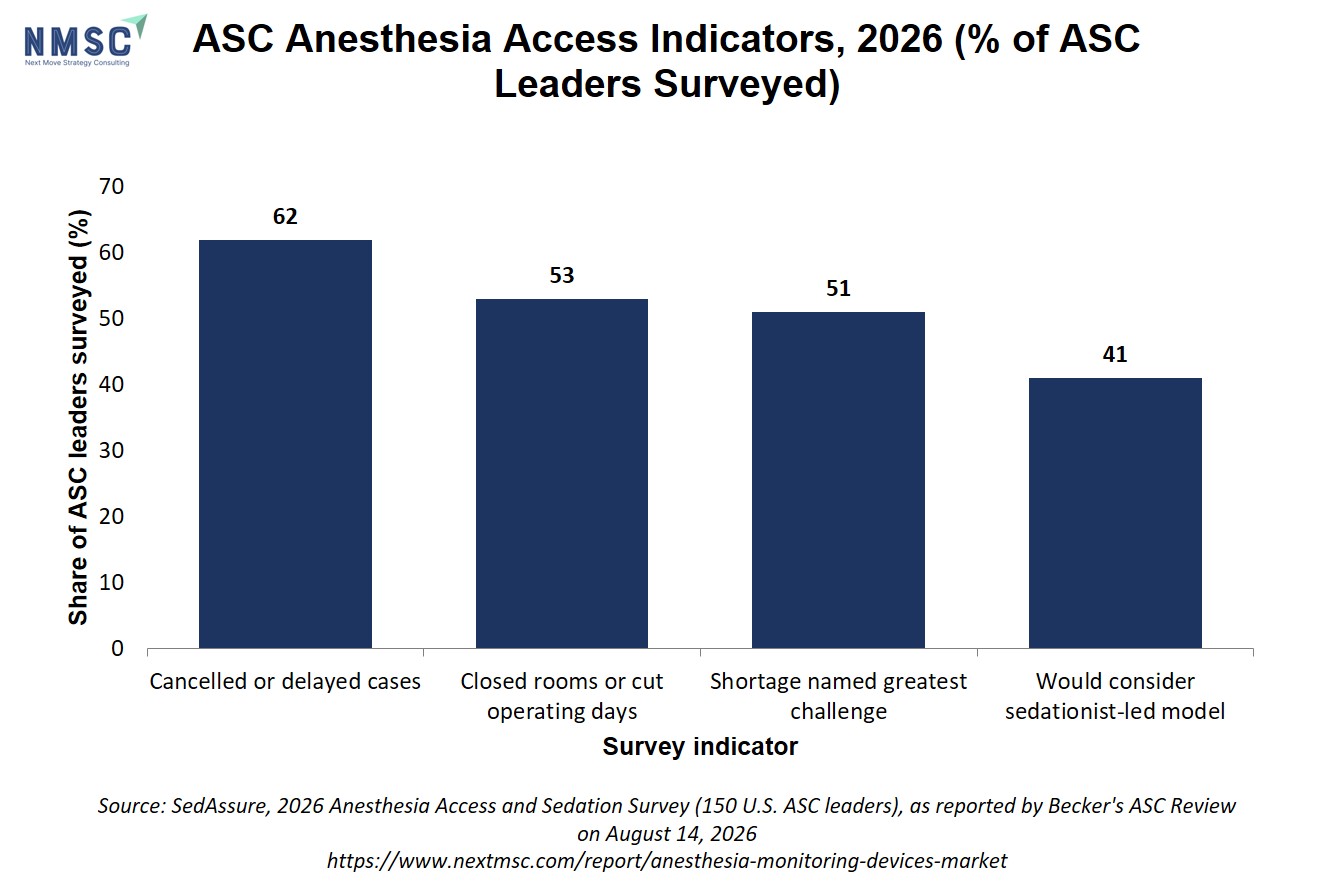
The SedAssure 2026 Anesthesia Access and Sedation Survey of 150 ASC leaders, reported by Becker's ASC Review on August 14, 2026, found that 62% of respondents had cancelled or delayed cases because of staffing gaps, 53% had closed rooms or reduced operating days, 51% named the anesthesia provider shortage as their single greatest challenge and 41% would consider a sedationist-led approach. The first three indicators describe disruption already experienced, while the fourth describes willingness to change the care model.
NMSC Strategic Perspective: Monitoring Becomes a Substitute for Scarce Supervision
NextMSC primary research and analysis reads these developments as one shift in the buying logic of the anesthesia monitoring devices market. Historically, a monitor was specified against a clinical checklist covering the parameters supported, display quality and alarm accuracy. Where anesthesia supervision is stretched and a facility can lose operating days for lack of coverage, the specification increasingly includes how much surveillance the device performs on the clinician's behalf. NextMSC's analysis points to three product directions that follow from this shift:
-
Integrated sedation-depth and hemodynamic monitoring that surfaces trends without a dedicated clinician watching each screen, as the pediatric Patient State Index illustrates for sedation depth.
-
Independent cross-checks of workstation function, which is the practical lesson of the Atlan safety notice: a monitor that confirms ventilation separately from the machine delivering it.
-
Modular, lower-cost configurations for ambulatory surgery centers, because NextMSC's end-user segmentation treats ambulatory surgery centers as a distinct buyer group alongside hospitals.
NextMSC also draws a caution. The high cost of advanced monitors, which its report identifies as the main restraint, now collides with ASC margins under pressure from the payment changes discussed below. Vendors able to price monitoring for outpatient centers hold a structural advantage over those selling premium hardware to hospitals alone.
Section Summary:
Four named developments, a cleared pediatric sedation index, a regulator's workstation notice and two workforce datasets, point in the same direction: the anesthesia monitoring devices market is being pulled toward devices that compensate for limited human supervision.
-
Masimo's pediatric Patient State Index (announced July 27, 2026) extends processed-EEG sedation monitoring to children aged 4 years and older.
-
MHRA notice DSI/2026/005 (August 4, 2026) requires permanent supervision of affected Dräger Atlan workstations until motor assemblies are replaced.
-
SedAssure reports that 62% of surveyed ASC leaders cancelled or delayed cases because of anesthesia staffing gaps.
Industry Impact Analysis: Payment Rules, Outpatient Migration and Capital Cycles in the Anesthesia Monitoring Devices Market
On November 4, 2026, the Centers for Medicare & Medicaid Services (CMS) released its final calendar year 2027 hospital outpatient prospective payment system and ambulatory surgical center payment rule. According to the analysis published by Holland & Knight on November 13, 2026, the rule raises ASC payment rates by 2.3% for facilities that meet quality reporting requirements. Becker's ASC Review, in an article published on November 11, 2026, counted 637 services removed from the inpatient-only list in the second year of a three-year phase-out, which pushes more surgery toward outpatient settings.
The same Becker's ASC Review article reported that CMS reduced the ASC weight scaler to 0.814 from 0.872, which holds payments for eye and gastrointestinal procedures down by 1% each despite the overall 2.3% increase. This detail matters for anesthesia monitoring because endoscopy was the procedure area that SedAssure's respondents named most often (61%) as ready for a sedationist-led model. In other words, the specialty where facilities are rethinking anesthesia staffing is also one where payment is tightening.
The Ambulatory Surgery Center Association (ASCA) published its third-quarter 2026 60-Second Survey on October 16, 2026, and Becker's ASC Review reported the results on October 20, 2026. Among 307 surgery centers in 44 states, 76% reported adequate access to anesthesia providers, but access varied by staffing model: 88% of anesthesiologist-only centers reported adequate access, compared with 72% of centers using supervised care teams, in which anesthesiologists oversee CRNAs or certified anesthesiologist assistants. Among centers having difficulty keeping anesthesia providers, 75% said the problem affected procedure volume.
The survey also describes how centers staff anesthesia. Supervised care teams account for 36.2% of respondents, CRNA-only models for 30.9%, anesthesiologist-only models for 21.5% and other arrangements for 11.4%.
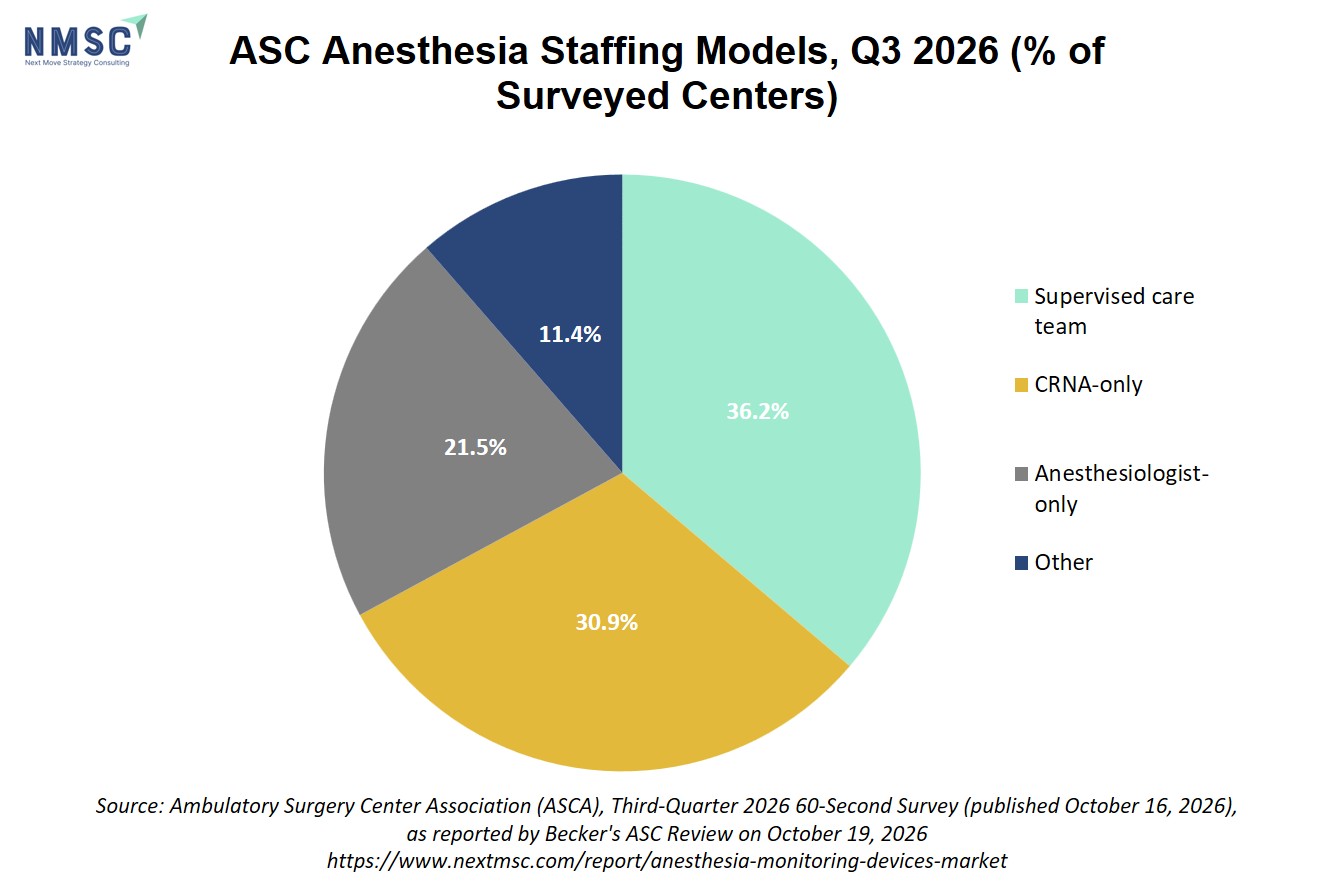
In ASCA's third-quarter 2026 60-Second Survey, supervised care teams were the most common anesthesia staffing model at 36.2% of respondents, followed by CRNA-only centers at 30.9%, anesthesiologist-only centers at 21.5% and other arrangements at 11.4%. The four shares total 100.0%. Reported adequate access to anesthesia providers was 72% in supervised care-team centers and 88% in anesthesiologist-only centers.
Outpatient migration widens the base of rooms that need compliant monitoring, but each room is purchased under tighter margins. NextMSC's analysis indicates that the ASCA distribution has a direct product implication: devices must serve physician-supervised, nurse-anesthetist-led and mixed teams alike, which favors configurable alarms and open data interfaces over single-workflow designs.
Hospital capital demand presents a mixed picture. In its preliminary third-quarter 2026 figures published on October 14, 2026, Drägerwerk AG & Co. KGaA reported medical-division net sales of about EUR 469 million, down 1.4% on a currency-adjusted basis, and medical order intake of about EUR 474 million, down 3.0%, while safety-division order intake rose 20.2%. For the first nine months, medical net sales grew 4.4% currency-adjusted to about EUR 1,367 million, but medical order intake fell 3.5%. Dräger confirmed its 2026 forecast of 2.0% to 6.0% currency-adjusted net sales growth.
GE HealthCare, by contrast, reported on October 28, 2026 third-quarter revenue of USD 5.5 billion, up 7.2%, and raised its full-year 2026 guidance. Peter Arduini, President and Chief Executive Officer of GE HealthCare, said in that release that the company delivered "strong top-line growth and margin expansion across all segments." NextMSC reads the divergence between Dräger's softer medical orders and GE HealthCare's broad growth as a sign that demand is not moving uniformly, and that one quarter of data should not be extrapolated into a trend.
Section Summary:
Payment policy, staffing models and vendor results all show an anesthesia monitoring devices market with growing volume in outpatient settings and uneven spending power behind it.
-
CMS's final 2027 rule raises ASC payment rates by 2.3% while cutting the ASC weight scaler to 0.814 from 0.872.
-
ASCA's third-quarter 2026 survey shows adequate anesthesia access ranging from 72% in supervised care-team centers to 88% in anesthesiologist-only centers.
-
Dräger's medical order intake fell 3.0% in the third quarter of 2026 on a currency-adjusted basis, while GE HealthCare's revenue rose 7.2%.
Pros and Cons of Recent Market Developments
The table below weighs each recent development on the dimensions that matter to buyers and vendors: clinical value, payment, workforce and supply-side risk.
|
Pros |
Cons |
|
The pediatric Patient State Index gives anesthesiologists an age-specific sedation index for children aged 4 years and older (Masimo, July 27, 2026). |
The clearance does not replace clinical judgment or full EEG interpretation, limiting how far the index can substitute for clinician attention. |
|
CMS's final 2027 rule raises ASC payment rates by 2.3%, supporting facility revenue (Holland & Knight, November 13, 2026). |
The ASC weight scaler falls to 0.814 from 0.872, reducing eye and gastrointestinal procedure payments by 1% each (Becker's ASC Review, November 11, 2026). |
|
Removal of 637 services from the inpatient-only list shifts more surgery toward outpatient settings, widening the installed-base opportunity. |
Outpatient buyers have smaller capital budgets: 62% of surveyed ASC leaders cancelled or delayed cases (SedAssure, August 14, 2026). |
|
Regulatory scrutiny, as in MHRA notice DSI/2026/005, raises the value of independent patient monitoring during workstation faults. |
Field corrections add supervision burdens and replacement logistics for hospitals and vendors. |
|
Interest in new care models is rising: 41% of ASC leaders would consider a sedationist-led approach (SedAssure, August 14, 2026). |
Hospital demand is uneven: Dräger's medical order intake fell 3.0% in Q3 2026 on a currency-adjusted basis (Drägerwerk AG & Co. KGaA, October 14, 2026). |
Key Data & Statistics
The tables below consolidate the quantitative evidence, each from a single named source, with projections labeled as such.
Table 1: U.S. Anesthesia Workforce Indicators
|
Indicator |
Value |
Period |
|
National anesthesiologist shortfall |
3,720 FTEs |
2026 |
|
Projected national anesthesiologist shortfall |
8,140 FTEs |
2031 (projection) |
|
Metropolitan anesthesiologist surplus |
2,540 FTEs |
2026 |
|
Non-metropolitan anesthesiologist shortage |
6,260 FTEs |
2026 |
|
Anesthesiologists likely to leave current organization within two years |
More than 42% |
2026 |
|
Anesthesia positions using locum tenens coverage |
Nearly two-thirds |
2025 |
|
Projected growth in outpatient surgical volume |
20% |
Next ten years (projection) |
Table 2: Dräger Divisional Performance, Preliminary Figures
|
Metric (EUR million) |
Q3 2026 |
Change, currency-adjusted |
Nine months 2026 |
Change, currency-adjusted |
|
Medical net sales |
469 |
-1.4% |
1,367 |
+4.4% |
|
Medical order intake |
474 |
-3.0% |
1,431 |
-3.5% |
|
Safety net sales |
381 |
+4.1% |
1,087 |
+6.5% |
|
Safety order intake |
452 |
+20.2% |
1,243 |
+13.1% |
Future Outlook & Forecast: The Anesthesia Monitoring Devices Market Through 2030
NextMSC's model projects growth in the anesthesia monitoring devices market from USD 1.89 billion in 2023 to USD 3.69 billion in 2030, a CAGR of 10.0% over 2024 to 2030, which implies that annual revenue nearly doubles within the forecast window. NextMSC segments the market by product, into advanced anesthesia monitors, basic anesthesia monitors and integrated anesthesia workstations, and by end user, into hospitals, ambulatory surgery centers and other facilities. Its regional analysis identifies North America as the largest region, a position it is expected to hold through the forecast period, and Asia-Pacific as the fastest-growing region.
Named external data points are consistent with the drivers in NextMSC's report. Medicus projects outpatient surgical volume to grow 20% over the next decade as the population aged 65 and older expands 55%, and reports that about 1 in 3 surgical patients are already 65 or older, accounting for roughly 5 million procedures a year. Chronic disease prevalence, a primary driver in NextMSC's report, is most visible in this older group.
Three uncertainties qualify the outlook. The first is price: advanced monitors remain costly for smaller facilities, and a payment environment that cuts specific ASC service lines by 1% does not ease that constraint. The second is regulatory: safety notices such as DSI/2026/005 can lengthen due diligence in procurement and shift buying toward vendors with strong field-service networks. The third is labor substitution: if sedationist-led models spread in endoscopy and pain management, the monitoring configuration required in those rooms will change toward simpler, more portable devices.
Medicus's projection that the national anesthesiologist shortfall will widen to 8,140 full-time equivalents by 2031 is a forecast and is labeled as such. If it materializes, facilities will need monitoring that preserves safety with fewer physician hours per case.
Section Summary:
NextMSC's forecast of USD 3.69 billion by 2030 rests on procedure volume, chronic disease and healthcare spending, while the 2026 developments add a labor-driven layer that favors integrated, configurable and cost-aware monitoring.
-
NextMSC projects a 10.0% CAGR for 2024 to 2030, with North America the largest region and Asia-Pacific the fastest-growing.
-
Medicus projects outpatient surgical volume to grow 20% over the next decade as the 65-and-older population grows 55%.
-
Price, regulatory scrutiny and sedationist-led care models are the main uncertainties for product design and procurement.
Next Steps for Stakeholders
The evidence supports specific actions for each group of decision-makers in the anesthesia monitoring devices market.
-
Device manufacturers: Prioritize age-specific and workflow-integrated parameters, as the pediatric Patient State Index clearance shows, and publish validation datasets with stated patient numbers, because buyers now weigh evidence alongside features.
-
Hospital and ASC executives: Audit installed anesthesia workstations against safety notices such as MHRA DSI/2026/005, and confirm that independent monitoring and supervision procedures remain in place until corrective work is complete.
-
ASC operators: Match the monitoring specification to the staffing model. ASCA's survey shows adequate access ranging from 72% in supervised care-team centers to 88% in anesthesiologist-only centers, so one configuration is unlikely to fit all.
-
Investors: Compare order intake and revenue across vendors, as the Dräger and GE HealthCare third-quarter results illustrate, and weigh exposure to outpatient channels against hospital capital cycles.
Conclusion
The anesthesia monitoring devices market is being shaped less by any single product launch than by the scarcity of the people who use the devices. Masimo's pediatric sedation index, the MHRA's notice on Dräger Atlan workstations, the SedAssure and ASCA surveys and the 2027 CMS final rule each reinforce one conclusion: outpatient settings will perform more surgery with thinner anesthesia coverage, and monitoring technology is being asked to close part of that gap.
NextMSC's projection of USD 3.69 billion by 2030 at a CAGR of 10.0% provides the quantitative frame, and the 2026 evidence supplies the mechanism. Manufacturers that combine clinical validation, interoperability and outpatient-appropriate pricing, and providers that align monitoring with their staffing model, are best placed to benefit as the anesthesia monitoring devices market expands.
About the Author
 Priyanshu Das
— Priyanshu Das is SEO Executive at Next Move Strategy Consulting, where he has led on-page and off-page SEO, keyword research, and SEO audits for the firm's B2B market research publications for 2 years. His audit process combines technical crawl analysis, backlink profile review, and competitor keyword gap mapping — using tools including Screaming Frog and Google Search Console — to prioritize fixes by organic search-visibility impact, informed by his own prior in-house and agency SEO experience.
About the Reviewer
 Sanyukta Deb
— Sanyukta Deb is Digital Marketing Team Lead at Next Move Strategy Consulting, where she has led content strategy and technical SEO for the firm's B2B market research publications for over 2 years. Her editorial process translates NextMSC's primary and secondary research — spanning technology, industrial, and consumer sectors — into commercial narratives, backed by search-intent, keyword, and competitive analysis. She brings 5 years of overall experience in digital marketing and content strategy.
















Add Comment