Audio Analytics Market: Why CX Platforms Are Buying Voice AI Now | NextMSC

Introduction
On November 2, 2026, Salesforce signed a definitive agreement to acquire Cresta, a voice-first customer experience platform whose voice agents resolve complex customer calls end to end. Three days later, Five9 agreed to acquire Level AI, a conversation intelligence platform that handles more than one billion customer interactions a year, for approximately USD 325 million in cash. Within one week, two platform vendors chose to own the layer that turns recorded speech into scored, searchable data instead of renting it from a partner.
According to Next Move Strategy Consulting's Audio Analytics Market report, the global audio analytics market was valued at USD 3.18 billion in 2023 and is projected to reach USD 9.46 billion by 2030, growing at a CAGR of 16.8% from 2024 to 2030. That trajectory describes a category that has moved beyond call recording and keyword spotting to sentiment scoring, call summarization, agent performance monitoring, fraud and deepfake detection, and acoustic event detection across contact centers, healthcare, financial services and public safety.
For More Information: Download FREE Sample on Audio Analytics Market Report
Audio Analytics Market Consolidation: Voice Intelligence Moves Into the CX Suite
Salesforce–Cresta and Five9–Level AI: Two Deals in One Week
Salesforce announced the Cresta agreement on November 2, 2026 and did not disclose terms. Cresta describes itself as a voice-first operating system for customer experience, and Salesforce said it will continue to support the leading contact center and telephony platforms its customers use today after the transaction closes. “Voice is where service is hardest to get right,” said Kishan Chetan, Executive Vice President and General Manager of Agentforce and Service Cloud at Salesforce, in the company's announcement dated November 2, 2026.
Five9 announced its Level AI agreement on November 5, 2026, in a transaction it values at approximately USD 325 million in cash, with closing expected in 2026. Level AI's platform combines AI agents, agent assist, quality management and voice of the customer analysis, and Five9 said it will offer the applications as standalone products, so enterprises that remain on-premises or sit on other cloud platforms can adopt them without first buying the Five9 CCaaS platform. Five9 describes Level AI's proprietary Latitude models as delivering lower costs and latencies than frontier models. Amit Mathradas, Chief Executive Officer of Five9, said in the announcement that the deal gives the company a new way to reach enterprises that want AI now but are not ready to move their contact center to the cloud.
The mechanism is distribution, not invention. Speech analytics engines have long sat beside contact center platforms as licensed modules. When a CRM vendor or a CCaaS vendor owns the conversation intelligence layer, the transcript, the sentiment score and the quality-management form are produced inside the same system that holds the customer record. That removes an integration step and gives the platform vendor first access to the call data that trains its models.
NiCE and Genesys: AI Revenue Becomes a Reported Metric
NiCE reported third quarter 2026 results on November 4, 2026, with total revenue up 8.0% to USD 790.7 million and AI ARR, defined by the company as CX AI and self-service ARR, up 46% to USD 392 million, equal to 16% of cloud revenue. Scott Russell, Chief Executive Officer of NiCE, said in the release that international revenue rose 33% year over year. The quarter also showed the cost of the transition: non-GAAP operating margin fell to 27.0% from 31.5% a year earlier, and NiCE announced a plan to reduce its global workforce by approximately 5%, with pre-tax restructuring charges of approximately USD 15 million to USD 20 million expected mainly in the fourth quarter of 2026.
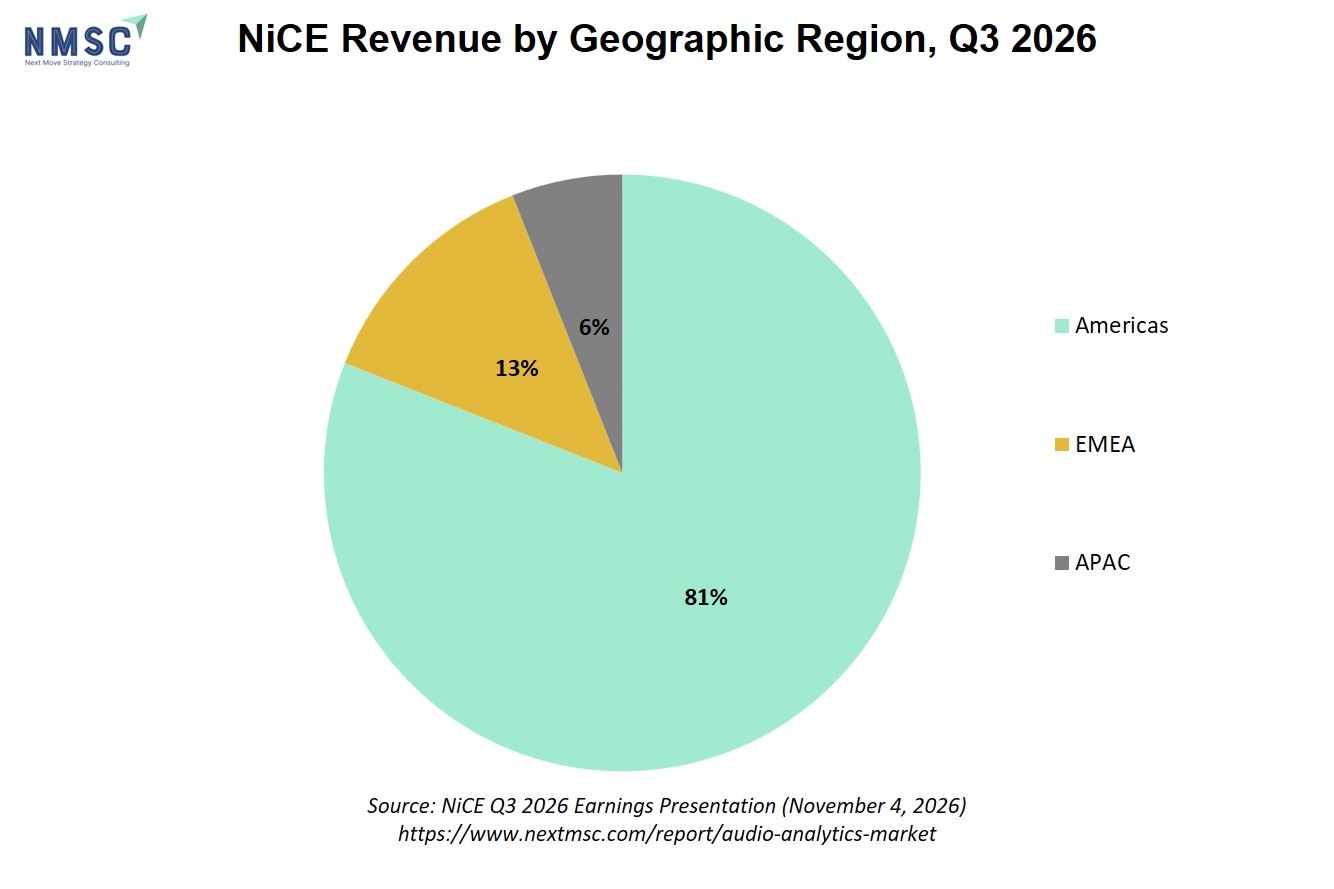
NiCE's Q3 2026 earnings presentation reports revenue by geographic region as follows: Americas 81% (USD 638 million, up 3% year over year), EMEA 13% (USD 108 million, up 45%) and APAC 6% (USD 45 million, up 12%). The three regions total 100% of the USD 791 million quarterly revenue.
Genesys reported on September 2, 2026 that Genesys Cloud annual recurring revenue reached nearly USD 2.9 billion in the second quarter of its fiscal year 2027, up more than 30% year over year, while Genesys Cloud AI ARR exceeded USD 400 million and grew more than twice as fast as total Genesys Cloud ARR. The platform processes more than 33 billion voice, digital and AI-driven conversations and over 6.5 billion sentiment events annually, according to Genesys, showing how much interaction data sits inside platform vendors.
CMSWire's October 29, 2026 review of vendor earnings found that, among CX vendors disclosing a comparable figure, AI accounts for roughly 12% to 15% of revenue depending on the measure. Five9, NiCE and RingCentral each reported an AI figure at about 15%, but each measures something different, and no vendor breaks out AI profit.
Wispr Flow, Deepgram and Modulate: Capital Reaches the Speech Layer
Venture capital is following the same logic. Reuters reported on August 17, 2026 that Wispr Flow, an AI dictation company, raised USD 280 million in a Series B round led by Menlo Ventures at a USD 2 billion valuation, up from USD 700 million nine months earlier, and reported use at more than 10,000 enterprises. On August 12, 2026, Deepgram announced in a company release that it had surpassed USD 100 million in ARR as it launched Flux TTS, a speech model for enterprise voice agents.
TechCrunch reported on September 28, 2026 that Modulate raised USD 25 million in a round led by Future Ventures, with Hyperplane and Lakestar participating. The Boston-based company runs more than 100 models, covering vocal emotion, tone, synthetic voice determination, intent, rule violations and scam attempts. Carter Huffman, Modulate's co-founder, told TechCrunch that callers are often polite even to AI agents yet very dissatisfied, so a neutral tone is not a reliable signal that a call succeeded.
NMSC Strategic Perspective: Why Ownership of the Conversation Layer Defines the Audio Analytics Market
NextMSC primary research and analysis reads the Salesforce–Cresta and Five9–Level AI agreements as evidence that the audio analytics market is shifting from a licensed-module model to a platform-embedded model. NextMSC segments the market into solutions and services, cloud and on-premises deployment, and applications that include customer experience management, call monitoring and summarization, agent performance monitoring, fraud detection and security, and sentiment analysis. Both deals favour the cloud segment and the call monitoring, summarization and agent performance applications, where a platform vendor can bundle analytics with routing and CRM data.
Regional evidence supports NextMSC's finding that North America dominates the market. NiCE drew 81% of its third quarter 2026 revenue from the Americas, and Salesforce and Five9 are both U.S. platform vendors. Growth, however, was faster elsewhere in NiCE's data: EMEA revenue rose 45% year over year and APAC revenue rose 12%, against 3% in the Americas. NextMSC primary research and analysis expects Asia-Pacific to show a steady rise as telecommunications and healthcare adoption widens, which makes delivery through platform partners the likely route into those regions.
NextMSC also identifies high implementation and maintenance cost as the market's main restraint. Embedding analytics in a platform contract moves that cost into an existing renewal, and NiCE's margin data shows the near-term price of the shift. The opportunity named in the report, emotion recognition, now collides with regulation.
Section Summary:
Four 2026 developments show analytics moving from a separate module to a platform-owned layer.
-
Salesforce (November 2, 2026) and Five9 (November 5, 2026) agreed to acquire Cresta and Level AI, bringing voice agents, quality management and conversation analytics under CRM and CCaaS platforms.
-
NiCE reported AI ARR of USD 392 million, 16% of cloud revenue, while non-GAAP operating margin fell to 27.0% from 31.5%.
-
Genesys Cloud AI ARR exceeded USD 400 million and grew more than twice as fast as Genesys Cloud ARR.
-
Wispr Flow's USD 280 million Series B and Modulate's USD 25 million round show capital reaching the speech and voice-security layers.
Industry Impact Analysis
The EU AI Act: Emotion Recognition and Synthetic Voice Now Carry Disclosure Duties
Article 50 of the EU AI Act, which sets transparency obligations for providers and deployers of certain AI systems, has applied since August 2, 2026. EY's analysis of Regulation (EU) 2026/1744, the Digital Omnibus on AI, adopted on July 8, 2026 and published in the Official Journal of the European Union on July 24, 2026, states that the Omnibus introduces no new transparency obligations and does not substantively alter the existing requirements. Those requirements include informing users when they interact with an AI system, labelling AI-generated or manipulated content and disclosing the use of emotion-recognition systems.
Two points matter to audio analytics vendors. A new Article 111(4) requires providers of systems placed on the market before August 2, 2026 to comply with the Article 50(2) machine-readable marking duty by December 2, 2026, according to EY. Separately, Article 5 of the AI Act prohibits emotion recognition in workplaces and educational institutions, so a call center that scores customer sentiment and one that scores the emotions of its own agents stand in different legal positions. NextMSC primary research and analysis expects vendors to configure and document those uses separately, which adds audit cost to the emotion recognition opportunity.
Voice Fraud: Deepfake Detection Becomes a Core Application
The FBI, in a warning reported by KPRC 2 Click2Houston on June 2, 2026, said criminals can build a realistic imitation of a family member's voice from a few seconds of audio taken from social media, and that Americans lost more than USD 893 million to AI-related scams the previous year. Fraud detection and security is one of NextMSC's application segments, and TechCrunch described Modulate as specialising in deepfake detection and in alerting call centers to possible scams. Because Modulate often sits beside the voice stack a company already uses, a fraud purchase need not replace the contact center platform.
Healthcare: Ambient Audio Spending Concentrates in Incumbent Hands
Healthcare Dive reported on November 16, 2026 on the 2026 State of AI in Healthcare report from Menlo Ventures, which polled more than 550 U.S. healthcare and life sciences executives and found health AI spending of USD 3.7 billion, more than double the prior year. Providers account for 77% of that spend. Microsoft's Dragon Copilot and Epic's Art took 68% of new ambient scribing dollars and now hold 46% of that segment, with AI startups losing 13% of market share, a consolidation that mirrors the contact center pattern.
Public Safety: Acoustic Gunshot Detection Faces Contract Scrutiny
On the acoustic side of audio analytics, the Denver Police Department said it will phase out ShotSpotter gunshot detection by the end of 2026, when a USD 4.7 million contract approved by the Denver City Council in 2021 expires in December, according to CBS News Colorado on August 21, 2026. From 2020 through June 2026, the department said, the program produced 25,217 alerts leading to 655 arrests and the recovery of 721 firearms, with officers locating shell casings associated with 6,672 alerts. Denver plans to launch a bidding process and gather community input.
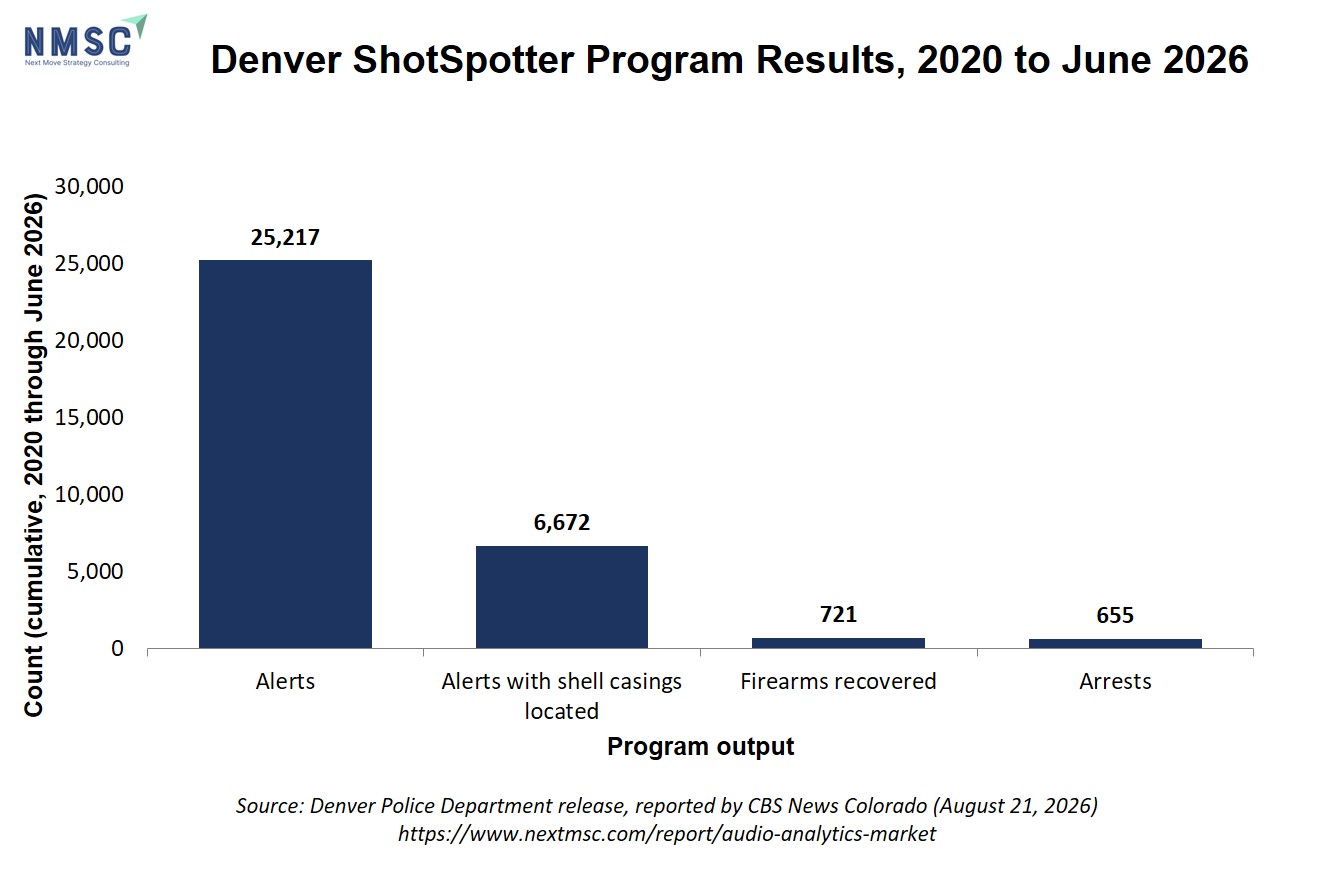
The Denver Police Department reported that, from 2020 through June 2026, its ShotSpotter program produced 25,217 alerts, with shell casings located in 6,672 alerts, 721 firearms recovered and 655 arrests. The figures are cumulative program totals reported in one release.
The scrutiny is not uniform. Fox News reported on June 30, 2026 that the Detroit City Council voted 5-4 to renew its SoundThinking ShotSpotter contract through March 2027. SoundThinking's second quarter 2026 results, released on August 13, 2026, showed revenue down 8% to USD 23.9 million from USD 25.9 million a year earlier, and a revised expectation for ARR entering 2027 of over USD 100.0 million, against a previous expectation of USD 110.0 million. The company also reported ShotSpotter win-backs in Erie, Pennsylvania and Cambridge, Massachusetts. NextMSC primary research and analysis concludes that acoustic contracts are becoming periodic, publicly debated decisions, raising the premium on measurable outputs like those Denver published.
Section Summary:
Regulation, fraud and procurement scrutiny now shape audio analytics purchasing as much as model accuracy does.
-
Article 50 of the EU AI Act has applied since August 2, 2026, and the Article 50(2) marking duty for existing systems falls due on December 2, 2026.
-
The FBI reported more than USD 893 million in AI-related scam losses, widening demand for deepfake detection.
-
Incumbent vendors took 68% of new ambient scribing dollars, according to the Menlo Ventures report summarized by Healthcare Dive.
-
Denver's phase-out and Detroit's 5-4 renewal show acoustic contracts being decided on published outcomes.
Pros and Cons of Recent Market Developments
|
Pros |
Cons |
|
Platform-embedded analytics removes an integration step, and Level AI's applications will also be offered standalone. |
NiCE's non-GAAP operating margin fell 450 basis points to 27.0% in the third quarter of 2026. |
|
AI ARR is now disclosed, with NiCE at USD 392 million and Genesys above USD 400 million, giving investors figures to track. |
Metrics are not comparable: Five9, NiCE and RingCentral each report an AI figure near 15% but measure different things, according to CMSWire. |
|
Deepfake and fraud detection opens security and risk teams as a new buyer group, supported by Modulate's USD 25 million round. |
Article 50 disclosure duties and the Article 5 workplace emotion-recognition prohibition raise compliance cost for vendors. |
|
Purpose-built models such as Level AI's Latitude are described by Five9 as cheaper and faster than frontier models. |
Public-sector contracts face scrutiny: Denver is phasing out ShotSpotter and SoundThinking cut its ARR expectation. |
Key Data & Statistics
Vendor AI Metrics Reported in 2026
|
Vendor |
Reporting Period (Date Reported) |
Reported AI Metric |
|
NiCE |
Q3 2026 (November 4, 2026) |
AI ARR USD 392M, up 46%, equal to 16% of cloud revenue |
|
Genesys |
Q2 fiscal 2027 (September 2, 2026) |
Genesys Cloud AI ARR above USD 400M, growing more than 2x as fast as Genesys Cloud ARR of nearly USD 2.9B |
|
Five9 |
Q2 2026 (August 6, 2026) |
AI revenue USD 39M, up 78%, equal to 15% of subscription revenue versus 9% a year earlier |
|
RingCentral |
Q3 2026 (October 22, 2026) |
Customers using at least one paid AI product account for about 15% of total ARR, above USD 400M |
Consolidation and Funding Events in Voice Analytics, 2026
|
Event |
Date |
Disclosed Value |
|
Salesforce agrees to acquire Cresta |
November 2, 2026 |
Terms not disclosed |
|
Five9 agrees to acquire Level AI |
November 5, 2026 |
USD 325M in cash; more than 1 billion customer interactions handled annually by Level AI |
|
Wispr Flow Series B |
August 17, 2026 |
USD 280M at a USD 2B valuation; more than 10,000 enterprises |
|
Modulate funding round |
September 28, 2026 |
USD 25M led by Future Ventures; more than 100 models |
|
Deepgram ARR milestone |
August 12, 2026 |
Above USD 100M in ARR |
Future Outlook & Forecast
The Road to USD 9.46 Billion: Three Forces Behind a 16.8% CAGR in the Audio Analytics Market
According to NextMSC primary research and analysis, the global audio analytics market is projected to reach USD 9.46 billion by 2030 from USD 3.18 billion in 2023, a CAGR of 16.8% from 2024 to 2030. Three forces underpin that trajectory.
-
Platform bundling: Level AI's applications will reach more than 4,000 Five9 customers, and more than 7,500 organizations use Genesys Cloud, according to company announcements. Each added customer on a platform that owns its analytics layer adds to call monitoring, summarization and agent performance demand in the cloud segment.
-
Growing training data and speech demand: NextMSC identifies increasing data sets for training AI and rising adoption of consumer electronics as market drivers. The 33 billion annual conversations on Genesys Cloud and the one billion interactions Level AI handles each year are the corpora on which analytics models improve, while Deepgram's USD 100 million ARR shows demand for the speech layer beneath them.
-
Compliance and security spending: The Article 50 duties that apply from August 2, 2026, the December 2, 2026 marking date for existing systems and the FBI's USD 893 million AI-scam loss figure all push enterprises to buy detection, disclosure and audit capability. High implementation and maintenance cost is the main restraint, so vendors that bundle deployment into a platform contract are better placed to convert that demand.
Asia-Pacific and Healthcare: Where Adoption Widens Next
NextMSC regional analysis finds that North America dominates and is expected to remain dominant through the forecast period, while Asia-Pacific is expected to show a steady rise driven by telecommunications and healthcare adoption. NextMSC's end-user view spans IT and telecommunications, BFSI, retail, healthcare and government. Healthcare Dive's report on provider spending, at 77% of health AI spend, shows healthcare buyers already purchasing at scale.
Section Summary:
NextMSC projects the market to reach USD 9.46 billion by 2030 at a 16.8% CAGR.
-
Platform bundling by Salesforce, Five9, NiCE and Genesys puts analytics inside existing renewals.
-
Growing conversation data and speech-layer funding improve the models that analytics depends on.
-
EU AI Act duties and voice-fraud losses make detection and disclosure a budgeted line item.
-
North America leads, with Asia-Pacific expected to rise steadily on telecommunications and healthcare demand.
Next Steps for Stakeholders
For C-Level Executives and Technology Leaders
Map every emotion-scoring use against Article 5 and Article 50 before the next renewal. Separate customer-sentiment scoring from any scoring of your own employees, document the disclosure given to callers, and confirm by December 2, 2026 that vendors meet the Article 50(2) marking duty.
Ask platform vendors for AI metrics on a common basis. CMSWire's October 29, 2026 review shows that Five9, NiCE and RingCentral each report a figure near 15% on a different measure. Request usage and cost data for your own contracts.
For Institutional Investors
Use the Level AI price as a reference point and track integration. Five9 values Level AI at approximately USD 325 million in cash and expects to close in 2026. Watch whether NiCE's non-GAAP operating margin, 27.0% in the third quarter of 2026, stabilises after the planned workforce reduction.
Separate disclosed ARR from growth narrative. Wispr Flow's USD 2 billion valuation shows capital availability, while SoundThinking's lowered ARR expectation shows the cost of disappointing renewals. Favour vendors that report AI revenue on a defined basis.
Conclusion
The audio analytics market is being reorganised around ownership of the conversation layer. Salesforce's agreement to acquire Cresta, Five9's USD 325 million agreement for Level AI and AI ARR of USD 392 million at NiCE show platform vendors absorbing analytics, while the EU AI Act, voice-cloning fraud and scrutiny of acoustic contracts reshape what buyers demand.
According to NextMSC primary research and analysis, the market is projected to reach USD 9.46 billion by 2030 at a 16.8% CAGR. Stakeholders that align deployment, compliance and capital allocation with these forces now will be best placed as demand scales toward 2030.
About the Author
 Priyanshu Das
— Priyanshu Das is SEO Executive at Next Move Strategy Consulting, where he has led on-page and off-page SEO, keyword research, and SEO audits for the firm's B2B market research publications for 2 years. His audit process combines technical crawl analysis, backlink profile review, and competitor keyword gap mapping — using tools including Screaming Frog and Google Search Console — to prioritize fixes by organic search-visibility impact, informed by his own prior in-house and agency SEO experience.
About the Reviewer
 Sanyukta Deb
— Sanyukta Deb is Digital Marketing Team Lead at Next Move Strategy Consulting, where she has led content strategy and technical SEO for the firm's B2B market research publications for over 2 years. Her editorial process translates NextMSC's primary and secondary research — spanning technology, industrial, and consumer sectors — into commercial narratives, backed by search-intent, keyword, and competitive analysis. She brings 5 years of overall experience in digital marketing and content strategy.

















Add Comment