Augmented Analytics Market: How Semantic Layers Are Rewiring BI | NextMSC

Introduction
Between October 27 and November 11, 2026, two of the largest enterprise data vendors redefined what an analytics product is expected to do. At Oracle AI World, Oracle announced Fusion Data Intelligence Data Agents and Deep Insight Agents, which let business users question governed enterprise data in plain language and pursue open-ended problems through conversationon October 27, 2026. On November 11, 2026, Databricks launched the second generation of Genie, an always-on agent grounded in what the company calls Genie Ontology. Neither announcement competes on chart quality or query speed. Both compete on whether an AI system understands what a company means by revenue, margin and customer.
According to Next Move Strategy Consulting's Augmented Analytics Market report, the global augmented analytics market was valued at USD 9.69 billion in 2024 and is projected to reach USD 35.72 billion by 2030, growing at a CAGR of 24.4% from 2025 to 2030. NextMSC primary research and analysis identifies North America as the leading region through the forecast period, and names cloud adoption, analytics demand from banking, financial services and insurance, and wider use of artificial intelligence and machine learning as the growth factors behind the forecast.
For More Information: Download FREE Sample on Augmented Analytics Market Report
This article examines why the November launches matter more than a product refresh. It traces the shift from dashboard-centric business intelligence toward governed context layers, reads what U.S. Census Bureau survey data show about AI use in business functions, and sets out what executives and investors should verify before committing capital to the augmented analytics market.
From Dashboards to Context: What the November 2026 Launches Mean for Augmented Analytics
Oracle Puts Deep Insight Agents on Top of Governed Fusion Data
Oracle used its Oracle AI World conference in November 2026 to expand Oracle Fusion Data Intelligence, the analytics layer prebuilt for Oracle Fusion Cloud Applications. According to Oracle's announcement, Data Agents let business users question the Fusion Data Intelligence datastore in plain language through a conversational companion embedded in the dashboard they are viewing. Deep Insight Agents go further. They combine semantic reasoning, business definitions and relationships, enterprise context and approved analytical methods to investigate performance drivers, assess wider business impact and compare potential responses. Oracle states that Data Agents are available now and that Deep Insight Agents are planned for general availability within the next 12 months.
Srikant Gokulnatha, Senior Vice President at Oracle, said in the same November 2026 announcement: “AI is only as useful as its understanding of your business.” The statement is a design requirement, not a slogan. An agent that cannot tell a booked order from a recognised sale will answer a revenue question fluently and incorrectly, and the cost of that error rises with every workflow the agent is permitted to touch.
Oracle's filings show why the vendor invests in this layer. In the Oracle Corporation Form 10-K for the fiscal year ended May 31, 2026, Oracle reported that cloud revenues represented 51% of total revenues, up from 43% in fiscal 2025 and 37% in fiscal 2024. Cloud applications, which supply the transactional data that Fusion Data Intelligence packages, accounted for 47% of cloud revenues in fiscal 2026, although that share has fallen from 65% in fiscal 2024 as cloud infrastructure grew to 53%. The same filing reports USD 10.3 billion of research and development spending in fiscal 2026.
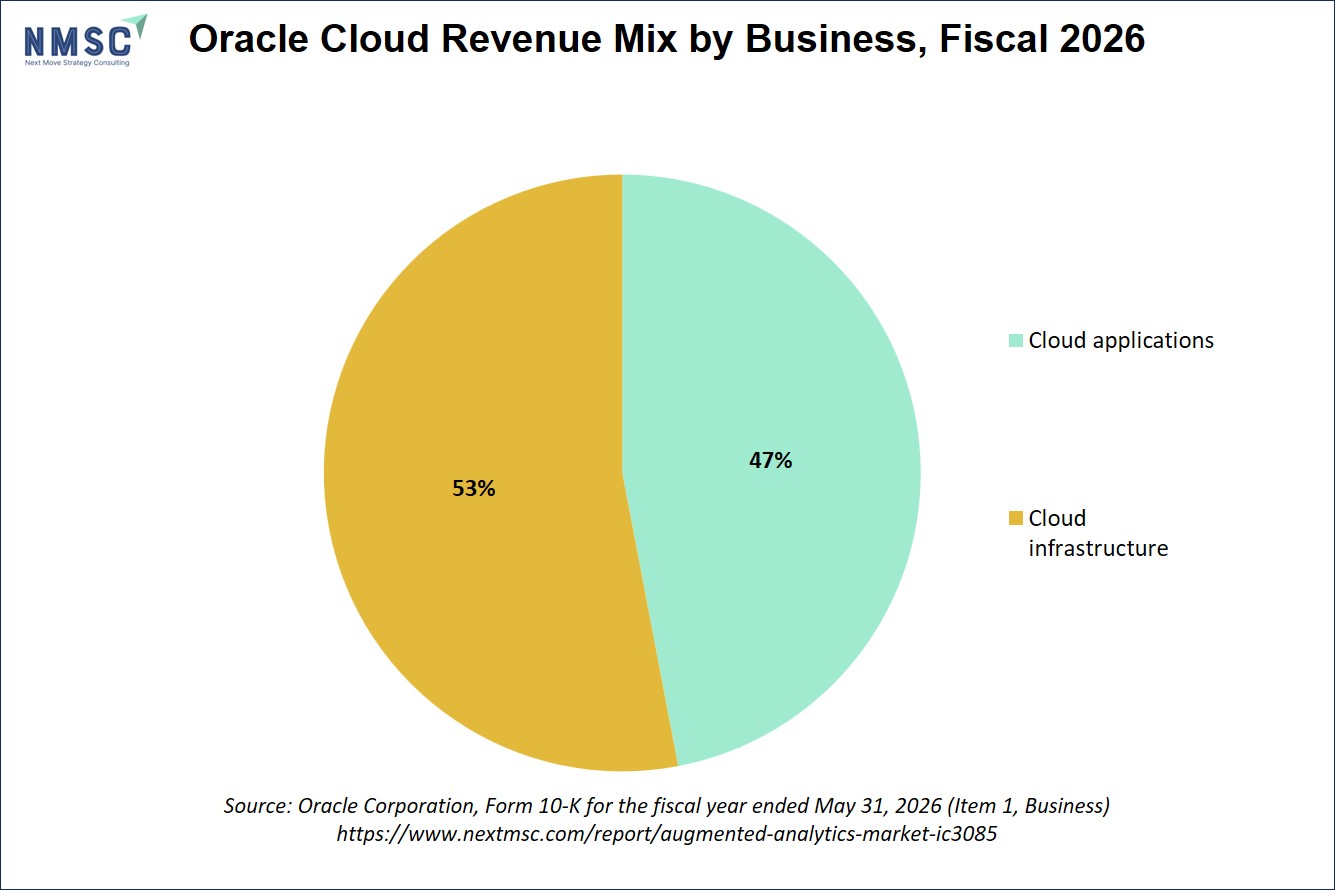
Oracle Corporation's Form 10-K for the fiscal year ended May 31, 2026 reports that cloud applications represented 47% of total cloud revenues and cloud infrastructure represented 53%. In fiscal 2025 the split was 58% and 42%, and in fiscal 2024 it was 65% and 35%.
Databricks, Zoho and Microsoft Build the Same Architecture
On November 11, 2026, Databricks announced the second generation of Genie, which it describes as an always-on, autonomous agent for enterprise work. Users give Genie a goal and boundaries. The agent delegates to sub-agents, tracks progress and raises decisions with the person through a priority inbox and email. Every action is grounded in Genie Ontology, which Databricks says captures definitions, metrics, people and processes and keeps them current as the business changes. All actions run under Unity Catalog permissions and Unity Gateway approval rules and budgets. Genie and Genie Ontology are generally available, while the always-on agent, Genie Search and Ontology Manager are coming to preview and beta programmes without published dates.
Ali Ghodsi, Co-founder and Chief Executive Officer of Databricks, said in the company's November 11, 2026 press release that Genie works because it knows “what we mean by revenue, which numbers are official, and who can see what.” Databricks charges for use instead of per seat. That moves cost risk from licence count to agent activity and makes spending limits a commercial feature.
Zoho followed on October 29, 2026, when IT Brief New Zealand reported that Zoho had converted Zoho Analytics into an agentic analytics platform. The update adds native semantic and ontology layers and rebuilds the Ask Zia assistant as a multi-agent system with six pre-built sub-agents for data analysis, visualisation, data preparation, modelling, coding and SQL generation. It supports the Model Context Protocol so agents can reach external systems, and gives administrators records of which agents ran, who used them and what data they accessed. Tony Thomas, Chief Executive Officer of Zoho USA, said that agents “cannot function only with data, but require a robust intelligence layer.” Zoho states that pricing is unchanged and that Zoho LLM credits are included in each plan.
Microsoft reached the same architecture from the Power BI side. In a company blog post published on September 28, 2026, Microsoft announced that Fabric IQ in Microsoft Copilot Chat and Cowork is generally available, grounding Copilot answers in the governed Power BI semantic models, metrics and business definitions that organisations already maintain. Microsoft states that the capability is on by default for Fabric and Power BI customers and preserves existing access controls and governance.
Google and Databox Move the Agent Into the Default Screen
Google placed the agent in the screen analysts open first. On August 10, 2026, Google announced new AI and agentic experiences across Google Ads and Google Analytics, extending Ask Advisor, the in-product AI agent it introduced for its marketing platforms earlier in 2026. Databox, which says more than 20,000 teams use its platform, announced on September 11, 2026 that it was repositioning the whole product around agentic analytics. The pattern is consistent. Conversational access is becoming the default entry point, and the buyer's question shifts from whether an assistant exists to what it is allowed to know.
NMSC Strategic Perspective: Context Ownership Decides the Augmented Analytics Market
NextMSC primary research and analysis reads the launches by Oracle, Databricks, Zoho and Microsoft as one architectural event. Oracle's Deep Insight Agents, Databricks' Genie Ontology, Zoho's semantic and ontology layers and Microsoft's Fabric IQ each place a governed definition layer between enterprise data and the language model. In each design, the vendor that owns the definitions owns the answer, and the agent is the interface to it. This differs from the earlier model of augmented analytics, in which machine learning automated data preparation, insight discovery and natural-language query inside a dashboard product.
Three consequences follow for the augmented analytics market. First, the software component should capture a larger share of spend than services where vendors ship prebuilt semantics, as Oracle does for Fusion applications, because implementation effort moves from consultants to packaged definitions. Second, cloud deployment becomes a prerequisite instead of a preference, since always-on agents run on vendor-managed compute with their own governance plane, as Databricks and Zoho describe. Third, the buying centre widens from the business intelligence team to finance, operations and security leaders, who must approve what an agent may read and do. These shifts align with the three growth factors recorded in NextMSC's report: cloud adoption, analytics demand in banking, financial services and insurance, and wider use of artificial intelligence and machine learning.
NextMSC also records privacy and security risk as the principal restraint in its report. The launches answer it with governance tooling, but delivery lags. Oracle's Deep Insight Agents carry a 12-month general availability horizon, and Databricks' always-on agent has no published preview date. Buyers are therefore evaluating roadmaps as much as products.
Section Summary:
Between September and November 2026, Oracle, Databricks, Zoho and Microsoft each placed a governed semantic or ontology layer beneath AI agents, while Google moved its agent onto the default analytics screen.
-
Oracle's Data Agents are available now, but its Deep Insight Agents are planned for general availability within 12 months.
-
Databricks' Genie and Genie Ontology are generally available, while the always-on agent is entering preview and beta programmes.
-
NextMSC projects the augmented analytics market to reach USD 35.72 billion by 2030 at a 24.4% CAGR.
Industry Impact Analysis
Adoption Is Concentrated Where Analytics Budgets Already Sit
The U.S. Census Bureau's Business Trends and Outlook Survey, summarised in the Bureau's May 26, 2026 America Counts story, offers the clearest public measure of which businesses use AI in their business functions. Overall use stayed between 17% and 20% from December 2025 to May 2026, and the rate for the period ending May 3, 2026 was 19.8%. Use reached 39.7% in the Information sector and 33.9% in Finance and Insurance. The Census Bureau revised the question in November 2025 to ask about use in any business function, so earlier readings are not comparable.
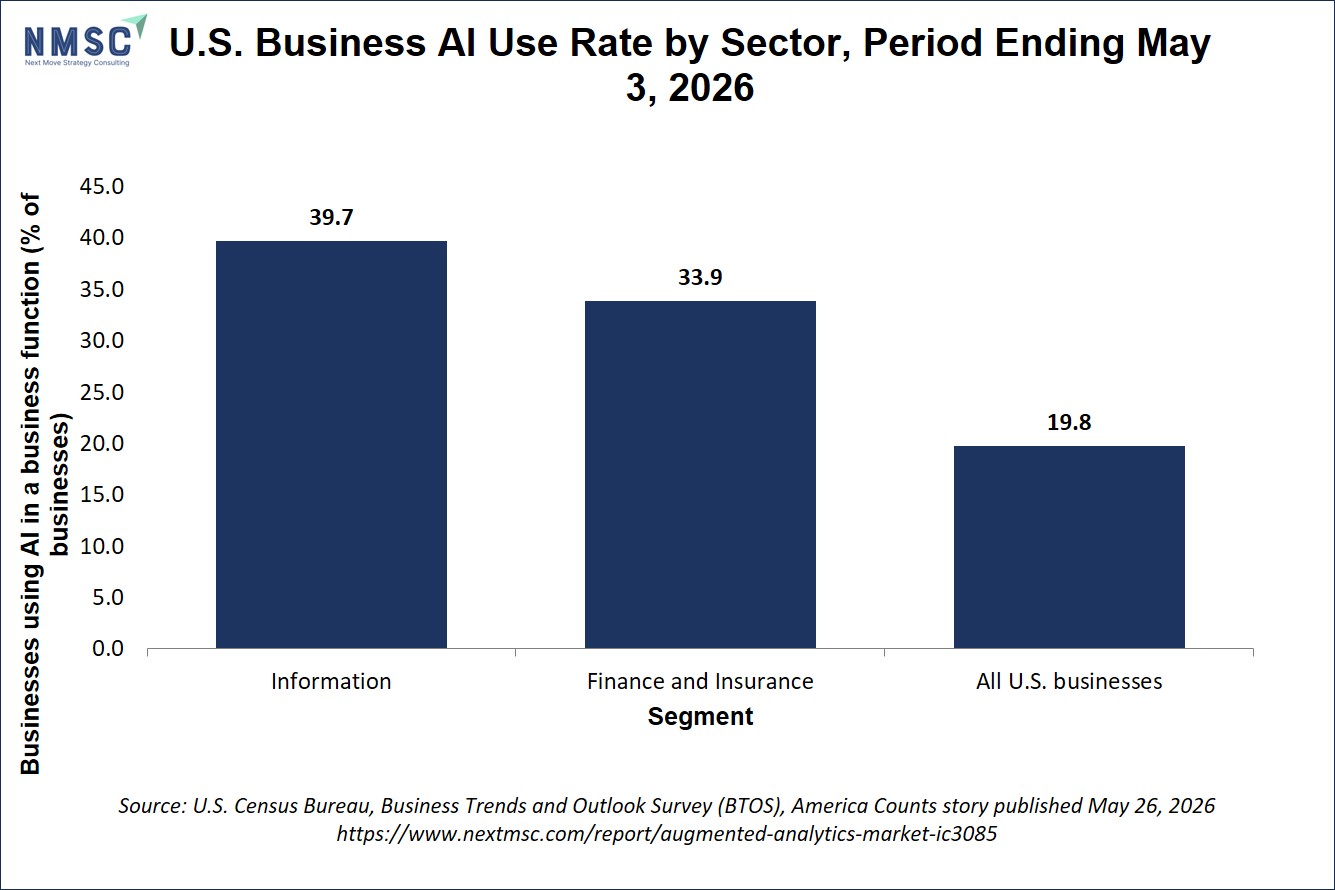
The U.S. Census Bureau's Business Trends and Outlook Survey recorded AI use in a business function at 39.7% of Information sector businesses, 33.9% of Finance and Insurance businesses and 19.8% of all U.S. businesses in the period ending May 3, 2026. Both sectors sit above the national rate. The data cover U.S. employer businesses only.
For vendors, the distribution matters more than the headline rate. Finance and Insurance, the banking, financial services and insurance vertical that NextMSC identifies as a growth factor, sits 14.1 percentage points above the national rate, and the Information sector sits 19.9 percentage points above it. The sectors that already run the largest analytics estates are the first to deploy agents, which concentrates near-term demand among buyers with strict audit requirements. The Census Bureau also reported no significant change in AI use among firms with fewer than 20 employees between December 2025 and May 2026, which limits near-term pull from small-business tiers.
Governance and Regulation Are Now Product Features
Governance is moving from compliance overhead to a purchasing criterion. Databricks states that every Genie action is auditable and bounded by approval rules and budgets, and Zoho's administrators can review which agents ran and what data they accessed. The Oracle Corporation Form 10-K for the fiscal year ended May 31, 2026 explains the pressure behind these features. The filing states that obligations under the EU AI Act continue to be implemented in phases through 2030 and that regulatory uncertainty may require Oracle to adjust or limit AI offerings in certain jurisdictions. Vendors that can show lineage, access policy and agent-level audit trails shorten security reviews, while those that cannot may find agent features restricted in regulated deployments.
Pricing Shifts From Seats to Consumption
Consumption pricing changes vendor economics. Databricks charges for use instead of per seat, Zoho keeps pricing unchanged with LLM credits included, and Microsoft switches Fabric-grounded answers on by default in Copilot Chat and Cowork. Where agents run continuously, compute cost scales with goals assigned, not users, so finance teams must treat agent budgets as they treat cloud budgets.
Section Summary:
Census Bureau data show AI use concentrated in the Information and Finance and Insurance sectors, and the November launches add governance and consumption controls aimed at those buyers.
-
Information (39.7%) and Finance and Insurance (33.9%) exceeded the 19.8% national AI use rate in the period ending May 3, 2026.
-
Audit trails and approval rules are becoming purchase criteria, as the Oracle Corporation Form 10-K discussion of EU AI Act phasing indicates.
-
Consumption pricing turns agent budgets into a finance-team control.
Pros and Cons of Recent Market Developments
|
Pros |
Cons |
|
Semantic and ontology layers, as in Oracle's Deep Insight Agents and Zoho Analytics, give AI answers consistent business definitions. |
Definition work shifts to customers. Someone must own and maintain the governed metrics, and weak definitions produce confident wrong answers. |
|
Embedded agents inside existing products, such as Fabric IQ in Microsoft Copilot Chat and Cowork, reach users without a new tool rollout. |
Embedding deepens dependence on one vendor's semantic layer and raises switching costs. |
|
Governance tooling such as lineage, access policy and agent audit records from Databricks and Zoho supports regulated adoption. |
Governance features lengthen implementation and do not remove the regulatory uncertainty described in the Oracle Corporation Form 10-K. |
|
Consumption pricing from Databricks aligns cost with work performed. |
Always-on agents make monthly spend harder to forecast without spending limits. |
|
Open protocols such as the Model Context Protocol, supported by Zoho and Databricks, let third-party assistants reach governed data. |
Several flagship capabilities are unreleased: Oracle's Deep Insight Agents are planned within 12 months, and Databricks' always-on Genie has no preview date. |
Key Data & Statistics
Selected Augmented Analytics Launches, August to November 2026
|
Vendor |
Date |
Capability |
|
Oracle |
October 27, 2026 |
Fusion Data Intelligence Data Agents and Deep Insight Agents |
|
Databricks |
November 11, 2026 |
Second-generation Genie, Genie Ontology and Genie Search |
|
Zoho |
October 29, 2026 |
Zoho Analytics semantic and ontology layers; Ask Zia with six sub-agents |
|
Microsoft |
September 28, 2026 |
Fabric IQ in Microsoft Copilot Chat and Cowork |
|
|
August 10, 2026 |
AI and agentic experiences in Google Ads and Google Analytics through Ask Advisor |
U.S. Business AI Use Rates, Period Ending May 3, 2026
|
Segment |
AI use rate |
|
All U.S. businesses |
19.8% |
|
Information sector |
39.7% |
|
Finance and Insurance sector |
33.9% |
|
Firms with 250 or more employees |
37% |
|
Firms with 100 to 249 employees |
32% |
Future Outlook & Forecast
NMSC's Forecast for the Augmented Analytics Market: USD 35.72 Billion by 2030
According to NextMSC primary research and analysis, the global augmented analytics market is projected to reach USD 35.72 billion by 2030, growing at a CAGR of 24.4% from 2025 to 2030, from USD 9.69 billion in 2024. The forecast implies a market 3.69 times its 2024 value by 2030, an increase of USD 26.03 billion. Three structural forces sustain it.
1. Context layers become standard equipment. Between September 28 and November 11, 2026, Oracle, Databricks, Zoho and Microsoft each shipped or extended a governed semantic or ontology layer under their agents. When four vendors with different installed bases converge on one design, buyers begin to treat the layer as a baseline requirement and compare vendors on how well definitions are maintained.
2. Cloud and consumption deployment. Cloud revenues reached 51% of Oracle's total revenues in fiscal 2026, and Databricks and Zoho run their agents inside vendor-managed environments with usage-based controls. NextMSC's report names cloud adoption as a primary growth factor, and always-on agents make it a technical precondition as well.
3. Demand from regulated sectors. Finance and Insurance reported a 33.9% AI use rate in the period ending May 3, 2026, 14.1 percentage points above the national rate. NextMSC's report identifies analytics use by banking, financial services and insurance institutions for risk management, fraud detection and operational efficiency as a growth factor, and governance tooling lowers the barrier for those buyers.
North America Leads While Asia-Pacific Builds Scale in the Augmented Analytics Market
NextMSC regional analysis identifies North America as the leading region, a position tied to the size of its telecom and IT sector, and Asia-Pacific as a region with consistent growth, supported by government adoption of data tools in India, China and Japan. The Census Bureau sector data in this article describe the United States only, and NextMSC does not extrapolate them to other regions. NextMSC's report records privacy and security risk as the main restraint and identifies blockchain integration for data integrity as a future opportunity.
Section Summary:
NextMSC projects the augmented analytics market to grow from USD 9.69 billion in 2024 to USD 35.72 billion in 2030, with context layers, cloud deployment and regulated-sector demand as the structural drivers.
-
Governed context layers are moving from differentiator to baseline requirement.
-
Usage-based, cloud-run agents make deployment model and cost control part of the product decision.
-
North America leads, and Asia-Pacific shows consistent growth through the forecast period.
Next Steps for Stakeholders
For C-Level Executives and Technology Leaders
-
Assign ownership of metric definitions before buying agents. Oracle, Databricks and Microsoft each ground agents in governed definitions, so the quality of your own revenue, margin and customer definitions sets the ceiling on answer quality. Name an accountable owner for every board-level metric.
-
Write agent permissions and budgets into procurement terms. Databricks exposes approval rules and spending limits through Unity Gateway, and Zoho exposes agent usage and cost tracking. Require equivalent audit trails and cost controls from any vendor.
-
Test roadmap claims against availability. Pilot what is generally available now, namely Oracle Data Agents, Databricks Genie and Genie Ontology, and Microsoft Fabric IQ in Copilot Chat and Cowork, and treat Oracle's Deep Insight Agents and Databricks' always-on Genie as options until preview or general availability dates are published.
For Institutional Investors
-
Track ownership of the context layer as a moat indicator. The vendor that maintains customer definitions controls the answer an agent gives, which should show up in renewal rates and expansion into adjacent workflows.
-
Use the Census Bureau series as a demand gauge. The Business Trends and Outlook Survey provides a biweekly view of AI use. Watch whether the Information and Finance and Insurance rates move above the 39.7% and 33.9% recorded for the period ending May 3, 2026.
-
Separate agent revenue from infrastructure revenue in filings. Oracle's cloud mix moved from 65% applications in fiscal 2024 to 47% in fiscal 2026. Check how each vendor discloses analytics and agent revenue before applying a growth multiple.
Conclusion
The augmented analytics market is no longer defined by who draws the best chart or answers the fastest query. In the weeks from September to November 2026, Oracle, Databricks, Zoho and Microsoft each moved the contest to a governed layer of business definitions, and Google and Databox moved agents onto the screens analysts open first. The vendors that own and maintain that layer will shape the answers their customers receive.
According to NextMSC primary research and analysis, the augmented analytics market is projected to reach USD 35.72 billion by 2030 at a CAGR of 24.4%. Census Bureau data show that adoption is concentrated in the Information and Finance and Insurance sectors, and vendor roadmaps show that several flagship capabilities remain unreleased. Executives and investors should therefore verify definitions, permissions, budgets and release dates before they commit.
About the Author
 Priyanshu Das
— Priyanshu Das is SEO Executive at Next Move Strategy Consulting, where he has led on-page and off-page SEO, keyword research, and SEO audits for the firm's B2B market research publications for 2 years. His audit process combines technical crawl analysis, backlink profile review, and competitor keyword gap mapping — using tools including Screaming Frog and Google Search Console — to prioritize fixes by organic search-visibility impact, informed by his own prior in-house and agency SEO experience.
About the Reviewer
 Sanyukta Deb
— Sanyukta Deb is Digital Marketing Team Lead at Next Move Strategy Consulting, where she has led content strategy and technical SEO for the firm's B2B market research publications for over 2 years. Her editorial process translates NextMSC's primary and secondary research — spanning technology, industrial, and consumer sectors — into commercial narratives, backed by search-intent, keyword, and competitive analysis. She brings 5 years of overall experience in digital marketing and content strategy.














Add Comment