Autonomous Commercial Vehicle Market Trends & Forecasts 2026
Introduction
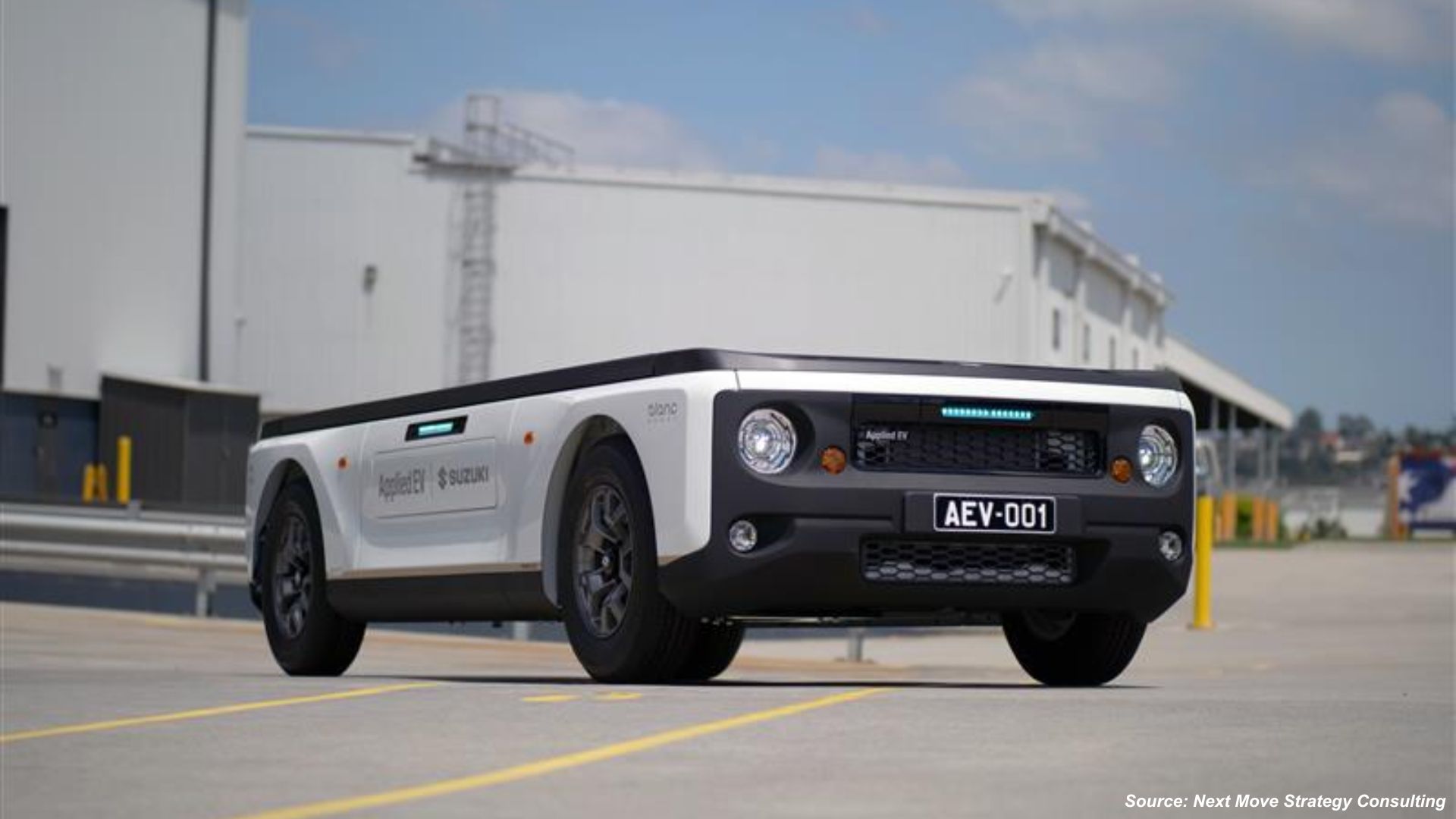
The global freight industry is at a pivotal crossroads. As e-commerce volumes surge, supply chains grow increasingly complex, and a structural truck driver shortage deepens across major economies, the Autonomous Commercial Vehicle Market has emerged as one of the most consequential technological frontiers in modern transportation. From driverless Class 8 trucks navigating U.S. interstate corridors to AI-enabled urban delivery vans optimizing last-mile logistics, self-driving commercial vehicles are no longer a distant prospect — they are an operational reality reshaping how goods move across the world.
In 2026, a convergence of landmark regulatory actions, commercial-scale deployments, and accelerating investment activity has elevated the autonomous commercial vehicle market from a technology demonstration phase to a genuine commercial enterprise. For C-level executives, institutional investors, and logistics operators, understanding the forces driving this transformation is no longer optional — it is a strategic imperative.
For More Information: Download FREE Sample on Autonomous Commercial Vehicle Market Report
From Pilot Programs to Commercial Scale: The Defining Shifts of 2026
Aurora Innovation's Second-Generation Driverless Trucks Signal a New Commercial Era
On July 22, 2026, Aurora Innovation (NASDAQ: AUR) announced the launch of its second-generation driverless trucks across its commercial network in the United States — a development that marks a defining inflection point for the autonomous commercial vehicle industry. Operating across 10 driverless routes throughout the U.S. Sun Belt, Aurora's fleet has now completed nearly 440,000 driverless miles on public roads.
The new fleet, built on the International® LT® Series vehicle platform and powered by Aurora's next-generation hardware — engineered to last one million miles — represents a fundamental shift from proof-of-concept to scalable commercial deployment. Manufacturing partner Roush is targeting an annual production run-rate of 1,000 Aurora trucks by the end of 2026, while a leading carrier has already committed to purchasing 500 Aurora Driver-powered trucks.
"Last year's driverless launch proved our technology could operate safely on public roads — our new platform now provides the foundation to deliver at scale," said Chris Urmson, CEO and co-founder of Aurora.
This commercial momentum is not isolated. In October 2025, Hyundai Motor, in collaboration with PlusAI, was recognized in TIME's 'Best Inventions 2025' for their autonomous hydrogen fuel cell truck — an innovation that integrates autonomous technology with sustainable hydrogen propulsion, signaling the industry's dual commitment to automation and decarbonization. Meanwhile, Daimler Truck's partnership with Torc Robotics to develop and deploy SAE Level 4 autonomous trucks in the U.S. market by 2027 further underscores the strategic alliances accelerating commercialization across the sector.
The Structural Driver Shortage: The Catalyst Accelerating Autonomous Adoption
Underlying the commercial urgency of autonomous trucking is a deepening, structural labor crisis in the global freight industry. According to the International Road Transport Union (IRU), 3.6 million truck driver positions remain unfilled across 36 countries representing 70% of global GDP — a figure that has remained persistently elevated despite easing transport demand in 2024.
The demographic outlook is particularly alarming. The share of truck drivers under 25 years of age fell by 5.8% from 2023 to 2024, while the share of drivers over 55 now stands at 31.6% — with the average global truck driver age reaching 44.5. The IRU projects that 3.4 million truck drivers will retire by 2029 across the countries studied.
In the United States specifically, the American Trucking Associations (ATA) projects a current shortfall of approximately 82,000 drivers in 2026, with the industry needing to recruit 1.1 million new drivers over the next decade to meet freight demand.
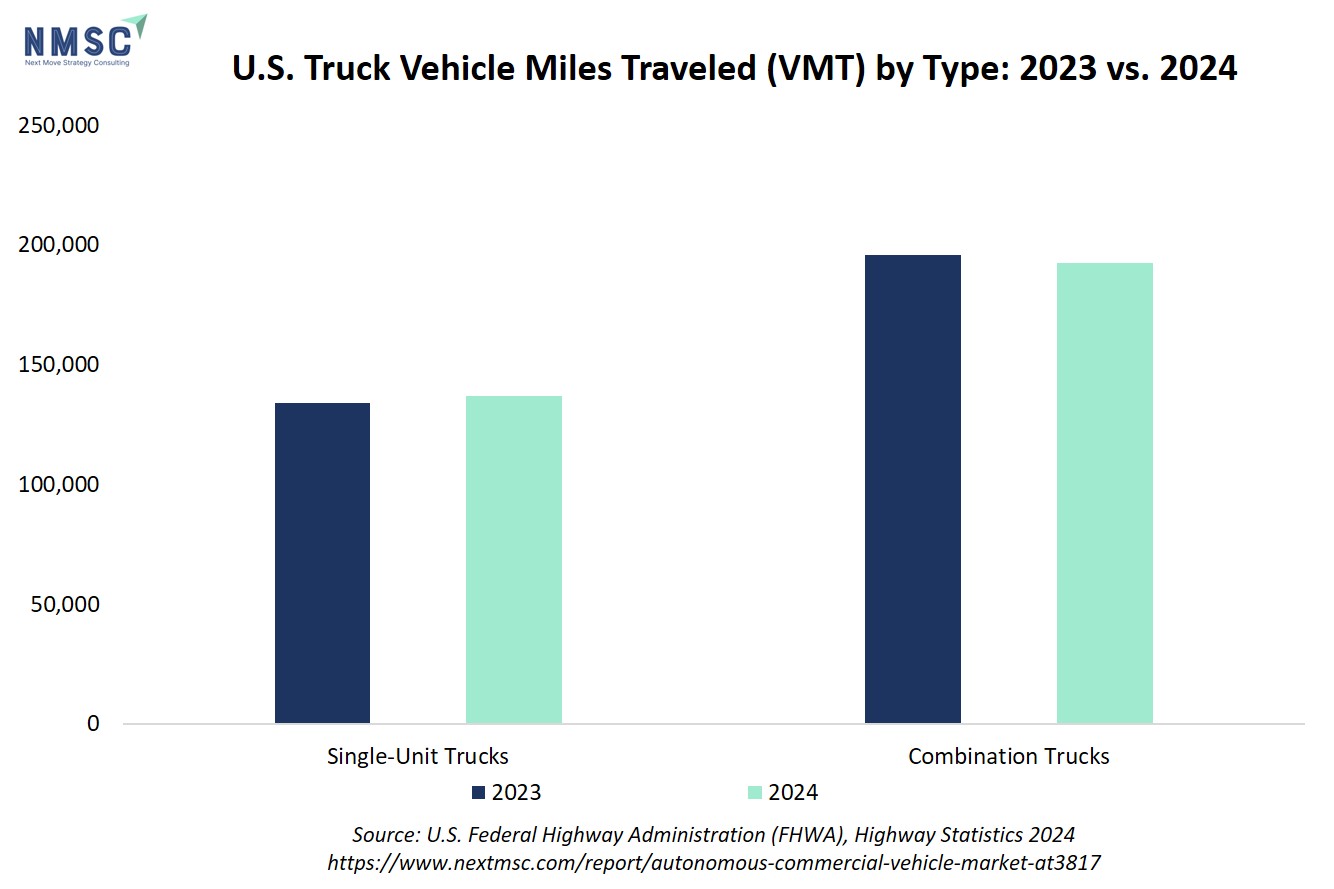
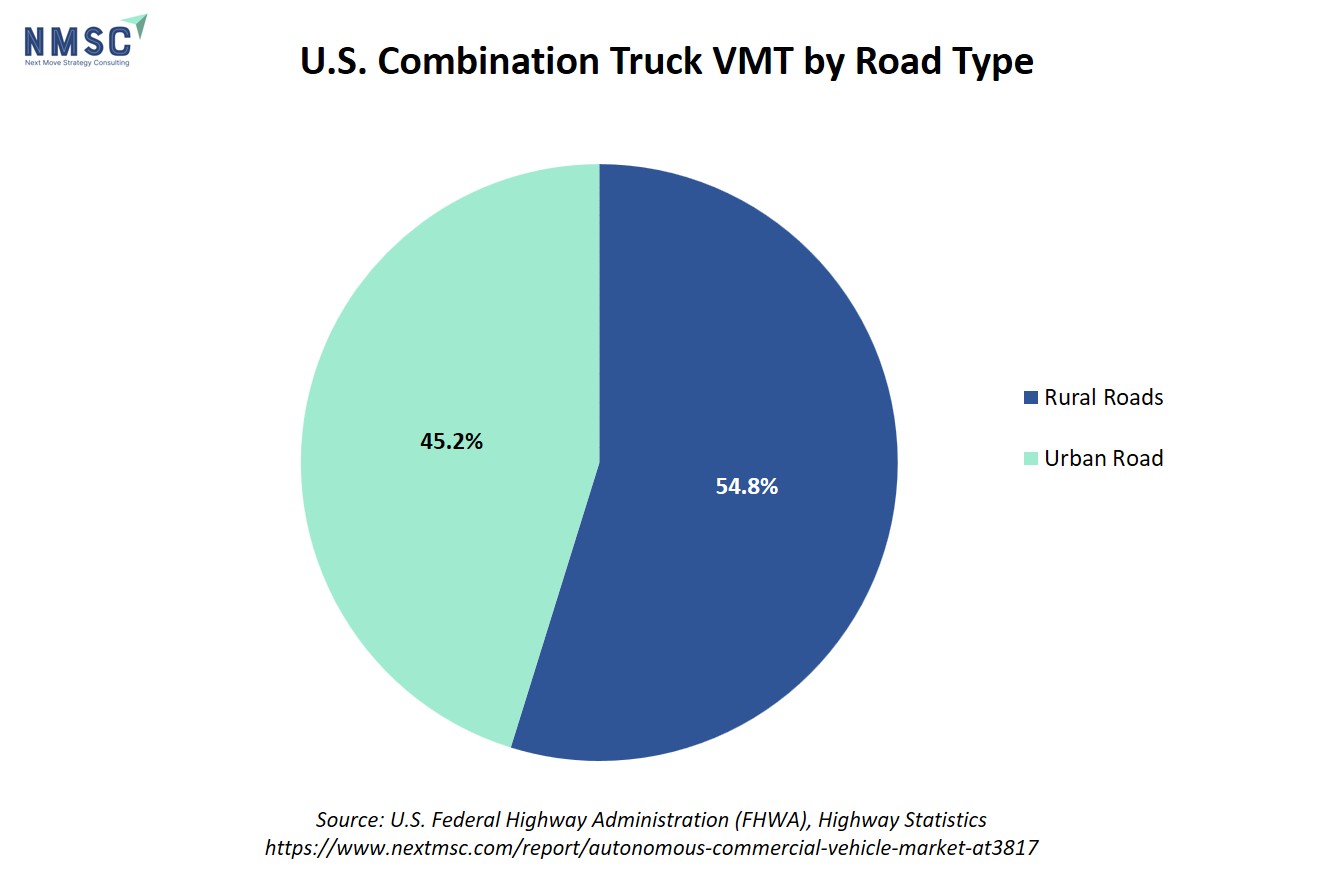
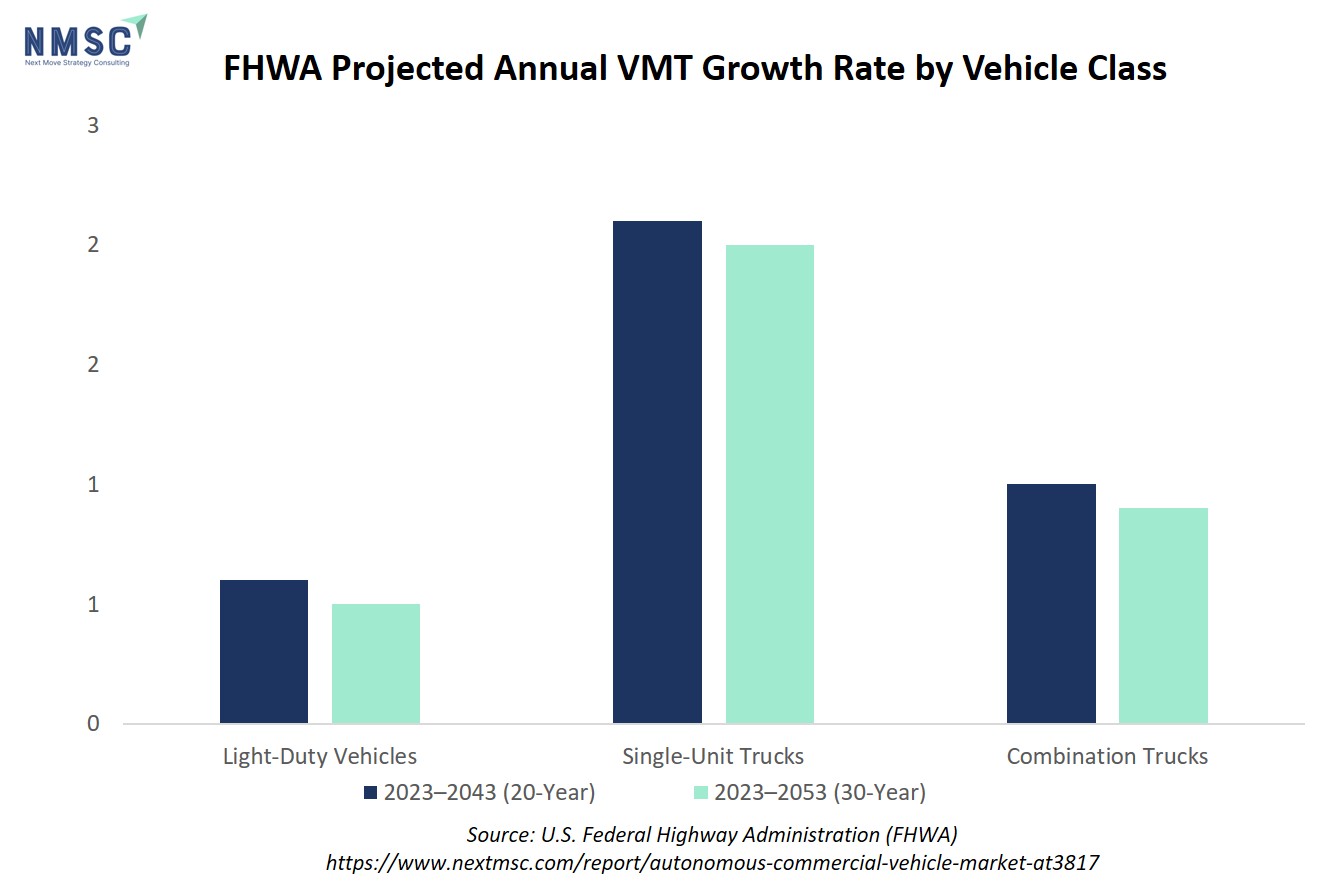
Compounding this labor challenge is rising freight demand. The Federal Highway Administration's 2025 forecast projects that single-unit truck vehicle miles traveled (VMT) will increase by 2.1% annually over the next 21 years, while combination truck VMT is expected to grow at an average annual rate of 1.3% over the same period. This trajectory creates an urgent structural case for autonomous commercial vehicles as a scalable, technology-enabled solution to the freight capacity gap.
NMSC Strategic Perspective: Converging Forces Define a Market at Inflection Point
From Next Move Strategy Consulting's analytical standpoint, the autonomous commercial vehicle market is experiencing a rare convergence of demand-side pressure and supply-side enablement that is compressing the typical technology adoption timeline. The structural driver shortage, rising freight VMT, and the maturation of AI-based navigation and vehicle-to-everything (V2X) connectivity are creating conditions where autonomous deployment is not merely advantageous — it is operationally necessary for logistics operators seeking to maintain service reliability and cost competitiveness.
NMSC's analysis further identifies that the logistics and supply chain segment — which accounts for 52.5% of the current market — will remain the primary growth engine through 2030, driven by the integration of autonomous trucks with warehouse management systems, real-time telematics, and route optimization platforms. The convergence of electrification and autonomy, exemplified by Hyundai's hydrogen fuel cell truck and Einride's fully electric autonomous platforms, is also creating new investment vectors that extend beyond traditional OEM boundaries.
Section Summary: The autonomous commercial vehicle market has transitioned from a testing-phase industry to a commercially active sector in 2026, driven by landmark deployments, a structural driver shortage crisis, and rising freight demand.
Key Takeaways:
-
Aurora Innovation launched second-generation driverless trucks in July 2026, with a manufacturing target of 1,000 trucks per year and nearly 440,000 driverless miles completed.
-
The IRU reports 3.6 million unfilled truck driver positions globally, with 3.4 million retirements projected by 2029.
-
The ATA projects an 82,000-driver shortfall in the U.S. in 2026, with 1.1 million new drivers needed over the next decade.
-
The Federal Highway Administration projects combination truck VMT to grow at 1.3% annually, reinforcing the structural case for autonomous freight solutions.
Industry Impact Analysis
Landmark Regulatory Actions Reshape the Competitive Landscape
The regulatory environment governing the autonomous commercial vehicle market has undergone its most consequential transformation to date in 2025 and 2026, with actions at both the federal and state levels fundamentally altering the deployment landscape.
California's Comprehensive AV Overhaul (April 2026)
On April 28, 2026, the California Department of Motor Vehicles (DMV) adopted the most comprehensive autonomous vehicle regulations in the United States. Critically, the new rules remove the longstanding prohibition on operating autonomous vehicles with a Gross Vehicle Weight Rating (GVWR) of 10,001 pounds or more — effectively opening California's market to AV freight operations for the first time.
The regulations also establish enhanced safety requirements, including mandatory 30-second response times for first responder calls, emergency geofencing directives, structured safety case requirements (500,000 miles of testing for heavy-duty vehicles), and expanded data reporting obligations covering system failures, vehicle immobilizations, and hard braking events.
"California continues to lead the nation in the development and adoption of AV technology, and these updated regulations further demonstrate the state's commitment to public safety," said DMV Director Steve Gordon.
Federal Framework: BUILD America 250 Act (June 2026)
At the federal level, the U.S. House of Representatives Committee on Transportation and Infrastructure advanced the BUILD America 250 Act (H.R. 8870) by a strong bipartisan vote in June 2026 — the first time a federal regulatory framework for autonomous commercial motor vehicles (CMV AVs) has been included in major transportation legislation.
Simultaneously, the SELF DRIVE Act of 2026 (H.R. 7390) was formally introduced in the 119th Congress, establishing a national framework for the testing, deployment, and research of autonomous vehicles — including provisions to update Federal Motor Vehicle Safety Standards for Level 4 and Level 5 Automated Driving Systems.
NHTSA's AV Framework and SMART Grants
In April 2025, the National Highway Traffic Safety Administration (NHTSA) announced its new Automated Vehicle (AV) Framework, centered on three principles: prioritizing safety, unleashing innovation, and enabling commercial deployment. As part of this framework, NHTSA streamlined crash reporting requirements and expanded the Automated Vehicles Exception Program (AVEP) to include domestically produced vehicles. The U.S. Department of Transportation also announced USD 54 million in SMART Grants in 2025, supporting 34 projects across 21 states focused on smart city technologies, including autonomous vehicle systems aimed at improving transportation efficiency, safety, and connectivity.
Labor and Workforce Implications
The advancement of autonomous commercial vehicles carries significant workforce implications that are generating bipartisan legislative attention. In 2025, Senator Josh Hawley (R-MO) raised concerns about labor displacement and drafted legislation requiring safety drivers in ADS vehicles, while Representative Ro Khanna (D-CA) called for regulations to protect commercial truck and long-haul drivers. These concerns reflect a genuine tension between the operational efficiency gains of autonomous trucking and the employment implications for millions of professional truck drivers globally. Industry stakeholders, policymakers, and labor organizations are increasingly engaged in shaping transition frameworks that address both technological adoption and workforce continuity.
Section Summary: The regulatory landscape for the autonomous commercial vehicle market has undergone transformative change in 2025–2026, with California's comprehensive AV overhaul, the first federal CMV AV framework, and NHTSA's innovation-enabling policies collectively creating a more favorable deployment environment — while labor displacement concerns add complexity to the policy landscape.
Key Takeaways:
-
California DMV's April 2026 regulations are the most comprehensive in the U.S., now permitting heavy-duty AV freight operations for the first time.
-
The BUILD America 250 Act (June 2026) marks the first federal regulatory framework specifically for autonomous commercial motor vehicles.
-
NHTSA's AV Framework and USD 54 million in SMART Grants are accelerating technology development and commercial deployment.
-
Labor displacement concerns are generating bipartisan legislative attention, creating a nuanced policy environment that industry stakeholders must actively navigate.
Key Regulatory and Commercial Milestones in the Autonomous Commercial Vehicle Market (2025–2026)
|
Date |
Event |
Significance |
Source |
|
April 2025 |
NHTSA announces new AV Framework |
Establishes principles of safety, innovation, and commercial deployment; streamlines crash reporting and expands AVEP |
NHTSA |
|
April 2025 |
IRU publishes 2024 Global Truck Driver Shortage Report |
3.6 million unfilled positions globally; 3.4 million retirements projected by 2029; average driver age 44.5 |
IRU |
|
October 2025 |
Hyundai Motor + PlusAI autonomous hydrogen truck recognized in TIME's Best Inventions 2025 |
Validates integration of autonomy and clean energy in commercial freight; supports hydrogen corridor development |
TIME / Hyundai Motor |
|
April 28, 2026 |
California DMV adopts comprehensive AV regulations |
First U.S. state to authorize heavy-duty AV freight operations; most comprehensive AV rules in the nation |
California DMV |
|
June 2026 |
U.S. House advances BUILD America 250 Act with CMV AV framework |
First federal regulatory framework for autonomous commercial motor vehicles, passed by strong bipartisan vote |
AV America / Holland & Knight |
|
July 22, 2026 |
Aurora Innovation launches second-generation driverless trucks |
Nearly 440,000 driverless miles completed; 1,000 trucks/year production target; 10 active U.S. Sun Belt routes |
Aurora Innovation |
Global Truck Driver Shortage — Key Statistics (2024–2029)
|
Metric |
Data Point |
Source |
|
Global unfilled truck driver positions (2024) |
3.6 million (across 36 countries, representing 70% of global GDP) |
IRU, April 2025 |
|
U.S. driver shortfall (2026) |
~82,000 drivers |
American Trucking Associations |
|
U.S. new drivers needed (next decade) |
1.1 million |
American Trucking Associations |
|
Projected global driver retirements by 2029 |
3.4 million |
IRU, April 2025 |
|
Share of drivers over 55 globally |
31.6% |
IRU, April 2025 |
|
Young drivers (under 25) as % of workforce |
6.5% (down 5.8% year-on-year) |
IRU, April 2025 |
|
Average global truck driver age |
44.5 years |
IRU, April 2025 |
|
Combination truck VMT growth (annual, U.S.) |
1.3% per year (projected through 2053) |
Federal Highway Administration, 2025 |
|
Single-unit truck VMT growth (annual, U.S.) |
2.1% per year (projected over next 21 years) |
Federal Highway Administration, 2025 |
Future Outlook & Forecast
The Autonomous Commercial Vehicle Market on a Sustained Growth Trajectory
According to Next Move Strategy Consulting (NMSC), the global autonomous commercial vehicle market was valued at USD 8.50 billion in 2024 and is expected to reach USD 9.89 billion by the end of 2025. The market is projected to grow to USD 21.08 billion by 2030, representing a compound annual growth rate (CAGR) of 16.35% during the forecast period of 2025 to 2030.
This growth trajectory is underpinned by several converging forces:
-
Technology Readiness and Regional Leadership: NMSC's 2024 Technology Readiness Index for Asia-Pacific highlights China (65.3) and Japan (63.8) as the leading markets for autonomous technology development and adoption, followed by Australia (60.5) and South Korea (60.1). These scores directly correlate with the pace of regulatory framework development, infrastructure investment, and supply chain sophistication in each market.
-
North America as the Commercial Vanguard: The United States leads global AI adoption at 45%, creating the most advanced ecosystem for developing and integrating the complex AI systems essential for autonomous commercial vehicles. The combination of NHTSA's enabling regulatory framework, state-level regulatory clarity in Texas and California, and the commercial momentum of players like Aurora Innovation positions North America as the near-term commercial leader in the autonomous commercial vehicle market.
-
Segment Dynamics: The autonomous trucks segment — encompassing heavy-duty, medium-duty, and light-duty configurations — will continue to dominate market revenue, driven by long-haul and regional freight demand. LiDAR-based sensor systems are expected to remain the preferred technology for commercial deployments due to their high-resolution 3D mapping capabilities and reliability in complex highway and urban environments. The logistics and supply chain end-user segment, currently accounting for 52.5% of market share, will sustain its dominant position as e-commerce volumes and global trade flows continue to expand.
-
Middle-Mile Trucking Enters the Revenue-Generation Phase: Omdia's July 2026 analysis confirms that autonomous middle-mile trucking has transitioned from testing to revenue generation in 2026, driven by driver shortages, AI advances, and new regulatory frameworks — a structural shift that is expected to accelerate fleet adoption across the logistics sector.
-
Section Summary: The autonomous commercial vehicle market is on a sustained growth trajectory, with NMSC projecting the market to more than double from USD 9.89 billion in 2025 to USD 21.08 billion by 2030 at a CAGR of 16.35%, supported by technology maturation, regulatory enablement, and structural freight demand growth across all major regions.
Key Takeaways:
-
NMSC projects the global autonomous commercial vehicle market to reach USD 21.08 billion by 2030, growing at a CAGR of 16.35% from 2025.
-
China (65.3) and Japan (63.8) lead Asia-Pacific in technology readiness, while the U.S. leads globally in AI adoption at 45%.
-
The logistics and supply chain segment accounts for 52.5% of market share and will remain the primary growth driver through 2030.
-
Autonomous middle-mile trucking has entered the commercial revenue-generation phase in 2026, per Omdia's analysis, signaling accelerating fleet adoption.
Next Steps for Stakeholders
For C-level executives, institutional investors, and logistics operators seeking to capitalize on the autonomous commercial vehicle market opportunity, the following strategic priorities are recommended:
-
Engage Proactively with the Evolving Regulatory Framework: The passage of the BUILD America 250 Act and California's comprehensive AV regulations represent a pivotal regulatory window. Logistics operators and OEMs should engage directly with NHTSA's rulemaking processes, state DMV permitting programs, and congressional surface transportation reauthorization discussions to shape frameworks that align with operational realities. Companies that establish early regulatory relationships will be better positioned to secure deployment permits and scale operations ahead of competitors.
-
Prioritize Strategic Partnerships Over Independent Development: The complexity and capital intensity of autonomous commercial vehicle development make strategic alliances essential. The Daimler Truck–Torc Robotics partnership and Aurora's ecosystem of logistics partners — including FedEx, Ryder, Schneider, and Werner — demonstrate that collaborative models accelerate commercialization while distributing risk. Investors should evaluate companies with established partnership ecosystems as indicators of commercial viability and long-term scalability.
-
Treat the Driver Shortage as a Structural Investment Thesis: The IRU's projection of 3.4 million driver retirements by 2029 and the ATA's documented 82,000-driver shortfall in the U.S. represent a structural, multi-year demand driver for autonomous trucking solutions. Institutional investors should treat the driver shortage not as a cyclical labor market issue but as a permanent structural shift that underpins the long-term investment case for autonomous commercial vehicle platforms.
-
Evaluate Electrification and Autonomy as Converging Value Propositions: The recognition of Hyundai and PlusAI's autonomous hydrogen fuel cell truck in TIME's Best Inventions 2025 signals that the market is increasingly rewarding companies that integrate autonomy with sustainable propulsion. Logistics operators should evaluate fleet transition strategies that combine autonomous capability with electric or hydrogen propulsion to meet both operational efficiency targets and ESG mandates.
-
Monitor SMART Grant Opportunities and Public Funding Channels: The U.S. DOT's USD 54 million SMART Grant program and similar public funding initiatives represent accessible capital for companies developing autonomous vehicle systems, smart city integration, and connected infrastructure. Technology providers and logistics operators should actively pursue these funding channels to accelerate R&D, reduce deployment costs, and demonstrate real-world operational value to regulators and investors alike.
Conclusion
The autonomous commercial vehicle market has reached a defining moment in 2026. The convergence of Aurora Innovation's commercial-scale driverless truck deployments, California's landmark heavy-duty AV regulations, the first federal CMV AV framework in the BUILD America 250 Act, and a structural global driver shortage of 3.6 million unfilled positions has created conditions for sustained, accelerating market growth. According to Next Move Strategy Consulting, the market is projected to grow from USD 9.89 billion in 2025 to USD 21.08 billion by 2030 at a CAGR of 16.35% — a trajectory that reflects both the urgency of the freight industry's labor and capacity challenges and the maturation of the technologies required to address them.
For decision-makers across logistics, transportation, and investment sectors, the strategic question is no longer whether autonomous commercial vehicles will transform freight operations — it is how quickly organizations can position themselves to lead, rather than follow, this transformation. The regulatory frameworks are taking shape, the technology is proving itself at scale, and the structural demand drivers are irreversible. The window for first-mover advantage in the autonomous commercial vehicle market is open — and it will not remain so indefinitely.
About the Author
 Sanyukta Deb
— Sanyukta Deb is Digital Marketing Team Lead at Next Move Strategy Consulting, where she has led content strategy and technical SEO for the firm's B2B market research publications for over 2 years. Her editorial process translates NextMSC's primary and secondary research — spanning technology, industrial, and consumer sectors — into commercial narratives, backed by search-intent, keyword, and competitive analysis. She brings 5 years of overall experience in digital marketing and content strategy.
Sanyukta Deb
— Sanyukta Deb is Digital Marketing Team Lead at Next Move Strategy Consulting, where she has led content strategy and technical SEO for the firm's B2B market research publications for over 2 years. Her editorial process translates NextMSC's primary and secondary research — spanning technology, industrial, and consumer sectors — into commercial narratives, backed by search-intent, keyword, and competitive analysis. She brings 5 years of overall experience in digital marketing and content strategy.
About the Reviewer
 Debashree Dey
— Debashree Dey is Assistant Manager at Next Move Strategy Consulting, where she supports cross-vertical market content and communications across diverse industries for 6 years. Her professional background includes senior content writing, communications, and published manuscript authorship, with experience developing audience-focused business narratives and maintaining clear, consistent messaging. Her role supports research-led content development and editorial quality across NextMSC publications.
Debashree Dey
— Debashree Dey is Assistant Manager at Next Move Strategy Consulting, where she supports cross-vertical market content and communications across diverse industries for 6 years. Her professional background includes senior content writing, communications, and published manuscript authorship, with experience developing audience-focused business narratives and maintaining clear, consistent messaging. Her role supports research-led content development and editorial quality across NextMSC publications.















Add Comment