Autonomous Commercial Vehicle Market By Type (Autonomous Trucks and Autonomous Buses), By Propulsion Type (Internal Combustion Engine, Electric Vehicles, Hybrid Vehicles), By Sensor Technology (LiDAR-Based Systems, Radar-Based Systems and Others), By Application (Freight Transport, Last-Mile Delivery and Others), By End-User Industry (Logistics and Supply Chain and Others) – Global Analysis & Forecast, 2025–2030
Industry: Automotive & Transportation | Publishing Date: June 19, 2026 | Last Updated: October 16, 2026 | No of Pages: N/A | No. of Tables: N/A | No. of Figures: N/A | Format: PDF | Report Code: AT3817
Industry Outlook
The global Autonomous Commercial Vehicle Market size was valued at USD 8.50 billion in 2024, and is expected to be valued at USD 9.89 billion by the end of 2025. The industry is projected to grow, hitting USD 21.08 billion by 2030, with a CAGR of 16.35% between 2025 and 2030.
The market is undergoing a rapid transformation driven by increasing freight demand and the need for efficient, scalable transport solutions. As logistics and supply chain operations expand, companies are exploring the deployment of autonomous trucks to optimize route efficiency, reduce operational costs, and improve delivery reliability. This shift enables transport providers to develop integrated fleet solutions and automated routing systems that enhance overall service quality and operational effectiveness. By aligning vehicle capabilities with evolving industry requirements, companies offer comprehensive, outcome-focused solutions that strengthen their competitive position in the market.
Simultaneously, supportive government policies and regulatory frameworks are creating a favorable environment for the growth self-driving commercial vehicles. Initiatives such as national frameworks for autonomous vehicle operations aim to reduce barriers to deployment, encourage innovation, and facilitate the commercialization of advanced trucking technologies. This regulatory backing allows companies to expand pilot programs, scale autonomous fleets, and optimize operations while maintaining compliance with safety and operational standards. Together, these factors are driving technological adoption, broadening market applications, and reinforcing the overall growth and competitiveness of the market.
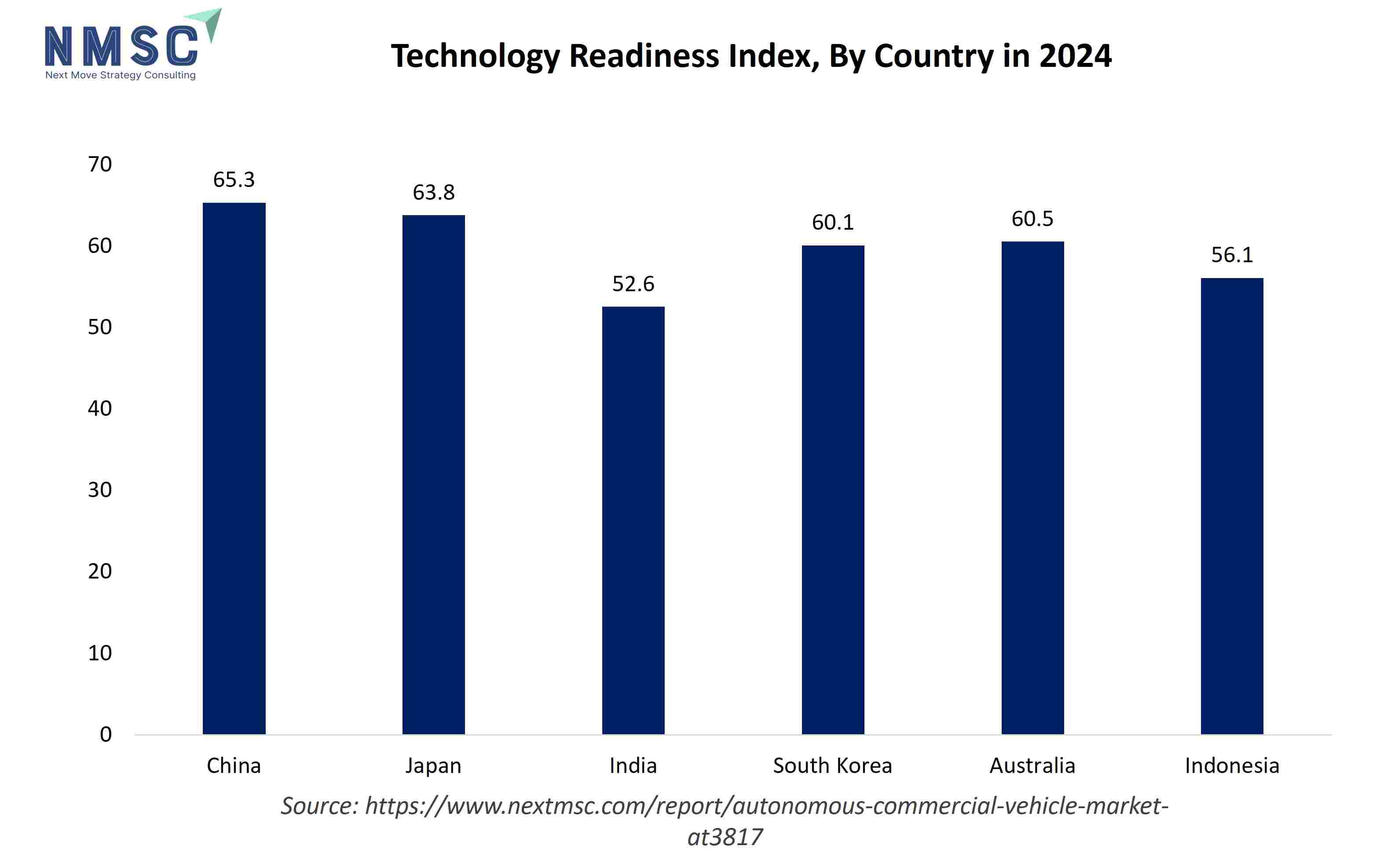
This chart illustrates the 2024 Technology Readiness Index for selected Asia-Pacific countries, with China (65.3) and Japan (63.8) leading, followed by Australia (60.5), South Korea (60.1), Indonesia (56.1), and India (52.6), indicating their relative capacity to develop and adopt new technologies. For the autonomous commercial vehicle market, this directly impacts the pace of development and deployment; countries with higher scores, like China and Japan, are better positioned to create advanced regulatory frameworks, robust infrastructure, and sophisticated supply chains, accelerating the commercialization of autonomous trucks and logistics solutions, while lower-scoring nations face slower adoption due to technological and infrastructural hurdles.
What Are the Key Trends in Autonomous Commercial Vehicle Industry?
How is the Autonomous Commercial Vehicle Market Driving Integration with Smart Infrastructure and AI Governance?
In the autonomous commercial vehicle market, automation is evolving beyond onboard systems to include seamless integration with AI-enabled infrastructure, such as edge sensors, traffic management systems, and vehicle-to-everything (V2X) connectivity. Policymakers and international transport organizations, including ITF and OECD, are emphasizing that such integrated infrastructure is critical for ensuring safe, efficient, and reliable automated freight operations. By leveraging connected systems, operators optimize route performance, reduce disruptions, and provide regulators with actionable operational data, which is increasingly a core requirement for large-scale deployments. As a result, companies in the market must design their fleets to interoperate with intelligent transport infrastructure and contribute data for performance monitoring, enabling smoother adoption, faster regulatory approval, and higher operational efficiency.
How is the Autonomous Commercial Vehicle Market Aligning with Growing Freight Demand and Infrastructure Readiness?
The autonomous commercial vehicle market growth is being propelled by rising freight demand and the gradual enhancement of transportation infrastructure. The Federal Highway Administration’s 2025 forecast indicates that combination truck vehicle miles traveled (VMT) are expected to grow by 0.9% annually, while single-unit truck VMT rise by 2.0% per year through 2053. This projected increase in freight activity highlights the urgent need for efficient, scalable, and technology-enabled solutions, positioning driverless trucks as a key driver for meeting future logistics demands. By deploying automated fleets on high-demand routes, companies optimize operations, reduce congestion, and improve delivery efficiency, aligning closely with long-term infrastructure growth trends.
What are the Key Market Drivers, Breakthroughs, and Investment Opportunities that will Shape the Autonomous Commercial Vehicle Industry in the Next Decade?
The global autonomous commercial vehicle industry is experiencing rapid growth, driven by increasing freight demand and the need for efficient, scalable transport solutions. Companies are leveraging autonomous trucks to optimize route planning, reduce labor costs, and enhance delivery reliability, allowing fleets to operate more efficiently across long-haul, regional, and last-mile logistics. By adopting advanced AI, sensor technologies, and telematics, service providers deliver comprehensive transport solutions that cater to evolving industry requirements, improve operational performance, and create new revenue opportunities. This focus on efficiency and reliability strengthens market competitiveness and aligns service offerings with the growing expectations of logistics and supply chain operators.
At the same time, supportive government policies and funding initiatives are shaping market innovation and adoption. Regulatory frameworks that enable higher levels of vehicle automation create favorable conditions for large-scale deployment of autonomous trucks, encouraging companies to expand pilot programs and scale operations safely. Additionally, public funding and grants for research, testing, and smart city integration provide opportunities for firms to accelerate technology development, optimize operational efficiency, and demonstrate the benefits of autonomous fleets. Collectively, these factors are driving technological adoption, expanding market applications, and reinforcing the growth and long-term potential of the autonomous commercial vehicle market.
Growth Drivers:
How is Rising Freight Demand and Vehicle Miles Traveled Driving Growth in the Autonomous Commercial Vehicle Market?
The autonomous commercial vehicle market is set to expand substantially, driven by the anticipated rise in freight activity and vehicle miles traveled (VMT). The Federal Highway Administration’s 2025 forecast projects that single-unit truck VMT will increase by 2.1% annually over the next 21 years and 1.9% over the next 31 years, while combination truck VMT is expected to grow at average annual rates of 1.3% and 1.1% over the same periods. This upward trend in freight demand highlights the need for efficient, high-capacity, and scalable transport solutions, creating an ideal environment for autonomous commercial vehicles. By deploying automated fleets, companies optimize route efficiency, reduce labor costs, and improve delivery reliability, effectively addressing the increasing logistics demand and aligning with long-term infrastructure growth trends.
How are Government Policies and Regulations Accelerating Autonomous Commercial Vehicle Deployment?
Government policies are emerging as a key growth driver for the autonomous commercial vehicle market expansion. In the United States, the 2025 "AMERICA DRIVES" Act establishes a national framework for autonomous vehicle operations, aiming to remove regulatory hurdles for advanced automation. By enabling Level 4 and Level 5 automated driving systems to operate without human drivers, the legislation creates a favorable environment for large-scale deployment of autonomous trucks across interstate freight corridors. This regulatory support not only accelerates market adoption but also encourages innovation, investment, and commercialization of autonomous trucking technologies. Companies in the market leverage this policy framework to expand pilot programs, scale operations, and optimize route efficiency while staying compliant with evolving safety standards.
Growth Inhibitors:
How is Regulatory Fragmentation Limiting the Growth of the Autonomous Commercial Vehicle Market?
A major inhibitor to the growth of the autonomous commercial vehicle industry is the fragmented regulatory environment across states and municipalities. For example, California’s Assembly Bill 33 (AB 33) places strict limitations on testing and deploying autonomous vehicles over 10,000 pounds, encompassing most commercial trucks. The law requires manufacturers to secure specialized permits and report every disengagement or incident, creating additional administrative burdens and potential deployment delays. This patchwork of regulations increases compliance costs, complicates nationwide rollout strategies, and slows the scaling of autonomous trucking operations. For market participants, navigating these diverse regulatory frameworks requires strategic planning and active engagement with policymakers to ensure consistent operational standards and reduce barriers to commercial adoption.
How are Government Funding Initiatives Creating Growth Opportunities in the Autonomous Commercial Vehicle Market?
Government funding initiatives present a significant growth opportunity for the autonomous commercial vehicle (ACV) market. The U.S. Department of Transportation’s 2025 announcement of USD 54 million in SMART Grants, supporting 34 projects across 21 states, exemplifies this trend. These grants target the development of smart city technologies, including autonomous vehicle systems, aiming to improve transportation efficiency, safety, and connectivity. For companies in the ACV market, such funding provides a pathway to accelerate research, testing, and deployment of autonomous commercial trucks. By leveraging these resources, firms pilot innovative technologies, optimize operational efficiency, and demonstrate the real-world value of their autonomous solutions, positioning themselves as leaders in a rapidly expanding and policy-supported market.
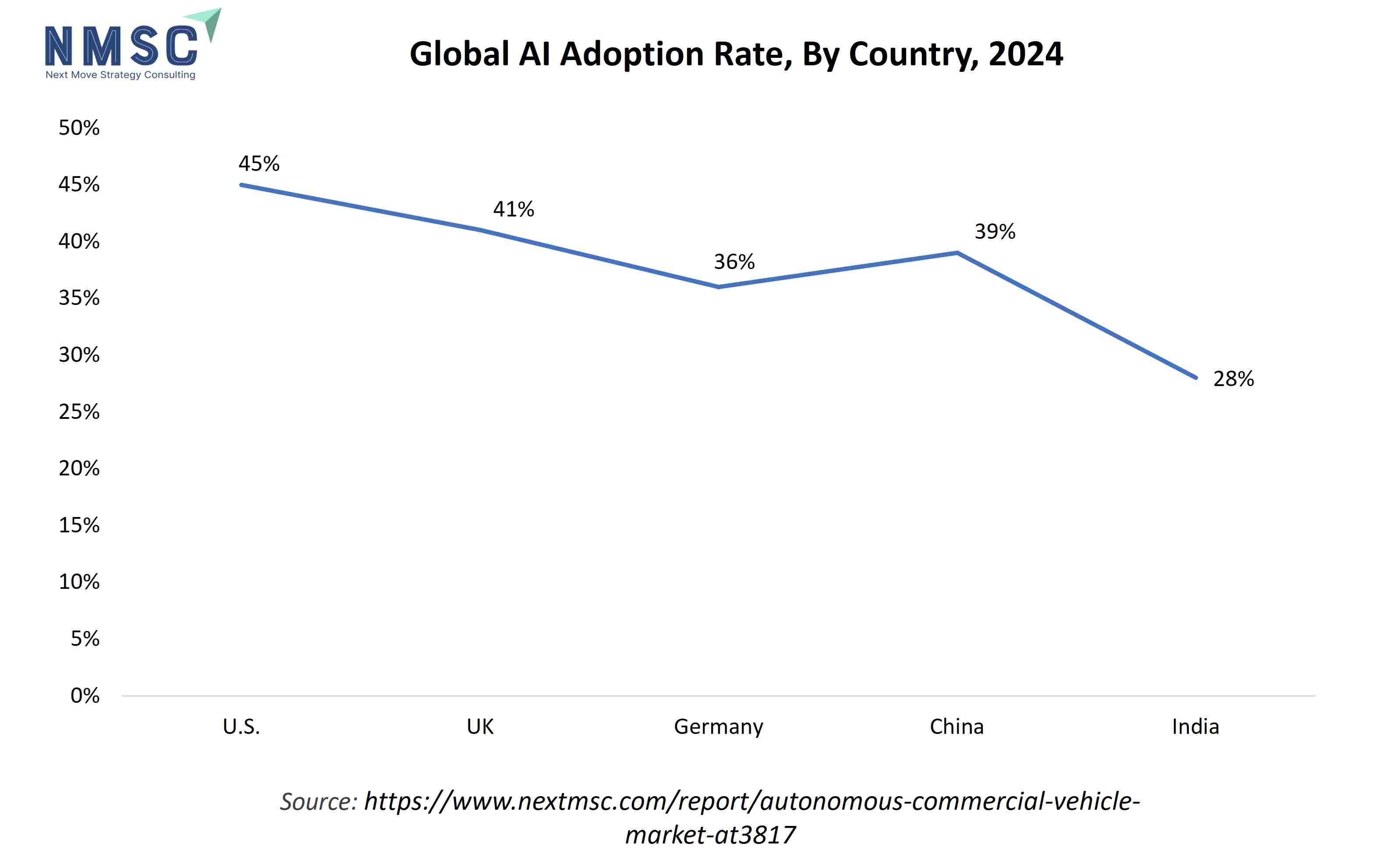
Based on the chart, the United States leads in AI adoption with a rate of 45%, followed by the UK (41%), China (39%), Germany (36%), and India (28%). This directly impacts the autonomous commercial vehicle industry by highlighting which countries are most primed for its growth; higher adoption rates in the U.S. and UK suggest more advanced ecosystems for developing and integrating the complex AI systems essential for self-driving trucks, likely leading to faster regulatory approval, greater public acceptance, and more rapid deployment, while nations with lower rates experience a slower and more fragmented market entry.
How Is the Autonomous Commercial Vehicle Industry Segmented in this Report, and What are the Key Insights from the Segmentation Analysis?
By Vehicle Type Insights
How is the Autonomous Commercial Vehicle Market Shaped by Vehicle Type?
Based on vehicle type, the market is segmented into autonomous trucks, autonomous buses.
The autonomous trucks segment forms a key part of the autonomous commercial vehicle market, focusing on vehicles designed for freight and logistics operations with minimal or no human intervention. These trucks utilize advanced technologies such as AI-based navigation, sensors, and vehicle-to-everything (V2X) communication to optimize routes, improve safety, and enhance operational efficiency. The segment is witnessing strong growth due to rising demand for efficient freight transport, increasing labor costs, and the need to reduce delivery times. Autonomous trucks are particularly critical for long-haul and regional logistics, offering scalable solutions that transform supply chains and meet the expanding demands of e-commerce and industrial transportation.
By Sensor Technology Insights
Which Sensor Technology is Emerging as the Most Flexible in the Autonomous Commercial Vehicle Industry?
Based on sensor technology, the market is segmented into LiDAR based systems, radar based systems and others.
LiDAR-based systems are a critical sensor technology in the market, providing high-resolution, real-time 3D mapping of a vehicle’s surroundings. By emitting laser pulses and measuring the time it takes for them to return after hitting objects, LiDAR enables precise detection of obstacles, road edges, pedestrians, and other vehicles, even in low-light or complex environments. This accuracy allows autonomous trucks and buses to navigate safely, maintain lane discipline, and perform advanced maneuvers such as adaptive cruise control and collision avoidance. LiDAR systems are increasingly adopted due to their reliability in complex urban and highway scenarios, making them essential for improving operational safety and efficiency in autonomous logistics vehicles. With technological advancements driving down costs and enhancing detection range, LiDAR continues to be a preferred choice for companies seeking robust and scalable autonomous navigation solutions.
By End-User Industry Insights
How is the Autonomous Commercial Vehicle Market Shaped by End-User Industry Segmentation?
Based on end user industry, the market is segmented into logistics and supply chain, public sector and private sector.
The logistics and supply chain segment is a primary end-user of autonomous commercial vehicles, driving demand for advanced transport solutions that enhance efficiency, reduce operational costs, and improve delivery reliability. Autonomous trucks and vans are increasingly deployed for long-haul, regional, and last-mile deliveries, allowing logistics companies to optimize route planning, minimize human error, and meet growing e-commerce and industrial shipping demands. By integrating autonomous vehicles with warehouse management systems, telematics, and real-time tracking technologies, supply chain operators achieve faster turnaround times, reduce fuel consumption, and enhance overall fleet utilization. As global trade volumes rise and the need for timely deliveries intensifies, the logistics and supply chain sector is expected to remain a major growth driver for the market, offering scalable solutions for both national and international freight operations.
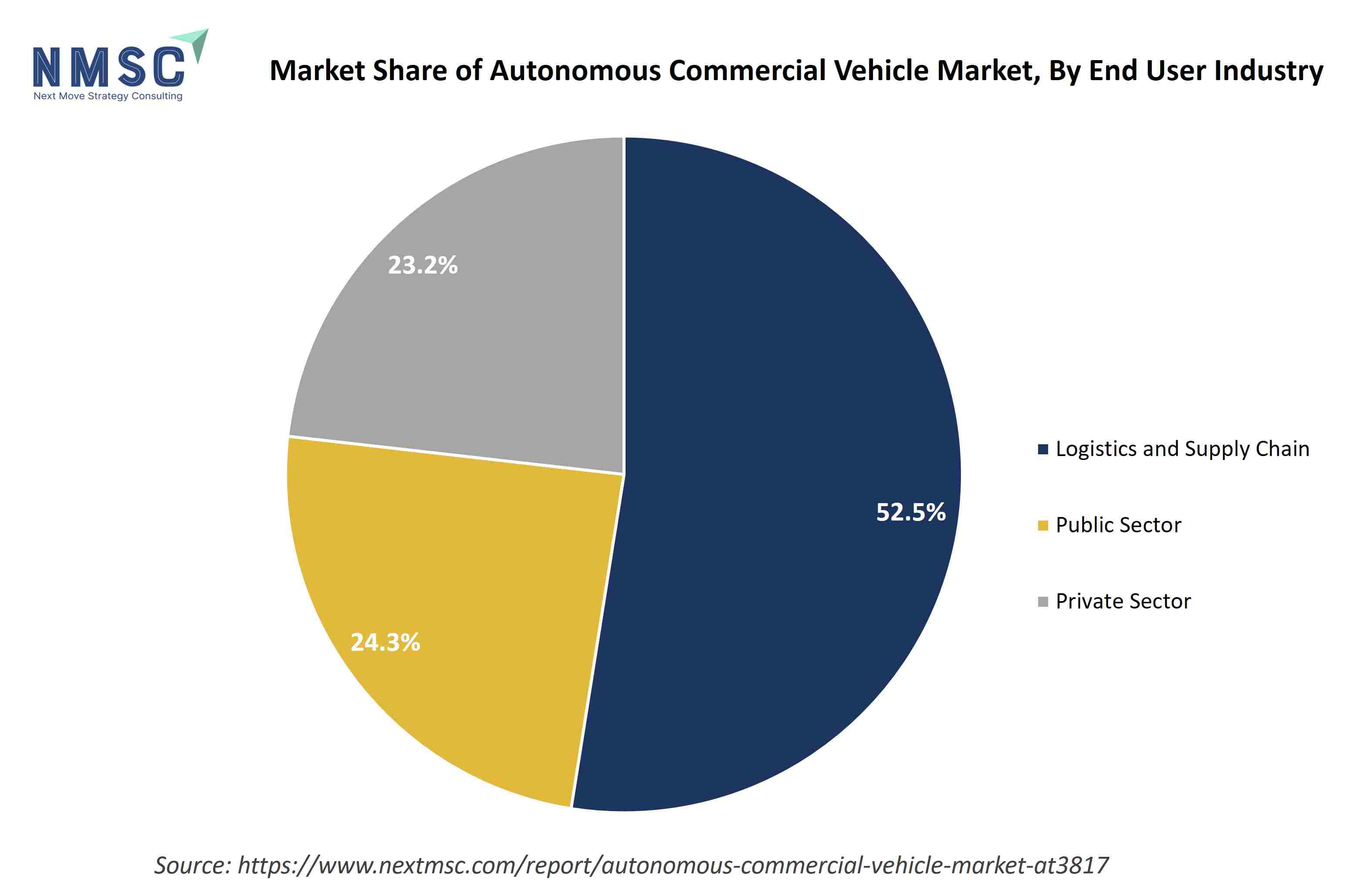
The chart illustrates the distribution of the autonomous commercial vehicle market share across different end-user industries. Logistics and Supply Chain emerges as the dominant segment, accounting for 52.5% of the market, highlighting the critical role of autonomous vehicles in optimizing freight, delivery, and supply chain operations. The Public Sector represents 24.3%, reflecting government adoption in areas such as public transit, smart city initiatives, and urban mobility projects. The Private Sector holds 23.2%, showcasing the increasing interest from private enterprises in deploying autonomous fleets for internal operations, corporate logistics, and last-mile deliveries. Overall, the chart emphasizes that while logistics remains the largest driver of market demand, both public and private sector adoption contributes significantly to the growth and deployment of autonomous commercial vehicles.
Regional Outlook
The market is geographically studied across North America, Europe, Asia Pacific, Latin America and the Middle East & Africa and each region is further studied across countries.
Autonomous Commercial Vehicle Market in North America
The North American ACV market is growing steadily, driven by rapid expansion of e-commerce and increasing demand for last-mile delivery solutions. Government support for autonomous vehicle testing and smart transport infrastructure further accelerates adoption. Urban congestion and labor shortages in logistics are encouraging fleet operators to integrate AI- and IoT-enabled autonomous trucks and vans. Strategic collaborations among OEMs, tech providers, and logistics companies enhance commercialization. Combined, these factors position the U.S. and Canada as leading markets for autonomous commercial vehicles in North America.
Autonomous Commercial Vehicle Market in United States
The U.S. autonomous vehicles market is witnessing strong growth, driven by rising demand for last-mile logistics automation and government initiatives aimed at accelerating autonomous vehicle testing and smart transport infrastructure development. The expansion of e-commerce, increasing freight volumes, and labor shortages are further boosting adoption. Collaborations between OEMs, technology firms, and logistics providers are facilitating the deployment of AI- and IoT-enabled autonomous trucks and vans. Additionally, urban congestion and the need for safer, more efficient freight movement strengthen market prospects across both urban and intercity corridors, positioning the U.S. as a key growth market for autonomous mobility solutions.
Autonomous Commercial Vehicle Market in Canada
Canada’s autonomous vehicles market is gaining momentum, supported by government regulations that enable pilot programs for self-driving trucks and vans, allowing controlled testing and deployment. Investments in smart city initiatives and connected transportation infrastructure are driving adoption by integrating AI-assisted navigation and fleet management systems. Urbanization and logistics modernization further bolster deployment, while collaborations between OEMs, technology providers, and logistics companies enhance commercialization across urban and intercity freight operations. The sector comprises 31 companies, including 18 funded firms that have collectively raised USD 769 million in venture capital and private equity, with 10 at Series A+ funding and 1 achieving unicorn status. Additionally, 6 acquisitions have occurred, representing 19.4% of all companies, notably higher than the 5.4% exit rate observed across tech companies in general, indicating strong market consolidation and investment activity.
Autonomous Commercial Vehicle Market in Europe
The European ACV market is expanding due to government-funded pilot programs and regulatory frameworks enabling autonomous vehicle testing and strong demand for efficient urban and intercity freight solutions. Countries such as the UK, Germany, France, and Spain are adopting AI-assisted fleet management, vehicle-to-everything (V2X) communication, and smart logistics technologies. Emission reduction policies, urban congestion, and e-commerce growth further drive adoption. Moreover, collaborations among OEMs, technology providers, and logistics operators are enhancing commercialization, positioning Europe as a key market for autonomous commercial vehicles.
Autonomous Commercial Vehicle Market in United Kingdom
The UK autonomous vehicles market is experiencing steady growth, driven by government-funded pilot programs testing autonomous trucks and delivery vans in urban logistics environments. Strict emissions regulations are encouraging fleet operators to adopt autonomous solutions to reduce carbon footprints. AI-assisted navigation, fleet management systems, and vehicle-to-everything (V2X) communication technologies are enhancing operational efficiency, while urban congestion and e-commerce growth further support adoption. Recent industry developments include Kia’s launch of the PV5, the company’s first purpose-built vehicle (PBV) in the UK, with 50 PBV centers at launch, expanding to 60 nationwide. The PV5 Cargo variant is priced from USD 34,556, qualifying for the USD 6,250, Government Plug-in Van Grant, while the PV5 Passenger variant starts at USD 41,244. These developments reflect increasing investment and commercialization of autonomous and smart commercial vehicles, positioning the UK as a key market for autonomous fleet solutions in Europe.
Autonomous Commercial Vehicle Market in Germany
Germany’s autonomous vehicles market is witnessing steady growth, driven by the country’s advanced automotive R&D capabilities that enable development of AI-assisted trucks and connected fleet solutions. Moreover, rising demand for efficient freight transport across industrial and urban hubs is accelerating adoption, as companies implement autonomous vehicles to optimize logistics and reduce operational costs. Further Sustainability initiatives and stringent emission reduction policies further reinforce market growth. Collaborations between OEMs, technology providers, and logistics firms support pilot programs and commercialization efforts, positioning Germany as a leading market in Europe.
Autonomous Commercial Vehicle Market in France
France’s autonomous vehicles market is experiencing robust growth, driven by supportive legislation that enables controlled testing and deployment of commercial autonomous trucks. In March 2025, WeRide, in partnership with French autonomous mobility operator beti, received Level-4 driverless public road testing and operating permits, making it the first technology company globally to hold such permits across five countries: China, the UAE, Singapore, France, and the USA. The adoption of smart logistics solutions across e-commerce and retail sectors further propels market expansion, as companies integrate AI-powered navigation, fleet management, and route optimization technologies.
Autonomous Commercial Vehicle Market in Spain
Spain’s autonomous commercial vehicles market is witnessing steady growth, driven by increasing urban logistics demands, freight efficiency needs, and government initiatives supporting smart transport and autonomous vehicle testing. The expansion of e-commerce and modernization of infrastructure further support adoption, while AI-enabled fleet management and last-mile delivery solutions facilitate operational efficiency. Pilot programs and public-private collaborations are enhancing commercialization, positioning Spain as an emerging market for autonomous commercial vehicles in Southern Europe. Notably, Madrid introduced its first autonomous electric minibus with passengers in Casa de Campo on 15 September 2024. Developed locally and operated by the Municipal Transport Company (EMT) in collaboration with the Automotive Technology Centre of Galicia (CTAG), the project aims to test autonomous mobility in real traffic conditions and address driver shortages, highlighting Spain’s commitment to advancing autonomous transportation solutions.
Autonomous Commercial Vehicle Market in Asia Pacific
The Asia-Pacific ACV market is witnessing rapid growth, supported by urban population expansion and increasing demand for efficient last-mile and intercity freight solutions. Government initiatives promoting smart transport infrastructure and pilot programs further accelerate adoption in countries like China, India, Japan, South Korea, and Australia. OEMs and technology providers are integrating AI, IoT, and real-time fleet management systems for safer and more efficient operations. Furthermore, e-commerce growth, logistics modernization, and strategic partnerships enhance commercialization, making Asia-Pacific one of the fastest-growing regions for autonomous commercial vehicles globally.
Autonomous Commercial Vehicle Market in China
China’s autonomous commercial vehicles market is growing rapidly, underpinned by strong government support and strategic direction. Recognizing the potential of autonomous driving to transform transport, enhance safety, and reduce carbon emissions, the Chinese government has integrated AV development into its national objectives. The “Made in China 2025” initiative prioritizes intelligent vehicles to reduce reliance on foreign technologies and advance next-generation mobility solutions. Government-led initiatives promoting smart transport networks facilitate testing and deployment of autonomous trucks and vans, while rapid urban freight growth and e-commerce expansion drive demand for efficient, cost-effective logistics solutions. Collaborations between OEMs and technology providers accelerate commercialization, and factors such as urban congestion, sustainability targets, and adoption of AI-enabled fleet management systems strengthen China’s position as a leading autonomous commercial vehicles market in the Asia-Pacific region.
Autonomous Commercial Vehicle Market in Japan
Japan’s autonomous commercial vehicles market is expanding steadily, supported by advanced AI and robotics infrastructure that enables development of vehicles with real-time navigation, safety, and fleet management features. Growing demand for safe and efficient urban freight transport drives adoption in cities and industrial hubs, while government initiatives promoting smart mobility and connected transport networks further accelerate deployment. Rising e-commerce volumes and increasing urban congestion reinforce the need for autonomous solutions, positioning Japan as a prominent market for autonomous commercial vehicles in the Asia-Pacific region.
Autonomous Commercial Vehicle Market in India
India’s autonomous commercial vehicles market is growing steadily, driven by rising urban congestion and the increasing demand for smart freight solutions. Deployment of autonomous trucks, vans, and three-wheelers in major cities is supported by government initiatives promoting electric and autonomous vehicle adoption, providing regulatory and financial incentives that encourage corporate integration. The rapid expansion of e-commerce and modernization of logistics infrastructure further bolster market growth. Companies are increasingly adopting AI-assisted fleet management and real-time monitoring systems to optimize operational efficiency across urban and intercity freight operations. Notably, in September 2025, Omega Seiki Mobility launched India’s first self-driving electric three-wheeler, Swayamgati, featuring a 10.3 kWh battery with a range of up to 120 km, highlighting the country’s innovation and early adoption in autonomous urban mobility.
Autonomous Commercial Vehicle Market in South Korea
South Korea’s autonomous commercial vehicles market is expanding steadily, fueled by widespread AI and IoT integration in transportation, which enhances navigation, safety, and operational efficiency. Government-backed smart mobility initiatives support the deployment of autonomous trucks and vans in urban logistics and freight operations, while collaborations between OEMs, technology providers, and logistics companies accelerate commercialization. Rising e-commerce volumes, urban congestion, and the growing need for efficient last-mile delivery further drive adoption, positioning South Korea as a key market for autonomous commercial vehicles in the Asia-Pacific region.
Autonomous Commercial Vehicle Market in Australia
Australia’s autonomous commercial vehicles market is poised for steady growth, with forecasts projecting that 2.6% of all new passenger vehicles will be highly or fully automated by 2030, rising to 50% by 2046. Government investments in autonomous transport research and infrastructure support pilot projects and commercial deployment, while regulatory reforms and updated liability standards facilitate integration. The need for efficient logistics across vast distances particularly in freight and mining drives adoption, supported by AI, IoT, and real-time vehicle monitoring for enhanced operational efficiency and safety. Public-private partnerships accelerate commercialization, and growing e-commerce volumes combined with rural-to-urban delivery demands further strengthen market expansion.
Autonomous Commercial Vehicle Market in Latin America
The Latin American ACV market is expanding due to rapid urbanization in major cities like São Paulo, Mexico City, and Buenos Aires, which increases demand for efficient urban freight solutions. Growing e-commerce penetration and modernization of logistics networks further drive adoption of autonomous trucks and delivery vans. Investments in AI-enabled fleet management and pilot programs for last-mile delivery enhance operational efficiency. Additionally, government initiatives to improve transport infrastructure and reduce emissions support commercialization, positioning Brazil, Mexico, and Argentina as emerging hubs for autonomous commercial vehicles in the region.
Autonomous Commercial Vehicle Market in Middle East & Africa
The Middle East & Africa ACV market is growing steadily, driven by government-backed smart city initiatives and investments in autonomous transport infrastructure. Rising urban freight volumes and logistics modernization, particularly in the UAE, Saudi Arabia, and South Africa, are increasing adoption of autonomous trucks and vans. Pilot programs for last-mile delivery, AI-enabled fleet management solutions, and strategic partnerships with technology providers are accelerating commercialization. The combination of infrastructure investment and growing demand for efficient, safe, and cost-effective urban and intercity freight transport positions the region as a high-potential market for ACVs.
Competitive Landscape
Who are the Leading Companies in the Autonomous Commercial Vehicle Market and How are they Competing?
The global autonomous commercial vehicle industry is driven by a combination of established automotive giants and forward-looking technology innovators. Companies such as Volvo Group, Daimler Truck AG, PACCAR Inc, Hyundai Motor Company, Toyota Motor Corporation, IVECO, BYD Company Limited, Yutong Bus Co., Ltd., Ashok Leyland, and Volkswagen Commercial Vehicles leverage their extensive experience in commercial vehicle manufacturing, global distribution networks, and strong brand reputations. These players focus on developing reliable, high-performance autonomous commercial vehicles, integrating advanced safety systems, connectivity solutions, and scalable fleet management technologies. Their established presence in logistics, transportation, and heavy-duty vehicle segments allows them to lead the market in standardization, regulatory compliance, and adoption of autonomous mobility solutions.
Meanwhile, specialized and innovation-driven companies like Einride AB, Navya SAS, Zoox, Inc, Nuro, Inc., and HOLON concentrate on niche autonomous solutions, electric mobility, and software-defined vehicle technologies. These companies emphasize agile development, cutting-edge AI-powered autonomy, on-demand fleet solutions, and fully electric or hybrid platforms. Their ability to rapidly prototype, deploy, and iterate autonomous systems creates competitive pressure on traditional manufacturers, pushing the market toward more flexible, technology-centric, and sustainable commercial vehicle operations. These dynamic fosters innovation while accelerating the adoption of autonomous transport across logistics, urban mobility, and last-mile delivery sectors.
Market Dominated by Autonomous Commercial Vehicle Giants and Specialists
The autonomous commercial vehicle market is shaped by a blend of established automotive leaders and specialized technology innovators. Companies like Volvo Group, Daimler Truck AG, PACCAR Inc, Hyundai Motor Company, Toyota Motor Corporation, IVECO, BYD Company Limited, Yutong Bus Co., Ltd., Ashok Leyland, and Volkswagen Commercial Vehicles dominate by offering reliable, high-performance autonomous commercial vehicles integrated with advanced safety systems, fleet management solutions, and electrification technologies, leveraging their global networks and standardized processes to ensure scalability and consistency. At the same time, specialized companies such as Einride AB, Navya SAS, Zoox, Inc, Nuro, Inc., and HOLON focus on agile, technology-driven solutions including fully autonomous electric trucks, last-mile delivery vehicles, and software-defined mobility platforms, emphasizing rapid innovation and flexible deployment. Together, these players are driving technological advancement, fostering competitive differentiation, and accelerating the adoption of autonomous commercial vehicles to meet evolving industry demands and the shift toward smarter, safer, and more efficient transportation.
Market Players to Opt for Expansion Strategies to Expand their Presence
In the autonomous commercial vehicle market, strategic partnerships and collaborations are becoming essential for expanding capabilities and accelerating adoption. For instance, Daimler Truck has partnered with Torc Robotics to develop and deploy SAE Level 4 autonomous trucks in the U.S. market by 2027. This collaboration allows both companies to leverage each other’s technological expertise and operational capabilities, enabling faster commercialization of autonomous solutions while mitigating risks and costs associated with independent development. Such strategic alliances are becoming a preferred approach for industry leaders seeking to strengthen their competitive position and scale their autonomous vehicle offerings globally.
List of Key Autonomous Commercial Vehicle Companies
-
Volvo Group
-
Hyundai Motor Company
-
Toyota Motor Corporation
-
IVECO
-
BYD Company Limited
-
Yutong Bus Co., Ltd.
-
Einride AB
-
Navya SAS
-
Zoox, Inc
-
Nuro, Inc.
-
HOLON
-
Ashok Leyland
-
Volkswagen Commercial Vehicles
What Are the Latest Key Industry Developments?
-
In October 2025, Hyundai Motor, in collaboration with PlusAI, was recognized in TIME's 'Best Inventions 2025' for their autonomous hydrogen fuel cell truck, marking a notable advancement in the autonomous commercial vehicle industry. This innovation not only showcases the integration of autonomous technology with sustainable hydrogen power but also supports the development of early hydrogen corridors for freight transport. The recognition underscores how manufacturers are combining autonomy and clean energy solutions to shape the next generation of commercial vehicles, addressing both efficiency and environmental sustainability in logistics operations.
-
In May 2024, Volvo Autonomous Solutions made a significant move in the market by unveiling the Volvo VNL Autonomous, a production-ready Class 8 truck developed in collaboration with Aurora Innovation. Designed to enhance freight capacity across the United States, this launch highlights Volvo’s commitment to integrating advanced autonomous technologies into commercial trucking. The introduction of the VNL Autonomous reflects the growing trend among industry players to accelerate the adoption of autonomous solutions, improve operational efficiency, and address the evolving demands of freight and logistics networks.
What Are the Key Factors Influencing Investment Analysis & Opportunities in the Market?
Investment in the autonomous commercial vehicle market share is increasingly driven by the rising demand for efficient, safe, and technologically advanced freight and logistics solutions. Funding trends indicate that investors are attracted to companies developing autonomous trucks, electric-powered commercial vehicles, and AI-enabled fleet management platforms. Valuations are influenced by a company’s ability to scale autonomous operations, expand into new regions, and integrate advanced safety and operational technologies that reduce costs and improve reliability. Investors are showing particular interest in businesses that combine automation, sustainability, and connectivity, reflecting the growing emphasis on digital transformation in transportation.
Geographically, regions with high freight volumes, strong logistics infrastructure, and supportive regulatory frameworks are emerging as hotspots for investment opportunities, as these areas offer higher adoption potential and faster deployment of autonomous solutions. Startups and specialized technology providers are attracting attention for their agility, innovative sensor and AI technologies, and niche autonomous applications, creating opportunities for strategic partnerships, acquisitions, and portfolio diversification. Collectively, these factors are shaping a dynamic and rapidly evolving investment landscape in the global autonomous commercial vehicle market trends.
Key Benefits for Stakeholders:
Next Move Strategy Consulting (NMSC) presents a comprehensive analysis of the autonomous commercial vehicle market report, covering historical trends from 2020 through 2024 and offering detailed forecasts through 2030. Our study examines the market at global, regional, and country levels, providing quantitative projections and insights into key growth drivers, challenges, and investment opportunities across all major market segments.
Report Scope
|
Parameters |
Details |
|
Market Size in 2025 |
USD 9.89 Billion |
|
Revenue Forecast in 2030 |
USD 21.08 Billion |
|
Growth Rate |
CAGR of 16.35% from 2025 to 2030 |
|
Analysis Period |
2024–2030 |
|
Base Year Considered |
2024 |
|
Forecast Period |
2025–2030 |
|
Market Size Estimation |
Billion (USD) |
|
Growth Factors |
|
|
Countries Covered |
33 |
|
Companies Profiled |
15 |
|
Market Share |
Available for 10 companies |
|
Customization Scope |
Free customization (equivalent up to 80 analyst-working hours) after purchase. Addition or alteration to country, regional & segment scope. |
|
Pricing and Purchase Options |
Avail customized purchase options to meet your exact research needs. |
|
Approach |
In-depth primary and secondary research; proprietary databases; rigorous quality control and validation measures. |
|
Analytical Tools |
Porter's Five Forces, SWOT, value chain, and Harvey ball analysis to assess competitive intensity, stakeholder roles, and relative impact of key factors. |
Key Market Segments
By Vehicle Type
-
Autonomous Trucks
-
Heavy-Duty Trucks
-
Light-Duty Trucks
-
Medium-Duty Trucks
-
-
Autonomous Buses
-
City Buses
-
Coach Buses
-
Shuttle Buses
-
By Propulsion Type
-
Internal Combustion Engine
-
Electric Vehicles (EV)
-
Hybrid Vehicles
By Level of Autonomy
-
Level 1 (Driver Assistance)
-
Level 2 (Partial Automation)
-
Level 3 (Conditional Automation)
-
Level 4 (High Automation)
-
Level 5 (Full Automation)
By Sensor Technology
-
LiDAR-Based Systems
-
Radar-Based Systems
-
Camera-Based Systems
-
Ultrasonic Sensors
By Application
-
Freight Transport
-
Last-Mile Delivery
-
Public Transportation
-
Mining and Construction
By End-User Industry
-
Logistics and Supply Chain
-
Warehouse Operations
-
Distribution Centers
-
-
Public Sector
-
Private Sector
Geographical Breakdown
-
North America: U.S., Canada, and Mexico.
-
Europe: U.K., Germany, France, Italy, Spain, Sweden, Denmark, Finland, Netherlands, and rest of Europe.
-
Asia Pacific: China, India, Japan, South Korea, Taiwan, Indonesia, Vietnam, Australia, Philippines, Malaysia and rest of APAC.
-
Middle East & Africa (MEA): Saudi Arabia, UAE, Egypt, Israel, Turkey, Nigeria, South Africa, and rest of MEA.
-
Latin America: Brazil, Argentina, Chile, Colombia, and rest of LATAM.
Conclusion & Recommendations
Our report equips stakeholders, industry participants, investors, policy-makers, and consultants with actionable intelligence to capitalize on autonomous commercial vehicle market transformative potential. By combining robust data-driven analysis with strategic frameworks, this report provides a comprehensive guide to understanding the rapidly evolving autonomous commercial vehicle landscape.


About the Author
 Jayanta Das
— Jayanta Das is Senior Analyst at Next Move Strategy Consulting, where he has spent 4.5 years covering the firm's full industry taxonomy — spanning aerospace and defense, healthcare, BFSI, energy and power, semiconductors, and beyond — rather than one specialization. His work follows NextMSC's research model, combining data mining, analytics, and secondary research to build market sizing and forecasts behind NextMSC's 2,000-plus research reports, trusted by more than 3,000 organizations globally.
Jayanta Das
— Jayanta Das is Senior Analyst at Next Move Strategy Consulting, where he has spent 4.5 years covering the firm's full industry taxonomy — spanning aerospace and defense, healthcare, BFSI, energy and power, semiconductors, and beyond — rather than one specialization. His work follows NextMSC's research model, combining data mining, analytics, and secondary research to build market sizing and forecasts behind NextMSC's 2,000-plus research reports, trusted by more than 3,000 organizations globally.
About the Reviewer
 Supradip Baul
— Supradip Baul is an accomplished business consultant and strategist with over a decade of rich experience in market intelligence, strategy, technology, and business transformation. His work has included rigorous qualitative and quantitative analysis across multiple industries, helping clients shape investment decisions and long-term roadmaps. Earlier in his career, he was associated with Gartner, where he contributed to industry-leading reports and market share analyses. He has worked with leading global companies and holds an MBA with a dual specialization in Marketing and Finance.
Supradip Baul
— Supradip Baul is an accomplished business consultant and strategist with over a decade of rich experience in market intelligence, strategy, technology, and business transformation. His work has included rigorous qualitative and quantitative analysis across multiple industries, helping clients shape investment decisions and long-term roadmaps. Earlier in his career, he was associated with Gartner, where he contributed to industry-leading reports and market share analyses. He has worked with leading global companies and holds an MBA with a dual specialization in Marketing and Finance.
At Next Move Strategy Consulting, we understand that insightful market research is the cornerstone of successful business decisions. That's why we employ a robust and multifaceted approach, combining various methodologies to deliver the most accurate and actionable data for our clients.

Research Landscape
We navigate the world of research with two primary approaches:
Qualitative Approach
Our qualitative research methodologies involve immersive techniques such as in-depth interviews, focus groups, and observational studies. By engaging directly with individuals and stakeholders, we uncover valuable insights that quantitative data alone may overlook.

Quantitative Research
In tandem with qualitative methodologies, NMSC leverages the power of Quantitative Research to provide a robust foundation of numerical insights. Through systematic data collection and analysis, we quantify patterns, preferences, and market trends, offering a comprehensive view of the business landscape.
Our quantitative research approach employs diverse tools, including surveys, experiments, and statistical modelling. These methodologies enable us to gather data from a large and representative sample, ensuring the statistical significance of our findings. By employing structured questionnaires and standardized data collection methods, we guarantee the reliability and validity of the information we present to our clients.
Quantitative research is particularly effective in measuring the prevalence of trends, assessing market size, and gauging the impact of various factors on consumer behavior. The numerical precision attained through this approach equips our clients with actionable insights, facilitating data-driven decision-making and strategy formulation.


Our Specialized Toolbox for Industry-Specific Market Research
We deploy a specialized arsenal of techniques tailored to meet your unique requirements. Here's a glimpse into our comprehensive toolbox:

Information Procurement
The stage entails acquiring market data or relevant information through various sources and methodologies.


Market Research Approach
We utilize both top-down and bottom-up approaches in market research analysis to achieve a comprehensive understanding of the market dynamics, leveraging the broad perspective of industry trends and macroeconomic factors alongside detailed insights from specific segments and individual companies.

Porters Five Forces Analysis
We conduct Porter's Five Forces analysis to evaluate the competitive landscape of an industry, providing us with insights into factors that affect profitability and strategic positioning.

SWOT Analysis

Forecasting
We utilize a forecasting model to predict future consumption by considering parameters like population, economics, regulations, market competition, drivers, constraints, technology, and pricing. We also employ statistical techniques such as multilinear regression, exponential smoothing, moving average, ARIMA, and Monte Carlo simulations for accurate predictions. In econometric forecasting, we analyzed short-term and long-term event impacts, attributing values based on regulatory frameworks, economic factors, and market events.





 Speak to Our Analyst