Challenges and Opportunities in the Agriculture Robots Market
Introduction
On September 2, 2026, the U.S. Department of Labor notified H-2A employers that farm wages could be adjusted retroactively, after a federal court found its 2025 wage methodology unlawful. The notice complies with an August 26, 2026 order from the U.S. District Court for the Eastern District of California. Current wage rates stay in force and the department states that no back-pay obligation exists today, yet employers that use H-2A labor from that date may owe wage adjustments once a new methodology is published. The price of seasonal farm labor, the variable behind every automation business case, has become a moving target just as autonomous machines reach commercial scale.
According to Next Move Strategy Consulting's Agriculture Robots Market report, the global agriculture robots market was valued at USD 8.78 billion in 2023 and is projected to reach USD 22.49 billion by 2030, growing at a CAGR of 14.4% from 2023 to 2030. The report segments demand by type, including unmanned aerial vehicles, milking robots, driverless tractors and automated harvest robots, by farming type and by application, and it profiles 20 companies across 28 countries.
For More Information: Download FREE Sample on Agriculture Robots Market Report
How Wage Rulings and Autonomy Platforms Are Rewiring the Agriculture Robots Market
A Federal Court Unsettles the Farm Wage Floor
The U.S. Department of Labor's Office of Foreign Labor Certification published its notice on September 2, 2026, in response to the court's August 26 order in United Farm Workers v. Department of Labor. The case challenges the October 2, 2025 interim final rule that changed how the Adverse Effect Wage Rate, the wage floor generally applicable to H-2A employers, is calculated. The court concluded that the methodology is unlawful but did not vacate the rule, so existing rates remain until the department publishes new ones, and it directed the department to produce a replacement methodology promptly. Employers that use H-2A labor between September 2, 2026 and the date a new methodology is issued may later be required to pay wage adjustments to qualifying workers whose hourly pay falls below the new rates. The department says it will defend its position.
The program at stake is large. According to the U.S. Department of Labor's H-2A Selected Statistics for the third quarter of fiscal year 2026, with data as of June 30, 2026, employers filed 20,695 applications and obtained certification for 349,867 positions out of 361,405 requested. Georgia led all states with 39,586 certified positions, or 11.3% of the total, followed by Florida with 35,193, Washington with 33,228, California with 31,467 and North Carolina with 25,704.
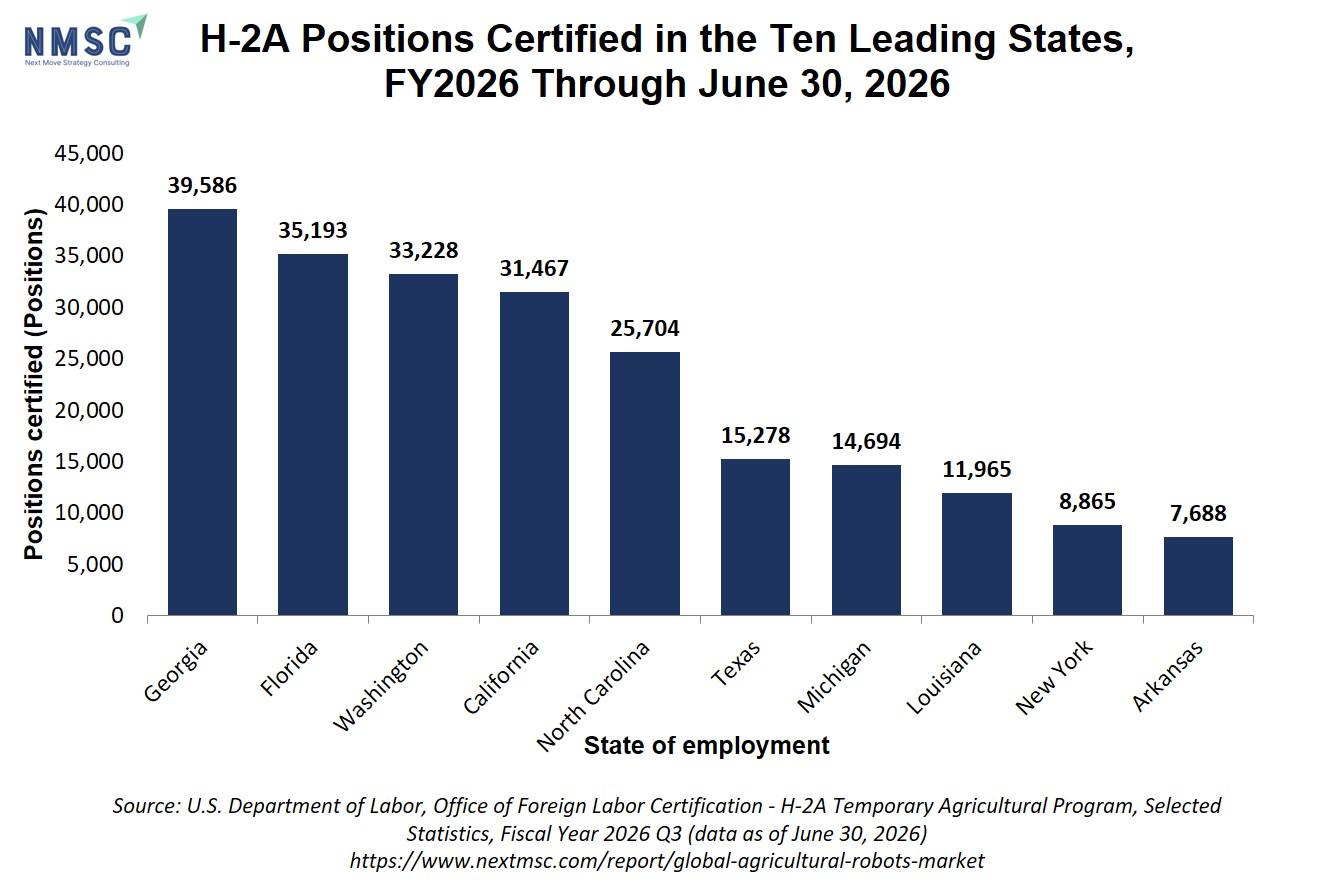
The chart ranks the ten states with the most H-2A positions certified in the first three quarters of fiscal year 2026, using the counts published by the U.S. Department of Labor. Georgia leads with 39,586 positions, followed by Florida with 35,193 and Washington with 33,228, while Arkansas ranks tenth with 7,688. The figures are actual certifications through June 30, 2026 and are not forecasts.
NextMSC primary research and analysis reads the ruling as a change in risk rather than a change in direction. A robot purchase is a bet on the future price of the labor it replaces. A lower expected wage floor lengthens payback, while a plausible reset with back wages shortens it and raises the value of a machine whose cost is fixed. Buyers with large seasonal crews now have a reason to evaluate automation as a hedge against wage-rate volatility, in addition to treating it as a labor-saving device.
Carbon Robotics Opens Tractor Autonomy to Any Implement Maker
On August 31, 2026, Carbon Robotics launched its Carbon Autonomy Ready program, with Great Plains Manufacturing as the first member. The program sets a technical specification and process for integrating any manufacturer's implements into the Carbon Autonomy platform. In the first integration, tractors running Carbon Autonomy read real-time data from Great Plains equipment through its Implement Command system and adjust depth, down pressure and leveling automatically, as an operator would. The companies planned to show a Great Plains HT1100 Terra-Max with integrated sensors and a Carbon implement kit at the 2026 Farm Progress Show.
Carbon Robotics founder and chief executive Paul Mikesell said in the announcement that autonomous implements help farmers lower costs by extending working hours, solving skilled operator shortages and raising tractor utilization. The commercial significance lies in the standard rather than the product: an open specification lets the installed base of seeding and soil management equipment become autonomous. Great Plains is a subsidiary of Kubota, which shows that equipment groups will connect their implements to third-party autonomy.
DJI Agriculture Pushes Spray Drones Into Heavy-Lift Work
On July 1, 2026, DJI Agriculture announced the global launch of the Agras T55 and the Agras T100 Dual Battery Spraying System. The company reported that more than 600,000 DJI agricultural drones are in use worldwide, treating 300 types of crops in more than 100 countries. The T55 lift system supports a 40 kg payload and adds Auto Balance Control and an Emergency Cable Release for stability and safety during lifting operations.
Unmanned aerial vehicles are one of the five type segments in NextMSC's research on this industry. NextMSC analysis indicates that the July launch widens the segment beyond spraying into material handling, which extends the task list that each airframe can serve.
Kubota Backs Agtonomy as Specialty-Crop Autonomy Reaches Dealers
On April 22, 2026, Kubota Corporation announced an investment in Agtonomy, a US start-up that develops physical AI automation for specialty crops in California, Oregon and Washington. The two companies have worked together since 2024. At CES 2026, Kubota exhibited its autonomous M5 Narrow tractor equipped with Agtonomy's driving system, and Kubota states that Agtonomy's services have since reached early commercial deployment across the western United States through Kubota's machinery dealers.
The distribution route is the notable element. Because Kubota describes the offer as services delivered through its dealers, growers may be able to access autonomy without buying a dedicated robot, which speaks directly to the affordability restraint that NextMSC identifies for small and mid-sized farms.
NMSC Strategic Perspective: Why Wage Uncertainty Sustains the Agriculture Robots Market
NextMSC primary research and analysis identifies three linked shifts in these announcements. First, the buying criterion is moving from labor savings alone to labor-price risk, as the court ruling shows. Second, autonomy is becoming a retrofit and standards business that does not require a farm to replace its entire fleet. Third, the task mix is broadening, from spray drones that now lift cargo to tractors that adjust their own implements.
Within NextMSC's segmentation, driverless tractors and unmanned aerial vehicles supply the clearest commercial evidence in this period, because the announcements involve tractor autonomy kits and a global drone launch. NextMSC's report identifies limited access to affordable and scalable robotic solutions as the principal restraint, particularly for small and mid-sized farms, so vendors that convert capital cost into dealer-delivered services hold a structural advantage in reaching them.
Section Summary:
Four developments from April to September 2026 show that wage risk, open autonomy standards and wider task coverage now shape purchase decisions.
-
The September 2, 2026 Department of Labor notice leaves wage rates in force but opens a possible back-wage window, which turns labor cost into a risk variable.
-
Carbon Robotics' August 31, 2026 program lets third-party implements run under one autonomy platform.
-
DJI Agriculture's July 1, 2026 launch and Kubota's April 22, 2026 investment extend automation to heavy-lift aerial work and dealer-served specialty crops.
Industry Impact Analysis
England's £20 Million Robotics Competition Shares the Development Risk
On August 3, 2026, the Department for Environment, Food and Rural Affairs (Defra), working with Innovate UK, opened a £20 million competition for farm robotics and automation under the Farming Futures R&D fund. Defra states that the funding targets robots that plant, tend and harvest crops, with the aim of reducing reliance on seasonal labour. It forms part of a £53 million expansion of the Farming Innovation Programme that brings the total available this year to £123 million, within a commitment to invest at least £200 million in farming innovation by 2030. Defra cited Fieldwork Robotics' raspberry-picking robot as an earlier beneficiary.
Public co-funding matters most for the segment that private capital finds hardest to underwrite. Harvest robots must prove reliability within short crop windows. Chris Danks, head of agrifood at Innovate UK, said in the August 3, 2026 announcement that the competition is intended to accelerate innovations from concept to on-farm application.
Deere Calls 2026 the Bottom of the Equipment Cycle
On August 20, 2026, Deere & Company reported third-quarter net income of USD 1.379 billion and raised its fiscal-year net income guidance to a range of USD 4.75 billion to USD 5.00 billion. The company said order book trends reinforce 2026 as the bottom of the agricultural equipment cycle. Its Production & Precision Agriculture segment recorded net sales of USD 3.998 billion, down 6% from USD 4.273 billion a year earlier, because of lower shipment volumes that were partly offset by price realization and currency effects.
For the agriculture robots market, the cycle matters because autonomy kits and autonomous tractors are capital purchases funded from the same farm cash flow as conventional equipment. A cycle trough helps explain why retrofit autonomy is gaining visibility ahead of full fleet replacement. NextMSC analysis treats a recovery in large-equipment orders as an upside catalyst for driverless tractors.
GEA Shows Where Dairy Robotics Budgets Are Firm
On August 10, 2026, GEA Group reported second-quarter order intake of EUR 1,494.7 million, up 14.2% from EUR 1,309.1 million a year earlier, and said demand was particularly strong in dairy farming, dairy processing and food. Half-year order intake reached EUR 2,949.0 million, which is 8.3% above the prior-year figure. GEA, which NextMSC profiles among the key players in this industry, reports these figures for the group as a whole, so they indicate the health of dairy-farming investment rather than robot sales alone.
Milking robots are a distinct type segment in NextMSC's research. Strong dairy-farming demand in the same quarter in which Deere reports lower large-equipment shipments indicates that livestock automation follows a different budget cycle from field-crop equipment.
Occupation Mix: Where Automation Meets the H-2A Workforce
The U.S. Department of Labor's third-quarter fiscal year 2026 statistics show which kinds of seasonal work farm employers certify as needing H-2A labor. Crop, nursery and greenhouse farmworkers account for 284,769 of the certified positions, or 81.4%. Agricultural equipment operators follow with 36,786 positions (10.5%), and workers handling farm, ranch and aquacultural animals hold 18,519 (5.3%). These three groups correspond closely to NextMSC's segmentation into harvest and field-operation robots, driverless tractors and dairy and livestock automation.
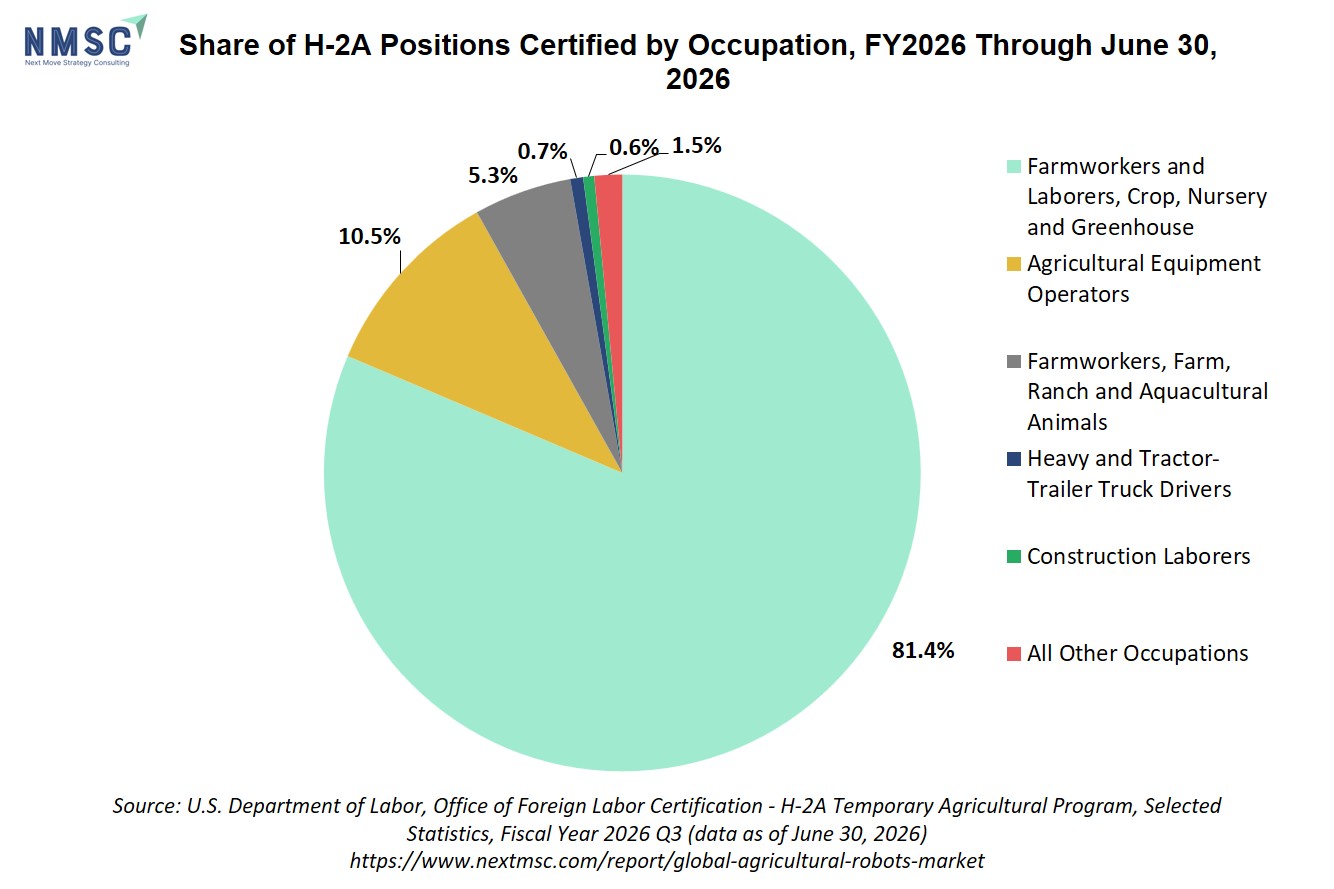
Crop, nursery and greenhouse farmworkers account for 81.4% of H-2A positions certified in fiscal year 2026 through June 30, 2026, followed by agricultural equipment operators at 10.5% and farm, ranch and aquacultural animal workers at 5.3%. Heavy and tractor-trailer truck drivers hold 0.7% and construction laborers 0.6%. The remaining 1.5% is all other occupations, calculated as 100.0% minus the five named categories from the same Department of Labor table.
Section Summary:
Public funding, equipment-cycle economics and dairy demand each point to a different budget logic inside the same industry.
-
Defra's £20 million competition, opened on August 3, 2026, shares development risk for robots that plant, tend and harvest.
-
Deere's 6% decline in Production & Precision Agriculture net sales and its trough statement show that large-equipment autonomy follows the farm capital cycle.
-
GEA's 14.2% second-quarter order growth indicates firm dairy-farming demand, although the figure covers the whole group.
Pros and Cons of Recent Market Developments
|
Pros |
Cons |
|
Carbon Robotics' Autonomy Ready specification lets third-party implements run under one platform, widening the usable equipment base. |
The September 2, 2026 labor notice leaves wage rates unsettled, which complicates payback modelling for buyers. |
|
DJI Agriculture's T55 adds a 40 kg lift capability to an installed base of more than 600,000 drones. |
Deere's Production & Precision Agriculture net sales fell 6% in the third quarter, a sign that large-equipment budgets remain cyclical. |
|
Kubota's dealer-delivered Agtonomy services give western US specialty-crop growers local support. |
Harvest robots such as Fieldwork Robotics' raspberry picker are still being made more durable and reliable before commercial rollout. |
|
Defra's £20 million competition shares development risk for robots that plant, tend and harvest. |
NextMSC's report identifies limited access to affordable and scalable robots as a restraint for small and mid-sized farms. |
|
GEA's 14.2% second-quarter order growth shows firm dairy-farming demand. |
GEA's figures cover the whole group, so they cannot isolate robot revenue. |
Key Data & Statistics
Key Industry Events and Quantified Detail, April to September 2026
|
Event |
Date |
Quantified Detail |
|
Kubota Corporation invests in Agtonomy |
April 22, 2026 |
Partnership since 2024; early dealer deployment in the western United States |
|
DJI Agriculture launches Agras T55 and T100 Dual Battery |
July 1, 2026 |
More than 600,000 drones in use; 40 kg lift payload |
|
Defra opens robotics competition |
August 3, 2026 |
£20 million; £123 million total programme funding this year; at least £200 million by 2030 |
|
GEA Group reports second quarter |
August 10, 2026 |
Order intake EUR 1,494.7 million, up 14.2%; half-year EUR 2,949.0 million, up 8.3% |
|
Deere & Company reports third quarter |
August 20, 2026 |
Net income USD 1.379 billion; Production & Precision Agriculture net sales USD 3.998 billion, down 6% |
|
Carbon Robotics launches Autonomy Ready program |
August 31, 2026 |
Great Plains Manufacturing first member |
|
U.S. Department of Labor issues H-2A notice |
September 2, 2026 |
Court order of August 26, 2026; current wage rates remain |
H-2A Program Reference Points, Fiscal Year 2026 Through June 30, 2026
|
Indicator |
Value |
Basis |
|
Applications received |
20,695 |
Fiscal year 2026, through June 30, 2026 |
|
Applications certified |
20,180 |
Fiscal year 2026, through June 30, 2026 |
|
Positions requested |
361,405 |
Fiscal year 2026, through June 30, 2026 |
|
Positions certified |
349,867 |
Fiscal year 2026, through June 30, 2026 |
|
Crop, nursery and greenhouse farmworkers |
284,769 (81.4%) |
Share of positions certified |
|
Agricultural equipment operators |
36,786 (10.5%) |
Share of positions certified |
|
Applications processed timely |
97.6% |
Resolved 30 days before start date |
Future Outlook & Forecast
The Road to USD 22.49 Billion: Three Forces Sustaining the Agriculture Robots Market
According to NextMSC primary research and analysis, the global agriculture robots market is projected to grow from USD 8.78 billion in 2023 to USD 22.49 billion by 2030 at a CAGR of 14.4%, an expansion of more than 2.5 times over the forecast period. The 2026 evidence points to three forces that sustain that trajectory.
Wage-rate risk as an adoption trigger. The court order of August 26, 2026 and the Department of Labor notice of September 2, 2026 mean that the wage floor for seasonal farm labor will be reset under a new methodology. Whichever direction the reset takes, buyers face volatility, and a machine with a fixed cost and predictable operating hours works as a hedge.
Open platforms and retrofit economics. Carbon Robotics' implement specification and Kubota's investment in Agtonomy show vendors competing to be the autonomy layer across many machines instead of selling one robot per farm. That lowers switching costs and supports services-based offers for smaller farms.
Public funding and segment breadth. Defra's £20 million competition supports harvest and tending robots that private buyers cannot yet underwrite, while DJI Agriculture's heavy-lift drones and GEA's dairy-farming order growth show demand in aerial and livestock segments that move on different budget cycles from field-crop equipment. A recovery in large-equipment orders, which Deere's third-quarter statement places after a 2026 trough, would add driverless tractors to that mix.
Regional Lens: North America Leads While Europe and Asia-Pacific Broaden Adoption
NextMSC regional analysis projects North America to lead the agriculture robots market, supported by large commercial farms, research and development investment by equipment makers and the labor pressures visible in the Department of Labor data. Europe has also recorded substantial growth, with the Defra competition and the dairy-farming strength reported by GEA Group as current signals. In Asia-Pacific, where NextMSC's research covers China, Japan, India, Australia and South Korea among other markets, DJI Agriculture's base of more than 600,000 drones illustrates the scale that aerial automation has already reached.
Section Summary:
NextMSC projects USD 22.49 billion by 2030 at a 14.4% CAGR, and the 2026 evidence supports three sustaining forces.
-
Wage-rate volatility after the August 26, 2026 court order strengthens the hedge value of automation.
-
Open, retrofit-ready platforms and services-based offers widen access beyond large farms.
-
Aerial, dairy and tractor segments follow different budget cycles, which spreads demand risk across the industry.
Next Steps for Stakeholders
For C-Level Executives and Farm Technology Leaders
Model automation payback against a range of wage floors. Because the Department of Labor must publish a new methodology after the August 26, 2026 order, test capital cases against a lower and a higher wage floor, including a back-wage scenario, before approving machine purchases.
Prioritise open, retrofit-ready platforms. Carbon Robotics' Autonomy Ready program and Kubota's dealer-delivered Agtonomy services show that autonomy can be added to equipment already owned. Require vendors to document implement compatibility and service coverage before committing capital.
Pursue public co-funding where it exists. UK businesses can bid for a share of Defra's £20 million competition through the Innovation Funding Service, and collaborative applications with researchers and farms are the intended route.
For Institutional Investors
Track the equipment cycle alongside autonomy news. Deere's statement that 2026 marks the bottom of the cycle, with Production & Precision Agriculture net sales down 6%, suggests that large-equipment autonomy revenue will follow orders, so retrofit and services revenue deserves a higher weighting in diligence.
Monitor the replacement wage methodology. Its publication date and the size of any back-wage exposure will show how urgently large seasonal employers need to fund automation.
Separate group results from robot revenue. GEA's 14.2% order growth and DJI Agriculture's 600,000-unit installed base are company-level figures, so diligence should isolate robot-specific revenue and margins.
Conclusion
The agriculture robots market is entering a phase in which the price of labor is as uncertain as the price of technology. A federal court has found the wage methodology unlawful, Carbon Robotics has opened its autonomy platform to any implement maker, DJI Agriculture has moved spray drones into heavy lift and Deere has called 2026 the bottom of the equipment cycle.
According to NextMSC primary research and analysis, the market is projected to reach USD 22.49 billion by 2030 at a CAGR of 14.4%. Executives who test payback against a range of wage floors and investors who separate robot revenue from group results will be best placed to act on that trajectory.
About the Author
 Priyanshu Das
— Priyanshu Das is SEO Executive at Next Move Strategy Consulting, where he has led on-page and off-page SEO, keyword research, and SEO audits for the firm's B2B market research publications for 2 years. His audit process combines technical crawl analysis, backlink profile review, and competitor keyword gap mapping — using tools including Screaming Frog and Google Search Console — to prioritize fixes by organic search-visibility impact, informed by his own prior in-house and agency SEO experience.
About the Reviewer
 Sanyukta Deb
— Sanyukta Deb is Digital Marketing Team Lead at Next Move Strategy Consulting, where she has led content strategy and technical SEO for the firm's B2B market research publications for over 2 years. Her editorial process translates NextMSC's primary and secondary research — spanning technology, industrial, and consumer sectors — into commercial narratives, backed by search-intent, keyword, and competitive analysis. She brings 5 years of overall experience in digital marketing and content strategy.
















Add Comment