How AI Is Transforming the AI-Optimized Battery Management Industry
Introduction
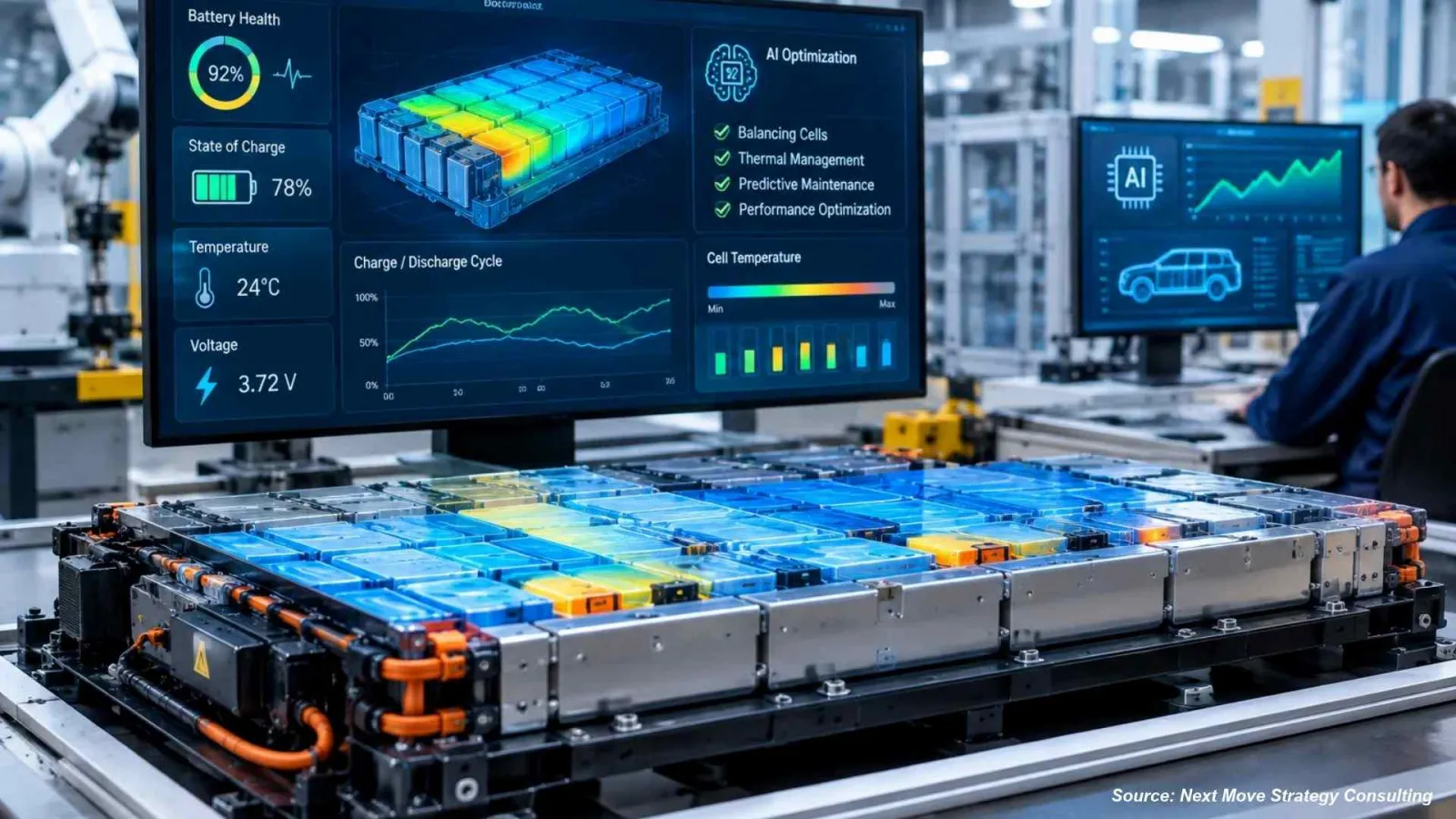
On June 15, 2026, NEXTY Electronics announced that it would support the introduction of Eatron Technologies' AI-based battery software to Japanese automotive manufacturers and Tier 1 suppliers, and ITmedia MONOist reported that several evaluation projects were already under way. The software reads the state, degradation and remaining life of a lithium-ion pack by running alongside the vehicle's existing battery management system rather than replacing it. The announcement is modest in headline terms, yet it captures the shift now defining the AI-optimized battery management market: intelligence that once lived in cloud analytics is moving into the control layer of the battery itself.
NextMSC primary research and analysis tracks this shift in its AI-Optimized Battery Management Market report, which covers solutions and services, motive and stationary batteries, four battery chemistries, three system topologies, cloud and on-premises deployment and six end-user groups across 28 countries, with 2024 as the base year and 2025 to 2030 as the forecast period. NextMSC profiles ten companies in the report, including Eatron Technologies, NXP Semiconductors and Huawei Digital Power.
For More Information: Download FREE Sample on AI-Optimized Battery Management Market Report
From Cloud Dashboards to Battery Silicon: How Edge AI Is Redefining Pack Intelligence
International Energy Agency Global EV Outlook 2026: Battery Management Becomes a Software Priority
The International Energy Agency's Global EV Outlook 2026, released in May 2026, gives the clearest macro context for this shift. Electric car sales grew by 20% in 2025 to exceed 20 million units, equal to one-quarter of all new cars sold, and the agency expects 23 million in 2026, or 28% of total car sales. Global sales in the first quarter of 2026 were around 3.9 million, 8% lower than a year earlier, mainly because of policy changes in China and the United States. Europe's first-quarter sales still rose by close to 30%, and Asia Pacific countries excluding China recorded 80% growth. Every one of those vehicles carries a battery pack whose usable life depends on how accurately its control software estimates charge, temperature and ageing.
What makes the 2026 edition different is a new section on automotive software and artificial intelligence. The International Energy Agency states that battery electric vehicles are currently the most advanced software-defined vehicles, built on centralised control architectures that can be updated remotely, and it names advanced driver assistance and EV battery management improvements as key applications of that architecture. For battery management vendors the combination matters: pack intelligence is now treated as a software layer that can be improved after the vehicle is sold, which is the commercial premise behind AI-based estimation.
Eatron Technologies and NEXTY Electronics: AI Software on Top of Existing Battery Hardware
The NEXTY Electronics announcement of June 15, 2026, as reported by ITmedia MONOist, concerns software from Eatron Technologies, a company based in the United Kingdom. The software uses AI to make battery condition visible and to predict degradation and lifetime for lithium-ion packs. According to the ITmedia MONOist report, it connects with existing battery management systems, physical models and customers' own algorithms, and it analyses state of charge and degradation in real time. Evaluation projects are already running with Japanese automotive manufacturers and Tier 1 suppliers.
The engineering problem explains why buyers are testing it. The internal state of a battery cannot be observed directly, so a control system must infer it from limited measurements, and battery behaviour changes with operating conditions and ageing, as the ITmedia MONOist report explains. An AI layer that learns those changes from field data corrects the drift that fixed lookup tables accumulate over a pack's life. Because it sits on top of existing hardware, it also lowers the switching cost for an automaker that has already validated a battery management unit.
A peer-reviewed review published by Frontiers in Batteries and Electrochemistry on July 17, 2026 points in the same direction from the research side. Mohammad Waseem's review examines how AI and machine learning integrate with battery state estimation, thermal management, fault diagnosis, intelligent charging, edge computing and cloud-based battery ecosystems. It concludes that combining AI-driven estimation with thermal management, safety control and cell balancing is essential for improving reliability and lifespan, and it notes growing emphasis on hybrid AI models, predictive analytics and deep learning rather than any single algorithm.
Huawei Digital Power at SNEC 2026: Battery Management Moves Into the Storage Plant Controller
On June 3, 2026, Huawei Digital Power launched a new generation of smart string grid-forming power conversion systems at SNEC 2026 in Shanghai, according to ESS News on June 9, 2026. The unit combines power conversion hardware, plant-level controls and AI-based energy management in one platform. It is designed as a core control unit for storage plants that integrates battery management with grid-stability functions, its wide voltage range supports lithium-ion, sodium-ion and other chemistries, and Huawei promotes a 4S architecture linking the power conversion system, battery management system, energy management system and thermal management system.
Huawei also presented an updated FusionSolar Agent architecture that moves from a digital platform approach to an energy-domain AI agent model. Zhou Tao, president of Huawei Digital Power's Smart PV & ESS product line, described the new unit as "an intelligent brain for energy storage plants" at the June 3, 2026 launch, as reported by ESS News. At the International Digital Energy Expo in Shanghai from September 15 to 17, 2026, Huawei Digital Power continued the theme with a grid forming and AI presentation that included a 241 kWh commercial and industrial hybrid-cooling grid-forming storage system, according to its press release of September 20, 2026.
The stationary side matters for market definition. A storage plant treats its batteries as a financial asset, so degradation forecasting and fault diagnosis translate directly into dispatch decisions and warranty exposure. Placing battery management inside the plant controller, as Huawei Digital Power describes, moves AI-optimized battery management from a pack-level feature to a plant-level operating layer.
Semiconductor Earnings: NXP Semiconductors and Analog Devices Show Where Silicon Demand Sits
NXP Semiconductors reported second-quarter 2026 results on July 28, 2026, for the quarter that ended June 28, 2026. Revenue was USD 3,496 million, up 19% year on year, with automotive revenue of USD 1,938 million, up 12%, and industrial and IoT revenue of USD 755 million, up 38%. Rafael Sotomayor, NXP's president and chief executive officer, said in the company's July 28, 2026 press release that "AI is moving from the cloud into the physical world", naming vehicles, factories and robots as destinations. Automotive is the largest end market in the NXP revenue mix, which is where battery electronics and software-defined vehicle content concentrate.
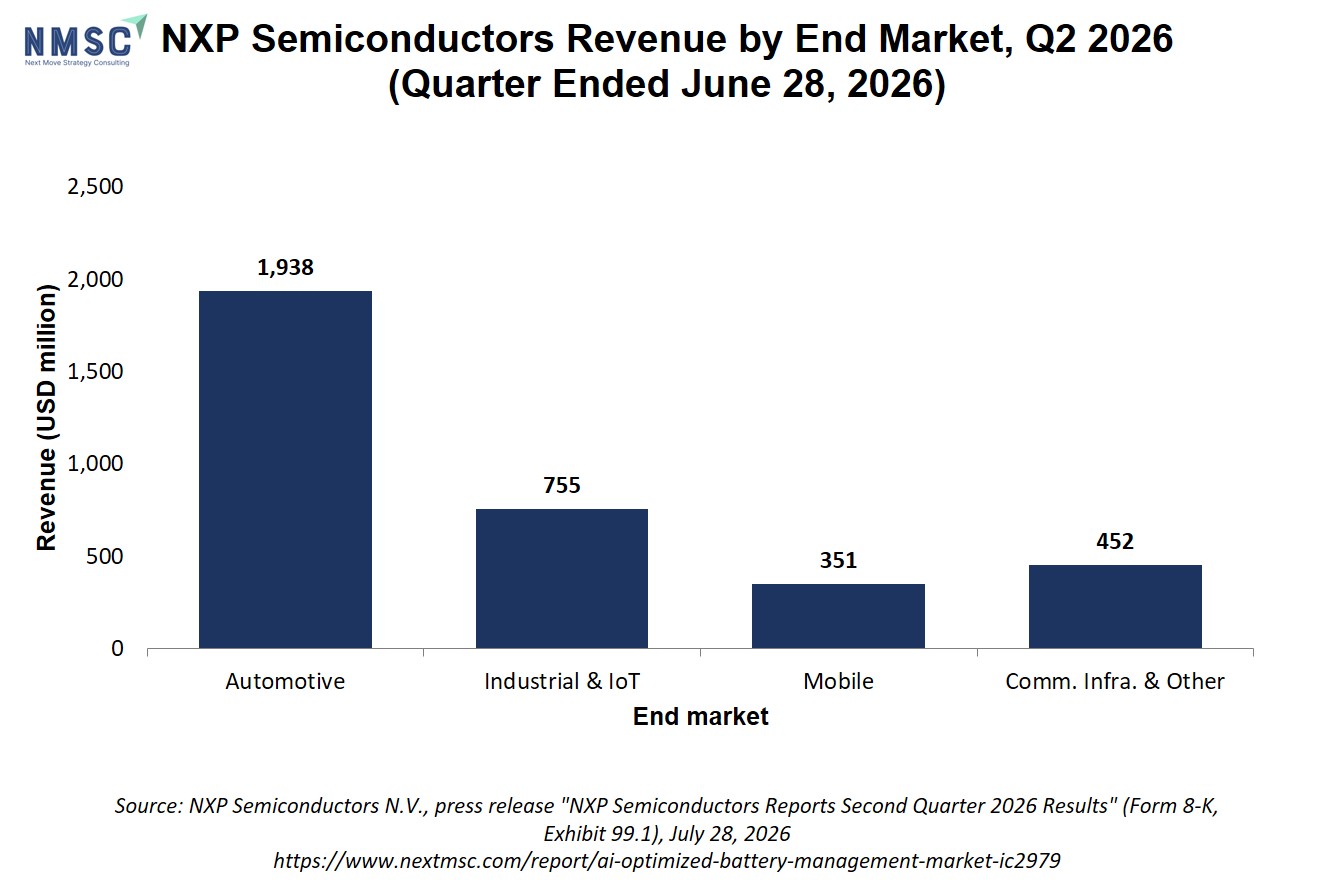
NXP Semiconductors reported automotive revenue of USD 1,938 million for the quarter ended June 28, 2026, ahead of industrial and IoT at USD 755 million, communications infrastructure and other at USD 452 million and mobile at USD 351 million. The four end markets sum to the company's total quarterly revenue of USD 3,496 million. The data is historical and comes from NXP Semiconductors' press release of July 28, 2026.
Analog Devices reported fiscal third-quarter 2026 results on August 19, 2026, for the quarter that ended August 1, 2026. Revenue was USD 4,021.9 million, up 40% year on year. Industrial accounted for 49% of revenue, automotive for 25%, communications for 16% and consumer for 10%. A year earlier automotive represented 30% of revenue, so its share fell even though automotive revenue grew 16% to USD 998.2 million, because data center demand lifted communications revenue by 84%. On the earnings call, Analog Devices management tied automotive growth to content gains in electric powertrains and driver assistance.
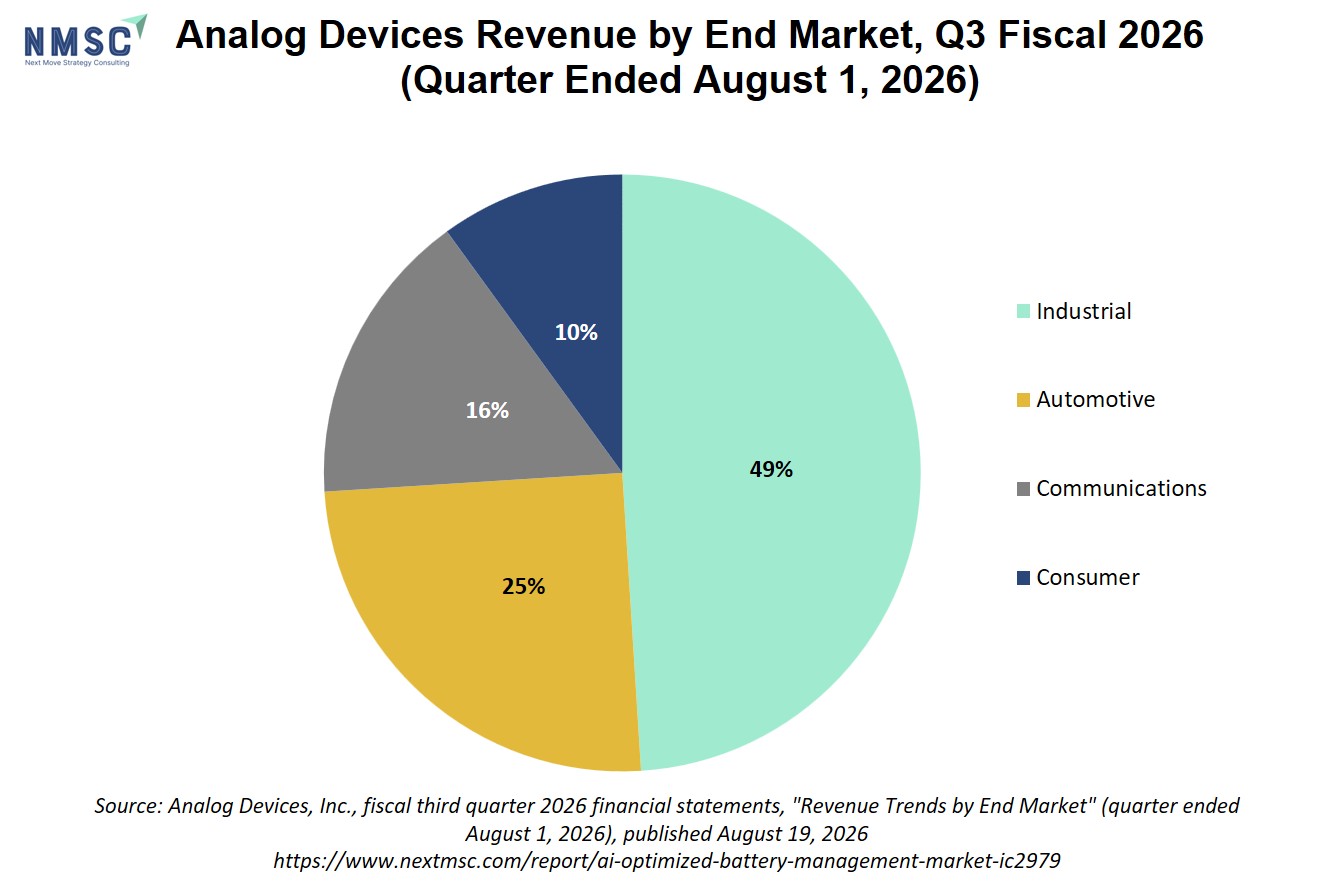
Analog Devices reported that industrial accounted for 49% of revenue in the quarter ended August 1, 2026, followed by automotive at 25%, communications at 16% and consumer at 10%. In the year-earlier quarter automotive represented 30% of revenue. The shares are the rounded percentages published in the company's financial statements of August 19, 2026.
NMSC Strategic Perspective: Why the AI-Optimized Battery Management Market Is Becoming a Hardware and Software Contest
NextMSC primary research and analysis identifies three developments in 2026 as the clearest evidence of how competition is being restructured: the NEXTY Electronics and Eatron Technologies deployment model for Japanese automakers, Huawei Digital Power's integration of battery management into the storage plant controller, and the supplier results from NXP Semiconductors and Analog Devices showing automotive electronics growing alongside faster AI-driven end markets. Each moves value away from standalone battery management units and toward the software that interprets battery data.
Based on the segmentation in the NextMSC report, this has direct consequences for how the market is read. The solutions component, which includes analytics and lifecycle management, gains weight relative to services as software layers are sold on top of installed hardware. The split between centralised, modular and distributed topologies becomes less about electronics architecture and more about where inference runs: in the cloud, in a domain controller or on the cell-monitoring chip.
Section Summary:
Four 2026 developments show that battery intelligence is shifting from standalone control units to software layers and plant-level controllers.
-
The International Energy Agency's May 2026 outlook treats EV battery management as a core application of software-defined vehicles.
-
NEXTY Electronics' June 15, 2026 announcement places Eatron Technologies' AI software on top of existing battery management systems at Japanese manufacturers.
-
Huawei Digital Power's June 3, 2026 launch integrates battery management into an AI-enabled storage plant controller.
-
NXP Semiconductors and Analog Devices report automotive growth of 12% and 16% respectively, alongside faster growth in AI-driven end markets.
Industry Impact Analysis
EU Battery Passport: Data Obligations That Raise the Value of the AI-Optimized Battery Management Market
The European Commission's updated guidance document, "Digital Batteries Passport: data points by category", appeared in August 2026 and lists 71 data points for the passport, ten of which are marked not to be filled in February 2027, according to the Battery-Tech Network's assessment of the document. Under Regulation (EU) 2023/1542 the passport becomes mandatory on February 18, 2027 for electric vehicle batteries, light means of transport batteries and industrial batteries above 2 kWh. Its data includes state of health, which is updated across the service life of a battery rather than recorded once at manufacture.
The Battery-Tech Network adds that the guidance defines state of health for an electric vehicle battery as a single value, the state of certified energy, whereas a light means of transport battery reports five parameters. A state-of-health value that must stay current for the life of a battery has to come from somewhere, and the battery management system is the component that measures the voltage, current and temperature behind it. Estimation accuracy therefore becomes a compliance asset as well as a performance feature, which strengthens the case for AI-based state estimation in packs sold into Europe, where the International Energy Agency reports that electric cars reached 28% of car sales in 2025.
Automotive: Volume, Fast Charging and Heavy-Duty Duty Cycles
The International Energy Agency projects that, without any new policy announcements, the global EV fleet grows more than sixfold by 2035 from 2025 levels, to as many as 510 million vehicles excluding two- and three-wheelers. The agency also reports that the first 1,000-volt models came out in 2025 and that announcements of charging times under 10 minutes continued into 2026. NextMSC primary research and analysis notes that faster charging raises the demands placed on state estimation and thermal control, because cells spend more time near their limits.
Heavy-duty vehicles add a second pressure. The International Energy Agency reports that electric truck sales more than doubled in 2025 and reached 9% of all truck sales worldwide, with one in four trucks sold in China being electric and CATL supplying 80% of the batteries. NextMSC primary research and analysis reads those long, repeated duty cycles as a reason fleet operators adopt predictive battery software.
Stationary Storage and Grid Services
In stationary storage, the Huawei Digital Power launch shows suppliers bundling battery management with power conversion, energy management and thermal management. The International Energy Agency adds that the first commercial vehicle-to-grid offers for private EV owners appeared in 2025, although few V2G-capable models exist, regulation is fragmented and standards are not yet clear. Every flexible use of a battery, whether smart charging or exporting power to the grid, depends on knowing how much usable energy a pack holds and how a given duty cycle affects its ageing.
Section Summary:
Regulation, vehicle volumes and storage economics all raise the value of accurate battery state data.
-
The EU battery passport from February 18, 2027 requires state of health that stays current through a battery's service life.
-
The International Energy Agency projects an EV fleet of up to 510 million vehicles by 2035 without new policy announcements.
-
Electric trucks reached 9% of global truck sales in 2025, adding demanding duty cycles for predictive software.
-
Plant-level controllers such as Huawei Digital Power's move battery management closer to dispatch and revenue decisions.
Pros and Cons of Recent Market Developments
|
Pros |
Cons |
|
Software layers such as Eatron Technologies' work with existing battery management systems, reducing switching cost for automakers. |
The ITmedia MONOist report describes evaluation projects only, so commercial volumes remain unproven. |
|
Plant-level integration, as in Huawei Digital Power's June 2026 launch, ties battery management to dispatch and thermal control. |
The International Energy Agency warns that more semiconductors mean more reliance on geographically concentrated supply chains. |
|
The EU battery passport from February 18, 2027 makes accurate, continuously updated state of health a requirement. |
Passport data is fragmented across suppliers, and ten of 71 data points are marked not to be filled in February 2027. |
|
Supplier results show automotive revenue growing 12% at NXP Semiconductors and 16% at Analog Devices. |
Analog Devices' automotive share of revenue fell from 30% to 25% as other AI-driven end markets grew faster. |
Key Data & Statistics
Table 1: Electric vehicle indicators from the Global EV Outlook 2026
|
Indicator |
Figure |
Period |
|
Growth in global electric car sales |
20% |
2025 |
|
Global electric car sales |
More than 20 million units |
2025 |
|
Electric share of new car sales, Europe |
28% |
2025 |
|
Global electric car sales, first quarter |
Around 3.9 million units, 8% lower year on year |
Q1 2026 |
|
Expected global electric car sales |
23 million units, 28% of car sales |
2026 |
|
Electric truck share of global truck sales |
9% |
2025 |
|
China's share of battery cell production |
Over 80% |
2025 |
|
Global EV fleet without new policies |
Up to 510 million vehicles |
2035 |
Table 2: Automotive revenue at two battery-electronics suppliers
|
Company and period |
Total revenue |
Automotive revenue |
Automotive growth, year on year |
|
NXP Semiconductors, Q2 2026 (ended June 28, 2026) |
USD 3,496 million |
USD 1,938 million |
12% |
|
Analog Devices, Q3 fiscal 2026 (ended August 1, 2026) |
USD 4,021.9 million |
USD 998.2 million |
16% |
Future Outlook & Forecast
What Will Shape the AI-Optimized Battery Management Market Through 2030
The International Energy Agency expects global electric car sales to reach 23 million in 2026, with Europe projected to grow by around 20% and one in three cars sold there being electric. China is set to reach almost 60% of total car sales, and sales across Asia Pacific countries other than China are expected to grow by over 50%. Latin America is projected to rise by 45%. NextMSC's own forecast period for the market runs from 2025 to 2030, with 2024 as the base year.
Three dated milestones frame the next phase. The first is February 18, 2027, when the EU battery passport becomes mandatory and state of health must be maintained for the life of covered batteries. The second is the maturing of edge deployments such as the Eatron Technologies evaluation projects in Japan, whose results will show whether AI estimation can be validated across several automakers. The third is standardisation in vehicle-to-grid, which the International Energy Agency describes as unclear today and which determines whether flexible battery use becomes a mainstream data source.
NextMSC primary research and analysis attributes growth in the market to expanding EV adoption, rising renewable energy capacity and the consumer electronics sector, and it identifies high cost and integration issues as the main restraints. Solid-state batteries and IoT and 5G connectivity are the technology shifts the NextMSC report highlights for later in the forecast period. The 2026 evidence adds a regulatory and a supplier dimension to those drivers: the passport raises the value of accurate battery data, and large semiconductor vendors are positioning edge intelligence as a growth area.
Section Summary:
Near-term outlook depends on vehicle volumes, regulatory dates and the validation of edge deployments.
-
The International Energy Agency expects 23 million electric car sales in 2026, equal to 28% of total car sales.
-
February 18, 2027 is the fixed date for the EU battery passport.
-
Edge deployments need multi-manufacturer validation before AI estimation becomes standard practice.
-
Vehicle-to-grid standards remain unclear, which limits flexible battery use at scale.
Next Steps for Stakeholders
For automotive manufacturers and Tier 1 suppliers, the NEXTY Electronics and Eatron Technologies model suggests a low-risk entry route: test AI estimation as a software layer on a validated battery management unit, and measure it against the accuracy and state-of-health reporting the EU passport will require from February 18, 2027.
For storage developers and operators, the Huawei Digital Power architecture raises a vendor question: whether battery management, power conversion and energy management should come from one supplier or remain separable. Operators should require degradation forecasting and fault diagnosis to be auditable, because those outputs feed dispatch and warranty decisions.
For investors, the supplier results from NXP Semiconductors and Analog Devices show automotive electronics growing at 12% and 16% while other AI-driven end markets grow faster. Diligence should separate battery intelligence revenue from broader automotive demand and look for multi-customer deployments beyond evaluation stage.
-
Pilot AI state estimation on existing battery management hardware and benchmark it against passport data requirements.
-
Specify where inference runs, cloud, domain controller or on-pack chip, and document the security controls for each.
-
Ask storage vendors for auditable degradation forecasts tied to warranty terms.
-
Track conversion of evaluation projects into volume contracts as the key adoption signal.
Conclusion
The ai-optimized battery management market is being reshaped by three forces that all surfaced between May and September 2026: software-defined vehicle architectures described by the International Energy Agency, product launches from Huawei Digital Power and Eatron Technologies that move intelligence closer to the battery, and a European passport regime that makes continuously updated state of health a legal requirement from February 18, 2027. Supplier results from NXP Semiconductors and Analog Devices confirm that automotive electronics are growing, while showing that AI-driven demand elsewhere is growing faster. The commercial question for 2027 is whether evaluation projects convert into volume deployments, and the NextMSC report provides the segmentation needed to follow that conversion by component, battery type, topology, deployment model and end user.
About the Author
 Priyanshu Das
— Priyanshu Das is SEO Executive at Next Move Strategy Consulting, where he has led on-page and off-page SEO, keyword research, and SEO audits for the firm's B2B market research publications for 2 years. His audit process combines technical crawl analysis, backlink profile review, and competitor keyword gap mapping — using tools including Screaming Frog and Google Search Console — to prioritize fixes by organic search-visibility impact, informed by his own prior in-house and agency SEO experience.
About the Reviewer
 Sanyukta Deb
— Sanyukta Deb is Digital Marketing Team Lead at Next Move Strategy Consulting, where she has led content strategy and technical SEO for the firm's B2B market research publications for over 2 years. Her editorial process translates NextMSC's primary and secondary research — spanning technology, industrial, and consumer sectors — into commercial narratives, backed by search-intent, keyword, and competitive analysis. She brings 5 years of overall experience in digital marketing and content strategy.
















Add Comment