How AI and Regulation Are Reshaping the Light-Cargo Robot Market | NextMSC
Introduction
The global light-cargo robot market is undergoing a structural transformation — one driven not merely by incremental technology upgrades, but by a convergence of regulatory realignment, geopolitical supply-chain reconfiguration, and the accelerating demands of e-commerce fulfillment. According to Next Move Strategy Consulting's Light-Cargo Robot Market report, the global light-cargo robot market is projected to reach USD 85.03 billion by 2030, growing at a CAGR of 24.7% from 2024 to 2030. This trajectory places light-cargo robotics among the fastest-scaling segments in industrial automation — and recent regulatory and commercial developments are accelerating the pace of change in ways that demand immediate strategic attention from operators, investors, and policymakers alike.
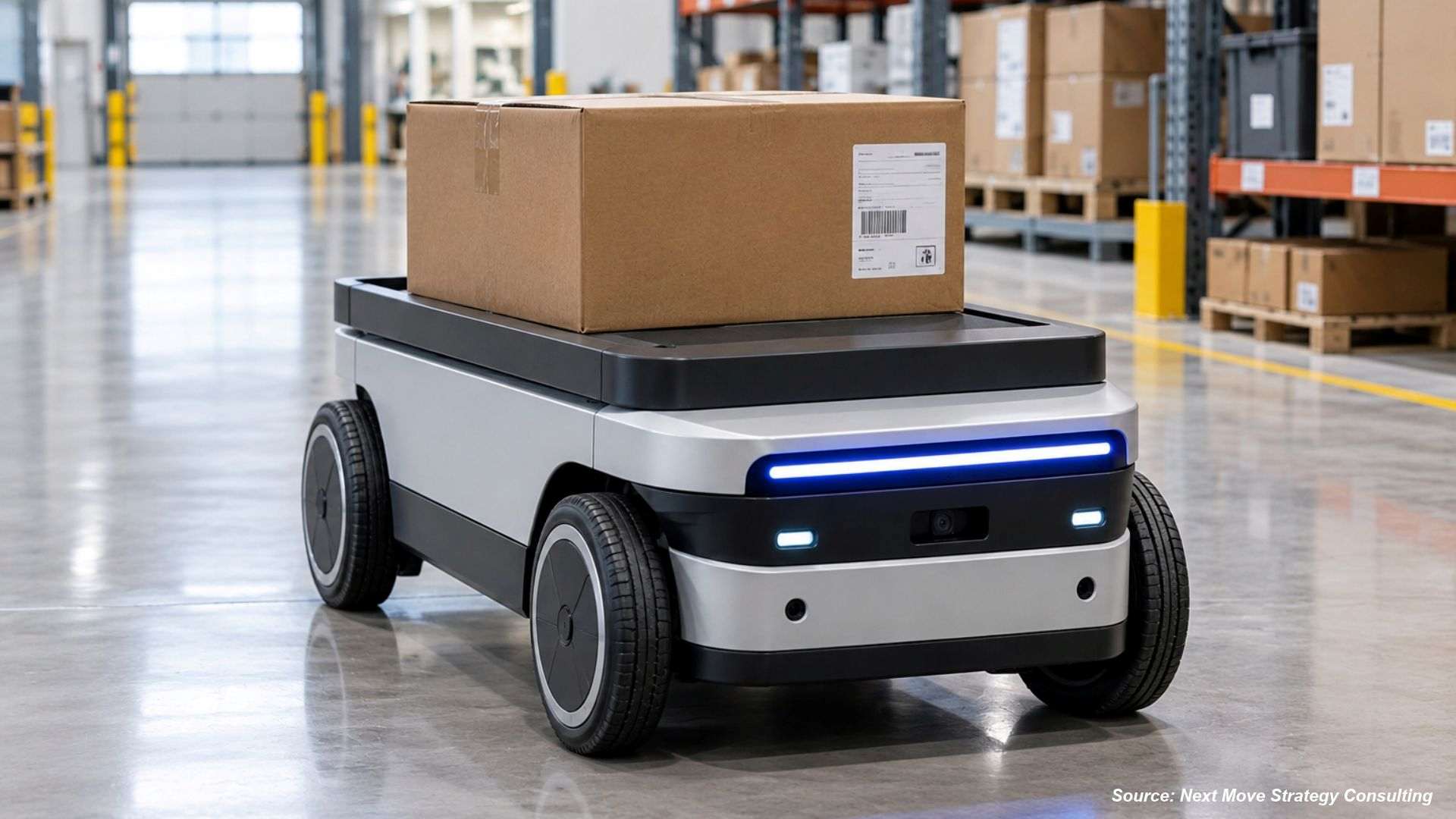
Light-cargo robots — compact, autonomous vehicles equipped with sensors, cameras, and mapping technology to transport goods across warehouses, factories, hospitals, and retail environments — are no longer peripheral tools. They are becoming the operational backbone of modern logistics infrastructure. The question for C-level decision-makers is no longer whether to deploy them, but which platforms, under which regulatory frameworks, and with which supply-chain partners.
For More Information: Download FREE Sample on Light-Cargo Robot Market Report
The FCC's July 2026 Ruling: A Geopolitical Fault Line Runs Through the Warehouse Floor
The Regulatory Event That Redrew the Competitive Map
On July 28, 2026, the U.S. Federal Communications Commission (FCC) added foreign-manufactured advanced robotic devices — explicitly including autonomous mobile robots (AMRs) — to its national-security Covered List under the Secure Networks framework. The action followed a determination by U.S. national security agencies that certain foreign-produced advanced robotic devices pose unacceptable risks to U.S. national security.
The practical implications are significant and immediate:
-
New models from foreign-manufactured systems can no longer receive the FCC equipment authorization required for importation, marketing, or sale in the United States.
-
The restrictions apply based on where a product is manufactured, not the nationality of the company's headquarters — meaning European and Asian firms with Chinese manufacturing operations are equally affected.
-
Industrial robots (articulated, Cartesian, SCARA, and parallel types) are explicitly excluded from the ruling; the restrictions target mobile, ground-based robots capable of autonomous navigation, perception, data collection, and remote command and control — the precise technical profile of light-cargo AMRs and AGVs.
-
A Conditional Approval pathway exists, requiring manufacturers to disclose corporate ownership, supply chains, software architecture, and cybersecurity controls to U.S. authorities.
The International Federation of Robotics (IFR) has confirmed it is monitoring the ruling and has prepared a detailed fact sheet for member companies on scope, covered products, and the Conditional Approval process.
This ruling follows a documented pattern of U.S. regulatory action against Chinese-manufactured networked technology embedded in critical infrastructure — from Huawei telecommunications equipment to DJI drones to ZPMC port cranes. In each prior category, the first formal regulatory step was followed by tightening restrictions. Warehouse robotics is the newest category in this sequence.
The strategic implication for the light-cargo robot market is direct: U.S. operators currently running foreign-manufactured AMR fleets face procurement uncertainty, while domestic and FCC-compliant manufacturers gain a structural competitive advantage that is regulatory in origin, not merely technological.
NMSC Strategic Perspective: Regulatory Disruption as a Market Accelerator
The FCC ruling does not suppress demand for light-cargo robots — it redirects it. NextMSC primary research and analysis indicates that regulatory-driven supply-chain realignment of this nature historically compresses procurement timelines, as operators accelerate migration decisions to avoid being caught mid-deployment with non-compliant systems. Three dynamics are now simultaneously in play:
-
Domestic and FCC-compliant manufacturers gain addressable market share. U.S.-headquartered and domestically manufactured AMR and AGV platforms — including those from key market players such as Omron Corporation and others with U.S.-based manufacturing — are positioned to absorb demand displaced from foreign-manufactured systems. Omron demonstrated its next-generation LD-150 and LD-300 AMRs at Automate 2026 in June, signaling continued product investment in the U.S. market.
-
The Robot-as-a-Service (RaaS) model gains urgency. Operators reluctant to commit capital to a fleet that may require replacement are accelerating adoption of RaaS subscription models, which transfer compliance risk to the vendor. The IFR's World Robotics 2026 Service Robots report confirms that RaaS business models continued to grow in popularity in 2025, with the U.S. already representing the dominant RaaS market for transportation and logistics robots.
-
Asia-Pacific demand remains structurally unaffected. The FCC ruling applies exclusively to the U.S. market. China's 15th Five-Year Plan (2026–2030) has placed robotics at the heart of its modern industrial system, explicitly targeting physical AI applications with robots as the primary driver of economic growth. This sustains the Asia-Pacific region's dominant position in the global light-cargo robot market — a position NMSC proprietary research identifies as the leading regional segment through the forecast period.
Section Summary: The FCC's July 2026 ruling is the most consequential single regulatory event to affect the light-cargo robot market in the current forecast cycle. It does not reduce total addressable market size — it restructures who captures it, on what timeline, and under what compliance conditions.
Key Takeaways:
-
Foreign-manufactured AMRs can no longer receive FCC equipment authorization for new U.S. market entry as of July 28, 2026.
-
The ruling applies based on manufacturing location, not company nationality — affecting a broad range of global vendors.
-
Domestic and FCC-compliant manufacturers gain a structural market advantage in the U.S., the world's second-largest robotics market.
-
Asia-Pacific demand, driven by China's 15th Five-Year Plan, remains unaffected and continues to anchor global market growth.
Industry Impact Analysis
Transportation and Logistics Robots: The Dominant Application Class
The IFR's World Robotics 2026 Service Robots report — published in September 2026 — confirms that transportation and logistics remained the leading application for professional service robots in 2025, with 117,500 units sold, representing a 21% year-on-year increase and a 47% market share of all professional service robot installations. This is the precise application class that encompasses light-cargo robots deployed in warehouses, distribution centers, and manufacturing facilities.
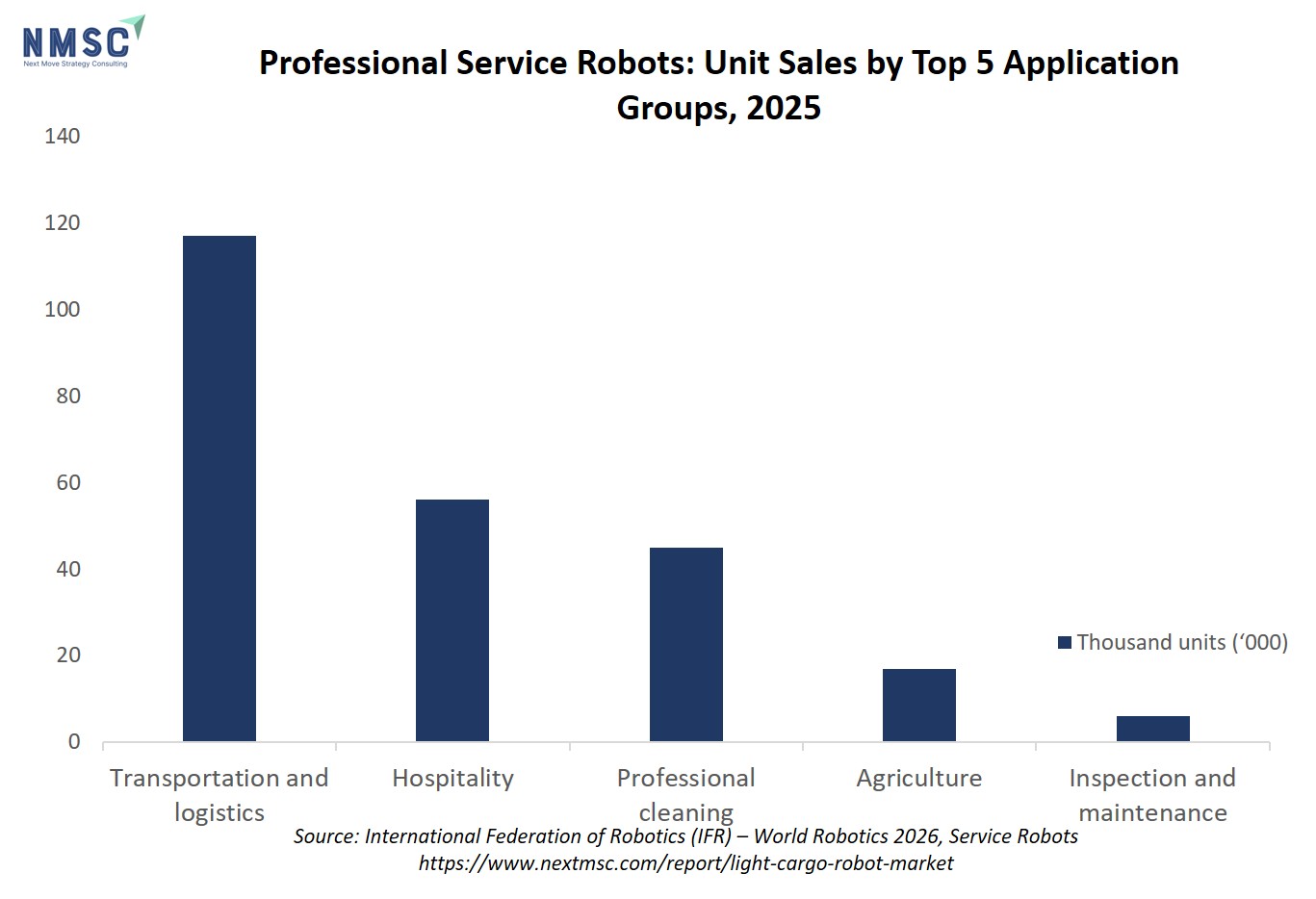
The broader professional service robot market grew 24% to nearly 250,000 units in 2025, according to IFR President Jane Heffner, who stated: "Service robots are expanding into everyday operations." This growth rate is consistent with NMSC's proprietary 24.7% CAGR projection for the light-cargo robot segment specifically.
Labor Shortages as a Structural Demand Driver
The IFR's position paper on service robots identifies labor shortages as the strongest driver of service robot adoption globally. Aging populations and declining birth rates are reducing available workforces in key economies — the United States, Japan, Germany, South Korea, and China — while demand for logistics, healthcare, and manufacturing services continues to grow.
This structural dynamic is particularly acute in warehouse and distribution center operations. DHL, for example, announced deployment of over 1,000 additional robots to support growth in e-commerce and life sciences fulfillment — a direct response to labor availability constraints rather than cost optimization alone.
AI Integration: From Programmed Routes to Adaptive Navigation
The IFR's Top 5 Global Robotics Trends for 2026 identifies AI and autonomy as the primary technology driver reshaping the robotics sector. Specifically, the convergence of Information Technology (IT) and Operational Technology (OT) — the integration of data-processing power with physical control capabilities — is enabling light-cargo robots to move from fixed-route AGV configurations to fully adaptive AMR deployments capable of real-time path optimization, obstacle avoidance, and fleet-level orchestration.
ABB, one of the key players in the light-cargo robot market, expanded AI-powered autonomy to its Flexley Mover mobile robot platform and opened a dedicated Autonomous Mobile Robotics training and showroom facility in June 2025 — a capital commitment that signals sustained product investment in the AMR segment.
Industrial Robot Installations: The Macro Context
The global operational stock of industrial robots surged 9% to a record 5 million units in 2025, driven by an 11% jump in annual installations to over 600,000 units — the first time this milestone has been surpassed. China accounted for 59% of global deployments, with 354,000 industrial robots installed in 2025 alone. The United States surpassed Japan to become the second-largest market, with installations growing 12% to approximately 38,500 units.
This macro expansion of industrial automation directly expands the addressable market for light-cargo robots, which serve as the intralogistics connective tissue between automated production cells, storage systems, and shipping zones.
The Barcelona Declaration: A Policy Framework for Acceleration
In July 2026, A3 (United States), IFR, VDMA Robotics + Automation (Germany), and AER Automation (Spain) formally signed the Barcelona Declaration on Robotics and Automation 2026 — a permanent international framework committing these organizations to work jointly with governments to advance policies that foster robotics development and adoption. The Declaration's 10 priorities include national robotics strategies, tax incentives for automation investment, and smart regulation that avoids unnecessary costs. This policy alignment across the world's three largest robotics markets creates a favorable regulatory environment for light-cargo robot adoption beyond the U.S. FCC ruling's immediate disruption.
Section Summary: The light-cargo robot market is being shaped by three simultaneous forces: a structural labor shortage that makes automation economically necessary, an AI-driven technology shift that makes AMRs operationally superior to legacy AGVs, and a geopolitical regulatory environment that is actively restructuring supply chains and vendor relationships.
Key Takeaways:
-
Transportation and logistics robots sold 117,500 units in 2025 — a 21% increase — confirming the light-cargo segment's position as the dominant professional service robot application.
-
Labor shortages in key economies are converting automation from a cost-optimization tool into an operational necessity.
-
AI integration is enabling light-cargo robots to handle dynamic, unstructured environments — expanding their addressable application base beyond fixed-route warehouse tasks.
-
The Barcelona Declaration creates a coordinated international policy framework that supports open research information across global academic, scientific, and institutional organizations.
Global Professional Service Robot Shipments by Application — 2025
|
Application |
Units Sold (2025) |
Year-on-Year Growth |
Market Share |
|
Transportation & Logistics |
117,500 |
+21% |
47% |
|
Hospitality |
~42,000+ |
Positive |
~17% |
|
Professional Cleaning |
~25,000+ |
+34% |
~10% |
|
Agricultural |
~19,500 |
-6% |
~8% |
|
Search, Rescue & Security |
~3,100 |
+19% |
~1% |
|
Total Professional Service Robots |
~250,000 |
+24% |
100% |
Global Industrial Robot Installations — Top 5 Markets (2025)
|
Country |
Units Installed (2025) |
Year-on-Year Growth |
Global Share |
|
China |
354,000 |
+20% |
~59% |
|
United States |
~38,500 |
+12% |
~6% |
|
Japan |
36,219 |
-19% |
~6% |
|
Republic of Korea |
~30,000 |
-1% |
~5% |
|
Germany |
~25,000 |
-8% |
~4% |
|
Global Total |
603,000+ |
+11% |
100% |
Future Outlook & Forecast
NMSC Market Trajectory: USD 14.58 Billion to USD 85.03 Billion
NextMSC proprietary research and analysis projects the global light-cargo robot market to expand from USD 14.58 billion in 2023 to USD 85.03 billion by 2030 at a 24.7% CAGR. This growth is underpinned by three structural forces that are not cyclical in nature: the permanent labor shortage in key manufacturing and logistics economies, the irreversible integration of AI into robot navigation and fleet management, and the accelerating volume of e-commerce fulfillment that requires automated intralogistics at scale.
Asia-Pacific: The Demand Engine
Asia-Pacific holds the dominant share of the light-cargo robot market and is expected to maintain this position through 2030. China's 15th Five-Year Plan (2026–2030) has explicitly positioned robotics as the primary driver of economic growth, with a focus on physical AI applications. China's domestic robot manufacturers already hold a 55% domestic market share in industrial robot installations — up from 30% in 2020 — demonstrating the country's capacity to scale production rapidly. The combination of the world's largest e-commerce market, the largest automotive manufacturing base, and an explicit national robotics strategy creates a demand environment that will sustain Asia-Pacific's leadership position throughout the forecast period.
North America: Regulatory Realignment Creates New Growth Vectors
The FCC's July 2026 ruling is expected to accelerate capital deployment toward domestic and FCC-compliant light-cargo robot platforms in the United States. The Association for Advancing Automation (A3) has formally published a "Vision for a National Robotics Strategy" advocating for a Federal Robotics Office, market-driven tax incentives, and a federal mandate to purchase domestic robotics technology. If enacted, these measures would directly expand the addressable market for domestically manufactured light-cargo robots in the U.S. — the world's second-largest robotics market.
Technology Convergence: The AMR Ascendancy
Within the light-cargo robot market, Autonomous Mobile Robots (AMRs) are displacing traditional Automated Guided Vehicles (AGVs) as the preferred platform for new deployments. AMRs' ability to navigate dynamically — using SLAM (Simultaneous Localization and Mapping) technology powered by AI — eliminates the fixed-infrastructure dependency of AGVs and enables deployment in environments where layout changes are frequent. The IFR identifies AI-driven autonomy and the convergence of IT and OT as the top two technology trends shaping robotics in 2026, both of which directly benefit the AMR segment.
The RaaS Model: Lowering the Adoption Barrier
The Robot-as-a-Service model is expanding the addressable customer base for light-cargo robots beyond large enterprises to small and medium-sized operators. The IFR confirms that RaaS business models continued to grow in popularity in 2025, with the U.S. already representing the dominant RaaS market for transportation and logistics robots. As compliance uncertainty around foreign-manufactured systems increases, RaaS contracts with domestic vendors offer operators a mechanism to access automation without long-term capital commitment to platforms that may require replacement.
Section Summary: The light-cargo robot market's 24.7% CAGR through 2030 is supported by structural demand drivers — labor shortages, e-commerce volume growth, and AI-driven technology advancement — that are not subject to cyclical reversal. The FCC ruling adds a regulatory tailwind for domestic manufacturers in the U.S. market, while China's 15th Five-Year Plan sustains Asia-Pacific's dominant position globally.
Key Takeaways:
-
NMSC projects the market to reach USD 85.03 billion by 2030, growing at 24.7% CAGR — one of the highest growth rates in industrial automation.
-
Asia-Pacific will remain the dominant region, anchored by China's national robotics strategy and the world's largest e-commerce market.
-
AMRs are displacing AGVs as the preferred platform, driven by AI-powered adaptive navigation capabilities.
-
The RaaS model is expanding the addressable customer base and accelerating adoption timelines, particularly in the U.S. market following the FCC ruling.
Next Steps for Stakeholders
For C-Level Executives and Operations Leaders:
-
Conduct an immediate fleet compliance audit. If your U.S. operations include foreign-manufactured AMRs or AGVs, determine whether those systems fall within the FCC's July 2026 Covered List definition. Engage legal counsel to assess exposure under the Conditional Approval pathway and establish a migration timeline before procurement pressure forces reactive decisions.
-
Prioritize AMR over AGV in new capital allocations. The technology and regulatory environment both favor AMR platforms. Fixed-infrastructure AGV deployments create long-term inflexibility in an environment where both warehouse layouts and compliance requirements are changing rapidly.
-
Evaluate RaaS contracts as a compliance hedge. For operators uncertain about the long-term regulatory trajectory, RaaS agreements with FCC-compliant domestic vendors transfer technology-refresh and compliance risk to the vendor while maintaining operational access to automation.
-
Align procurement with AI-integration roadmaps. Light-cargo robot platforms that support SLAM navigation, fleet-level AI orchestration, and WMS/WES integration will deliver compounding operational returns as AI capabilities advance. Platforms without these capabilities will require replacement within the forecast period.
For Investors and Capital Allocators:
-
Identify domestic and FCC-compliant AMR manufacturers as priority investment targets. The FCC ruling has created a structural competitive moat for U.S.-manufactured and FCC-compliant platforms that is regulatory in origin and therefore durable. This moat will widen if further restrictions follow — as historical precedent in analogous technology categories suggests they will.
-
Monitor China's 15th Five-Year Plan implementation for Asia-Pacific exposure. Chinese domestic robot manufacturers have demonstrated the capacity to scale rapidly — domestic market share grew from 30% to 55% in five years. Investors with Asia-Pacific exposure should track the pace of humanoid and AMR commercialization under the new plan.
-
Assess RaaS business model scalability. The shift from capital sales to subscription revenue in the light-cargo robot market creates more predictable revenue streams and higher customer lifetime value. Vendors with established RaaS platforms in the U.S. market are positioned to capture disproportionate share of the compliance-driven migration demand.
Conclusion
The global light-cargo robot market is not simply growing — it is being restructured. The FCC's July 2026 ruling has introduced a geopolitical dimension to procurement decisions that operators and investors cannot afford to treat as a peripheral compliance matter. It is a market-shaping event that will determine which vendors capture the U.S. market's share of a USD 85.03 billion global opportunity by 2030.
At the same time, the structural demand drivers — labor shortages, e-commerce volume, and AI-driven operational efficiency — remain intact and are accelerating. The IFR's confirmation that transportation and logistics robots sold 117,500 units in 2025 at a 21% growth rate, combined with NMSC's proprietary 24.7% CAGR projection, presents a consistent and credible picture of sustained market expansion.
For decision-makers, the imperative is clear: the light-cargo robot market rewards early movers who align their platform choices, vendor relationships, and capital allocation with the regulatory and technological realities now in place — not those anticipated two years ago. The window for proactive positioning is open. It will not remain so indefinitely.
About the Author
 Sanyukta Deb
— Sanyukta Deb is Digital Marketing Team Lead at Next Move Strategy Consulting, where she has led content strategy and technical SEO for the firm's B2B market research publications for over 2 years. Her editorial process translates NextMSC's primary and secondary research — spanning technology, industrial, and consumer sectors — into commercial narratives, backed by search-intent, keyword, and competitive analysis. She brings 5 years of overall experience in digital marketing and content strategy.
Sanyukta Deb
— Sanyukta Deb is Digital Marketing Team Lead at Next Move Strategy Consulting, where she has led content strategy and technical SEO for the firm's B2B market research publications for over 2 years. Her editorial process translates NextMSC's primary and secondary research — spanning technology, industrial, and consumer sectors — into commercial narratives, backed by search-intent, keyword, and competitive analysis. She brings 5 years of overall experience in digital marketing and content strategy.
About the Reviewer
 Debashree Dey
— Debashree Dey is Assistant Manager at Next Move Strategy Consulting, where she supports cross-vertical market content and communications across diverse industries for 6 years. Her professional background includes senior content writing, communications, and published manuscript authorship, with experience developing audience-focused business narratives and maintaining clear, consistent messaging. Her role supports research-led content development and editorial quality across NextMSC publications.
Debashree Dey
— Debashree Dey is Assistant Manager at Next Move Strategy Consulting, where she supports cross-vertical market content and communications across diverse industries for 6 years. Her professional background includes senior content writing, communications, and published manuscript authorship, with experience developing audience-focused business narratives and maintaining clear, consistent messaging. Her role supports research-led content development and editorial quality across NextMSC publications.

















Add Comment