Challenges and Opportunities in the Agrochemicals Market
Introduction
On October 1, 2026, Corteva completed the spin-off of its seed and genetics business into Vylor Inc. and began operating as a pure-play global crop protection company, according to the company's press release of that date. The separation unbundles a portfolio in which seeds, traits and chemistry were sold together, and it arrives in the same quarter in which the U.S. Supreme Court, Chinese price data and the results of five leading suppliers have all moved the economics of the agrochemicals market at once.
According to Next Move Strategy Consulting's Agrochemicals Market report, the global agrochemicals market was valued at USD 241.36 billion in 2023 and is projected to reach USD 305.01 billion by 2030, growing at a CAGR of 3.4% from 2024 to 2030. That trajectory implies an increase of USD 63.65 billion in annual market value between 2023 and 2030, and the events of the past six months will determine which suppliers capture it.
For More Information: Download FREE Sample on Agrochemicals Market Report
This analysis examines five developments: Corteva's separation, the Monsanto v. Durnell ruling on pesticide labeling, pricing signals from China and Latin America, regulatory and weather effects on European sales, and the demand data published by the Food and Agriculture Organization of the United Nations (FAO). Together they show that growth in agrochemicals no longer depends on acreage and weather alone; ownership structure, litigation exposure and generic competition now shape returns just as strongly.
A Seed-and-Chemistry Giant Splits in Two: How Corteva's October 2026 Separation Redraws the Agrochemicals Market
Corteva Becomes a Pure-Play Crop Protection Company
Corteva's board approved the separation on September 12, 2026, with a record date of September 24, 2026, according to the company's Form 8-K filed with the U.S. Securities and Exchange Commission. The spin-off was consummated on October 1, 2026. Corteva's pro forma financial statements for the new crop protection company show a reduction of USD 3.761 billion in principal indebtedness, net of USD 700 million of newly incurred long-term debt, together with USD 3.499 billion of cash received from Vylor. Corteva's press release adds that its crop protection revenue grew by more than USD 1 billion between 2020 and 2025, and that the company enters its new structure with an USD 11 billion development pipeline that includes 12 new active ingredients, five of them biologicals.
The operating record that the new company inherits is solid but not frictionless. In its second-quarter earnings release of July 30, 2026, Corteva reported crop protection net sales of USD 1,847 million, down 4% from USD 1,919 million a year earlier, because a 4% price decline and a 2% volume decline outweighed a 2% currency benefit. Corteva's Form 10-Q attributes the price decline mainly to the competitive pricing environment in Latin America. Segment operating EBITDA still rose 2% to USD 342 million in the quarter, since cost and productivity actions and favorable currency offset weaker volume and Latin American price pressure. For the first half, net sales rose 3% to USD 3,729 million and segment operating EBITDA rose 9% to USD 776 million.
Peers report the same pattern in sharper form. FMC Corporation reported second-quarter 2026 revenue of USD 867 million, down 17% from the prior year, lowered its full-year revenue guidance to USD 3.50 billion to USD 3.70 billion and listed management of the post-patent transition for Rynaxypyr among its operating priorities, according to its earnings release of July 29, 2026. Syngenta Group, in its first-half results of August 27, 2026, reported crop protection sales of USD 6.6 billion, up 4%, while ADAMA, its post-patent unit, held sales flat at USD 2.1 billion as volume growth in most regions was offset by pricing pressure.
Monsanto v. Durnell: A Federal Label Now Outranks State Warnings
On June 25, 2026, the U.S. Supreme Court ruled 7-2 in Monsanto Co. v. Durnell that the Federal Insecticide, Fungicide, and Rodenticide Act expressly preempts state-law failure-to-warn claims when the U.S. Environmental Protection Agency has made a definitive determination on product safety, according to Bayer's Half-Year Financial Report of August 4, 2026. CNBC reported that the Court reversed and remanded a Missouri judgment in favor of John Durnell, and Chemical & Engineering News noted that EPA has repeatedly concluded glyphosate is not likely to be carcinogenic to humans and has therefore not required a cancer warning on Roundup labels.
The ruling matters to the whole agrochemicals market, not to Bayer alone. CropWatch, published by the University of Nebraska-Lincoln, expects the decision to affect similar failure-to-warn lawsuits involving glyphosate products and other pesticides. Bayer states that the ruling should result in the dismissal of current warning-based claims and foreclose future claims built on state failure-to-warn theories, which make up the vast majority of claims in the litigation to date. The legacy cost remains visible: Bayer's payments to resolve legal proceedings, largely PCB and glyphosate matters, produced a net operating cash outflow of EUR 2,246 million in the first half of 2026, including EUR 432 million paid into a trust fund under the class settlement. In July 2026 Bayer also consolidated its U.S. glyphosate business into Ruveon LLC, a St. Louis unit that stays within the Bayer Group and is solely responsible for glyphosate in the United States.
Pricing Is the Real Battleground: Generics, Chinese Technicals and Latin American Discounting
Price signals now diverge by molecule. Bayer reports that second-quarter sales of glyphosate-based products rose 12.6% to EUR 734 million on higher volumes and prices, led by Europe, the Middle East and Africa, while sales of its non-glyphosate herbicides fell because of lower North American prices amid ongoing generic pressure. China's National Bureau of Statistics recorded 95% glyphosate technical at 28,250.0 yuan per tonne in its survey of September 21-30, 2026, published on October 9, 2026, up 4.3% on the previous ten-day period and following a 6.4% rise to 27,092.9 yuan per tonne in mid-September, as reported by Global Agriculture on October 12, 2026. Over the same period the bureau's four tracked fertilizer prices all fell: small and medium granule urea by 1.3%, 55% monoammonium phosphate by 3.8%, 62% white muriate of potash by 0.5% and 45% NPK compound by 0.3%.
Latin America remains the pressure point for volume suppliers. Corteva ties its price decline to competition in the region, and FMC attributes its lower guidance to a more challenging operating environment and customer purchasing patterns. UPL shows the other side of the same market. Its first-quarter fiscal 2027 revenue rose 10% to INR 10,181 crore with pricing contributing 3%, and regional revenue grew 15% in India to INR 2,602 crore, 18% in North America to INR 1,582 crore, 8% in Latin America to INR 2,603 crore and 4% in Europe to INR 1,598 crore, according to the company's results of August 3, 2026.
NMSC Strategic Perspective: Specialization Is Replacing Scale as the Source of Margin
NextMSC primary research and analysis reads these developments as a shift from portfolio breadth to portfolio specialization. Once an active ingredient loses patent protection, generic suppliers set its price, and the originator's earnings depend on replacing that revenue with new actives. Corteva's separation, FMC's management of the Rynaxypyr transition and ADAMA's trade of price for volume all illustrate that mechanism. NMSC's model projects growth of 3.4% annually through 2030 for the agrochemicals market, a pace that rewards suppliers who hold price in differentiated chemistries rather than those competing in off-patent actives.
The projection also needs to be read against external benchmarks. Bayer estimates, as of July 2026, that the combined global seed and crop protection market will be flat or grow by 0% to 3% in 2026, a broader scope that includes seed and traits. NMSC's agrochemicals-only model, which applies top-down and bottom-up estimation, projects a 3.4% CAGR over 2024 to 2030. NMSC's report identifies Asia Pacific as the region holding the dominant market share, supported by population growth, urbanization, government subsidies and climate-driven pest pressure, and names the shift toward organic farming and tighter residue limits as the principal restraint on conventional products.
The strategic implication is that value migrates toward three pools: patent-protected new actives, biologicals and locally registered formulations. Corteva's pipeline of 12 new actives and Syngenta Crop Protection's almost 900 new registrations, re-registrations and label extensions in the first half of 2026 show where leading suppliers are placing capital.
Section Summary:
Corteva's separation, a federal ruling on pesticide labels and divergent pricing have turned portfolio composition into the main competitive variable.
-
Corteva became a pure-play crop protection company on October 1, 2026, with an USD 11 billion pipeline and a reduced debt load in its pro forma accounts.
-
The June 25, 2026 Supreme Court ruling in Monsanto v. Durnell narrows state-level failure-to-warn exposure for registrants whose labels follow EPA determinations.
-
Glyphosate pricing is recovering while off-patent herbicides and Latin American volumes remain under generic pressure.
Industry Impact Analysis: Litigation, Regulation and Trade Flows in the Agrochemicals Market
Litigation Risk Becomes More Predictable
For registrants, preemption converts an open-ended, state-by-state liability into a federal labeling question. Bayer's first-half report shows how much capital the legacy exposure has absorbed, yet its Crop Science division still raised EBITDA before special items by 20.5% to EUR 3,916 million in the first half of 2026 and lifted the margin to 31.4%, helped by efficiency programs and a substantial decline in the cost of goods sold. In the second quarter alone, Crop Science EBITDA before special items rose 30.2% to EUR 902 million, an 18.4% margin. Bayer's own wording limits the expected effect to warning-based claims, which leaves other legal theories to be tested in lower courts.
Regulation and Weather Shape the European Product Mix
Eurostat reported on May 13, 2026 that EU pesticide sales rebounded by 8% in 2024 to about 316,000 tonnes, the second-lowest level since the series began in 2011. Its Statistics Explained fact sheet attributes the uptick largely to wet weather, which raised the use of fungicides and molluscicides, and adds that withdrawals, uncertainty over approval renewals and more competitive prices also influenced sales. Fungicides and bactericides accounted for 40% of EU sales volume, herbicides for 35% and insecticides for 17%. Organophosphorus herbicides, which include glyphosate, represented 42.4% of EU herbicide sales. Regulation also shows up in supplier results: Bayer attributes a substantial first-half decline in non-glyphosate herbicide volumes in Europe, the Middle East and Africa to regulatory impacts.
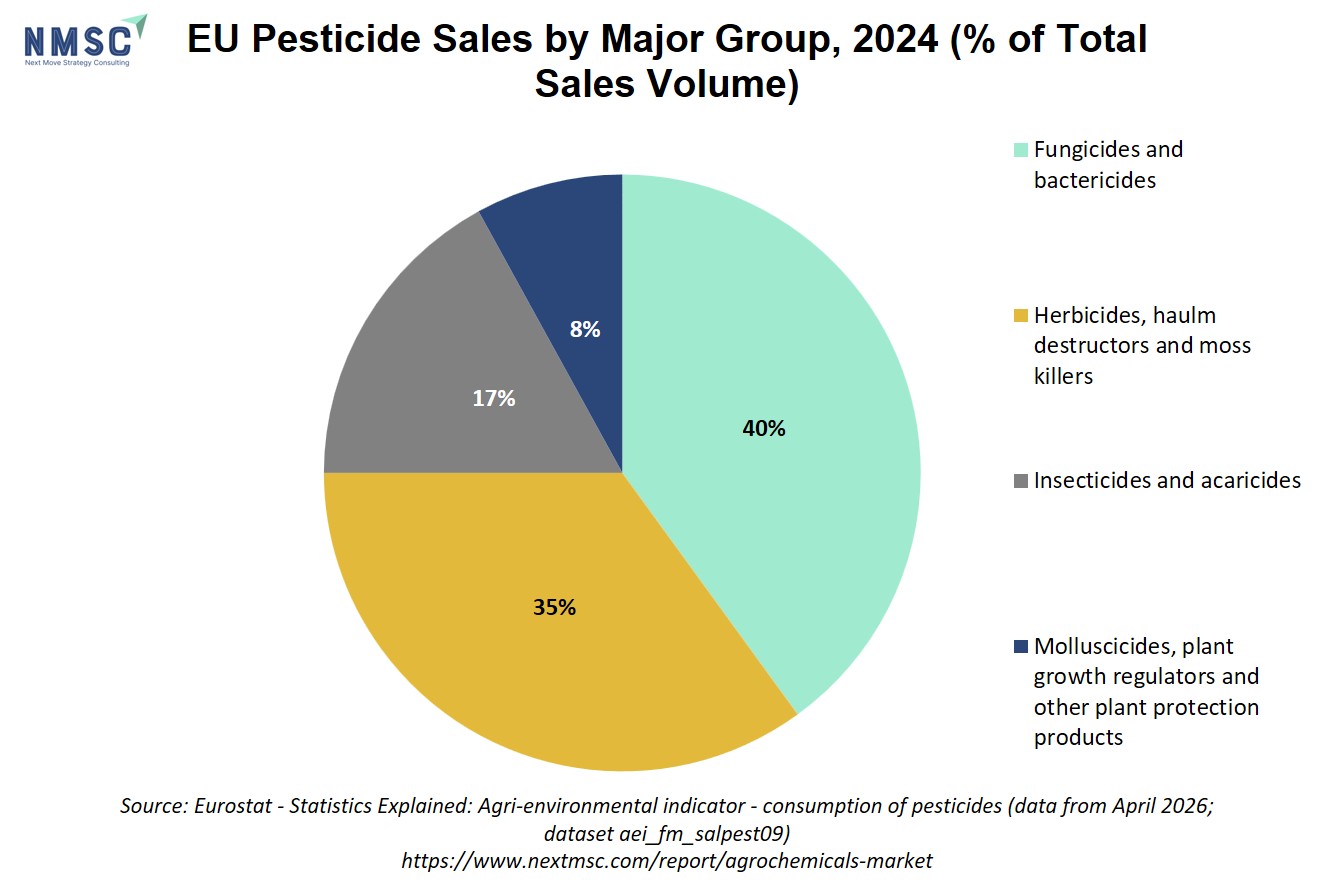
Eurostat reports that fungicides and bactericides accounted for 40% of EU pesticide sales in 2024, herbicides, haulm destructors and moss killers for 35% and insecticides and acaricides for 17%. Eurostat states that molluscicides, plant growth regulators and other plant protection products together represented less than 10%; the 8% shown for this group is the remainder after subtracting the three published shares from 100%.
Demand Fundamentals Remain Intact
FAO's July 30, 2026 data release shows that global agricultural pesticide use reached 3.92 million tonnes of active ingredients in 2024, a 5% increase on 2023 and an 18% increase over a decade, equal to 2.49 kilograms per hectare of cropland. Over 2015 to 2024 the volume of pesticide exports rose 53% while their value rose 35%, so volume outgrew value by 18 percentage points, a pattern that matches the price pressure suppliers describe. FAO also reported that the Americas imported 2.31 million tonnes of formulated pesticides in 2024, valued at USD 14.0 billion, the highest of any region.
Crop prices are strengthening the farm economics behind that demand. The FAO Food Price Index averaged 136.0 points in September 2026, up 1.5% on August and 5.8% on a year earlier, and its cereal sub-index stood 17.2% above its September 2025 level. NextMSC primary research and analysis treats higher grain prices as a supportive signal for crop protection spending, although Bayer cautions that farmer profitability, rising input costs and financial strain in agriculture remain risks. Bayer also flags energy and raw material prices linked to the conflict in the Middle East as a factor it continues to monitor.
Regional Divergence Is Visible in Company Data
Corteva's first-half 2026 crop protection sales were USD 1,262 million in North America, USD 1,185 million in Europe, the Middle East and Africa, USD 801 million in Latin America and USD 481 million in Asia Pacific. Asia Pacific was the only region with positive organic growth in the first half, at 7%, while North America's second-quarter sales fell 12% on channel purchase timing. UPL's India revenue growth of 15% and Bayer's Asia Pacific Crop Science sales growth of 9.5% on a currency and portfolio-adjusted basis in the second quarter point in the same direction.
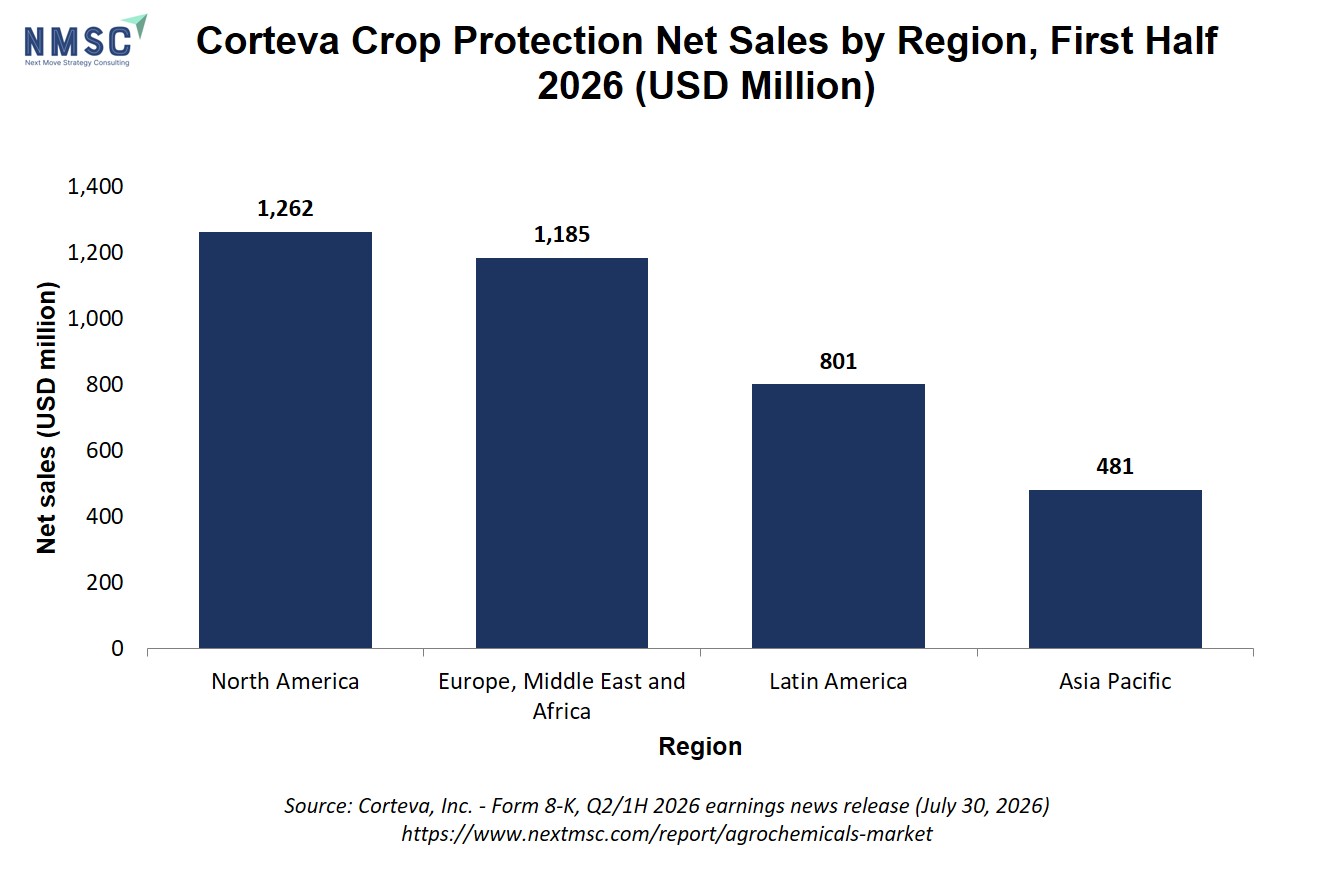
Corteva's Form 8-K reports total first-half 2026 crop protection net sales of USD 3,729 million. North America and Europe, the Middle East and Africa together account for USD 2,447 million of that total, with Latin America at USD 801 million and Asia Pacific at USD 481 million.
Section Summary:
Regulatory clarity in the United States contrasts with weather-driven and approval-driven volatility in Europe, while Asia Pacific supplies the strongest growth signals.
-
Preemption reduces litigation uncertainty but does not eliminate legacy payments, as Bayer's EUR 2,246 million first-half outflow shows.
-
EU sales rebounded 8% in 2024 on wet weather, yet remain near the lowest level recorded since 2011.
-
FAO data show use rising 5% in 2024 while export volume has outgrown export value over the decade.
Pros and Cons of Recent Market Developments
|
Pros |
Cons |
|
The Durnell ruling gives registrants a federal labeling standard for failure-to-warn claims. |
Non-warning legal theories remain open, and Bayer carried EUR 2,246 million of net legal-related outflows in the first half. |
|
Corteva's separation creates a pure-play crop protection company with an USD 11 billion pipeline. |
Without seed earnings, a single-segment company absorbs price declines such as Corteva's 4% fall in second-quarter prices. |
|
Glyphosate pricing has recovered, lifting Bayer's second-quarter glyphosate-based sales by 12.6%. |
Chinese glyphosate technical prices rose 6.4% in mid-September and 4.3% in late September, raising formulators' input costs. |
|
Asia Pacific demand is growing, with UPL's India revenue up 15% and Corteva's Asia Pacific organic sales up 7%. |
Delayed monsoon conditions held back UPL's India crop protection volumes, showing how timing can erase demand. |
|
FAO reports pesticide use of 3.92 million tonnes in 2024, up 5%. |
EU pesticide sales of about 316,000 tonnes remain near their lowest level since 2011. |
Key Data & Statistics
Reported Supplier Performance, 2026
|
Supplier |
Period |
Reported metric |
Value and change |
|
Corteva |
Q2 2026 |
Crop protection net sales |
USD 1,847 million, down 4% |
|
Syngenta Group |
H1 2026 |
Crop protection sales |
USD 6.6 billion, up 4% |
|
Bayer |
Q2 2026 |
Glyphosate-based product sales |
EUR 734 million, up 12.6% |
|
FMC Corporation |
Q2 2026 |
Revenue |
USD 867 million, down 17% |
|
UPL |
Q1 FY2027 |
Consolidated revenue |
INR 10,181 crore, up 10% |
Demand, Trade and Price Indicators
|
Indicator |
Value |
Period |
|
Global agricultural pesticide use |
3.92 million tonnes of active ingredients, up 5% |
2024 |
|
Change in pesticide export volume and value |
Volume up 53%, value up 35% |
2015 to 2024 |
|
EU pesticide sales |
About 316,000 tonnes, up 8% |
2024 |
|
FAO Food Price Index |
136.0 points, up 5.8% year on year |
September 2026 |
|
China 95% glyphosate technical price |
28,250.0 yuan per tonne, up 4.3% |
September 21-30, 2026 |
Future Outlook & Forecast: The Agrochemicals Market to 2030
NMSC's report projects the global agrochemicals market to grow from USD 241.36 billion in 2023 to USD 305.01 billion by 2030 at a CAGR of 3.4% from 2024 to 2030. NextMSC primary research and analysis expects that growth to be unevenly distributed. Suppliers with patent-protected actives, biological portfolios and regional registration depth should grow faster than the market average, while suppliers dependent on off-patent herbicides in contested regions are likely to see volume gains offset by price erosion.
Near-term guidance supports a cautious reading. FMC expects third-quarter revenue excluding India of USD 840 million to USD 900 million, down 9% at the midpoint, and fourth-quarter revenue of USD 1.06 billion to USD 1.20 billion, up 4% at the midpoint. UPL guided fiscal 2027 revenue growth of 7% to 11% and EBITDA growth of 10% to 14%, as reported by Kotak Neo on August 3, 2026. Bayer continues to expect price pressure in crop protection from generic suppliers while anticipating robust underlying demand for the products.
Five variables will decide whether the market tracks above or below the NMSC forecast: how lower courts apply Durnell to claims that are not based on warnings, the direction of Chinese technical prices after the recent run, the depth of discounting in Latin America, the pace at which post-patent products such as Rynaxypyr lose revenue, and the weather-driven swings in European fungicide demand. Grain prices add a sixth, positive variable if the FAO cereal index holds its September level.
Section Summary:
NextMSC projects the agrochemicals market to reach USD 305.01 billion by 2030 at a 3.4% CAGR, with growth concentrated in differentiated products.
-
Supplier guidance for the second half of 2026 points to uneven revenue, with FMC projecting a 9% third-quarter decline at the midpoint.
-
Asia Pacific remains the dominant region in NMSC's report and the strongest source of growth in company data.
-
Patent-protected actives and biologicals carry the earnings that off-patent products no longer deliver.
Next Steps for Stakeholders
Executives and investors can translate these developments into specific actions across the next two quarters.
-
Crop protection executives should rebuild portfolio plans around patent expiry dates, since Corteva, FMC and ADAMA all report that off-patent revenue is the main source of price pressure.
-
Investors should compare Corteva's reduced debt in its pro forma accounts with the cash-flow impact of its Latin American price decline before sizing positions in the new pure-play company.
-
Legal and regulatory teams should map pending claims against the Durnell standard, separating warning-based claims from design-defect and other theories.
-
Procurement teams that buy glyphosate technical should secure supply before the Southern Hemisphere season, because Chinese prices rose in both mid-September and late September 2026.
-
Regional strategy leaders should weight Asia Pacific and North American herbicide demand above European volumes, where weather and approval timing cause larger swings.
Conclusion
The agrochemicals market enters the final quarter of 2026 with a new structure, a clearer litigation standard and a more fragmented pricing picture. NMSC's projection of USD 305.01 billion by 2030 at a 3.4% CAGR remains the headline expectation, but the evidence from Corteva, Bayer, Syngenta Group, FMC and UPL shows that the revenue will not be shared evenly. Bayer's expectation of flat to 3% growth in the combined seed and crop protection market in 2026 and NMSC's 3.4% CAGR frame the range within which suppliers will compete. Suppliers that replace off-patent sales with new actives, and that adapt to regional regulation and pricing, will capture the value that the forecast implies.
About the Author
 Priyanshu Das
— Priyanshu Das is SEO Executive at Next Move Strategy Consulting, where he has led on-page and off-page SEO, keyword research, and SEO audits for the firm's B2B market research publications for 2 years. His audit process combines technical crawl analysis, backlink profile review, and competitor keyword gap mapping — using tools including Screaming Frog and Google Search Console — to prioritize fixes by organic search-visibility impact, informed by his own prior in-house and agency SEO experience.
About the Reviewer
 Sanyukta Deb
— Sanyukta Deb is Digital Marketing Team Lead at Next Move Strategy Consulting, where she has led content strategy and technical SEO for the firm's B2B market research publications for over 2 years. Her editorial process translates NextMSC's primary and secondary research — spanning technology, industrial, and consumer sectors — into commercial narratives, backed by search-intent, keyword, and competitive analysis. She brings 5 years of overall experience in digital marketing and content strategy.
















Add Comment