Commercial Touch Display Market Trends & Forecasts for 2026
Introduction
The commercial touch display market stands at a decisive inflection point in 2026. Across retail environments, hospital corridors, corporate boardrooms, and transit hubs, interactive display technology has transitioned from a supplementary investment to a foundational pillar of modern business infrastructure. As organizations worldwide accelerate their digital transformation agendas, the demand for high-performance, AI-integrated touch display solutions is intensifying at a pace that few anticipated even two years ago.
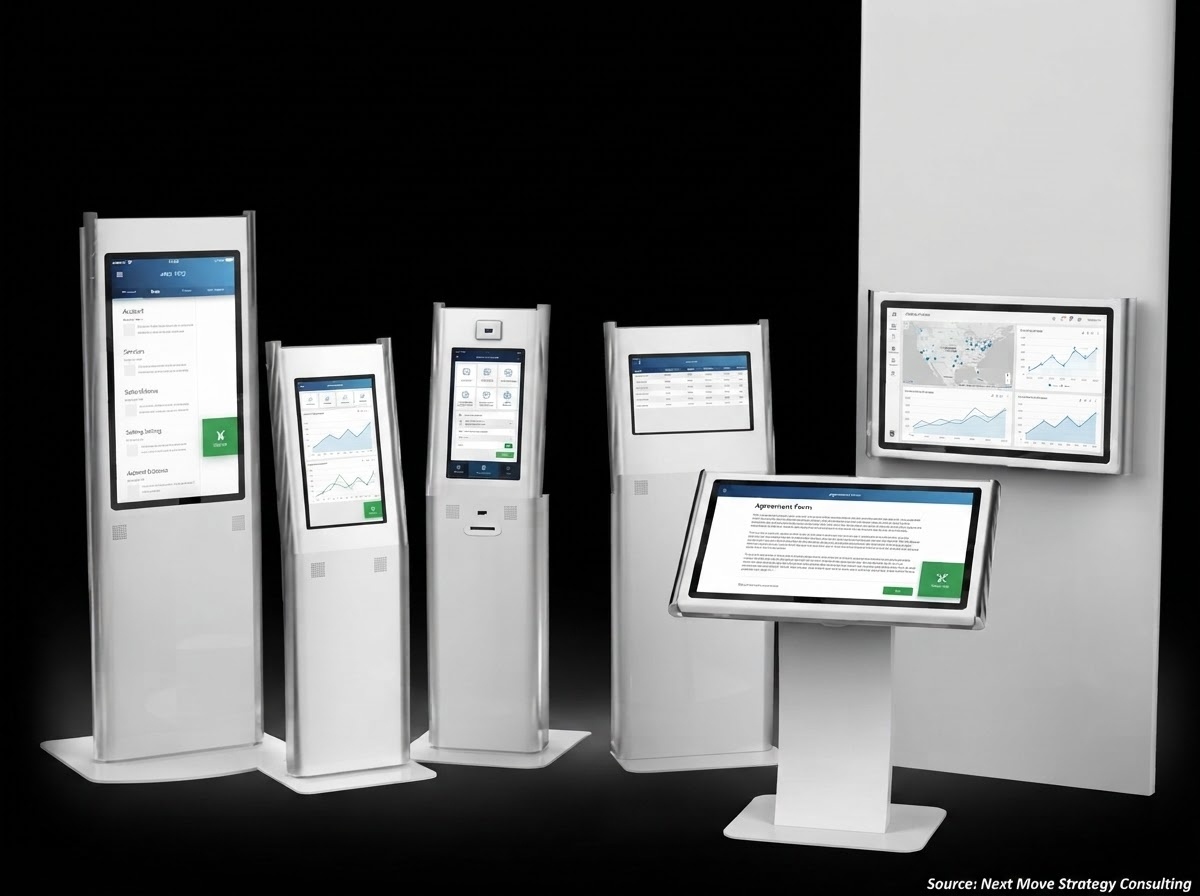
The Commercial Touch Display Market encompasses a broad spectrum of solutions — from point-of-sale (POS) terminals and medical imaging displays to large-format signage and open-frame touchscreen kiosks. What unites these diverse applications is a shared imperative: delivering intuitive, responsive, and visually compelling interactions that drive measurable business outcomes. According to Next Move Strategy Consulting, the global commercial touch display market is projected to reach USD 9.43 billion, expanding at a CAGR of 8.5% by 2030. This trajectory reflects not only technological advancement but also a fundamental shift in how businesses conceptualize customer and employee engagement across every major vertical.
For More Information: Download FREE Sample on Commercial Touch Display Market Report
Samsung's ISE 2026 Debut Signals a New Era for the Commercial Touch Display Market
The Industry's Most Consequential Product Launch of 2026
In February 2026, the global commercial display industry witnessed one of its most significant product launches in recent memory. At Integrated Systems Europe (ISE) 2026 in Barcelona — the world's premier professional AV and systems integration event, which drew more than 92,000 attendees — Samsung Electronics unveiled its glasses-free 3D Spatial Signage, marking a definitive shift in the trajectory of immersive commercial display technology.
The 85-inch Samsung Spatial Signage, powered by Samsung's patented 3D Plate technology, delivers spatial depth behind the LCD panel without requiring specialized viewing equipment such as 3D glasses. The display features 4K UHD resolution (2,160 x 3,840) in a 9:16 portrait format, enabling brands and venues to present 360-degree rotating product visuals with natural-looking depth. Complementing the hardware launch, Samsung introduced AI Studio — a new AI-powered content application within its Samsung VXT cloud-based digital signage platform — which transforms static images into signage-ready video content automatically, eliminating the need for external production tools or manual setup.
Samsung also unveiled the 130-inch Micro RGB Signage (QPHX model) and the 108-inch The Wall All-in-One (MMF-A model), reinforcing its leadership in supersized commercial display formats. Notably, The Wall All-in-One became the world's first LED display to receive Cisco collaboration certification, enabling seamless integration with enterprise meeting room ecosystems. Additionally, through a new partnership with Logitech, Samsung's 4K Smart Signage QBC series was included in Microsoft's Express Install for Microsoft Teams Rooms, enabling room installations to be completed in under an hour.
"For commercial environments, bringing displays and content solutions together is becoming increasingly important. Glasses-free 3D Spatial Signage, combined with new AI-powered capabilities in Samsung VXT, allows us to deliver a more integrated approach to immersive commercial displays, helping businesses create engaging experiences across a wide range of commercial environments."
— SW Yong, President and Head of the Visual Display Business, Samsung Electronics
This launch carries particular strategic weight given that Samsung has maintained its No. 1 position in the global commercial display market for 17 consecutive years, as confirmed by the Omdia Q3 2025 Public Display Report.
ISE 2026: A Definitive Barometer for Global Commercial Display Momentum
Beyond Samsung's announcements, ISE 2026 served as a comprehensive barometer for the state of the global commercial display industry. The Global Commercial Display Conference, hosted at ISE 2026 on February 3, 2026, in Barcelona, presented critical market intelligence across three key display categories, co-presented by DISCIEN and the China Commercial Display Promotion Association.
Key data points presented at the conference include:
-
Interactive Flat Panel Displays (IFPDs): Annual global shipment volume reached approximately 29.16 million units in 2025, representing year-on-year growth of 3.3%. Market structure shifts were notable — Indonesia's government procurement of 300,000 units emerged as a significant demand catalyst, while North America experienced a temporary slowdown attributable to advance stockpiling driven by tariff considerations and the exhaustion of ESF funds.
-
LED Displays: The global LED display industry recorded a sell-in volume of USD 6.66 billion in 2025, with sell-out volume expected to reach USD 9.74 billion, driven by new application segments including LED cinemas, XR virtual production, cultural tourism immersive experiences, and commercial retail.
-
Electronic Paper Displays (EPDs): Shipments reached 481.1 million units in 2025, representing year-on-year growth of 35%, driven by large North American orders and the expansion of electronic shelf labels (ESL), with the 2–3-inch segment accounting for 75% of ESL shipments.
The conference also highlighted Europe's commercial display market undergoing a structural transformation driven by green recovery policies and sustainability mandates, with digital signage increasingly positioned as intelligent, connected systems supported by IoT sensors, data analytics, and cloud platforms.
ISE 2026 itself recorded the largest show footprint in its history, with more than 92,000 attendees — a clear signal of accelerating global momentum in the professional AV and commercial display sector.
NMSC Strategic Perspective: AI Integration as the Central Growth Catalyst
From Next Move Strategy Consulting's analytical standpoint, the developments at ISE 2026 validate a core thesis central to our commercial touch display market assessment: the convergence of artificial intelligence with interactive display hardware represents the single most consequential growth catalyst for this market through 2030.
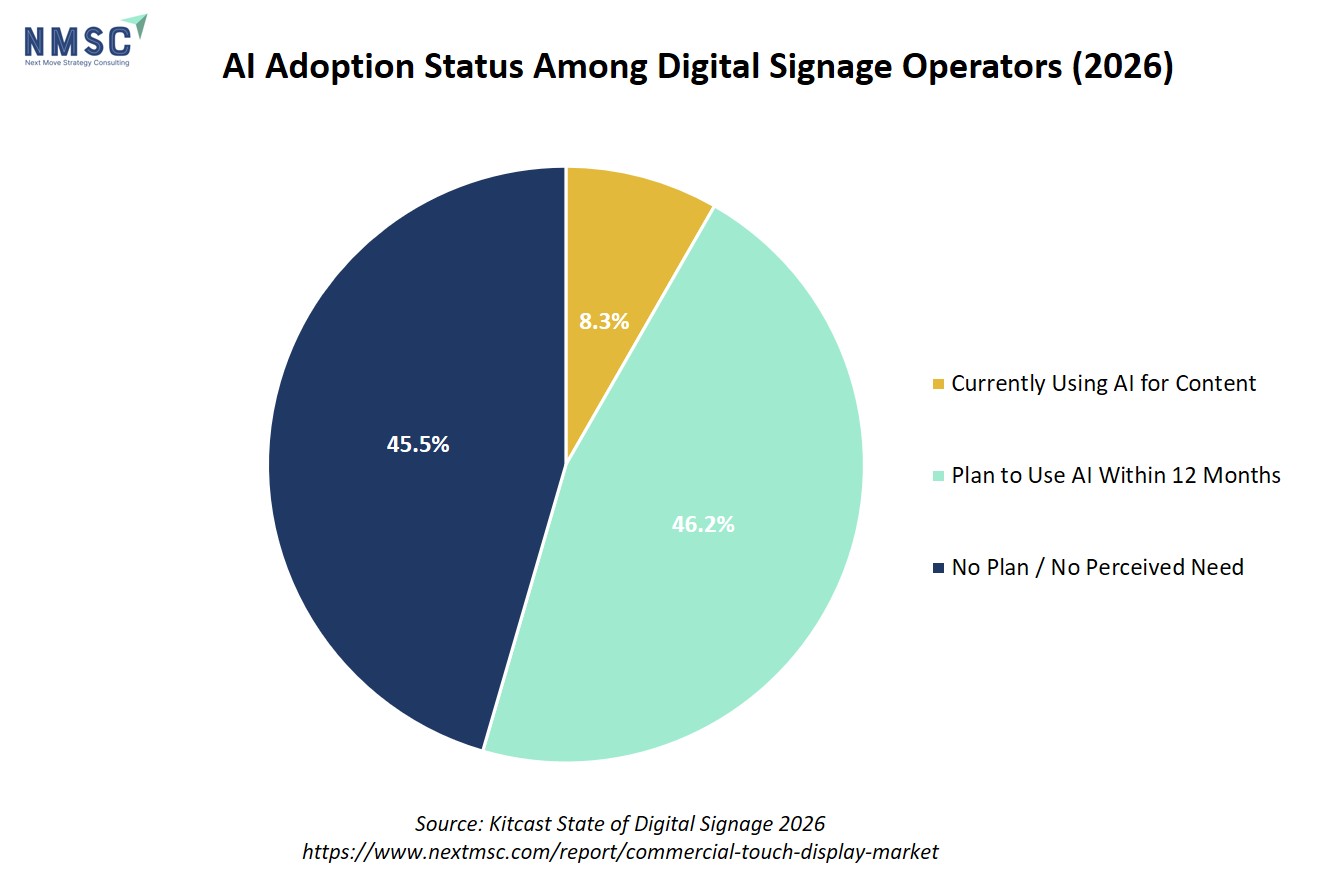
The integration of AI-powered content management — as demonstrated by Samsung's VXT AI Studio — directly addresses one of the most persistent barriers to commercial touch display adoption: the operational complexity and cost of content creation and management. By automating content optimization and enabling real-time personalization, AI-driven platforms dramatically reduce the total cost of ownership for commercial touch display deployments, making the technology accessible to a broader range of enterprise and mid-market operators.
Furthermore, the enterprise collaboration angle — exemplified by Samsung's Cisco certification and Logitech-Microsoft Teams Rooms partnership — signals a critical market expansion beyond traditional retail and hospitality applications into corporate environments. This cross-sector penetration is a key structural driver underpinning NMSC's projected CAGR of 8.5% for the commercial touch display market through 2030. The growing role of AI and intelligent workflows — from real-time translation and accessibility tools to smarter room and display control — signals deeper integration of AV with IT and user experience design, a trend that NMSC expects to intensify materially over the forecast horizon.
Section Summary: The ISE 2026 event and Samsung's landmark product launches have fundamentally redefined the competitive and technological landscape of the commercial touch display market in 2026, with AI integration and enterprise collaboration emerging as the defining strategic themes.
Key Takeaways:
-
Samsung's glasses-free 3D Spatial Signage, launched at ISE 2026, represents a paradigm shift in immersive commercial display technology, combining AI-powered content creation with enterprise-grade integration capabilities.
-
ISE 2026 attracted over 92,000 attendees — a record — reflecting strong global momentum in the professional AV and commercial display sector.
-
Global IFPD shipments reached 29.16 million units in 2025 (YoY growth: 3.3%), while LED display sell-in volume reached USD 6.66 billion and EPD shipments grew 35% year-on-year.
-
AI integration is rapidly transitioning from a differentiating feature to a baseline expectation in commercial touch display deployments across all major end-user segments.
Industry Impact Analysis
Retail: From Passive Signage to Intelligent Customer Engagement
The retail sector represents one of the most dynamic application domains for commercial touch display technology. The convergence of AI-driven personalization, real-time inventory integration, and interactive self-service capabilities is fundamentally transforming the in-store experience. AI integration in digital signage is projected to reach 41% adoption in 2026, with 4K display standardization at 71% and cloud content management system (CMS) adoption climbing to 78%. Interactive content drives six times the engagement of passive screens, and touch displays represent a USD 7.61 billion category within the broader digital signage ecosystem.
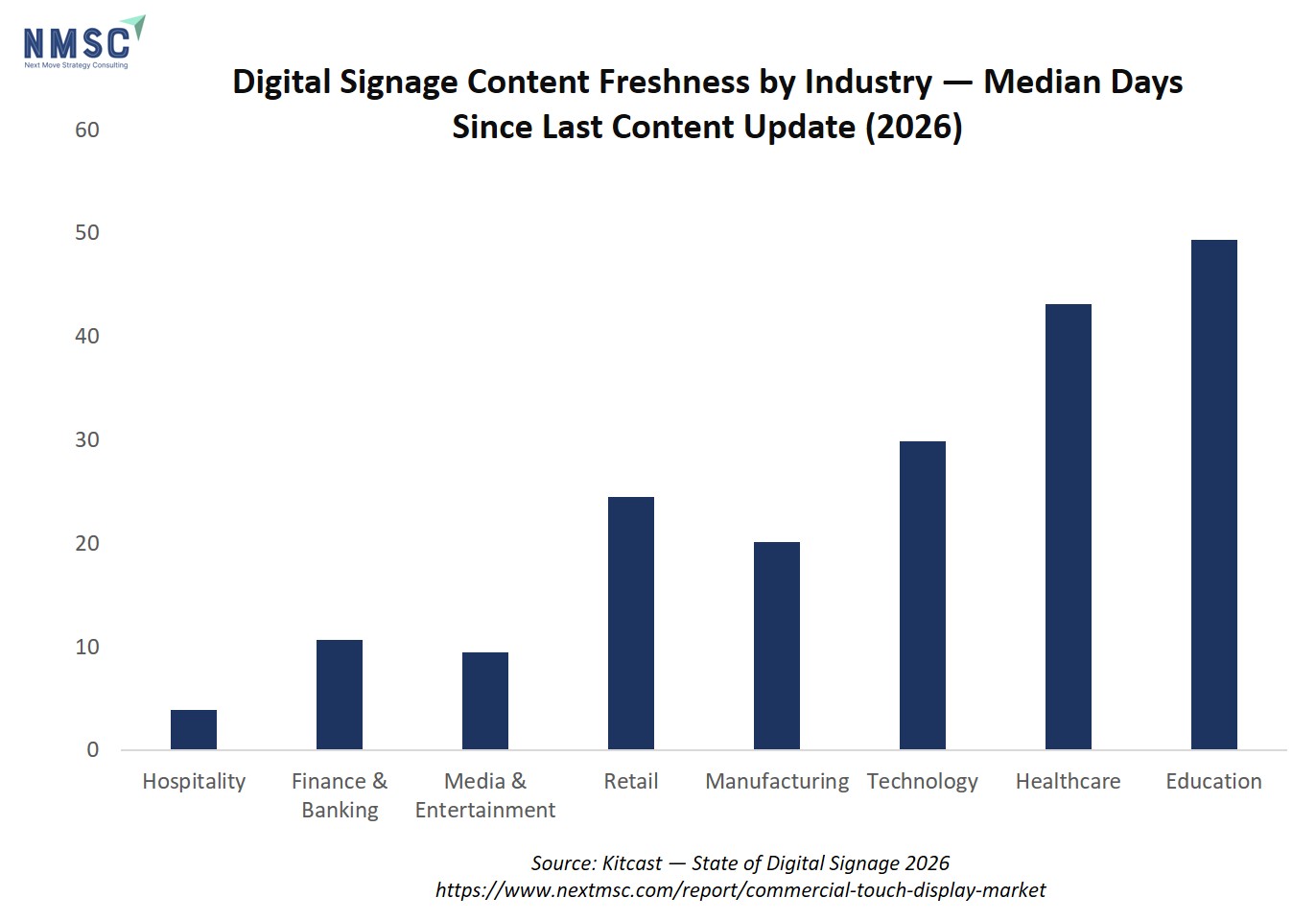
Key retail digital signage trends in 2026 include AI-personalized content delivery, smart-store integration, and screens tied directly to inventory and loyalty systems. Leading commercial display manufacturers are focusing on developing AI-powered, interactive, and analytics-enabled display solutions specifically designed for high-traffic retail environments.
Healthcare: Precision Visualization and Workflow Optimization
The healthcare sector is emerging as one of the most strategically significant end-user segments for commercial touch displays. Medical imaging and diagnostic applications demand the highest levels of display precision, color accuracy, and touch responsiveness. Commercial touch panels enable radiologists and clinical staff to manipulate high-resolution X-ray, CT, and MRI images with precision, annotate findings in real time, and streamline diagnostic workflows. According to NMSC's market analysis, the expansion of the medical imaging and diagnostic sector is one of the primary growth drivers for the commercial touch display market, with the global diagnostic market having witnessed growth of approximately USD 43 billion in 2022 and expected to grow at a 5% CAGR through 2025, as cited by the Global Electronic Council.
Healthcare institutions are increasingly adopting touch displays for telemedicine platforms, patient education systems, and operational management interfaces — a trend accelerated by sustained post-pandemic investments in digital health infrastructure. Rolling smart displays have moved from consumer novelty to essential managed endpoints for healthcare organizations, enabling mobile clinical workflows and real-time patient communication.
Education: Smart Classrooms and the Digital Curriculum Transition
The education sector continues to be a primary demand driver for commercial touch display technology globally. Interactive flat panel displays are replacing traditional whiteboards in classrooms across North America, Europe, and Asia-Pacific, enabling real-time content annotation, collaborative learning, and integration with digital curriculum platforms. The U.S. Department of Education's National Education Technology Plan (NETP), announced in 2024, specifically emphasizes the use of dynamic digital applications to engage students in academic content — a policy directive that directly supports commercial touch display procurement across public school systems.
The European Commission's Digital Education Action Plan further reinforces this trend, having adopted a comprehensive digital education framework to enhance digital skills among students across EU member states — a program that directly propels demand for interactive touch displays in educational settings.
Corporate Environments: Hybrid Work and the Collaboration Display Imperative
The normalization of hybrid work models has created sustained demand for large-format interactive displays in corporate meeting rooms, executive briefing centers, and collaborative workspaces. Displays and conferencing solutions are reshaping businesses worldwide — in the corporate meeting room, interactive flat panels and integrated AV bars add smart framing, speaker-aware analytics, and AI assistance to turn discussions into decisions at speed. Samsung's inclusion in Microsoft's Express Install program for Teams Rooms, announced at ISE 2026, exemplifies the deepening convergence between commercial touch display hardware and enterprise collaboration software ecosystems.
The restaurant and food service industry also represents a significant demand driver. The National Restaurant Association has reported that restaurant sales in the U.S. reached USD 1 trillion by the end of 2024, with commercial touch panels playing a central role in streamlining ordering processes, reducing wait times, and improving order accuracy across quick-service and full-service restaurant formats.
Section Summary: The commercial touch display market is experiencing broad-based demand expansion across retail, healthcare, education, and corporate sectors, each driven by distinct but complementary digital transformation imperatives that collectively reinforce the market's growth trajectory through 2030.
Key Takeaways:
-
AI integration in digital signage is projected at 41% adoption in 2026, with cloud CMS adoption at 78% and 4K display standardization at 71% — all of which directly benefit commercial touch display deployments.
-
Healthcare and education sectors are high-growth end-user segments, supported by government digital transformation mandates including the U.S. NETP and the EU Digital Education Action Plan.
-
Enterprise collaboration requirements are driving large-format touch display adoption in corporate environments, with certified compatibility with Microsoft Teams, Cisco Webex, and Zoom becoming a baseline procurement requirement.
-
The food service and restaurant sector — with U.S. sales reaching USD 1 trillion in 2024 — represents a substantial and growing demand base for POS terminals and self-service touch display solutions.
|
Market Segment (by End User) |
Key Application |
Primary Growth Driver |
Regional Strength |
|
Healthcare |
Medical imaging, telemedicine, patient education displays |
Diagnostic precision requirements; digital health infrastructure investment |
North America, Europe |
|
Education |
Interactive whiteboards, smart classroom IFPDs |
U.S. NETP; EU Digital Education Action Plan; government procurement |
North America, Asia-Pacific |
|
Retail / BFSI |
POS terminals, self-service kiosks, digital signage |
AI personalization; contactless transaction demand; e-commerce growth |
Asia-Pacific, North America |
|
Transportation |
Wayfinding, passenger information systems |
Smart city infrastructure investment; public sector digitalization |
Europe, Asia-Pacific |
|
Corporate / Entertainment |
Collaboration displays, boardrooms, event venues |
Hybrid work normalization; enterprise AV-IT convergence |
North America, Europe |
|
Sports |
Stadium displays, fan engagement screens |
Immersive experience demand; large-format LED adoption |
Global |
|
Food Service / Hospitality |
Self-ordering kiosks, menu boards, POS systems |
Restaurant industry growth; operational efficiency imperatives |
North America, Asia-Pacific |
Future Outlook & Forecast for the Commercial Touch Display Market
NMSC Market Forecast: A Trajectory Defined by Technology Convergence
According to Next Move Strategy Consulting's proprietary analysis, the global commercial touch display market is projected to grow USD 9.43 billion by 2030, at a CAGR of 8.5% during the forecast period 2024–2030. This growth trajectory is underpinned by three primary structural drivers: the accelerating integration of AI and IoT capabilities into display hardware and software platforms; the expansion of digital transformation initiatives across healthcare, education, and retail sectors; and the increasing standardization of 4K and ultra-high-definition resolution as a baseline commercial display specification.
From a technology segmentation perspective, capacitive touch technology is expected to maintain its dominant position within the commercial touch display market, given its superior multi-touch accuracy, durability, and compatibility with modern enterprise software ecosystems. Infrared touch technology is gaining traction in large-format applications — particularly in education and corporate environments — due to its ability to support simultaneous multi-user interaction on displays exceeding 65 inches. Surface Acoustic Wave (SAW) technology continues to serve niche applications requiring high optical clarity, while resistive touch remains relevant in industrial and ruggedized deployment contexts.
From a regional standpoint, North America is projected to maintain its dominant market share through 2030, supported by robust enterprise technology investment, government education digitalization programs such as the NETP, and the presence of leading commercial display manufacturers and system integrators. Asia-Pacific, however, is identified as the fastest-growing regional market, driven by the expansion of e-commerce infrastructure in China and India, the growth of the food service sector, and large-scale government procurement programs in markets such as Indonesia. China remains the leading global e-commerce market, generating approximately 50% of global e-commerce transactions in 2023 and expected to generate approximately USD 3.56 trillion by the end of 2024 — a scale of digital commerce that directly drives demand for commercial touch display solutions at the point of sale and in logistics environments.
Emerging Technology Vectors: Haptic Feedback, E-Paper, and Sustainable Displays
Beyond the near-term forecast horizon, several emerging technology vectors are poised to reshape the commercial touch display market's competitive landscape. Haptic feedback integration — which delivers tactile sensations that simulate physical button interactions — is expected to create new product differentiation opportunities, particularly in healthcare and retail kiosk applications where tactile confirmation enhances user confidence and accessibility. NMSC identifies haptic feedback as a key opportunity factor for the commercial touch display industry in the forthcoming years.
E-paper (EPD) technology, as highlighted at ISE 2026's Global Commercial Display Conference, is rapidly expanding beyond e-readers into retail signage, transportation information systems, and public displays. With large-format color ePaper displays now reaching up to 75 inches and offering ultra-low power consumption, wireless content updates, and low total cost of ownership, EPD represents a compelling sustainable alternative to conventional LCD and LED displays. E Ink's key color ePaper platforms — including Spectra™ 6, Kaleido™ 3, Marquee™, and Gallery™ — are enabling larger sizes, improved color performance, and reliable operation in diverse commercial environments.
The sustainability dimension of commercial display procurement is becoming increasingly material for institutional buyers. Europe's commercial display market is undergoing a structural shift toward energy-efficient hardware and software-defined networks, driven by green recovery policies and rising ESG reporting requirements. Digital signage is no longer seen as a collection of standalone screens, but as intelligent, connected systems supported by IoT sensors, data analytics, and cloud platforms — a paradigm shift that NMSC expects to accelerate globally as corporate sustainability mandates intensify through 2030.
Section Summary: The commercial touch display market is on a well-supported growth trajectory through 2030, with AI integration, regional expansion in Asia-Pacific, and emerging sustainable display technologies serving as the primary catalysts for sustained value creation.
Key Takeaways:
-
NMSC projects the global commercial touch display market to reach USD 9.43 billion by 2030, growing at a CAGR of 8.5% from 2024 to 2030.
-
Capacitive touch technology remains the dominant technology segment; infrared touch is gaining ground in large-format, multi-user applications in education and corporate environments.
-
Asia-Pacific is the fastest-growing regional market, driven by e-commerce expansion, food service sector growth, and large-scale government procurement programs.
-
Haptic feedback, e-paper displays, and sustainable display hardware represent the next frontier of product innovation and competitive differentiation in the commercial touch display market.
Next Steps for Stakeholders
For C-Level Executives and Technology Decision-Makers:
-
Prioritize AI-Integrated Display Platforms: The competitive advantage in commercial touch display deployments is increasingly determined not by hardware specifications alone, but by the intelligence of the content management ecosystem. Executives should evaluate vendors based on their AI-powered content creation, real-time analytics, and remote device management capabilities — with Samsung's VXT AI Studio serving as a current benchmark.
-
Mandate Enterprise Collaboration Certification: As hybrid work models become permanent fixtures of corporate operations, procurement teams must ensure that commercial touch display solutions carry certified compatibility with enterprise collaboration platforms — specifically Microsoft Teams Rooms, Cisco Webex, and Zoom — to avoid costly integration failures post-deployment.
-
Incorporate Sustainability Criteria into Procurement Frameworks: With European green recovery policies and global ESG mandates intensifying, institutional buyers should incorporate energy efficiency ratings, total cost of ownership over a five-year lifecycle, and end-of-life recyclability into commercial display procurement criteria. E-paper display technology warrants serious evaluation for low-motion, high-frequency content update applications.
-
Assess Asia-Pacific Supply Chain Exposure: Given the structural shifts in IFPD market dynamics — including tariff-driven stockpiling in North America and government procurement volatility in emerging markets — supply chain risk assessment should be a priority for organizations with significant commercial display procurement volumes.
For Investors:
-
Monitor the AI-Display Convergence Opportunity: Companies that successfully integrate AI-powered content management with commercial touch display hardware — as demonstrated by Samsung's VXT platform — are positioned to capture disproportionate value as the market expands toward USD 9.43 billion by 2030.
-
Track Government Education and Healthcare Procurement Pipelines: Large-scale government procurement programs — such as Indonesia's 300,000-unit IFPD order and the U.S. NETP — represent predictable, high-volume demand signals that can inform investment timing and sector allocation decisions within the commercial touch display value chain.
Conclusion
The commercial touch display market in 2026 is defined by a convergence of forces that are simultaneously expanding its addressable market and elevating its strategic importance across every major industry vertical. Samsung's landmark launches at ISE 2026 — from glasses-free 3D Spatial Signage to AI-powered content management platforms — have set a new benchmark for what commercial display technology can deliver. The Global Commercial Display Conference at ISE 2026 provided authoritative institutional data confirming robust growth across IFPD, LED, and EPD categories, while Europe's green recovery agenda is reshaping procurement criteria in ways that will reverberate globally.
According to Next Move Strategy Consulting, the global commercial touch display market is projected to reach USD 9.43 billion by 2030, growing at a CAGR of 8.5% from 2024 to 2030. For C-level executives, investors, and technology strategists, the imperative is clear: organizations that invest proactively in AI-integrated, enterprise-compatible, and sustainability-aligned commercial touch display solutions will be best positioned to capture the operational and competitive advantages this market offers in the years ahead.
About the Author
 Sanyukta Deb
— Sanyukta Deb is Digital Marketing Team Lead at Next Move Strategy Consulting, where she has led content strategy and technical SEO for the firm's B2B market research publications for over 2 years. Her editorial process translates NextMSC's primary and secondary research — spanning technology, industrial, and consumer sectors — into commercial narratives, backed by search-intent, keyword, and competitive analysis. She brings 5 years of overall experience in digital marketing and content strategy.
Sanyukta Deb
— Sanyukta Deb is Digital Marketing Team Lead at Next Move Strategy Consulting, where she has led content strategy and technical SEO for the firm's B2B market research publications for over 2 years. Her editorial process translates NextMSC's primary and secondary research — spanning technology, industrial, and consumer sectors — into commercial narratives, backed by search-intent, keyword, and competitive analysis. She brings 5 years of overall experience in digital marketing and content strategy.
About the Reviewer
 Debashree Dey
— Debashree Dey is Assistant Manager at Next Move Strategy Consulting, where she supports cross-vertical market content and communications across diverse industries for 6 years. Her professional background includes senior content writing, communications, and published manuscript authorship, with experience developing audience-focused business narratives and maintaining clear, consistent messaging. Her role supports research-led content development and editorial quality across NextMSC publications.
Debashree Dey
— Debashree Dey is Assistant Manager at Next Move Strategy Consulting, where she supports cross-vertical market content and communications across diverse industries for 6 years. Her professional background includes senior content writing, communications, and published manuscript authorship, with experience developing audience-focused business narratives and maintaining clear, consistent messaging. Her role supports research-led content development and editorial quality across NextMSC publications.


















Add Comment