E-Commerce and Last-Mile Delivery Market: Logistics Enters New Era | NextMSC

Introduction
The global e-commerce and last-mile delivery market is undergoing a structural transformation — one driven not by incremental efficiency gains, but by simultaneous disruptions in regulatory frameworks, autonomous technology deployment, and the geographic expansion of delivery infrastructure into previously underserved markets. According to Next Move Strategy Consulting's E-commerce and Last-Mile Delivery Market report, the global e-commerce and last-mile delivery market was valued at USD 178.40 billion in 2025 and is projected to reach USD 454.67 billion by 2035, growing at a CAGR of 9.95% from 2026 to 2035. The market is estimated at USD 193.82 billion in 2026, representing an absolute dollar opportunity of USD 260.85 billion across the forecast period — a figure that positions last-mile logistics as one of the most capital-intensive and strategically consequential segments in global commerce.
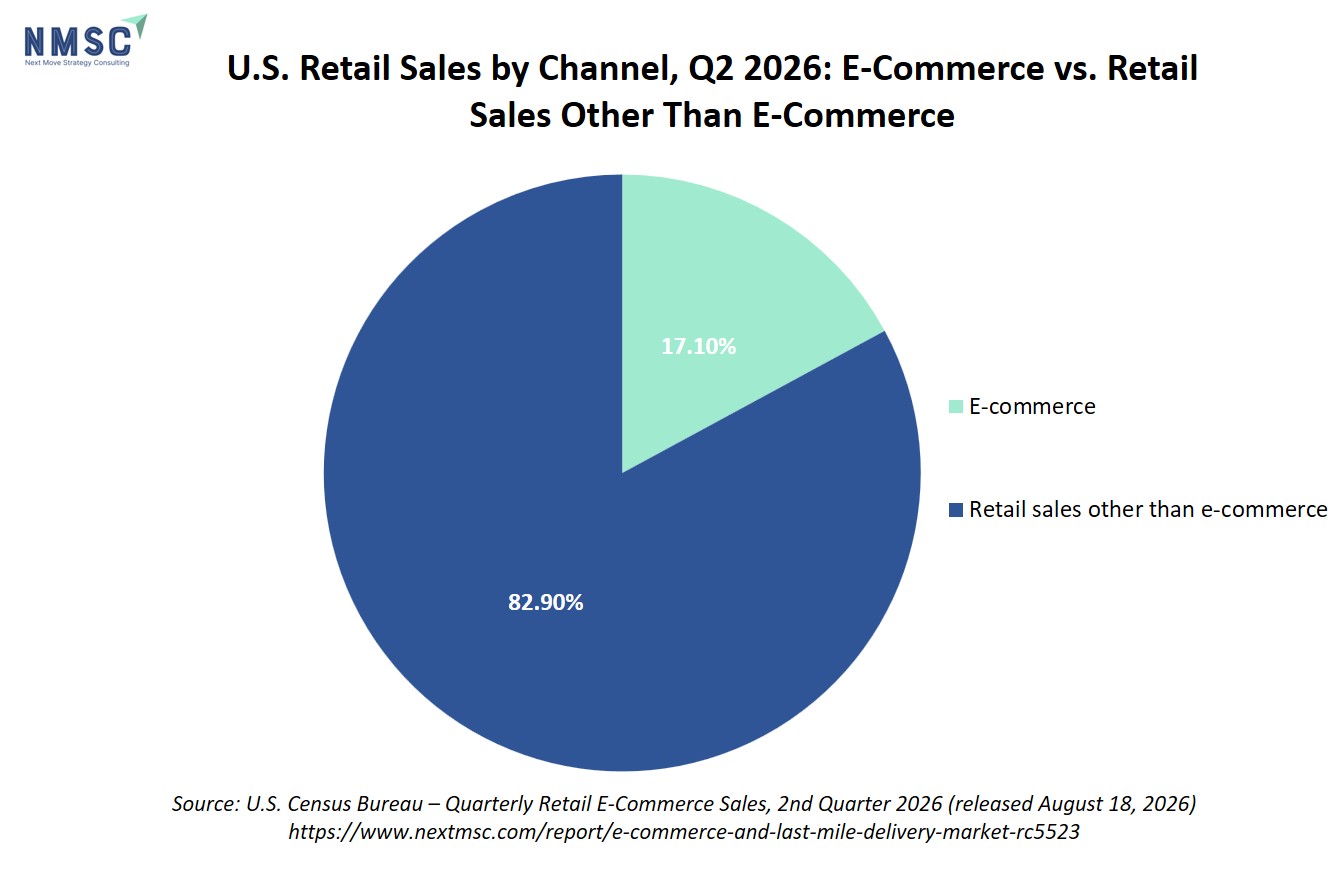
The structural case for this growth is grounded in verifiable demand signals. The U.S. Census Bureau reported that seasonally adjusted retail e-commerce sales reached USD 340.2 billion in Q2 2026, a 12.2% increase from Q2 2025, with e-commerce now accounting for 17.1% of total U.S. retail sales — up from 16.3% in Q2 2025. This sustained share gain means that every percentage point of e-commerce penetration translates directly into incremental parcel volume that must be physically delivered — and the final mile remains the most expensive, most operationally complex, and most consumer-visible segment of that delivery chain.
For More Information: Download FREE Sample on E-commerce and Last-Mile Delivery Market Report
From Rural Gaps to Regulatory Resets: The Forces Reshaping Last-Mile Delivery
Amazon's $4 Billion Rural Infrastructure Commitment Redraws the Competitive Map
On April 30, 2025, Amazon.com, Inc. announced a USD 4 billion investment to expand its rural last-mile delivery network across the United States by the end of 2026. The initiative encompasses the development of more than 200 new delivery stations, tripling Amazon's rural delivery footprint to cover over 13,000 ZIP codes spanning 1.2 million square miles — an area equivalent to the combined landmass of Alaska, California, and Texas. The program is projected to create over 100,000 new jobs and enable the delivery of more than one billion additional packages annually to rural Prime members, with average delivery times cut by half relative to 2023 baselines.
The strategic significance of this investment extends beyond Amazon's own competitive positioning. As Reuters reported on April 30, 2025, the announcement came at a moment when multiple logistics providers were actively retreating from rural delivery due to cost-per-parcel economics — making Amazon's counter-cyclical commitment a deliberate market-share capture strategy targeting the rural delivery gap left by withdrawing incumbents. The deployment of predictive AI for inventory placement across these new stations further signals that Amazon is building a data-driven rural logistics infrastructure that will be structurally difficult for regional carriers to replicate at comparable cost.
Separately, Amazon announced in August 2026 that its Prime Air drone delivery program is expanding to nearly 500 U.S. cities and towns, marking the most significant geographic scaling of commercial drone delivery in the country's history. This expansion directly intersects with the FAA's ongoing Part 108 BVLOS (Beyond Visual Line of Sight) rulemaking, for which the draft final rule was submitted to the Office of Information and Regulatory Affairs on July 10, 2026, according to the Federal Register. The convergence of Amazon's commercial drone scaling and the FAA's regulatory finalization creates a narrow but consequential window in which first-mover carriers can lock in airspace corridors and operational approvals ahead of broader market entry.
FedEx Integrator Program: Embedding Carrier Capabilities Directly Into Merchant Workflows
On November 12, 2025, FedEx Corporation announced the global launch of the FedEx Integrator Program, a self-serve API and webhook framework enabling supply chain management software providers and digital ecosystem partners to embed FedEx shipping capabilities and near-real-time shipment visibility directly into their platforms. Jason Brenner, Senior Vice President of Digital Portfolio at FedEx, stated: "By enabling shipping and logistics platforms to embed FedEx capabilities easily through self-serve integration, we ensure consistent, dependable shipping experiences so merchants can stay focused on growing their business."
The program's strategic logic is rooted in the structural shift toward platform-embedded logistics: as e-commerce merchants increasingly manage fulfillment through integrated SCM software stacks, carriers that are not natively accessible within those stacks risk being displaced by competitors who are. The FedEx Integrator Program is a direct response to this disintermediation risk, positioning FedEx as the default shipping layer within third-party merchant technology environments rather than a standalone carrier requiring separate integration.
DHL's €120 Million Dubai South Commitment Anchors MEA as a Cross-Border Logistics Hub
On December 4, 2025, DHL Group officially opened its expanded Middle East & Africa (MEA) Innovation Center in Dubai South — a 1,700-square-meter permanent co-creation hub — alongside a €120 million commitment by DHL Supply Chain to develop a 55,000-square-meter carbon-neutral multi-user warehouse on a 96,000-square-meter land plot under a 38-year leasehold agreement. The warehouse is strategically positioned adjacent to the upcoming Al Maktoum International Airport, which is projected to become the world's largest airport upon completion, and is designed to serve as a contract logistics gateway connecting East-West trade flows.
Katja Busch, Chief Commercial Officer at DHL and Head of DHL Customer Solutions & Innovation, described the MEA Innovation Center as "one of only four DHL Innovation Centers worldwide," underscoring the region's elevation to a tier-one strategic priority within DHL's global network. This investment is consistent with NMSC's proprietary research and analysis, which identifies the Middle East & Africa region as growing at a 10.4% CAGR from 2026 to 2035, with Gulf Cooperation Council economies directing national digital economy program capital toward last-mile fleet and fulfillment infrastructure.
NMSC Strategic Perspective: Three Structural Shifts Defining the Competitive Frontier
NMSC's primary research and analysis identifies three structural shifts that are simultaneously compressing the competitive window for incumbents and expanding the addressable market for technology-enabled entrants.
First, the bifurcation of delivery speed expectations is accelerating segment divergence. NMSC's analysis shows that Express/Same-Day Delivery is expanding at a 13.4% CAGR from 2026 to 2035 — nearly double the 7.4% CAGR of Standard Delivery — as quick-commerce platforms normalize sub-hour fulfillment windows across grocery and food categories. Carriers that cannot demonstrate credible same-day delivery coverage in top-50 metropolitan markets within the next 24 months risk losing enterprise e-commerce contracts to competitors who can.
Second, the crowdsourced delivery model is migrating from food delivery into general retail parcel fulfillment at a pace that is structurally compressing 3PL margins. NMSC's analysis indicates that Crowdsourced Delivery Platforms are the fastest-growing service provider category at a 14.8% CAGR from 2026 to 2035, as platforms including DoorDash, Inc. and Uber Technologies, Inc. extend gig-driver capacity beyond restaurant delivery into retail and grocery parcel fulfillment. This migration is not additive to the 3PL market — it is substitutive for the lower-margin, shorter-distance delivery segments that 3PLs have historically relied upon for volume density.
Third, the healthcare and pharmaceutical delivery segment is emerging as the highest-margin growth vector within the last-mile ecosystem. NMSC's analysis shows Healthcare & Pharmaceuticals is the fastest-growing end-use industry at a 15.8% CAGR from 2026 to 2035, driven by telehealth-linked pharmacy fulfillment and time-sensitive specimen delivery. Carriers that invest in temperature-controlled, chain-of-custody last-mile capabilities now are building a defensible premium-pricing position in a segment where delivery failure carries regulatory and patient-safety consequences that make switching costs structurally high.
Section Summary:
The e-commerce and last-mile delivery market is being reshaped by capital commitments, regulatory shifts, and technology deployments that are occurring simultaneously across geographies and delivery formats.
-
Amazon's USD 4 billion rural network expansion and Prime Air drone scaling to nearly 500 U.S. cities are redefining the geographic and technological boundaries of last-mile delivery in North America.
-
FedEx's Integrator Program embeds carrier capabilities directly into merchant SCM workflows, reducing the risk of carrier disintermediation as e-commerce platforms consolidate their technology stacks.
-
DHL's €120 million Dubai South warehouse and MEA Innovation Center position the Gulf as a strategic East-West logistics gateway aligned with NMSC's 10.4% CAGR forecast for the Middle East & Africa region.
-
NMSC's analysis identifies Express/Same-Day Delivery (13.4% CAGR), Crowdsourced Platforms (14.8% CAGR), and Healthcare & Pharma delivery (15.8% CAGR) as the three highest-velocity growth vectors through 2035.
Industry Impact Analysis
The EU De Minimis Abolition: A Structural Reset for Cross-Border Last-Mile Economics
Effective July 1, 2026, the European Union abolished its long-standing €150 customs duty exemption on low-value imports, replacing it with a flat €3 duty per item line for qualifying B2C cross-border shipments. The reform mandates item-level customs declarations, introduces merchant and manufacturer identifier requirements, and requires non-IOSS (Import One-Stop Shop) shipments to clear customs in the destination country rather than at the first EU point of entry — fundamentally altering the routing logic of cross-border last-mile networks.
The scale of the disruption is significant. Mazen Zaher, Founder of Sama Airleasing, noted that cross-border e-commerce from China accounted for 4.6 billion small parcels imported into the EU in 2024, and that France's parcel tax introduced in March 2026 — a precursor to the EU-wide reform — produced a 92% drop in customs declarations for small parcels at Paris Charles de Gaulle in its first week, with volume shifting to alternative hubs including Liège, Amsterdam, and Frankfurt.
UPS confirmed on its official guidance page that as of July 1, 2026, the €150 customs duty exemption has been removed, and that all imports below €150 are now subject to duty. For last-mile operators serving the EU market, the operational consequences are threefold: higher declaration volumes requiring item-level data accuracy, increased routing complexity as non-IOSS flows must align with destination-country clearance, and a structural cost increase that disproportionately affects smaller merchants and simplified import models while favoring larger carriers with established customs infrastructure and data capabilities.
Stephan Horn, Senior Manager of Strategy & Business Development at Fraport AG, stated: "We anticipate that upcoming EU de minimis regulatory changes will temporarily slow overall market growth in this segment. However, e-commerce will remain a resilient and key growth driver in the air cargo sector." This assessment aligns with NMSC's analysis, which projects Europe's last-mile delivery market growing at a 6.5% CAGR from 2026 to 2035 — the slowest of any region — reflecting the compliance cost burden that gig-work classification directives and customs reform impose on carriers operating in the EU.
FAA Part 108 BVLOS Rulemaking: The Regulatory Gate for Commercial Drone Delivery Scale
The FAA's proposed Part 108 rule, which establishes a performance-based regulatory framework for routine Beyond Visual Line of Sight (BVLOS) drone operations, represents the single most consequential regulatory development for the delivery drone segment. The draft final rule was submitted to the Office of Information and Regulatory Affairs on July 10, 2026, and remains under review. Once finalized, Part 108 would normalize commercial drone delivery operations that currently require individual waivers — a process that has constrained the scalability of drone delivery programs to isolated corridors and pilot geographies.
NMSC's analysis shows that Delivery Drones are the fastest-growing vehicle type in the last-mile delivery market, expanding at a 21.6% CAGR from 2026 to 2035, from a 2025 base of USD 5.37 billion to a projected USD 33.87 billion by 2035. The regulatory finalization of Part 108 is the primary gating factor for this growth trajectory: carriers that have pre-positioned drone infrastructure, secured municipal operating agreements, and built FAA compliance capacity will be able to scale commercial operations within weeks of rule finalization, while late entrants will face a 12-to-18-month regulatory onboarding lag.
Gig-Worker Classification: The Labor Cost Variable That Determines Crowdsourced Platform Margins
The European Union's Platform Work Directive, which entered into force in 2024 and requires member states to transpose its provisions into national law, establishes a legal presumption of employment for platform workers — including gig-delivery drivers — unless platforms can rebut that presumption through defined criteria. For crowdsourced delivery platforms operating in the EU, this directive is converting a variable cost (per-delivery contractor fees) into a fixed cost structure (employment benefits, social contributions, minimum wage obligations) that materially compresses per-parcel margins.
NMSC's analysis indicates that regulatory uncertainty over gig-driver classification exerts a -0.8% drag on the market's CAGR forecast, concentrated in Europe and North America between 2026 and 2030. Platforms that proactively transition to hybrid employment structures — blending employed drivers for high-density urban routes with contractor capacity for peak-demand overflow — are better positioned to absorb compliance costs without sacrificing the delivery speed that differentiates crowdsourced platforms from traditional 3PL carriers.
Section Summary:
The regulatory and competitive environment is simultaneously creating cost headwinds and structural opportunities across different geographies and delivery formats.
-
The EU's abolition of the €150 de minimis threshold from July 1, 2026 increases customs processing complexity for the 4.6 billion small parcels annually imported into the EU, favoring carriers with established customs data infrastructure over simplified import operators.
-
FAA Part 108 BVLOS rulemaking — with the draft final rule under OIRA review as of July 10, 2026 — is the primary regulatory gate for commercial drone delivery scaling, and first-mover carriers with pre-positioned infrastructure will capture a structural timing advantage upon finalization.
-
EU Platform Work Directive compliance is converting crowdsourced delivery's variable cost model into a partially fixed cost structure, compressing per-parcel margins for platforms that have not yet transitioned to hybrid employment frameworks.
-
NMSC's analysis projects Europe as the slowest-growing region at 6.5% CAGR, directly reflecting the cumulative compliance burden of gig-work regulation and customs reform on carrier operating models.
U.S. Retail E-Commerce Sales — Quarterly Performance (Q2 2025 – Q2 2026)
|
Quarter |
E-Commerce Sales (USD Bn, Seasonally Adjusted) |
E-Commerce as % of Total Retail |
YoY Change (%) |
|
Q2 2025 |
303.3 |
16.3% |
— |
|
Q3 2025 |
310.8 |
16.4% |
— |
|
Q4 2025 |
318.0 |
16.7% |
+5.9% |
|
Q1 2026 |
327.9 |
17.0% |
+10.1% |
|
Q2 2026 |
340.2 |
17.1% |
+12.2% |
Future Outlook & Forecast
The USD 454.67 Billion Horizon: Where Growth Concentrates Through 2035
NMSC's primary research and analysis projects the global e-commerce and last-mile delivery market to reach USD 454.67 billion by 2035, growing at a 9.95% CAGR from 2026 to 2035. The USD 260.85 billion absolute dollar opportunity created between 2026 and 2035 is not distributed evenly across segments, geographies, or delivery formats — and the carriers that correctly identify where growth concentrates will capture disproportionate returns.
Asia-Pacific will account for the largest share of incremental growth. NMSC's analysis projects the region expanding from USD 57.07 billion in 2025 to USD 199.10 billion by 2035 at a 13.8% CAGR — the fastest of any region. India is the fastest-growing individual country at a 17.3% CAGR, driven by rapid quick-commerce dark-store expansion and the scaling of Delhivery Limited's delivery network. China's market, anchored by Alibaba Group Holding Limited's Cainiao logistics network and JD.com, Inc.'s owned-fleet infrastructure, is projected to grow from USD 17.12 billion in 2025 to USD 55.25 billion by 2035 at a 12.9% CAGR.
Autonomous delivery will transition from pilot to commercial scale within the forecast window. NMSC's analysis shows Delivery Drones growing at a 21.6% CAGR and Autonomous Delivery Robots at an 18.7% CAGR from 2026 to 2035 — both significantly above the overall market rate. The FAA Part 108 BVLOS finalization, expected within the near term given the draft final rule's submission to OIRA in July 2026, will be the primary catalyst for commercial drone delivery scaling in the United States. Amazon's expansion of Prime Air to nearly 500 U.S. cities in 2026 demonstrates that the consumer acceptance and operational infrastructure for drone delivery are already in place — the regulatory framework is the remaining constraint.
Healthcare and pharmaceutical delivery will command premium economics. NMSC's analysis projects Healthcare & Pharmaceuticals as the fastest-growing end-use industry at a 15.8% CAGR from 2026 to 2035, expanding from USD 12.47 billion in 2025 to USD 50.64 billion by 2035. Telehealth-linked pharmacy fulfillment and time-sensitive specimen delivery are creating a structurally distinct delivery category where temperature control, chain-of-custody documentation, and delivery reliability carry regulatory and patient-safety consequences that justify premium per-parcel pricing unavailable in standard retail delivery.
The crowdsourced delivery model will capture the largest share of service provider growth. NMSC's analysis shows Crowdsourced Delivery Platforms growing at a 14.8% CAGR — the fastest of any service provider category — as gig-driver capacity expands from food delivery into retail parcel and grocery fulfillment. Platform-Owned Fleets are the second-fastest growing at a 10.7% CAGR, as e-commerce marketplaces build dedicated last-mile subsidiaries to control delivery speed and customer experience. Postal & Courier Services, growing at only 5.6% CAGR, face the most significant structural displacement as platform-owned and crowdsourced models capture volume from traditional postal networks.
Section Summary:
-
The e-commerce and last-mile delivery market's growth through 2035 is concentrated in specific segments, geographies, and technology formats that reward early capital commitment and regulatory positioning.
-
Asia-Pacific's 13.8% CAGR — anchored by India's 17.3% CAGR and China's 12.9% CAGR — will generate the largest share of the USD 260.85 billion absolute dollar opportunity between 2026 and 2035.
-
Delivery Drones (21.6% CAGR) and Autonomous Delivery Robots (18.7% CAGR) are the fastest-growing vehicle types, with FAA Part 108 finalization serving as the primary commercial scaling catalyst in the U.S. market.
-
Healthcare & Pharmaceuticals (15.8% CAGR) and Crowdsourced Delivery Platforms (14.8% CAGR) are the fastest-growing end-use and service provider categories respectively, both offering premium economics unavailable in standard retail delivery.
-
Postal & Courier Services face structural displacement at a 5.6% CAGR, as platform-owned fleets and crowdsourced models capture the volume density that postal networks have historically relied upon for route economics.
Next Steps for Stakeholders
For C-Level Executives at Logistics Carriers and 3PL Providers:
The competitive window for autonomous delivery positioning is narrowing. FAA Part 108 finalization will trigger a rapid scaling phase in which carriers with pre-positioned drone infrastructure and municipal operating agreements will capture first-mover route density advantages. Executives should initiate regulatory affairs engagement with the FAA and relevant municipal transportation authorities now, rather than waiting for rule finalization, to ensure operational readiness within 90 days of the final rule's publication.
The EU de minimis reform demands an immediate audit of cross-border last-mile routing architectures. Carriers serving the EU market should assess which shipment flows are IOSS-compliant versus non-IOSS, update IT systems to support item-level customs declarations, and evaluate whether destination-country clearance requirements necessitate network redesign. Carriers that complete this compliance infrastructure buildout before competitors will capture volume from smaller operators unable to absorb the data quality and routing complexity requirements.
For Investors and Financial Analysts:
NMSC's analysis identifies three investment categories with above-market growth trajectories: autonomous delivery technology platforms (Delivery Drones at 21.6% CAGR, Autonomous Robots at 18.7% CAGR), healthcare and pharmaceutical last-mile logistics providers (15.8% CAGR end-use growth), and crowdsourced delivery platforms expanding beyond food into retail parcel fulfillment (14.8% CAGR). Valuation frameworks for crowdsourced platforms should incorporate EU Platform Work Directive compliance costs as a margin compression variable, particularly for platforms with significant European revenue exposure.
Asia-Pacific — specifically India and China — represents the highest-growth regional allocation opportunity. India's 17.3% CAGR is driven by quick-commerce dark-store expansion and the scaling of domestic logistics networks, creating investment opportunities in both platform-owned fleet infrastructure and route-optimization software providers serving the Indian market.
For Enterprise E-Commerce Merchants:
The EU de minimis reform requires immediate action on product master data quality. Item-level customs declarations now mandate merchant and manufacturer identifiers, GTIN, EAN, or UPC codes, and accurate HS code classification for all shipments below €150 entering the EU. Merchants that have not yet implemented structured product data management systems face clearance delays and potential duty penalties that will directly impact delivery speed commitments to EU consumers.
Merchants evaluating last-mile carrier partnerships should prioritize carriers with credible automation roadmaps — specifically those with demonstrated route-optimization software integration and active drone or autonomous robot delivery pilots. NMSC's analysis indicates that enterprise e-commerce contracts are increasingly awarded to carriers that can demonstrate technology-enabled delivery visibility and speed guarantees, rather than those competing solely on per-parcel pricing.
Conclusion
The e-commerce and last-mile delivery market is not growing uniformly — it is bifurcating. On one side, standard delivery and postal networks are growing at rates well below the market average, facing structural displacement from platform-owned fleets and crowdsourced models. On the other, express and same-day delivery, autonomous vehicle formats, healthcare logistics, and crowdsourced platforms are growing at rates that are two to three times the overall market CAGR, driven by specific, traceable mechanisms: quick-commerce dark-store densification, FAA regulatory finalization, telehealth-linked pharmacy fulfillment, and gig-driver capacity expansion into retail parcel delivery.
NMSC's primary research and analysis projects the global e-commerce and last-mile delivery market to reach USD 454.67 billion by 2035 at a 9.95% CAGR, with a USD 260.85 billion absolute dollar opportunity concentrated in Asia-Pacific, autonomous delivery technology, and healthcare logistics. The carriers, investors, and merchants that align capital allocation with these specific growth vectors — rather than the overall market average — will capture the disproportionate returns that structural bifurcation consistently produces.
About the Author
 Sanyukta Deb
— Sanyukta Deb is Digital Marketing Team Lead at Next Move Strategy Consulting, where she has led content strategy and technical SEO for the firm's B2B market research publications for over 2 years. Her editorial process translates NextMSC's primary and secondary research — spanning technology, industrial, and consumer sectors — into commercial narratives, backed by search-intent, keyword, and competitive analysis. She brings 5 years of overall experience in digital marketing and content strategy.
Sanyukta Deb
— Sanyukta Deb is Digital Marketing Team Lead at Next Move Strategy Consulting, where she has led content strategy and technical SEO for the firm's B2B market research publications for over 2 years. Her editorial process translates NextMSC's primary and secondary research — spanning technology, industrial, and consumer sectors — into commercial narratives, backed by search-intent, keyword, and competitive analysis. She brings 5 years of overall experience in digital marketing and content strategy.
About the Reviewer
 Debashree Dey
— Debashree Dey is Assistant Manager at Next Move Strategy Consulting, where she supports cross-vertical market content and communications across diverse industries for 6 years. Her professional background includes senior content writing, communications, and published manuscript authorship, with experience developing audience-focused business narratives and maintaining clear, consistent messaging. Her role supports research-led content development and editorial quality across NextMSC publications.
Debashree Dey
— Debashree Dey is Assistant Manager at Next Move Strategy Consulting, where she supports cross-vertical market content and communications across diverse industries for 6 years. Her professional background includes senior content writing, communications, and published manuscript authorship, with experience developing audience-focused business narratives and maintaining clear, consistent messaging. Her role supports research-led content development and editorial quality across NextMSC publications.

















Add Comment