
E-Commerce and Last-Mile Delivery Market Size, Share, Trends and Growth Analysis, By Delivery Type (Standard, Express/Same-Day, Scheduled, and Click-and-Collect), By Service Provider (E-commerce Platform-Owned Fleet, Third-Party Logistics, Postal & Courier Services, and Crowdsourced Delivery Platforms), By Vehicle Type, By End Use Industry (Retail and Apparel, Electronics, Grocery and FMCG, and Others), and Region — Global Industry Report and Forecast, 2026–2035
Industry: Retail and Consumer | Publishing Date: August 3, 2026 | Last Updated: August 3, 2026 | No of Pages: N/A | No. of Tables: N/A | No. of Figures: N/A | Format: PDF | Report Code: RC5523
What Is the E-commerce and Last-Mile Delivery Market Size?
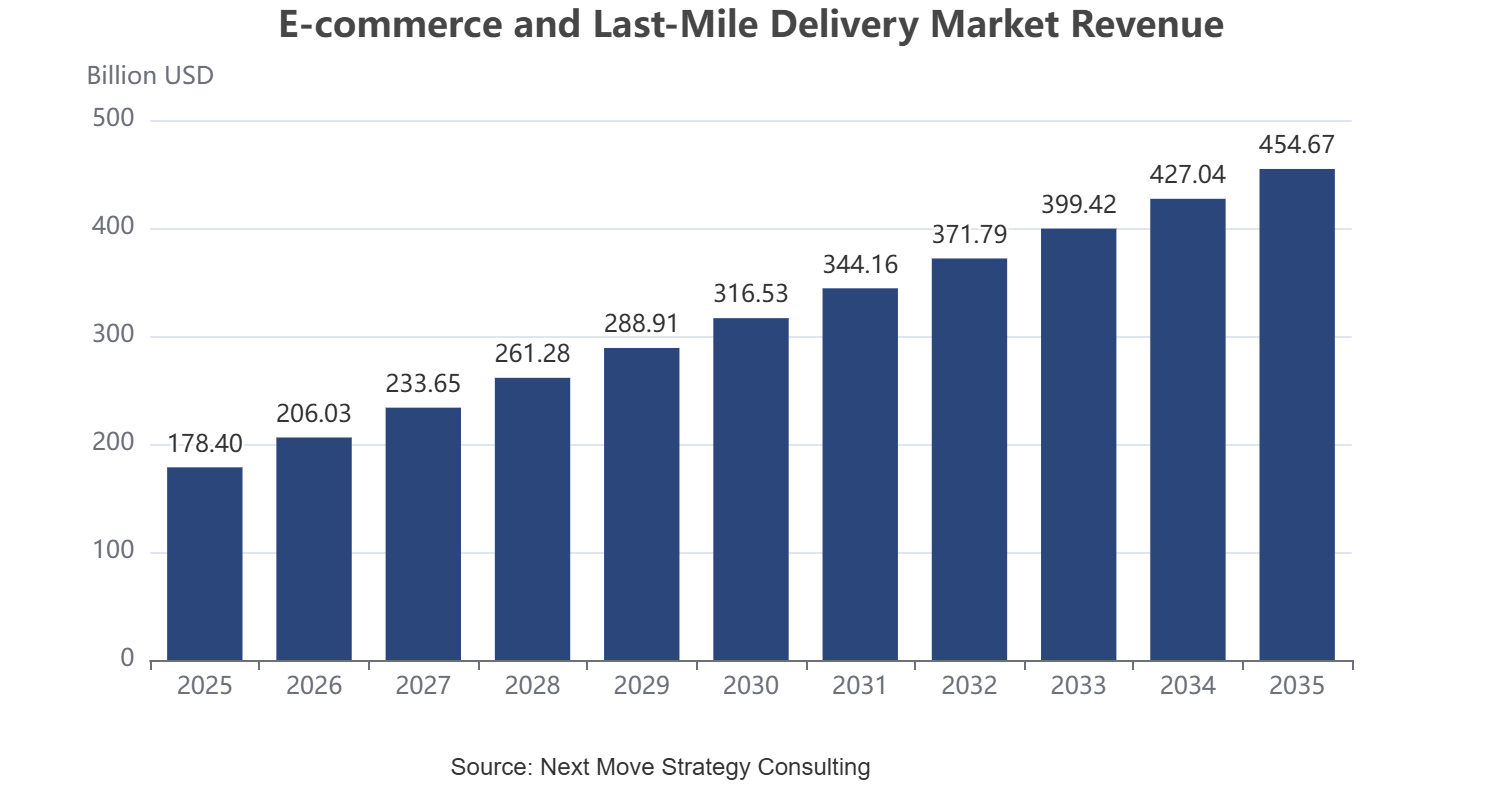
The e-commerce and last-mile delivery market covers the transportation, fulfillment, and delivery services that move online-ordered goods and prepared food from fulfillment centers or merchants to end consumers. The global e-commerce and last-mile delivery market size was valued at USD 178.40 billion in 2025 and is estimated at USD 193.82 billion in 2026, forecast to reach USD 454.67 billion by 2035 at a 9.95% CAGR from 2026 to 2035, driven by rising online retail penetration, quick-commerce demand, crowdsourced fleet expansion, and autonomous delivery adoption.
From our research, we found that growth is increasingly concentrated in express and same-day delivery formats as consumer expectations for delivery speed continue to rise across both developed and emerging e-commerce markets. Through our market assessment, we observed that third-party logistics providers are capturing a growing share of platform volume as e-commerce marketplaces increasingly outsource last-mile fulfillment to specialized carriers rather than expanding owned fleets.
|
Parameters |
Details |
|
Market Size in 2025 |
USD 178.40 Billion |
|
Market Size in 2026 |
USD 193.82 Billion |
|
Revenue Forecast in 2035 |
USD 454.67 Billion |
|
Growth Rate |
CAGR of 9.95% from 2026 to 2035 |
|
Analysis Period |
2025–2035 |
|
Base Year Considered |
2025 |
|
Forecast Period |
2026–2035 |
|
Market Size Estimation |
Revenue (USD Billion) |
|
Companies Profiled |
20 |
|
Countries Covered |
33 |
|
Market Share |
Available for Top 10 Companies |
E-commerce and Last-Mile Delivery Market Overview
What Does the E-commerce and Last-Mile Delivery Market Cover?
The market encompasses the final-mile transportation of e-commerce parcels and food orders, spanning platform-owned delivery fleets, third-party logistics providers, postal and courier networks, and crowdsourced gig-driver platforms. Our assessment indicates that scope extends across delivery vehicle categories, from two-wheelers and vans to emerging autonomous robots and drones, serving retail, grocery, electronics, food and beverage, and healthcare end-use industries within this market report.
How Has the Last-Mile Delivery Market Structure Evolved?
The market has evolved from postal-dominated parcel delivery into a fragmented ecosystem of platform-owned fleets and specialized 3PL carriers competing on speed. NMSC's analysis indicates that quick-commerce demand accelerated fleet densification in urban centers, prompting e-commerce marketplaces to build dedicated last-mile subsidiaries rather than depend solely on national postal operators for final delivery.
What Regulatory Environment Shapes Last-Mile Delivery Operations?
Regulatory frameworks governing gig-driver classification, vehicle emissions, and drone airspace access materially shape last-mile operating models. The U.S. Department of Transportation's Federal Aviation Administration continues to expand Part 108 drone delivery rulemaking, while European Union gig-work directives are reshaping crowdsourced driver classification. Our findings suggest that compliance costs increasingly favor larger carriers with dedicated regulatory affairs capacity.
How Is Technology Adoption Transforming Last-Mile Delivery?
Technology adoption is shifting toward route-optimization software, autonomous sidewalk robots, and drone delivery pilots as carriers seek to reduce per-parcel delivery cost. Based on research conducted by NMSC, we found that leading e-commerce platforms are piloting robotic and drone delivery in dense suburban corridors, positioning automation as a key differentiator for cost-sensitive express and grocery delivery formats.
|
Key Takeaways |
|
By Delivery Type: Standard Delivery held the largest share of approximately 42% (USD 74.92 Billion) in 2025; Express/Same-Day Delivery is the fastest-growing sub-segment at 13.4% CAGR from 2026–2035. |
|
By Service Provider: Third-Party Logistics (3PL) Providers held the largest share of approximately 38% (USD 67.81 Billion) in 2025; Crowdsourced Delivery Platforms is the fastest-growing sub-segment at 14.8% CAGR from 2026–2035. |
|
By Vehicle Type: Vans & Light Commercial Vehicles held the largest share of approximately 46% (USD 82.05 Billion) in 2025; Delivery Drones is the fastest-growing sub-segment at 21.6% CAGR from 2026–2035. |
|
By End Use Industry: Retail & Apparel held the largest share of approximately 30% (USD 53.52 Billion) in 2025; Healthcare & Pharmaceuticals is the fastest-growing sub-segment at 15.8% CAGR from 2026–2035. |
|
Dominant Region: North America dominated with approximately 34% revenue share (USD 60.67 Billion) in 2025. |
|
Fastest-Growing Region: Asia-Pacific is expected to register the highest CAGR of 13.8% during 2026–2035. |
|
Dominant Country: U.S. led with approximately USD 47.33 Billion in 2025. |
|
Fastest-Growing Country: India is the fastest-growing country at approximately 17.3% CAGR from 2026–2035. |
Market Opportunity: The e-commerce and last-mile delivery market is expected to create an absolute dollar opportunity of USD 260.85 billion between 2026 and 2035, presenting significant investment potential across the platform-owned fleet, third-party logistics, and crowdsourced delivery value chain.
NMSC's analysis indicates that carriers are increasingly consolidating last-mile volume with fewer, technology-enabled logistics partners to simplify multi-region delivery-speed compliance, a shift that favors diversified 3PL and platform-owned fleets over single-format specialists as quick-commerce competition intensifies through 2035.
Key Emerging Trends
Based on our market evaluation, we noticed that four structural trends are reshaping carrier strategy, technology investment, and consumer expectations across the e-commerce and last-mile delivery industry.
How Is Quick Commerce Redefining Delivery Speed Expectations?
Quick-commerce formats promising delivery within 10 to 30 minutes are compressing traditional same-day delivery windows across urban grocery and convenience categories. In our observation, platforms including Amazon.com, Inc. and Meituan are expanding dark-store networks to shorten last-mile distances, transforming stakeholder expectations for grocery and food and beverage delivery timelines industry-wide.
Why Is Crowdsourced Delivery Capacity Expanding Rapidly?
Crowdsourced gig-driver platforms are expanding delivery capacity without proportional fleet capital investment, allowing carriers to scale volume during peak demand periods. Through our market assessment, we observed that DoorDash, Inc. and Uber Technologies, Inc. continue to broaden crowdsourced capacity beyond food delivery into retail parcel and grocery fulfillment, reshaping cost structures across the broader delivery ecosystem.
How Are Autonomous Delivery Robots Gaining Commercial Traction?
Sidewalk delivery robots are moving from pilot programs into limited commercial deployment across university towns and dense suburban corridors. Our analysis shows that regulatory approval from municipal transportation authorities remains a gating factor, though early deployments demonstrate meaningful per-parcel cost reduction, positioning autonomous robots as a credible complement to traditional van-based delivery fleets.
What Role Does Delivery Drone Technology Play in Emerging Logistics Networks?
Delivery drone pilots are expanding beyond rural test corridors into suburban last-mile trials following expanded Federal Aviation Administration Part 108 rulemaking in the United States. Our findings suggest that drone delivery is gaining particular traction in healthcare and pharmaceutical logistics, where time-sensitive delivery requirements justify premium per-parcel drone economics relative to ground-based alternatives.
Supply Chain Structure of the E-Commerce and Last-Mile Delivery Market
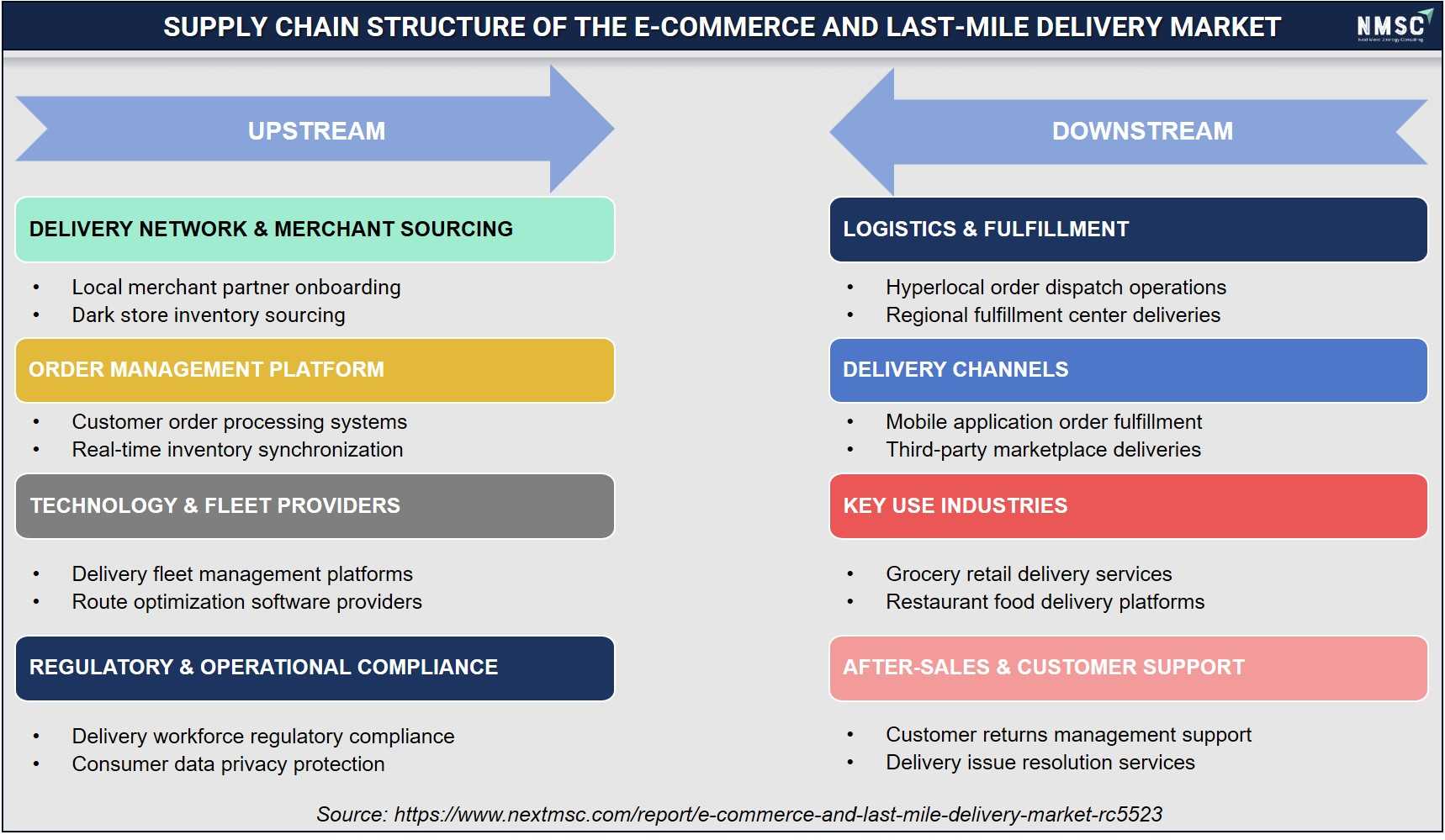
Based on our supply chain assessment, we identified that the e-commerce and last-mile delivery market relies on coordinated merchant onboarding, digital order management platforms, fleet management technologies, logistics providers, fulfilment centers, and delivery networks to ensure efficient order execution. Furthermore, our analysis indicates that downstream operations emphasize rapid fulfilment, multi-channel delivery, customer support, and returns management, while regulatory compliance and real-time inventory visibility strengthen operational efficiency, customer satisfaction, and overall supply chain resilience.
Growth Drivers, Restraints & Opportunities
Growth Catalyst and Risk Assessment Matrix
|
Driver / Trend / Restraint |
(+/−) % Impact on CAGR Forecast |
Geographic Relevance |
Impact Timeline |
|
Rising global e-commerce order volume |
+2.6% |
Global |
2026-2035 |
|
Expansion of quick-commerce dark-store networks |
+1.8% |
North America, Asia-Pacific |
2026-2032 |
|
Growth in crowdsourced gig-driver delivery capacity |
+1.5% |
Global |
2026-2035 |
|
Rising last-mile fuel and labor costs |
-1.2% |
North America, Europe |
2026-2035 |
|
Regulatory uncertainty over gig-driver classification |
-0.8% |
Europe, North America |
2026-2030 |
|
Whitespace in autonomous robot and drone delivery |
+1.1% |
North America, Asia-Pacific |
2028-2035 |
|
Opportunity in healthcare and pharmaceutical delivery logistics |
+0.9% |
Global |
2026-2035 |
|
Opportunity in emerging-market quick-commerce expansion |
+1.3% |
Asia-Pacific, Latin America |
2026-2035 |
What Is the Primary Growth Driver of the E-Commerce and Last-Mile Delivery Market?
Rising global e-commerce order volume remains the primary driver of the market. The U.S. Census Bureau reported that e-commerce continues to represent a growing share of total retail sales, sustaining parcel volume growth. From our research, we found that this structural shift toward online purchasing continues to underpin baseline last-mile delivery demand across both developed and emerging markets.
How Is Quick Commerce Driving Market Growth?
Expanding quick-commerce dark-store networks are accelerating market growth by shortening delivery distances and enabling sub-hour fulfillment windows. Our assessment indicates that this densification strategy, pioneered by grocery and convenience platforms, is compressing traditional same-day delivery timelines and pushing broader demand toward express and scheduled delivery formats across urban markets.
How Does Crowdsourced Delivery Capacity Support Growth?
Growth in crowdsourced gig-driver delivery capacity supports scalable, asset-light fleet expansion during peak e-commerce demand periods. Based on NMSC's research, we found that platforms increasingly blend owned-fleet and crowdsourced capacity to manage seasonal demand volatility, supporting sustained volume growth without proportional capital expenditure across the broader delivery ecosystem.
What Is Restraining E-Commerce and Last-Mile Delivery Market Growth?
Rising fuel and labor costs restrain carrier margins across the market, as last-mile delivery remains the most expensive segment of the logistics value chain. The U.S. Bureau of Labor Statistics tracks continued wage growth among delivery and courier occupations, pressuring carrier cost structures. Our analysis shows that smaller regional carriers face particular exposure given limited route-density economies of scale.
How Does Regulatory Uncertainty Restrain Market Growth?
Regulatory uncertainty over gig-driver employment classification restrains crowdsourced platform expansion in several jurisdictions. European Union gig-work directives continue to reshape driver classification requirements, increasing compliance costs for platforms reliant on independent-contractor delivery models. Our findings suggest that this uncertainty is prompting some platforms to shift toward hybrid employment structures.
How Does Autonomous Delivery Create Market Opportunity?
Whitespace remains in autonomous robot and drone delivery, presenting an opportunity for carriers to reduce per-parcel delivery cost in dense and rural corridors alike. Our assessment indicates that early movers securing municipal regulatory approval for robot sidewalk delivery stand to capture durable cost advantages over traditional van-based competitors.
How Does Healthcare Delivery Create Market Opportunity?
Healthcare and pharmaceutical delivery logistics present a significant opportunity as time-sensitive prescription and specimen delivery volumes rise. Our analysis shows that carriers developing temperature-controlled, chain-of-custody delivery capabilities can capture premium pricing within this fast-growing, currently underserved end-use category.
How Does Emerging-Market Expansion Create Market Opportunity?
Emerging-market quick-commerce expansion in Asia-Pacific and Latin America presents an opportunity for carriers and platforms to capture first-mover share as online retail penetration accelerates. Our findings suggest that platforms establishing dense dark-store and crowdsourced driver networks early in these markets will be best positioned to defend share as competition intensifies.
Segmentation Analysis
Segment Sizing: By Delivery Type
|
Segment |
2025 (USD) |
2035 (USD) |
CAGR% (2026–2035) |
|
Standard Delivery |
USD 74.92 Billion |
USD 154.69 Billion |
7.4% |
|
Express/Same-Day Delivery |
USD 60.66 Billion |
USD 203.68 Billion |
13.4% |
|
Scheduled Delivery |
USD 24.98 Billion |
USD 54.26 Billion |
8.0% |
|
Click-and-Collect |
USD 17.84 Billion |
USD 42.04 Billion |
9.0% |
|
Total |
USD 178.40 Billion |
USD 454.67 Billion |
9.95% |
Which Delivery Type Dominates the Last-Mile Delivery Market?
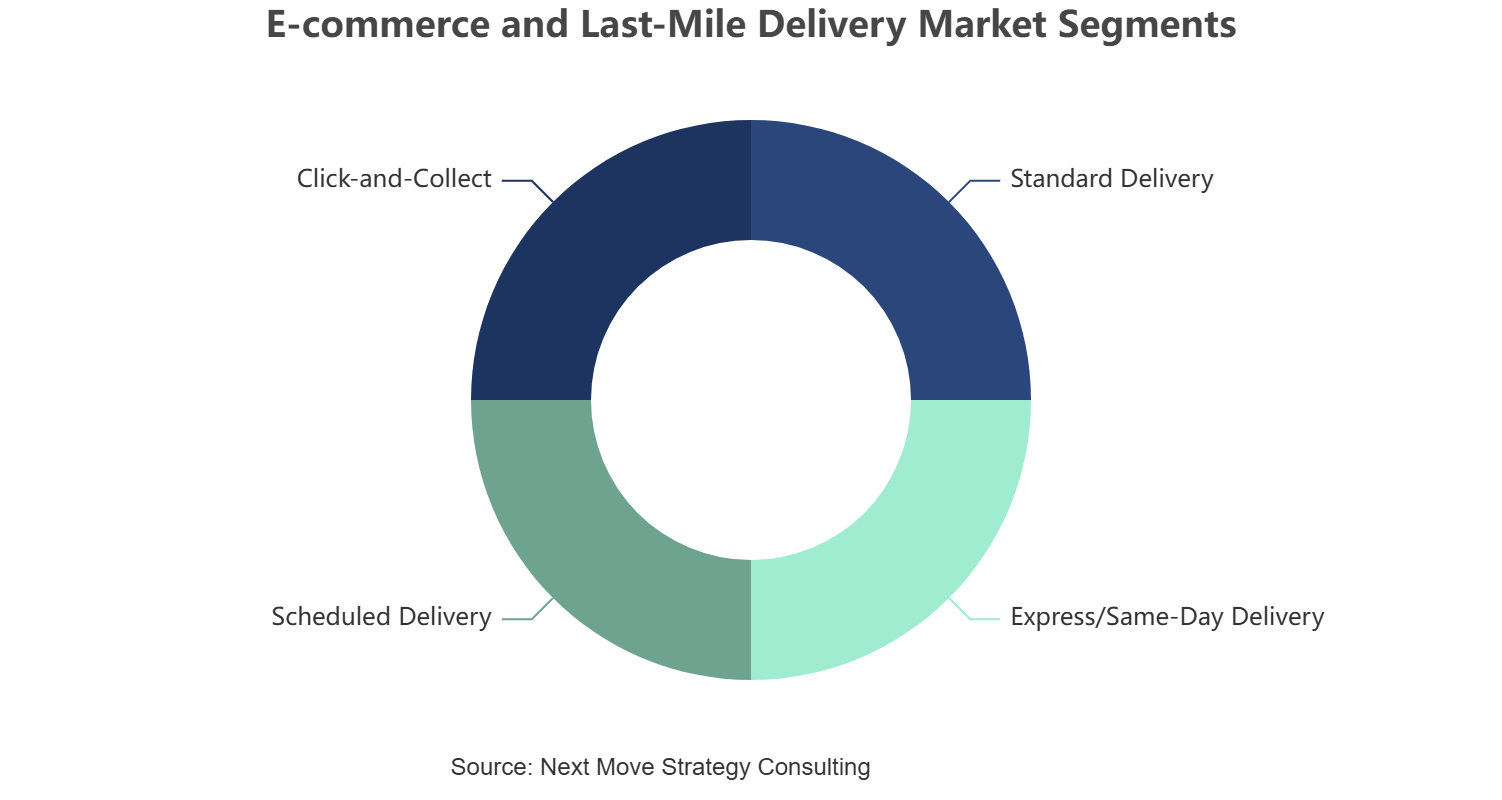
Standard Delivery led the market with USD 74.92 billion in 2025, supported by cost-conscious retail and electronics shipments that tolerate multi-day delivery windows. Our findings suggest that Express/Same-Day Delivery is the fastest-growing delivery type, expanding at a 13.4% CAGR from 2026 to 2035, as quick-commerce platforms normalize sub-hour and same-day fulfillment across grocery and food categories.
Segment Sizing: By Service Provider
|
Segment |
2025 (USD) |
2035 (USD) |
CAGR% (2026–2035) |
|
Third-Party Logistics (3PL) Providers |
USD 67.81 Billion |
USD 172.34 Billion |
9.9% |
|
E-commerce Platform-Owned Fleet |
USD 53.52 Billion |
USD 145.63 Billion |
10.7% |
|
Postal & Courier Services |
USD 39.23 Billion |
USD 69.49 Billion |
5.6% |
|
Crowdsourced Delivery Platforms |
USD 17.84 Billion |
USD 67.21 Billion |
14.8% |
|
Total |
USD 178.40 Billion |
USD 454.67 Billion |
9.95% |
Which Service Provider Segment Leads Last-Mile Delivery Demand?
Third-Party Logistics (3PL) Providers led the market with USD 67.81 billion in 2025, as e-commerce marketplaces increasingly outsource last-mile fulfillment to specialized carriers such as FedEx Corporation and United Parcel Service, Inc. Our analysis shows that Crowdsourced Delivery Platforms is the fastest-growing service provider category, registering a 14.8% CAGR from 2026 to 2035, driven by gig-driver capacity expansion beyond food delivery.
Segment Sizing: By Vehicle Type
|
Segment |
2025 (USD) |
2035 (USD) |
CAGR% (2026–2035) |
|
Vans & Light Commercial Vehicles |
USD 82.05 Billion |
USD 206.48 Billion |
9.8% |
|
Two-Wheelers |
USD 64.22 Billion |
USD 123.42 Billion |
6.5% |
|
Cargo Bikes |
USD 17.84 Billion |
USD 45.53 Billion |
10.0% |
|
Autonomous Delivery Robots |
USD 8.92 Billion |
USD 45.37 Billion |
18.7% |
|
Delivery Drones |
USD 5.37 Billion |
USD 33.87 Billion |
21.6% |
|
Total |
USD 178.40 Billion |
USD 454.67 Billion |
9.95% |
Which Vehicle Type Dominates the Last-Mile Delivery Market?
Vans & Light Commercial Vehicles led the market with USD 82.05 billion in 2025, remaining the backbone of multi-parcel route delivery across suburban and rural geographies. Our assessment indicates that Delivery Drones is the fastest-growing vehicle type, expanding at a 21.6% CAGR from 2026 to 2035 from a smaller base, as expanded aviation rulemaking unlocks commercial drone delivery corridors.
Segment Sizing: By End Use Industry
|
Segment |
2025 (USD) |
2035 (USD) |
CAGR% (2026–2035) |
|
Retail & Apparel |
USD 53.52 Billion |
USD 106.28 Billion |
6.9% |
|
Grocery & FMCG |
USD 39.23 Billion |
USD 112.81 Billion |
11.4% |
|
Electronics |
USD 35.68 Billion |
USD 74.43 Billion |
7.5% |
|
Food & Beverage |
USD 32.13 Billion |
USD 99.80 Billion |
12.4% |
|
Healthcare & Pharmaceuticals |
USD 12.47 Billion |
USD 50.64 Billion |
15.8% |
|
Others |
USD 5.37 Billion |
USD 10.71 Billion |
7.0% |
|
Total |
USD 178.40 Billion |
USD 454.67 Billion |
9.95% |
Which End Use Industry Leads Last-Mile Delivery Market Demand?
Retail & Apparel led the market with USD 53.52 billion in 2025, reflecting the largest share of overall e-commerce parcel volume. Our findings suggest that Healthcare & Pharmaceuticals is the fastest-growing end use industry, registering a 15.8% CAGR from 2026 to 2035, as time-sensitive prescription and specimen delivery volumes expand alongside telehealth-linked pharmacy fulfillment.
Regional Outlook
Geographic Performance Snapshot
|
Region |
2025 (USD) |
2035 (USD) |
CAGR% (2026–2035) |
Key Driver |
|
North America |
USD 60.67 Billion |
USD 125.98 Billion |
7.5% |
Mature e-commerce base and quick-commerce dark-store expansion |
|
Europe |
USD 39.23 Billion |
USD 75.42 Billion |
6.5% |
Gig-work regulation reshaping crowdsourced delivery models |
|
Asia-Pacific |
USD 57.07 Billion |
USD 199.10 Billion |
13.8% |
Rapid online retail penetration and quick-commerce scale-up |
|
Middle East & Africa |
USD 12.47 Billion |
USD 33.05 Billion |
10.4% |
Gulf e-commerce infrastructure investment |
|
Latin America |
USD 8.96 Billion |
USD 21.12 Billion |
9.0% |
Expanding urban delivery network density |
|
Total |
USD 178.40 Billion |
USD 454.67 Billion |
9.95% |
-- |
North America E-commerce and Last-Mile Delivery Market Outlook
North America leads the market with a mature e-commerce base and dense quick-commerce dark-store infrastructure. Through our analysis, we observed that Amazon.com, Inc. and third-party carriers continue to expand same-day delivery coverage across major metropolitan corridors. Regulatory influence stems from evolving Federal Aviation Administration drone rulemaking, while technology adoption remains advanced across route optimization and delivery automation.
Europe E-commerce and Last-Mile Delivery Market Outlook
Europe's market reflects a mature but regulation-intensive landscape shaped by evolving gig-work classification directives across member states. From our assessment, we found that carriers including La Poste Groupe and International Distribution Services plc continue to modernize parcel networks to meet rising e-commerce volume. Technology adoption favors route-density optimization, with competitive intensity elevated among postal incumbents and private carriers.
Asia-Pacific E-commerce and Last-Mile Delivery Market Outlook
Asia-Pacific is the fastest-growing region, propelled by rapid online retail penetration in China and India and dense quick-commerce scale-up across urban centers. Based on our engagements, we found that Alibaba Group Holding Limited and Meituan continue to expand delivery density through integrated logistics networks. Regulatory frameworks remain developing, while technology adoption is accelerating through automated sortation and drone delivery pilots.
Middle East & Africa E-commerce and Last-Mile Delivery Market Outlook
The market in Middle East & Africa is expanding as Gulf Cooperation Council economies invest in e-commerce logistics infrastructure alongside rising urban online retail adoption. Through our engagements, we found that Saudi Arabia and the UAE are attracting last-mile fleet investment tied to national digital economy programs. Regulatory influence remains moderate, and technology adoption is gradually improving through imported route-optimization platforms.
Latin America E-commerce and Last-Mile Delivery Market Outlook
Latin America's market is supported by expanding urban delivery network density in Brazil and Argentina alongside rising e-commerce adoption. According to evaluation, regulatory frameworks remain less stringent than in North America or Europe, though national postal operators are modernizing last-mile infrastructure. Technology adoption remains centered on route-density improvements, with competitive intensity increasing as regional carriers partner with global platforms.
U.S. E-commerce and Last-Mile Delivery Market
Based on our engagements, the U.S. market was valued at approximately USD 47.33 Billion in 2025 and is projected to reach USD 94.88 Billion by 2035, growing at a 7.0% CAGR. Demand structure reflects region-typical adoption levels for last-mile delivery, where the U.S. Department of Transportation's evolving drone delivery rulemaking and dense quick-commerce competition among national e-commerce platforms shape demand. Technology penetration continues to rise, and competitive intensity remains active among domestic and international carriers serving this market.
Canada E-commerce and Last-Mile Delivery Market
Through our analysis, the Canada market was valued at approximately USD 8.49 Billion in 2025 and is projected to reach USD 19.21 Billion by 2035, growing at a 8.5% CAGR. Demand structure reflects region-typical adoption levels for last-mile delivery, where Canada Post modernization programs and rising urban quick-commerce adoption shape demand. Technology penetration continues to rise, and competitive intensity remains active among domestic and international carriers serving this market.
UK E-commerce and Last-Mile Delivery Market
According to evaluation, the UK market was valued at approximately USD 7.05 Billion in 2025 and is projected to reach USD 13.01 Billion by 2035, growing at a 6.1% CAGR. Demand structure reflects region-typical adoption levels for last-mile delivery, where Royal Mail network modernization and gig-driver classification rules under UK employment law shape demand. Technology penetration continues to rise, and competitive intensity remains active among domestic and international carriers serving this market.
Germany E-commerce and Last-Mile Delivery Market
Based on our engagements, the Germany market was valued at approximately USD 7.84 Billion in 2025 and is projected to reach USD 14.83 Billion by 2035, growing at a 6.4% CAGR. Demand structure reflects region-typical adoption levels for last-mile delivery, where Deutsche Post AG's dense parcel network and rising quick-commerce grocery delivery shape demand. Technology penetration continues to rise, and competitive intensity remains active among domestic and international carriers serving this market.
France E-commerce and Last-Mile Delivery Market
Through our analysis, the France market was valued at approximately USD 5.89 Billion in 2025 and is projected to reach USD 10.87 Billion by 2035, growing at a 6.1% CAGR. Demand structure reflects region-typical adoption levels for last-mile delivery, where La Poste Groupe network density and expanding urban quick-commerce competition shape demand. Technology penetration continues to rise, and competitive intensity remains active among domestic and international carriers serving this market.
China E-commerce and Last-Mile Delivery Market
Through our analysis, the China market was valued at approximately USD 17.12 Billion in 2025 and is projected to reach USD 55.25 Billion by 2035, growing at a 12.9% CAGR. Demand structure reflects region-typical adoption levels for last-mile delivery, where Alibaba Group Holding Limited's Cainiao network and JD.com, Inc.'s owned-fleet logistics shape demand. Technology penetration continues to rise, and competitive intensity remains active among domestic and international carriers serving this market.
India E-commerce and Last-Mile Delivery Market
From our assessment, the India market was valued at approximately USD 10.26 Billion in 2025 and is projected to reach USD 46.69 Billion by 2035, growing at a 17.3% CAGR. Demand structure reflects region-typical adoption levels for last-mile delivery, where rapid quick-commerce dark-store expansion and Delhivery Limited's growing delivery network shape demand. Technology penetration continues to rise, and competitive intensity remains active among domestic and international carriers serving this market.
Japan E-commerce and Last-Mile Delivery Market
According to evaluation, the Japan market was valued at approximately USD 7.40 Billion in 2025 and is projected to reach USD 16.08 Billion by 2035, growing at a 8.0% CAGR. Demand structure reflects region-typical adoption levels for last-mile delivery, where Japan Post Holdings Co., Ltd.'s dense parcel network and rising same-day delivery adoption shape demand. Technology penetration continues to rise, and competitive intensity remains active among domestic and international carriers serving this market.
South Korea E-commerce and Last-Mile Delivery Market
Based on our engagements, the South Korea market was valued at approximately USD 5.15 Billion in 2025 and is projected to reach USD 12.65 Billion by 2035, growing at a 9.5% CAGR. Demand structure reflects region-typical adoption levels for last-mile delivery, where advanced quick-commerce infrastructure and dense urban delivery competition shape demand. Technology penetration continues to rise, and competitive intensity remains active among domestic and international carriers serving this market.
Australia E-commerce and Last-Mile Delivery Market
Based on our engagements, the Australia market was valued at approximately USD 3.98 Billion in 2025 and is projected to reach USD 9.03 Billion by 2035, growing at a 8.5% CAGR. Demand structure reflects region-typical adoption levels for last-mile delivery, where expanding quick-commerce grocery delivery and rising van-based fleet investment shape demand. Technology penetration continues to rise, and competitive intensity remains active among domestic and international carriers serving this market.
Saudi Arabia E-commerce and Last-Mile Delivery Market
Based on our engagements, the Saudi Arabia market was valued at approximately USD 2.36 Billion in 2025 and is projected to reach USD 6.86 Billion by 2035, growing at a 11.6% CAGR. Demand structure reflects region-typical adoption levels for last-mile delivery, where Vision 2030-linked digital economy investment and expanding quick-commerce grocery delivery shape demand. Technology penetration continues to rise, and competitive intensity remains active among domestic and international carriers serving this market.
UAE E-commerce and Last-Mile Delivery Market
Through our analysis, the UAE market was valued at approximately USD 2.12 Billion in 2025 and is projected to reach USD 5.86 Billion by 2035, growing at a 10.9% CAGR. Demand structure reflects region-typical adoption levels for last-mile delivery, where the UAE's role as a regional e-commerce logistics hub shapes demand. Technology penetration continues to rise, and competitive intensity remains active among domestic and international carriers serving this market.
South Africa E-commerce and Last-Mile Delivery Market
From our assessment, the South Africa market was valued at approximately USD 1.26 Billion in 2025 and is projected to reach USD 2.97 Billion by 2035, growing at a 9.0% CAGR. Demand structure reflects region-typical adoption levels for last-mile delivery, where steady e-commerce growth and expanding regional courier network investment shape demand. Technology penetration continues to rise, and competitive intensity remains active among domestic and international carriers serving this market.
Brazil E-commerce and Last-Mile Delivery Market
Based on our engagements, the Brazil market was valued at approximately USD 4.03 Billion in 2025 and is projected to reach USD 9.12 Billion by 2035, growing at a 8.5% CAGR. Demand structure reflects region-typical adoption levels for last-mile delivery, where expanding urban delivery network density and rising quick-commerce grocery adoption shape demand. Technology penetration continues to rise, and competitive intensity remains active among domestic and international carriers serving this market.
Argentina E-commerce and Last-Mile Delivery Market
Through our analysis, the Argentina market was valued at approximately USD 1.43 Billion in 2025 and is projected to reach USD 2.97 Billion by 2035, growing at a 7.5% CAGR. Demand structure reflects region-typical adoption levels for last-mile delivery, where steady e-commerce parcel growth supported by expanding courier networks shapes demand. Technology penetration continues to rise, and competitive intensity remains active among domestic and international carriers serving this market.
Consumer Behavior Analysis of the E-Commerce and Last-Mile Delivery Market
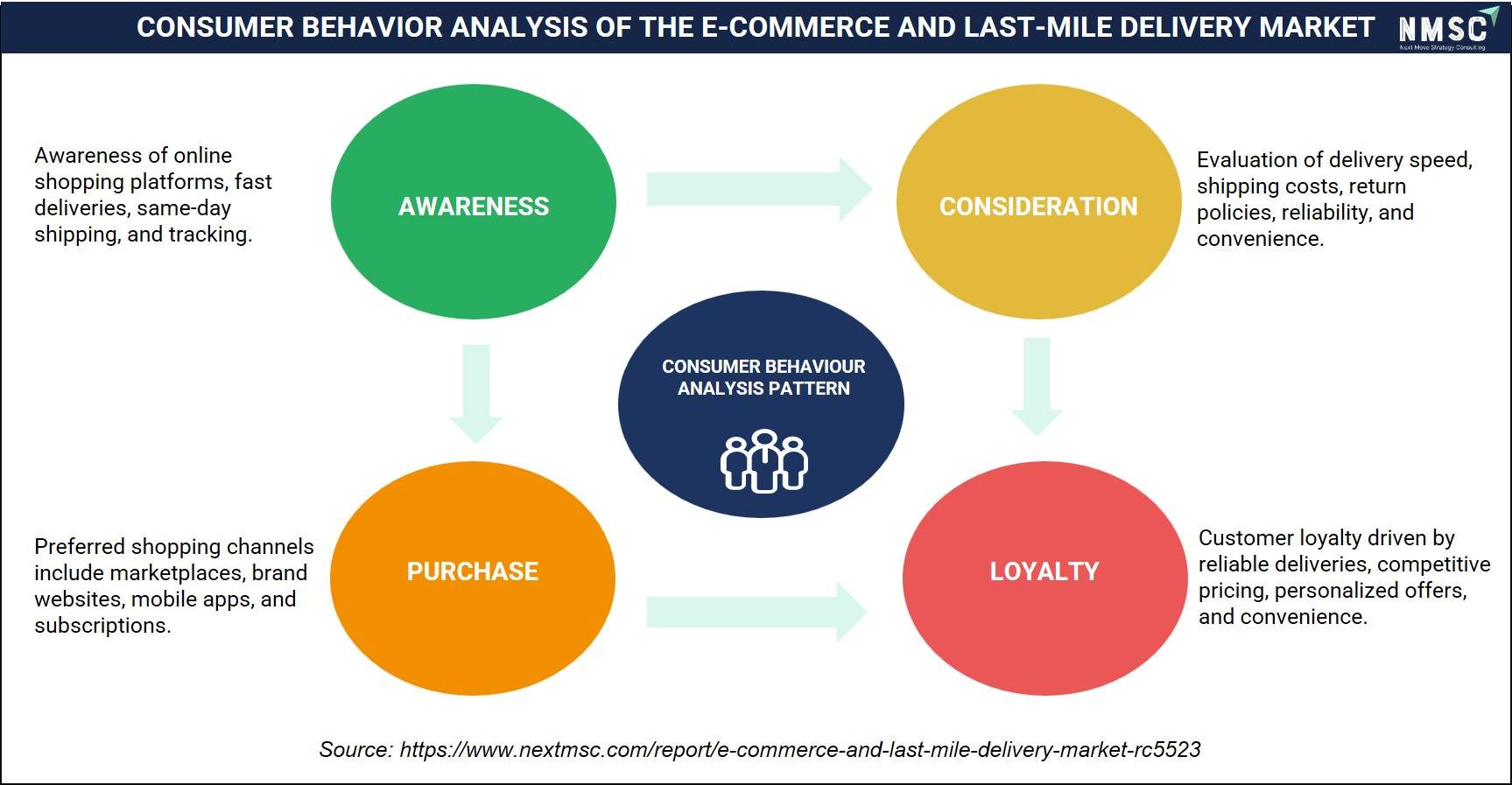
Based on our consumer behavior assessment, we identified that purchasing decisions in the e-commerce and last-mile delivery market are primarily influenced by delivery speed, shipping costs, order tracking, return convenience, and platform reliability. Furthermore, our analysis indicates that consumers increasingly prefer mobile applications, online marketplaces, and direct brand websites while demonstrating stronger loyalty toward service providers that consistently deliver fast fulfilment, transparent communication, competitive pricing, and seamless post-purchase support.
Competitive Landscape
|
Dimension |
Description |
|
Market Structure |
Moderately fragmented; the top 10 companies profiled in this report account for a significant share of global last-mile delivery revenue, while numerous regional and crowdsourced platforms serve local density needs. |
|
Innovation Focus |
Route optimization software, autonomous delivery robots, and drone delivery pilots dominate current innovation pipelines across leading carriers and platforms. |
|
M&A Activity |
Selective consolidation through logistics acquisitions, exemplified by e-commerce platforms acquiring regional last-mile carriers to broaden owned-fleet delivery density. |
How Do Companies Compete in the Last-Mile Delivery Market?
Companies compete primarily on delivery speed, route density, and cost per parcel across the industry. Global carriers such as United Parcel Service, Inc. and FedEx Corporation leverage broad logistics networks to serve enterprise e-commerce customers, while platforms including DoorDash, Inc. compete on crowdsourced driver density within dense urban delivery corridors.
Which Competitive Archetypes Dominate the Last-Mile Delivery Market?
Two archetypes dominate the market: diversified global logistics carriers offering integrated parcel and freight delivery, and asset-light crowdsourced platforms built on gig-driver networks. Deutsche Post AG exemplifies the integrated logistics archetype through its DHL Group parcel network, while Uber Technologies, Inc. exemplifies the crowdsourced archetype through flexible driver-matching technology extended across food and retail delivery.
How Are Companies Differentiating Through Innovation?
Innovation and differentiation strategy increasingly center on autonomous delivery robots and route-optimization algorithms. XPO, Inc. and GXO Logistics, Inc. continue to expand automated sortation and fleet-routing technology to reduce per-parcel delivery cost. Our analysis shows that carriers unable to demonstrate credible automation roadmaps risk losing enterprise e-commerce contracts to more technologically advanced competitors.
What M&A and Expansion Activity Is Shaping the Market?
Mergers, acquisitions, and geographic expansion continue to consolidate last-mile delivery capabilities within the industry. E-commerce platforms have pursued targeted acquisitions of regional courier and crowdsourced delivery specialists to broaden owned-fleet density, while logistics majors expand geographic footprint and pricing leverage across express and scheduled delivery service tiers.
Key Market Players
Our assessment indicates that the following 20 companies are actively shaping fleet strategy, technology investment, and geographic expansion within the global e-commerce and last-mile delivery market.
-
Amazon.com, Inc.
-
FedEx Corporation
-
Deutsche Post AG (DHL Group)
-
United States Postal Service
-
Alibaba Group Holding Limited
-
JD.com, Inc.
-
Meituan
-
DoorDash, Inc.
-
Uber Technologies, Inc.
-
La Poste Groupe
-
International Distribution Services plc
-
Japan Post Holdings Co., Ltd.
-
S.F. Holding Co., Ltd.
-
Deliveroo plc
-
Maplebear Inc.
-
Eternal Limited
-
Delhivery Limited
-
XPO, Inc.
-
GXO Logistics, Inc.
Latest Developments
From our research, we found that recent activity within the last-mile delivery market is concentrated on autonomous delivery pilots and crowdsourced capacity expansion, reflecting the industry's broader automation and speed-focused modernization.
|
Date |
Event |
|
December 2025 |
Deutsche Post AG (DHL Group) officially opened its newly expanded Middle East & Africa (MEA) Innovation Center in Dubai South alongside a approximately USD 136.5 million investment by DHL Supply Chain into a state-of-the-art, carbon-neutral 55,000-square-meter multi-user warehouse. The strategic dual-project establishes a permanent co-creation hub for regional logistics solutions and strengthens the company's contract logistics capabilities. Verified via DHL Official Press Release. |
|
November 2025 |
FedEx Corporation officially launched the global FedEx Integrator Program to expand its digital integration framework for supply chain management (SCM) software providers and third-party logistics partners. The platform provides self-serve application programming interfaces (APIs) and webhooks, enabling merchants to seamlessly embed FedEx shipping capabilities and gain near-real-time shipment visibility across their customer journeys. Verified via FedEx Newsroom. |
|
May 2025 |
Amazon.com, Inc. announced a strategic USD 4 billion investment to expand its delivery network and accelerate last-mile shipping speeds across thousands of smaller cities, towns, and rural communities in the United States by 2026. The initiative includes the development of more than 200 new delivery stations to triple its rural delivery footprint, halve delivery times, and leverage predictive AI for inventory placement. Verified via Amazon Official Press Release and Supply Chain Dive Coverage. |
Expert Insights
 “Consumers hold brands accountable for the delivery experience. Delivery should be thought of as an extension of the brand, and not just a cost bucket to manage.”
— Raj Ramanan, CEO, AxleHire
Statement made during an interview with PYMNTS discussing the growing strategic importance of last-mile delivery in shaping customer experience and brand loyalty for e-commerce businesses.
Market Interpretation
The statement highlights the evolving role of last-mile delivery as a strategic differentiator rather than a logistics function. As e-commerce businesses increasingly compete on delivery speed, reliability, and customer satisfaction, investments in intelligent routing, real-time tracking, and flexible fulfillment networks are accelerating. This growing emphasis on delivery experience is expected to drive sustained demand for advanced last-mile delivery solutions, supporting the expansion of the global E-commerce and Last-mile Delivery Market.
Investment Opportunities
What Capital Inflows Are Targeting the Last-Mile Delivery Market?
Capital inflows into the market are increasingly directed toward autonomous delivery technology and crowdsourced platform capacity. Venture and strategic investors continue to fund route-optimization software startups. Through our market assessment, we observed that investors favor platforms demonstrating validated unit economics, viewing delivery cost per parcel as a proxy for long-term margin sustainability.
How Is Infrastructure Investment Supporting Delivery Network Expansion?
Infrastructure investment is expanding dark-store and micro-fulfillment center networks across North America and Asia-Pacific to serve rising quick-commerce demand. Our findings suggest that carriers are investing in automated sortation facilities to improve delivery responsiveness across express and scheduled delivery formats.
What ESG Considerations Are Shaping Investment Decisions?
Environmental, social, and governance considerations are increasingly central to investment decisions, with electric vehicle fleet transition and gig-driver labor standards as key criteria. The U.S. Environmental Protection Agency's vehicle emissions guidance continues to inform fleet electrification disclosures. Our analysis shows that investors increasingly favor carriers with credible fleet decarbonization roadmaps.
How Is Digital Transformation Reshaping Investment Priorities?
Digital transformation is reshaping investment priorities toward route-optimization algorithms, real-time delivery tracking, and predictive demand forecasting software. Our assessment indicates that carriers investing early in integrated technology stacks are best positioned to capture enterprise e-commerce contracts requiring advanced delivery visibility.
What PE/VC and M&A Activity Is Shaping the Market?
Private equity and venture capital activity continues to target crowdsourced delivery platforms and route-optimization software providers. Our findings suggest that strategic acquirers, including established logistics carriers, are pursuing bolt-on acquisitions of regional last-mile specialists to expand delivery density without organic fleet build-out.
Key Benefits for Stakeholders
How Does This Report Benefit Enterprise Technology Leaders and CIOs?
Enterprise technology leaders and CIOs gain access to validated segmentation and competitive benchmarking that support last-mile delivery vendor selection decisions. Our analysis shows that the report's service provider and vehicle type breakdowns in Section 7 help technology teams align delivery integration roadmaps with regional infrastructure realities described in Section 8.
How Does This Report Benefit Investors and Financial Analysts?
Investors and financial analysts benefit from consistent, single-point market size and CAGR estimates that support valuation decisions across the delivery supply chain. Our findings suggest that the regional and segment-level growth differentials detailed in Section 7 and Section 8 help identify which carriers are positioned to capture above-market growth through 2035.
How Does This Report Benefit Technology Vendors and Product Teams?
Technology vendors and product teams gain insight into emerging requirements around autonomous delivery and route optimization detailed in Section 5 and Section 6. Our assessment indicates that this analysis helps R&D teams prioritize development roadmaps around the vehicle type and service provider categories with the strongest projected growth.
Key Market Segments
By Delivery Type
-
Standard Delivery
-
Express/Same-Day Delivery
-
Scheduled Delivery
-
Click-and-Collect
By Service Provider
-
E-commerce Platform-Owned Fleet
-
Third-Party Logistics (3PL) Providers
-
Postal & Courier Services
-
Crowdsourced Delivery Platforms
By Vehicle Type
-
Two-Wheelers
-
Vans & Light Commercial Vehicles
-
Autonomous Delivery Robots
-
Delivery Drones
-
Cargo Bikes
By End Use Industry
-
Retail & Apparel
-
Electronics
-
Grocery & FMCG
-
Food & Beverage
-
Healthcare & Pharmaceuticals
-
Others
By Region
-
North America: U.S., Canada, Mexico
-
Europe: UK, Germany, France, Italy, Spain, Sweden, Denmark, Finland, Netherlands, Rest of Europe
-
Asia-Pacific: China, India, Japan, South Korea, Taiwan, Indonesia, Vietnam, Australia, Philippines, Malaysia, Rest of APAC
-
Middle East & Africa: Saudi Arabia, UAE, Egypt, Israel, Turkey, Nigeria, South Africa, Rest of MEA
-
Latin America: Brazil, Argentina, Chile, Colombia, Rest of LATAM
Conclusion and Recommendations
What Is the Long-Term Outlook for the E-commerce and Last-Mile Delivery Market?
The long-term outlook for the market remains positive, with global revenue projected to increase from USD 178.40 billion in 2025 to USD 454.67 billion by 2035 at a 9.95% CAGR. We observed that sustained e-commerce order growth, rapid quick-commerce expansion, and increasing adoption of technology-enabled fulfillment networks will continue underpinning demand across delivery types, vehicle categories, and end-use industries throughout the forecast period.
What Strategic Positioning Should E-commerce and Last-Mile Delivery Providers Pursue?
Providers should prioritize express and same-day delivery capabilities while accelerating investments in autonomous delivery technologies, AI-driven route optimization, and integrated logistics platforms to strengthen long-term competitiveness. Our assessment indicates that companies expanding crowdsourced delivery capacity alongside high-density owned fleets and enterprise technology partnerships will be best positioned to secure premium contracts and improve operational efficiency within the e-commerce and last-mile delivery market.
How Attractive Is the E-commerce and Last-Mile Delivery Market for New Investment?
The e-commerce and last-mile delivery industry presents an attractive investment case, supported by a USD 260.85 billion absolute dollar opportunity between 2026 and 2035 and robust growth across Asia-Pacific and autonomous delivery segments. We found that investment attractiveness is highest for logistics providers combining scalable delivery infrastructure, automation capabilities, and digital visibility solutions to serve enterprise, retail, healthcare, and quick-commerce customers efficiently.
What Market Shifts and Key Risks Should Stakeholders Monitor?
Stakeholders should monitor rising fuel and labor costs, evolving gig-worker regulations, and delays in autonomous vehicle and drone approvals as key risks influencing market performance. Our analysis shows that providers unable to improve operational efficiency or adapt to changing labor regulations risk losing market share to competitors with advanced automation capabilities and stronger route-density economics, particularly across highly regulated markets.
What Are the Key Growth Pathways for the E-commerce and Last-Mile Delivery Market?
Key growth pathways include expanding express and same-day delivery networks, scaling autonomous robot and drone delivery programs, and strengthening last-mile logistics capabilities for healthcare, grocery, and pharmaceutical deliveries. Next Move Strategy Consulting's analysis indicates that companies pursuing these strategies while maintaining cost competitiveness and technology-driven operational excellence will be best positioned to capture the e-commerce and last-mile delivery market's projected growth through 2035.
About the Author

About the Reviewer

At Next Move Strategy Consulting, we understand that insightful market research is the cornerstone of successful business decisions. That's why we employ a robust and multifaceted approach, combining various methodologies to deliver the most accurate and actionable data for our clients.

Research Landscape
We navigate the world of research with two primary approaches:
Qualitative Approach
Our qualitative research methodologies involve immersive techniques such as in-depth interviews, focus groups, and observational studies. By engaging directly with individuals and stakeholders, we uncover valuable insights that quantitative data alone may overlook.

Quantitative Research
In tandem with qualitative methodologies, NMSC leverages the power of Quantitative Research to provide a robust foundation of numerical insights. Through systematic data collection and analysis, we quantify patterns, preferences, and market trends, offering a comprehensive view of the business landscape.
Our quantitative research approach employs diverse tools, including surveys, experiments, and statistical modelling. These methodologies enable us to gather data from a large and representative sample, ensuring the statistical significance of our findings. By employing structured questionnaires and standardized data collection methods, we guarantee the reliability and validity of the information we present to our clients.
Quantitative research is particularly effective in measuring the prevalence of trends, assessing market size, and gauging the impact of various factors on consumer behavior. The numerical precision attained through this approach equips our clients with actionable insights, facilitating data-driven decision-making and strategy formulation.


Our Specialized Toolbox for Industry-Specific Market Research
We deploy a specialized arsenal of techniques tailored to meet your unique requirements. Here's a glimpse into our comprehensive toolbox:

Information Procurement
The stage entails acquiring market data or relevant information through various sources and methodologies.


Market Research Approach
We utilize both top-down and bottom-up approaches in market research analysis to achieve a comprehensive understanding of the market dynamics, leveraging the broad perspective of industry trends and macroeconomic factors alongside detailed insights from specific segments and individual companies.

Porters Five Forces Analysis
We conduct Porter's Five Forces analysis to evaluate the competitive landscape of an industry, providing us with insights into factors that affect profitability and strategic positioning.

SWOT Analysis

Forecasting
We utilize a forecasting model to predict future consumption by considering parameters like population, economics, regulations, market competition, drivers, constraints, technology, and pricing. We also employ statistical techniques such as multilinear regression, exponential smoothing, moving average, ARIMA, and Monte Carlo simulations for accurate predictions. In econometric forecasting, we analyzed short-term and long-term event impacts, attributing values based on regulatory frameworks, economic factors, and market events.





 Speak to Our Analyst