Edge AI in Industrial Automation: Market Outlook and Trends
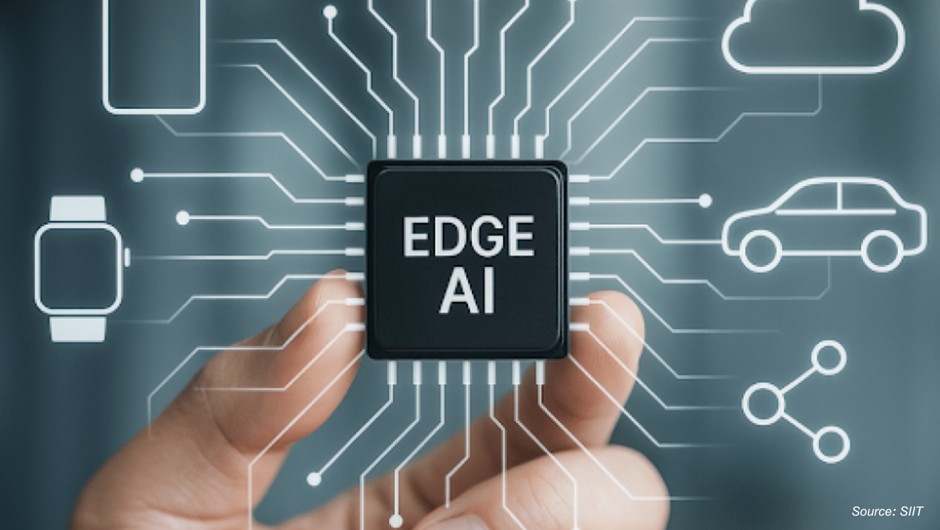
On 21 April 2026, Siemens announced the general availability of its Industrial AI Suite, built on Industrial Edge. Siemens says the platform supports predictive maintenance and visual inspection, showing how AI is moving into manufacturing workflows rather than remaining in separate dashboards. This shift matters because factory equipment produces data faster than remote teams can review it. Edge AI runs models close to that equipment, allowing systems to interpret sensor or image data near its source. The wider Edge AI Market is expanding beyond manufacturing. NextMSC values the global market at USD 28.64 billion in 2025 and estimates USD 37.88 billion for 2026. It forecasts USD 261.37 billion by 2035, representing a 23.94% CAGR from 2026 to 2035. This outlook gives manufacturers context as they assess local intelligence. The real question is how edge processing changes plant operations, not simply how many AI devices factories install.
What changes when AI runs beside industrial machines?
Traditional factory analytics often send sensor readings, images, or operating records to a central server. The system processes the information and returns a result. That model works for many planning tasks, but it can slow decisions that depend on immediate machine feedback.
Industrial Edge AI moves inference closer to the production process. A model may run inside a smart camera, sensor, industrial PC, edge gateway, or local server. It can assess a signal near the machine and send a result to an approved control system. This approach can reduce network delays and limit the amount of raw data sent elsewhere. It does not remove the need for networks. Factories still need connections for model updates, fleet management, remote support, and plant-wide analysis.
Deployment can happen on the device, through a gateway, on an edge server, or through a hybrid setup. The right design depends on response time, processing load, power limits, data policies, and the number of machines involved. Arm's December 2025 analysis identifies near-sensor inference, real-time response, power efficiency, and secure software updates as core industrial computing needs.
Where is Edge AI changing industrial automation first?
Manufacturers are applying local AI where fast feedback can reduce inspection delays, unplanned stoppages, or manual handling. Four use cases show how the technology fits into production.
|
Application |
What Edge AI does |
Operational value |
|
Quality inspection |
Analyses images near the line and flags visible defects or dimensional variation. |
Helps teams identify quality issues before more units move downstream. |
|
Predictive maintenance |
Reviews vibration, temperature, current, and machine-cycle patterns for signs of abnormal operation. |
Helps maintenance teams investigate equipment before a failure stops production. |
|
Robotics and material movement |
Uses camera and sensor inputs to guide robot positioning, object handling, and mobile robot navigation. |
Supports more flexible handling when parts or routes vary. |
|
Process and energy control |
Analyses local operating data and identifies conditions that may need adjustment. |
Helps operators tune processes within approved production limits. |
The manufacturing opportunity is also visible in NextMSC's market segmentation. Its current report identifies manufacturing as the largest industry vertical in the Edge AI Market. It estimates that segment at USD 6.32 billion in 2025. The forecast reaches USD 57.43 billion by 2035. These figures describe the market's manufacturing vertical, not revenue from one application or a count of AI-enabled factories.
How does a smart factory turn local AI into autonomous action?
A smart factory becomes more autonomous when local AI connects to the systems that coordinate production. The process usually follows a sequence. Sensors and cameras collect machine or product data. An edge processor runs an AI model on that data. The model produces an alert, classification, forecast, or recommended adjustment. A connected control system then applies an approved response or asks an operator to review it. Sensors measure the result and feed information back into the process.
This architecture must work with factory systems already in place. Programmable logic controllers manage machine control. Supervisory control and data acquisition systems monitor processes, while human-machine interfaces present information to operators. Manufacturing execution systems coordinate production activities. Cisco's April 2026 factory-floor article describes the move toward running control logic, HMI, SCADA, and AI workloads within a more connected industrial environment.
A hybrid model can split these responsibilities. Time-sensitive inference can run locally, while central systems manage model training, updates, long-term records, and comparisons across sites. AI should not be treated as an unrestricted controller. Manufacturers need clear limits for automated actions, human escalation, and safety-related decisions.
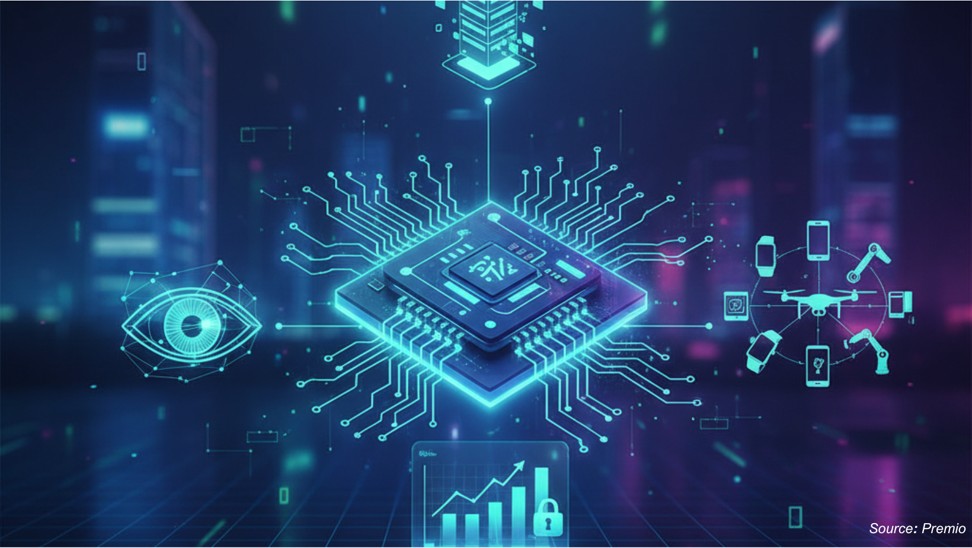
At Hannover Messe 2026, AWS and SoftServe demonstrated a robotic production cell coordinated by cloud services, with a local gateway handling device communication. AWS reported continuous operation across all five days of the event. AWS reported that the cell ran continuously for five days while producing custom coasters. The demonstration illustrates coordination across several suppliers, and does not prove that every factory can reproduce the setup at the same cost or scale.
What do recent developments reveal about industrial Edge AI?
Recent activity points to progress in both sensor-level research and industrial computing platforms. On 29 April 2026, Fraunhofer IMS reported initial laboratory results from its GenSATIOn-Edge project, which is developing sensor nodes that run AI models on edge devices to monitor machining processes. Its tests on CNC milling machines examined links between vibration signals, process parameters, and tool properties. The results suggest that AI output is more useful when paired with process knowledge.
On 26 May 2026, Emerson announced a collaboration with SiMa.ai to bring real-time AI processing to Emerson industrial PCs. The companies described applications involving image, video, audio, text, and sensor inputs on factory floors and remote sites. The announcement lists quality inspection, anomaly detection, asset performance, and predictive maintenance among the intended uses. It describes a collaboration and product direction, not independently verified productivity gains at customer sites.
Together, these developments show that industrial Edge AI is moving beyond proof-of-concept software. Hardware suppliers, automation vendors, and research institutes are building ways to run inference close to machines. Wider adoption will still depend on integration, reliability, and clear returns for plant operators.
What prevents manufacturers from scaling Edge AI?
Legacy equipment is a major barrier. Factories may use different controllers, protocols, data formats, and machine generations. Connecting AI applications to these systems can require gateways, custom integration, and careful testing. A pilot that works on one production line may need redesign before it can operate across several plants.
Model reliability creates another deployment challenge. Lighting, raw materials, machine wear, product variants, and line speeds can change over time. Models need monitoring and controlled updates to avoid incorrect alerts or decisions. Industrial teams must also plan for compute capacity, heat, power, spare parts, and long equipment lifecycles.
Cybersecurity risks require careful attention too. Connecting operational technology with business networks and remote services can increase the number of systems that need protection. On 21 May 2026, NIST released the initial public draft of SP 1800-41. The guide covers cyberattack response and recovery in industrial control system environments for manufacturers. The guide is not specific to Edge AI, but it is relevant to factories connecting more digital systems to operational technology.
Successful deployments therefore need clear ownership, tested fallback procedures, secure update practices, and staff who understand both industrial controls and AI systems. Manufacturers should begin with a measurable problem, validate the model under real operating conditions, and expand only after the process performs reliably.
Frequently asked questions
Does industrial Edge AI require an internet connection?
An internet connection is not always required. A model can run locally without sending every input to the cloud. However, remote monitoring, software updates, central model management, and cross-site reporting may still need network access.
What hardware is used for Edge AI in manufacturing?
Common options include smart cameras, embedded processors, industrial PCs, edge gateways, and rugged edge servers. Hardware choice depends on the model's workload, environment, response time, and power limits.
Can Edge AI work with existing PLC and SCADA systems?
Yes, where suitable interfaces and integration methods are available. Engineers must validate data exchange, response timing, cybersecurity, and operating limits before connecting AI outputs to production controls.
Conclusion
Edge AI is changing industrial automation by bringing inference closer to machines, products, and production lines. Its value comes from faster local analysis, better visibility into equipment conditions, and more responsive coordination across factory systems. Adoption still requires careful integration, cybersecurity, and model oversight. Manufacturers assessing this shift can use the NextMSC Edge AI Market report. It covers market forecasts, segmentation, regional coverage, and competitive analysis to support investment planning.
About the Author
 Mayurima Roy
— Mayurima Roy is Research Analyst at Next Move Strategy Consulting, where she has spent 4 years working across the firm's full industry coverage rather than a single fixed vertical. Her work centers on structured research, ongoing trend tracking, competitive assessment, and insight-led content development, translating complex market data into clear, decision-ready narratives that support informed client decision-making across diverse global industries, market sectors, and world regions every day.
About the Reviewer
 Supradip Baul
— Supradip Baul is an accomplished business consultant and strategist with over a decade of rich experience in market intelligence, strategy, technology, and business transformation. His work has included rigorous qualitative and quantitative analysis across multiple industries, helping clients shape investment decisions and long-term roadmaps. Earlier in his career, he was associated with Gartner, where he contributed to industry-leading reports and market share analyses. He has worked with leading global companies and holds an MBA with a dual specialization in Marketing and Finance.














Add Comment