Advanced Quantum Sensing Market: Why Jammed Skies Favor Atoms | NextMSC
Introduction
On September 4, 2026, the U.S. Defense Innovation Unit (DIU) and Honeywell Aerospace announced that an Embraer 170 jet had flown a round trip between Seattle's Puget Sound and southern Alaska for 4 hours and 23 minutes without GPS, guided by a quantum-sensor navigation system that DIU said improved position accuracy by 89% against traditional backup methods. Honeywell told DefenseScoop on September 8, 2026 that the flights took place the week of June 22, so the result rests on months of data review. For procurement teams, safety officers and investors, the signal is plain: quantum sensing is becoming a navigation requirement, and the advanced quantum sensing market is where that requirement turns into purchase orders.
According to Next Move Strategy Consulting's Advanced Quantum Sensing Market report, the global advanced quantum sensing market was valued at USD 0.47 billion in 2025 and is projected to reach USD 7.25 billion by 2035, growing at a CAGR of 31.5% from 2026 to 2035. NextMSC primary research and analysis puts the 2026 base at USD 0.62 billion, an absolute dollar opportunity of USD 6.63 billion over the forecast period. This blog tests that trajectory against events from the last six months and converts them into guidance for executives and investors.
For More Information: Download FREE Sample on Advanced Quantum Sensing Market Report
From Benchtop to Flight Deck: How GPS-Free Trials Are Rewriting Quantum Sensing Demand
DIU and Honeywell: Four Hours Over the Pacific With GPS Off
The flight sits inside DIU's Transition of Quantum Sensing program, launched in spring 2024 with five lines of effort that include magnetic navigation, inertial sensors and gravimeters, according to ExecutiveGov on September 8, 2026. Honeywell joined through its Quantum Enabled Sensor Technologies program. MagNav reads the Earth's natural magnetic field with quantum sensors and uses its signatures as a position reference, which DIU said hostile forces cannot spoof or block.
Two details matter to buyers. Pilots viewed navigation data on standard tablets instead of the installed avionics, which Leeham News and Analysis reported on September 9, 2026 as evidence that operators could adopt the system without extensive flight-deck overhauls. The 89% figure compares against what DIU calls traditional backup navigation methods, and DefenseScoop's coverage did not detail the baseline or the calculation. DIU and Honeywell plan another test on a U.S. military C-17 Globemaster III later in 2026.
Q-CTRL: Gravity and Magnetic Navigation Move From Air to Sea
On August 27, 2026, Q-CTRL announced what it called the first GPS-free quantum gravimetric navigation demonstration at sea, in the Coral Sea off eastern Australia. The company reported one nautical mile of positioning accuracy, more than 10 times better than navigation-grade backups, and Quantum Computing Report's coverage that day described an 83-kilometer trajectory aboard a 29-meter vessel.
Software is the commercial lever. Q-CTRL says AI-driven stabilization lets the sensor work in heavy seas without gimbals, temperature control or frequent recalibration. Chief Executive Michael Biercuk told Janes on October 5, 2026 that Pacific trials of its magnetic system were its first in the true maritime domain, with about 1 kilogram of hardware aboard. Earlier, on July 14, 2026, Q-CTRL stated that its Ironstone Opal system was the first quantum navigation product to achieve safety-of-flight qualification under the RTCA DO-160 standard and had held positioning accuracy better than 0.3 nautical miles through 95% of a flight, meeting the RNP 0.3 requirement.
Infleqtion: A Public Filing Shows Where Sensing Revenue Comes From
Infleqtion, the neutral-atom company listed on the NYSE as INFQ, gave investors their clearest look yet at quantum sensing economics in its Form 10-Q for the quarter ended June 30, 2026. Revenue reached USD 13.5 million, up 157% from USD 5.3 million a year earlier, and government customers supplied 92% of the total, up from 85%. Infleqtion first reported USD 12.6 million on August 12, 2026, then updated the figure in a release dated August 17, 2026 that cited non-cash, accounting-based revenue adjustments on two government contracts and raised 2026 revenue guidance to approximately USD 45.1 million from approximately USD 43 million.
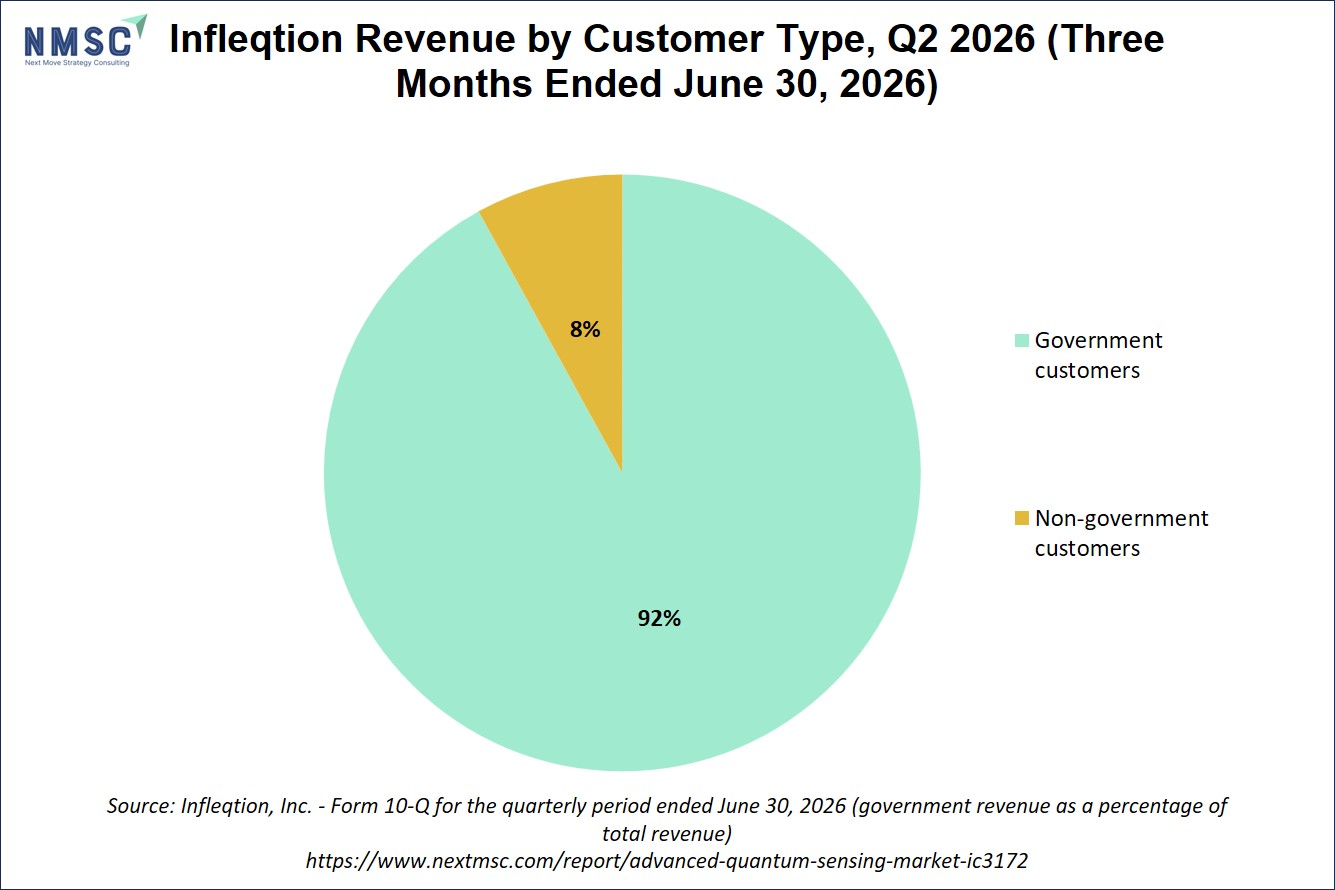
Infleqtion's Form 10-Q reports that revenue from government customers was 92% of total revenue in the three months ended June 30, 2026, against 85% in the prior-year quarter. Customers outside government account for the remaining 8%, calculated as 100% minus the reported government share. The filing also identifies one customer as 82% of total revenue in the same quarter.
The mix matters more than the headline. Service revenue climbed 504% to USD 10.4 million while product revenue fell 11% to USD 3.2 million, and the filing attributes the quarter's growth primarily to a USD 6.7 million increase in services under the NASA quantum gravity gradiometer contract, with smaller gains from a U.S. Army contract and an ARPA-E project. One customer accounted for 82% of revenue. The pattern describes an industry still paid mainly to develop and qualify sensors for public programs, not to ship units at volume.
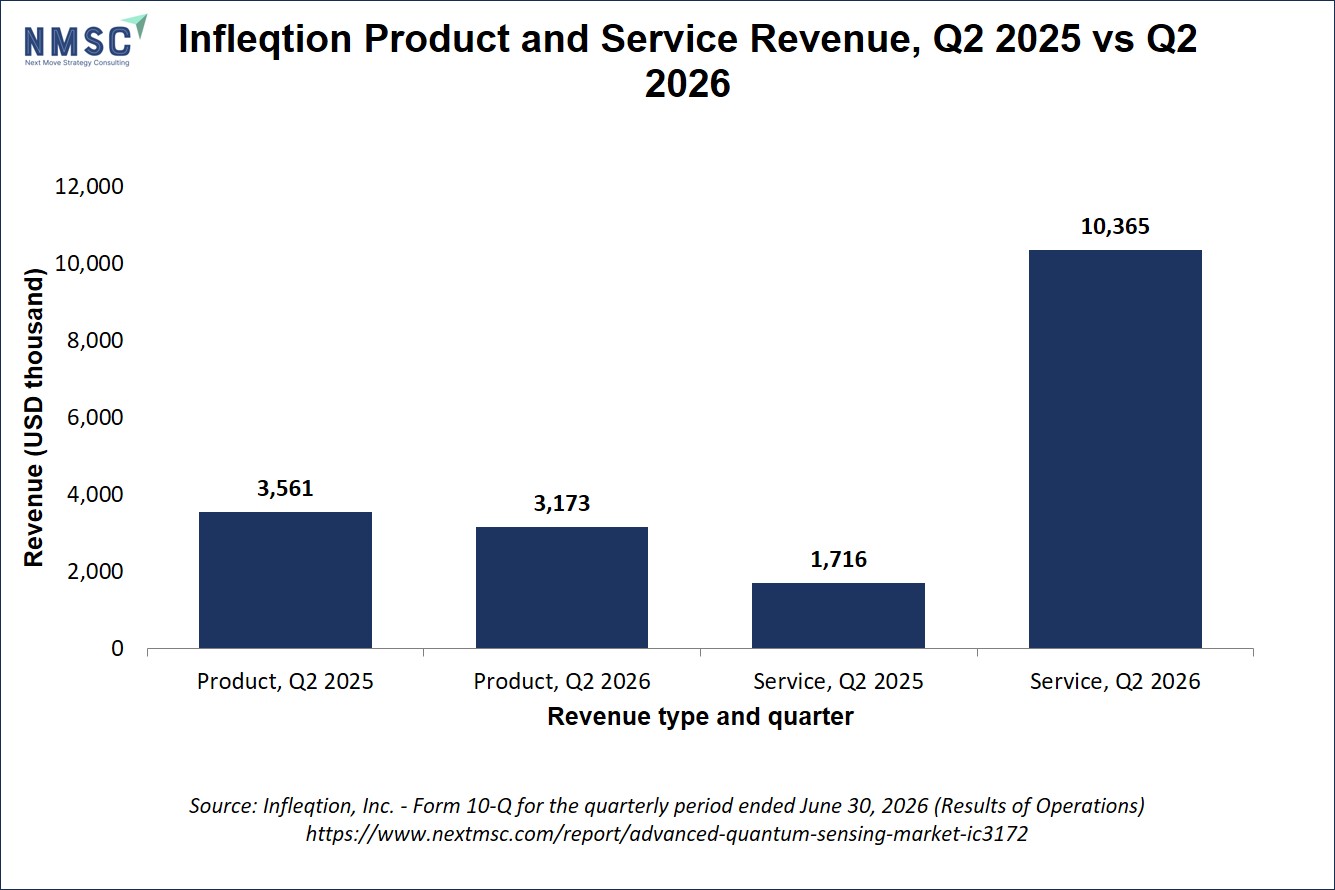
Infleqtion's Form 10-Q reports service revenue of USD 10,365 thousand in the three months ended June 30, 2026, against USD 1,716 thousand a year earlier. Product revenue was USD 3,173 thousand, against USD 3,561 thousand. The filing attributes the quarter's revenue increase primarily to a USD 6.7 million increase in services performed under the NASA quantum gravity gradiometer contract.
Quantum Computing Report reported on August 27, 2026 that NASA awarded Infleqtion a USD 20 million follow-on contract for the Quantum Gravity Gradiometer Pathfinder mission, bringing total NASA funding to USD 40 million and moving the program into hardware integration, subsystem fabrication and drop-tower testing in Hannover, Germany. On its August 12, 2026 earnings call, Infleqtion reported about USD 582 million in cash and securities with no debt, according to MarketBeat, which funds manufacturing scale-up ahead of volume demand.
Infleqtion also said it has begun engaging terrestrial customers for quantum gravity sensing, including detection of subsurface features and critical mineral deposits, according to MarketBeat's August 12, 2026 summary of the call. Those applications sit outside defense budgets, which makes them the first test of whether gravity sensing can sell commercially.
SandboxAQ and Northrop Grumman: Magnetic Navigation Reaches Expendable Drones
On September 9, 2026, Quantum Computing Report covered SandboxAQ's flight-test campaign of its AQNav magnetic navigation system on Northrop Grumman's Lumberjack, a Group 3 one-way-attack drone, described as the first reported operational flight test of a MagNav payload on an expendable platform. SandboxAQ cites more than 450 flight-test hours across C-17, C-130J and commercial aircraft. "Quantum sensing is here today [for] navigation in face of GPS jamming and spoofing," said Jack Hidary, Founder and Chief Executive Officer of SandboxAQ, in Breaking Defense's article dated June 22, 2026.
NMSC Strategic Perspective: What the Advanced Quantum Sensing Market Is Really Buying
NextMSC primary research and analysis reads these events as one signal: buyers are paying to remove GPS dependence, and contracts reward vendors that pair a sensor with software, qualification evidence and a platform partner. NextMSC proprietary research is consistent with that reading, assigning rising defense demand for GPS-denied navigation the largest positive impact on the 2026 to 2035 CAGR at +6.5%, ahead of government quantum funding programs at +5.0%.
In NextMSC segment analysis, atomic clocks held the largest sensor-type share in 2025 at USD 0.10 billion, while magnetic sensors are the fastest-growing sensor type at a 35.7% CAGR and neutral-atom platforms the fastest-growing technology platform at 38.5%. The DIU and Q-CTRL results rest on magnetic and gravimetric sensing, which supports that ranking. The Infleqtion filing adds a caution: with 92% of Q2 revenue tied to government customers, near-term growth follows program awards, and NextMSC regards defense and space qualification credentials as the main source of vendor differentiation through 2035.
Section Summary:
Five dated events show navigation trials moving into funded programs, with government budgets still supplying nearly all revenue.
-
DIU and Honeywell flew 4 hours and 23 minutes without GPS and reported 89% better position accuracy than traditional backup methods.
-
Q-CTRL reported one nautical mile of accuracy at sea and DO-160 qualification for aircraft use.
-
Infleqtion's Q2 2026 revenue of USD 13.5 million was 92% government-funded, with 82% from one customer.
-
SandboxAQ extended magnetic navigation to an expendable drone platform.
Industry Impact Analysis
Executive Order 14411 Puts a 2028 Date on Fielding
Signed on June 22, 2026, Executive Order 14411 covers quantum sensors alongside computing and secure communications, according to Breaking Defense on the same date. It directs the Pentagon to identify at least three next-generation quantum sensor projects within 60 days and to field three new types of quantum sensors by September 30, 2028, and it tasks Commerce, Energy, NASA and the National Science Foundation with exploring quantum sensing and networking. A dated fielding obligation converts demonstration budgets into acquisition programs, which favors vendors with flight-test records such as Honeywell, Q-CTRL and SandboxAQ.
Interference Is Now a Routine Operating Condition
The European Union Aviation Safety Agency (EASA) published the fourth revision of its safety bulletin on satellite navigation outages on July 3, 2026, and its public interference table for the seven days to October 14, 2026 listed 42 flight information regions, 11 of them flagged for spoofing. Q-CTRL's August 27, 2026 release cited about 978,000 GPS jamming events worldwide in the first quarter of 2026, 98% of them in the Middle East, affecting more than 1,100 vessels. Operators facing that exposure are buying a position source that does not depend on a satellite signal.
From Qualification to Installation
Ben Mohr, Honeywell Aerospace's offering director for alternative navigation products, said at an AIN roundtable in August 2026, as Leeham News and Analysis reported, that quantum magnetometers are already small enough for aircraft and commercially available. Combined with Q-CTRL's DO-160 qualification, that shifts the bottleneck from sensor physics to platform integration, certification paperwork and supply chain capacity.
Healthcare and Export Controls Sit Outside the Defense Cycle
NextMSC primary research and analysis shows medical and healthcare as the fastest-growing application, rising from USD 0.04 billion in 2025 to USD 1.23 billion in 2035 at a 42.9% CAGR as magnetic sensing moves into non-invasive diagnostic imaging. Two NextMSC-quantified restraints temper the outlook: high per-unit hardware and cryogenic infrastructure costs, which reduce the CAGR by 3.5%, and export control restrictions on sensitive quantum technologies, which reduce it by 1.5% across North America, Europe and Asia-Pacific.
A Fragmented Field Where Specialists Meet Industrial Groups
NextMSC competitive analysis describes a highly fragmented, early-stage field in which specialist developers compete with diversified industrial groups. Infleqtion exemplifies the neutral-atom specialist, while Honeywell International and Robert Bosch, through Bosch Quantum Sensing, bring manufacturing scale and integration experience from aerospace and industrial portfolios. NextMSC finds that competition centers on sensor precision, field-deployment readiness and defense qualification, and that developers unable to show field validation risk exclusion from defense and space shortlists. The DIU flight, flown on a Honeywell test aircraft, shows why.
Section Summary:
Policy deadlines and interference data are lifting demand, while hardware cost and export rules cap commercial reach.
-
Executive Order 14411 requires three new quantum sensor types in the field by September 30, 2028.
-
EASA's interference table listed 42 flight information regions in a single seven-day window ending October 14, 2026.
-
Magnetic navigation hardware is small enough for aircraft, so integration and certification now pace deployment.
-
NextMSC places healthcare at a 42.9% CAGR, with export controls and hardware cost as the main restraints.
Pros and Cons of Recent Market Developments
|
Pros |
Cons |
|
Flight and sea trials by DIU, Honeywell and Q-CTRL replace laboratory claims with field evidence. |
The 89% accuracy figure uses a backup baseline that DefenseScoop's coverage did not detail, which complicates vendor comparison. |
|
Executive Order 14411 sets a September 30, 2028 fielding date for three new sensor types. |
Government customers supplied 92% of Infleqtion's Q2 2026 revenue, concentrating demand in public budgets. |
|
Software stabilization lets sensors run aboard ships and aircraft without gimbals or frequent recalibration. |
One customer supplied 82% of Infleqtion's Q2 2026 revenue, which exposes vendors to single-contract risk. |
|
Honeywell says magnetic navigation hardware is already small enough for installation on aircraft. |
Export controls and high per-unit hardware costs restrict commercial reach, per NextMSC research. |
Key Data & Statistics
Key Quantum Sensing Events and Quantified Signals (June to October 2026)
|
Event |
Date |
Quantified Signal |
|
Executive Order 14411 signed |
June 22, 2026 |
Three sensor projects to be identified within 60 days; fielding by September 30, 2028 |
|
Q-CTRL Ironstone Opal airworthiness qualification |
July 14, 2026 |
RTCA DO-160 qualified; better than 0.3 nautical miles through 95% of a flight |
|
Infleqtion Form 10-Q for Q2 2026 |
August 18, 2026 |
Revenue USD 13.5 million, up 157%; government customers 92% of revenue |
|
Q-CTRL maritime gravimetric trial |
August 27, 2026 |
One nautical mile accuracy; more than 10 times better than navigation-grade backups |
|
NASA follow-on contract to Infleqtion |
August 27, 2026 |
USD 20 million follow-on; total NASA funding USD 40 million |
|
DIU and Honeywell MagNav release |
September 4, 2026 |
4 hours 23 minutes without GPS; 89% better position accuracy than traditional backups |
Infleqtion Revenue Profile, Three Months Ended June 30
|
Indicator |
Q2 2026 |
Q2 2025 |
|
Product revenue (USD thousand) |
3,173 |
3,561 |
|
Service revenue (USD thousand) |
10,365 |
1,716 |
|
Total revenue (USD thousand) |
13,538 |
5,277 |
|
Government customers' share of revenue |
92% |
85% |
|
Largest customer's share of revenue |
82% |
64% |
|
Revenue from U.S. customers (USD thousand) |
12,514 |
4,182 |
Future Outlook & Forecast
The Road to USD 7.25 Billion in the Advanced Quantum Sensing Market
According to NextMSC primary research and analysis, the advanced quantum sensing market is projected to reach USD 7.25 billion by 2035, growing at a CAGR of 31.5% from 2026 to 2035. Three forces underpin that path.
1. Navigation trials become programs. Executive Order 14411's September 30, 2028 deadline, the planned C-17 test and NASA's USD 40 million pathfinder funding give vendors dated demand. NextMSC proprietary research assigns defense demand for GPS-denied navigation a +6.5% impact on CAGR and government funding programs +5.0%.
2. Packaging and software shrink the cost of deployment. Q-CTRL's maritime installation of about 1 kilogram and its software-based stabilization point toward lower integration cost. NextMSC quantifies miniaturization and room-temperature packaging at +2.5% on CAGR, against a drag of 3.5% from hardware and cryogenic costs.
3. Space and healthcare widen the buyer base. NASA's gravity gradiometer pathfinder and magnetic sensing for diagnostic imaging add buyers outside defense. NextMSC assigns +3.5% to space qualification programs and +4.0% to healthcare imaging.
Regional Outlook: North America Leads, Asia-Pacific Closes the Gap
NextMSC regional analysis shows North America leading with approximately 44% share, or USD 0.21 billion, in 2025 and reaching USD 2.61 billion by 2035 at a 28.5% CAGR. Asia-Pacific is the fastest-growing region at 38.5%, rising from USD 0.09 billion to USD 2.32 billion, and India is the fastest-growing country at 45.0%. Infleqtion's Q2 2026 filing, in which U.S. customers supplied USD 12,514 thousand of USD 13,538 thousand, is consistent with North America's lead.
Segment Outlook: Magnetic Sensors and Neutral Atoms Outgrow the Base
NextMSC segment analysis shows where revenue moves inside the total. Magnetic sensors rise from USD 0.08 billion in 2025 to USD 1.74 billion in 2035 at a 35.7% CAGR, overtaking atomic clocks, which grow from USD 0.10 billion to USD 1.16 billion at 26.9%. By technology platform, neutral atoms grow from USD 0.05 billion to USD 1.16 billion at 38.5%, while solid-state defects, the largest platform in 2025 at USD 0.10 billion, reach USD 1.31 billion at 28.5%. By application, defense and security stays largest at USD 1.74 billion in 2035, but navigation and positioning, at 29.7%, and medical and healthcare, at 42.9%, grow faster in relative terms.
Catalysts to Watch Through 2028
Infleqtion reports third-quarter results on November 16, 2026, according to its Business Wire release of October 29, 2026, and its chief executive said in August that the company would provide more detail on 2027 revenue visibility at that point. The C-17 flight test planned by DIU and Honeywell later in 2026 will extend the MagNav evidence, and the executive order's 2028 fielding date will test supplier capacity. NextMSC proprietary research flags limited manufacturing scale and skilled workforce, at a drag of 2.5% on CAGR, as the constraint most likely to slow awards from converting into shipments.
Section Summary:
NextMSC projects the advanced quantum sensing market to reach USD 7.25 billion by 2035 at a 31.5% CAGR.
-
Dated federal fielding obligations convert navigation trials into acquisition programs.
-
Smaller packaging and software stabilization lower integration cost, offset by hardware and cryogenic expense.
-
Space and healthcare applications add buyers beyond defense.
-
Asia-Pacific, at 38.5% CAGR, is closing on North America's 2025 lead.
Next Steps for Stakeholders
For C-Level Executives and Program Leaders
-
Treat GPS-independent navigation as a resilience requirement, not an experiment. EASA's July 3, 2026 bulletin revision and its October 14, 2026 interference table show the exposure. Request flight-test evidence, qualification status and the baseline behind any accuracy claim, since DIU's 89% figure is measured against traditional backup methods.
-
Plan for platform integration early. With quantum magnetometers already small enough for aircraft, integration, certification and supplier capacity now set deployment speed. Ask vendors for installation data and a path to DO-160-type qualification.
-
Map vendors to the executive order timeline. Programs aimed at the September 30, 2028 fielding date will favor vendors with deliverable hardware, so start supplier due diligence now rather than after awards are announced.
-
Budget for software and sustainment, not only sensor hardware. Q-CTRL's results depend on AI-driven stabilization, and Infleqtion's service revenue grew 504% while product revenue fell 11%. Calibration, software update and qualification terms will shape lifetime cost more than unit price.
For Institutional Investors
-
Read revenue quality before revenue growth. Infleqtion's 157% growth rests on a NASA services contract and one customer at 82% of revenue. Track customer concentration and the shift from services to product revenue when Infleqtion reports third-quarter results on November 16, 2026.
-
Back qualification, not demonstration. NextMSC proprietary research favors vendors with defense and space qualification credentials. Prefer companies with documented flight or sea trials and platform partners, and treat export-control exposure as a pricing variable.
Conclusion
The advanced quantum sensing market is moving from laboratory proof to platform deployment. A 4-hour-23-minute GPS-free flight, a one-nautical-mile sea trial, a DO-160 qualification and a USD 40 million NASA program all arrived within five months of an executive order that set a 2028 fielding date.
According to NextMSC primary research and analysis, the market is projected to reach USD 7.25 billion by 2035 at a 31.5% CAGR. Stakeholders who demand field evidence, plan for integration and watch government revenue concentration will be best placed to capture that growth.
About the Author
 Priyanshu Das
— Priyanshu Das is SEO Executive at Next Move Strategy Consulting, where he has led on-page and off-page SEO, keyword research, and SEO audits for the firm's B2B market research publications for 2 years. His audit process combines technical crawl analysis, backlink profile review, and competitor keyword gap mapping — using tools including Screaming Frog and Google Search Console — to prioritize fixes by organic search-visibility impact, informed by his own prior in-house and agency SEO experience.
About the Reviewer
 Debashree Dey
— Debashree Dey is Assistant Manager at Next Move Strategy Consulting, where she supports cross-vertical market content and communications across diverse industries for 6 years. Her professional background includes senior content writing, communications, and published manuscript authorship, with experience developing audience-focused business narratives and maintaining clear, consistent messaging. Her role supports research-led content development and editorial quality across NextMSC publications.













Add Comment