Egypt Data Center Colocation: 5 Companies Moving Market
In This Article:
1. Telecom Egypt Company SAE
2. GPX Egypt Ltd.
3. Vodafone Egypt Telecommunications SAE
4. Etisalat Misr SAE
5. Raya Data Center SAE
A Market Moving from Connectivity Infrastructure to Digital Capacity
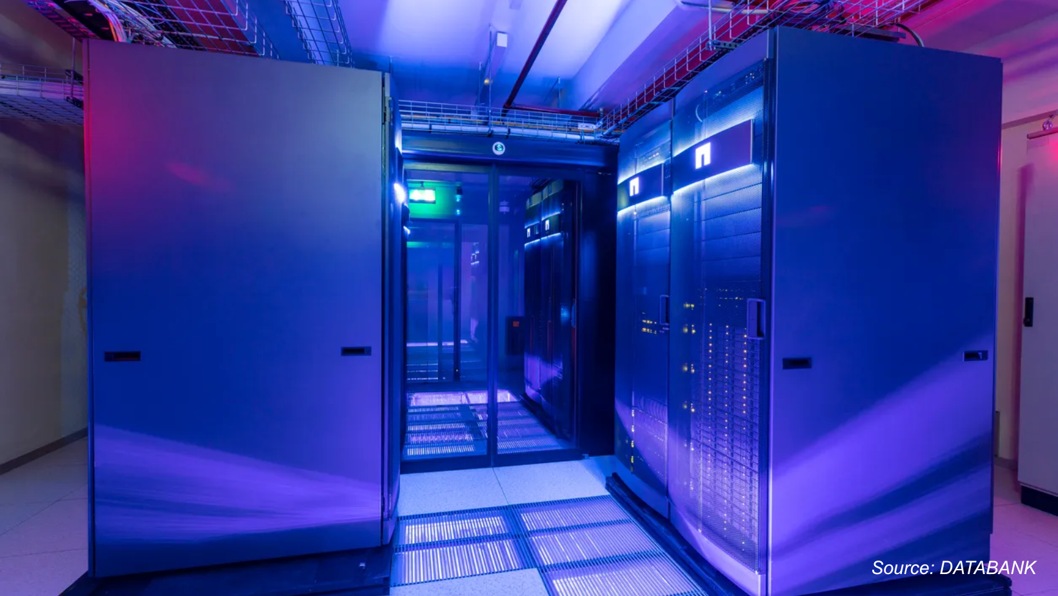
We observed the Egypt Data Center Colocation Market moving beyond its traditional role as a secure place to host servers toward a more strategic digital-infrastructure layer supporting cloud migration, enterprise modernization, telecom traffic, and regional connectivity. The market was valued at USD 134.7 million in 2025 and is estimated at USD 161 million in 2026, before reaching USD 358.6 million by 2035 at a 9.30% CAGR from 2026 to 2035.
Our analysis indicates that this expansion is being shaped by the combination of enterprise demand, higher availability requirements, subsea-cable connectivity and the need for locally hosted infrastructure under Egypt’s data-protection framework. Cairo remains the principal demand hub, while operators are moving toward Tier III and Tier IV facilities, higher contracted power capacities, managed services and stronger interconnection capabilities. Further, based on our assessment, we noticed that end users are increasingly valuing scalability, resilience, low-latency connectivity, and compliance alongside conventional rack space and power. The next stage of market development is therefore likely to emphasize hyperscale-ready capacity, cloud on-ramps, sophisticated cooling and more energy-efficient facility design.
Want Insights on the Egypt Data Center Colocation market? Access a FREE Sample Instantly.
Key Takeaway: Egypt’s colocation market is becoming a strategic connectivity and digital-capacity layer rather than a conventional hosting segment, with scale, resilience, compliance and interconnection increasingly determining competitive position as the market moves toward USD 358.6 million by 2035.
The report’s headline colocation-format split illustrates how the market is expanding across both enterprise-oriented retail capacity and larger wholesale deployments:
Colocation Format, 2025–2035 (USD Million)
|
Colocation Format |
2025 |
2035 |
|
Retail Colocation |
72.8 |
163.4 |
|
Wholesale Colocation |
61.9 |
195.2 |
|
Total |
134.7 |
358.6 |
The split shows a meaningful change in composition: retail colocation remains the larger format in absolute 2025 and 2035 value, while wholesale capacity grows faster and accounts for a greater share of the incremental opportunity. This supports the report’s view that Egypt’s next development phase will increasingly favor larger blocks of capacity alongside the established enterprise colocation base.
Telecom Egypt Company SAE
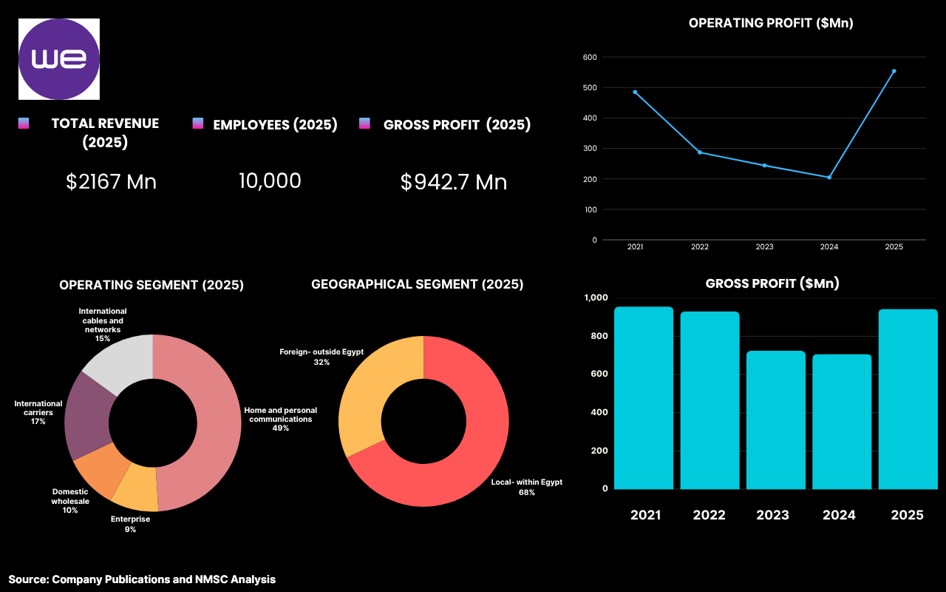
Telecom Egypt Company SAE, headquartered in Cairo, is Egypt’s incumbent telecommunications operator and a major provider of fixed-line connectivity, international communications infrastructure, submarine cable capacity, enterprise services and data-center solutions. Its infrastructure footprint gives it a distinctive role in the Egypt Data Center Colocation Market because connectivity and hosting increasingly converge around the same digital infrastructure layer. The company’s subsea cable network and domestic fiber assets strengthen its ability to position data centers as interconnection points between Egyptian enterprises and international traffic routes.
In July 2026, Telecom Egypt announced that it would not proceed with the proposed transaction that would have transferred a 75%–80% stake in a subsidiary owning the Regional Data Hub to Helios Investment Partners. The company stated that it would continue with its strategic plan to carve out data-center assets and operations into a wholly owned subsidiary. Our analysis indicates that retaining full ownership while pursuing a dedicated data-center structure could give Telecom Egypt greater strategic control over capacity, connectivity integration, and future investment decisions in Egypt.
Based on our evaluation, Telecom Egypt is positioned around the convergence of carrier infrastructure and data-center capacity. Its strongest strategic advantage is the ability to combine fiber, international connectivity, submarine cable infrastructure, and secure hosting within one national platform. The company’s decision to retain full ownership of its data-center assets may allow closer alignment between network expansion and colocation strategy. Over the longer term, that integrated model could support stronger enterprise, cloud and international-carrier demand while preserving flexibility for future capital partnerships.
“We have followed by establishing Egypt’s largest secure data centers designed to host sensitive data at the highest international security standards.” — Mohamed Nasr, Managing Director and CEO, Telecom Egypt.
GPX Egypt Ltd.
GPX Egypt Ltd. operates within GPX Global Systems’ carrier-neutral data-center platform, with its headquarters in New York and a substantial operating presence in Cairo. The company specializes in high-availability, carrier-neutral facilities designed for telecommunications operators, cloud service providers, content networks, and enterprises requiring resilient colocation environments. GPX’s Cairo facilities are built around Tier 4 infrastructure and rich interconnection, giving the company a focused proposition within the Egypt Data Center Colocation Market.
GPX’s major Cairo 2 expansion enters its 2026 delivery window, with the company’s planned Rated-4 facility designed for 12 MW of power, high-density applications, and 52U cabinets, with phase one scheduled to become customer-ready in the third quarter of 2026. Although the original expansion announcement predates the current period, the 2026 delivery milestone makes the project a significant capacity-development event for the market. Our assessment indicates that additional Tier 4 capacity can improve GPX’s ability to serve enterprise, cloud and network customers seeking higher availability in Egypt.
GPX’s strategic position is centered on premium reliability, carrier neutrality and infrastructure depth rather than broad telecommunications bundling. That positioning becomes increasingly relevant as customers compare facilities on uptime, interconnection density, power availability and support for higher-density computing. The company’s focus on Rated-4 infrastructure also places it close to the market’s transition toward higher-resilience facilities. As Egypt attracts additional cloud and regional traffic, GPX’s advantage will depend on converting infrastructure quality into sustained occupancy and deeper ecosystem connectivity.
Vodafone Egypt Telecommunications SAE
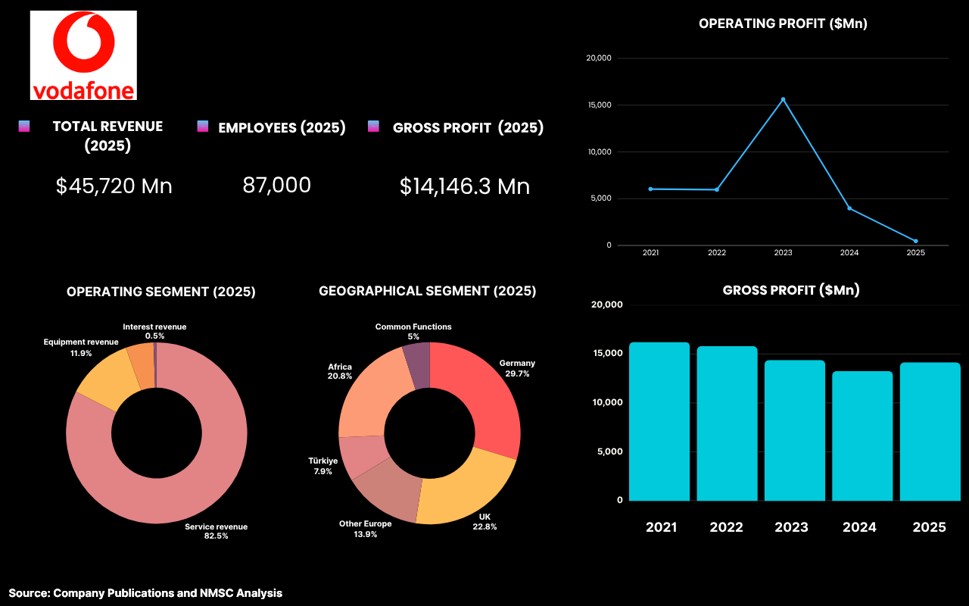
Vodafone Egypt Telecommunications SAE, based in Cairo, is a major Egyptian telecommunications operator providing mobile connectivity, broadband, enterprise services, cloud and hosting solutions, including colocation capabilities. Its data-center proposition is closely linked to the evolution of network traffic and enterprise digital services. The Egypt Data Center Colocation Market influences Vodafone Egypt by increasing the need for resilient infrastructure capable of supporting growing data consumption, cloud services, disaster recovery, and the expanding requirements created by advanced mobile networks.
In June 2025, Vodafone Egypt launched 5G services in Egypt, adding higher-capacity mobile connectivity to a market already experiencing rapid data-demand growth. Vodafone’s FY2026 reporting states that the launch was designed to support rapidly growing data demand, while the company also secured an additional 1,800 MHz of spectrum in February 2026. Our analysis indicates that the 5G rollout indirectly strengthens demand for data-center capacity through increased traffic volumes, edge applications, cloud services, and enterprise workloads that require dependable backend infrastructure.
Vodafone Egypt therefore occupies a hybrid strategic position spanning telecommunications connectivity, cloud services and colocation. The company’s network footprint can generate organic demand for supporting infrastructure as mobile data usage, enterprise digitization and 5G-enabled applications expand. Going forward, competitive differentiation is likely to depend on how effectively Vodafone integrates network, cloud and hosting capabilities while maintaining capacity efficiency and regulatory compliance. The company is consequently positioned to benefit from the convergence between telecommunications infrastructure and the broader colocation ecosystem.
Etisalat Misr SAE
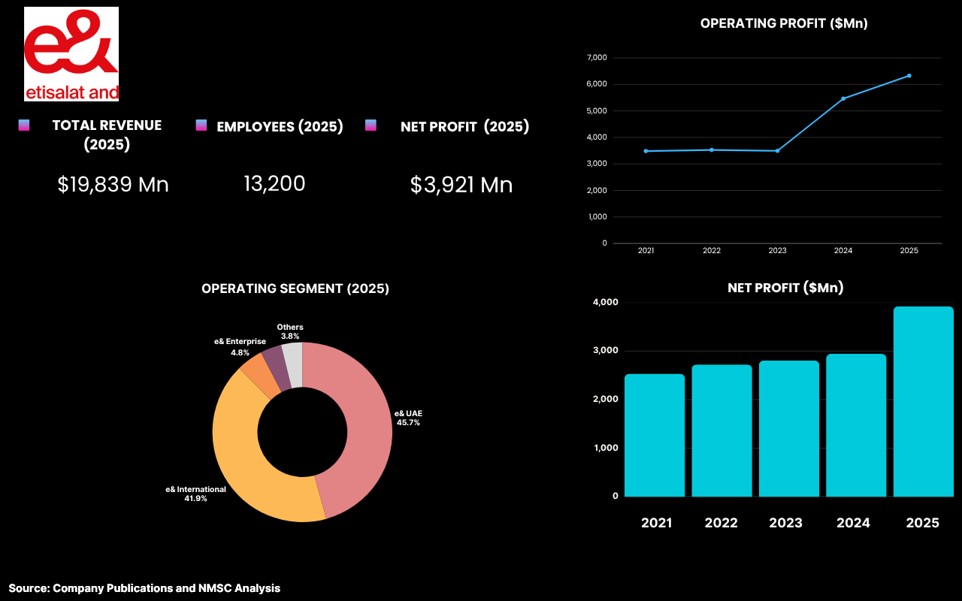
Etisalat Misr SAE, headquartered in Cairo, operates as a telecommunications and digital-services provider under e& and offers enterprise connectivity, cloud, security and hosting capabilities in Egypt. Its relevance to the Egypt Data Center Colocation Market is tied to its role as both a network operator and provider of digital infrastructure services. The company’s public cloud, virtualization and colocation capabilities allow enterprise customers to shift from capital-intensive on-premise environments toward more flexible infrastructure models, while its telecom network provides the connectivity layer required for distributed digital workloads.
In October 2025, Etisalat Misr received ISO/IEC 27017:2015 certification covering its public cloud services along with enterprise security, IT, physical security and human-resources processes. While certification is not a capacity expansion by itself, it is a significant service-development milestone because ISO/IEC 27017 addresses cloud security controls relevant to customer confidence and governance. Our assessment indicates that stronger security certification can support the company’s positioning among regulated and enterprise customers seeking compliant local infrastructure and reinforces the credibility of its cloud and colocation-related services.
Etisalat Misr’s strategic position rests on combining telecom connectivity with enterprise-oriented cloud and infrastructure services. In a market where compliance, security and availability increasingly shape purchasing decisions, the company’s ability to integrate these capabilities can reduce the distinction between telecommunications and colocation offerings. Based on our evaluation, continued investment in cloud security, virtualization and localized infrastructure should help Etisalat Misr remain relevant as Egyptian enterprises move toward hybrid IT environments and demand more professionally managed digital capacity.
Raya Data Center SAE
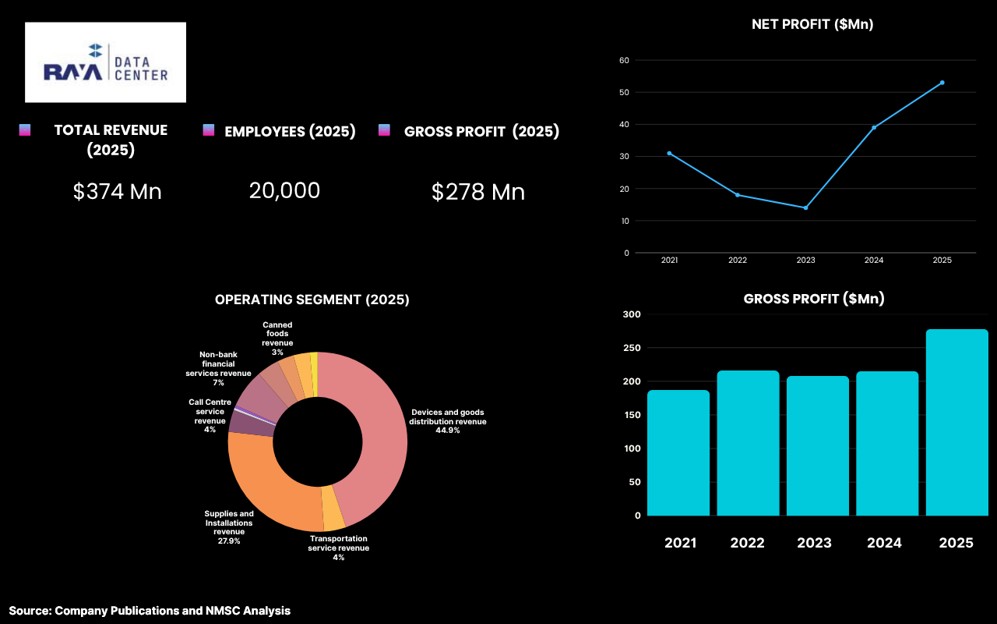
Raya Data Center SAE, based in Giza within the Cairo metropolitan area, is a specialist digital-infrastructure provider under Raya Information Technology. The company focuses on data-center, cloud, colocation, infrastructure-as-a-service and related managed services for enterprises, telecommunications customers and other organizations. In the Egypt Data Center Colocation Market, Raya’s strategy is closely tied to the growth of certified local capacity and the shift toward scalable infrastructure for cloud workloads. Its proposition emphasizes secure hosting, interconnection, cloud connectivity and infrastructure services rather than telecommunications alone.
Raya’s 2025 reporting provides an important update on its data-center expansion trajectory. In its FY2025 earnings release issued in March 2026, Raya Information Technology reported that data-center infrastructure demand had lifted Raya Network Services’ revenue contribution from 8% in 2024 to 19% in 2025, while the business participated in major projects with Telecom Egypt and e& Egypt. The company also continued the development strategy associated with its Africa50-backed Tier III project in Egypt. Our analysis indicates that the combination of rising infrastructure demand and project execution strengthens Raya’s positioning as a specialist local capacity provider.
Raya Data Center’s strategic position is increasingly defined by specialization, localized execution, and the ability to combine colocation with broader cloud and infrastructure services. Its engagement with major Egyptian institutions and telecom operators also demonstrates how specialist operators can participate in larger digital-transformation programs without relying solely on wholesale hyperscale demand. Based on our assessment, future competitiveness will depend on the successful delivery of additional certified capacity, energy-efficient infrastructure, and services that support increasingly complex enterprise workloads.
Band Title: Inside the Egypt Data Center Colocation Market Report
Band Subline: Market segments, company landscape, Egypt coverage and forecasts through 2035.
Band Button: “Explore the Full Report”
Market Outlook: Capacity, Compliance and Connectivity Converge
Our analysis indicates that Egypt’s colocation market is entering a more infrastructure-intensive phase as enterprises, telecom operators, cloud providers and public institutions demand greater resilience, scalability and data availability. Cairo is expected to remain the principal center of activity because of its concentration of enterprises, connectivity infrastructure, and existing facilities, while Egypt’s subsea cable position provides an additional structural advantage for international data flows. The market’s evolution is also supported by demand for localized hosting and compliance-oriented infrastructure as organizations become more attentive to data governance and operational continuity.
The competitive landscape is consequently moving toward differentiation through infrastructure quality, connectivity depth, service bundling, and investment scale. Tier III and Tier IV development, higher contracted power capacities, cloud on-ramps and managed services are becoming important mechanisms for operators seeking to capture higher-value workloads. Based on our evaluation, sustainability is also becoming more relevant as data-center operators incorporate energy-efficiency measures, renewable-energy considerations, and optimized cooling into facility planning. These factors are likely to influence both operating economics and enterprise procurement decisions over time.
Looking ahead, the market is projected to reach USD 358.6 million by 2035, reflecting a substantial expansion from the 2025 base and a 9.30% CAGR during 2026–2035. The largest opportunities are likely to arise in wholesale and hyperscale-ready capacity, cloud connectivity, resilient power infrastructure, managed services, and facilities capable of supporting higher-density workloads. At the same time, operators will need to manage power reliability, investment cycles, regulatory approvals, and the capital intensity of advanced facilities. NMSC’s assessment suggests that the long-term direction of Egypt’s colocation industry will be defined by the convergence of regional connectivity, enterprise digitalization, cloud migration, and increasingly sophisticated digital infrastructure requirements.
About the Author
 Mayurima Roy
— Mayurima Roy is Research Analyst at Next Move Strategy Consulting, where she has spent 4 years working across the firm's full industry coverage rather than a single fixed vertical. Her work centers on structured research, ongoing trend tracking, competitive assessment, and insight-led content development, translating complex market data into clear, decision-ready narratives that support informed client decision-making across diverse global industries, market sectors, and world regions every day.
Mayurima Roy
— Mayurima Roy is Research Analyst at Next Move Strategy Consulting, where she has spent 4 years working across the firm's full industry coverage rather than a single fixed vertical. Her work centers on structured research, ongoing trend tracking, competitive assessment, and insight-led content development, translating complex market data into clear, decision-ready narratives that support informed client decision-making across diverse global industries, market sectors, and world regions every day.
About the Reviewer
 Supradip Baul
— Supradip Baul is an accomplished business consultant and strategist with over a decade of rich experience in market intelligence, strategy, technology, and business transformation. His work has included rigorous qualitative and quantitative analysis across multiple industries, helping clients shape investment decisions and long-term roadmaps. Earlier in his career, he was associated with Gartner, where he contributed to industry-leading reports and market share analyses. He has worked with leading global companies and holds an MBA with a dual specialization in Marketing and Finance.
Supradip Baul
— Supradip Baul is an accomplished business consultant and strategist with over a decade of rich experience in market intelligence, strategy, technology, and business transformation. His work has included rigorous qualitative and quantitative analysis across multiple industries, helping clients shape investment decisions and long-term roadmaps. Earlier in his career, he was associated with Gartner, where he contributed to industry-leading reports and market share analyses. He has worked with leading global companies and holds an MBA with a dual specialization in Marketing and Finance.


















Add Comment