Electric Aviation Market Size, Share, Trends and Growth Analysis, By Platform Type (Fixed-Wing eCTOL Aircraft, eVTOL Aircraft, and Hybrid-Electric Aircraft), By Propulsion Type (Battery Electric Propulsion, Hybrid-Electric Propulsion, and Hydrogen-Electric Propulsion), By Range Category, By Application (Cargo and Logistics Transport, Flight Training and General Aviation, and Emergency Medical Services), By End User, and Region - Global Industry Report and Forecast
Industry: Aerospace & Defense | Publishing Date: August 4, 2026 | Last Updated: August 4, 2026 | No of Pages: N/A | No. of Tables: N/A | No. of Figures: N/A | Format: PDF | Report Code: AD5544
What Is the Electric Aviation Market Size?
The global Electric Aviation Market size was valued at USD 1.85 billion in 2025 and is estimated at USD 2.51 billion in 2026, forecast to reach USD 48.60 billion by 2035, expanding at a 39.0% CAGR between 2026 and 2035. North America leads with approximately a 44% share, while eVTOL Aircraft dominate all other platform types with approximately a 42% share.
We observed that growth is broad-based across every segmentation axis, with hydrogen-electric propulsion and long-range platforms driving the dominant structural shifts through 2035.
|
Key Takeaways |
|
By Platform Type: eVTOL Aircraft held the largest share of approximately 42% (USD 0.78 billion) in 2025; eVTOL Aircraft is also the fastest-growing sub-segment at 42.9% CAGR from 2026–2035. |
|
By Propulsion Type: Battery Electric Propulsion held the largest share of approximately 62% (USD 1.15 billion) in 2025; Hydrogen-Electric Propulsion is the fastest-growing sub-segment at 50.6% CAGR from 2026–2035. |
|
By Range Category: Short-Range Under 200 km held the largest share of approximately 56% (USD 1.04 billion) in 2025; Long-Range Over 500 km is the fastest-growing sub-segment at 51.6% CAGR from 2026–2035. |
|
By Application: Urban Air Mobility and Air Taxi held the largest share of approximately 30% (USD 0.56 billion) in 2025; Urban Air Mobility and Air Taxi is also the fastest-growing sub-segment at 42.6% CAGR from 2026–2035. |
|
By End User: Commercial Airlines and Operators held the largest share of approximately 46% (USD 0.85 billion) in 2025; Commercial Airlines and Operators is also the fastest-growing sub-segment at 42.6% CAGR from 2026–2035. |
|
Dominant Region: North America dominated with approximately 44% revenue share (USD 0.81 billion) in 2025. |
|
Fastest-Growing Region: Asia-Pacific is expected to register the highest CAGR of 44.8% during 2026–2035. |
|
Dominant Country: The U.S. led with approximately USD 0.68 billion in 2025. |
|
Fastest-Growing Country: India is the fastest-growing country at approximately 45.2% CAGR from 2026–2035. |
Market Opportunity: The electric aviation market is expected to create an absolute dollar opportunity of USD 46.09 billion between 2026 and 2035, presenting significant investment potential across eVTOL certification programs, hydrogen-electric propulsion development, and regional aircraft electrification.
According to NMSC analysis, aircraft developers are increasingly pairing FAA and EASA certification milestones with airline pre-order commitments to de-risk commercialization, a shift that favors vertically integrated manufacturers over component-only suppliers as multiple eVTOL and fixed-wing programs approach entry into service through 2035.
Ecosystem Analysis of the Electric Aviation Industry
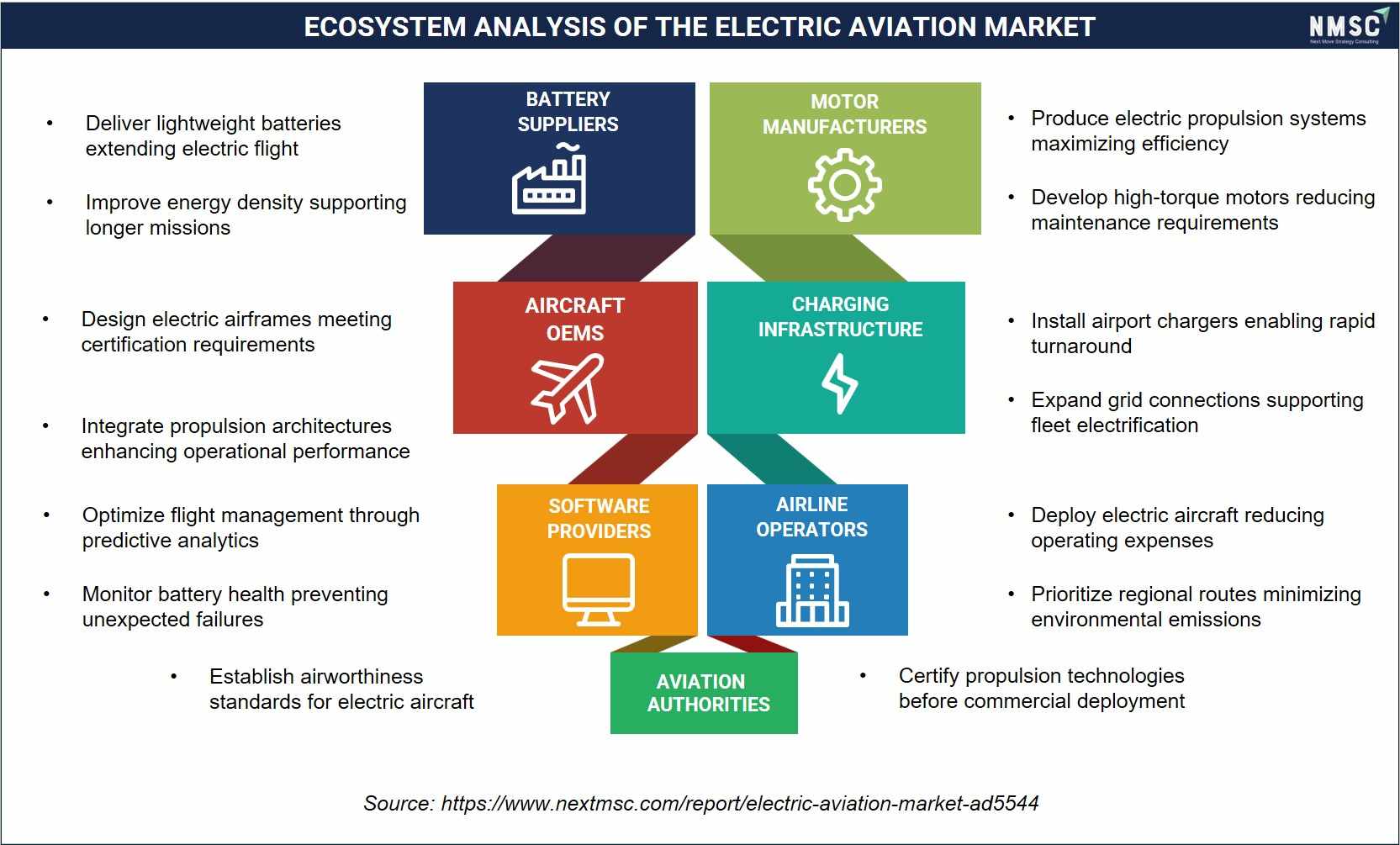
The above infographic maps the interdependent electric aviation ecosystem, highlighting critical roles from battery suppliers and OEMs to infrastructure providers and operators. Expertise centers on developing lightweight propulsion systems, predictive software, and certified airframes. However, the sector’s ultimate viability hinges on aviation authorities, whose rigorous certification standards ensure safety and regulatory compliance before commercial deployment, establishing a foundational barrier that dictates the market's pace of operational scaling.
What Does the Electric Aviation Market Encompass?
The electric aviation market encompasses the design, manufacture, and sale of battery-electric, hybrid-electric, and hydrogen-electric aircraft and dedicated propulsion systems, spanning fixed-wing conventional take-off and landing aircraft, electric vertical take-off and landing aircraft, and hybrid-electric regional platforms. Our assessment indicates that the scope spans airframe manufacturers, dedicated electric propulsion developers, and battery integration specialists serving air taxi operators, regional airlines, cargo carriers, and flight training providers worldwide.
Regulatory frameworks including the U.S. Federal Aviation Administration's special conditions for electric propulsion and the European Union Aviation Safety Agency's type certification standards shape aircraft design and certification timelines. We observed that technology adoption is shifting from single-seat trainer aircraft toward multi-passenger eVTOL and regional platforms nearing commercial certification. NMSC's analysis indicates that this structural shift, combined with expanding airline pre-order books, is redefining manufacturer prioritization across the market.
|
Field |
Details |
|
Market Size in 2025 |
USD 1.85 Billion |
|
Market Size in 2026 |
USD 2.51 Billion |
|
Revenue Forecast in 2035 |
USD 48.60 Billion |
|
Growth Rate |
CAGR of 39% from 2026 to 2035 |
|
Analysis Period |
2025–2035 |
|
Base Year Considered |
2025 |
|
Forecast Period |
2026–2035 |
|
Market Size Estimation |
USD Billion |
|
Companies Profiled |
17 |
|
Countries Covered |
38 |
|
Market Share |
Available for Top 10 Companies |
Key Emerging Trends
Based on research conducted by NMSC, we found that four structural trends are reshaping platform design, certification strategy, and stakeholder engagement across the industry.
How Is Regional Aircraft Electrification Reaching Flight Test Milestones?
Regional hybrid-electric aircraft programs are advancing from prototype to piloted flight testing as battery energy density improves. We observed that the U.S. Federal Aviation Administration issued Heart Aerospace a Special Airworthiness Certificate in the Experimental Category on July 23, 2026, authorizing piloted flight testing of its X1 demonstrator, a 106-foot-wingspan all-electric aircraft powered by four 400-kilowatt motors. Regional aircraft developers are prioritizing flight test data collection to support subsequent type certification submissions.
Why Is Long-Distance Hydrogen-Electric Flight Gaining Credibility?
Hydrogen-electric propulsion is gaining credibility as a pathway to extend electric aircraft range beyond battery-limited short hops. Our findings suggest that Joby Aviation's 523-mile hydrogen-electric flight in July 2025 set a new distance record for zero-emission vertical take-off and landing aircraft, demonstrating regional-range viability. Propulsion developers including ZeroAvia are advancing certifiable hydrogen-electric powertrain configurations, positioning hydrogen as a complementary technology to battery-electric platforms for longer routes.
How Is FAA Certification Pathway Clarity Shaping Manufacturer Strategy?
Certification pathway clarity from aviation regulators is directly shaping which manufacturers can commercialize on schedule. According to the U.S. Government Accountability Office, the FAA had issued special conditions for four of ten electric propulsion products submitted since 2018 as of March 2026, covering engine models from Safran, magniX, Beta Technologies, and ZeroAvia. Manufacturers without special conditions issued face continued regulatory uncertainty, concentrating near-term commercial launches among certification frontrunners.
How Is Industry Consolidation Reshaping the Competitive Field?
Industry consolidation and restructuring are reshaping which electric aviation programs reach commercialization. We observed that several early eVTOL entrants encountered significant financial restructuring in 2024 and 2025, while better-capitalized programs including Joby Aviation, Archer Aviation, and Beta Technologies advanced toward FAA certification with 2026 commercial-launch targets. NMSC's analysis indicates that capital intensity is increasingly concentrating market share among well-funded, vertically integrated manufacturers.
Growth Drivers and Restraints
Growth Catalyst and Risk Assessment Matrix
|
Factors |
Type |
(+/−) % Impact on CAGR |
Geographic Relevance |
Impact Timeline |
|
Multiple eVTOL programs approaching 2026 FAA certification |
Driver |
+7.2% |
North America |
2026–2035 |
|
Airline pre-order commitments for regional electric aircraft |
Driver |
+5.6% |
Global |
2026–2035 |
|
China's low-altitude economy policy support |
Driver |
+4.8% |
Asia-Pacific |
2026–2035 |
|
Battery energy density improvements extending range |
Driver |
+3.4% |
Global |
2026–2033 |
|
Hydrogen-electric propulsion development for regional routes |
Driver |
+2.1% |
Global |
2028–2035 |
|
Government funding for sustainable aviation demonstration programs |
Driver |
+1.5% |
Europe, North America |
2026–2032 |
|
High capital intensity and certification cost for new entrants |
Restraint |
−3.1% |
Global |
2026–2035 |
|
Limited battery energy density constraining payload and range |
Restraint |
−2.4% |
Global |
2026–2032 |
|
Program restructuring and financial distress among early entrants |
Restraint |
−1.8% |
Europe, North America |
2026–2030 |
|
Vertiport and charging infrastructure development lag |
Restraint |
−1.2% |
Global |
2026–2033 |
What Is the Primary Growth Driver of the Electric Aviation Market?
Multiple eVTOL programs approaching FAA certification is the primary driver of the market. According to the U.S. Government Accountability Office, the FAA had received 23 aviation products with electric propulsion for certification since 2018 as of March 2026, with several programs targeting 2026 commercial entry into service. We observed that this certification pipeline maturity, combined with airline pre-order books, continues to anchor investor and operator confidence in near-term commercialization timelines.
How Is Airline Pre-Ordering Driving Market Growth?
Airline and operator pre-order commitments are accelerating market growth by providing manufacturers with revenue visibility ahead of certification. Eve Air Mobility's binding framework agreement with Brazilian operator Revo for up to 50 eVTOL aircraft, valued at approximately USD 250 million and disclosed in July 2025, illustrates how commercial agreements are de-risking manufacturer production planning. NMSC's analysis indicates that this order-book visibility is compressing the capital-raising challenges that have historically constrained electric aircraft manufacturers.
What Is Restraining Electric Aviation Market Expansion?
High capital intensity and certification cost restrain new entrant viability across the market. Industry analysis indicates that fewer than a handful of the more than 800 active electric aircraft programs identified at end-2024 possess the USD 1 to 2 billion in capital required for full certification and industrialization. We found that undercapitalized developers face particular exposure, as extended certification timelines and battery technology limitations compound funding requirements beyond initial program estimates.
Segmentation Analysis
Segment Sizing: By Platform Type
|
Segment |
2025 (USD) |
2035 (USD) |
CAGR% (2026–2035) |
|
Fixed-wing eCTOL aircraft |
USD 0.63 Billion |
USD 10.69 Billion |
32.4% |
|
eVTOL aircraft |
USD 0.78 Billion |
USD 26.24 Billion |
42.9% |
|
Hybrid-electric aircraft |
USD 0.44 Billion |
USD 11.67 Billion |
39.1% |
|
Total |
USD 1.85 Billion |
USD 48.60 Billion |
39.0% |
Which Platform Type Dominates the Market?
eVTOL Aircraft led the market with USD 0.78 billion in 2025, reflecting concentrated capital investment and certification progress among urban air mobility developers including Joby Aviation and Archer Aviation. Our findings suggest that eVTOL Aircraft is also the fastest-growing platform type, registering a 42.9% CAGR from 2026 to 2035, as multiple programs advance toward FAA certification and commercial air taxi service launches across major metropolitan markets.
Segment Sizing: By Propulsion Type
|
Segment |
2025 (USD) |
2035 (USD) |
CAGR% (2026–2035) |
|
Battery electric propulsion |
USD 1.15 Billion |
USD 23.33 Billion |
35.1% |
|
Hybrid-electric propulsion |
USD 0.52 Billion |
USD 15.55 Billion |
41.0% |
|
Hydrogen-electric propulsion |
USD 0.18 Billion |
USD 9.72 Billion |
50.6% |
|
Total |
USD 1.85 Billion |
USD 48.60 Billion |
39.0% |
Which Propulsion Type Is Most Widely Used in Electric Aviation?
Battery Electric Propulsion remained the leading propulsion category within the market, reaching USD 1.15 billion in 2025 on sustained demand for proven, certified electric motor systems across trainer and short-range eVTOL aircraft. Based on research conducted by NMSC, we found that Hydrogen-Electric Propulsion is the fastest-growing category at a 50.6% CAGR from 2026 to 2035, reflecting Joby Aviation's 523-mile record flight and growing developer interest in extending range beyond battery-limited configurations.
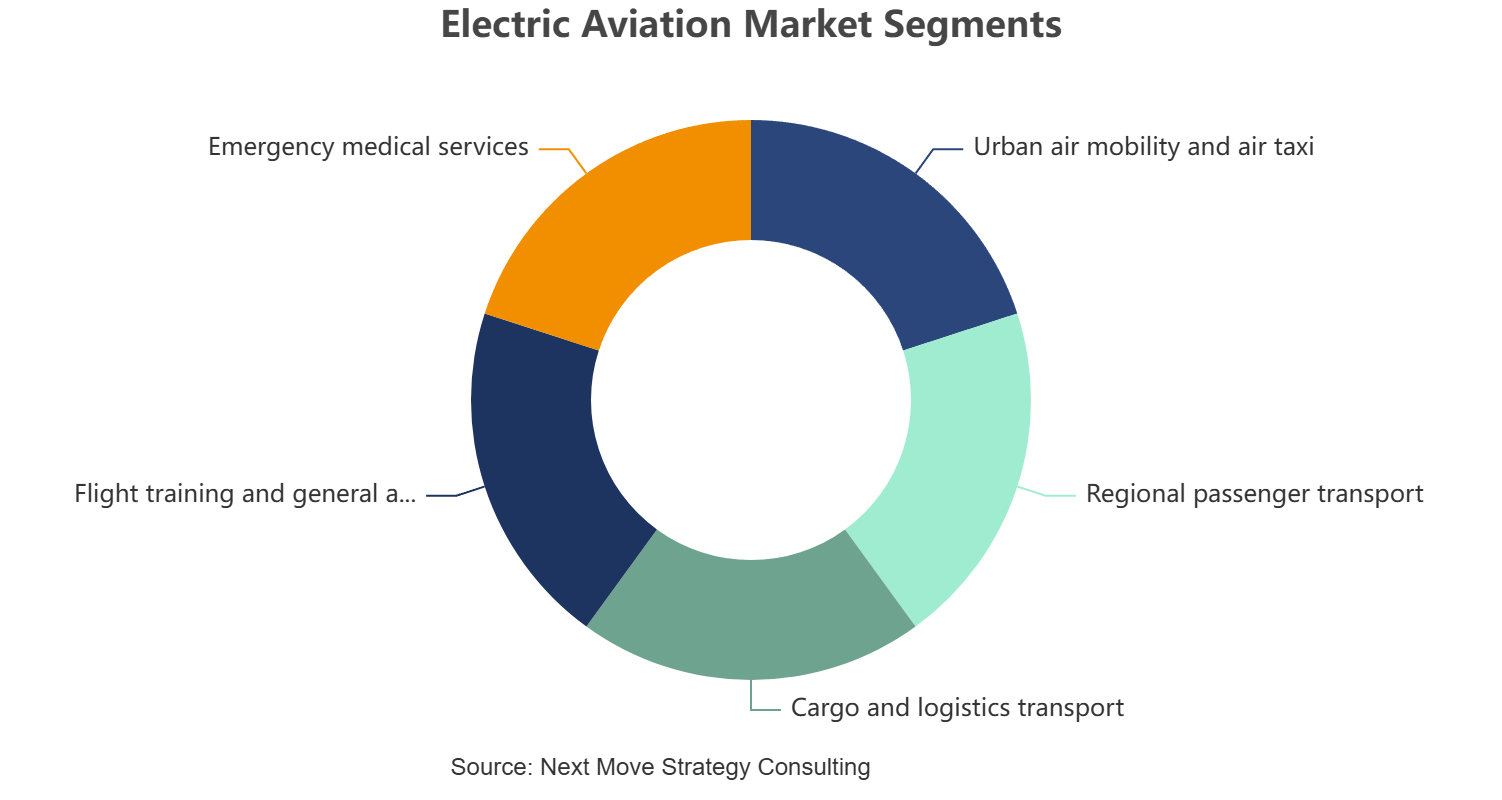
Segment Sizing: By Application
|
Segment |
2025 (USD) |
2035 (USD) |
CAGR% (2026–2035) |
|
Urban air mobility and air taxi |
USD 0.56 Billion |
USD 18.47 Billion |
42.6% |
|
Regional passenger transport |
USD 0.44 Billion |
USD 12.64 Billion |
40.4% |
|
Cargo and logistics transport |
USD 0.33 Billion |
USD 9.23 Billion |
40.0% |
|
Flight training and general aviation |
USD 0.37 Billion |
USD 4.37 Billion |
27.2% |
|
Emergency medical services |
USD 0.15 Billion |
USD 3.89 Billion |
38.8% |
|
Total |
USD 1.85 Billion |
USD 48.60 Billion |
39.0% |
Which Application Leads Electric Aviation Market Demand?
Urban Air Mobility and Air Taxi remained the leading application within the market, valued at USD 0.56 billion in 2025 on expanding commercial passenger service pilots in Gulf and U.S. metropolitan markets. Our findings suggest that Urban Air Mobility and Air Taxi are also the fastest-growing application, registering a 42.6% CAGR from 2026 to 2035, as certified eVTOL platforms transition from flight testing to revenue-generating passenger operations.
Growth Opportunities
Our analysis shows that three forward-looking opportunities stand out for stakeholders positioning within the electric aviation market over the 2026-2035 forecast period.
How Can Vertiport Infrastructure Development Unlock Urban Air Mobility Scale?
Vertiport and charging infrastructure development presents a whitespace opportunity for stakeholders seeking to enable eVTOL commercial scale. Developers that build certified vertiport networks in early-launch cities stand to capture recurring infrastructure revenue as urban air mobility operators require reliable take-off, landing, and charging facilities beyond initial pilot routes.
Where Does Hydrogen-Electric Propulsion Create New Demand for Regional Routes?
Regional route operators seeking range beyond battery-electric limitations represent an underpenetrated opportunity for hydrogen-electric propulsion developers. Companies that commercialize certifiable hydrogen-electric powertrains can secure long-term supply agreements with regional airlines, differentiating from battery-only competitors constrained to short-range applications.
How Can Cargo and Logistics Electrification Benefit Fixed-Wing Manufacturers?
Cargo and logistics operators seeking lower operating costs create an opportunity for fixed-wing eCTOL manufacturers offering purpose-built freighter variants. Early movers that secure feeder route contracts with regional cargo carriers can differentiate with proven payload economics, capturing share from an application segment less exposed to passenger-certification complexity than urban air mobility.
Regional Outlook
Geographic Performance Snapshot
|
Region |
2025 (USD) |
2035 (USD) |
CAGR% (2026–2035) |
Key Driver |
|
North America |
USD 0.81 Billion |
USD 17.50 Billion |
36.0% |
FAA certification progress and concentrated eVTOL developer base |
|
Europe |
USD 0.52 Billion |
USD 11.66 Billion |
36.6% |
EASA type certification and regional aircraft electrification programs |
|
Asia-Pacific |
USD 0.41 Billion |
USD 15.55 Billion |
44.8% |
China's low-altitude economy policy and expanding domestic manufacturing |
|
Middle East & Africa |
USD 0.07 Billion |
USD 2.43 Billion |
43.4% |
Gulf urban air mobility pilot programs and smart city initiatives |
|
Latin America |
USD 0.04 Billion |
USD 1.46 Billion |
44.2% |
Growing eVTOL fleet order commitments from regional operators |
|
Total |
USD 1.85 Billion |
USD 48.60 Billion |
39.0% |
– |
North America
North America's market maturity reflects the most advanced certification pipeline globally, anchored by Joby Aviation, Archer Aviation, and Beta Technologies pursuing 2026 FAA commercial certification. Regulatory influence is significant, with FAA special conditions issued for four electric propulsion products through March 2026. Technology adoption favors eVTOL and hybrid-electric regional platforms. NMSC's analysis indicates a strategic outlook centered on continued certification milestones supporting commercial service launches through 2035.
Europe
Europe's market maturity is shaped by EASA's early leadership in electric aircraft type certification, exemplified by the Pipistrel Velis Electro's full type certificate. Regulatory influence is pronounced, with national governments supporting sustainable aviation demonstration programs. Technology adoption spans certified trainer aircraft and emerging hybrid-electric regional platforms. Our assessment indicates a strategic outlook centered on regional aircraft electrification and continued certification leadership.
Asia-Pacific
Asia-Pacific's market maturity is earlier-stage but accelerating fastest globally, driven by China's low-altitude economy policy support and domestic eVTOL manufacturer EHang's commercial progress. Regulatory influence is strengthening as regional aviation authorities formalize electric aircraft certification frameworks. Technology adoption is shifting rapidly toward domestically manufactured eVTOL platforms. We observed that competitive intensity is rising as regional manufacturers scale production, supporting the fastest regional CAGR through 2035.
Middle East & Africa
The Middle East & Africa market remains early-stage, shaped by Gulf Cooperation Council urban air mobility pilot programs tied to smart city development. Regulatory influence is limited but emerging as national aviation authorities coordinate with global eVTOL developers. Technology adoption centers on pilot-stage air taxi programs, exemplified by Joby Aviation's Dubai flight testing. Our findings suggest a strategic outlook of steady, pilot-linked growth through the forecast period.
Latin America
Latin America's market maturity trails other regions, with demand concentrated in early eVTOL fleet order commitments from regional operators. Regulatory influence is nascent, with technology adoption favoring imported eVTOL platforms from established global manufacturers. Competitive intensity remains limited, dominated by manufacturer partnerships with regional launch operators. NMSC's analysis indicates a strategic outlook of steady, order-book-linked growth as regional urban air mobility programs emerge.
U.S.
Based on our estimates, the U.S. electric aviation market was valued at approximately USD 0.68 billion in 2025, projected to reach USD 14.70 billion by 2035 at a 36.0% CAGR. Demand structure is anchored in eVTOL certification programs and hybrid-electric regional aircraft flight testing. Adoption levels are high, regulatory influence is significant under FAA oversight, technology penetration favors certification-stage platforms, and competitive intensity is elevated among domestic and international manufacturers.
Canada
The market in Canada was valued at approximately USD 0.10 billion in 2025, projected to reach USD 2.10 billion by 2035 at a 36.0% CAGR. Demand structure is concentrated in flight training and regional cargo applications suited to remote community access. Regulatory influence stems from Transport Canada's validation of Pipistrel type certificates in late 2025. Technology penetration favors established trainer aircraft, with competitive intensity moderate and strategic outlook tied to continued regional connectivity programs.
UK
As per our estimate, the UK market was valued at approximately USD 0.17 billion in 2025, projected to reach USD 3.73 billion by 2035 at a 36.6% CAGR. Demand structure centers on eVTOL developer Vertical Aerospace's domestic certification program. Regulatory influence is substantial under UK Civil Aviation Authority oversight, technology penetration spans certified trainer aircraft and eVTOL flight testing, and competitive intensity is elevated as domestic and international manufacturers compete for launch market positioning.
Germany
According to our analysis, the German market was valued at approximately USD 0.20 billion in 2025, projected to reach USD 4.43 billion by 2035 at a 36.5% CAGR. Demand structure reflects Germany's concentration of electric propulsion component suppliers and eVTOL heritage from early urban air mobility pioneers. Regulatory influence is strong under EASA, technology penetration favors advanced propulsion and battery integration, and competitive intensity is high given Germany's aerospace engineering base.
France
Based on our estimates, the French electric aviation market was valued at approximately USD 0.10 billion in 2025, projected to reach USD 2.33 billion by 2035 at a 36.6% CAGR. Demand structure is supported by Safran's electric motor development and Airbus's electric propulsion research programs. Regulatory influence is significant under EASA, technology penetration is advanced in propulsion component development, and competitive intensity centers on established aerospace suppliers serving European airframe manufacturers.
China
The market in China was valued at approximately USD 0.18 billion in 2025, projected to reach USD 6.68 billion by 2035 at a 44.8% CAGR. Demand structure is driven by domestic eVTOL manufacturer EHang's commercial passenger-carrying certification and national low-altitude economy policy support. Regulatory influence is strengthening under national aviation authority frameworks, technology penetration favors domestically manufactured eVTOL platforms, and competitive intensity is rising as local manufacturers scale production capacity.
India
As per our estimate, the Indian market was valued at approximately USD 0.06 billion in 2025, projected to reach USD 2.41 billion by 2035 at a 45.2% CAGR, the fastest among countries covered. Demand structure centers on early-stage flight training and cargo pilot programs. Regulatory influence is emerging, technology penetration is accelerating from a small base, and competitive intensity is increasing as domestic and international manufacturers establish early market positioning.
Japan
According to our analysis, the Japanese market was valued at approximately USD 0.07 billion in 2025, projected to reach USD 2.57 billion by 2035 at a 44.3% CAGR. Demand structure reflects domestic automaker and aerospace manufacturer urban air mobility investment ahead of planned commercial launches. Regulatory influence is well established, technology penetration favors partnerships with global eVTOL developers, and competitive intensity remains concentrated among established domestic conglomerates.
South Korea
Based on our estimates, the South Korean market was valued at approximately USD 0.05 billion in 2025, projected to reach USD 1.85 billion by 2035 at a 44.7% CAGR. Demand structure is supported by Hyundai Motor Company's Supernal urban air mobility program targeting domestic and export markets. Regulatory influence is growing, technology penetration is advancing toward domestic eVTOL commercialization, and competitive intensity centers on the domestic conglomerate scaling toward international partnerships.
Australia
The market in Australia was valued at approximately USD 0.02 billion in 2025, projected to reach USD 0.79 billion by 2035 at a 44.7% CAGR. Demand structure is concentrated in flight training and regional connectivity applications suited to Australia's dispersed population centers. Regulatory influence stems from national aviation safety authority alignment with international certification standards, technology penetration favors trainer aircraft, and competitive intensity remains moderate with global manufacturers serving domestic operators.
UAE
As per our estimate, the UAE electric aviation market was valued at approximately USD 0.03 billion in 2025, projected to reach USD 0.97 billion by 2035 at a 43.3% CAGR. Demand structure is anchored in urban air mobility pilot programs tied to national smart city initiatives, exemplified by Joby Aviation's Dubai flight testing. Regulatory influence is emerging under national civil aviation authority programs, technology penetration favors premium eVTOL platforms, and competitive intensity is elevated among global developers pursuing Gulf launch contracts.
Saudi Arabia
According to our analysis, the Saudi Arabian market was valued at approximately USD 0.03 billion in 2025, projected to reach USD 0.85 billion by 2035 at a 43.0% CAGR. Demand structure reflects growing urban air mobility investment under national diversification and giga-project programs. Regulatory influence is emerging, technology penetration favors premium global eVTOL platforms, and competitive intensity is concentrated among global developers supporting new mobility developments.
South Africa
Based on our estimates, the South African market was valued at approximately USD 0.01 billion in 2025, projected to reach USD 0.34 billion by 2035 at a 43.0% CAGR. Demand structure is supported by early flight training and cargo pilot applications. Regulatory influence remains limited, technology penetration is concentrated in early-stage trainer platforms, and competitive intensity is centered on global manufacturers with limited regional distribution presence.
Brazil
The market in Brazil was valued at approximately USD 0.02 billion in 2025, projected to reach USD 0.85 billion by 2035 at a 44.4% CAGR. Demand structure is driven by Eve Air Mobility's domestic manufacturing presence and binding fleet order agreements with regional operators including Revo. Regulatory influence is growing under national civil aviation agency oversight. Technology penetration favors domestically developed eVTOL platforms, and competitive intensity centers on Eve's established regional operator relationships.
Argentina
As per our estimate, Argentina's market was valued at approximately USD 0.01 billion in 2025, projected to reach USD 0.32 billion by 2035 at a 43.7% CAGR. Demand structure is supported by nascent regional connectivity and flight training applications. Regulatory influence remains limited, technology penetration is modest, and competitive intensity is centered on global manufacturers with early-stage regional distribution serving domestic operators.
Regulatory Framework Impacting the Electric Aviation Industry
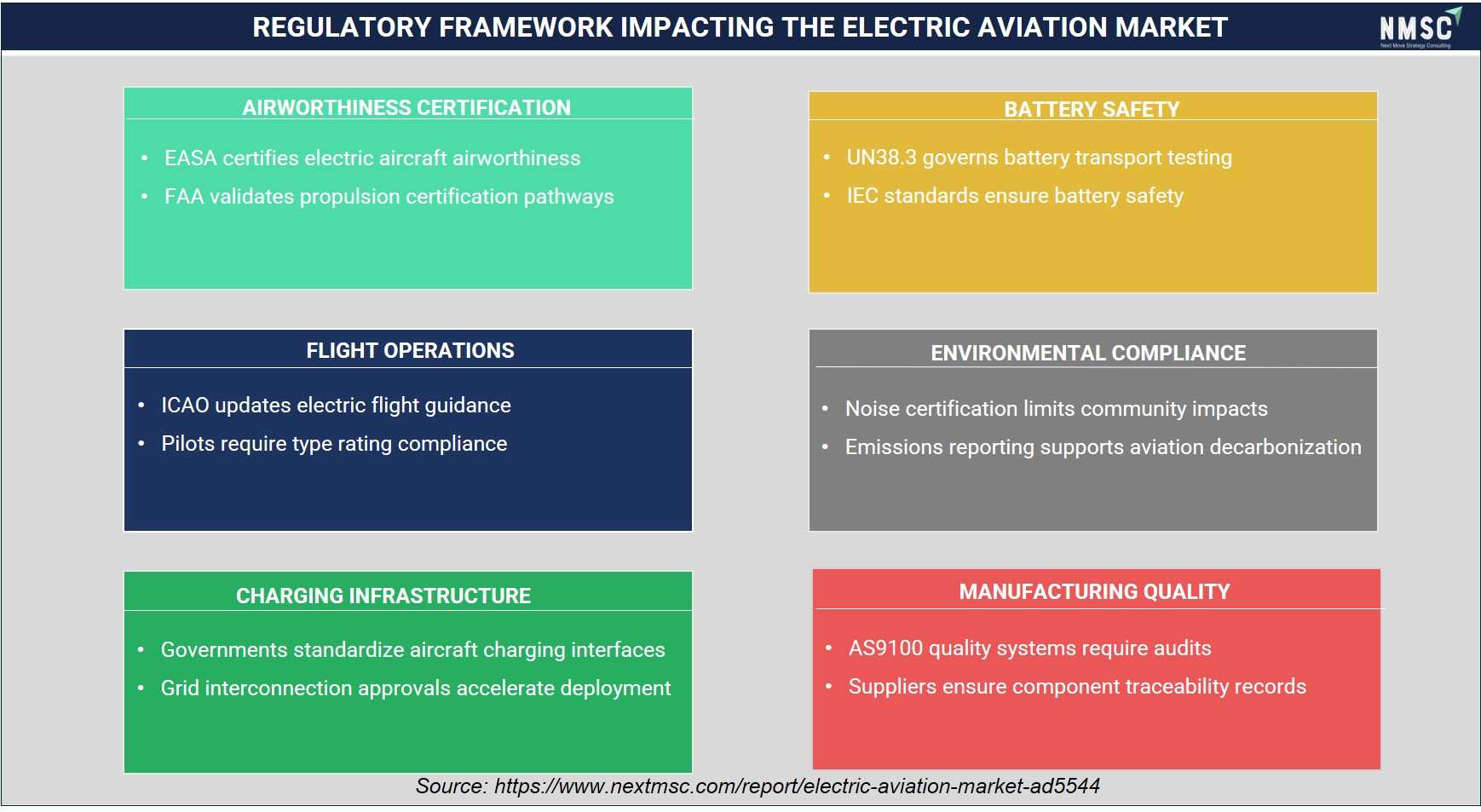
The above infographic outlines the robust regulatory framework governing the electric aviation market, where stringent airworthiness and battery safety standards (EASA, FAA, UN38.3) establish critical compliance barriers. Operational expertise is further shaped by ICAO flight guidance and environmental noise/emissions mandates. Crucially, manufacturing and charging infrastructure regulations demand rigorous AS9100 traceability and standardized grid interconnections, ensuring that all commercial deployments meet the highest levels of safety and quality assurance prior to market entry.
Competitive Landscape
We observed that the electric aviation industry features a fragmented competitive landscape, with well-capitalized eVTOL developers competing alongside diversified aerospace conglomerates and dedicated propulsion specialists on certification progress, capital access, and airline partnership depth across the Industry.
Key Takeaways
|
Field |
Details |
|
Market Structure |
Fragmented; more than 800 active electric aircraft programs were identified at end-2024, yet only a small number of well-capitalized developers including Joby Aviation, Archer Aviation, and Beta Technologies possess the capital required for full certification. |
|
Innovation Focus |
eVTOL certification progress, hydrogen-electric propulsion development, and hybrid-electric regional aircraft flight testing dominate current innovation pipelines across leading manufacturers. |
|
M&A Activity |
Selective consolidation and restructuring, with several early eVTOL entrants undergoing financial distress in 2024 and 2025 while capital concentrated among certification-stage leaders. |
How Do Companies Compete in the Electric Aviation Market?
Companies compete primarily on certification progress, capital access, and airline or operator partnership depth across the industry. Vertically integrated manufacturers such as Joby Aviation and Archer Aviation leverage FAA certification advancement and airline pre-order books to secure commercial launch positioning, while diversified aerospace conglomerates such as Textron and Airbus compete through established manufacturing infrastructure and existing regulatory relationships.
Which Competitive Archetypes Dominate the Electric Aviation Market?
Two archetypes dominate the market: vertically integrated eVTOL and fixed-wing manufacturers controlling airframe design through commercial operations, and diversified aerospace conglomerates and propulsion specialists supplying certified electric motor and battery systems. Joby Aviation and Eve Holding exemplify the vertically integrated archetype, while Safran and Honeywell exemplify the propulsion specialist archetype supplying certified components across multiple airframe programs.
How Are Companies Differentiating Through Innovation in Electric Aviation?
Innovation and differentiation strategy increasingly center on certification milestone achievement and range extension technology. Joby Aviation's hydrogen-electric distance record and Heart Aerospace's FAA-authorized flight testing both illustrate how developers pursue technical validation to build investor and regulator confidence. Our analysis shows that manufacturers unable to demonstrate credible certification progress risk exclusion from airline partnership discussions as commercial launch windows narrow toward 2026 and beyond.
What M&A and Expansion Activity Is Shaping the Market?
Restructuring and selective partnership activity continue to shape competitive positioning within the industry. Heart Aerospace's 2025 relocation of its headquarters from Sweden to Los Angeles, citing proximity to investors and the U.S. aerospace supply chain, illustrates how developers pursue geographic repositioning to secure capital access, while Eve Air Mobility's framework agreement with Brazilian operator Revo demonstrates continued expansion through binding commercial partnerships.
Key Market Players
Our assessment indicates that the following companies are actively shaping platform development, propulsion technology, and certification strategy within the global electric aviation market.
-
Joby Aviation, Inc.
-
Archer Aviation Inc.
-
Beta Technologies, Inc.
-
Eve Holding, Inc.
-
Vertical Aerospace Group Ltd.
-
EHang Holdings Limited
-
The Boeing Company
-
Textron Inc.
-
Airbus SE
-
magniX USA, Inc.
-
ZeroAvia, Inc.
-
Heart Aerospace Inc.
-
Safran SA
-
Honeywell International Inc.
-
Rolls-Royce Holdings plc
-
Hyundai Motor Company
- Pyka Inc.
Latest Developments
We found that recent milestones within the electric aviation market are concentrated on certification progress and flight test records, reflecting the industry's transition from prototype development toward commercial service.
|
Date |
Event |
|
July 2026 |
Archer Aviation, BETA Technologies, and Macquarie Capital launched America's Consortium for Electric Skyways (ACES) to support interoperable electric aviation charging infrastructure across the U.S. The consortium aims to electrify more than 250 aviation sites by 2030, including major airports and metropolitan areas. |
|
April 2026 |
Joby Aviation completed New York City's first point-to-point eVTOL air-taxi demonstration flights, including operations connecting John F. Kennedy International Airport with existing heliport infrastructure across the city. |
|
April 2026 |
Joby Aviation partnered with Air Space Intelligence to support the integration of electric air taxis into the U.S. National Airspace System. The partnership combines Joby's electric aircraft with ASI's AI-enabled Flyways platform to improve flight planning and operational coordination as electric aviation services scale. |
Expert Insights
 “Electric air taxi operations can't scale without the infrastructure to charge them. That's why we're building the backbone to support the next 250 years of electric aviation in America. We're putting interoperable chargers in the locations where we plan to fly, including the core eIPP markets, and using the industry-adopted charging standard so every operator can share in their usage and distribute the cost across the whole industry. This is how you build the foundation for the next-gen aviation technologies that will transform how Americans move through their cities.”
— Adam Goldstein, Founder & Chief Executive Officer of Archer Aviation
Statement made following the launch of America's Consortium for Electric Skyways (ACES), which aims to develop more than 250 interoperable electric-aircraft charging sites across the U.S.
Market Interpretation
The insight highlights that charging infrastructure and interoperability are critical requirements for scaling electric aviation. While electric aircraft development and certification remain essential, commercial deployment will also depend on accessible, standardized, and shared charging networks across airports and urban aviation locations. The development indicates that electric aviation companies are increasingly investing in ecosystem infrastructure to reduce operational barriers, improve network scalability, and support broader adoption of eVTOL aircraft and electric air-taxi services.
Investment Opportunities
What Capital Inflows Are Targeting the Electric Aviation Market?
Capital inflows into the electric aviation market are increasingly directed toward certification-stage eVTOL and regional aircraft developers. Heart Aerospace's 2025 headquarters relocation to Los Angeles, citing proximity to its largest investors, illustrates how capital availability shapes even fundamental corporate decisions. We observed that investors favor developers demonstrating validated flight-test progress, viewing FAA and EASA certification milestones as a proxy for long-term commercialization viability.
How Significant Is Infrastructure Investment in the Electric Aviation Market?
Infrastructure investment tied to vertiport development and charging networks is a critical enabler of electric aviation market scalability. Skyports Infrastructure's January 2025 design approval for Dubai's first commercial vertiport illustrates growing investment in ground infrastructure ahead of commercial eVTOL launches. Our assessment indicates that operators increasingly condition service launch timelines on confirmed vertiport and charging infrastructure availability alongside aircraft certification status.
What ESG Considerations Are Shaping Electric Aviation Investment?
Environmental, social, and governance considerations directly shape electric aviation investment through zero-emission flight and noise reduction priorities. The Pipistrel Velis Electro's ultra-quiet 60 decibel operation and zero in-flight emissions exemplify the sustainability positioning central to electric aircraft value propositions. NMSC's analysis indicates that aviation industry decarbonization commitments are increasingly directing capital toward manufacturers with credible zero-emission and noise-reduction technology roadmaps.
Key Benefits for Stakeholders
How Does This Report Benefit Aerospace Industry Leaders?
Aerospace industry leaders gain access to validated segmentation, platform benchmarking, and regional regulatory analysis that supports electric aircraft development strategy decisions. The report's platform type and propulsion type breakdowns help executives evaluate eVTOL, fixed-wing, and hybrid-electric investment priorities against evolving certification frameworks, supporting more informed portfolio decisions across battery, hybrid, and hydrogen-electric technology pathways.
How Does This Report Benefit Investors and Financial Analysts?
Investors and financial analysts benefit from consolidated market sizing, regional growth forecasts, and competitive positioning data that inform capital allocation across the electric aviation value chain. The report's country-level revenue estimates and growth catalyst matrix support due diligence on airframe manufacturers, propulsion developers, and infrastructure providers positioned to capture forecast demand growth through 2035.
How Does This Report Benefit Technology Vendors and Product Teams?
Technology vendors and product teams gain competitive intelligence on certification milestone trends, hydrogen-electric propulsion advancement, and recent developments among the 17 companies profiled. This supports product roadmap decisions around propulsion technology selection, range extension strategy, and vertiport infrastructure partnership aligned with the fastest-growing platform and regional segments identified in this report.
Key Market Segments
By Platform Type
-
Fixed-wing eCTOL aircraft
-
eVTOL aircraft
-
Hybrid-electric aircraft
By Propulsion Type
-
Battery electric propulsion
-
Hybrid-electric propulsion
-
Hydrogen-electric propulsion
By Range Category
-
Short-range under 200 km
-
Medium-range 200 to 500 km
-
Long-range over 500 km
By Application
-
Urban air mobility and air taxi
-
Regional passenger transport
-
Cargo and logistics transport
-
Flight training and general aviation
-
Emergency medical services
By End User
-
Commercial airlines and operators
-
Private and business operators
-
Government and defense operators
By Region
-
North America: U.S., Canada, Mexico.
-
Europe: UK, Germany, France, Italy, Spain, Sweden, Denmark, Finland, Netherlands, Rest of Europe.
-
Asia-Pacific: China, India, Japan, South Korea, Taiwan, Indonesia, Vietnam, Australia, Philippines```html , Malaysia, Rest of APAC.
-
Middle East & Africa: Saudi Arabia, UAE, Egypt, Israel, Turkey, Nigeria, South Africa, Rest of MEA.
-
Latin America: Brazil, Argentina, Chile, Colombia, Rest of LATAM.
Conclusion & Recommendations
What Is the Long-Term Outlook for the Electric Aviation Market?
The long-term outlook for the electric aviation market remains structurally positive, supported by a USD 46.09 billion absolute dollar opportunity between 2026 and 2035 and multiple eVTOL and regional aircraft programs approaching commercial certification. We found that eVTOL platforms will continue commanding the largest revenue share as urban air mobility services scale from pilot programs to sustained commercial operations across major metropolitan markets through the forecast period.
What Strategic Positioning Should Stakeholders Pursue?
Stakeholders should pursue strategic positioning that combines certification progress with airline and operator pre-order commitments to de-risk commercialization timelines. NMSC's analysis indicates that manufacturers bundling proprietary propulsion development with binding fleet order agreements are best positioned to capture recurring, multi-year revenue across the electric aviation market.
How Attractive Is the Electric Aviation Market for New Investment?
The electric aviation industry presents an attractive investment case, supported by a USD 46.09 billion absolute dollar opportunity between 2026 and 2035 and multiple eVTOL and regional aircraft programs approaching commercial certification. We found that eVTOL platforms will continue commanding the largest revenue share as urban air mobility services scale from pilot programs to sustained commercial operations across major metropolitan markets through the forecast period.
What Market Shifts and Key Risks Should Stakeholders Monitor?
Stakeholders should monitor certification timeline shifts, as delays in FAA or EASA special condition issuance directly compress commercial launch windows and revenue recognition schedules. Battery energy density breakthroughs or stagnation represent a binary risk that could expand or constrain addressable market scope across range-sensitive applications. Competitive rationalization — the consolidation of undercapitalized programs — may concentrate market share more rapidly than current fragmentation metrics suggest, altering partnership dynamics and supply chain leverage.
What Are the Key Growth Pathways for the Electric Aviation Market?
The electric aviation market's key growth pathways run through three converging channels: (1) eVTOL certification and commercial air taxi launch in metropolitan markets, which anchors near-term revenue and validates the business model for electric urban mobility; (2) hydrogen-electric propulsion commercialization for regional routes, which extends the addressable market beyond battery-limited range and opens a high-value segment for propulsion developers; and (3) vertiport and charging infrastructure build-out, which removes the operational constraint most likely to bottleneck scaling even after aircraft certification is achieved. NMSC's analysis indicates that stakeholders pursuing integrated strategies across all three pathways are best positioned to capture outsized returns through 2035.
About the Author
 Mayurima Roy
— Mayurima Roy is Research Analyst at Next Move Strategy Consulting, where she has spent 4 years working across the firm's full industry coverage rather than a single fixed vertical. Her work centers on structured research, ongoing trend tracking, competitive assessment, and insight-led content development, translating complex market data into clear, decision-ready narratives that support informed client decision-making across diverse global industries, market sectors, and world regions every day.
Mayurima Roy
— Mayurima Roy is Research Analyst at Next Move Strategy Consulting, where she has spent 4 years working across the firm's full industry coverage rather than a single fixed vertical. Her work centers on structured research, ongoing trend tracking, competitive assessment, and insight-led content development, translating complex market data into clear, decision-ready narratives that support informed client decision-making across diverse global industries, market sectors, and world regions every day.
About the Reviewer
 Supradip Baul
— Supradip Baul is an accomplished business consultant and strategist with over a decade of rich experience in market intelligence, strategy, technology, and business transformation. His work has included rigorous qualitative and quantitative analysis across multiple industries, helping clients shape investment decisions and long-term roadmaps. Earlier in his career, he was associated with Gartner, where he contributed to industry-leading reports and market share analyses. He has worked with leading global companies and holds an MBA with a dual specialization in Marketing and Finance.
Supradip Baul
— Supradip Baul is an accomplished business consultant and strategist with over a decade of rich experience in market intelligence, strategy, technology, and business transformation. His work has included rigorous qualitative and quantitative analysis across multiple industries, helping clients shape investment decisions and long-term roadmaps. Earlier in his career, he was associated with Gartner, where he contributed to industry-leading reports and market share analyses. He has worked with leading global companies and holds an MBA with a dual specialization in Marketing and Finance.
At Next Move Strategy Consulting, we understand that insightful market research is the cornerstone of successful business decisions. That's why we employ a robust and multifaceted approach, combining various methodologies to deliver the most accurate and actionable data for our clients.

Research Landscape
We navigate the world of research with two primary approaches:
Qualitative Approach
Our qualitative research methodologies involve immersive techniques such as in-depth interviews, focus groups, and observational studies. By engaging directly with individuals and stakeholders, we uncover valuable insights that quantitative data alone may overlook.

Quantitative Research
In tandem with qualitative methodologies, NMSC leverages the power of Quantitative Research to provide a robust foundation of numerical insights. Through systematic data collection and analysis, we quantify patterns, preferences, and market trends, offering a comprehensive view of the business landscape.
Our quantitative research approach employs diverse tools, including surveys, experiments, and statistical modelling. These methodologies enable us to gather data from a large and representative sample, ensuring the statistical significance of our findings. By employing structured questionnaires and standardized data collection methods, we guarantee the reliability and validity of the information we present to our clients.
Quantitative research is particularly effective in measuring the prevalence of trends, assessing market size, and gauging the impact of various factors on consumer behavior. The numerical precision attained through this approach equips our clients with actionable insights, facilitating data-driven decision-making and strategy formulation.


Our Specialized Toolbox for Industry-Specific Market Research
We deploy a specialized arsenal of techniques tailored to meet your unique requirements. Here's a glimpse into our comprehensive toolbox:

Information Procurement
The stage entails acquiring market data or relevant information through various sources and methodologies.


Market Research Approach
We utilize both top-down and bottom-up approaches in market research analysis to achieve a comprehensive understanding of the market dynamics, leveraging the broad perspective of industry trends and macroeconomic factors alongside detailed insights from specific segments and individual companies.

Porters Five Forces Analysis
We conduct Porter's Five Forces analysis to evaluate the competitive landscape of an industry, providing us with insights into factors that affect profitability and strategic positioning.

SWOT Analysis

Forecasting
We utilize a forecasting model to predict future consumption by considering parameters like population, economics, regulations, market competition, drivers, constraints, technology, and pricing. We also employ statistical techniques such as multilinear regression, exponential smoothing, moving average, ARIMA, and Monte Carlo simulations for accurate predictions. In econometric forecasting, we analyzed short-term and long-term event impacts, attributing values based on regulatory frameworks, economic factors, and market events.





 Speak to Our Analyst