Embedded AI: Transforming Intelligent Systems in 2026
Embedded AI is rapidly reshaping how devices process data, make decisions, and deliver real-time intelligence. Unlike traditional cloud-based artificial intelligence systems, embedded AI integrates intelligence directly into hardware, enabling faster, more secure, and energy-efficient operations.
Recent 2025–2026 developments highlight a shift from experimental adoption to real-world deployment, particularly in platforms designed for operational efficiency and specialized processors optimized for edge intelligence.
What Is Embedded AI and Why It Matters
Embedded AI refers to artificial intelligence capabilities built directly into hardware systems such as microcontrollers, processors, or edge devices. This enables systems to analyze data locally without constant reliance on cloud infrastructure.
Key Advantages
-
Reduced latency due to on-device processing
-
Improved data privacy and security
-
Lower bandwidth consumption
-
Real-time decision-making capabilities
These advantages are becoming critical across industries such as healthcare, education management, and industrial automation.
Our insights states that Embedded AI is transitioning from a performance enhancement tool to a foundational technology layer. Organizations are increasingly prioritizing on-device intelligence to reduce dependency on centralized systems and improve operational resilience.
Embedded AI Platforms: Real-World Implementation
A major advancement in embedded AI platforms comes from Arly’s launch of an AI-embedded system designed for youth program management.
Key Highlights from the Platform
-
The platform integrates artificial intelligence directly into program workflows
-
Enables automated scheduling, communication, and administrative tasks
-
Designed to improve operational efficiency for youth organizations
According to the official release, this platform represents the first AI-embedded solution specifically tailored for youth program management
Impact on Operational Efficiency
|
Feature |
Impact |
|
Automated workflows |
Reduces manual administrative workload |
|
Integrated AI tools |
Enhances decision-making accuracy |
|
Centralized system |
Improves coordination and communication |
NMSC concludes, the emergence of domain-specific embedded AI platforms indicates a shift toward vertical specialization. Rather than generic artificial intelligence tools, the market is moving toward tailored solutions that address specific operational challenges with precision.
Embedded AI Hardware: The Rise of NPUs
Hardware innovation is equally critical in advancing embedded AI capabilities. CEVA’s NeuPro-Nano Neural Processing Unit (NPU) represents a significant breakthrough in this domain.
Key Developments
-
NeuPro-Nano NPU received an Artificial Intelligence Award at Embedded World 2026
-
Designed for ultra-efficient AI processing at the edge
-
Optimized for low power consumption and high performance
Why NPUs Matter
-
Enable complex AI workloads on small devices
-
Reduce reliance on cloud-based computation
-
Improve scalability for edge deployments
Our observations at Next Move Strategy Consulting indicates, the recognition of specialized NPUs highlights a broader industry trend toward hardware-software co-design. Performance improvements are no longer driven solely by algorithms but by tightly integrated architectures that optimize both computing efficiency and energy usage.
|
Category |
Details |
|
Overview |
Hardware innovation is critical in advancing embedded AI capabilities, with CEVA’s NeuPro-Nano Neural Processing Unit (NPU) representing a significant breakthrough |
|
Award Recognition |
NeuPro-Nano NPU received an Artificial Intelligence Award at Embedded World 2026 |
|
Core Design |
Designed for ultra-efficient AI processing at the edge |
|
Performance Optimization |
Optimized for low power consumption and high performance |
|
Why NPUs Matter – Workload Capability |
Enable complex AI workloads on small devices |
|
Why NPUs Matter – Cloud Dependency |
Reduce reliance on cloud-based computation |
|
Why NPUs Matter – Scalability |
Improve scalability for edge deployments |
Embedded AI Use Cases Across Industries
Embedded AI is no longer limited to experimental applications. Its integration is expanding across multiple sectors:
Key Application Areas
-
Education & Program Management: AI-enabled platforms streamline operations and engagement
-
Consumer Electronics: Smart devices with real-time intelligence
-
Industrial Automation: Predictive maintenance and process optimization
-
Healthcare Devices: Faster diagnostics and monitoring
These applications demonstrate how embedded AI is enabling localized intelligence with minimal latency.
We have observed that the breadth of use cases suggests that embedded AI is evolving into a horizontal enabler across industries. Its ability to deliver real-time insights at the edge positions it as a critical component in next-generation digital ecosystems.
Next Move Strategy Consulting: Industry Impact
The recent developments in Embedded AI platforms and processors signal a transformative phase for the industry.
Key Industry Impacts
-
Acceleration of edge computing adoption
-
Increased demand for energy-efficient AI hardware
-
Growth of vertical-specific AI platforms
-
Reduced dependency on centralized cloud systems
These changes are expected to redefine how organizations deploy and scale artificial intelligence solutions.
Analysis from Next Move Strategy Consulting indicates the convergence of specialized platforms and advanced hardware is creating a more mature embedded AI ecosystem. This evolution is likely to drive faster adoption cycles and unlock new business models centered around real-time intelligence.
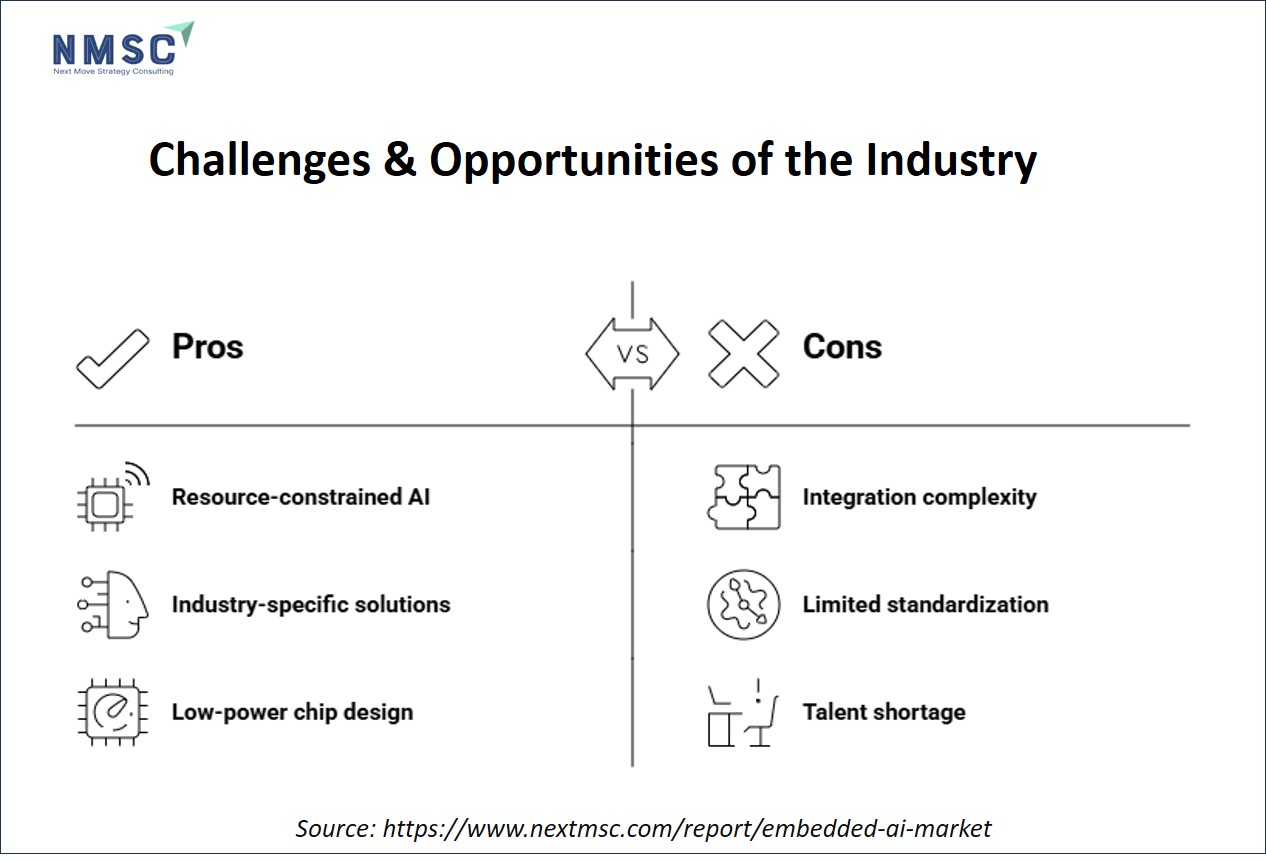
Challenges and Opportunities
Challenges
-
Integration complexity across hardware and software layers
-
Limited standardization in embedded AI frameworks
-
Need for skilled talent in edge AI development
Opportunities
-
Expansion of AI into resource-constrained environments
-
Development of industry-specific solutions
-
Innovation in low-power AI chip design
We have observed that, while technical barriers remain, the opportunities outweigh the challenges. Organizations that invest early in embedded AI capabilities are likely to gain a competitive advantage through improved efficiency and innovation.
Key Players
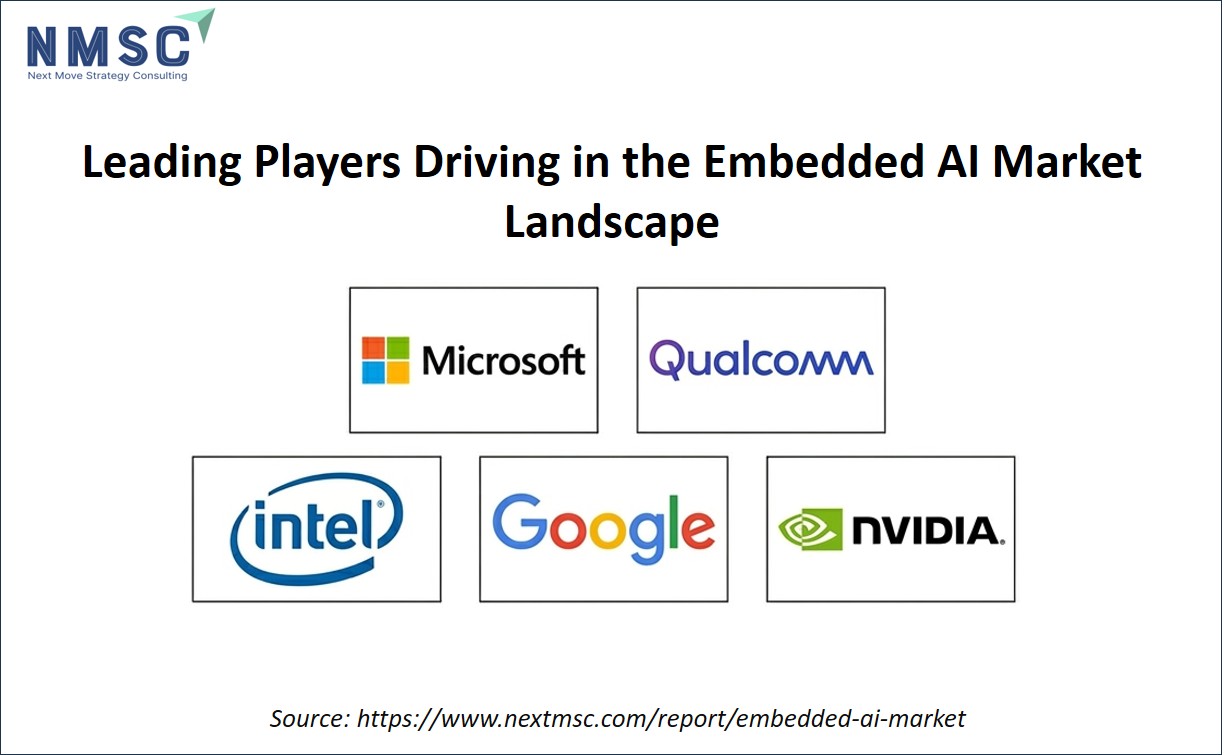
Various key market players operating in the embedded AI industry include Microsoft Corporation, Qualcomm Inc., Intel Corporation, Google LLC, NVIDIA Corporation, NXP Semiconductors, STMicroelectronics, Renesas Electronics Corporation, SenseTime, and Horizon Robotics. These market players are adopting various strategies such as product launches and acquisition to maintain their dominance in the global market.
For instance, in November 2023, Microsoft launched custom AI server chips for Azure, aiming to enhance the performance and efficiency in AI workloads on its cloud platforms. This initiative directly targets the embedded AI industry by providing specialized hardware solutions that optimize AI processing capabilities in cloud environment.
Conclusion
Embedded AI is redefining the future of intelligent systems by bringing computation closer to the source of data. With advancements in both platforms and hardware, the technology is moving toward widespread adoption across industries.
From AI-driven management systems to award-winning NPUs, the latest developments underscore the growing importance of embedded intelligence in building efficient, scalable, and secure solutions.
Our observations at Next Move Strategy Consulting indicates that Embedded AI will continue to evolve as a core pillar of digital transformation, enabling organizations to unlock new levels of performance, efficiency, and innovation in the years ahead.
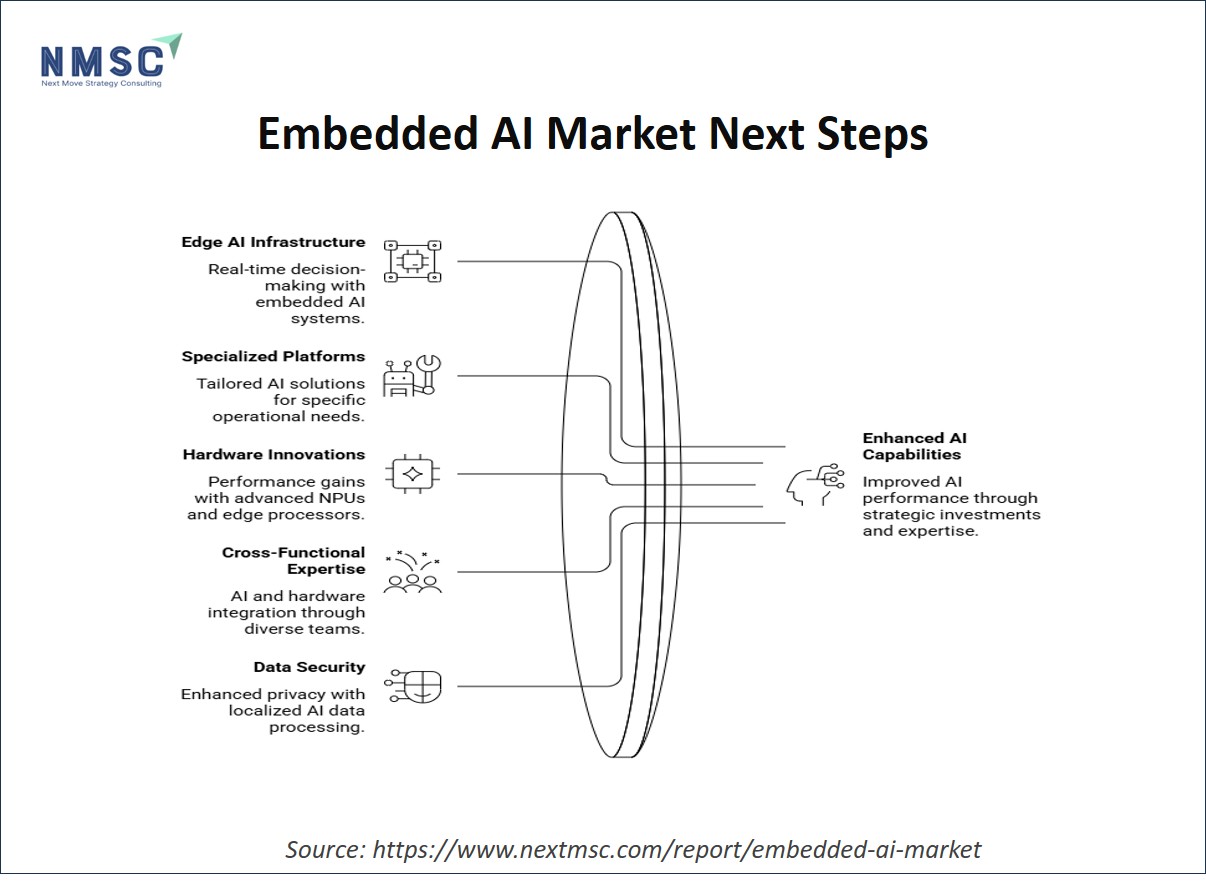
Next Steps: Actionable Takeaways
1. Invest in Edge AI Infrastructure: Focus on integrating embedded AI capabilities into existing systems to improve real-time decision-making
2. Adopt Specialized Platforms: Explore domain-specific AI solutions tailored to operational needs
3. Monitor Hardware Innovations: Track advancements in NPUs and edge processors for performance gains
4. Build Cross-Functional Expertise: Develop teams that understand both AI algorithms and hardware integration
5. Prioritize Data Security: Leverage embedded AI to enhance privacy through localized processing
About the Author
 Sanyukta Deb
— Sanyukta Deb is Digital Marketing Team Lead at Next Move Strategy Consulting, where she has led content strategy and technical SEO for the firm's B2B market research publications for over 2 years. Her editorial process translates NextMSC's primary and secondary research — spanning technology, industrial, and consumer sectors — into commercial narratives, backed by search-intent, keyword, and competitive analysis. She brings 5 years of overall experience in digital marketing and content strategy.
Sanyukta Deb
— Sanyukta Deb is Digital Marketing Team Lead at Next Move Strategy Consulting, where she has led content strategy and technical SEO for the firm's B2B market research publications for over 2 years. Her editorial process translates NextMSC's primary and secondary research — spanning technology, industrial, and consumer sectors — into commercial narratives, backed by search-intent, keyword, and competitive analysis. She brings 5 years of overall experience in digital marketing and content strategy.
About the Reviewer
 Debashree Dey
— Debashree Dey is Assistant Manager at Next Move Strategy Consulting, where she supports cross-vertical market content and communications across diverse industries for 6 years. Her professional background includes senior content writing, communications, and published manuscript authorship, with experience developing audience-focused business narratives and maintaining clear, consistent messaging. Her role supports research-led content development and editorial quality across NextMSC publications.
Debashree Dey
— Debashree Dey is Assistant Manager at Next Move Strategy Consulting, where she supports cross-vertical market content and communications across diverse industries for 6 years. Her professional background includes senior content writing, communications, and published manuscript authorship, with experience developing audience-focused business narratives and maintaining clear, consistent messaging. Her role supports research-led content development and editorial quality across NextMSC publications.

















Add Comment