Exploring 2025 Golf Equipment Market Innovations

Introduction
According to Next Move Strategy Consulting's Golf Equipment Market report, the global golf equipment market was valued at USD 10.50 billion in 2025 and is projected to reach USD 16.91 billion by 2035, growing at a CAGR of 4.88% from 2026 to 2035. The market is expected to reach USD 11.01 billion in 2026, so the coming twelve months test whether premium demand can hold while the cost of imported goods shifts again.
For More Information: Download FREE Sample on Golf Equipment Market Report
On August 6, 2026, Acushnet Holdings Corp. reported second-quarter net sales of USD 820.0 million, up 13.8% year over year, and lifted its full-year net sales outlook to USD 2,650 to USD 2,675 million. Two days earlier, on August 4, 2026, Callaway Golf Company reported second-quarter net sales of USD 612.2 million from continuing operations and raised its full-year Adjusted EBITDA outlook to USD 246 to USD 260 million. Both releases showed the same pattern: demand for premium clubs and balls stayed firm, and refunds of previously paid tariffs improved profit.
That pattern matters because the golf equipment market is no longer led by new-golfer volume alone. Rounds played slowed in July and August 2026, United States tariff policy changed again on July 24, 2026, and the USGA and R&A are still weighing equipment rules for elite play.
From Tariff Refunds to Tour Rules: What Is Moving Golf Equipment Demand in 2026
Acushnet Holdings Corp.: GTS Drivers Lift the Golf Equipment Market's Premium Tier
Acushnet Holdings Corp. reported on August 6, 2026 that second-quarter net sales rose 13.8% to USD 820.0 million, or 14.2% in constant currency, with growth in all reportable segments and all regions. Net income attributable to the company rose 65.1% to USD 124.8 million, and Adjusted EBITDA rose 45.8% to USD 208.6 million, a margin of 25.4% against 19.9% a year earlier.
Titleist golf equipment led the quarter. Segment net sales rose 20.3% to USD 545.9 million, driven by higher volumes of the newly introduced GTS drivers and fairways and the latest generation T-Series irons, together with higher average selling prices of Pro V1 golf ball models. FootJoy golf wear grew 3.1% to USD 157.8 million and Golf gear grew 3.8% to USD 79.6 million, both on higher average selling prices rather than higher volume.
David Maher, President and Chief Executive Officer of Acushnet Holdings Corp., said on August 6, 2026 that results benefited from the “successful launch of the new Titleist GTS drivers and fairways,” which arrived earlier in the year than the typical third-quarter metal woods launch. The company also reported a benefit of about USD 38 million from refunds of tariffs previously paid under the International Emergency Economic Powers Act (IEEPA), net of the effect on incentive compensation.
Regional data shows how broad the quarter was. United States net sales rose 14.7% to USD 498.4 million, EMEA rose 15.9% to USD 114.3 million, Japan rose 18.9% to USD 35.9 million and Rest of World rose 18.5% to USD 91.4 million. Korea was the exception at USD 80.0 million, flat against USD 80.1 million a year earlier, although it grew 6.7% in constant currency.
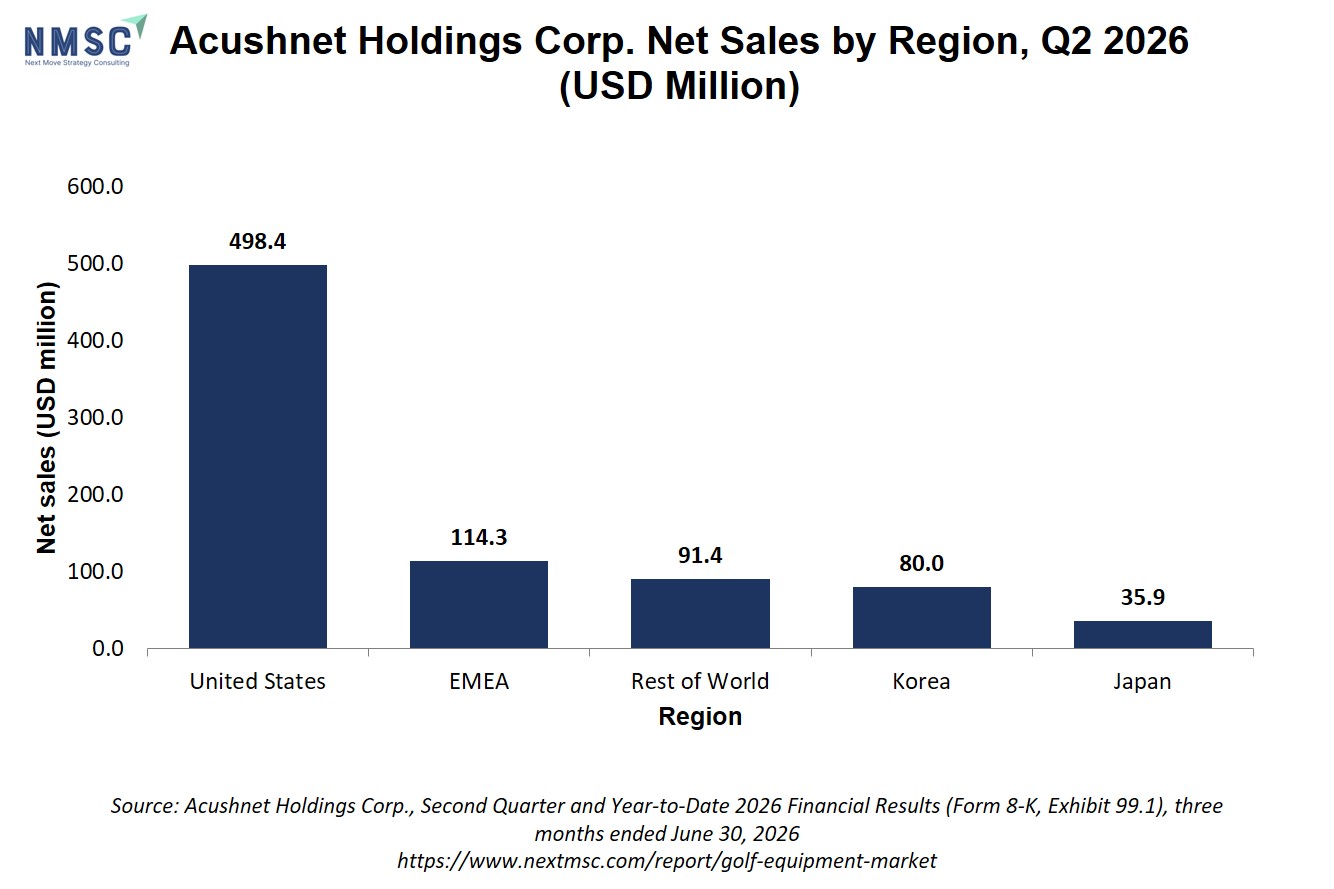
Acushnet Holdings Corp. reports net sales by region for the three months ended June 30, 2026 in its second-quarter results release. The United States contributed USD 498.4 million of the USD 820.0 million total, followed by EMEA at USD 114.3 million, Rest of World at USD 91.4 million, Korea at USD 80.0 million and Japan at USD 35.9 million. The five regions sum to the reported consolidated net sales of USD 820.0 million.
Callaway Golf Company: Margin Gains Outpace Sales Growth
Callaway Golf Company reported on August 4, 2026 that second-quarter net sales from continuing operations rose 2.0% to USD 612.2 million. Golf Equipment net sales rose 4.5% to USD 430.3 million, with strength in both clubs and balls, while SGB Media noted that Apparel, Gear and Other fell 3.6% because of shipment timing and currency headwinds in Asia. Six-month net sales reached USD 1,299.7 million, up 5.7%.
Profitability moved faster than revenue. GAAP gross margin rose about 620 basis points to 50.1% and non-GAAP gross margin rose 460 basis points to 48.5%, which the company attributed to select price increases, cost reductions and the rationalization of lower-margin business. Adjusted EBITDA from continuing operations rose 35.8% to USD 124.9 million. Inventory fell USD 49.7 million year over year to USD 518.2 million, largely on strong sell-through.
Chip Brewer, President and Chief Executive Officer of Callaway Golf Company, said in the August 4, 2026 release that the company remains encouraged by “the continued resilience of the golf consumer.” The company raised its full-year net sales outlook to USD 2.045 billion to USD 2.070 billion.
Tariff Refunds Versus the New Section 301 Duties
Tariff policy is now one of the largest swing factors in reported profit. According to EY Global Tax News, the United States Trade Representative finalized Section 301 forced labor tariffs on 60 economies, with additional duties of 10% or 12.5% taking effect on July 24, 2026 as the temporary 10% global tariffs under Section 122 expired. Products already subject to Section 232 tariffs are exempt, which prevents stacking with those measures.
For Callaway Golf Company, SGB Media reported on August 4, 2026 that the new rates were better than the 20% level the company had assumed after the Section 122 expiry. The company now expects full-year 2026 gross tariff expense of about USD 43 million, USD 7 million better than prior guidance, compared with USD 34 million in 2025. It has applied for Phase 1 and Phase 2 refunds of about USD 11 million and USD 32 million, and it recognized USD 10.8 million of Phase 1 refunds in the second quarter.
Acushnet Holdings Corp. reported that its updated outlook includes about USD 30 million of net IEEPA tariff refunds expected in 2026. Both companies therefore show reported profit that is partly one-time. Analysts comparing 2026 with 2027 should separate recurring price effects from refund income. First-half net sales at Acushnet already equal about 59% of the low end of its full-year outlook, which signals a slower second half.
NMSC Strategic Perspective: Why Fitting, Not Rounds, Anchors the Golf Equipment Market
NextMSC primary research and analysis, based on interviews with specialty golf retailers, certified club fitters and regional distributors across North America, Europe and Asia-Pacific, finds that the golf equipment market is increasingly driven by premium upgrade cycles rather than incremental participation gains. NextMSC channel audits indicate that average selling prices for drivers and multi-material irons have risen steadily, supported by carbon composite faces, tungsten perimeter weighting and AI-assisted clubface optimization.
The Acushnet Holdings Corp. and Callaway Golf Company results are consistent with that finding. Acushnet reported volume-led growth in clubs and price-led growth in balls, wear and gear, while Callaway reported margin expansion from select price increases and cost reductions. NextMSC research indicates that custom fitting studios raise conversion rates and average transaction values, which reinforces ecosystem-led buying and supports gross margin resilience for leading brands.
NextMSC also assesses direct-to-consumer channels and digital configurators as a durable profit lever. Online customization tools and virtual fitting reduce decision friction and raise average order value in premium driver and iron categories, while brands that integrate CRM and retargeting see stronger repeat purchases. NextMSC treats cost sensitivity as a cyclical restraint rather than a structural weakness.
Section Summary:
Second-quarter 2026 results show premium clubs, price increases and tariff refunds driving reported profit, while NextMSC research ties durable demand to fitting and direct channels.
-
Acushnet Holdings Corp. grew Titleist golf equipment net sales 20.3% on GTS driver and T-Series iron volume.
-
Callaway Golf Company lifted GAAP gross margin about 620 basis points on pricing and cost actions.
-
Tariff refunds and the 10% to 12.5% Section 301 duties make 2026 profit comparisons less reliable.
-
NextMSC links resilient demand to custom fitting, digital configurators and direct-to-consumer sales.
Industry Impact Analysis
Equipment Rules: The Rollback Delay and Three Proposed Tour Rules
On June 17, 2026, Golf Digest reported that the USGA and R&A, together with the PGA Tour and DP World Tour, issued a joint statement saying they would reevaluate the approach to the golf ball distance rollback. The governing bodies kept 2030 as the implementation date. The 2023 plan raised the swing speed used in the Overall Distance Standard test from 120 mph to 125 mph without changing the 317-yard distance limit, and in March 2026 the USGA had already moved the start to 2030 for all golfers, dropping an earlier staggered 2028 start for elite play.
GOLF.com reported on September 23, 2026 that the USGA and R&A sent their fourth notice of 2026 to manufacturers, seeking feedback on three model local rules proposed by the PGA Tour and DP World Tour. The rules would apply only at the highest levels of the game and could start as early as January 2028. They would require a ball that tests at 317.0 yards or less, a driver head with a maximum characteristic time of 239 microseconds, or a club length limit below 46 inches for clubs other than putters. The comment window closed on October 21, 2026.
The commercial reading is that the proposals touch tour equipment, not the clubs and balls sold to recreational golfers, and GOLF.com noted that none of the rules would affect the recreational game. Distance pressure is real, though: GOLF.com reported that average PGA Tour driving distance reached 306 yards in 2026, up 16 yards over ten years. NextMSC assesses that a tour-only rule would leave retail inventory unchanged, while a single 2030 date for all golfers gives manufacturers a longer window to adjust ball and club specifications.
Participation: Rounds Slow After a Record Start
Volume indicators softened in the summer. The First Call, citing the National Golf Foundation, reported on September 1, 2026 that national rounds played fell 3.6% in July, although rounds through July were still tracking 2.5% ahead of the prior record year. On October 1, 2026, The First Call reported that rounds fell 5% in August, the second consecutive monthly decline, leaving rounds played 1% ahead of last year's record total heading into the final third of the year.
The slowdown has not yet shown up in the equipment results above, which cover April to June. NextMSC reads this gap as a lag: equipment sell-in and fitting-led upgrades respond to product launches and price points, while rounds respond to course access and discretionary spending. A further decline in rounds would test the premium thesis, and NextMSC lists discretionary spending exposure as the largest negative impact on the forecast CAGR.
Regional Contrast: Strength in the United States and EMEA, a Flat Korea
The regional pattern also shapes demand. In the first six months of 2026, Acushnet Holdings Corp. net sales rose 9.9% in the United States, 17.9% in EMEA and 17.4% in Rest of World, while Korea fell 3.5% in reported currency and rose 0.5% in constant currency. Japan rose 10.6% in reported currency and 17.6% in constant currency, which shows how currency movements can hide or exaggerate regional trends in yen- and won-denominated markets.
NextMSC research adds that Japan and South Korea show technology-intensive buying inside compact indoor venues, where analytics and simulator integration influence equipment selection, while Europe reflects steadier procurement and North America sustained upgrade momentum.
Section Summary:
Rule proposals target the tour, rounds slowed in July and August 2026, and regional growth is uneven.
-
The USGA and R&A kept 2030 for the rollback, and the proposed tour rules could start in January 2028.
-
National rounds fell 3.6% in July and 5% in August but remain 1% ahead of last year's record.
-
Acushnet Holdings Corp. grew first-half net sales 17.9% in EMEA while Korea declined 3.5%.
Pros and Cons of Recent Market Developments
|
Pros |
Cons |
|
Titleist golf equipment net sales rose 20.3% in the second quarter on GTS driver and T-Series iron volume. |
National rounds played fell 3.6% in July and 5% in August 2026, which can slow replacement purchases. |
|
Callaway Golf Company lifted GAAP gross margin about 620 basis points through pricing and cost actions. |
Net income at both companies includes tariff refund income that will not recur. |
|
Section 301 tariffs of 10% to 12.5% came in below the 20% level Callaway Golf Company had assumed after Section 122 expired. |
Callaway Golf Company still expects USD 43 million of gross tariff expense in 2026, up from USD 34 million in 2025. |
|
The proposed model local rules would apply to tour play only, leaving recreational equipment unchanged. |
The distance debate keeps the 2030 rollback and the possible 2028 tour rules open questions for product planning. |
Key Data & Statistics
The tables below consolidate the dated, quantified events behind this analysis and the segment detail from Acushnet Holdings Corp. behind the golf equipment market in 2026.
Key Golf Equipment Developments and Quantified Impact (2026)
|
Event |
Date |
Quantified Impact |
|
Callaway Golf Company second-quarter results |
August 4, 2026 |
Net sales USD 612.2M (+2.0%); Adjusted EBITDA USD 124.9M (+35.8%) |
|
Acushnet Holdings Corp. second-quarter results |
August 6, 2026 |
Net sales USD 820.0M (+13.8%); Adjusted EBITDA USD 208.6M (+45.8%) |
|
Section 301 forced labor tariffs take effect |
July 24, 2026 |
10% or 12.5% on 60 economies; replaces the expiring 10% Section 122 tariffs |
|
USGA and R&A rollback reassessment |
June 17, 2026 |
2030 date kept; 125 mph test speed; 317-yard limit unchanged |
|
Proposed tour model local rules |
September 23, 2026 |
Ball 317.0 yards or less; driver CT 239 microseconds; club length below 46 inches |
Acushnet Holdings Corp. Net Sales by Reportable Segment, Q2 2026 vs Q2 2025 (USD Million)
|
Segment |
Q2 2026 |
Q2 2025 |
Change |
|
Titleist golf equipment |
545.9 |
453.8 |
+20.3% |
|
FootJoy golf wear |
157.8 |
153.0 |
+3.1% |
|
Golf gear |
79.6 |
76.7 |
+3.8% |
Future Outlook & Forecast
The Road to USD 16.91 Billion: Four Forces Sustaining a 4.88% CAGR in the Golf Equipment Market
According to NextMSC primary research and analysis, the global golf equipment market is projected to rise from USD 11.01 billion in 2026 to USD 16.91 billion by 2035, a CAGR of 4.88% from 2026 to 2035. Four forces underpin that path, and one restrains it.
1. Premium upgrade cycles: NextMSC assigns a positive impact of 1.0% on the CAGR forecast to AI-enabled custom fitting, multi-material construction and measurable performance gains, with an impact timeline of one to three years. The 20.3% growth in Titleist golf equipment at Acushnet Holdings Corp. and the gross margin gain at Callaway Golf Company show this force in reported results. Within golf clubs, NextMSC found that drivers led 2025 revenue and irons followed closely.
2. Indoor golf ecosystems: NextMSC assigns a positive impact of 0.8% to simulator centers, indoor academies and data-integrated retail. Frequent simulator users were more inclined to buy fitted clubs and premium golf balls than outdoor-only players, and indoor venues reduce seasonality, although the effect is concentrated in metropolitan areas.
3. Direct-to-consumer expansion: NextMSC assigns a positive impact of 0.7% to digital configurators, online customization and CRM-led retention. Retail partners confirmed that direct platforms strengthen pricing discipline and reduce channel discounting, provided logistics, after-sales support and fitting integration hold up.
4. Women and junior golfers: NextMSC assigns a positive impact of 0.6% to participation among women and juniors supported by development programs, strongest in North America, Europe and South Korea, with gradual uptake in Southeast Asia.
The restraint, cost sensitivity: NextMSC assigns a negative impact of 0.8% to high equipment cost and discretionary spending exposure. Entry-level golfers often delay full-set purchases, and mid-tier categories show more volatility in slowdowns, particularly in Europe and emerging Asia-Pacific. The July and August 2026 decline in rounds played, the Section 301 duties and the unresolved rule proposals all sit on this side of the ledger.
Segment Outlook: Clubs Lead, With Balls and Channels Following
NextMSC reports that golf clubs accounted for the largest revenue share of the golf equipment market in 2025, helped by adjustable drivers and game-improvement irons. Golf balls remain the high-volume segment, with tour balls taking a significant revenue share on professional endorsement. Offline retail through specialty stores and pro shops dominated sales because of fitting and expert guidance, while online retail grew rapidly, and electric trolleys and spikeless footwear gained share within accessories.
Section Summary:
NextMSC projects the market to reach USD 16.91 billion by 2035 at a 4.88% CAGR, with premium fitting as the largest positive force.
-
Four positive drivers add 0.6% to 1.0% each to the CAGR forecast, led by premium upgrade cycles.
-
Cost sensitivity subtracts 0.8%, and 2026 rounds data keeps that risk visible.
-
Clubs led 2025 revenue, and offline fitting channels still dominate while online retail grows.
Next Steps for Stakeholders
For Equipment Manufacturers and Brand Executives
Separate recurring profit from refund income. Acushnet Holdings Corp. expects about USD 30 million of net IEEPA refunds in 2026 and Callaway Golf Company expects refunds of up to just under USD 50 million over the program. Set 2027 margin targets from price and mix, not from refund income.
For Retailers, Fitters and Simulator Operators
Treat fitting as the conversion engine. NextMSC research shows that custom fitting studios raise conversion and average transaction values. Tie 2027 inventory orders to rounds data and sell-through, as Callaway Golf Company did when it cut inventory by USD 49.7 million.
For Institutional Investors
Use the segment mix as the signal. Titleist golf equipment grew 20.3% while FootJoy golf wear grew 3.1% and Golf gear grew 3.8%, so club and ball exposure carries the premium thesis. Compare first-half momentum with full-year outlooks, since Acushnet's first-half net sales already equal about 59% of the low end of its annual range.
Conclusion
The golf equipment market entered the second half of 2026 with strong premium demand, improving margins and an uneven backdrop. Acushnet Holdings Corp. grew second-quarter net sales 13.8%, Callaway Golf Company raised its outlook, the new Section 301 tariffs landed below the rate Callaway had assumed, and the USGA and R&A kept 2030 while seeking comment on tour-only rules. Yet national rounds played fell in July and August 2026, and reported profit includes refund income that will fade.
According to NextMSC primary research and analysis, the golf equipment market is projected to reach USD 16.91 billion by 2035 at a 4.88% CAGR, a forecast that rests on fitting-led upgrades, indoor golf, direct-to-consumer sales and broader participation, and that carries a 0.8% drag from cost sensitivity. Stakeholders who plan around price and mix rather than refunds, and who track rounds data closely, will be best placed as the golf equipment market moves toward 2035.
About the Author
 Sanyukta Deb
— Sanyukta Deb is Digital Marketing Team Lead at Next Move Strategy Consulting, where she has led content strategy and technical SEO for the firm's B2B market research publications for over 2 years. Her editorial process translates NextMSC's primary and secondary research — spanning technology, industrial, and consumer sectors — into commercial narratives, backed by search-intent, keyword, and competitive analysis. She brings 5 years of overall experience in digital marketing and content strategy.
About the Reviewer
 Debashree Dey
— Debashree Dey is Assistant Manager at Next Move Strategy Consulting, where she supports cross-vertical market content and communications across diverse industries for 6 years. Her professional background includes senior content writing, communications, and published manuscript authorship, with experience developing audience-focused business narratives and maintaining clear, consistent messaging. Her role supports research-led content development and editorial quality across NextMSC publications.

















Add Comment