Facial Recognition for Business: Use Cases Beyond Security
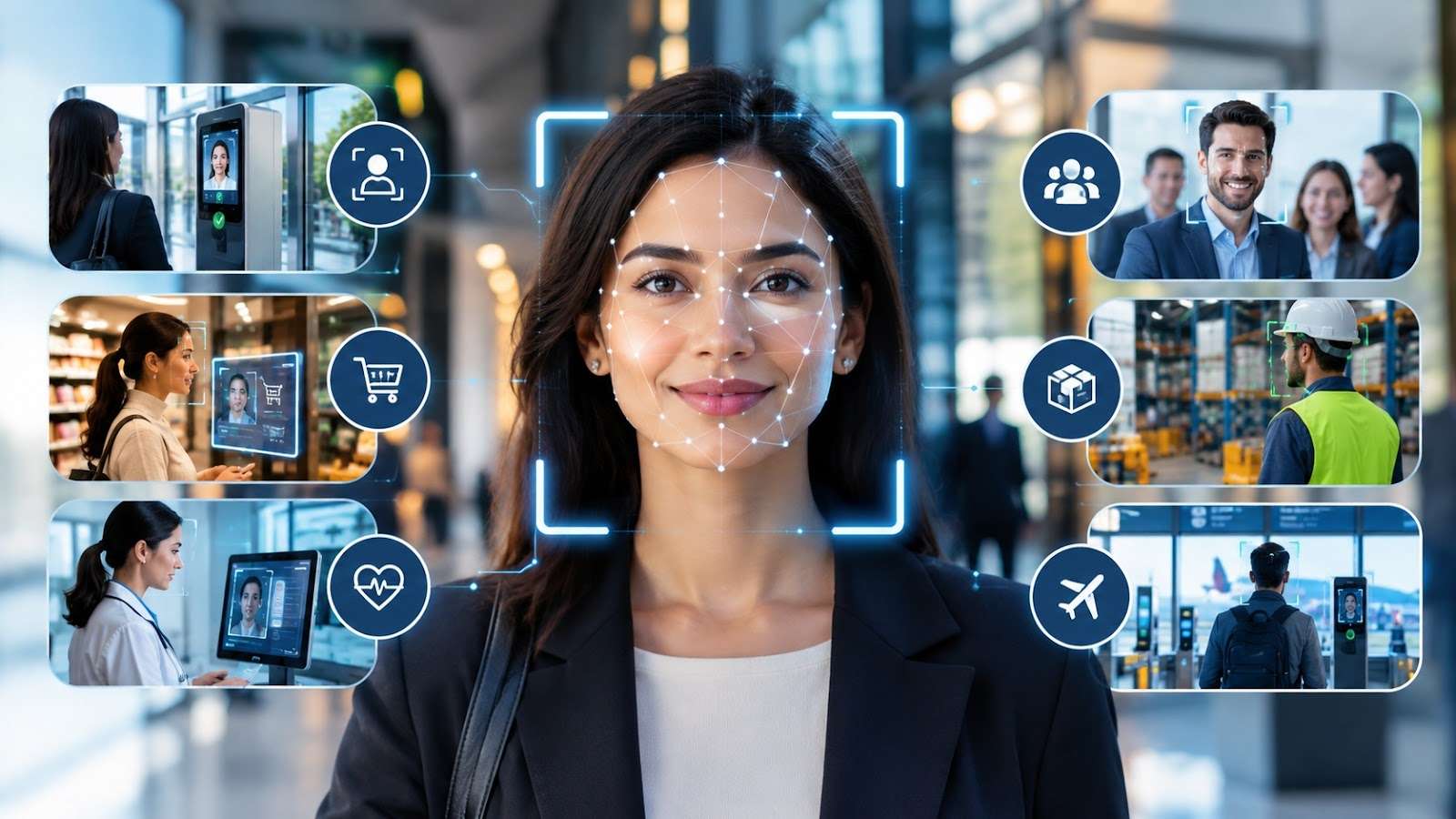
Facial recognition is often discussed as a security technology: controlling access, identifying suspicious activity, or confirming someone’s identity. For businesses, though, its usefulness can extend well beyond the security team. When deployed carefully, facial recognition can support customer onboarding, employee workflows, account recovery, payments, and other processes where knowing who is interacting with a system matters.
The challenge is deciding where facial recognition genuinely reduces friction and where it creates unnecessary privacy, accuracy, or governance risks.
Customer onboarding without repeated manual checks
One of the clearest business uses for facial recognition is remote customer onboarding.
A bank, insurer, marketplace, telecommunications provider, or other regulated business may need to establish that a new customer is both a real person and the person represented by an identity document. A typical workflow can compare a selfie or short video with the portrait on an accepted ID, often alongside document validation and liveness checks.
That changes the role of face recognition technology from simple identification to one component in a wider identity verification process. The goal isn’t necessarily to identify an unknown person from a large database. In many commercial applications, the narrower task is one-to-one verification: does the person presenting this credential match the enrolled identity?
That distinction matters. Businesses evaluating facial recognition should define the actual problem before choosing a system. A one-to-one comparison for account enrollment has different privacy, accuracy, and operational requirements from searching thousands of faces for a possible match.
The onboarding process also needs fallback paths. Poor lighting, damaged cameras, accessibility requirements, appearance changes, and technical failures can all make an automated check difficult. A customer shouldn’t become permanently locked out of a legitimate service simply because one biometric attempt fails.
Account recovery can become less dependent on passwords
Account recovery is an overlooked identity problem.
Companies may invest heavily in strong authentication while leaving the recovery process dependent on weaker mechanisms such as security questions, email access, or knowledge that an attacker could obtain elsewhere. If someone loses a phone or can’t access their usual authentication method, proving ownership becomes difficult.
Facial verification can provide another recovery signal when a trusted facial reference was established earlier. Instead of asking whether someone knows an old password, a service can ask whether the person attempting recovery appears to be the enrolled account holder.
This approach is already appearing in consumer identity systems. Cyber Security News recently reported on Google introducing selfie-video identity verification as an additional way for users to regain access to locked accounts, illustrating how biometrics can support recovery rather than simply initial login.
Even here, facial recognition shouldn’t become the only recovery mechanism. Deepfakes, compromised devices, presentation attacks, and false non-matches mean businesses need layered recovery policies. Device reputation, possession factors, previous account activity, and human review can provide additional context when the biometric result is uncertain.
Faster employee and contractor workflows
Workplace facial recognition is commonly associated with door access, but the same identity signal can support operational processes inside a business.
Consider an organization where employees repeatedly authenticate before accessing shared terminals, controlled equipment, restricted records, or internal applications. Facial verification can reduce reliance on manually entered credentials in situations where repeatedly typing a password is impractical.
A warehouse employee might authenticate at a shared workstation without carrying a dedicated token. A field technician could confirm identity before viewing customer records. A contractor could receive temporary authorization tied to an approved identity rather than a credential that can easily be handed to somebody else.
There are limits, particularly in employment settings. Businesses need to consider applicable biometric privacy, labor, and data protection requirements before deploying workplace systems. Consent may also be complicated when employees realistically cannot refuse a technology required by their employer.
For that reason, the business case should start with a specific operational problem. Deploying facial recognition merely because it seems more convenient than a badge can create considerably more governance work than it eliminates.
Payments and high-value transaction approval
Another potential use is transaction confirmation.
A business doesn’t necessarily need facial recognition for every purchase. In many cases, that would add unnecessary processing and privacy concerns. It may be more useful when the risk or value of an action increases.
For example, a financial service could request biometric reverification before changing account ownership details or authorizing a sensitive transaction. An online marketplace might introduce additional identity assurance when a seller changes payout information. A high-value rental service could verify that the person collecting an item matches the customer who completed the reservation.
This is where facial recognition works best as part of risk-based authentication rather than as a universal checkpoint. Routine actions can remain low-friction, while unusual or sensitive actions trigger stronger verification.
The approach also recognizes an important limitation: successful onboarding doesn’t guarantee that the same legitimate user is controlling the account months later. Identity assurance can sometimes need to continue throughout the customer relationship.
Personalization is possible, but it deserves caution
Facial recognition and related face-analysis technologies have also been explored for personalization, customer analytics, and automated experiences.
A hotel, for instance, could theoretically recognize an enrolled loyalty member at a kiosk and retrieve the correct reservation. A private membership facility might allow enrolled customers to check in without searching for an app or physical card. A device shared within a household or business could load the appropriate profile after verifying the authorized user.
These applications can be convenient because identity becomes part of the interaction instead of a separate login step.
However, businesses should distinguish voluntary recognition from passive identification.
A customer intentionally presenting their face to retrieve their account is very different from continuously scanning everybody who walks through a store. The second model introduces significantly broader questions about notice, consent, data retention, purpose limitation, and whether people can reasonably avoid being processed.
There is also an important technical distinction between recognizing an enrolled identity and attempting to infer attributes such as age, gender, emotion, or intent from someone's face. These are different technologies with different reliability concerns. Businesses shouldn't assume that because a system can accurately match two images, every form of facial analysis is equally dependable.
Physical check-in can become more efficient
Airports helped popularize the idea of biometric passenger processing, but similar workflows can apply to smaller commercial environments.
Hotels, coworking spaces, conferences, clinics, gyms, and private facilities all deal with some version of the same problem: connect the person who arrives with an existing reservation, membership, appointment, or credential.
Facial recognition can shorten that process when participation is clearly defined. Instead of finding a booking reference, membership card, or QR code, an enrolled customer could confirm their identity at a kiosk and continue.
The benefit is less about replacing staff and more about removing repetitive identity checks. Staff can spend less time matching names to records, while customers can move through routine check-in steps faster.
The deployment still needs alternatives. Some customers won’t want biometric enrollment. Others may be unable to use facial recognition reliably. A well-designed system treats biometrics as one supported route, not as the only way to access a legitimate service.
Convenience depends on accuracy in real conditions
Business deployments often fail when teams evaluate facial recognition as a feature instead of a measurable system.
An algorithm can perform well under controlled testing and behave differently when cameras, lighting, pose, image compression, demographics, or capture conditions change. That is why evaluation should reflect the intended environment rather than relying solely on a vendor’s headline accuracy figure.
The National Institute of Standards and Technology (NIST) has repeatedly evaluated face recognition systems and documented substantial differences between algorithms, including demographic differentials in many systems tested. Its Face Recognition Technology Evaluation program provides useful context for organizations comparing performance claims.
For a business buyer, the practical questions are straightforward. What happens when the system is uncertain? How frequently does it reject legitimate users? How is a possible false match handled? Can performance be tested using conditions similar to those in the actual deployment?
A system that saves several seconds during successful transactions may still produce a poor customer experience if exceptions require lengthy manual intervention.
Biometric data changes the privacy equation
Facial recognition is different from many other convenience technologies because the underlying identifier is difficult to replace.
If a password is exposed, the user can create another one. A person cannot issue themselves a new face.
Businesses therefore need to think carefully about what they actually store. Depending on the system architecture, that might include raw images, biometric templates, derived mathematical representations, or combinations of these records. Storage duration, encryption, access controls, deletion procedures, and third-party processing all matter.
Purpose limitation is equally important. If facial data was collected for account verification, using the same information later for unrelated analytics or marketing may create legal and trust problems.
Teams should also document retention rules before deployment rather than deciding what to delete years later. Keeping biometric information indefinitely simply because storage is available increases exposure without necessarily producing additional business value.
Treat facial recognition as an identity layer, not a feature
The strongest business use cases have one thing in common: facial recognition solves a defined identity problem.
It might help establish who is opening an account, confirm who is recovering one, reconnect an arriving customer with a reservation, or add assurance before a sensitive transaction. In each case, the technology supports an existing business process rather than becoming the process itself.
That approach also makes evaluation easier. You can measure whether facial recognition reduces abandoned onboarding attempts, speeds check-in, lowers recovery friction, or improves transaction assurance while monitoring false matches and exception rates.
The wrong starting point is asking where a business can put facial recognition. The better question is where identity verification currently creates friction, risk, or unnecessary manual work, and whether facial recognition is the appropriate way to address it.
About the Author
 Sanyukta Deb
— Sanyukta Deb is Digital Marketing Team Lead at Next Move Strategy Consulting, where she has led content strategy and technical SEO for the firm's B2B market research publications for over 2 years. Her editorial process translates NextMSC's primary and secondary research — spanning technology, industrial, and consumer sectors — into commercial narratives, backed by search-intent, keyword, and competitive analysis. She brings 5 years of overall experience in digital marketing and content strategy.
Sanyukta Deb
— Sanyukta Deb is Digital Marketing Team Lead at Next Move Strategy Consulting, where she has led content strategy and technical SEO for the firm's B2B market research publications for over 2 years. Her editorial process translates NextMSC's primary and secondary research — spanning technology, industrial, and consumer sectors — into commercial narratives, backed by search-intent, keyword, and competitive analysis. She brings 5 years of overall experience in digital marketing and content strategy.
About the Reviewer
 Debashree Dey
— Debashree Dey is Assistant Manager at Next Move Strategy Consulting, where she supports cross-vertical market content and communications across diverse industries for 6 years. Her professional background includes senior content writing, communications, and published manuscript authorship, with experience developing audience-focused business narratives and maintaining clear, consistent messaging. Her role supports research-led content development and editorial quality across NextMSC publications.
Debashree Dey
— Debashree Dey is Assistant Manager at Next Move Strategy Consulting, where she supports cross-vertical market content and communications across diverse industries for 6 years. Her professional background includes senior content writing, communications, and published manuscript authorship, with experience developing audience-focused business narratives and maintaining clear, consistent messaging. Her role supports research-led content development and editorial quality across NextMSC publications.















Add Comment