4 WordPress Website Development Agencies to Consider
Every mobile app, internal dashboard, and customer-facing platform a business ships is built on an application framework the reusable code, libraries, and tooling that spare development teams from rebuilding the same plumbing from scratch. The application frameworks market is no longer shaped only by conventional web and mobile development: cloud-native architecture and a fast-moving wave of AI-assisted, agentic development tooling are changing what organizations expect from a modern framework and its surrounding ecosystem.
This piece looks at what's actually driving that shift, using verifiable announcements from the vendors building this infrastructure rather than recycled market-report boilerplate.
What's Driving the Market Right Now
Two forces are reinforcing each other: cloud infrastructure providers are racing to make it easier for AI coding agents to build directly on their platforms, and enterprise cloud adoption keeps climbing to give that infrastructure somewhere to run.
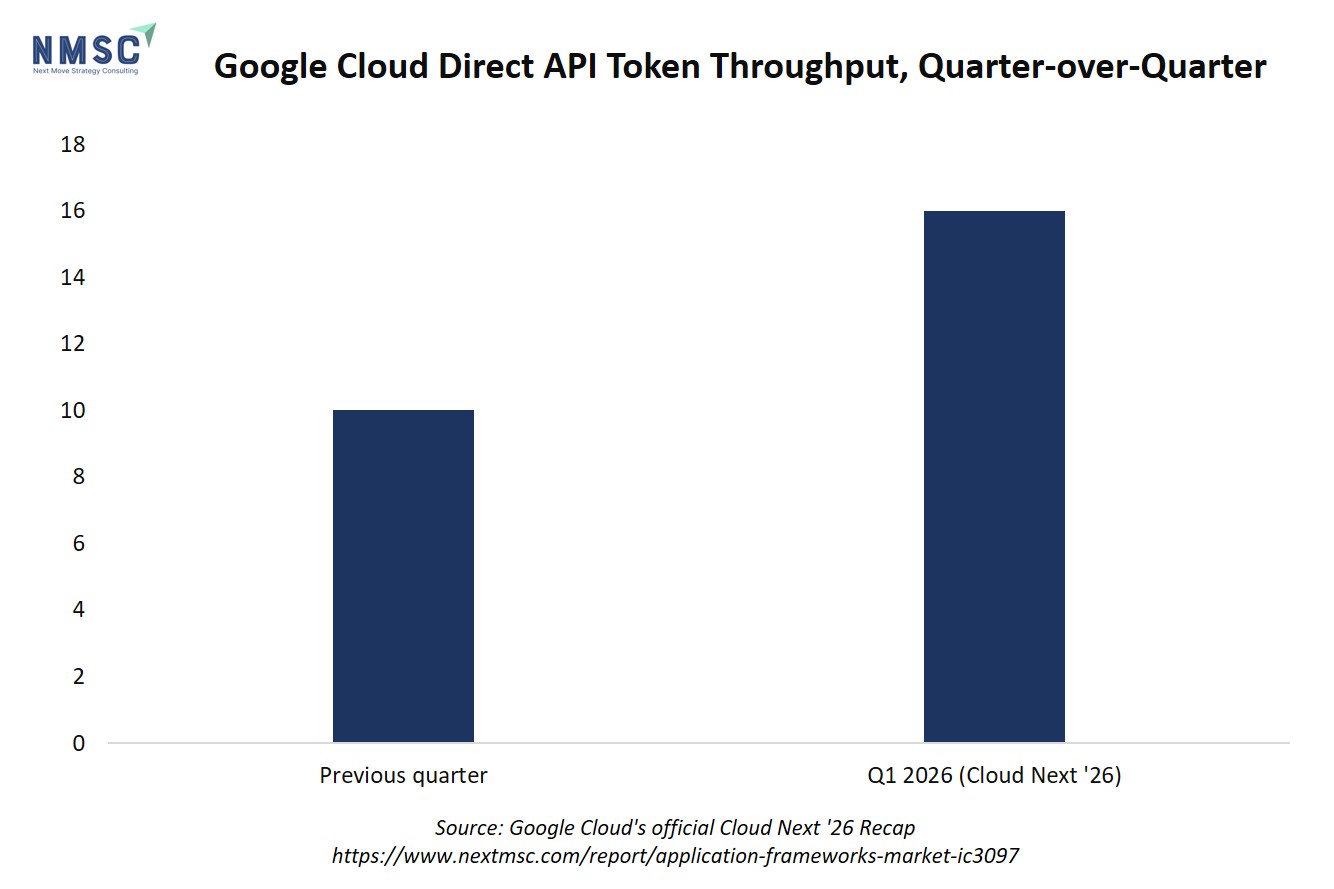
On the infrastructure side, Google reported at Cloud Next '26 (April 22, 2026) that nearly 75% of Google Cloud customers were using its AI products, with direct API token throughput reaching more than 16 billion tokens per minute up from 10 billion the prior quarter. AWS moved on a similar timeline: a March 25, 2026 Agent Plugin for AWS Serverless let coding assistants like Claude Code and Cursor build and troubleshoot serverless applications directly, followed a day later by an AWS Step Functions expansion adding 28 new service integrations and over 1,100 API actions, including direct orchestration of Amazon Bedrock AgentCore. On May 6, 2026, AWS followed with the Agent Toolkit for AWS, launching 40+ agent skills spanning infrastructure-as-code, storage, analytics, serverless, and containers.
Recent Cloud Platform Announcements Supporting AI-Assisted Development (March–June 2026)
|
Date |
Organization |
Development |
|
March 25, 2026 |
AWS |
Agent Plugin for AWS Serverless AI-assisted build/deploy/troubleshoot for Lambda, EventBridge, Step Functions, API Gateway |
|
March 26, 2026 |
AWS |
Step Functions adds 28 service integrations and 1,100+ API actions, including Amazon Bedrock AgentCore |
|
April 22, 2026 |
Google Cloud |
~75% of Cloud customers using AI products; direct API throughput at 16B tokens/minute, up from 10B the prior quarter |
|
May 6, 2026 |
AWS |
Agent Toolkit for AWS launches with 40+ agent skills across infrastructure, storage, analytics, serverless, and containers |
|
June 18, 2026 |
AWS |
Amazon Bedrock AgentCore harness reaches general availability, providing a managed orchestration layer for production agents |
This pattern extends beyond any single vendor. Separately, Eurostat reported that 52.7% of EU enterprises used paid cloud computing services in 2025, up from 45.3% in 2023 confirming that the infrastructure demand behind these announcements is broad-based, not concentrated in a handful of large accounts.
Section summary: Cloud providers are racing to make their platforms agent-buildable, and enterprise cloud adoption is climbing fast enough to give that infrastructure somewhere to run.
-
Google Cloud's direct API throughput grew 60% quarter-over-quarter (10B → 16B tokens/minute)
-
AWS shipped three major agent-development capabilities in a ten-week window (March–May 2026)
-
EU enterprise cloud adoption rose 7.4 percentage points between 2023 and 2025 (Eurostat)
Framework Ecosystems Are Evolving, Not Being Replaced
The current wave of AI-tooling investment doesn't point to established frameworks being displaced it points to them absorbing more capability around the edges. Microsoft's .NET 11 development cycle is a useful example: Preview 5 shipped June 9, 2026 alongside routine .NET 10/9/8 servicing updates, and Preview 6 followed July 14, 2026 with further runtime, ASP.NET Core, .NET MAUI, and Entity Framework Core improvements, ahead of a planned November 2026 general-availability release. That's an incremental, multi-preview cycle not a rewrite.
The practical implication for buyers: organizations don't necessarily need to switch frameworks to modernize. In many cases, staying current on an established platform's release cycle and integrating modern AI and cloud tooling around it is the lower-risk path.
Security and Governance Move Closer to the Framework Layer
As agent-assisted development becomes routine, security questions move earlier in the development process rather than staying a post-launch concern. AWS's Agent Toolkit, for instance, ships with IAM-based guardrails on which actions agents can perform and CloudWatch/CloudTrail observability built in security controls baked into the development layer itself rather than bolted on afterward. The same logic applies to the applications these frameworks produce: authentication design is what actually stops unauthorized access to the sensitive data most mobile and web applications handle, which makes a framework's built-in authentication and session-management support a practical evaluation criterion, not an afterthought.
Market Segments and Business Implications
NMSC's Application Frameworks Market coverage divides the market by deployment type, organization size, application, and end user a structure worth mapping to what actually changes for a buyer at each level.
Application Frameworks Market Segmentation and Business Implications
|
Market dimension |
Segments |
Business implication |
|
Deployment |
On-premises; Cloud-based |
Framework choice increasingly tracks portability and infrastructure strategy, not just language preference |
|
Organization size |
SMBs; Large enterprises |
Smaller organizations weigh simplicity and cost; enterprises weigh governance and lifecycle support |
|
Application |
Web; Mobile; Desktop |
Framework fit should follow the target user experience, not general popularity |
|
End user |
Retail/e-commerce; Healthcare; BFSI; IT & Telecom; Others |
Industry requirements shape security, compliance, and integration priorities differently |
Section summary: Market structure here is multidimensional a technically strong framework can still be the wrong fit for a given deployment model or industry's compliance requirements.
-
Cloud-based deployment raises the importance of platform and API integration
-
Enterprise buyers need governance and lifecycle support, not just development speed
-
Industry vertical materially changes which security and compliance features matter most
Industry Impact
The effect of these shifts reaches beyond engineering teams. In retail and e-commerce, frameworks need to support fast feature releases and third-party integrations. In BFSI and healthcare, auditability and controlled change management carry more weight than raw development speed. In IT and telecommunications, frameworks increasingly need to support distributed workloads and high operational availability. Across all of these, the same infrastructure-layer investment described above agent tooling embedded directly into cloud platforms means a framework decision now has downstream effects on how much custom integration work a team has to do later, not just how fast the first version ships.
Section summary: Framework decisions ripple into how much integration and compliance work an organization carries for the life of the application, not just how quickly it launches.
-
Retail/e-commerce prioritizes release speed and third-party integration support
-
BFSI and healthcare prioritize auditability and controlled change management
-
Agent tooling now embedded at the cloud-platform layer changes the total integration burden, not just the initial build
What to Weigh When Evaluating a Framework
-
Cloud-readiness - built for containerized/serverless environments, or retrofitted for them
-
Ecosystem maturity - release cadence, community size, and long-term maintenance track record.
For organizations building or maintaining web applications, the availability of experienced development partners can also influence technology decisions. Professional WordPress development services can help businesses implement, customize, maintain, and scale WordPress-based applications according to their specific functional requirements.
-
AI-tooling compatibility - how well-documented and conventionally structured the codebase is, given how much day-to-day development now runs through AI coding agents
-
Security posture - authentication support, patch cadence, and built-in guardrails against common risks
-
Total cost of ownership - licensing, hosting, and maintenance effort over the application's lifecycle, not just initial build cost
Market Outlook
NMSC's Application Frameworks Market report covers the 2025–2030 forecast period and segments the market by deployment type, organization size, application, and end-user industry. At the time of this refresh, the live report page had not yet published finalized market-size, CAGR, or forecast figures so this article does not reproduce numbers that aren't yet available; readers who need the specific forecast should consult the full report directly once those figures are live.
For More Information: Download FREE Sample on Application Frameworks Market Report
Final Thoughts
The application frameworks market isn't being reshaped by any single technology it’s cloud providers racing to make their platforms agent-buildable, established frameworks absorbing that capability incrementally rather than being replaced, and security moving earlier into the development process. Organizations evaluating their framework strategy should weigh cloud-readiness and AI-tooling compatibility alongside the more familiar questions of ecosystem maturity and total cost of ownership.
Section summary: Growth in the application frameworks market is being driven jointly by agent-ready cloud infrastructure, incremental framework evolution, and earlier-stage security investment - not by any one factor in isolation.
-
Cloud platforms and AI coding agents are being built toward each other, not in parallel
-
Established frameworks are absorbing new capability through regular release cycles rather than being displaced
-
The full market-sizing and forecast data sits in NMSC's dedicated report, once published
About the Author
 Sanyukta Deb
— Sanyukta Deb is Digital Marketing Team Lead at Next Move Strategy Consulting, where she has led content strategy and technical SEO for the firm's B2B market research publications for over 2 years. Her editorial process translates NextMSC's primary and secondary research — spanning technology, industrial, and consumer sectors — into commercial narratives, backed by search-intent, keyword, and competitive analysis. She brings 5 years of overall experience in digital marketing and content strategy.
Sanyukta Deb
— Sanyukta Deb is Digital Marketing Team Lead at Next Move Strategy Consulting, where she has led content strategy and technical SEO for the firm's B2B market research publications for over 2 years. Her editorial process translates NextMSC's primary and secondary research — spanning technology, industrial, and consumer sectors — into commercial narratives, backed by search-intent, keyword, and competitive analysis. She brings 5 years of overall experience in digital marketing and content strategy.
About the Reviewer
 Debashree Dey
— Debashree Dey is Assistant Manager at Next Move Strategy Consulting, where she supports cross-vertical market content and communications across diverse industries for 6 years. Her professional background includes senior content writing, communications, and published manuscript authorship, with experience developing audience-focused business narratives and maintaining clear, consistent messaging. Her role supports research-led content development and editorial quality across NextMSC publications.
Debashree Dey
— Debashree Dey is Assistant Manager at Next Move Strategy Consulting, where she supports cross-vertical market content and communications across diverse industries for 6 years. Her professional background includes senior content writing, communications, and published manuscript authorship, with experience developing audience-focused business narratives and maintaining clear, consistent messaging. Her role supports research-led content development and editorial quality across NextMSC publications.

















Add Comment