Full Hybrid Electric Vehicle Market: Why Hybrids Win the EV Reset | NextMSC
Introduction
On October 19, 2026, the U.S. Energy Information Administration (EIA) published a Today in Energy analysis showing how sharply American buying patterns moved after federal purchase credits for battery electric vehicles expired on September 30, 2025. Battery electric vehicles fell to 6% of new light-duty sales in the third quarter of 2026 from 10% a year earlier, while hybrid electric vehicles, which were never eligible for those credits, reached 16%. The same pattern appears in company disclosures: on October 1, 2026, Toyota Motor North America reported that electrified vehicles accounted for 57.4% of its third-quarter U.S. sales. For automakers, suppliers and investors, the full hybrid electric vehicle market is no longer a transitional footnote to the battery electric story. It is where near-term volume, margin and policy risk are being decided.
According to Next Move Strategy Consulting's Full Hybrid Electric Vehicle Market report, the global full hybrid electric vehicle market was valued at USD 142.31 billion in 2022 and is projected to reach USD 308.71 billion by 2030, growing at a CAGR of 10.1% from 2023 to 2030. NextMSC primary research and analysis identifies government incentives, rising fuel prices and growing consumer awareness of running-cost savings as the principal demand drivers, and Asia-Pacific, led by China, as the region holding the largest share today.
For More Information: Download FREE Sample on Full Hybrid Electric Vehicle Market Report
The Credit Cliff and the Hybrid Rebound: How 2026 Reset the Full Hybrid Electric Vehicle Market
EIA's October 2026 Analysis: Battery Electric Retreats While Hybrids Hold
The EIA's October 19, 2026 analysis provides the cleanest public view of the reset. Two federal incentives, the New Clean Vehicle Credit and the Qualified Commercial Clean Vehicle Credit, expired on September 30, 2025, and hybrid vehicles were not eligible for either. Battery electric vehicles had reached a record 12% of U.S. light-duty sales in September 2025, immediately before expiry, and then declined to 6% in the third quarter of 2026. Over the first nine months of the year their share was 6%, against 8% in the same period of 2025. Plug-in hybrids fell from 1.8% to 0.7% of sales between the third quarters of 2025 and 2026. The decline was steepest in the luxury segment, where battery electric vehicles dropped from 31% of luxury sales in the third quarter of 2025 to 12% in the third quarter of 2026.
Electrification as a whole did not collapse. EIA reports that hybrid, battery electric and plug-in hybrid vehicles together made up 23% of new sales in the third quarter of 2026, compared with 24% a year earlier. Subtracting EIA's battery electric and plug-in hybrid shares from that combined figure implies that conventional hybrids rose from roughly 12% of sales to roughly 16% (NextMSC calculation from rounded EIA figures).
Toyota: Scale in Electrified Sales and Higher Half-Year Earnings
Toyota Motor North America's October 1, 2026 release showed U.S. third-quarter sales of 633,223 vehicles, up 0.6%, of which 363,367 were electrified, up 28.5% and equal to 57.4% of the total. September alone reached 117,215 electrified units, up 37.8%, or 58.2% of that month's sales. "Our third-quarter results reinforce a simple truth—customers want choices," said Andrew Gilleland, Senior Vice President, Automotive Operations Group, Toyota Motor North America, in the release.
The global picture is consistent. According to Just Auto's summary of Toyota Motor Corporation's October 29, 2026 sales results, Toyota and Lexus sold 3,503,419 hybrid electric vehicles worldwide in the first nine months of 2026, up 6.3%, while total Toyota and Lexus sales fell 3.4% to 7,515,873 units. Hybrids therefore represented 46.6% of Toyota and Lexus volume and 85.3% of its 4,108,211 electrified units (NextMSC calculation from reported figures). Battery electric sales rose 127% to 309,766 units, a fraction of the hybrid base. Toyota and Lexus sales in China fell 19% to 1,055,544 units over the same period.
Toyota Motor Corporation's November 5, 2026 results for April to September 2026 put net income attributable to the company at 2.236 trillion yen (USD 14.1 billion), up from 1.773 trillion yen, on revenue of 26.962 trillion yen, up 9.5%. The release does not break earnings down by powertrain, so the link to hybrids is one of scale rather than formal attribution.
Honda's May 2026 Pivot: Fifteen Hybrid Models by 2030
On May 14, 2026, Honda Motor Co., Ltd. announced plans for 15 new hybrid models across the Honda and Acura brands by 2030, with North America as the primary market, as reported by AutoConnectedCar on May 14, 2026. Engineering and manufacturing resources are shifting away from the company's earlier electric vehicle timeline toward hybrids. The next-generation two-motor system is claimed to improve fuel economy by more than 10% over current hybrids, with system cost targeted to fall by 30%, and a new hybrid platform begins rollout in 2027. Hybrid production is expanding at the Marysville and East Liberty plants in Ohio.
"We have made steady progress in the development of hybrid vehicle technologies, where Honda has strengths," said Toshihiro Mibe, Chief Executive Officer of Honda Motor Co., Ltd., in the May 14, 2026 announcement. Honda's electrified lineup accounted for nearly one-third of its total U.S. sales in 2025.
Hyundai Motor Company and Kia: Hybrid Volumes Outgrow Total Sales
Hyundai Motor Company's October 29, 2026 release reported global retail sales of 2,879,590 units for the first nine months of 2026, down 5.1%,. Hybrid sales moved in the opposite direction: 524,437 units globally, up 19%, and 229,187 units in North America, up 56%, with U.S. hybrid sales up 35% in the third quarter. In May 2026, Hyundai Motor America reported hybrid sales up 90% year over year and Kia America reported hybrid volume up 179%, according to CBT News on June 2, 2026. "Our hybrid portfolio is seeing strong traction, while EV demand continues to improve," said Randy Parker, President and Chief Executive Officer of Hyundai Motor North America, in that release.
NMSC Strategic Perspective: Why Eligibility and Cost Now Decide Powertrain Mix
NextMSC primary research and analysis reads these developments as a change in the basis of competition rather than a temporary swing in sentiment. Three variables now explain most of the movement in powertrain mix: eligibility for purchase incentives, powertrain cost, and independence from charging infrastructure. Full hybrids score well on two of the three, because they were never subject to the credit cliff and they refuel at existing stations. Cost is where manufacturers now compete, as Honda's 30% system cost target shows. The measurable result is visible in EIA's figures: a combined electrified share that moved only from 24% to 23%, with its composition shifting toward hybrids.
NextMSC's research also identifies a restraint that the 2026 data confirm. The report names rising demand for battery electric and fuel cell electric vehicles as the main brake on full hybrid growth, and ACEA's European data show battery electric registrations growing 48.5% in the first nine months of 2026 against 10.7% for hybrid-electric vehicles. A hybrid strategy built on the U.S. reset will therefore not transfer automatically to Europe.
Section Summary:
Four sets of 2026 disclosures show hybrids holding share and gaining volume where battery electric purchase incentives have been removed.
-
EIA reports battery electric vehicles at 6% of U.S. light-duty sales in the third quarter of 2026, down from 10%, while hybrid electric vehicles reached 16%.
-
Toyota and Lexus hybrid sales rose 6.3% worldwide in nine months while total sales fell 3.4%.
-
Hyundai Motor Company's global hybrid sales rose 19% in nine months as total retail sales fell 5.1%.
Industry Impact Analysis
Europe: Hybrid-Electric Models Hold 36.3% of Registrations as Battery Electric Surges
The European Automobile Manufacturers' Association (ACEA) reported on October 22, 2026 that EU new car registrations rose 5.7% to 8,517,059 units in the first nine months of 2026. Hybrid-electric vehicles, a category that ACEA defines to include both full and mild hybrids, recorded 3,090,530 registrations, up 10.7% from 2,792,227, and held a 36.3% share, the largest of any powertrain. Battery electric registrations rose 48.5% to 1,931,465 units for a 22.7% share, up from 16.1%. Petrol registrations fell 19.1% to 1,802,078 units and diesel fell 19.5% to 602,206 units.
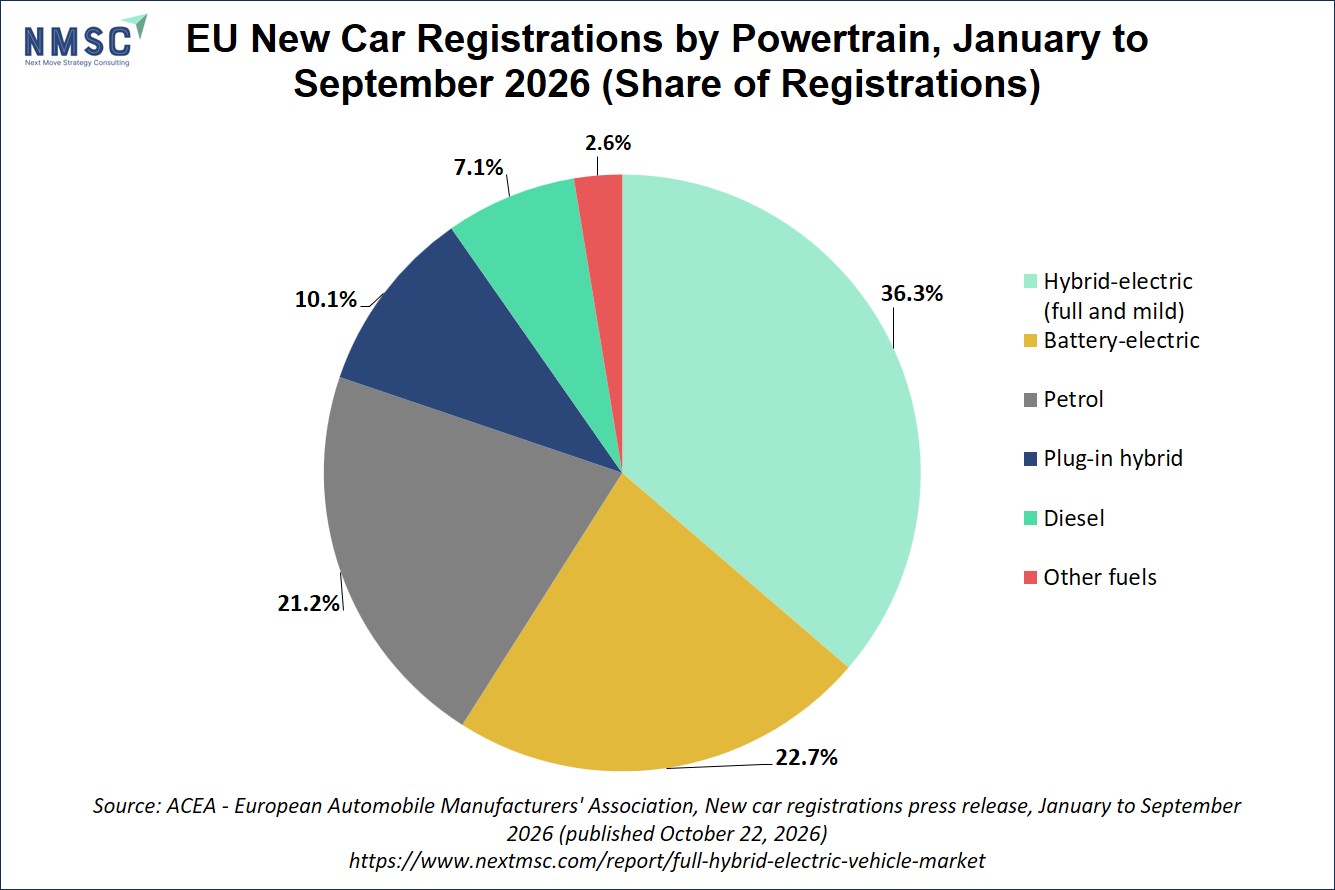
ACEA's September 2026 press release reports EU new car registrations by powertrain for January to September 2026: hybrid-electric (including full and mild hybrids) 36.3%, battery-electric 22.7%, petrol 21.2%, plug-in hybrid 10.1% and diesel 7.1%. The remaining 2.6% is the residual for other fuels, which ACEA groups as fuel-cell electric, natural gas, LPG, E85/ethanol and other fuels. ACEA marks the 2026 figures as provisional.
Because ACEA's hybrid-electric category combines full and mild hybrids, it is a directional indicator rather than a full hybrid figure. Petrol and diesel registrations together fell by 572,428 units, while hybrid-electric registrations rose by 298,303 units and battery electric registrations by 631,177 units, more than twice the hybrid-electric gain (NextMSC calculation from ACEA unit data).
Where European Hybrid Demand Concentrates: Five Markets Carry Most of the Volume
ACEA's country table shows that hybrid-electric demand is concentrated. Germany recorded 632,695 registrations (+4.9%), Italy 623,441 (+20.8%), France 534,854 (+0.6%), Spain 427,523 (+20.5%) and Poland 234,140 (+11.7%) in the first nine months of 2026. Together these five markets account for 2,452,653 of the EU total of 3,090,530, or 79.4% (NextMSC calculation from ACEA data).
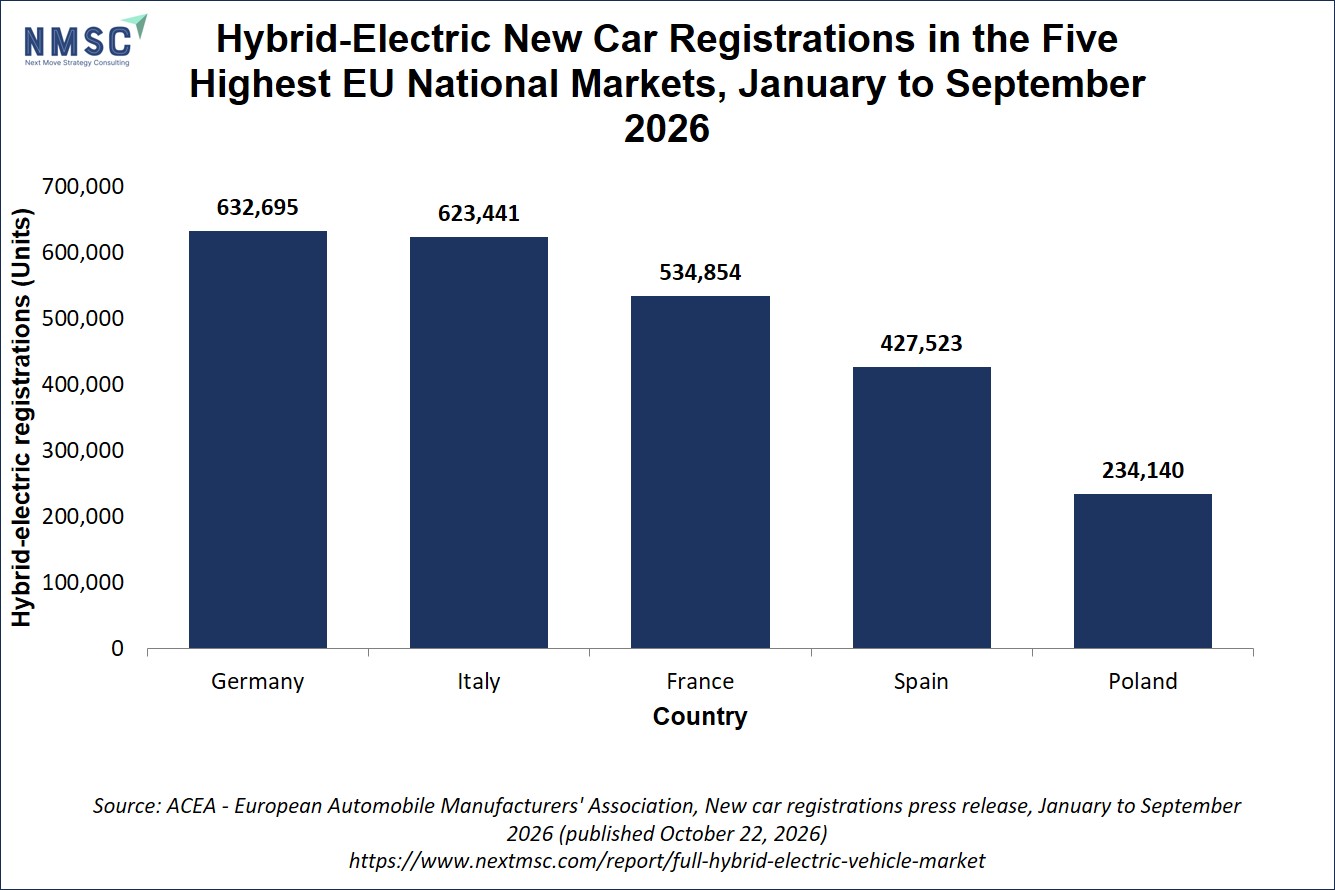
ACEA's country table for January to September 2026 lists hybrid-electric registrations of 632,695 in Germany, 623,441 in Italy, 534,854 in France, 427,523 in Spain and 234,140 in Poland. These are the five highest national totals in the table, against an EU total of 3,090,530. The category includes full and mild hybrids, and ACEA marks the 2026 figures as provisional.
Growth rates differ by more than 20 percentage points across these markets, so uniform regional targets would misallocate production and supplier commitments.
Regulation: The European Parliament Committee Vote on the 2035 Target
On November 4, 2026, a committee of the European Parliament voted to relax the 2035 emissions target for new cars from a 100% reduction to 87.5%, according to Euronews. The European Commission's December 2025 proposal had set the figure at 90%, so the Parliament position goes further. Manufacturers using climate-friendly steel would receive an additional 7.5% credit. The text still requires approval by the full Parliament and then negotiation with member states in the Council before it becomes law.
"We want climate neutrality, but with the rules we have now agreed on, we are also ensuring technology neutrality," said Peter Liese, climate spokesperson of the European People's Party (EPP) Group in the European Parliament, as quoted by Euronews on November 4, 2026. Euronews reports that the Commission approach would allow plug-in hybrids, and even petrol and diesel vehicles, to remain on sale after 2035. The reporting does not specify how the Parliament text treats full hybrids, so NextMSC treats the direction of travel as favourable to hybrid powertrains and the detail as unresolved.
India: Delhi Removes Strong Hybrid Benefits From Its EV Policy
India shows a different policy pressure. According to Business Today on June 30, 2026, Delhi's new electric vehicle policy gives no benefits to strong hybrid vehicles. An April 11, 2026 draft had proposed a 50% exemption from road tax and registration fees for strong hybrids priced below Rs 30 lakh until March 31, 2030. Delhi Transport Secretary Niharika Rai said the provision was dropped after stakeholder consultations.
Business Today notes that electric vehicles attract 5% GST while strong hybrids are taxed at 40%, the same as conventional vehicles. Based on VAHAN registration data, strong hybrid car sales rose 35% to about 112,000 units in FY2025-26, against an 84% rise in electric car sales to over 200,000 units. Strong hybrid sales therefore grew despite taxation at the conventional-vehicle rate.
Section Summary:
Regional evidence is divergent: hybrids gain from incentive removal in the United States, grow steadily in Europe, and face policy resistance in Delhi.
-
ACEA data show hybrid-electric registrations at 36.3% of EU registrations, with five markets holding 79.4% of volume.
-
The November 4, 2026 committee vote proposes an 87.5% target for 2035, subject to plenary and Council approval.
-
Delhi's June 2026 policy removed proposed strong hybrid benefits.
Pros and Cons of Recent Market Developments
|
Pros |
Cons |
|
Hybrids were ineligible for the credits that expired on September 30, 2025, and EIA shows hybrid electric vehicles at 16% of new U.S. sales in the third quarter of 2026. |
EU battery electric registrations rose 48.5% in nine months, more than four times the 10.7% growth of hybrid-electric registrations, according to ACEA. |
|
Honda Motor Co., Ltd. targets a 30% system cost reduction and more than 10% better fuel economy from its next-generation hybrid system. |
The European Parliament's 87.5% target still needs plenary and Council approval, so European planning assumptions remain provisional. |
|
Toyota Motor North America's electrified sales rose 28.5% in the third quarter of 2026, reaching 57.4% of its U.S. volume. |
Toyota and Lexus sales in China fell 19% in nine months, although NextMSC identifies Asia-Pacific as the largest regional base. |
|
Hyundai Motor Company's global hybrid sales rose 19% in nine months while total retail sales fell 5.1%. |
Delhi dropped the proposed 50% road tax exemption for strong hybrids, which remain taxed at 40% GST against 5% for electric vehicles. |
Key Data & Statistics
Key Industry Events and Quantified Impact, May to November 2026
|
Event |
Date |
Quantified Impact |
|
Honda announces hybrid programme |
May 14, 2026 |
15 new hybrid models by 2030; 30% system cost target |
|
Toyota Motor North America reports Q3 U.S. sales |
October 1, 2026 |
363,367 electrified units, +28.5%, 57.4% of sales |
|
EIA publishes post-credit analysis |
October 19, 2026 |
Battery electric 6% (10% a year earlier); hybrid electric 16% |
|
ACEA publishes EU registrations |
October 22, 2026 |
Hybrid-electric 3,090,530 units, +10.7%; 36.3% share |
|
Hyundai Motor Company reports Q3 results |
October 29, 2026 |
Global hybrid sales 524,437, +19% |
|
European Parliament committee vote |
November 4, 2026 |
2035 target eased from 100% to 87.5% |
Powertrain Reference Points Used in This Analysis
|
Indicator |
Value |
Basis |
|
U.S. plug-in hybrid share, Q3 2026 |
0.7% (1.8% in Q3 2025) |
U.S. Energy Information Administration |
|
Toyota and Lexus hybrid sales, nine months 2026 |
3,503,419 units, +6.3% |
Just Auto summary of Toyota Motor Corporation results |
|
EU battery electric registrations, nine months 2026 |
1,931,465 units, 22.7% share |
ACEA |
|
India strong hybrid car sales, FY2025-26 |
About 112,000 units, +35% |
Business Today citing VAHAN data |
|
Global full hybrid electric vehicle market |
USD 142.31 billion (2022) to USD 308.71 billion (2030) |
NextMSC primary research and analysis |
Future Outlook & Forecast
Full Hybrid Electric Vehicle Market Outlook: The Road to USD 308.71 Billion
According to NextMSC primary research and analysis, the global full hybrid electric vehicle market is projected to reach USD 308.71 billion by 2030 from USD 142.31 billion in 2022, a CAGR of 10.1% over 2023 to 2030. The 2026 evidence supports three of the forces behind that trajectory, and also marks the limits of each.
1. Eligibility-neutral demand. Hybrids were not subject to the U.S. credit expiry, and EIA's figures show their share rising to 16% as battery electric fell. The limit is policy design: Delhi's decision shows that incentive regimes can exclude hybrids.
2. Cost reduction and platform investment. Honda's 30% system cost target and the 56% growth in Hyundai Motor Company's North American hybrid sales indicate that manufacturers are committing capacity, not only marketing. The limit is execution: Honda's new platform begins rollout in 2027 and large-platform hybrids follow in 2029, so supply responds with a lag.
3. Regulatory flexibility. The proposed move to an 87.5% EU target would keep hybrid powertrains in more European line-ups for longer if adopted. The limit is that ACEA data show battery electric registrations adding 631,177 units in nine months against 298,303 for hybrid-electric, so flexibility does not by itself remove the competitive pressure.
Segments and Regions: Where NextMSC Analysis Points
NextMSC's report segments the market by component type, fuel type (gasoline-electric and diesel-electric), powertrain (series, parallel and power split hybrids) and vehicle type (passenger cars, commercial vehicles, two wheelers and others). Regionally, NextMSC research identifies Asia-Pacific as both the region with the largest current share and the fastest-growing region, with China as the largest contributor. NextMSC also identifies highly efficient regenerative braking systems, and AI-driven algorithms that predict driving conditions and optimise power distribution between engine and motor, as technology opportunities.
Section Summary:
NextMSC projects the global full hybrid electric vehicle market to reach USD 308.71 billion by 2030 at a 10.1% CAGR, with 2026 data supporting the demand case and defining its limits.
-
Eligibility-neutral demand supports U.S. hybrid share, but incentive design differs by jurisdiction.
-
Cost reduction programmes such as Honda's 30% target determine how much volume converts into margin.
-
Battery electric growth in Europe remains the principal competitive restraint, as ACEA's 2026 registration data show.
Next Steps for Stakeholders
For C-Level Executives and Product Leaders
-
Plan hybrid capacity by market, not by region. ACEA's data show five EU markets carrying 79.4% of hybrid-electric registrations, with growth ranging from +0.6% in France to +20.8% in Italy. Allocate platforms and supplier commitments on country-level evidence.
-
Treat the cost curve as the competitive variable. Honda Motor Co., Ltd.'s 30% system cost target sets a public benchmark. Compare your own bill of materials for battery, electric motor and power-control electronics against it, and test whether a comparable reduction is achievable before 2027 platform decisions.
-
Keep optionality on battery electric. Battery electric registrations in the EU grew 48.5% in nine months, and NextMSC identifies battery electric demand as the main restraint on full hybrid growth. Hybrid-heavy line-ups should retain a credible battery electric pathway so that a policy change in either direction does not strand capital.
For Institutional Investors
-
Separate policy-driven demand from structural demand. U.S. hybrid gains coincided with the expiry of a battery electric incentive and may partly reverse if incentives return. Growth in markets without such a shift, such as India under a 40% GST rate, is the cleaner test of structural demand.
-
Monitor four disclosures. These are the European Parliament plenary vote and Council negotiation on the 2035 target, EIA's next quarterly share data, Honda's 2027 platform rollout and Toyota's electrified mix in its next sales release.
Conclusion
The full hybrid electric vehicle market entered the final quarter of 2026 with unusually specific evidence behind it. EIA's October 19, 2026 analysis, Toyota Motor North America's 57.4% electrified share, Hyundai Motor Company's 19% growth in global hybrid sales and Honda Motor Co., Ltd.'s 15-model programme all point the same way, while ACEA's registration data show Europe electrifying faster.
According to NextMSC primary research and analysis, the market is projected to reach USD 308.71 billion by 2030 at a 10.1% CAGR. The 2026 evidence suggests that the strongest positions will belong to manufacturers that match hybrid investment to market-level policy and cost conditions.
About the Author
 Priyanshu Das
— Priyanshu Das is SEO Executive at Next Move Strategy Consulting, where he has led on-page and off-page SEO, keyword research, and SEO audits for the firm's B2B market research publications for 2 years. His audit process combines technical crawl analysis, backlink profile review, and competitor keyword gap mapping — using tools including Screaming Frog and Google Search Console — to prioritize fixes by organic search-visibility impact, informed by his own prior in-house and agency SEO experience.
About the Reviewer
 Debashree Dey
— Debashree Dey is Assistant Manager at Next Move Strategy Consulting, where she supports cross-vertical market content and communications across diverse industries for 6 years. Her professional background includes senior content writing, communications, and published manuscript authorship, with experience developing audience-focused business narratives and maintaining clear, consistent messaging. Her role supports research-led content development and editorial quality across NextMSC publications.















Add Comment