Gelatin Market: Why Collagen Margins Are Redrawing Supply Maps | NextMSC

Introduction
On October 28, 2026, Darling Ingredients Inc. reported that third-quarter net sales in its Food Ingredients segment, which houses its gelatin and collagen business, rose 9.3% year on year to USD 415.8 million. One day later, its management told investors that Brazilian tariffs were complicating South American shipments of those same products. The two statements capture the position of the gelatin market in late 2026: demand for collagen-based ingredients is still expanding, while the cost, geography and ownership of gelatin capacity are being rewritten by tariffs, plant closures and consolidation.
According to Next Move Strategy Consulting's Gelatin Market report, the global gelatin market was valued at USD 5.03 billion in 2023 and is projected to reach USD 8.36 billion by 2030, growing at a CAGR of 7.6% from 2024 to 2030. NextMSC primary research and analysis segments the gelatin market by source, function, type, application and region, and identifies Europe as the region holding the largest share.
For More Information: Download FREE Sample on Gelatin Market Report
This article tests that forecast against the evidence of the past five months, drawing on filings and releases from Darling Ingredients, Tessenderlo Group and GELITA and on the final action of the Office of the U.S. Trade Representative on Brazil.
From Tariff Walls to Collagen Margins: What Five Months of Deals Reveal About the Gelatin Market
Darling Ingredients' Third Quarter: Collagen Growth Meets a 37.5% Brazil Tariff
Darling Ingredients Inc. detailed its third-quarter 2026 results in an earnings release dated October 28, 2026 and an earnings call on October 29, 2026. Total net sales reached USD 1.79 billion, and the Food Ingredients segment contributed USD 415.8 million against USD 380.6 million a year earlier, a 9.3% increase. The release also states that Darling processes about 15% of the world's animal agricultural by-products and produces about 30% of the world's collagen, a category the company defines to include both gelatin and hydrolyzed collagen. That scale makes the company's quarterly commentary a direct window into trade flows across the gelatin market.
The call, as transcribed by The Motley Fool on October 29, 2026, explained why sales growth did not translate into equally strong profit growth. Chief Financial Officer Robert Day said the product most in demand in the United States is water-soluble collagen made from beef hides, and that the United States has no tanneries, so the raw material for beef hide gelatin and collagen is sourced from countries such as Brazil. A long supply chain reacts to tariffs in a predictable order: buyers draw down inventories instead of placing new orders, suppliers hold stock or slow their sales, and the effect lasts for one or two quarters until shelf prices adjust and ordering resumes. Chief Executive Officer Randall C. Stuewe added that strong China collagen sales partly offset the Brazilian disruption.
The segment tables in the release show the squeeze. Food Ingredients Adjusted EBITDA rose only 3.0%, from USD 71.6 million to USD 73.8 million, and gross margin slipped from 27.5% of net sales to 26.5%, as calculated from the release's segment figures. Day tied the softer result to tariff-driven inventory drawdowns, yet he also said demand is intact: "Water soluble collagen demand continues to grow at near double-digit rates." The statement was made by Robert Day, Chief Financial Officer of Darling Ingredients, on the October 29, 2026 earnings call.
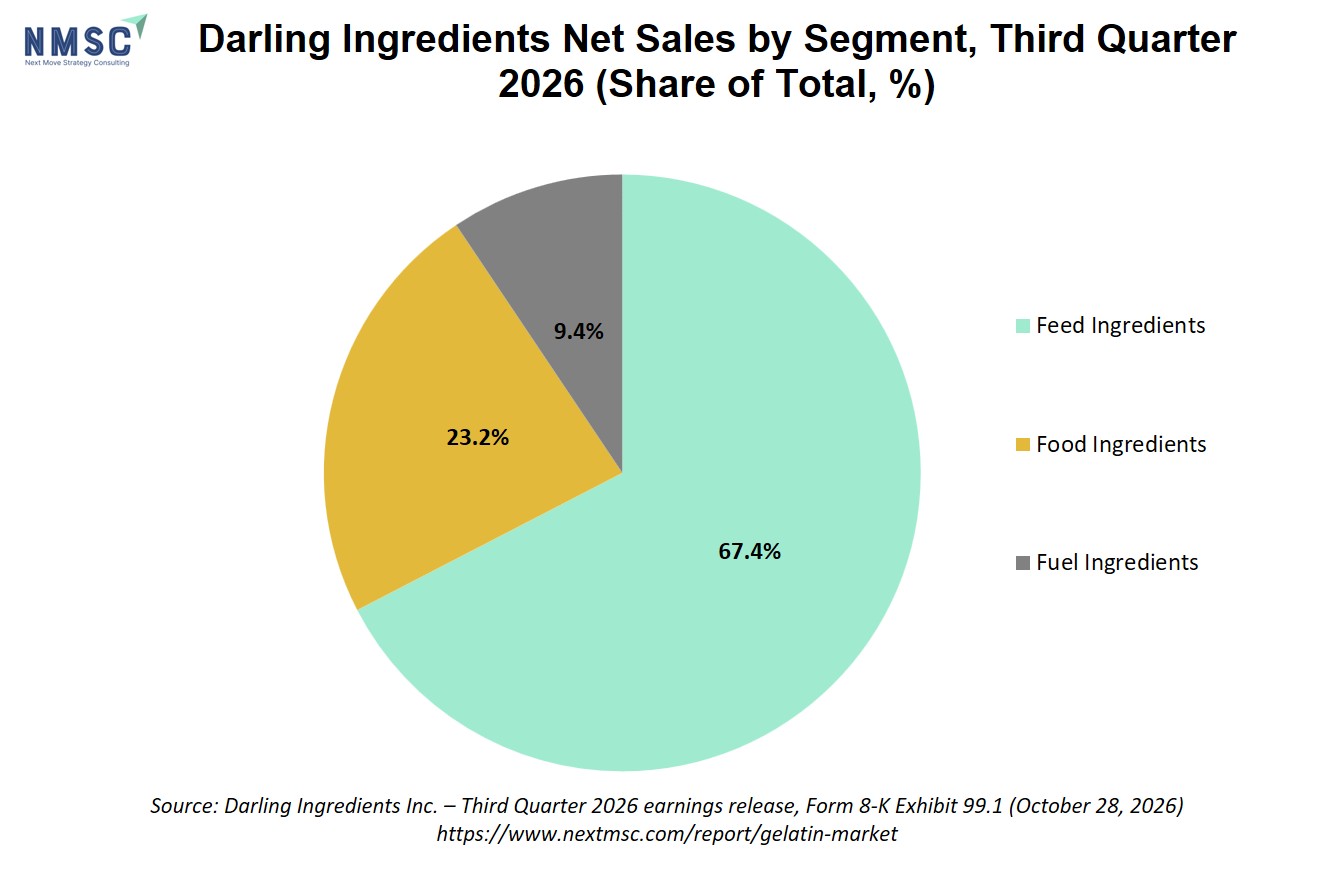
Darling Ingredients reported third-quarter 2026 net sales of USD 1,791.1 million, of which Feed Ingredients contributed USD 1,206.7 million, Food Ingredients USD 415.8 million and Fuel Ingredients USD 168.6 million. The Food Ingredients segment, which includes gelatin and collagen, therefore accounted for 23.2% of the total. The shares are calculated from the published segment net sales.
Darling's response is strategic rather than tactical. In the second-quarter call, summarized by MarketBeat on July 31, 2026, Day said collagen currently earns about 2.5 to 3 times the margin of gelatin, and that targeted health ingredients can earn 7 to 11 times that margin. The company approved a spray-drying project for collagen in Kaiping, China, and plans extraction and spray-drying capacity in Paraguay, and on the October call it highlighted the launch of NxCogni, a collagen designed to support cognitive resilience. Each step moves capacity toward products that carry richer margins than commodity gelatin and toward production sites outside Brazil.
Darling also confirmed that its joint venture with Tessenderlo Group, combining Darling's Rousselot collagen and gelatin business with PB Leiner, is in regulatory review with closing targeted for the first quarter of 2027. Tessenderlo Group's August 27, 2026 release states that Darling will hold 85% and Tessenderlo Group 15%.
Tessenderlo Group Exits European Bone Gelatin and Takes Full Control of a Brazilian Plant
Tessenderlo Group's June 15, 2026 press release reported that its PB Leiner unit completed the purchase of the remaining 40% of PB Brasil Industria e Comercio de Gelatinas Ltda, owner of a beef hide gelatin plant in Acorizal, Mato Grosso, Brazil, which gave the group 100% ownership. The half-year release puts the cost of that stake and a 2.08% stake in PB Leiner (Hainan) Biotechnology Co. Ltd. at EUR 31.2 million. The purchase deepened PB Leiner's position in Brazilian beef hide gelatin one month before the United States finalized its Brazil tariff action.
On July 2, 2026, Tessenderlo Group announced its intention to close the PB Leiner production site in Vilvoorde, Belgium, after concluding that no feasible option, including a search for an acquirer, could sustain the site on a viable and profitable basis. The August 27, 2026 release reports a formal agreement with employee representatives on August 21, restructuring costs of about EUR 31 million to be recognized in the second half of 2026, and completion of the restructuring expected in the first half of 2027.
The financial effect appears in the segment numbers. Revenue in the Bio-valorization segment, which contains PB Leiner and the rendering business Akiolis, fell 9.1% excluding currency effects to EUR 279.0 million in the first half of 2026, and the release attributes lower PB Leiner volumes to the reorganization of European bone gelatin and to a September 2025 incident at its Argentina collagen facility. Yet segment Adjusted EBITDA rose from EUR 4.7 million to EUR 12.2 million, because the end of European bone gelatin operations and cost savings more than offset continued margin pressure. Smaller capacity produced better earnings, a signal that the gelatin market is currently rewarding footprint discipline over volume.
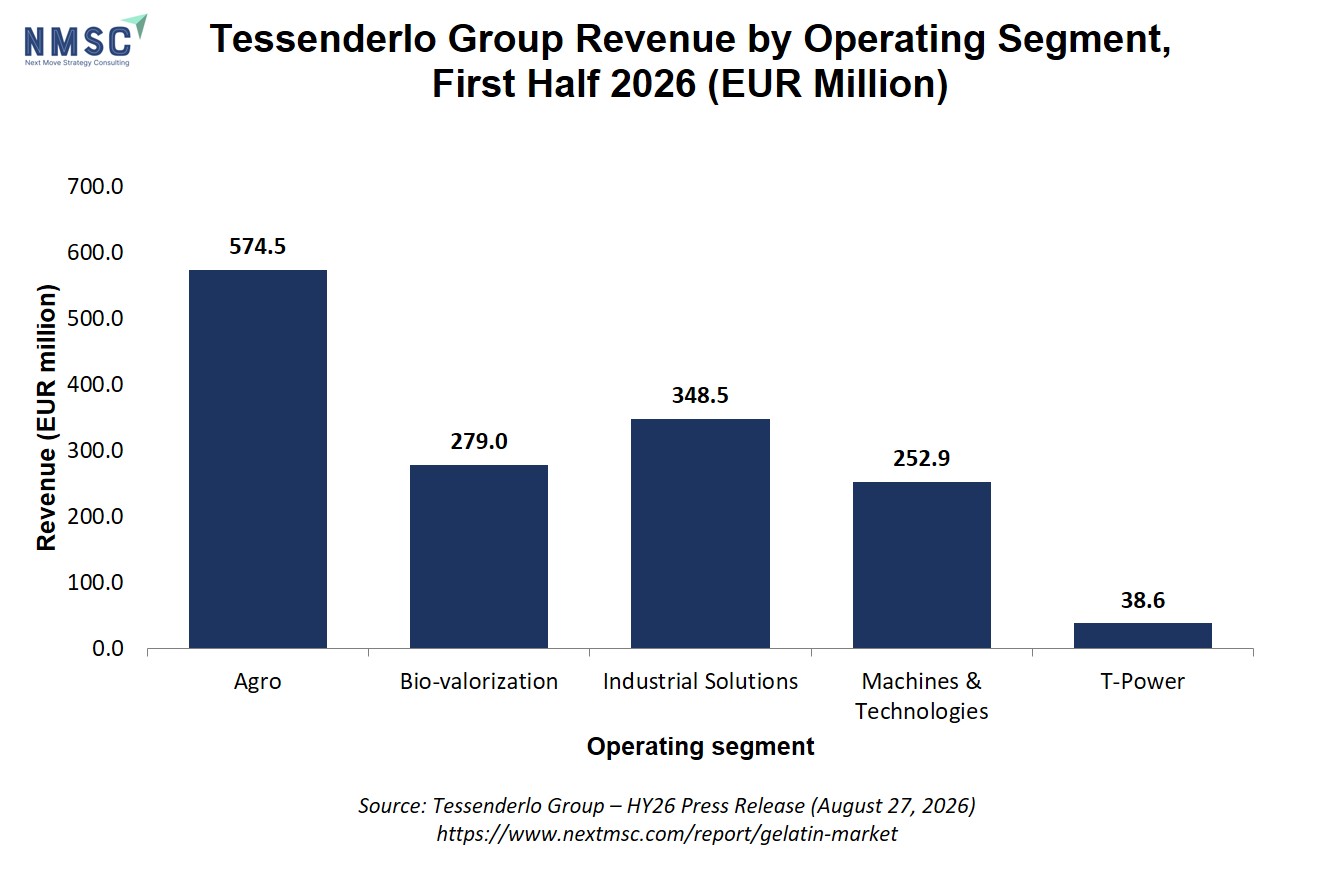
Tessenderlo Group reported first-half 2026 revenue of EUR 1,493.5 million. Agro led with EUR 574.5 million, followed by Industrial Solutions with EUR 348.5 million and Bio-valorization with EUR 279.0 million. Machines & Technologies reported EUR 252.9 million and T-Power EUR 38.6 million.
GELITA Pushes Gelatin Toward Biomedical Purity and Functional Formats
On June 12, 2026, GELITA announced that it would present at BIO International 2026 in San Diego a MEDELLAPRO gelatin grade with fewer than 10 endotoxin units per gram, positioned for surgical sealants, hemostatic agents, scaffolds and drug delivery systems. The company also featured VACCIPRO collagen peptides for vaccine stabilization and scheduled a June 23, 2026 lecture by Dr. Michelle Montgomery, Senior Manager R&D at GELITA, on non-animal recombinant collagen proteins, a reminder that the same producer is investing in a possible substitute for animal-derived gelatin.
At SupplySide Global 2026, Angie Rimel of GELITA described the company's new releases in a video interview published by Nutritional Outlook on November 9, 2026. They included a specialized gelatin for chewable soft gels and a bioactive collagen peptide, Curaderm, aimed at skin barrier health, and she presented collagen peptides as moving beyond beauty into healthy aging and sports nutrition. Nutritional Outlook framed the interview around collagen protein in the GLP-1 era.
NMSC Strategic Perspective: Value Is Moving from Commodity Gelatin to Collagen, Biomedical Grades and Secure Hides
NextMSC primary research and analysis reads these 2026 events as one structural shift rather than three separate company stories. European bone gelatin capacity, which Tessenderlo Group has been unwinding since its November 2024 announcement, is being closed. Capacity with access to hides, particularly in South America, is being acquired and consolidated into larger groups. Meanwhile the profit pool is moving toward collagen peptides, pharmaceutical and biomedical gelatin and application-specific grades, a movement that Darling's disclosed margin multiples quantify.
Three consequences follow for the gelatin market. First, supply security now carries a tariff dimension that did not exist in NextMSC's 2023 base year: a Brazilian beef hide gelatin plant serves non-U.S. customers freely but serves U.S. customers at a cost set in Washington. Second, regional shares will shift more slowly than capacity ownership. NextMSC primary research and analysis finds Europe holding the largest regional share, and the Vilvoorde closure changes who produces for Europe more than it changes who consumes in Europe. Third, high-purity gelatin is better placed to defend price, because an ultra-low-endotoxin grade such as MEDELLAPRO is qualified through regulated biomedical applications rather than negotiated as a commodity.
NextMSC primary research and analysis therefore retains its 7.6% CAGR view for the gelatin market while expecting uneven growth by segment. Pharmaceutical, nutraceutical and personal care applications, which NextMSC tracks as separate application segments, hold the strongest claim on incremental value, while commodity food gelatin remains exposed to raw material and trade cost volatility.
Section Summary:
Three producers and one trade action point the same way: value is moving to collagen and biomedical grades while European bone gelatin capacity contracts and Brazil-linked trade faces tariffs.
-
Darling Ingredients reported Food Ingredients net sales of USD 415.8 million in the third quarter of 2026, up 9.3%, while Brazilian tariffs slowed South American shipments.
-
Tessenderlo Group will close its Vilvoorde site and now owns 100% of its Brazilian beef hide gelatin plant; Bio-valorization Adjusted EBITDA rose to EUR 12.2 million.
-
GELITA introduced gelatin below 10 endotoxin units per gram and new collagen products for healthy aging and soft gels.
Industry Impact Analysis
Trade Policy: How a 25% Tariff Becomes a 37.5% Problem for Collagen Supply Chains
The final action of the Office of the U.S. Trade Representative under Section 301, issued on July 15, 2026, applies a 25% tariff to goods of Brazil, with exemptions listed in an annex and for articles covered by Section 232 tariffs. Global Trade Alert reported that the measure took effect on July 22, 2026. CNN reported on July 16, 2026 that a separate Section 301 forced-labor investigation was expected to add 12.5%, which would bring Brazil's tariff burden to 37.5%, the figure Stuewe cited on Darling's October 29 call. He said the burden affects fats as well as collagen.
For gelatin buyers the mechanism is cost layering rather than a single price increase. Because the raw material for beef hide gelatin and collagen is not available domestically, U.S. buyers cannot avoid the border by switching to local hides. The tariff is then compounded by inventory financing and the destocking cycle Day described, which is why one quarter of weaker orders can precede a repricing of finished goods. Darling's Food Ingredients sales still grew 9.3%, so the evidence points to demand being delayed and redirected, not destroyed.
Tariff policy also moves in the other direction. According to MarketBeat's July 31, 2026 summary, Darling's second-quarter results included about USD 18 million of net IEEPA tariff recoveries for the Rousselot business, which Stuewe excluded on the October call when comparing quarters. Tariff cost can be incurred and refunded within two quarters, which complicates multi-quarter contract pricing.
Raw-Material Geography: Hides Gain Strategic Weight as European Bone Capacity Exits
Tessenderlo Group's sequence of decisions shows where capacity is heading. It purchased full control of a Brazilian beef hide gelatin plant, announced the closure of a Belgian site, and described its European bone gelatin activities as still being unwound in the first half of 2026. The September 2025 incident at the Argentina collagen facility, which continued to depress PB Leiner volumes, illustrates the operational risk attached to single-site collagen production.
Darling's planned capacity in Kaiping, China, and Paraguay adds production sites outside Brazil. Together with the Tessenderlo joint venture, it points to a gelatin market in which scale and flexibility between origins matter more than any single plant's volume.
Product Mix: Collagen Peptides, Pharmaceutical Grades and the Margin Gap
The margin gap disclosed by Darling explains why producers are reallocating capital. If collagen earns 2.5 to 3 times the margin of gelatin and targeted ingredients earn 7 to 11 times, every ton of extraction capacity redirected from commodity gelatin raises the return on the same hide. MarketBeat's summary adds that higher whey prices led some companies to use collagen as a complementary protein ingredient. GELITA's ultra-low-endotoxin gelatin and vaccine-stabilizing collagen peptides push in the same direction from the pharmaceutical end of the range.
Section Summary:
Policy, raw material geography and product mix now shape gelatin economics more than volume growth alone.
-
The USTR's 25% Brazil tariff, which management says reaches 37.5% in combination with a second action, lengthens beef hide supply chains that serve U.S. demand.
-
European bone gelatin is exiting while hide-based capacity in Brazil, China and Paraguay is being acquired or built.
-
Collagen earns 2.5 to 3 times the margin of gelatin, and targeted ingredients 7 to 11 times, according to Darling's management.
Pros and Cons of Recent Market Developments
The 2026 developments carry benefits and costs that differ by participant. The table below compares them using figures disclosed by the companies and agencies named above.
|
Pros |
Cons |
|
Collagen earns 2.5 to 3 times the margin of gelatin, according to Darling's Chief Financial Officer (July 2026). |
The 25% USTR tariff on Brazilian goods lengthens supply chains and triggers buyer destocking. |
|
Darling's Food Ingredients net sales rose 9.3% to USD 415.8 million in the third quarter. |
Food Ingredients gross margin slipped from 27.5% to 26.5% of net sales. |
|
Tessenderlo Group's Bio-valorization Adjusted EBITDA rose to EUR 12.2 million after exiting European bone gelatin. |
Bio-valorization revenue fell 9.1% excluding currency effects; Vilvoorde closure costs are about EUR 31 million. |
|
GELITA's gelatin below 10 endotoxin units per gram opens stricter biomedical uses. |
The Darling and Tessenderlo joint venture still awaits regulatory approval. |
|
Full ownership of the Acorizal plant secures beef hide gelatin capacity for PB Leiner. |
The September 2025 Argentina collagen incident shows the exposure of single-site production. |
Key Data & Statistics
Two tables consolidate the verifiable figures behind this analysis: Darling's Food Ingredients results and Tessenderlo Group's Bio-valorization results.
Darling Ingredients Food Ingredients Segment, Third Quarter 2026 versus Third Quarter 2025 (USD million)
|
Metric |
Q3 2026 |
Q3 2025 |
Change |
|
Net sales |
415.8 |
380.6 |
+9.3% |
|
Segment Adjusted EBITDA |
73.8 |
71.6 |
+3.0% |
|
Gross margin |
110.3 |
104.8 |
+5.2% |
|
Gross margin as a share of net sales |
26.5% |
27.5% |
-1.0 pt |
Tessenderlo Group Bio-valorization Segment, First Half 2026 versus First Half 2025 (EUR million)
|
Metric |
HY26 |
HY25 |
Change as reported |
|
Revenue |
279.0 |
312.2 |
-10.6% |
|
Adjusted EBITDA |
12.2 |
4.7 |
+161.8% |
|
Adjusted EBITDA margin |
4.4% |
1.5% |
+2.9 pts |
|
Adjusted EBIT |
-5.6 |
-14.4 |
+61.1% |
Future Outlook & Forecast: What the Gelatin Market Must Resolve by 2027
NextMSC's forecast of USD 8.36 billion for the gelatin market by 2030 implies an increase of USD 3.33 billion over the 2023 base of USD 5.03 billion. The 2026 evidence suggests where that increase will be earned and which operating constraints must be resolved first.
Near-term milestones are dated. Darling targets closing of its Tessenderlo joint venture in the first quarter of 2027, subject to regulatory approvals, and Tessenderlo Group expects the Vilvoorde restructuring to be finalized in the first half of 2027 under the agreement reached with employee representatives on August 21, 2026.
Tariff outcomes are the main swing factor. NextMSC primary research and analysis considers two cases. If exemptions widen or buyers absorb the cost into shelf prices, as Day expects will happen when tariffs persist, demand resumes and Brazilian capacity regains its U.S. volumes. If the combined 37.5% burden persists without pass-through, more U.S.-bound volume is likely to move to producers in China, Paraguay and other origins, which is consistent with the capacity Darling is adding in Kaiping and Paraguay.
By application, the segmentation used in NextMSC's Gelatin Market report is the right lens: food and beverage, personal care, pharmaceutical, nutraceutical, photography and others will not grow evenly. Pharmaceutical applications carry the capsule and biomedical demand that GELITA is targeting, and nutraceutical applications carry the collagen peptide demand that Darling describes as growing near double-digit rates.
NextMSC primary research and analysis also lists plant-based alternatives as a growth factor and allergic reactions to animal-sourced gelatin as a restraint for the gelatin market. GELITA's recombinant collagen lecture shows an incumbent producer hedging that substitution risk rather than ignoring it.
Section Summary:
The path to NextMSC's USD 8.36 billion forecast runs through the closing of one joint venture, one plant closure and one unresolved tariff question.
-
Darling's joint venture with Tessenderlo Group is targeted to close in the first quarter of 2027, subject to regulatory approval.
-
Tessenderlo Group expects to finalize the Vilvoorde restructuring in the first half of 2027.
-
Application mix, not volume, will separate high-return gelatin suppliers from commodity suppliers.
Next Steps for Stakeholders
The evidence supports specific actions for each group of decision makers.
-
Procurement and supply chain leaders: map every gelatin and collagen supply line by hide origin and tariff treatment, and qualify a second source before inventory drawdown, the first buyer reaction Darling's Chief Financial Officer describes, leaves production lines short.
-
Product and R&D leaders: test gelling-agent alternatives for commodity applications, and reserve gelatin and collagen for formats where texture, qualification or protein content justify the cost.
-
Pharmaceutical and nutraceutical buyers: request endotoxin, traceability and continuity documentation, since GELITA's purity benchmark shows qualified grades becoming a separate tier.
-
Producers: weigh closing or converting bone-based capacity against the Tessenderlo precedent, where Bio-valorization Adjusted EBITDA rose from EUR 4.7 million to EUR 12.2 million as the segment shrank.
-
Investors: track the joint venture's regulatory timetable, the Food Ingredients gross margin ratio and the stacking of U.S. tariffs on Brazilian goods.
Conclusion
The gelatin market entered the final quarter of 2026 growing in demand and shrinking in capacity. Darling Ingredients reported a 9.3% rise in Food Ingredients net sales while its Chief Financial Officer described near double-digit growth for water-soluble collagen. Tessenderlo Group raised segment earnings by closing European bone gelatin capacity, and GELITA pursued biomedical grades. Against that evidence, NextMSC's projection that the gelatin market will grow from USD 5.03 billion in 2023 to USD 8.36 billion by 2030 at a CAGR of 7.6% is credible, provided that suppliers manage tariffs, hide access and product mix as carefully as they manage volume.
About the Author
 Priyanshu Das
— Priyanshu Das is SEO Executive at Next Move Strategy Consulting, where he has led on-page and off-page SEO, keyword research, and SEO audits for the firm's B2B market research publications for 2 years. His audit process combines technical crawl analysis, backlink profile review, and competitor keyword gap mapping — using tools including Screaming Frog and Google Search Console — to prioritize fixes by organic search-visibility impact, informed by his own prior in-house and agency SEO experience.
About the Reviewer
 Sanyukta Deb
— Sanyukta Deb is Digital Marketing Team Lead at Next Move Strategy Consulting, where she has led content strategy and technical SEO for the firm's B2B market research publications for over 2 years. Her editorial process translates NextMSC's primary and secondary research — spanning technology, industrial, and consumer sectors — into commercial narratives, backed by search-intent, keyword, and competitive analysis. She brings 5 years of overall experience in digital marketing and content strategy.
















Add Comment