How Five Leaders Are Reshaping Prefabricated Data Centers
The Shift From Site-Built to Factory-Integrated Capacity
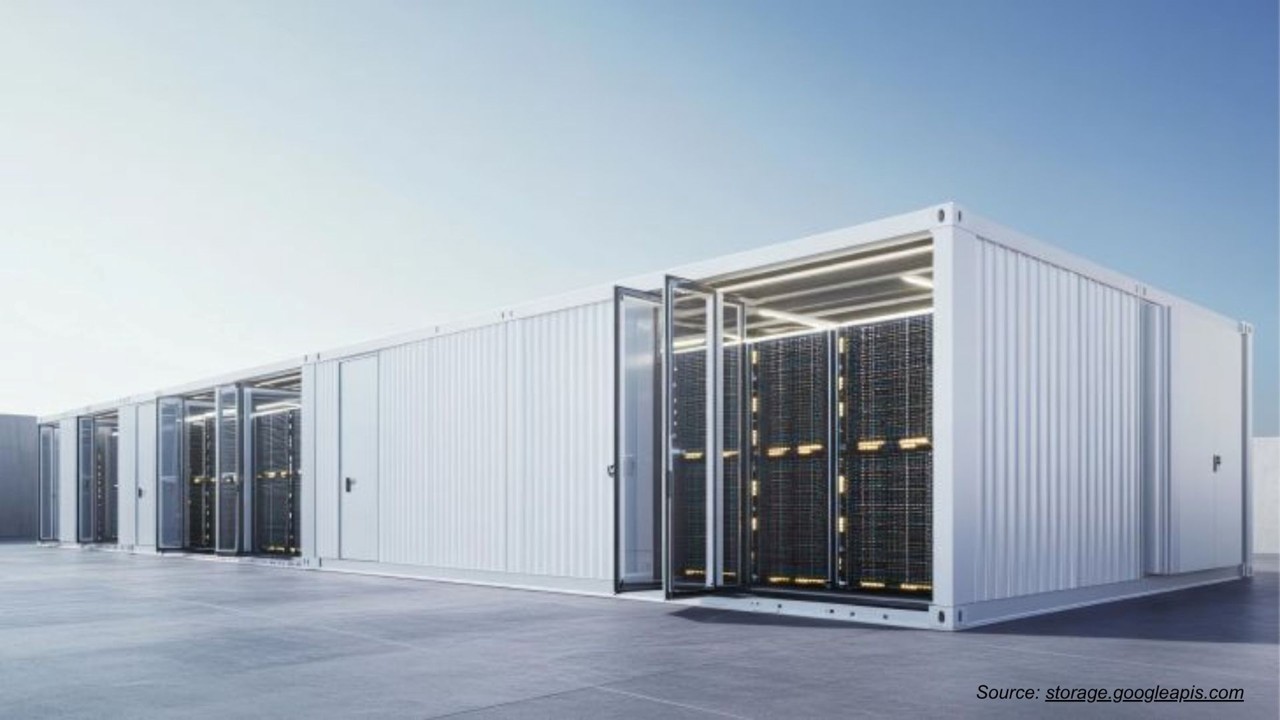
The global Prefabricated Data Center Market was valued at USD 17.80 billion in 2025 and is projected to reach USD 52.45 billion by 2035, expanding at a CAGR of 10.34% from 2026 to 2035. Our analysis indicates that this growth reflects a structural change in infrastructure delivery: operators increasingly need factory-engineered power, cooling, and IT modules that can be installed and commissioned faster than conventional site-built facilities. Schneider Electric, Vertiv, Huawei, Rittal, and Silent-Aire illustrate five approaches to this transition, spanning standardized power blocks, integrated systems, digital engineering, modular electrical distribution, and advanced thermal management.
We observed that artificial intelligence (AI) and high-performance computing are changing module specifications as rack densities rise and conventional air-cooling configurations face increasing thermal demands. Hyperscale cloud providers, colocation operators, enterprises, and telecom companies are prioritizing scalable infrastructure with predictable delivery schedules. Factory testing and standardized designs can reduce on-site integration complexity, although grid interconnection delays and shortages of transformers and switchgear remain constraints. In Europe, energy reporting requirements and the European Commission's proposed data-center rating scheme are also increasing attention to measurable performance and efficiency.
Want Insights on the Prefabricated Data Center market? Access a FREE Sample Instantly.
Key takeaway: The competitive advantage is shifting from selling individual enclosures, power systems, or cooling units toward delivering validated, repeatable infrastructure blocks. As AI campuses raise power density, suppliers integrating electrical distribution, liquid cooling, factory testing, and local service can reduce execution risk, although module availability alone cannot resolve electricity-grid constraints.
The report's product segmentation illustrates the opportunity across infrastructure layers.
Prefabricated Data Center Market by Product Type, 2025–2035 (USD Billion)
|
Segment |
2025 (USD Bn) |
2035 (USD Bn) |
CAGR% (2026–2035) |
|
IT Modules |
6.58 |
19.77 |
10.54% |
|
Power Modules |
5.08 |
13.97 |
9.58% |
|
Cooling Modules |
3.65 |
12.45 |
11.94% |
|
Other Modules |
2.49 |
6.27 |
8.62% |
|
Total |
17.8 |
52.45 |
10.34% |
Note: The 2035 segment figures sum to USD 52.46 billion when added at their displayed precision, versus the report's stated global total of USD 52.45 billion. Figures are reproduced without adjustment.
IT Modules maintain the largest revenue contribution, while Cooling Modules record the fastest growth among the four product categories. This divergence suggests that suppliers need to protect their core infrastructure businesses while investing in thermal technologies suited to high-density computing. The following company developments show how manufacturers are responding to that requirement.
Schneider Electric SE
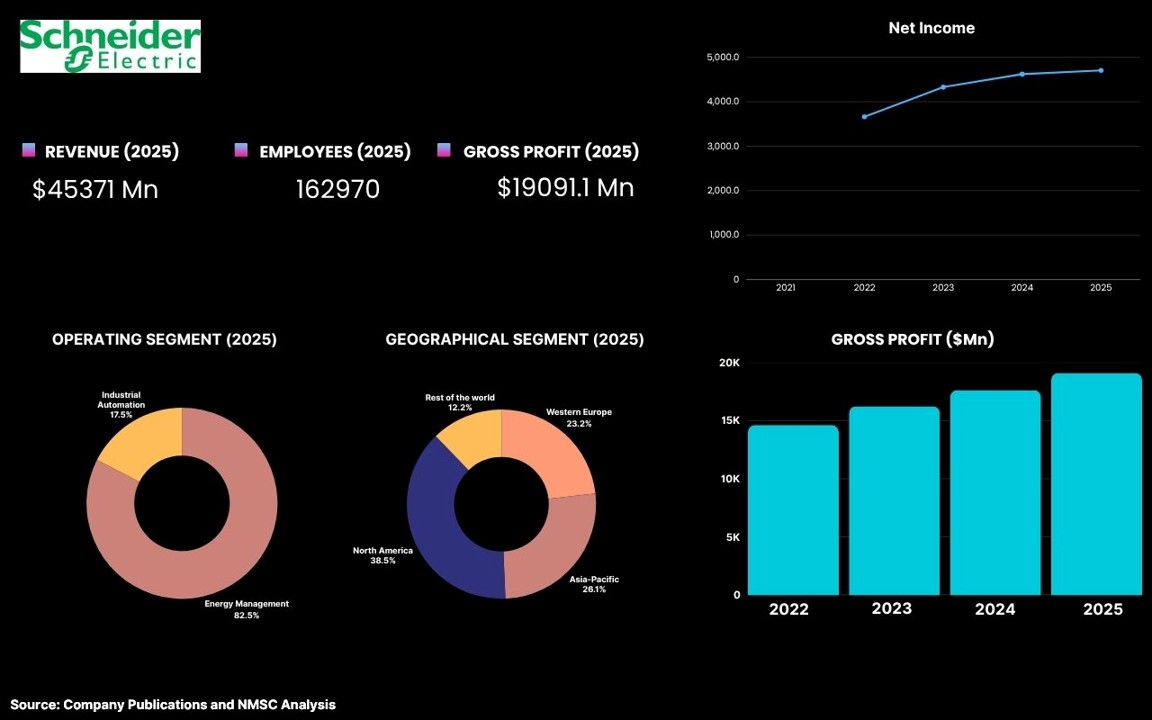
Schneider Electric SE, headquartered in Rueil-Malmaison, France, operates across energy management, electrical distribution, automation, and critical digital infrastructure. Its data-center portfolio includes power protection, switchgear, cooling-related controls, and modular infrastructure. The Prefabricated Data Center Market influences the company's strategy by creating demand for integrated power systems that can be engineered and validated before deployment. Schneider Electric's combination of electrical equipment and digital energy management positions it to serve hyperscale operators and colocation providers seeking scalable capacity with more predictable installation schedules.
On 16 September 2026, Schneider Electric introduced prefabricated power modules and power skids in 2 MW, 2.25 MW, and 2.5 MW configurations. The solutions incorporate its Galaxy VXL uninterruptible power supply technology and reference designs developed with NVIDIA for high-density AI infrastructure. The company stated that deployments could be achieved in as little as six months and that the equipment was manufactured and tested at its expanded Barcelona facility. This development strengthens Schneider Electric's position in standardized, high-capacity infrastructure, with subsequent geographic availability planned beyond Europe.
Based on our evaluation, Schneider Electric's principal advantage lies in integrating electrical infrastructure with digital controls and standardized engineering. The expansion of its prefabricated power portfolio aligns directly with the shift toward repeatable megawatt-scale deployments, particularly for AI-focused campuses. Its ability to extend production capacity and adapt reference designs across regions should support its competitive position. However, successful execution will also depend on component availability, local installation requirements, and the timing of customer grid connections.
Vertiv Holdings Co.
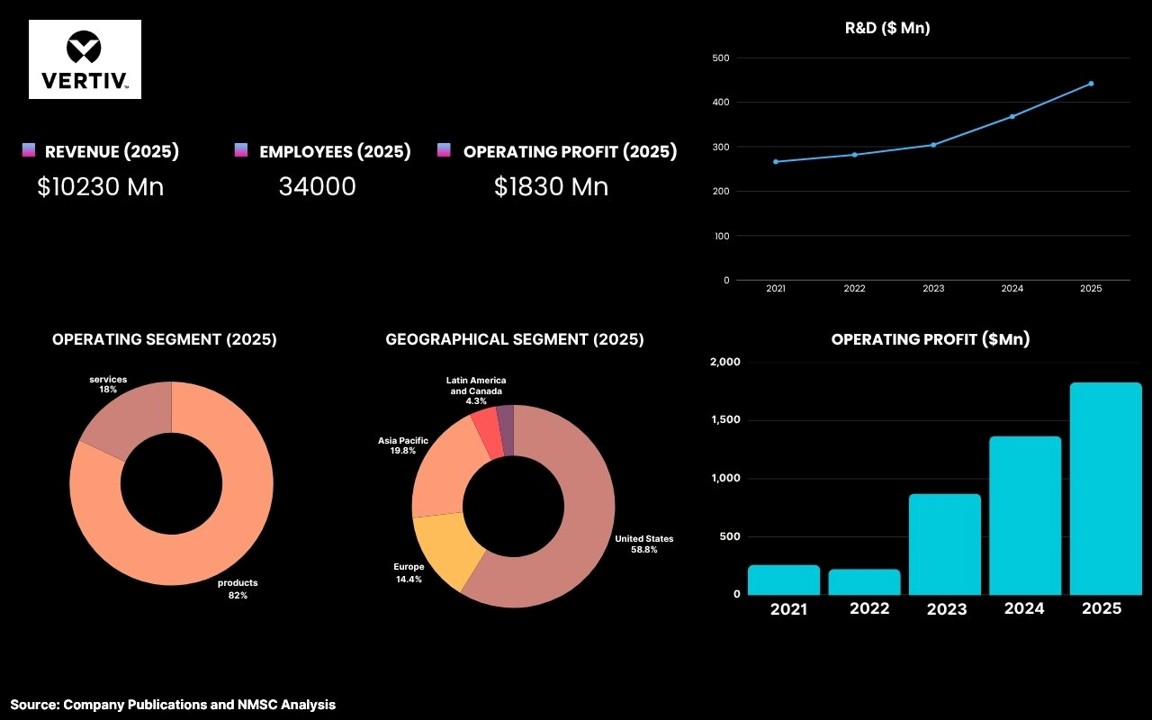
Vertiv Holdings Co., headquartered in Westerville, Ohio, United States, specializes in critical digital infrastructure, including power management, thermal management, racks, monitoring systems, and lifecycle services. Its business is closely connected to the Prefabricated Data Center Market because operators increasingly seek coordinated power and cooling infrastructure rather than separately procured equipment. Vertiv's position across these technical layers supports integrated designs for cloud, colocation, enterprise, and high-performance computing facilities, where deployment schedules and operational reliability carry significant weight.
On 5 August 2025, Vertiv announced the global availability of Vertiv OneCore, a factory-assembled solution integrating power, thermal, and IT infrastructure for high-density data centers of 5 MW and above. The platform uses a coordinated delivery approach spanning design, installation, and readiness for operation, reducing the amount of integration work required at the site. Its applicability across enterprise, colocation, sovereign, and neocloud environments broadens the addressable customer base beyond traditional hyperscale projects. The launch reinforces Vertiv's strategy of competing through integrated infrastructure and simplified project execution.
Our assessment indicates that Vertiv's strongest differentiation is the breadth of its power, cooling, and service capabilities within a single infrastructure offering. OneCore allows the company to compete on deployment coordination rather than on individual equipment specifications alone. This positioning is relevant as customers add capacity in stages and seek infrastructure aligned with AI hardware requirements. Continued competitiveness will depend on manufacturing throughput, standardized configurations, and its ability to support increasingly demanding thermal loads across different deployment environments.
Dell Technologies
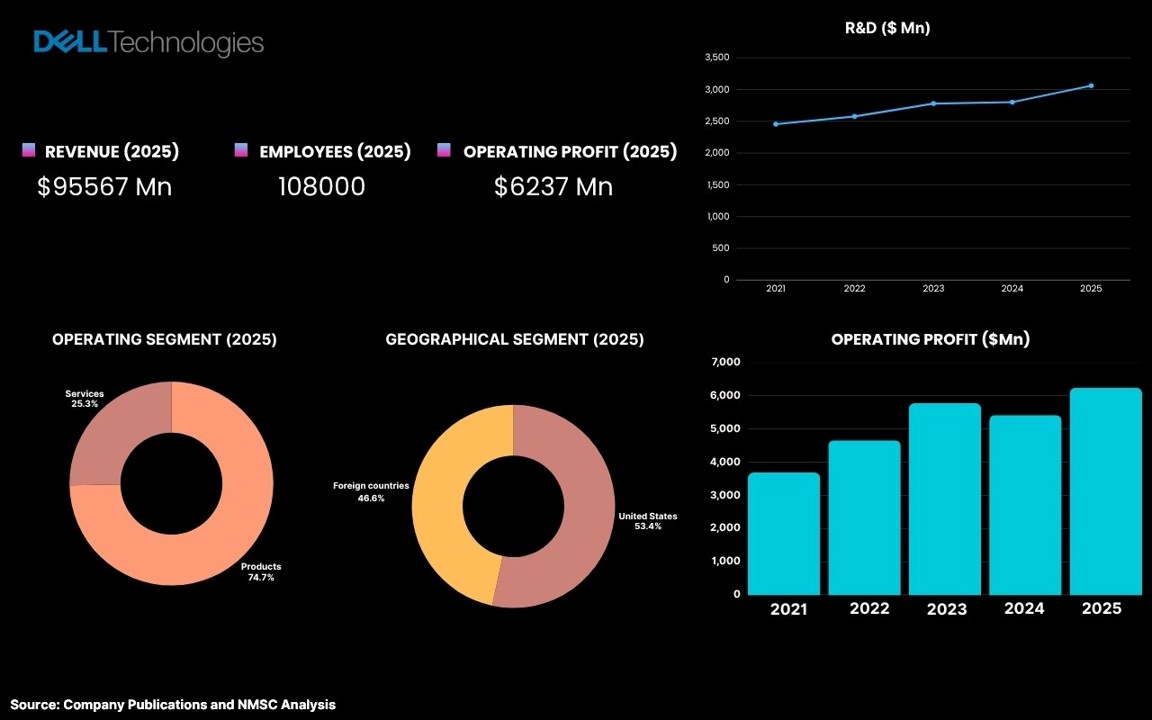
Dell Technologies, headquartered in Round Rock, Texas, United States, is a global technology company specializing in enterprise servers, storage systems, networking, and integrated IT infrastructure. Its PowerEdge servers and Integrated Rack Scalable Systems support high-performance computing, cloud infrastructure, and artificial intelligence (AI) workloads. The Prefabricated Data Center Market aligns with Dell's strategy of delivering factory-integrated computing infrastructure that reduces on-site integration requirements. By combining compute, storage, networking, power, and cooling technologies, Dell can address the growing need for scalable, high-density infrastructure among hyperscale cloud providers, enterprises, and AI infrastructure operators.
On 21 October 2026, Dell Technologies announced the Dell Modular Data Center with NVIDIA DSX POD reference design, a containerized AI infrastructure solution integrating compute, storage, networking, rack-level power, and liquid cooling. The solution is designed to connect with prepared power infrastructure, shifting critical integration and testing activities away from the deployment site. Dell stated that the modular data center design is expected to become available in early 2027. This development strengthens Dell's position in the Prefabricated Data Center Market by extending its integrated rack-scale capabilities into containerized, AI-ready infrastructure.
Based on our evaluation, Dell Technologies is strategically positioned to benefit from the convergence of modular infrastructure and high-density AI computing. Its established server, storage, and networking portfolio gives the company a foundation for supplying integrated IT modules and complete rack-scale configurations. The new modular data center initiative could broaden its reach among customers seeking faster deployment and coordinated infrastructure procurement. However, commercial execution will depend on product availability, power readiness, cooling performance, and customer adoption. As the market evolves, Dell's ability to connect computing systems with factory-integrated power and thermal infrastructure will remain an important competitive differentiator.
Huawei Technologies Co., Ltd.
Huawei Technologies Co., Ltd., headquartered in Shenzhen, China, operates across telecommunications, digital infrastructure, computing, and energy-management technologies. Through Huawei Digital Power, it supplies data-center facility solutions encompassing power, cooling, monitoring, and prefabricated modules. The Prefabricated Data Center Market supports Huawei's strategy of combining digital intelligence with factory-integrated infrastructure. Its modular portfolio serves applications ranging from smaller edge installations to larger cloud and colocation facilities, enabling the company to address buyers with different capacities, site conditions, and deployment requirements.
At the DataCloud Global Congress on 2 June 2026, Huawei unveiled a grid-interactive AI data-center strategy and associated infrastructure solutions. The announcement covered power architecture, megawatt-level liquid cooling, intelligent operations, and standardized prefabricated modules intended to simplify construction and accelerate deployment. Huawei also presented an integrated approach linking power generation, grid connections, computing loads, and energy storage. This development connects directly to the market's growing emphasis on high-density computing and faster infrastructure delivery. It may strengthen Huawei's competitiveness where customers prioritize coordinated electrical, thermal, and digital management.
Based on our assessment, Huawei competes through the integration of facility infrastructure, digital controls, and power technologies. Its emphasis on factory-based construction and grid interaction could appeal to operators seeking a coordinated response to rising AI-related electricity demand. The company's established position in Asia-Pacific provides a relevant regional base, while international opportunities depend on local requirements and procurement conditions. Its long-term prospects will hinge on continued product development, demonstrable operating performance, and its capacity to meet individual markets' technical and regulatory expectations.
Inline CTA Band
Band Title: Inside the Prefabricated Data Center Market Report
Band Subline: Explore 2025 market sizing, 2035 forecasts, four product categories, cooling technologies, and coverage of 38 countries.
Band Button: Explore the Full Report
Rittal GmbH & Co. KG
Rittal GmbH & Co. KG, headquartered in Herborn, Germany, supplies industrial and IT enclosures, racks, power distribution equipment, and climate-control solutions. Its standardized systems support data-center infrastructure where repeatability, efficient assembly, and scalable electrical design are essential. The Prefabricated Data Center Market gives Rittal an opportunity to extend its enclosure and power-distribution capabilities into increasingly integrated data-center architectures. This is particularly relevant as AI workloads drive higher rack densities and increase the need to coordinate power delivery, thermal management, and equipment layouts.
On 17 March 2026, Rittal and Siemens announced a strategic partnership to develop efficient data-center power distribution solutions for the IEC market. The collaboration includes work on a standardized sidecar power rack designed to deliver scalable power directly within the data-center white space. The companies aim to address the electrical requirements of increasingly demanding AI applications while supporting faster, more standardized infrastructure construction. For Rittal, the partnership offers a route to deepen integration with electrical equipment and broaden its role in modular data-center designs.
Our evaluation suggests that Rittal's competitive position rests on standardized infrastructure engineering and its ability to work alongside electrical technology partners. The Siemens collaboration could strengthen its relevance in projects where power distribution architecture has become a critical design decision rather than a secondary equipment choice. Its opportunity lies in making scalable power solutions easier to specify and integrate. The key test will be how effectively the partnership translates into commercially available designs that meet the technical demands of AI-oriented facilities.
“We have a long-standing collaboration with Siemens in a number of fields. We are proud to be taking our partnership to the next level. Both companies are driven by the desire to innovate.”
— Prof. Dr. Friedhelm Loh, Owner and CEO, Friedhelm Loh Group; source: Rittal's official partnership announcement.
Silent-Aire (Johnson Controls)
Silent-Aire, a Johnson Controls company, has an established base in Edmonton, Alberta, Canada, and specializes in modular data centers and precision cooling equipment, including computer-room air-conditioning and computer-room air-handling systems. Its offering connects prefabricated enclosures with the thermal systems needed to maintain operating conditions for critical computing infrastructure. The Prefabricated Data Center Market is particularly relevant to Silent-Aire because factory integration and high-density computing are increasing demand for cooling solutions that can scale alongside server and power capacity.
On 8 September 2025, Johnson Controls announced an expanded Silent-Aire coolant distribution unit platform for high-density data centers, with scalable configurations spanning 500 kW to more than 10 MW. The CDU portfolio supports liquid-cooling deployments in which heat must be removed directly from high-density computing equipment. This development broadens Silent-Aire's relevance to AI infrastructure and complements its modular data-center capabilities. It also places the company within a growing market for integrated thermal systems, where compatibility, scalability, and service support can influence purchasing decisions.
Based on our assessment, Silent-Aire's strategic position is differentiated by its combination of modular data-center design and advanced cooling expertise. Rising AI rack densities create opportunities for the company to participate in projects where conventional room-level cooling requires supplementation or replacement with liquid-based systems. Its connection to Johnson Controls also gives it access to broader building technology and service capabilities. Long-term growth will depend on delivering reliable thermal performance across varied module sizes while helping operators manage energy consumption, commissioning, and maintenance complexity.
Market Summary
The Prefabricated Data Center Market is evolving as demand for digital infrastructure increasingly intersects with AI computing, cloud expansion, and the need for faster capacity deployment. Factory-engineered IT, power, and cooling modules offer operators a way to undertake equipment fabrication and testing in parallel with site preparation. This approach can reduce on-site integration work and improve delivery predictability. According to the report, North America accounted for approximately 38% of global market revenue in 2025, reflecting the importance of hyperscale and colocation infrastructure. Cloud service providers, enterprises, and telecom operators remain relevant buyers, while edge installations create additional demand for compact, containerized systems.
Competition is increasingly organized around integrated infrastructure, standardized power blocks, advanced thermal management, and digital commissioning. Schneider Electric and Vertiv emphasize coordinated power and infrastructure delivery, Huawei combines prefabrication with intelligent power and facility management, Rittal is strengthening electrical distribution collaboration, and Silent-Aire is extending its liquid-cooling capabilities. Across these strategies, localization and manufacturing capacity matter because suppliers must balance high-specification engineering with dependable delivery. Factory testing can improve consistency, but customization, component shortages, and differences in site conditions continue to complicate implementation.
Our analysis indicates that long-term opportunities will concentrate in cooling modules, larger-capacity deployments, and service offerings that support installed infrastructure throughout its lifecycle. The report identifies Cooling Modules as the fastest-growing product category, with a projected CAGR of 11.94% from 2026 to 2035. Direct liquid cooling, hybrid thermal architectures, standardized megawatt-scale power systems, and digitally validated designs are likely to shape product development. At the same time, delayed grid connections can prevent completed modules from becoming operational, while upfront costs may constrain adoption in some markets. The market's direction is therefore clear, but commercial success will depend on combining factory scalability with power availability, locally appropriate designs, and reliable lifecycle support.
About the Author
 Liza Phukan
— Liza Phukan is Research Associate at Next Move Strategy Consulting, where she has covered emerging industries and market research across sectors for 3.5 years. Her work includes analyzing industry developments, validating market data, and developing structured business content from research findings. She uses secondary research and data-validation practices to turn complex market information into clear decision-useful market analysis for business audiences and support report development and B2B.
About the Reviewer
 Debashree Dey
— Debashree Dey is Assistant Manager at Next Move Strategy Consulting, where she supports cross-vertical market content and communications across diverse industries for 6 years. Her professional background includes senior content writing, communications, and published manuscript authorship, with experience developing audience-focused business narratives and maintaining clear, consistent messaging. Her role supports research-led content development and editorial quality across NextMSC publications.













Add Comment