How Intelligent Automation and Integrated Software Platforms Are Redefining the Future of the Intralogistics Software Market?
Based on Next Move Strategy Consulting analysis, the Intralogistics Software Market size was valued at USD 11.30 billion in 2025, and is expected to be valued at USD 13.22 billion by the end of 2026. The industry is projected to grow, hitting USD 49.12 billion by 2035, with a CAGR of 15.83% between 2026 and 2035. Based on our ongoing market assessment and discussions with warehouse automation specialists, system integrators, and supply chain technology practitioners, we found that the intralogistics software market continues to demonstrate strong operational relevance and sustained adoption across modern distribution environments. Enterprise-grade software platforms remain the preferred approach for managing complex material flows, reflecting consistent industry confidence in their validated performance capabilities, interoperability, and data-driven optimisation outcomes. Moreover, logistics complexity is expanding across manufacturing, retail, and e-commerce sectors, with rising throughput requirements and multi-node fulfilment models reinforcing steady solution demand. This structural reliance supports market resilience, while iterative platform enhancements from established vendors and emerging digital solution providers are improving usability, scalability, and integration flexibility, thereby strengthening long-term deployment continuity.
Want Insights on the Intralogistics Software Market? Access a FREE Sample Instantly
From our observations, the growing adoption of cloud-enabled orchestration and remote monitoring capabilities is directly improving access to intralogistics software functionality and strengthening operational responsiveness. Additionally, warehouse operators are increasingly implementing integrated execution models that combine software platforms with robotics coordination, predictive analytics, and workflow optimisation tools. These approaches deliver more consistent real-world performance, reduce operational bottlenecks, and enhance throughput stability, reinforcing professional trust in software-led logistics management. Overall, the market is shaped by expert-driven deployment strategies, digitally enabled execution frameworks, and a clear shift toward intelligent, integrated automation ecosystems over fragmented or manual coordination approaches.
Intelligent Orchestration Platforms Emerging as the Backbone of Modern Intralogistics Operations
Based on our analysis, we observe a clear shift toward intelligent orchestration platforms becoming foundational to intralogistics software deployments. Supply chain operators and technology vendors increasingly recognise that warehouse and material-handling environments differ widely in layout complexity, throughput variability, and automation maturity. Consequently, rigid execution systems are gradually being replaced by adaptive, data-driven platforms that coordinate robotics, inventory flows, and workforce tasks across dynamic operational settings.
From our market assessments, we found that intralogistics execution is becoming decisively insight-led. Enterprises are deploying software capable of contextual decision support, predictive workload balancing, and real-time optimisation, enabling precise control while reducing downtime, bottlenecks, and resource misallocation, long-standing challenges in high-volume logistics environments. We further observed that this transition reflects a structural shift rather than incremental improvement, as operators prioritise consistency, scalability, and measurable operational outcomes. Our research indicates that intelligent orchestration is evolving from a differentiating feature into a core competitive requirement. Additionally, the integration of AI-driven analytics, digital twin simulation, and IoT-enabled visibility is materially improving execution accuracy and long-term system responsiveness. These advancements strengthen operational trust, increase platform reliance, and drive reinvestment cycles, ultimately reinforcing the commercial and technological sustainability of intralogistics software adoption. Collectively, these developments highlight a market defined by expertise-driven innovation, performance transparency, and sustained enterprise engagement.
From Standalone Systems to Unified Execution Platforms: Where Is Intralogistics Software Evolving?
From our interviews with warehouse operators and automation solution providers, we observe that the scope of intralogistics software is expanding beyond traditional warehouse management functionality toward integrated, intelligence-enabled operational ecosystems. As throughput visibility, execution accuracy, and system responsiveness become higher priorities, real-time analytics and automation orchestration capabilities are increasingly embedded alongside core logistics applications. Operational management models are therefore evolving to support data-guided execution and continuous performance optimisation:
-
Real-Time Visibility and Analytics Integration: Facilities are deploying advanced monitoring and analytics platforms to capture granular operational data and enable faster decision adjustments.
-
Technology-Enabled Execution Expansion: Software-driven coordination tools are enhancing operators’ ability to evaluate workflows, allocate resources dynamically, and refine process efficiency.
-
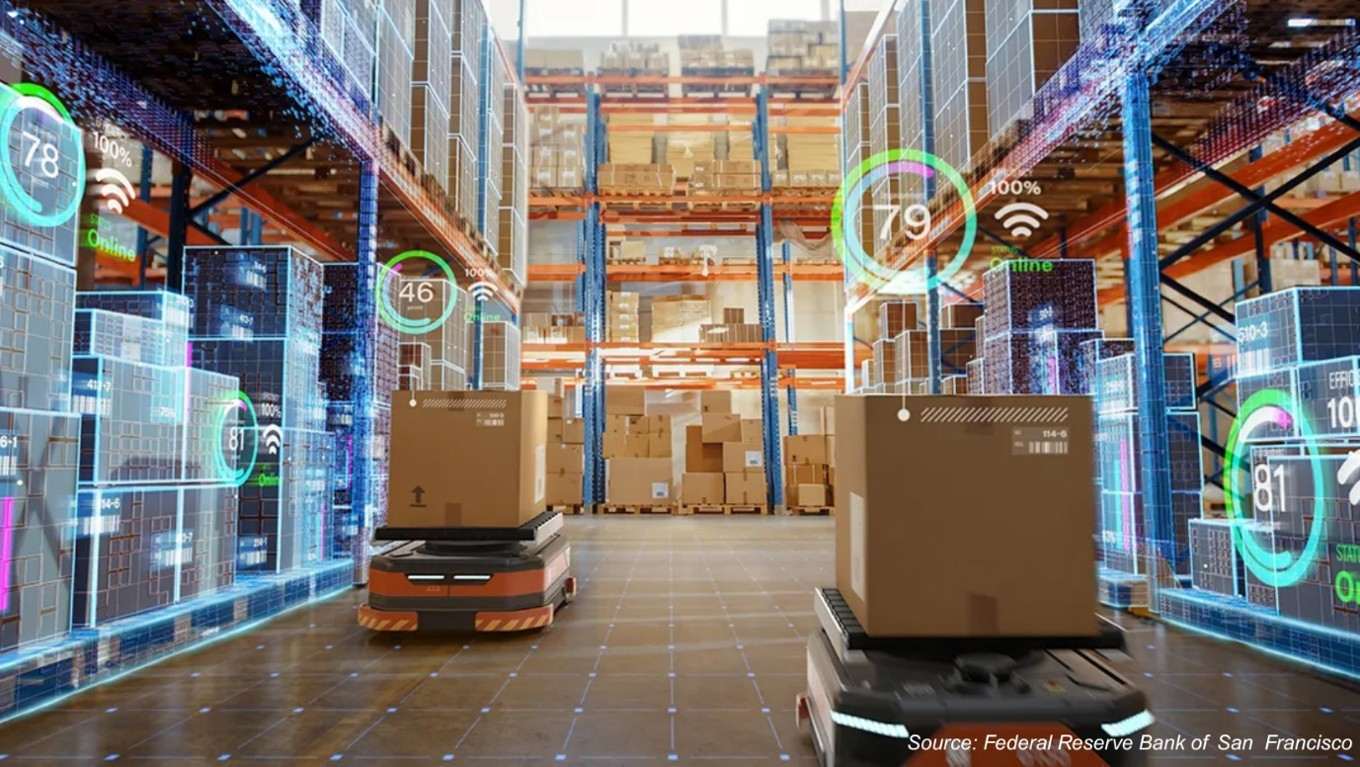
Robotics and Automation Integration: Autonomous mobile robots, automated storage systems, and smart conveyors are becoming embedded within structured execution environments managed through centralised software control.
-
Software–Hardware Convergence: Combining logistics software with automation equipment is improving control over complex, high-volume material flows and exception handling.
-
Process Standardisation and Performance Monitoring: Data-backed optimisation frameworks are enabling more consistent benchmarking, reporting, and outcome reliability across facilities.
Based on our observations, these developments signal a convergence between execution software and automation infrastructure, reinforcing evidence-driven operational governance and accelerating the evolution of intralogistics software toward platform-centric logistics ecosystems.

Edge Vision Intelligence & Real-Time Data Visibility Emerging as a Defining Trend in Modern Intralogistics Operations
Edge vision intelligence and real-time data visibility are increasingly becoming central to modern intralogistics environments, reflecting the rising operational complexity of warehouses and the limitations of delayed or batch-based monitoring approaches. Through our ongoing market evaluation and technology deployment assessments, we observe growing enterprise reliance on edge-enabled vision systems that process visual data directly at operational nodes to track inventory movement, detect anomalies, and support workflow validation. By addressing visibility and decision support simultaneously at the source, organizations achieve faster response times and more consistent execution reliability. Additionally, real-time insights reduce dependence on manual verification and fragmented reporting tools, simplifying operational oversight and strengthening workforce responsiveness, factors widely recognised as essential for sustained efficiency and throughput optimization.
Meanwhile, evolving digital transformation strategies indicate that edge-driven intelligence plays a strategic role in scalability and risk management. Based on our discussions with technology integrators, we identified that enterprises are prioritising architectures that combine computer vision, sensor fusion, and low-latency analytics within secure processing environments to maintain continuity while minimizing network strain. Our assessment further suggests that continuous data visibility shortens diagnostic cycles, reduces disruption exposure, and supports facility-specific performance modelling aligned with dynamic demand patterns. As capabilities mature, edge vision frameworks are expected to progress beyond monitoring toward predictive exception handling and semi-autonomous coordination, reinforcing their importance as a foundational enabler in next-generation intralogistics software ecosystems.
From Automation Support to Strategic Enabler: Where Is Autonomous Robotics & Fleet Optimization Heading?
From our discussions with warehouse operators and automation solution providers, we observe that autonomous robotics and fleet optimization are progressing beyond tactical productivity tools into core coordination layers within intralogistics software environments. As throughput consistency, labour flexibility, and operational predictability become stronger determinants of facility performance, robotics orchestration platforms and fleet analytics tools are increasingly deployed alongside warehouse execution systems. Operational strategies are therefore advancing toward synchronized automation frameworks that balance scalability with real-time control:
-
Robotics Coordination Enablement: Autonomous mobile robots and automated guided vehicles are being centrally orchestrated through software platforms to streamline material flow and minimize idle time across facilities.
-
Dynamic Fleet Optimization: Real-time routing, workload balancing, and predictive scheduling tools are supporting efficient robot utilization and reduced congestion within complex warehouse layouts.
-
Continuous Performance Monitoring: Analytics-driven dashboards and alerting mechanisms reinforce uptime and reliability through proactive diagnostics and utilization tracking.
-
Integrated Automation Ecosystems: Converging robotics management with inventory, labour, and order orchestration systems enables cohesive operational visibility and execution alignment.
-
Efficiency-Led Adoption Expansion: Productivity-driven investment decisions are encouraging sustained enterprise engagement with autonomous fleet optimization capabilities.
Based on our market observations and deployment assessments, these developments indicate that robotics orchestration is transitioning into a strategic infrastructure component within intralogistics software ecosystems, strengthening execution resilience and supporting long-term scalability across modern distribution environments.

What Does the Future Hold for Intelligent Intralogistics Software Ecosystems?
Looking ahead, our assessment indicates that the intralogistics software market will increasingly be shaped by deeper operational intelligence, tighter automation integration, and more connected execution environments. Warehouse strategies are progressively shifting toward software architectures informed by real-time operational data, facility-specific workflow requirements, and long-term scalability priorities rather than short-term efficiency gains alone. As platform capabilities advance, both next-generation analytics engines and optimized legacy modules are expected to enhance execution accuracy while improving interoperability across heterogeneous automation assets. In parallel, hybrid orchestration models combining centralized control platforms with edge-enabled decision layers are gaining traction, enabling more resilient management of high-throughput or dynamically changing logistics scenarios.
Simultaneously, digital enablement technologies are transforming operational engagement by moving facilities from periodic optimization reviews to continuously monitored and adaptive execution frameworks. AI-supported forecasting, digital twin simulation, and predictive maintenance analytics are increasingly embedded into software environments, strengthening performance consistency through sustained system visibility and operator oversight. Heightened attention to e-commerce fulfilment complexity and multi-site distribution networks is also expanding demand for solutions addressing traceability, energy efficiency, and asset utilization alongside throughput optimization. Taken together, these developments reflect an evolving ecosystem centred on expertise-driven innovation, data-informed decision governance, and scalable orchestration capabilities that reinforce long-term reliability and confidence in modern intralogistics operations.
Strategic Outlook for the Intralogistics Software Market
Based on NMSC’s analysis and validation through ongoing engagements with warehouse automation specialists and system integrators, we found that the intralogistics software market continues to evolve toward intelligent, platform-centric execution environments. Evidence gathered through deployment assessments and industry consultations indicates that enterprises increasingly prioritise solutions delivering interoperability, real-time visibility, and measurable operational outcomes across robotics coordination, inventory flows, and workforce optimisation. Furthermore, the integration of AI analytics, digital twin simulation, and edge-enabled monitoring strengthens decision accuracy and throughput stability. As adoption matures, software is transitioning into a strategic infrastructure layer, reinforcing scalability, operational resilience, and sustained enterprise trust within increasingly complex logistics ecosystems.
About the Author
 Tushmi Dutta
— Tushmi Dutta is a focused researcher specializing in detailed analysis and insight-driven research across diverse business landscapes. She supports strategic initiatives through structured data interpretation, thorough validation, and clear communication of findings that aid informed decision-making. With a strong interest in writing, she enjoys presenting research insights in an engaging and accessible manner. Beyond work, she enjoys traveling, reading, painting, and continuously learning new skills that contribute to her creative and professional growth.
Tushmi Dutta
— Tushmi Dutta is a focused researcher specializing in detailed analysis and insight-driven research across diverse business landscapes. She supports strategic initiatives through structured data interpretation, thorough validation, and clear communication of findings that aid informed decision-making. With a strong interest in writing, she enjoys presenting research insights in an engaging and accessible manner. Beyond work, she enjoys traveling, reading, painting, and continuously learning new skills that contribute to her creative and professional growth.
About the Reviewer
 Sikha Haritwal
— Sikha Haritwal is an assistant manager with strong expertise in market research, data analysis, and cross-functional coordination. She plays a key role in leading complex research initiatives, strengthening analytical rigor, and enabling data-driven decision-making across teams. Known for her leadership mindset and structured problem-solving approach, she supports process improvement, enhances operational efficiency, and contributes to building scalable frameworks that drive long-term strategic outcomes and organizational effectiveness.
Sikha Haritwal
— Sikha Haritwal is an assistant manager with strong expertise in market research, data analysis, and cross-functional coordination. She plays a key role in leading complex research initiatives, strengthening analytical rigor, and enabling data-driven decision-making across teams. Known for her leadership mindset and structured problem-solving approach, she supports process improvement, enhances operational efficiency, and contributes to building scalable frameworks that drive long-term strategic outcomes and organizational effectiveness.


















Add Comment