How Is AI-Powered Pharmacy Software Rewriting Medication Error Prevention?

Medication errors still injure an estimated 1.3 million Americans a year and cost the U.S. health system more than $40 billion annually, according to longstanding FDA and Institute of Medicine estimates a reminder that healthcare's biggest safety gaps are often administrative and technological, not clinical. Closing that gap is exactly the job of the healthcare IT market, and 2026 has been the year AI moved from clinical-decision-support pilot projects into full production across the industry's largest platforms.
This piece looks at what has actually changed: the size and trajectory of the market itself, the AI and dealmaking moves from twenty of the sector's largest vendors over the past several months, and the verified government data behind how fast patients and providers are adopting these tools.
Healthcare IT Market Snapshot: Size, Forecast, and Growth Drivers
The global healthcare IT market was valued at USD 687.67 billion in 2026 and is projected to reach USD 2,668.39 billion by 2035, growing at a CAGR of 16.26% between 2026 and 2035, up from a 2025 base of USD 591.49 billion. Growth is concentrated around three forces: regulatory pressure toward mandatory digital patient records, the shift to value-based care and integrated revenue-cycle management, and rising adoption of cloud infrastructure and AI across clinical and administrative workflows. Rising cybersecurity compliance costs are the clearest headwind, disproportionately affecting smaller providers.
Healthcare IT Market Snapshot, 2025–2035
|
Parameter |
Detail |
|
Market Size, 2026 |
USD 687.67 billion |
|
Revenue Forecast, 2035 |
USD 2,668.39 billion |
|
Growth Rate |
CAGR of 16.26% from 2026 to 2035 |
|
Base Year |
2025 (USD 591.49 billion) |
|
Forecast Period |
2026–2035 |
|
Companies Profiled |
20 |
|
Countries Covered |
33 |
Section summary: the market's growth case rests on regulatory momentum and infrastructure spending that is already underway, not a single technology cycle.
-
USD 687.67B (2026) → USD 2,668.39B (2035) at a 16.26% CAGR
-
Mandatory digital-record rules, value-based care, and cloud/AI adoption are the core drivers
-
Rising cybersecurity compliance costs are the market's clearest headwind, especially for smaller providers
Current Trends Reshaping the Healthcare IT Market
The clearest theme across 2026's vendor announcements is AI moving from a documentation tool to something closer to a coworker. Oracle extended its Clinical AI Agent to inpatient nurses in September, building on a physician-facing tool that has already saved U.S. health systems more than 400,000 documentation hours. Epic Systems used its August Users Group Meeting to unveil Ergo, an AI-native clinical interface, alongside Agent Factory for building custom agents and Cosmos Curiosity, a predictive-analytics tool drawing on more than 300 million de-identified patient records; Berlin's Charité became its first German customer. Microsoft upgraded Dragon Copilot from an ambient scribe into a full agentic assistant integrated with Microsoft 365, a tool now used daily by more than 100,000 clinicians across nine countries. Amazon Web Services entered the category outright in March with Amazon Connect Health, a purpose-built agentic AI service; UC San Diego Health, an early adopter, cut 630 staff-hours of administrative work per week.
That same logic giving software the specific clinical context to act, not just alert is what has driven measurable reductions in medication errors at hospitals piloting AI-enhanced clinical decision support. But off-the-shelf modules rarely fit a given hospital's patient mix or formulary, which is why more health systems now turn to firms offering pharmacy management software development services built around a hospital's own data, formulary, and workflow rather than a generic template.
Section summary: the largest EHR and cloud vendors are converging on the same idea AI that acts inside existing clinical workflows rather than sitting beside them.
-
Oracle's Clinical AI Agent has saved clinicians over 400,000 documentation hours since its 2024 debut
-
Epic and Microsoft are both moving from single-purpose AI tools to full agent platforms
-
AWS's Amazon Connect Health, live since March 2026, has cut hundreds of administrative hours per week at early adopters
Industry Impact: Consolidation Reshapes Who Owns the Data
Beyond product launches, 2026 has been a year of consolidation. GE HealthCare completed its $2.3 billion acquisition of Intelerad in March, pairing its hospital-based imaging strength with Intelerad's cloud-first, outpatient-focused platform. McKesson signed a roughly $2.25 billion deal for Precision Medicine Group in August, doubling down on an Oncology & Multispecialty segment that had already grown 33% year over year. Merative launched a cloud-native Merge Imaging Suite in April and, through its Truven unit, acquired employer health-data platform Springbuk. Not every deal is closing on favorable terms, though: Dedalus paused a €1.3 billion leveraged-loan repricing in February amid investor unease over AI's potential to disrupt legacy health-software vendors even as the company was separately ranked the top Acute Care EHR provider across the DACH and Southern Europe regions in the 2026 Best in KLAS rankings.
As imaging, data, and monitoring platforms increasingly sit alongside core EHR systems, that consolidation is also reshaping the broader digital healthcare market that healthcare IT increasingly overlaps with.
Section summary: consolidation is now as central to competitive position in healthcare IT as any single product launch, and not every incumbent is finding the transition easy.
-
GE HealthCare's $2.3B Intelerad deal builds a unified, cloud-first imaging platform
-
McKesson's $2.25B Precision Medicine Group deal targets its fastest-growing segment
-
Dedalus paused a €1.3B loan refinancing amid investor concern about AI-driven disruption to incumbents
Competitive Landscape: Specialists, IT Services, and Payers Compete on Different Turf
Ambulatory-care EHR vendors are racing to embed AI directly into billing and scheduling. athenahealth rolled out a roadmap of more than 80 AI features across revenue-cycle workflows in June, while eClinicalWorks launched its healowIQ point-of-care evidence tool and continued expanding its healow Genie AI contact center across federally qualified health centers. NextGen Healthcare's Ambient Assist scribe now powers roughly 1.5 million patient encounters a year, and MEDITECH completed its Expanse rollout across 34 more HCA Healthcare hospitals in September, bringing HCA's total live sites to 72. Veradigm took a different path: after attracting five acquisition bids, it ended its strategic review and chose to stay independent, launching a new Health Network Architecture platform instead. Siemens Healthineers won FDA clearance for its Coronary Cockpit AI tool and launched its AI-enabled Atellica Forte diagnostics platform, even as it trimmed full-year revenue guidance on Diagnostics-segment weakness.
Payers and global IT-services firms are competing on different turf entirely. Optum, UnitedHealth's technology arm, is on track to invest nearly $1.5 billion in AI in 2026, and its new Optum AI consulting arm has already signed outside clients. Cognizant expanded its Google Cloud partnership around Gemini Enterprise, naming healthcare a priority sector; Wipro formed a dedicated AI-native platforms unit built around industry assets including its healthcare-specific IHS and HPS platforms; and Tata Consultancy Services was named a Leader in Healthcare Payer Digital Services by Everest Group on the back of a $9.5 billion quarterly order book. R1 RCM rounded out the quarter with two new AI tools on its Phare operating system, now live with health systems including Providence.
Healthcare IT Vendor AI and M&A Activity Tracker, 2026
|
Company |
Most Recent Material Move |
Date |
Source |
|
Oracle |
Launched Clinical AI Agent for nurses in U.S. inpatient EHRs, extending a tool that has saved physicians 400,000+ documentation hours since 2024. |
Sept. 2026 |
oracle.com; Fierce Healthcare |
|
Epic Systems |
Unveiled Ergo, Agent Factory, and Cosmos Curiosity at UGM 2026; added Charité (Berlin) as its first German customer. |
Aug. 2026 |
Becker's Hospital Review |
|
Microsoft |
Upgraded Dragon Copilot into an agentic clinical assistant with Microsoft 365 integration; 100,000+ clinicians now use it across 9 countries. |
March 2026 |
Microsoft; HIT Consultant |
|
Amazon Web Services |
Amazon Connect Health, AWS's agentic AI for healthcare, reached general availability; UC San Diego Health saved 630 staff-hours per week. |
March 2026 |
aboutamazon.com; AHA |
|
GE HealthCare |
Completed its $2.3 billion acquisition of imaging-software firm Intelerad to build a cloud-first, AI-enabled imaging platform. |
March 2026 |
GE HealthCare press release |
|
McKesson |
Agreed to acquire Precision Medicine Group for ~$2.25 billion, expanding its fastest-growing Oncology & Multispecialty segment (+33% YoY). |
Aug. 2026 |
McKesson investor relations |
|
Merative |
Launched Merge Imaging Suite VNA v26.0, a cloud-native enterprise imaging platform, and acquired employer-data firm Springbuk via Truven. |
September 2025 |
Merative newsroom |
|
Dedalus |
Paused a €1.3 billion leveraged-loan repricing amid investor unease over AI's disruption of legacy health-software vendors. |
Feb. 2026 |
Bloomberg |
|
athenahealth |
Rolled out a roadmap of 80+ AI features across athenaOne's revenue-cycle workflows, including express coding and denial resolution. |
June 2026 |
TechTarget |
|
eClinicalWorks |
Launched healowIQ, a point-of-care evidence tool, alongside continued rollout of its healow Genie AI contact-center platform. |
May 2026 |
Healthcare IT Today |
|
NextGen Healthcare |
Its NextGen Ambient Assist AI scribe now powers roughly 1.5 million patient encounters annually. |
2026 |
nextgen.com |
|
MEDITECH |
Completed its Expanse EHR rollout across 34 more HCA Healthcare hospitals, bringing HCA's total live sites to 72. |
Sept. 2026 |
Business Wire |
|
Veradigm |
Ended a strategic review after attracting five acquisition bids, opting to stay standalone; launched Health Network Architecture. |
January 2025 |
Healthcare IT News; Veradigm |
|
Siemens Healthineers |
Won FDA clearance for its Coronary Cockpit AI tool and launched the AI-enabled Atellica Forte platform, even as full-year revenue guidance was trimmed. |
July 2026 |
Siemens Healthineers Q3 FY26 results |
|
Optum (UnitedHealth) |
On track to invest nearly $1.5 billion in AI in 2026; its new Optum AI consulting arm signed its first external contracts. |
April 2026 |
SEC filings; PYMNTS |
|
Cognizant |
Expanded its Google Cloud/Gemini Enterprise partnership, naming healthcare and life sciences a priority go-to-market sector. |
July 2026 |
Cognizant press release |
|
Wipro |
Formed a dedicated AI-native platforms unit to scale its industry AI assets, including its IHS and HPS healthcare platforms. |
2026 |
wipro.com |
|
Tata Consultancy Services |
Named a Leader in Healthcare Payer Digital Services by Everest Group, alongside a $9.5 billion Q1 FY27 order book. |
Aug. 2026 |
Everest Group; tcs.com |
|
R1 RCM |
Launched AI-powered AR Recovery and Denial Management tools on its Phare operating system, live with health systems including Providence. |
April 2026 |
Becker's Hospital Review |
Section summary: no single business model is winning outright ambulatory EHR vendors, payers, and global IT-services firms are each finding a different angle into the same AI buildout.
-
Ambulatory EHR vendors are embedding AI directly into daily billing and scheduling workflows
-
Optum's $1.5B AI investment shows payers, not just software vendors, are now building AI businesses
-
Global IT-services firms (Cognizant, Wipro, TCS) are positioning healthcare as a flagship AI vertical
Patient Engagement Goes Mainstream
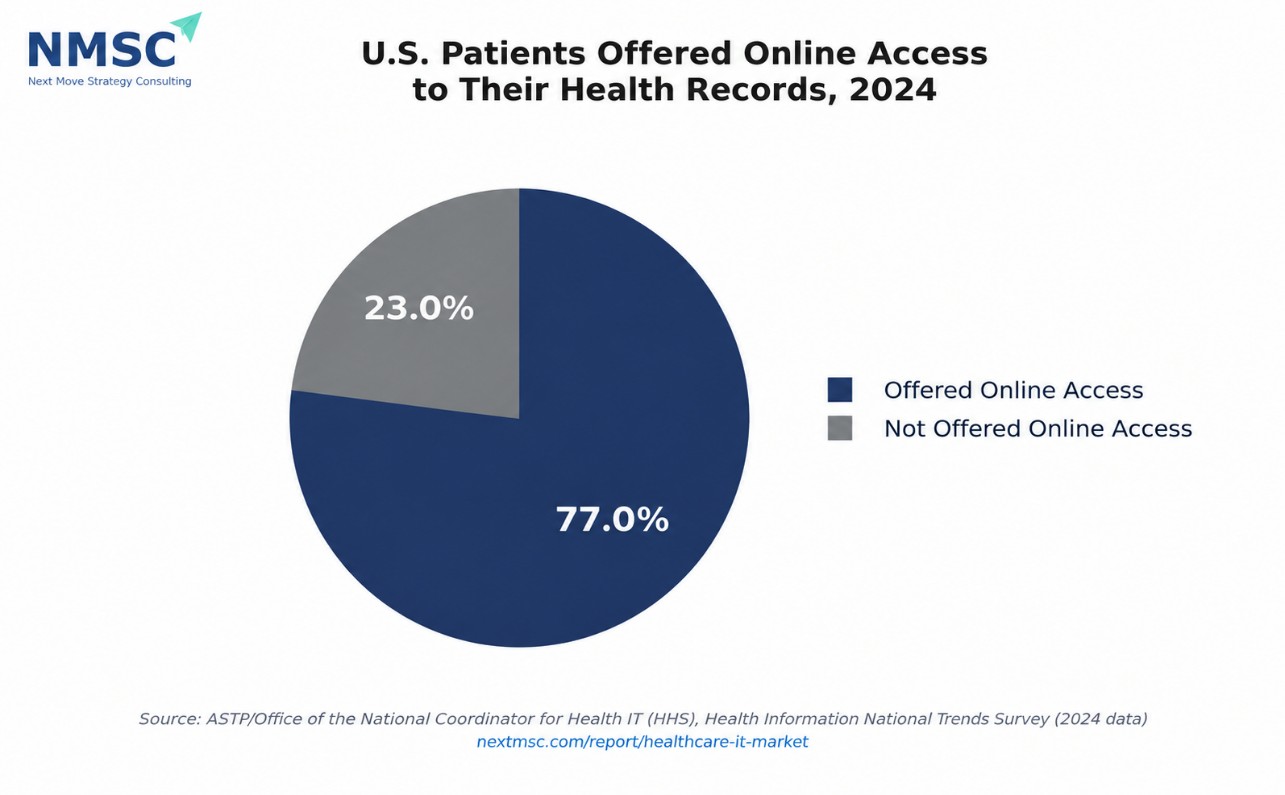
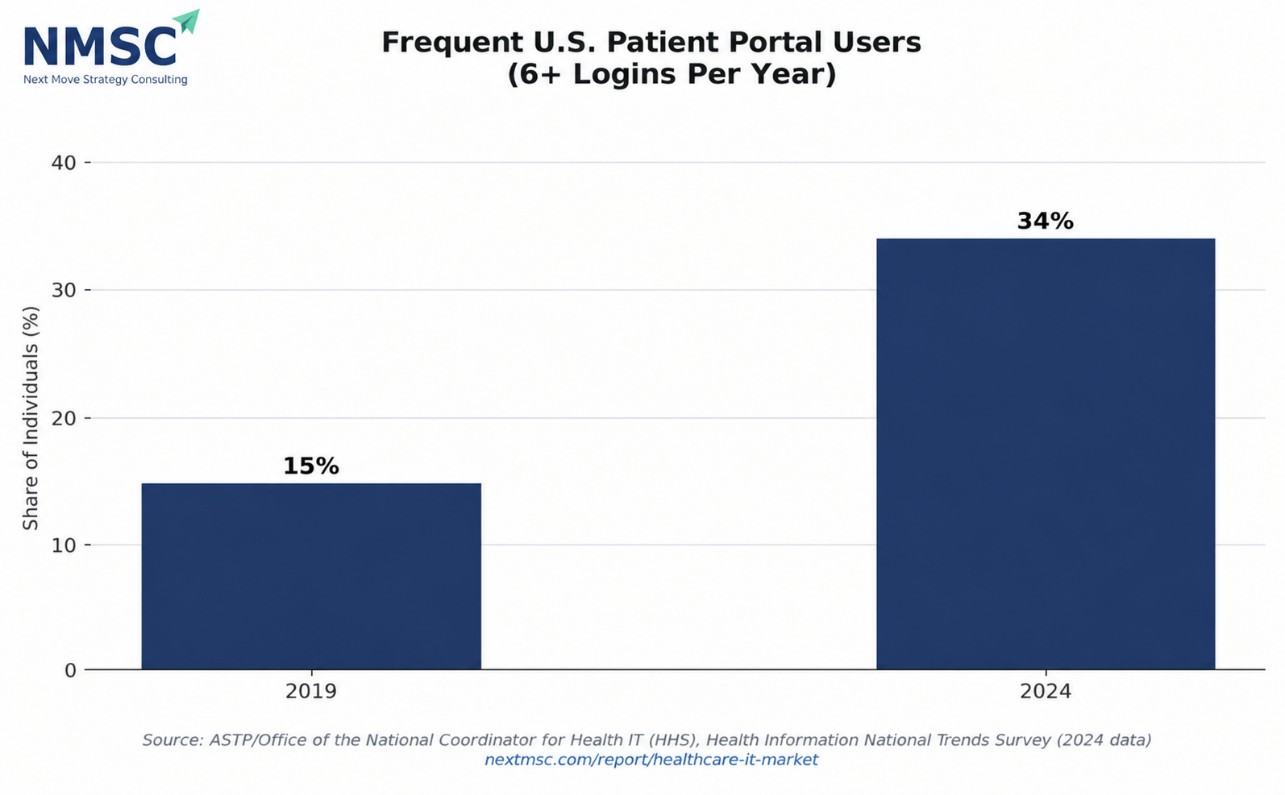
Government data confirms the infrastructure behind all of this is now largely in place. As of 2024, more than 99% of non-federal acute care hospitals and 91% of office-based physicians had adopted a certified EHR, according to the HHS Assistant Secretary for Technology Policy/Office of the National Coordinator for Health IT (ASTP/ONC). Patient-facing access is following the same curve: 77% of individuals were offered online access to their health records in 2024, up from 73% in 2022, and frequent portal use logging in six or more times a year has more than doubled since 2019.
That growth in patient-facing access is pulling investment toward adjacent categories, including patient monitoring tools that extend visibility beyond the hospital, and healthcare cybersecurity platforms needed to protect a growing volume of patient-accessible data.
Section summary: the data infrastructure and the patient demand for it are both now firmly in place, which is precisely why AI vendors are racing to build on top of it.
-
Certified EHR adoption is now nearly universal among hospitals (>99%) and widespread among physicians (91%)
-
77% of patients were offered online access to their records in 2024, up from 73% in 2022
-
Frequent patient-portal use has more than doubled since 2019, from 15% to 34%
Future Outlook: Toward Autonomous Healthcare Operations
With the market forecast to nearly quadruple from USD 687.67 billion in 2026 to USD 2,668.39 billion by 2035, the next phase looks less like incremental feature releases and more like a structural shift in what healthcare software is for. Oracle's nurse-facing agent, Epic's Agent Factory, Microsoft's Work IQ layer, and AWS's Amazon Connect Health all point toward systems that coordinate across clinical and administrative tasks rather than handling one in isolation. Expect further consolidation of the kind seen at GE HealthCare, McKesson, and Merative, particularly among mid-sized vendors that lack the balance sheet to build agentic AI internally.
One open question remains where the original medication-safety data began: the FDA has yet to publish comprehensive guidance on adaptive AI in clinical decision support, leaving individual health systems to define their own governance and validation frameworks in the meantime.
Section summary: expect the market to keep consolidating around a smaller number of AI-native platforms, with regulatory clarity on adaptive clinical AI remaining the field's biggest open question.
-
Market forecast to reach USD 2,668.39B by 2035 at a 16.26% CAGR
-
Agentic AI is moving from single-task assistants toward coordinated, multi-system platforms
-
Comprehensive FDA guidance on adaptive AI in clinical decision support is still pending
Conclusion
The healthcare IT market's next chapter will be defined less by any single AI feature than by how quickly agentic platforms, consolidation, and patient demand converge. For a full breakdown of market sizing, segmentation, and vendor share, Download Free Sample of the complete Next Move Strategy Consulting report.
About the Author
 Sanyukta Deb
— Sanyukta Deb is Digital Marketing Team Lead at Next Move Strategy Consulting, where she has led content strategy and technical SEO for the firm's B2B market research publications for over 2 years. Her editorial process translates NextMSC's primary and secondary research — spanning technology, industrial, and consumer sectors — into commercial narratives, backed by search-intent, keyword, and competitive analysis. She brings 5 years of overall experience in digital marketing and content strategy.
Sanyukta Deb
— Sanyukta Deb is Digital Marketing Team Lead at Next Move Strategy Consulting, where she has led content strategy and technical SEO for the firm's B2B market research publications for over 2 years. Her editorial process translates NextMSC's primary and secondary research — spanning technology, industrial, and consumer sectors — into commercial narratives, backed by search-intent, keyword, and competitive analysis. She brings 5 years of overall experience in digital marketing and content strategy.
About the Reviewer
 Debashree Dey
— Debashree Dey is Assistant Manager at Next Move Strategy Consulting, where she supports cross-vertical market content and communications across diverse industries for 6 years. Her professional background includes senior content writing, communications, and published manuscript authorship, with experience developing audience-focused business narratives and maintaining clear, consistent messaging. Her role supports research-led content development and editorial quality across NextMSC publications.
Debashree Dey
— Debashree Dey is Assistant Manager at Next Move Strategy Consulting, where she supports cross-vertical market content and communications across diverse industries for 6 years. Her professional background includes senior content writing, communications, and published manuscript authorship, with experience developing audience-focused business narratives and maintaining clear, consistent messaging. Her role supports research-led content development and editorial quality across NextMSC publications.


















Add Comment