How is the Athletic Footwear Market Evolving in 2025?
Introduction
The global athletic footwear industry is undergoing a structural reset — one driven not merely by consumer preference shifts, but by a simultaneous convergence of landmark M&A consolidation, tightening regulatory mandates, and a widening performance gap between the world's two dominant brands. According to Next Move Strategy Consulting's Athletic Footwear Market report, the global athletic footwear market was valued at USD 173.19 billion in 2025 and is projected to reach USD 224.32 billion by 2030, growing at a CAGR of 5.31% during the forecast period. NMSC's proprietary research and analysis, which applies bottom-up segment modeling across nine product categories, nine price tiers, and five regional clusters, underpins this forecast.
The forces shaping this trajectory are specific and traceable. Within a single calendar year, the industry witnessed the largest sneaker buyout in history, the completion of a USD 2.4 billion retail consolidation that repositioned over 3,200 stores under a single ownership structure, the enforcement of new World Athletics shoe regulations that directly affect product design specifications for competitive footwear, and the activation of the European Union's Ecodesign for Sustainable Products Regulation (ESPR) ban on destroying unsold footwear — a provision that compels brands to redesign their inventory management and product lifecycle strategies from the ground up. Each of these events carries direct, measurable implications for market participants across the value chain.
For More Information: Download FREE Sample on Athletic Footwear Market Report
The Consolidation Wave Reshaping Athletic Footwear Distribution
Two Landmark Deals That Redrew the Competitive Map
The most consequential structural event of the past twelve months was not a product launch — it was a pair of transactions that fundamentally altered how athletic footwear reaches consumers at scale.
On September 8, 2025, Dick's Sporting Goods completed its USD 2.4 billion acquisition of Foot Locker, giving the combined entity a footprint of over 3,200 stores and, critically, a first meaningful entry into international retail markets where Foot Locker had established presence. Dick's expects the transaction to be accretive to earnings per share in fiscal 2026, with projected cost synergies of USD 100 million to USD 125 million in the medium term, primarily through supply chain and operational integration. For brands such as Nike, Adidas, and On Holding, this consolidation concentrates wholesale negotiating power in fewer hands — a dynamic that compresses margin flexibility and raises the stakes of shelf-space allocation decisions.
Simultaneously, Skechers agreed to be taken private by 3G Capital for USD 9.42 billion — the footwear industry's largest buyout on record — exiting public markets after 26 years. The deal, announced in May 2025 and closed in September 2025, was structured at USD 63 per share — a 28% premium to the stock's prior close — and financed through a combination of 3G Capital equity and committed debt financing from JPMorgan Chase Bank. By August 2026, Skechers had become the second-largest footwear brand in the United States by unit volume, according to the company's own announcement. The privatization removes Skechers from quarterly earnings scrutiny, enabling 3G Capital to execute its characteristic margin-improvement playbook — cost rationalization, operational efficiency, and selective geographic expansion — without the pressure of public market reporting cycles.
NMSC Strategic Perspective: What Consolidation Means for Market Structure
NMSC's primary research and analysis identifies this consolidation wave as a structural inflection point rather than a cyclical event. When a single retail entity controls 3,200+ storefronts across multiple geographies, brand partners face a binary choice: negotiate from a position of product differentiation strength, or accept reduced shelf presence. This dynamic accelerates the strategic importance of direct-to-consumer (DTC) channels — yet Nike's own FY2026 results demonstrate the risk of over-rotating toward DTC without maintaining wholesale relationships. Nike's NIKE Direct revenues declined 6% on a reported basis for the full fiscal year ended May 31, 2026, while wholesale revenues grew 6%, underscoring that omnichannel balance — not channel exclusivity — is the operative competitive model.
For emerging brands and regional specialists, the Dick's-Foot Locker merger creates a paradox: access to a larger combined retail network, but under terms set by a more powerful counterparty. NMSC's analysis suggests that brands with validated performance differentiation — measurable through independent biomechanical testing, race-day adoption rates, or regulatory compliance credentials — will retain pricing power in this environment, while undifferentiated mid-tier brands face margin compression.
Section Summary
The USD 2.4 billion Dick's-Foot Locker merger and the USD 9.42 billion Skechers privatization represent the two largest structural transactions in athletic footwear retail history, both closing within weeks of each other in September 2025. Together, they concentrate distribution power, accelerate the strategic value of DTC channels, and raise the minimum threshold of brand differentiation required to maintain wholesale leverage.
Key Takeaways:
-
Dick's Sporting Goods now controls 3,200+ stores post-acquisition, with projected synergies of USD 100–125 million in the medium term.
-
Skechers' USD 9.42 billion go-private deal — the industry's largest buyout ever — removes it from public market scrutiny and positions it for margin-focused restructuring under 3G Capital.
-
Nike's FY2026 results confirm that wholesale recovery (+6%) is outpacing DTC (-6%), validating omnichannel distribution as the operative competitive model.
-
Brands lacking measurable performance differentiation face accelerating margin pressure as consolidated retail counterparties gain negotiating leverage.
Industry Impact Analysis
The Nike-Adidas Reputation Divergence and Its Market Implications
The competitive dynamics between Nike and Adidas have shifted materially in the past eighteen months, and the divergence is now quantifiable across both financial and reputational metrics.
Adidas reported double-digit currency-neutral growth across all markets for the full year of 2025, reaching a record €24.81 billion (approximately $29.5 billion USD) in annual sales. The Adizero footwear family drove more than 30% growth in Adidas's running category during 2025, while lifestyle collaborations with Pharrell Williams and Bad Bunny lifted the lifestyle segment by 12%. RepTrak's 2026 global reputation ranking — based on 230,000 consumer surveys across 14 major economies — placed Adidas at number two globally, behind only Lego, while Nike fell from number 21 in 2024 to number 50.
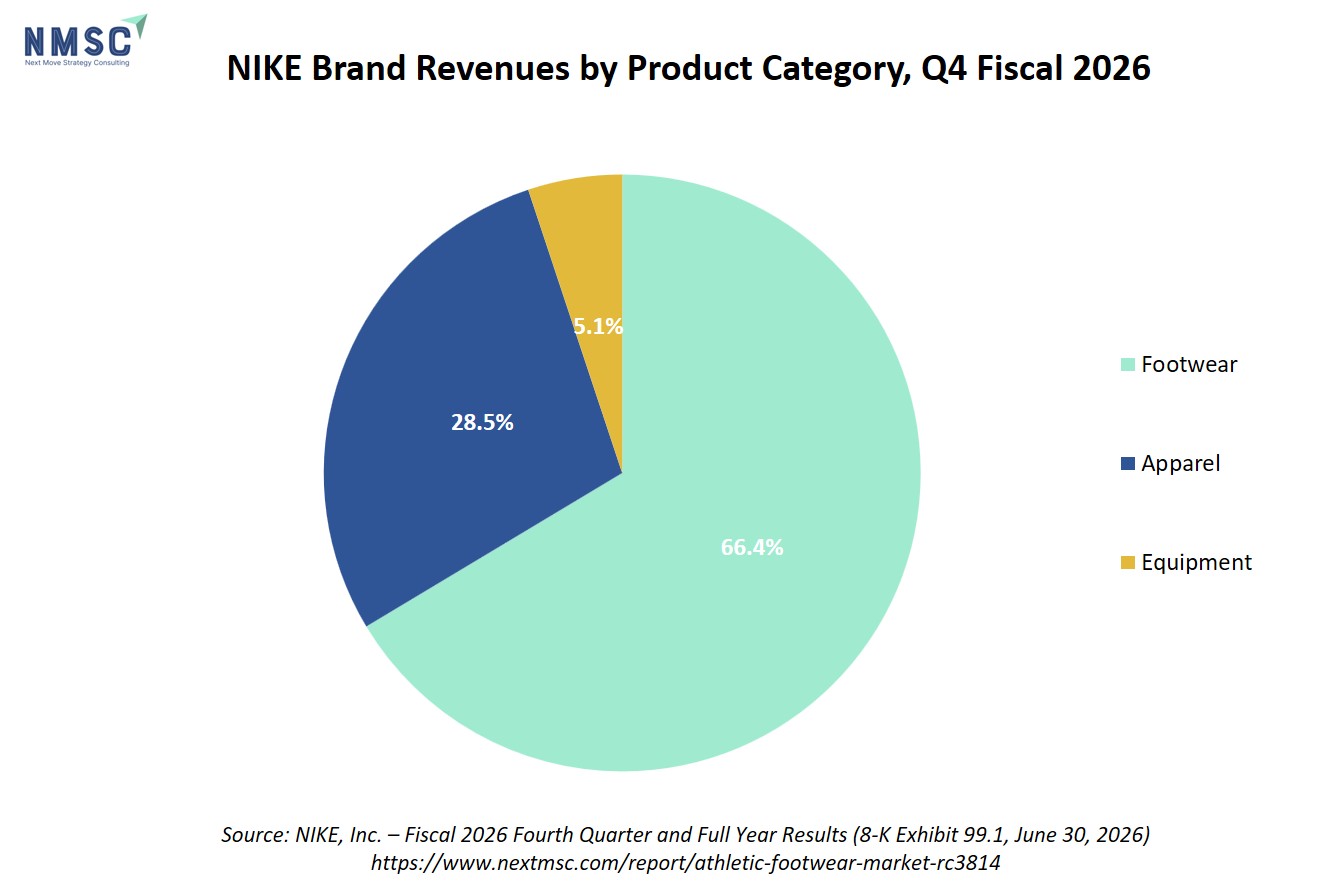
Nike's FY2026 full-year revenues were USD 46.4 billion — flat on a reported basis and down 2% on a currency-neutral basis. North America remained a relative bright spot, with Nike Brand footwear revenues growing 5% to USD 13.3 billion for the full year. However, Greater China footwear revenues declined 13% to USD 4.2 billion — a market that once served as Nike's primary growth engine — and EMEA footwear revenues fell 5% on a currency-neutral basis. Elliott Hill, President and CEO of NIKE, Inc., stated in the company's June 30, 2026 earnings release: "In fiscal 2026, we took decisive actions to strengthen the foundation of NIKE, Inc. and reposition our business for long-term growth. While we continue to face top-line headwinds, we're encouraged by progress in performance product."
World Athletics Shoe Regulations: A Compliance Threshold That Reshapes Product Development
On March 19, 2026, World Athletics approved updated Athletic Shoe Regulations, effective from April 20, 2026. These regulations continue the framework established in 2022, maintaining maximum sole height thresholds of 40mm for road shoes and 25mm for track shoes in distances of 800 meters or longer, while introducing updated provisions on shoe construction and certification requirements for elite competition. For brands competing in the elite running segment — where race-day shoe adoption by professional athletes directly influences consumer purchasing decisions — compliance with these specifications is not optional. A shoe that fails World Athletics certification cannot be worn in Diamond League or World Championship competition, effectively removing it from the most visible marketing platform in distance running. This regulatory constraint accelerates R&D investment in midsole foam density optimization and plate geometry, as brands must achieve maximum energy return within a fixed sole height envelope.
EU ESPR: The Destruction Ban That Forces Inventory Strategy Redesign
The EU's Ecodesign for Sustainable Products Regulation (ESPR), which entered into force in July 2024, activated its ban on the destruction of unsold textiles and footwear in 2026. For athletic footwear brands operating in European markets, this provision eliminates the longstanding practice of incinerating or landfilling excess inventory — a practice that previously served as a margin-protection mechanism by preventing discounted secondary market sales from eroding brand equity. Brands must now redirect unsold stock through repair, resale, donation, or certified recycling channels, each of which carries its own cost structure and logistical complexity. The United Nations Environment Programme has documented that the fashion industry accounts for up to 8% of global greenhouse gas emissions and ranks as the second-largest consumer of water worldwide — the regulatory context that drove the ESPR's scope.
Health Imperative as a Structural Demand Driver
The WHO has documented that insufficient physical activity increases the risk of premature mortality by 20–30% compared to those who are sufficiently active. Despite this well-established risk, nearly 31% of adults globally — approximately 1.8 billion people — did not meet recommended physical activity levels, according to data cited by the NCD Alliance drawing on WHO surveillance. This gap between recommended and actual activity levels represents a structural demand reservoir for athletic footwear — particularly in the walking, training, and entry-level running segments, where the primary purchase motivation is health maintenance rather than competitive performance.
Section Summary
The industry impact landscape in 2025–2026 is defined by four simultaneous forces: a measurable brand reputation divergence between Adidas and Nike with direct revenue consequences; new World Athletics shoe regulations that set binding product specifications for elite competition footwear; the EU ESPR destruction ban that eliminates a key inventory management tool for European-market brands; and a structural health-driven demand base of 1.8 billion physically inactive adults globally.
Key Takeaways:
-
Adidas's Adizero line drove 30%+ running category growth in 2025, while Nike's Greater China footwear revenues fell 13% — a divergence that reflects both brand strategy and geopolitical exposure.
-
World Athletics shoe regulations effective April 20, 2026 set binding sole height and construction standards that directly constrain elite performance product design.
-
The EU ESPR destruction ban, active in 2026, forces brands to build reverse logistics and resale infrastructure for unsold footwear inventory across European markets.
-
The 1.8 billion physically inactive adults globally represent a structurally addressable demand base for health-oriented footwear, particularly in the economy and mid-range price tiers.
Pros and Cons of Recent Market Developments
|
Development |
Pros |
Cons |
|
Dick's Sporting Goods – Foot Locker Merger (USD 2.4B, Sept 2025) |
Creates a 3,200+ store omnichannel network; projected USD 100–125M in cost synergies; expands Dick's international footprint |
Concentrates wholesale negotiating power; smaller brands face reduced shelf-space access; integration risk during Foot Locker turnaround phase |
|
Skechers Privatization by 3G Capital (USD 9.42B, Sept 2025) |
Removes quarterly earnings pressure; enables long-term operational restructuring; Skechers now #2 globally by unit volume |
3G Capital's cost-cutting playbook may reduce R&D and marketing investment; reduced transparency for trade partners and suppliers |
|
World Athletics Shoe Regulations (Effective April 20, 2026) |
Establishes clear, enforceable product standards; validates brands with compliant elite-performance lines; drives R&D investment in foam and plate technology |
Increases product development cost and certification timelines; limits design freedom in sole construction; may disadvantage smaller brands with limited R&D budgets |
|
EU ESPR Destruction Ban on Unsold Footwear (2026) |
Accelerates circular design investment; opens resale and repair revenue streams; strengthens brand reputation among sustainability-conscious consumers |
Requires new reverse logistics infrastructure; increases operational complexity for inventory management; short-term cost burden for brands with high overstock levels |
|
Adidas Reputation Surge to #2 Globally (RepTrak 2026) |
Validates community-led brand strategy; drives organic consumer advocacy; Adizero running line demonstrates performance-to-reputation linkage |
Intensifies competitive pressure on Nike and challenger brands; raises consumer expectations for ethical conduct and community engagement across the industry |
Key Data & Statistics
Nike Brand Footwear Revenue by Geographic Segment — FY2026 vs. FY2025
|
Geographic Segment |
FY2026 Footwear Revenue (USD M) |
FY2025 Footwear Revenue (USD M) |
YoY Change (Reported) |
YoY Change (Currency-Neutral) |
|
North America |
13,317 |
12,684 |
+5% |
+5% |
|
Europe, Middle East & Africa |
7,643 |
7,569 |
+1% |
-5% |
|
Asia Pacific & Latin America |
4,377 |
4,452 |
-2% |
-3% |
|
Greater China |
4,188 |
4,805 |
-13% |
-15% |
|
Total Nike Brand Footwear |
29,525 |
29,510 |
0% |
-2% |
Future Outlook & Forecast
From USD 173 Billion to USD 224 Billion: The Structural Drivers of the Next Five Years
NMSC's proprietary research and analysis projects the global athletic footwear market to grow from USD 173.19 billion in 2025 to USD 224.32 billion by 2030 at a CAGR of 5.31%. This trajectory is supported by three structural demand mechanisms that are specific to this market's architecture.
Running Participation as a Sustained Volume Driver
Road running participation has rebounded to and, in several markets, exceeded pre-pandemic levels. This sustained participation keeps replacement cycles active for road and race models — a category where midsole foam degradation after 400–600 miles of use creates predictable repurchase behavior that is structurally different from fashion-driven categories. The World Athletics shoe regulations effective April 2026 are accelerating brand investment in next-generation foam compounds and carbon-fiber plate geometries, which will cascade from elite-tier products into mid-range lines within 18–24 months of initial launch — a pattern consistent with how ReactX foam and Adizero technology migrated from race-day to training models.
Athleisure's Structural Permanence
Post-2024 data confirms that athleisure demand has not reverted to pre-pandemic levels. Lifestyle and casual performance silhouettes now capture a materially larger share of total footwear spend than they did in 2019, as consumers have permanently integrated comfort-oriented footwear into professional and social contexts that previously required formal footwear. This structural shift enlarges the total addressable market for athletic footwear beyond the sports participation base — a dynamic that NMSC's segment analysis captures through the dedicated Athleisure Footwear and Daily Active & Commuting consumer usage categories.
Asia-Pacific as the Volume Growth Engine
China's athletic footwear market is expanding on the strength of government-led sports participation initiatives and a growing middle class with rising disposable income. India's market is driven by a young demographic base and increasing e-commerce penetration that is bringing performance footwear to consumers in Tier 2 and Tier 3 cities for the first time. South Korea's tech-forward consumer base is accelerating adoption of smart footwear and sensor-embedded performance tracking — a segment that, while currently in the hundreds of millions in revenue, is growing at high double-digit rates from its current base, according to NMSC's proprietary research and analysis.
Sustainability as a Product Architecture Imperative
The EU ESPR destruction ban and the forthcoming Digital Product Passport requirements for textiles and footwear (expected under the ESPR delegated act in 2027) are converting sustainability from a marketing narrative into a product engineering constraint. Brands that have already invested in modular construction, recycled midsole components, and take-back infrastructure will face lower compliance costs when these requirements activate — creating a measurable cost advantage over brands that have treated sustainability as a communications exercise rather than an engineering discipline.
Tariff Exposure as a Near-Term Headwind
The U.S. tariff environment — which drove Skechers to withdraw its annual forecast in April 2025 before ultimately accepting 3G Capital's buyout offer — remains a material risk for brands with concentrated manufacturing in China. Nike's FY2026 results included a USD 986 million benefit from the expected recovery of IEEPA tariffs following a U.S. Supreme Court ruling on February 20, 2026, which found that tariffs imposed under the International Emergency Economic Powers Act were unauthorized. This ruling provides near-term relief but does not eliminate the structural incentive to diversify manufacturing away from single-country concentration.
Section Summary
NMSC's forecast of USD 224.32 billion by 2030 at a 5.31% CAGR is supported by running participation recovery, the structural permanence of athleisure demand, Asia-Pacific volume growth, and sustainability-driven product innovation. Near-term headwinds include tariff exposure for China-concentrated supply chains and the compliance cost burden of EU ESPR requirements.
Key Takeaways:
-
Running shoe replacement cycles — driven by foam degradation physics rather than fashion cycles — provide a predictable, recurring demand base that insulates the category from discretionary spending volatility.
-
Athleisure's permanent integration into non-sport contexts has structurally enlarged the total addressable market beyond sports participation demographics.
-
The EU ESPR Digital Product Passport requirement (expected 2027) will create a measurable cost advantage for brands that have already built modular, traceable product architectures.
-
The U.S. Supreme Court's February 2026 IEEPA ruling provided Nike with a USD 986 million tariff recovery benefit — but the underlying supply chain concentration risk that made tariffs so damaging remains unresolved for the industry.
Next Steps for Stakeholders
For C-Level Executives at Athletic Footwear Brands:
The Dick's-Foot Locker merger has permanently altered the wholesale power balance in North America. Brands that have not yet quantified their revenue exposure to a single consolidated retail counterparty should conduct that analysis immediately and develop contingency distribution strategies — including accelerated DTC investment, specialty retail partnerships, and B2B e-commerce channel development for institutional buyers such as sports teams, schools, and fitness operators.
On the regulatory front, the EU ESPR destruction ban is active now. Brands selling into European markets without a certified reverse logistics pathway for unsold inventory are operating in non-compliance. The 2027 Digital Product Passport requirement for footwear demands that product traceability infrastructure — material composition data, supplier chain documentation, and end-of-life routing — be built into product development workflows starting in the current fiscal year, not as a compliance retrofit.
For Institutional Investors:
The Skechers privatization at USD 9.42 billion — a 28% premium to market — establishes a valuation reference point for the athletic footwear sector. Brands with strong unit economics, global distribution networks, and defensible positioning in the comfort and value segments are attractively positioned for similar strategic interest. The Adidas-Nike reputation divergence, as measured by RepTrak's 230,000-survey methodology, suggests that community-led brand strategies with measurable stakeholder engagement metrics are generating durable revenue premiums — a factor that should be incorporated into brand equity valuation models.
For Supply Chain and Operations Leaders:
Manufacturing concentration in China carries quantified tariff risk, as demonstrated by Skechers' April 2025 forecast withdrawal and Nike's reliance on a USD 986 million IEEPA recovery to protect FY2026 margins. Diversification into Vietnam, Indonesia, and India — markets where NMSC's regional analysis identifies growing manufacturing capability — should be treated as a strategic priority rather than a cost optimization exercise.
For Product Development and Innovation Teams:
World Athletics shoe regulations effective April 2026 define the technical envelope within which elite performance footwear must operate. R&D investment should be concentrated on achieving maximum energy return within the 40mm road and 25mm track sole height limits — the brands that solve this optimization problem first will capture both race-day adoption and the downstream consumer halo that elite performance visibility generates.
Conclusion
The global athletic footwear market is not simply growing — it is being restructured. The USD 173.19 billion market of 2025 is being reshaped by consolidation that concentrates retail power, regulations that mandate product and inventory redesign, and a brand competition that has shifted from marketing spend to community architecture. NMSC's proprietary research and analysis projects this market to reach USD 224.32 billion by 2030 at a 5.31% CAGR — a trajectory that is achievable for brands that treat the current regulatory and competitive disruption as a design brief rather than a compliance burden.
The brands that will capture disproportionate share of this growth are those that can simultaneously satisfy World Athletics performance specifications, comply with EU ESPR circular design requirements, maintain wholesale relationships with a newly consolidated retail landscape, and build the community-led brand equity that RepTrak's 2026 data confirms is now the primary driver of consumer advocacy. That is a demanding combination — and precisely why the market's structural complexity is creating durable competitive moats for those who navigate it with precision.
About the Author
 Sanyukta Deb
— Sanyukta Deb is Digital Marketing Team Lead at Next Move Strategy Consulting, where she has led content strategy and technical SEO for the firm's B2B market research publications for over 2 years. Her editorial process translates NextMSC's primary and secondary research — spanning technology, industrial, and consumer sectors — into commercial narratives, backed by search-intent, keyword, and competitive analysis. She brings 5 years of overall experience in digital marketing and content strategy.
About the Reviewer
 Debashree Dey
— Debashree Dey is Assistant Manager at Next Move Strategy Consulting, where she supports cross-vertical market content and communications across diverse industries for 6 years. Her professional background includes senior content writing, communications, and published manuscript authorship, with experience developing audience-focused business narratives and maintaining clear, consistent messaging. Her role supports research-led content development and editorial quality across NextMSC publications.
















Add Comment