Luxury Jewelry Market: How Gold, Heritage and Ethics Shape Demand | NextMSC
Introduction
The global luxury jewelry market is undergoing a structural transformation — one driven not merely by consumer aspiration, but by the convergence of record-high precious metal prices, a decisive shift toward ethical provenance, and the rapid maturation of digital retail channels that are redefining how ultra-high-net-worth individuals discover and acquire fine pieces. According to Next Move Strategy Consulting's Luxury Jewelry Market report, the global luxury jewelry market was valued at USD 70.24 billion in 2025 and is projected to reach USD 75.79 billion in 2026, expanding further to USD 150.25 billion by 2035, registering a CAGR of 7.9% from 2026 to 2035.
This trajectory is not uniform across geographies or product categories. Asia-Pacific continues to outpace every other region in volume growth, anchored by China's stratifying gold jewelry market and India's expanding affluent class. Meanwhile, in mature Western markets, the investment-grade and collectible jewelry segment is gaining measurable traction as gold prices — which J.P. Morgan Global Research forecasts to average USD 6,000 per ounce by Q4 2026 — elevate the perceived store-of-value proposition of high-karat pieces. For C-suite executives and institutional investors evaluating this market, the central question is no longer whether luxury jewelry will grow, but which material categories, distribution models, and regional bets will capture disproportionate value over the next decade.
For More Information: Download FREE Sample on Luxury Jewelry Market Report
De Beers Rewrites the Natural Diamond Narrative — and What It Signals for the Broader Market
The Desert Diamonds Campaign: A Decade-Defining Industry Pivot
On October 3, 2025, De Beers Group launched Desert Diamonds — its first new consumer "beacon" in over a decade — backed by what the company described as its largest category marketing investment in more than ten years. The campaign draws on the warm-white, champagne, and amber hue spectrum of naturally occurring diamonds sourced from southern African desert landscapes, positioning color variation not as a quality compromise but as a marker of geological authenticity and individual character.
The strategic rationale behind the campaign is grounded in measurable consumer data. De Beers' own research confirmed that more than 90% of surveyed consumers said they would like to own and would consider purchasing a desert diamond. Over the two years preceding the launch, desert-toned diamonds generated more than 250,000 social media mentions and 450 million digital views — a volume of organic engagement that De Beers used as the empirical basis for committing to a fully integrated campaign spanning television, outdoor, digital, audio, and social channels.
The campaign's timing is deliberate. It arrives at a moment when lab-grown diamonds have captured a significant share of the bridal and fashion segments, compelling natural diamond producers to articulate a differentiated value proposition rooted in geological rarity and irreproducibility. As Sandrine Conseiller, CEO of De Beers Brands & Diamond Desirability, stated at the launch: "Natural diamonds are unique and rare — no two are the same. Their colors have been forged by nature and perfected over billions of years." The campaign has already drawn retail participation from Jared Jewelers and KAY Jewelers through Neil Lane's Desert Diamonds bridal collection, signaling that the beacon model — historically responsible for creating cultural icons such as the tennis bracelet and the eternity ring — retains its capacity to mobilize the broader trade.
NMSC Strategic Perspective: The Authenticity Premium as a Structural Growth Driver
From NMSC's proprietary research and analysis, the Desert Diamonds campaign represents more than a marketing initiative — it reflects a structural recalibration of the natural diamond value chain in response to the lab-grown segment's price compression. The campaign's emphasis on individuality, provenance, and geological narrative directly addresses the primary objection that lab-grown advocates raise against natural stones: that they are interchangeable commodities. By anchoring consumer desire to the irreproducible character of each stone, De Beers is effectively repositioning natural diamonds within the same "rarity and provenance" framework that sustains demand for investment-grade colored gemstones and high jewelry collectibles.
NMSC's analysis indicates that this authenticity premium will become an increasingly decisive purchase driver as the luxury jewelry market bifurcates: a volume-driven, accessible-luxury tier where lab-grown stones will continue to gain share, and a value-preservation, high-jewelry tier where natural stone provenance, blockchain-enabled traceability, and artisanal craftsmanship will command a widening price premium. Brands that invest now in traceable supply chains and compelling origin narratives — as De Beers is doing with its Tracr platform — are positioning themselves to capture the higher-margin tier of this bifurcated market.
Section Summary:
The De Beers Desert Diamonds launch is the most consequential natural diamond marketing initiative in over a decade, backed by consumer research showing 90%+ purchase consideration and two years of organic digital momentum. It signals a deliberate industry-wide strategy to defend the natural diamond's premium positioning against lab-grown alternatives.
-
De Beers committed its largest category marketing budget in ten years to the Desert Diamonds beacon, targeting the growing consumer preference for individuality and geological authenticity.
-
The campaign mobilized major retail partners including Jared Jewelers and KAY Jewelers, demonstrating the beacon model's continued capacity to drive trade-wide adoption.
-
NMSC's analysis identifies the authenticity premium as a structural, not cyclical, growth driver — one that will widen the price gap between natural and lab-grown stones in the high-jewelry and investment-collectible segments.
-
Brands investing in provenance technology (blockchain traceability, certified ethical sourcing) are building a durable competitive moat in the higher-margin tier of the luxury jewelry market.
Industry Impact Analysis
Gold's Historic Price Surge Reshapes Margin Structures and Consumer Behavior
Gold's price trajectory has become one of the most consequential variables in the luxury jewelry market's near-term dynamics. J.P. Morgan Global Research forecasts gold to average USD 6,000 per ounce by Q4 2026, with USD 6,300 per ounce a possibility for 2027 — a level that would represent a more than 75% increase from the 2025 annual average of USD 3,440 per ounce. This sustained price elevation is driven by a combination of central bank accumulation — the People's Bank of China ramped reported purchases from approximately one ton per month to eight tons in April 2026 — geopolitical risk premiums, and structural demand from China's insurance sector, which received regulatory approval to allocate up to 1% of assets under management to physical gold in early 2025.
For luxury jewelry brands, this creates a dual-edged dynamic. On the demand side, Bain & Company's China Personal Luxury Report (January 2026) found that jewelry was the most resilient luxury category in China's contracting market, with its decline narrowing to just 0%–5% in 2025 — outperforming fashion (down 5%–8%), leather goods (down 8%–11%), and watches (down 14%–17%) — precisely because rising gold prices reinforced jewelry's value-preservation appeal among selective Chinese consumers. On the supply side, brands face margin compression as gold input costs rise faster than retail price adjustments — a pressure that is accelerating the adoption of strategic hedging, long-term supplier contracts, and alternative material strategies.
Platinum Jewelry Reaches a Seven-Year Demand High
While gold dominates headlines, platinum is quietly staging a significant recovery in the jewelry segment. According to the World Platinum Investment Council (WPIC), global platinum jewelry demand grew 7% in 2025, reaching a seven-year high — driven in part by platinum's price discount relative to gold, which made it an attractive alternative for consumers seeking precious metal jewelry at a lower entry price point. WPIC's January 2026 analysis notes that platinum jewelry demand is now globally diversified, with growth across all markets including China, reversing a multi-year decline. For luxury maisons, platinum's rarity narrative — it is approximately 30 times rarer than gold — combined with its growing investment and sustainability storytelling appeal, positions it as a compelling material for premium differentiation.
Consolidation Accelerates: MadaLuxe Acquires IPPOLITA
The competitive landscape is consolidating around brands with strong heritage credentials and scalable distribution infrastructure. In December 2025, MadaLuxe Group announced the acquisition of a majority stake in IPPOLITA, the New York City-based fine jewelry house founded by Ippolita Rostagno in 1999. The transaction adds IPPOLITA to MadaLuxe's expanding portfolio of luxury fashion and lifestyle brands, reflecting a broader private equity and strategic investor thesis that niche fine jewelry houses with authentic design identities and loyal UHNW client bases represent undervalued acquisition targets in the current market environment.
China's Market Stratifies: Laopu Gold Emerges as a Structural Winner
China's luxury jewelry market is not declining uniformly — it is stratifying. While international maisons faced headwinds from cautious consumer sentiment, Laopu Gold — a homegrown luxury brand specializing in traditional Chinese goldsmithing — reported revenue of RMB 27.30 billion in 2025, representing 221% year-on-year growth, according to financial disclosures reported by Jing Daily. Laopu's performance demonstrates that Chinese consumers are not abandoning luxury jewelry — they are redirecting spending toward brands that integrate cultural heritage, local aesthetic identity, and investment-grade gold content. This stratification has direct implications for international brands: generic global positioning is losing ground to culturally resonant, locally anchored narratives.
Ethical Sourcing Transitions from Differentiator to Baseline Expectation
Chopard's 2025 Sustainability Report confirms that 84% of its ethical gold was sourced from artisanal and small-scale mines (ASM) accredited by the Swiss Better Gold Association in 2025, with the brand having committed to 100% ethical gold sourcing since 2018. This benchmark is increasingly becoming the industry's minimum standard rather than a premium differentiator, as younger UHNW consumers — particularly in North America and Northern Europe — treat supply chain transparency as a non-negotiable purchase criterion rather than an aspirational attribute.
Section Summary:
The luxury jewelry market's near-term dynamics are shaped by four converging forces: gold's historic price surge reinforcing jewelry's investment appeal, platinum's seven-year demand high driven by its price discount to gold, accelerating M&A consolidation around heritage fine jewelry brands, and China's market stratification favoring culturally resonant local players.
-
J.P. Morgan forecasts gold to average USD 6,000/oz by Q4 2026, simultaneously compressing brand margins and reinforcing consumer perception of gold jewelry as a store of value.
-
WPIC data confirms global platinum jewelry demand grew 7% in 2025 to a seven-year high, with growth recorded across all major markets including China.
-
MadaLuxe Group's acquisition of IPPOLITA (December 2025) reflects growing private equity conviction in niche fine jewelry houses with authentic design heritage.
-
Laopu Gold's 221% revenue growth in 2025 demonstrates that China's luxury jewelry market is stratifying — not contracting — with cultural authenticity and investment-grade gold content as the decisive purchase drivers.
Pros and Cons of Recent Market Developments
|
Development |
Pros |
Cons |
|
Gold Price Surge (J.P. Morgan: avg. USD 6,000/oz by Q4 2026) |
Elevates jewelry's investment-grade appeal; supports premium pricing for gold pieces; reinforces value-preservation narrative with UHNW buyers |
Compresses gross margins for brands without hedging programs; reduces volume demand in price-sensitive aspirational segments; accelerates consumer shift to lighter-weight or alternative-material designs |
|
De Beers Desert Diamonds Campaign (Oct 2025) |
Reignites consumer desire for natural diamonds with a culturally resonant, individuality-driven narrative; mobilizes trade-wide retail participation |
Requires sustained multi-year marketing investment to build beacon status; risks being overshadowed by lab-grown diamond price advantages in the bridal segment |
|
Lab-Grown Diamond Market Expansion |
Expands the addressable market by attracting ethically conscious and value-driven buyers; enables brands to offer accessible luxury entry points |
Accelerates price deflation in the diamond segment; risks diluting the exclusivity premium of natural diamond collections if not clearly segmented |
|
MadaLuxe–IPPOLITA Acquisition (Dec 2025) |
Provides IPPOLITA with distribution scale and capital for geographic expansion; validates niche fine jewelry as an attractive M&A target |
Integration risk for brand identity and artisanal positioning; potential tension between MadaLuxe's portfolio breadth and IPPOLITA's boutique heritage |
|
Platinum Jewelry Demand Recovery (WPIC: +7% in 2025) |
Diversifies material mix; platinum's rarity and sustainability narrative resonates with younger UHNW consumers; price discount to gold improves accessibility |
Platinum jewelry demand remains structurally smaller than gold and diamond segments; brand investment in platinum storytelling is still nascent outside Japan and select Western markets |
|
China Market Stratification (Bain: jewelry -0% to -5% in 2025) |
Jewelry outperformed all other luxury categories in China; rising gold prices and value-preservation logic support continued resilience |
International maisons face structural headwinds from local competitors like Laopu Gold; consumer consolidation toward fewer preferred brands intensifies competitive pressure |
Key Data & Statistics
Key External Market Indicators Shaping the Luxury Jewelry Landscape
|
Indicator |
Data Point |
Implication for Luxury Jewelry |
|
Gold Price Forecast (Q4 2026 avg.) |
USD 6,000/oz |
Elevates investment-grade gold jewelry appeal; compresses brand margins without hedging |
|
Gold Price Forecast (2027) |
USD 6,300/oz |
Sustained price elevation reinforces long-term store-of-value narrative for gold pieces |
|
Global Platinum Jewelry Demand Growth (2025) |
+7% YoY; seven-year high |
Platinum's price discount to gold drives material substitution and new consumer entry |
|
China Personal Luxury Market (2025) |
Contracted 3%–5%; jewelry best-performing category at -0% to -5% |
Jewelry's value-preservation logic outperforms fashion and watches in a selective market |
|
China Luxury Market Outlook (2026) |
Modest growth expected |
Recovery trajectory supports renewed international brand investment in China retail |
|
Laopu Gold Revenue Growth (2025) |
RMB 27.30 billion; +221% YoY |
Cultural-heritage positioning and investment-grade gold content drive outperformance vs. international peers |
|
De Beers Desert Diamonds Consumer Consideration |
>90% purchase consideration in consumer research |
Natural diamond authenticity narrative resonates strongly; beacon model retains trade mobilization power |
|
Global Luxury Goods Sales Growth (2026) |
Expected +1% to +4% |
Luxury sector recovery supports renewed consumer confidence in discretionary high-value purchases |
Future Outlook & Forecast
A USD 150 Billion Market by 2035 — But the Path Is Selective
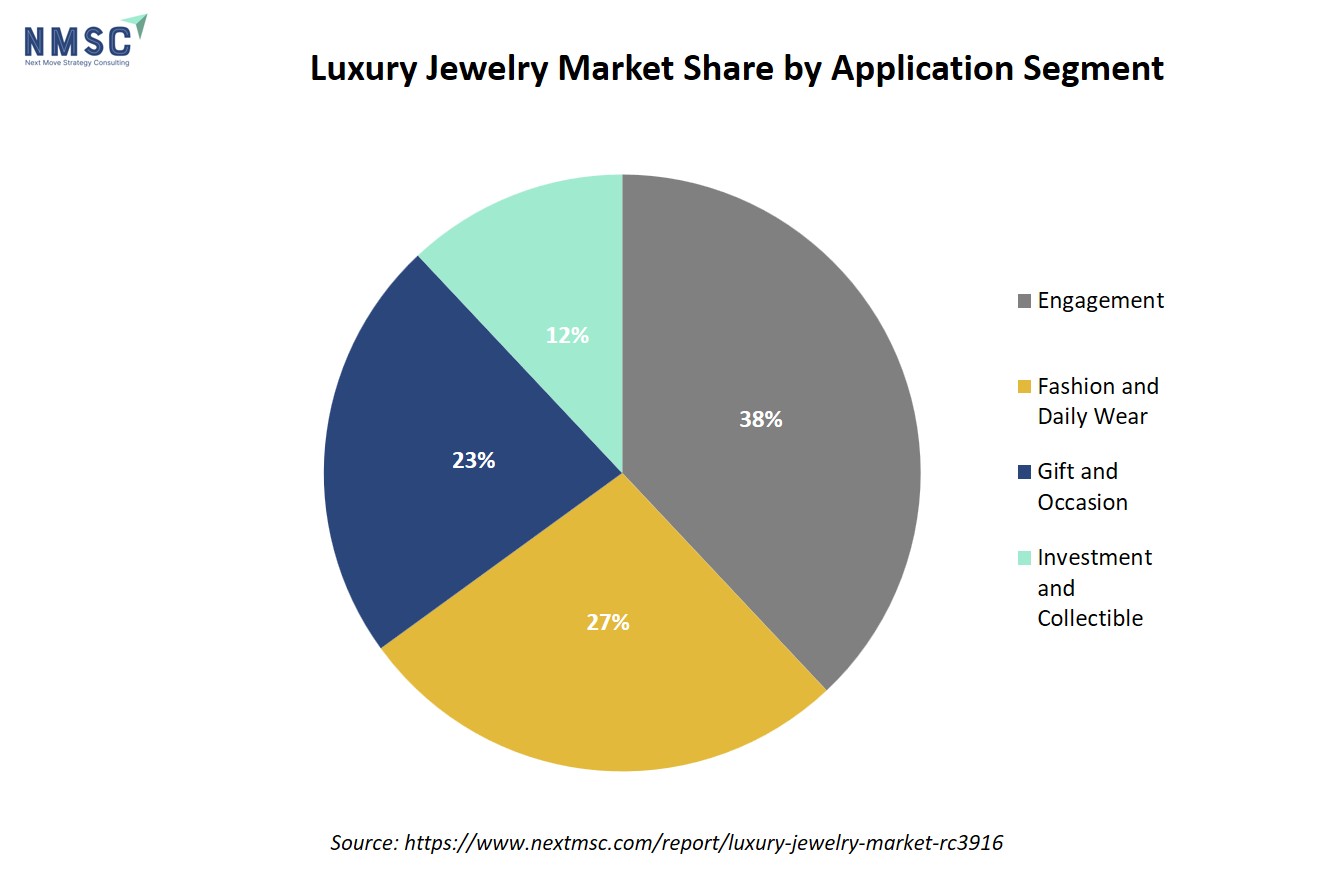
According to NMSC's proprietary research and analysis, the global luxury jewelry market is on a trajectory to reach USD 150.25 billion by 2035, growing at a CAGR of 7.9% from 2026 to 2035. This growth will not be evenly distributed across segments, geographies, or business models. NMSC's analysis identifies three structural forces that will determine which brands and categories capture disproportionate value over this period.
Force 1: The Investment-Grade Jewelry Thesis Gains Institutional Legitimacy
As gold prices remain structurally elevated — J.P. Morgan's base case projects USD 6,000/oz by Q4 2026 and USD 6,300/oz by end-2027 — the investment-and-collectible application segment of luxury jewelry is transitioning from a niche preference among ultra-wealthy collectors to a mainstream consideration among affluent consumers seeking tangible asset diversification. Bain & Company's analysis of China's 2025 luxury market confirms this dynamic: jewelry's relative resilience in a contracting market was explicitly attributed to "value-preservation considerations and rising gold prices," a rationale that is equally applicable to UHNW consumers in the Middle East, India, and Southeast Asia.
Force 2: Digital Channels Become the Primary Discovery Engine, Not a Secondary Sales Channel
NMSC's analysis of distribution channel dynamics indicates that the online segment — comprising brand websites and luxury marketplaces — is the fastest-growing channel in the luxury jewelry market, driven by the adoption of augmented reality try-on tools, AI-powered personalization, and social commerce. This shift is particularly pronounced among younger UHNW consumers in Asia-Pacific and North America, who increasingly initiate their luxury jewelry purchase journey through digital touchpoints before completing transactions in-store. Brands that treat digital as a discovery and engagement layer — rather than a transactional channel — are building the client relationships that translate into high-value in-store conversions and repeat purchases.
Force 3: Ethical Sourcing Becomes a Revenue-Generating Attribute, Not a Cost Center
The World Platinum Investment Council's January 2026 analysis notes that platinum jewelry demand is benefiting from its association with responsible sourcing and rarity, with demand growing across all major markets in 2025. Chopard's 2025 Sustainability Report demonstrates that a credible ethical sourcing program — 84% of gold from ASM-accredited mines — is now a brand equity asset that commands premium pricing and strengthens client loyalty among the most valuable consumer segments. NMSC's analysis projects that brands with certified ethical supply chains will command a measurable price premium over peers without such credentials by the end of the forecast period, as regulatory pressure on supply chain transparency intensifies across the EU and North America.
Regional Outlook: Asia-Pacific Leads, Middle East Accelerates
Asia-Pacific remains the fastest-growing and most strategically significant region in NMSC's forecast model, driven by China's recovering luxury market, India's expanding affluent class, and South Korea's fashion-forward UHNW consumer base. Bain & Company expects China's personal luxury goods market to return to modest growth in 2026, with jewelry positioned as one of the most resilient categories given its dual role as adornment and store of value. The Middle East & Africa region, anchored by Gulf Cooperation Council markets with deep cultural traditions around gold and diamond gifting, represents a secondary growth engine that is increasingly attracting flagship boutique investments from global maisons.
Section Summary:
NMSC's forecast of USD 150.25 billion by 2035 at a 7.9% CAGR reflects a market where growth is structurally concentrated in investment-grade pieces, digital-first discovery models, and ethically certified collections — not in volume-driven, accessible-luxury segments.
-
Gold's sustained price elevation above USD 5,000/oz is converting the investment-and-collectible jewelry segment from a niche to a mainstream consideration among affluent consumers globally.
-
Digital channels are transitioning from secondary sales tools to primary brand-building and client-acquisition engines, with AR try-on and AI personalization as the key differentiating capabilities.
-
Brands with certified ethical supply chains — demonstrated by Chopard's 84% ASM-accredited gold sourcing — are building a durable price premium that will widen as regulatory transparency requirements intensify.
-
Asia-Pacific, led by China's recovering market and India's expanding affluent class, will account for the largest share of incremental market growth through 2035.
Next Steps for Stakeholders
For C-Level Executives at Luxury Jewelry Maisons:
-
Invest in provenance infrastructure now, not later. De Beers' Desert Diamonds campaign demonstrates that origin storytelling — backed by verifiable data — is the most effective counter-positioning to lab-grown diamond price competition. Brands that have not yet deployed blockchain-enabled traceability (such as De Beers' Tracr platform) should treat this as a strategic priority, not a compliance exercise.
-
Recalibrate China strategy around cultural authenticity, not global brand equity alone. Laopu Gold's 221% revenue growth in 2025 is a direct signal that Chinese consumers are rewarding brands that integrate local cultural heritage into their design and narrative. International maisons should evaluate co-creation partnerships with Chinese designers and invest in culturally resonant limited-edition collections for Tier 1 and Tier 2 city markets.
-
Hedge gold price exposure systematically. With J.P. Morgan forecasting gold to average USD 6,000/oz by Q4 2026, brands without structured hedging programs face margin erosion that will compound over the forecast period. CFOs should review commodity hedging strategies and evaluate long-term supplier contracts that lock in input costs at current levels.
-
Treat the online channel as a client relationship platform, not a transaction engine. The fastest-growing distribution channel in NMSC's analysis is online — but the highest-value transactions in luxury jewelry still close in-store. Brands should invest in digital tools (virtual consultations, AR try-on, personalized digital lookbooks) that deepen client relationships and drive qualified traffic to flagship boutiques.
For Institutional Investors and Private Equity:
-
Prioritize acquisition targets with authentic heritage, niche design identity, and underdeveloped digital infrastructure. The MadaLuxe–IPPOLITA transaction (December 2025) illustrates the thesis: niche fine jewelry houses with loyal UHNW client bases and strong brand identity are undervalued relative to their long-term revenue potential when paired with distribution scale and digital investment.
-
Monitor the investment-grade jewelry segment as a distinct asset class. As gold prices remain structurally elevated and UHNW consumers increasingly view high-karat jewelry as a tangible asset, the investment-and-collectible segment is developing characteristics — price appreciation, liquidity through secondary markets, and provenance documentation — that warrant dedicated portfolio allocation analysis.
-
Evaluate Asia-Pacific exposure selectively. Bain & Company's forecast of modest growth in China's luxury market in 2026, combined with Laopu Gold's outperformance, suggests that the most attractive investment opportunities in the region are in culturally anchored local brands and in international maisons with demonstrated ability to localize their product and narrative strategies.
Conclusion
The global luxury jewelry market's path to USD 150.25 billion by 2035 is structurally sound, but the distribution of value within that growth will be highly selective. The market's defining tension — between natural diamond provenance and lab-grown accessibility, between gold's investment appeal and its margin pressure, between digital discovery and in-store conversion — is not a temporary disruption but a permanent feature of the competitive landscape that brands must navigate with precision.
De Beers' Desert Diamonds campaign, Chopard's ethical gold commitment, Laopu Gold's cultural-heritage outperformance, and the WPIC's confirmation of platinum jewelry's seven-year demand high collectively point to a market where authenticity, traceability, and cultural resonance are the durable sources of competitive advantage. Brands and investors that align their strategies with these structural forces — rather than chasing volume in commoditized segments — are best positioned to capture the luxury jewelry market's long-term value creation.
About the Author
 Sanyukta Deb
— Sanyukta Deb is Digital Marketing Team Lead at Next Move Strategy Consulting, where she has led content strategy and technical SEO for the firm's B2B market research publications for over 2 years. Her editorial process translates NextMSC's primary and secondary research — spanning technology, industrial, and consumer sectors — into commercial narratives, backed by search-intent, keyword, and competitive analysis. She brings 5 years of overall experience in digital marketing and content strategy.
Sanyukta Deb
— Sanyukta Deb is Digital Marketing Team Lead at Next Move Strategy Consulting, where she has led content strategy and technical SEO for the firm's B2B market research publications for over 2 years. Her editorial process translates NextMSC's primary and secondary research — spanning technology, industrial, and consumer sectors — into commercial narratives, backed by search-intent, keyword, and competitive analysis. She brings 5 years of overall experience in digital marketing and content strategy.
About the Reviewer
 Debashree Dey
— Debashree Dey is Assistant Manager at Next Move Strategy Consulting, where she supports cross-vertical market content and communications across diverse industries for 6 years. Her professional background includes senior content writing, communications, and published manuscript authorship, with experience developing audience-focused business narratives and maintaining clear, consistent messaging. Her role supports research-led content development and editorial quality across NextMSC publications.
Debashree Dey
— Debashree Dey is Assistant Manager at Next Move Strategy Consulting, where she supports cross-vertical market content and communications across diverse industries for 6 years. Her professional background includes senior content writing, communications, and published manuscript authorship, with experience developing audience-focused business narratives and maintaining clear, consistent messaging. Her role supports research-led content development and editorial quality across NextMSC publications.
















Add Comment